Candid Camera

Early on in the pandemic, various meeting leaders—whether Zoom or Teams—asked participants to put on their cameras.  The point was that, missing seeing other people at the office, the video feed was psychologically reassuring.  I get that.  I began working remotely before the pandemic broke out and I’m still reeling from being ahead of the curve for once in my life.  Does it always feel this giddy?  In any case, we’ve got to the point where many people simply do not put on their cameras, even in small meetings.  Since we are trained for diversity we know that some people simply don’t want us to know how they look on a certain day (or perhaps how cluttered their background is).  And that’s perfectly fine.  It does make me think how artificial work in the office is.

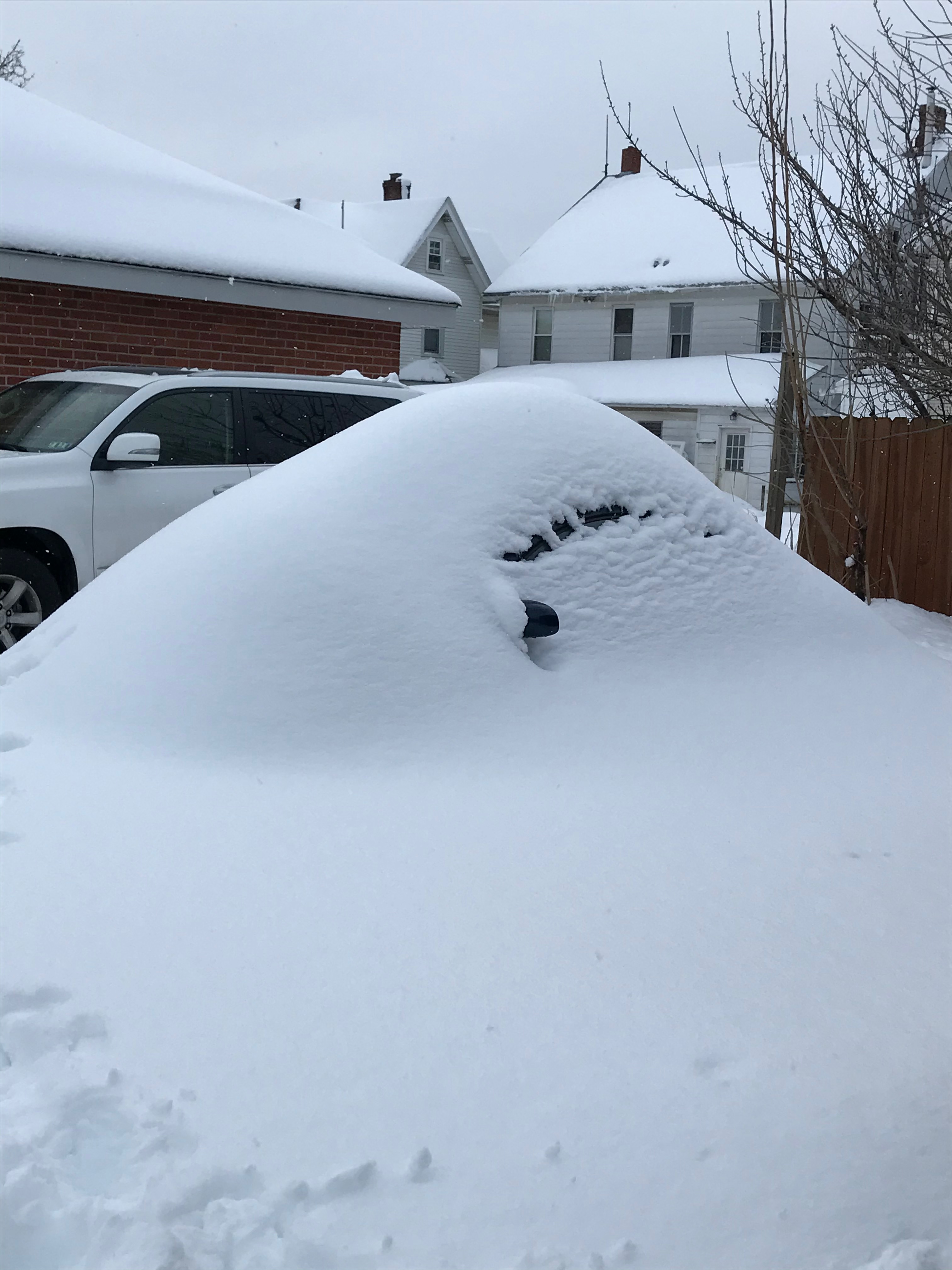
At least you could see this kind.

You put yourself together a certain way to be seen by other people.  In fact, we sometimes even put “dress codes” together for work.  I even had an employer once say dress was “business casual,” only wrinkles were unacceptable.  I don’t iron my clothes, so I guess that particular employer was warning not to let them sit in the clothes basket too long after taking them from the dryer (or clothes line).  In any case, now that we’ve come to realize we may not always look our best, we have an option to leave the camera off.  How many days commuting into the office did we feel this way but were given no choice?  Since leaving academia I’ve never had an office at work.  I was a midlife cubicle denizen.  I never liked the idea. Who looks their best after getting out of bed at 3:00 a.m.?

Being on view isn’t the same as working productively.  The pandemic has also taught us that going into the office is often not necessary at all.  If they supply the tech, which we’d need anyway, we will do our work without Big Brother watching over us all the time.  We’ve become, it seems to me, more humane.  Turning the camera off is a way of perhaps admitting I didn’t sleep well last night.  Or something’s really bothering me and I don’t feel like smiling falsely.  Or any number of other things that might put us in the place of wanting some space.  For once now we have it.  It is my hope that once things start to get “back to normal” that we will have learned some lessons.  We can treat people more like humans want to be treated and still contribute to the bottom line.  It’s amazing how much people will do if they’re treated like human beings rather than cogs in the capitalist machine.


The Persistence of Forgetfulness

It has happened twice this past week.  Maybe you’ve noticed, but probably I’m presuming too much.  Last Sunday and Thursday past, there were no posts on this blog.  Both days a post was cued up and ready for me to hit the “publish” button, but other things interfered.  To get a sense of this you need to realize that my blog posts are always ready to go by 6:00 a.m.  By that point I’ve been awake for a minimum of two hours and have already lined up my initial thoughts for the day.  I also realize that many other people are not awake yet.  Since my blog posts feed out to Twitter I worry (rightly) that a tweet so early will be dismissed along with other early morning bird calls.  I load up my post and wait.

In an abundance of caution, I begin my job at 6:30.  The reason is clear enough—I was let go from two jobs after being told I was doing great.  I don’t want that to happen again.  I’m one of those people whose best time is the morning.  I’m aware this is unusual, bordering on the freakish.  I have come to a compromise—I push the publish button just before I start work.  When I began working remotely (I was ahead of the curve, for once), I knew we’d need a house with a dedicated office.  That office is upstairs and is reserved for work.  My creative writing is done downstairs.  Since I go upstairs before actually starting work to settle in, I need to remember to click “publish” before I read the first work email of the day.  If I don’t, Thursday happens.  (It very nearly happened again yesterday!)

What about Sunday, did I hear you ask (in my imagination)?  Fair question.  Weekends I try to hold out until after 7:00 (so late!) or later to post.  But on Sunday I’m in charge of the adult education program in my faith tradition.  I schedule and run the Zoom meeting.  Since that program is early, I need to be ready early.  By 6:00 a.m. on Sunday my post was loaded.  Many Sundays, however, are about as busy as a workday although it’s all volunteer work.  I awoke Monday morning and found Sunday’s post still in the dock.  The world has been spared my musings for a day.  Ironically, WordPress had been sending daily streak messages “You’re on a streak!”  My streak struck out on Sunday, and again on Thursday.  Maybe it’s time for a new routine.

It’s like there are two minds at work here.

Kafkaesque

Although it’s a bit early—it’s never really too early—I just finished a banned book.  One of the main reasons I do annual book challenges is to help keep myself well rounded.  The categories often include books I might not otherwise read, although banned books are among those toward which I gravitate.  Lists of banned books are quite long, and so the choices are many.  I read Haruki Murakami’s Kafka on the Shore for this particular category this time around.  As the name Kafka in the title implies, there will be some surrealism here.  It was banned, as many books are, because of the sexual elements.  Anyone who made it through their teenage years without having struggled with that, however, is truly fiction.

Kafka is, in this instance, a fifteen-year-old Japanese boy running away from home.  On his journey, interlaced with that of an older, disabled man, he begins to discover what it is to grow up.  A number of unexpected things happen along the way, and pretty soon you’re not able to tell which world you’re really in.  The story refuses to be tied down to the ordinary.  The writing draws you in, however, and reminds the reader that being a teenager is indeed a liminal state.  Almost larval, to use a Kafka metaphor.  And yes, the metaphor is extremely heavy here.  There’s no denying two worlds bleed into each other as the story progresses.  Becoming an adult, it seems, involves having to make difficult choices.

Woven in with the base story is the Oedipus myth.  American cultural figures also appear.  Questions are raised but never really answered.  I’m not sure that I was fully ready for the mind-bending nature of the narrative.  Especially in these days when it’s considered okay, with a badly distorted moral compass, to hate those who are different, it’s important to read books like this.  There are characters you simply can’t figure out.  There are situations that seem unlikely, but that match some of the inherent strangeness of life itself.  I’m trying hard not to give away spoilers here, but this is a profound book.  I can’t tell if it was written for teenage readers or not—there’s clearly a lot of life experience behind it, and we were all teens at one time.  It was banned for being honest about sexuality, but perhaps, as is the case with most, if not all banned books, the real problem is that it’s simply too honest about being human.


Is This Contact?

And speaking of the X-Files—but ah, I shouldn’t jest!  In fact, I strongly advocate avoiding the ridicule response when a claim seems outlandish.  A few weeks ago I posted on a review of Alan Steinfeld’s Making Contact: Preparing for the New Realities of Extraterrestrial Existence, a book just out.  The review I’d seen made reference to the aspects of religion and paranormal in the book, and given the mainstream media’s treatment of the topic of UFOs lately, I thought I should see what was being said.  As you might expect for a collection of essays, the tome is a mixed bag.  While ridicule is excluded, a healthy skepticism is necessary.  Amid the contributors with known credentials are those who make claims that are difficult to verify.  Much like the rest of life, you’re left making choices.

Amid all of this, where does religion come in?  Books like this often reveal the deep biblical literalism of our society.  Amid the authors who haven’t held government (although that’s hardly a situation where critical thinking is necessary) or university posts, there is clearly the assumption that the Bible is literally true.  Cherry-picked verses are “explained” by the presence of UFOs or aliens, with the supposition that if it’s in the Good Book it must be true.  This kind of simple credulity is quite common, but it does make you wonder if all the homework’s been done.  I know, I know, biblical scholars spoil all the fun!  If one piece of the puzzle doesn’t fit, however, perhaps the picture hasn’t been put together correctly.

That’s not the extent of the religious—or better, spiritual side of the topic.  Many of the essays are written from a somewhat “New Age” perspective with vibrations, and energy, and universal guidance of spiritual beings.  Other essays deal with government whistle-blowers who seem to tell a coherent story of secrecy and deception on the part of those in power.  No matter how you slice it, reading this book without ridicule is a perception-bending experience.  It may not be the one book everyone needs to read to get up-to-date information on where things stand in public perception, but it will make you think.  Given how much the topic has been in the media lately, and how it has at last been treated without snide asides, may be cause for hope.  “No go” topics may be vanishing, if only because our military admits to taking this one seriously.  And there seem to be, as always, religious implications.


The Slippery Slope

Maybe you store your data on an external drive.  Tech companies want you to put everything on the cloud, but I like to know where my data are.  The problem is devices are now slick.  I use a MacBook Air.  I do this because it was the only Mac I could afford at the time and it came with limited storage space.  The solution is to buy an external drive, just like the old days.  My external terabyte drive is a WD Elements drive.  The problem is both of these devices are so sleek they’re slippery.  Since my Mac’s not young any more each morning I connect my Elements drive to let it back up my data.  It takes a while and when I need to move and put the laptop down, the external drive slips across the laptop.  Then one time it fell.

The fall wasn’t far, maybe two inches.  It was enough, however, to lose hundred and hundreds of hours of work.  The disk failed.  Two slippery surfaces that looked so sleek led to the loss of so many hours of work that I want to weep.  There’s no way to get the disk recognized again.  Even the manufacturer seems to indicate that one such temporary slip is fatal to data.  Or at least to disk drives.  I think of all the futuristic shows I’ve watched where nothing has a square edge.  Everything is rounded and smooth.  I bet they store their data in a cloud, or maybe they call it a galaxy.  One thing’s for sure, they don’t try to stick a slippery disk drive on top of a slippery computer.  Otherwise this future would never happen.

Slippery slope?.

The problem here is when my computer began to complain of feeling too full, I transferred much of my data to this now failed drive.  That was the only place it existed since I can’t afford multiple drives.  Now I’m guessing I’ll need to pay a data recovery firm to recover all those files that represent most of my non-work life for the better part of nearly two decades.  Is it square to admit missing angular surfaces that could be stacked with impunity?  Think of that classic design known as a “book.”  Great data storage.  Fairly easy data retrieval.  If one falls off the stack, it doesn’t break.  So at work they wonder why editors don’t get behind ebooks.  I’m happier with my information right where I know I put it.  With right angles, and boxy looks, and data precisely where I left them.


Nihil Obstat

Intolerance within religions has been on my mind lately.  Every religion has a history and the study of that history demonstrates that religious leadership reflects the rise of dominant personalities to the top.  Once that dominant personality reaches the zenith of leadership, he (and it usually is a he) decides what it is proper, or orthodox, for others to believe.  I was thinking about this while seeing a book with an imprimatur.  There is a wide range of belief within Catholicism.  Books which teach official doctrine, or which are used for educational purposes, require an imprimatur for widespread use.  An imprimatur requires a review process and includes a designated bishop to declare the work “without error.”  In the context of scholarship, this practice makes certain assumptions—that humans of a certain rank can declare a statement an error or fact.  A theological fact.

Theological facts don’t really exist.  If a fact is something that has empirical measures to determine its truth or falsity, theology falls outside the pale.  Ultimately it will come down to the word of one person outweighing that of another.  And as doctrine changes over time it would seem that old imprimaturs might expire.  The idea is that when something is declared without error, it is without error at that time.  As centuries progress, new empirical facts are discovered that impinge on theological “facts.”  The idea that any one word is final seems hopelessly time-bound.  I’m not picking on Catholicism here, because many religions have official teachings that rank as non-Catholic nihil obstats. It’s merely a convenient example.

The fact hidden in plain sight in cases of religions not permitting diverse views is that censorship stands behind it.  It’s no wonder that in a world increasingly supportive of diversity that “one size fits all” theology has come to be questioned.  Religions, however, lose their authority if they can’t declare the truth or falsity behind a proposition.  Bishops come from priests.  And priests come from seminarians.  I used to teach seminarians—I don’t know if any of my former students have become Episcopalian bishops or not—opportunities are about as rare as teaching posts.  The point is, those who make such doctrinal decisions had to learn them partially from the academic community that grants degrees.  As the academy opens up to new ways of looking at things, future imprimaturs will reflect the realities of their times.  Religions—all religions—evolve and change.  What may be an error today might look quite different in a future light.  Perhaps tolerance now will anticipate where we’ll eventually be, in the truth of the time.

Photo by Sarah Ardin on Unsplash

Looking In

There’s a real danger to the lifelong study of religion.  Learning to look at any tradition from the point of view of an observer will create a sense of being on the outside looking in.  I’m a member of a religious organization.  I occasionally consider pursuing ordination within it—this was my original sense of my calling in life—but I’m compelled to consider the phenomenon of being outside looking in.  When I was an Episcopalian (before the church showed its true colors in my particular case), I wrote a letter to my rector asking how I could get off of the church steps and be invited inside.  My rector wrote back with some insipid advice and was among those who voted, as a trustee, to oust me from my fourteen-year career at Nashotah House.  Outside again.

Studying the history of religions provides dangerous levels of insight.  Simple, mindless acceptance of teachings becomes impossible.  This isn’t arrogance, as any who know me can attest, but rather a form of hyper-awareness.  You can’t emerge from forty-plus years of reading about, and deeply pondering, religion unscathed.  Many, of course, dismiss any observations by those lacking the denominational seal of approval.  “If you knew what you were talking about,” so the reasoning goes, “you’d be a minister or a professor.”  So you speak from the sidelines at best.  Outside.  Even within my own group I have merely the role of “member,” lacking the official piece of paper from the seminary or other accrediting body that states I might know some things.

Of course, I have much yet to learn.  This religion thing is a tough nut to crack.  Were I younger and better paid I might consider undergoing college again to take a different path.  As it is, I’ve invested more than a half-century trying to get where I am, wherever that is.  I sit outside watching the birds.  They’re back pretty much in full force now.  They seem so certain about where they’re going.  How can you fly without a full level of commitment?  Earthbound, I muddle about with my head somewhere above the clouds I cannot reach.  I read about religious traditions unknown to me.  Often I find nuggets of great value in them.  Of course, I’m not clergy so you need not take my word for it.  I, after all, draw inspiration simply by sitting outside, always outside, and watching the birds. 


Our Stories

People’s stories are interesting.  The received wisdom is that if you wish to change a politician’s mind, tell her or him a story.  In fact, it seems that we’re hardwired to enjoy stories.  That’s why it’s so unfortunate that we seldom take the time to listen to other people’s stories.  We’re too busy.  For an organization to which I belong, I recently asked that five minutes of each agenda be set aside so that one member could tell her or his story at each meeting.  That way it’s possible to get to know who it is you’re working with, without the tired “one thing nobody knows about you” trope.  The idea was adopted and it seems a worthwhile use of agenda time.  I don’t know that I’ve ever heard someone’s account and found myself anything less than fascinated.

When we reflect back over our lives, we do it in narrative format.  We tell ourselves a story about our life.  And these stories intersect with other people’s stories.  Some of those people may be famous or wealthy or ordinary, but each is unique.  Considering that there are billions of us on this planet, that’s a lot of tales.  There’s not so much a lesson to be learned from this than there is a simple reminder—it is worthwhile to listen to others.  I’ve run into a few people who are household names in my time.  Some of them are routinely criticized in the media, by people who never met them.  Who don’t know them.  Who don’t know their stories.

Much of our time at “work” is really time trying to earn money for a company.  It may involve dealing with other people, but not closely enough to really know their story.  I think of this every time an author and I could engage in a conversation about our experience of the academic life only to have to keep the discussion to “the business at hand.”  The human element, it seems, is unimportant.  I would read other people’s stories all day, if I could.  We crave a narrative, but getting one’s not a paying position.  How have we come to this place where we have time for only disconnected memes and not the stories behind them?  Bookstore owners know a perennial selling genre is the biography.  We’ll pay to know a famous person’s story.  The fact is each of our lives is also a tale worth telling.  We would all benefit from listening to each other’s experiences.  Tell your story, I’m listening.


Considering the Time

Does anybody else find the name “Office 365” ominous?  Perhaps I’ve been reading too much about Orwell, but the idea that work is waiting for you every single day of the year is worrisome.  The way people unthinkingly buy into technology is a way of being used.  Like Cassandra, however, I get the feeling I’m just talking to myself.  365 could simply mean it’s always available.  For me, however, the PC is symbolic of corporate America.  And corporate America wants everything thing you have, at least if it can be liquidated.  That includes your time.  Now that the weather’s improving I spend beautiful days sitting at a desk behind a screen.  Before I know it that beautiful day’s gone for good and I’ve not stepped outside once.  I’ve been 365ing.

An organization I know has a dysfunction.  It keeps trying to plaster on technological bandages to solve its problems.  Such bandages only pull the wounds open again when they’re yanked off.  It’s the latest thing, the new communication technology that “everyone will use.”  Only it never is.  It’s just one more app that I’ll have to learn and yet another way to invade my private time.  Time I might otherwise spend outdoors.  Look!  The sun is shining!  All day long the birds and bees fly by my windows, celebrating.  I’m sitting here scratching my head.  Yammer or Slack?  And who comes up with these stupid names?  And are they available 24/7?  Do they even take into account that human beings have to sleep?

Studies now show that people my age who routinely get less than six hours sleep a night have a greater risk of developing dementia in their seventies.  Yet Office 365 will be waiting even for them.  Those whose retirement funds were never as secure as they hoped or thought they were face a future at the Office.  It will be there, always waiting.  Like Winston my time comes at a cost.  It’s the chill, early hours of the day.  Even as I work on my personal writing (which is not even done in Word, thank you very much), I know that the Office—which now includes Teams and even holds my calendar in its icy electronic fingers—is waiting.  Perhaps, if it’s a weekend, I’ll be able to stave it off a bit.  Even if I can, however, it will be waiting 24/7, 365.  Only time outside those parameters can be called one’s own.


Artificial Priorities

Maybe it has happened to you.  Or perhaps it only affects ultra-early risers.  I’ll be in the middle of typing a blog post when a notice appears on my computer screen that my laptop will be shutting down in a few seconds for an upgrade.  Now, if you’re caught up in the strengthening chain of thinking that develops while you’re writing, you may take a little while to react to this new information.  If you don’t respond quickly enough, your computer simply quits and it will be several minutes—sometimes an hour or more—before you can pick up where you were interrupted, mid-sentence.  Long ago I decided that automatic updates were something I had to do.  Too many websites couldn’t run things properly with old systems.  It’s just that I wish artificial intelligence were a little more, well, intelligent.

Photo by Markus Spiske on Unsplash

I keep odd hours.  I already know that.  I’ve been trying for years to learn to sleep past the long-distance commuting hour of three a.m.  Some days I’m successful, but most days I’m not.  That means that I write these posts when computer programers assume everyone is asleep.  Doesn’t it notice that I’m typing even as it sends its ominous message?  Is there no way for automatic updates—which send you warnings the day before—can do their work at, say, midnight or one a.m., when I’m never using my computer?  Ah, but the rest of the world prefers to stay up late!  I need the uninterrupted time when few of us are stirring to come up with my creative writing, whether fictional or nonal.  So I have to tell my electronic conscience to be patient.  It can restart at ten p.m. when I’m asleep.

Wouldn’t it be easy enough to set active hours for your personal devices?  After all, they pretty much know where we are all the time.  They know the websites we visit and are able to target product advertising to try to get us to buy.  They data-mine constantly.  How is it that my laptop doesn’t know, after many years of this, that I’m always working at the same time every day?  Is there no way to convince it that yes, some people do not follow everyone else’s schedule?  What about individual service?  You know what brands I like.  You sell my information to the highest bidder.  You remember every website onto which I’ve strayed, sometimes by a poorly aimed click.  I could point out more, but I see that my computer has decided now is the time to resta


Welcome the Stranger

Welcome, sibling! Have you ever contributed to a genealogy online?  I know not everyone’s into their ancestry, but there’s enough of the treasure-hunt to it, and enough mystery to keep you turning the pages.  Some time ago—it was when I was a professor, because I actually had some leisure time—I posted a bit on WikiTree.  WikiTree is a free communal effort to map the world of relationships.  Just about every week there’s a newsletter emailed around, offering how many degrees of separation you are from someone famous.  Often this is tied into the news cycle, so recently Prince Philip was among those measured.  Then Carrie Fisher.  Without fail, over the past several weeks, the family member through whom I’m connected to the famous is a great uncle.  The same great uncle.

I usually lose interest when the relationship starts to get to siblings and spouses.  There are webs everywhere.  Still, this intrigued me.  I’d never knowingly heard of this great uncle (and certainly never met him) but he was under 20 degrees of separation from several famous people.  It made me consider how you never can tell what relationships might lead to connections.  My direct ancestors, as far as I know, were all humble, work-a-day sorts.  One branch of the family had an engineer a couple generations removed, but for the most part they were farmers, laborers, truck drivers, and such.  The web of human relationships includes everyone, of course.  At some point in our family trees, we share a common ancestor, be they Neanderthal or Cro-Magnon (or a blending of the two).  When we harm or hate another person we’re harming or hurting a sibling, distant or close.

Getting along with everyone may be too much for which to hope, but at least tolerating seems worth stretching for.  I once found a long-lost cousin.  This was accompanied by a wonderful feeling of having found a family I didn’t even know.  Genealogy made that particular reunion possible.  Before that I might have passed this cousin as a stranger on the street.  It made me stop and think.  Is that stranger actually someone related?  Traveling back to the areas my ancestors lived I occasionally glimpse a face that could be a distant uncle or aunt.  My mental calculus kicks in, but there’s really no way to know just how close they might be.  Now, if I were my unknown great uncle chances might be somewhat better that I’m only a degree or two removed.  Even so, I should try to treat the stranger as though that were the case.

We’re all interconnected.


Learning from Nature

Netflix is one of those companies that has shown that new models for providing both television and movies are emerging.  Of course there are many subscription services, but Netflix rose to the top of the pile during this pandemic.  I don’t watch it much, since my time is generally otherwise spoken for, but I did have a chance to watch My Octopus Teacher, a documentary about Craig Foster’s relationship with an octopus.  The story unfolds over a year in which Foster comes to know, and to be recognized by, an octopus.  Quite apart from the Cthulhu references that may come to mind, octopuses are often skittish, highly intelligent mollusks.  Perhaps what made this movie such a surprise hit was just how emotionally attached viewers become to the cephalopod through Foster’s relationship with her.

Photo by Serena Repice Lentini on Unsplash

Almost immediately in the documentary, the viewer is struck by just how intelligent octopuses are.  The particular personality—and there is no other word for it—featured in this film is able to think and solve problems.  Not only that, but she is capable of forming a relationship with a human being she came to trust.  For many decades we’ve been taught that animals are like automatons, reacting with stock behaviors, because they can’t think.  Any claims to animal intelligence were chalked up as “anthropomorphism,” or inappropriately allowing animals to share in that coveted human trait of being “intelligent.”  The idea comes from the Bible and not even scientists would question it for the longest time.  Spending part of each day with one octopus, however, gives the lie to animals being subject to programmed behavior.  Like both Heisenberg and Schrödinger demonstrated, being involved in the scenario necessarily changes it. 

Animal intelligence has great implications for religion, of course.  This is perhaps why it is such a taboo subject.  What does it mean if animals can think and act intentionally?  Does it imply morality?  Foster implicitly raises that very question as he tries to decide whether to keep the pajama sharks away from the octopus he’s befriended.  Is he watching nature or has he become a part of it?  Our religions are often our ethical signposts.  In more recent years ethics has been shifted to the philosophy department since many people outwardly distrust the obviously mythical aspects of religious stories.  Nevertheless, the implications are clearly there.  Doesn’t it make a difference that our world is filled with other intelligent beings apart from those of us with opposable thumbs?  Watch My Octopus Teacher before deciding on an answer.


Post-1984

To truly understand a religion, you must be part of it.  This is the dilemma that underlies the entire discipline of religious studies.  And it all comes down to that slippery concept of “belief.”  One of the books that has been on my reading list for years now is Heather and Gary Botting’s The Orwellian World of Jehovah’s Witnesses.  What finally prompted me to read it was the (relatively) recent receipt of an invitation to spend what many call Good Friday (for it is today for the Orthodox) with the local Kingdom Hall crowd.  As I mentioned in an earlier post, the last people to come to my door before the pandemic began were the Jehovah’s Witnesses.  I’ve read about them before, but scholarly literature on the sect is rare, despite their obvious influence.  One reason for this, I suspect, is that to understand you have to partake.

This is where the book by the Bottings comes in.  They were raised as Witnesses and eventually left.  They have been on the inside.  This book takes the interesting hook of comparing that inside world to the vision of the Party in George Orwell’s 1984.  Not only that, but the math regarding the end of the world, or Armageddon, more properly speaking, showed that 1984 was the terminus for the next phase of Witnesses’ history inaugurated by the spiritual return of Jesus in 1914.  It is no accident that this book itself was published in 1984.  The world of the Watchtower is explored creatively and somewhat thoroughly here.  The only problem with reading it nearly forty years later is that I’m left curious for updates.  The Witnesses are, after all, still out there.

The thing about beliefs is that we all have them and we can’t always explain them.  They are part of our rational faculties, but also part of our emotional thinking as well.  No one is totally objective and even Mr. Spock gives in to feelings once in a while.  No system of belief is entirely rational.  Since we don’t have all the data it necessarily can’t be.  We tend to believe what we feel is right.  Those raised in traditions of NRM (New Religious Movements) absorb the beliefs their parents and guardians teach them just as much as Catholic school kids do.  They are often warned about those outside the tradition and what they will inevitably say about it.  This makes them look prophetic.  Once a child has been raised in an exclusionary system, getting her or him out of it is not only difficult, but often damaging to them.  So it is with belief.  This book really made me think.


The Cost of Content

Those who don’t read this blog (you, my friend, are in a rarified crowd) aren’t aware of my antipathy to tech for tech’s sake.  Many people mindlessly go after the latest technology without stopping to think of the consequences.  I was reluctant to get a cell phone.  Not a decade ago I got along fine without one.  When I finally succumbed, I found I didn’t use it much.  I still don’t.  Nevertheless, many have charged ahead.  It’s not the first time I’ve been let behind.  I recently wrote about an organization I joined that unilaterally decided to make all members sign up for Slack.  “It’s better than email,” they said.  What they didn’t say is that it doesn’t replace email.  In fact, what it does is gives you yet another communication medium you have to constantly check.  Why?

Not that long ago—a year or two perhaps—it was recommended that you ask people what their preferred form of communication was.  Phone call?  Text?  Email?  Well, my cell phone plan charges by the call and text so please don’t use that.  My preference, since about the last century, has been email.  I check it regularly and I respond as long as emails don’t get buried by others on top of them.  What did my organization do?  Went to Slack.  How long, I ask, will it be before advertisers and others figure out how to do the Slack stack?  How long before a new technology (giddy giggle) comes along and we all have to do that instead?  I’ve lost track of the number of software packages and apps I’ve had to learn for work.  Several dozens at least.  What suffers?  The content does.

Now I get three or four, or nine or ten Slack notifications a day, through my email. (My computer has no room for a nw app.)  It has compounded the premature burial issue I’ve got.  That email that arrived just yesterday is now on page two.  When will I have time to navigate to it?  I guess I’ve been slacking off.  So now I check my email to see if there’s another system that I have to check to find out someone wants to contact me.  I miss the days when humanity drove communication instead of technology doing it.  Learning some new system isn’t always the solution to complex problems.  Or at least we can find out the preferences of the individual before making them learn (and probably eventually forget) a new communication system.  It seems to me that we should be spending actual time on the content of the communication itself instead of playing with new toys.


Time To Think

Although I’m not Roman Catholic, I often thought about joining a monastery as a teen and twenty-something.  The idea of spending all my time devoted to contemplating the ultimate reality still has a strong appeal.  I know quite a few rationalists who have no time for spirituality, but it seems to me that we all need it for facing death.  Most people, I know, avoid the topic if at all possible.  Contemplatives, on the other hand, spend quite a bit of time preparing for it.  Since it’s inevitable that makes sense.  I often wonder why people consider the most common thing in human experience with such trepidation.  If it’s a source of anxiety, shouldn’t it be confronted?  That’s not to say we need to look forward to it, but it does mean we shouldn’t run from it either.

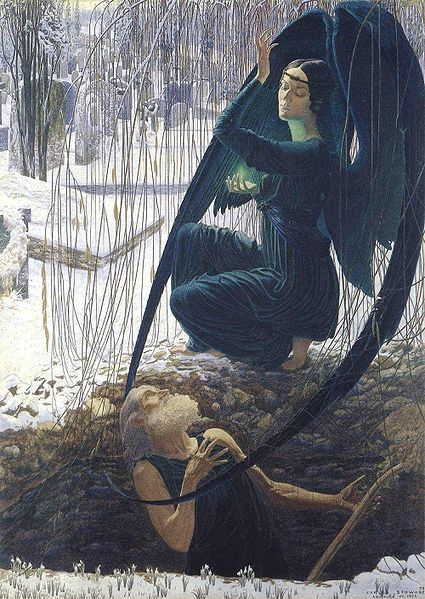
Carlos Schwabe, Death of the Undertaker; Wikimedia Commons

The combination of Christianity and rationalism, it seems to me, lead to this terror.  Christianity because it views death as an enemy, and rationalism because it has no comfort to offer.  I’ve been reading about how pre-Christian cultures thought of death.  They didn’t display the fear that Paul seems to have introduced into the equation.  Since American culture is so heavily influenced by the Bible (as was European culture before it), we have adopted the scriptural view that death is a problem.  The Hebrew Bible, in which there was no real afterlife, was less concerned with making sure you avoided Hell—they had no Hell to avoid.  The anxiety seems to have been introduced by, ironically, the concept of resurrection.

I’ve noted on pieces I’ve written for other websites that resurrection is among the favorite themes for horror films.  One of the reasons is precisely this discomfort in taking death at face value.  Our religions keep us aware of the spiritual side of our nature.  They have developed around the world in different forms and all of them address death in some way.  Most without a profound sense of anxiety.  There is some irony in cultures that adopt resurrection as a theological tenet are among those that try to avoid death most assiduously.  It plays into those cultures’ views on abortion and capital punishment.  As well as their performance of social justice.  While Paul asked death where its sting was, and seems legitimately not to have feared it, in the centuries following his position seems to have eroded.  There seems to be plenty to contemplate here, if only secular society had monasteries.