The Problem with History

The problem with history is that it shows foundational views are constantly shifting.  Let me preface this statement by noting that although I taught Hebrew Bible for many years my training was primarily as an historian of religion.  More specifically, the history of a religious idea that shifted over time.  My dissertation on the topic of Asherah required specialization in Ugaritic and in the religions of the ancient world that included Israel.  I have subsequently been researching the history of ideas, and my current, apparently non-sequiturial books on horror and the Bible are simply a further development of that interest.  The focus has shifted more toward the modern period, but the processes of uncovering history remain the same.  Many people don’t like horror.  I get that.  It is, however, part of the larger picture.

History, to get back to my opening assertion, is not fixed.  It’s also tied to the dilemma that I often face regarding religion.  Since Jesus of Nazareth never wrote anything down, and since Paul of Tarsus was writing to specific groups with their own issues, no systematic theology of Christianity emerged during that crucial first generation.  What eventually grew was an evolving set of premises claimed both by Catholicism and Orthodoxy to be the original.  Neither really is.  Then Protestantism made claims that the establishment had it wrong and the Bible, which was a bit ad hoc to begin with, was the only source for truth.  It’s a problematic source, however, and systems built upon it have also continued to evolve.  Herein lies the dilemma.  With stakes as high as eternal damnation, the wary soul wants to choose correctly.  There is no way, though, to test the results.

Eventually a decision has to be made.  Christian history is full of movements where one group or another has “gone back” to the foundations to reestablish “authentic” Christianity.  The problem is that centuries have intervened.  That “original” worldview, and the sources to reconstruct that worldview, simply no longer exist.  The primitivist religions have to back and fill a bit in order to have any foundation at all.  What emerges are hybrid religions that think they’re pristine originals.  Historians know, however, that no originals exist.  We have no original biblical manuscripts.  Teachings of Catholicism, and even Orthodoxy, change in response to the ongoing nature of human knowledge.  History contains no instructions for getting behind the curtain to naked reality itself.  At the same time the stakes have not changed.  The consequences are eternal.  Those who choose must do so wisely. 


Reentry

Image credit: NASA/ISS Expedition 28, public domain from Wikimedia Commons

They call it reentry, I suspect, because of the perils and stress experienced by astronauts reentering the earth’s atmosphere.  If the calculations are off, you either burn up or bounce back into the void.  Neither is a pleasant prospect.  It is also the feeling many of us experience at returning to work after the holidays.  We’ve had a taste of life without gravity, then suddenly you’re back into the thick of things.  It didn’t help that among my accumulated emails (I do not check work emails during my few allotted vacation days or holidays) was the notice of the sudden death of fellow scholar Gary Knoppers.  Gary’s interest early on included Ugaritic, before shifting to Second Temple Studies.  I once asked him over breakfast if he recalled the question I posed as a grad student when he presented an Ugaritic paper back in Kansas City.  Of course he didn’t; I don’t recall any questions I was ever asked either.  (With one exception.)

Gary died prematurely, just back before Christmas.  The usual venues for finding out such news, like the Society of Biblical Literature portal, were also on vacation.  It is maybe best that I didn’t learn about it until reentry.  Still, it didn’t make it any easier.  I can’t claim to have known Gary very well, but the suddenness with which someone you know dies can lead to shock.  Not so much the fact of death itself, but that it has claimed someone you knew.  I was working with him on a book idea for my employer.  We had traded health complaints about not being young men anymore.  It’s all so very human.

On Ash Wednesday a couple years back one of my colleagues asked if I was going to get ashes.  I replied that I thought about death every day and that I didn’t need ashes to remind me.  She thought it was a funny response, but it is actually true.  One benefit of my religious upbringing is that it early took away the fear of dying.  Since all people have to face mortality, it never made sense to me to fear it.  That doesn’t mean the same thing as wanting to die, but the price to pay is frequent visits to the valley of the shadow in my mind.  I was merely being honest that Ash Wednesday; my interest in horror is, by the way, related to that constant awareness.  Gary was a productive scholar and a kindly man.  Learning of his death so soon after the holidays became its own kind of reentry.  And a reminder that January looks both forward and back.


Slight Reading

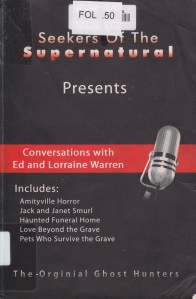
It will soon be time to turn to holiday-oriented posts, but if you’re like me you’ve been seeing the decorations and hearing the music for some time now already.  Given that, at least in name, Christmas is a religious holiday it fits naturally into this blog.  So does the supernatural in itself.  This year I have read most—there’s one book unavailable—of the book-length work of/about Ed and Lorraine Warren.  The latest, some five years after Ed died, was Conversations with Ed and Lorrain Warren by T. Sealyham.  My copy, which came used from a library, has all the marks of self-publication.  It really needed an editor to go over it.  The transcribed radio interviews with Tony Spera, the Warrens’ son-in-law, the accounts told are familiar to those who know the Warrens’ other work, with a few new ones thrown in.

What is immediately striking here, apart from the factual errors (the Isle of Skye is not in the North Sea and Loch Ness is not between Edinburgh and Jedburgh) is the strong desire for credibility.  Personal anecdotes are offered as proof.  Even on the radio claims are made to having photographs (which can’t be seen in that medium) that aren’t shown because of various restrictions.  There’s no doubt that Ed and Lorraine were completely sincere in that they believed in the reality of the phenomena they studied.  They have to be credited with taking seriously what mainstream science simply cannot study.  I often found myself wondering why there can’t be any middle ground here.  The truth only appears when all the hands are face-up on the table.

Volumes like this, that preserve misstatements of a clearly aging Ed, do not help the cause of credibility.  Yes, people get forgetful with age.  Yes, people sometimes misspeak.  Credulity, however, doesn’t lead to credibility.  Many times Tony, after receiving an intriguing answer to a question, would immediately switch the subject instead of following up with a probing request for more detail.  The interview becomes a pastiche of friends remembering old times and claiming this is the truth because they all agree that it is.  Perhaps my negative response comes from the fact that truth itself is under attack by the United States government even as I write.  The world has lost the ability to judge objective evidence and come out with a reasoned assessment.  Are there ghosts?  Perhaps so, but to get to the truth of the matter will require more than the insistence that we believe “because I told you so.”


Solstice Musings

Should my posts of late be castigated as against the Christmas spirit I would rely on Andy Williams’ song, “The Most Wonderful Time of the Year” in my defense.  “There’ll be scary ghost stories,” the crooner sings amid images of cheer and celebration.  What may not be appreciated by my less sober celebrants is that the long nights of winter have as close an association with ghosts as they do with the numerous religious holidays that fervently pray for the return of the light at this time of year.  In merry old England, which along with Germany developed the modern concept of Christmas, the holiday was observed with evening ghost stories as is well represented by Charles Dickens’ A Christmas Carol (likely the source behind Williams’ lyric reference).

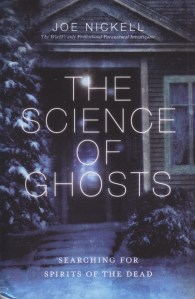
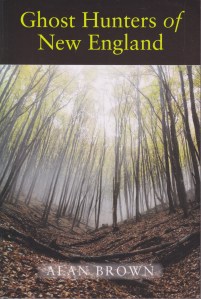
So I read about ghosts when the light begins to fail.  Or at least that’s my excuse.  When Ghost Hunters took to the air in 2004 the world became aware that electronic devices can pick up anomalies and other ghost-hunting groups began to appear.  Alan Brown, apparently curious about this development, wrote Ghost Hunters of New England as a field guide of sorts to paranormal investigators.  The book divides the region by states and includes the answers to survey questions asked to each of them.  The result isn’t especially inspirational, however, as these groups share in common the obvious absence of scientists.  It may be that professional scientists fear the career impact of such associations, but as is the case in many academic disciplines, their lack of participation simply erodes the credibility of science in the eyes of many.

Human investigation of the world has reached a point where many academic specialists can no longer communicate effectively with the average person.  I work in academic publishing and it is clear that many specialists simply do not recollect the level at which those without advanced training read.  We therefore see the rise of hoi polloi as self-appointed experts.  If scientists won’t investigate ghosts, plumbers will.  And since, no matter what science declares, many people experience ghosts, they will listen to those who at least seek answers.  The problem with books like Brown’s, of course, is that if a fad fades the groups disappear leaving the information outdated.  A couple of the groups were interesting enough to send me to the websites listed only to find the domain name for sale and the ghost hunting shingle removed from the door.  Still, the book had some useful information for those willing to consider the possibilities.  After all, the nights can be awfully long in December.  And there’ll be scary ghost stories…


Reflecting on Light

Now that we’re approaching the winter solstice, light is pretty much on the minds of those of us in the northern hemisphere.  Or lights.  The use of Christmas lights and Hanukkah lights may have symbolic value to the religions that promote them, but both also reflect the pagan use of sympathetic magic to bring back the light.  Human beings tend to be visually oriented, and many of us feel the increasing darkness deeply.  Days are brief enough to be awake for the entirety of daylight’s duration, and then you still have to get home after work.  After dark.  All our enlightened hours are spent for the benefit of the company.  It takes its toll.  And so we string holiday lights, bringing cheer into the preternaturally long hours starved for illumination.

Although the snow hasn’t stayed around here, I did notice an interesting reflection of light outdoors the other day.  The windows of a house were casting a light-shadow on a fence that had the look of a cross.   It took some convincing to assure me that this was pareidolia—the assigning of intentionality to random “signal.”  We see faces where they don’t really exist, and when we see crosses in this evangelical haven of America we have to assume they’re intentional.  Sometimes, however, they’re simply a trick of the light.  The sun has a low angle this time of year, and the light that is otherwise scattered back into what is wonderfully termed airglow—the natural illumination caused by sunlight as its luminosity brightens the daytime sky—is focused lower.  Light takes shape and sometimes it seems religious.


In New York City, where repeated patterns are pervasive, such reflections often appear on neighboring buildings as “X-Files” symbols of Xs in circles, giving the city a mysterious look.  Out here, however, they appear as crosses.  You see what you want to see.  Or, sometimes you can’t help seeing what appears utterly obvious to credulous eyes.  I’ve had people insist that crosses like this are intentional.  In reality, they’re a natural result of rectangles reflecting the morning light when the sun follows its low profile ecliptic during the waning of the year.  That doesn’t mean that it can’t be read for something else, of course,  Religion is all about interpretation.  Light forms patterns and seems strong enough to banish darkness.  And given how many hours it’s dark these days, I’m willing to take what help I can get.  The solstice will soon be here.


Long Nights

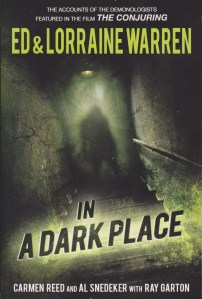
Before I really knew who Ed and Lorraine Warren were, I watched a made-for-television movie called, I think, A Haunting in Connecticut.  Unlike many television movies, it was actually quite scary.  Fast forward several years and I find myself writing a book that involves the Warrens.  I felt obligated to read all the books they “wrote”—all of them ghostwritten—and I’d been holding off on the one titled In a Dark Place, which is the story behind this television movie which was subsequently made into a theatrical movie.  The book is by Ray Garton and the parents of the family involved (Carmen Reed and Al Snedeker) are also credited.  The story is indeed a dreary one, not something I expected would bring any holiday cheer.  About that I was correct.

Why do I do it, then?  A concern with veracity drives me.  Throughout history enough people have told stories like this that either we have to lump our species together as a bunch of lying attention-grubbers, or there might be something to what they say.  The academic and official responses have long been to state that such things can’t happen, so they don’t.  When compared with how we come to know other things about life, we quickly realize that it involves experience.  In cases where experience is anomalous we tend to dismiss it.  We are great conformers.  What if there really was a demon in the Snedeker house?  Others have told similar tales.  If there’s any reality to it, shouldn’t we know?

As a former academic, I always thought that if we really wish to learn the truth, no subject should be off-limits.  That’s not the same thing as credulousness.  We don’t have to believe everything overwrought people say, but the subject should be worth consideration.  Of course, those who ghostwrote for the Warrens claim that they were given liberty to stretch the truth to make a better story.  They also tend to claim that the basic elements of the story are true.  When someone’s writing a book, there’s likely some hope of remuneration involved.  And sometimes the truth isn’t quite flashy enough for major presses with the bottom line in sight.  Still, the question of what really happened is left open.  The internet is a place where credulity reigns.  We can seek truth there only with great caution.  Maybe that is the lesson to apply to books like this as well.  Although In a Dark Place is scary, there was money at stake, and as the wise say, money changes everything.


Taking It Seriously

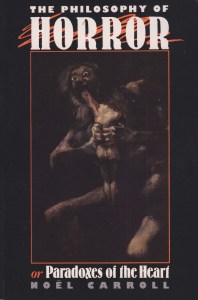
It would be incorrect to say that I choose to watch and read horror.  What would be more correct would be “Horror compels me to read and watch it.”  Those of us mesmerized by the genre tend to be a reflective lot.  We ask ourselves the question others frequently ask us—why watch it?  And yet, horror films tend to do very well at the box office.  Some even become cultural icons.  Of the many books analyzing horror, it would be difficult to suggest one more influential than Noël Carroll’s The Philosophy of Horror: or Paradoxes of the Heart.  It has been in just about every bibliography I have read in the subject.  It’s easy to see why.  There are lots of gems in this book, and it does indeed address the paradox at the heart of it all.

Philosophy, due to the very fact that there are competing schools, doesn’t attempt to provide the answer.  It offers an answer, one that hopefully makes sense of the overall question.  What question?  The one with which I began: why do people get into horror?  Carroll comes down to a deceptively simple answer, but I would make bold to suggest it does so at the cost of having undercut the religious element.  As in nearly every book on horror, Carroll does address the connection with religion.  He finds it lacking, but the reason seems to be his definition of religion.  He follows, perhaps a little too closely, Rudolf Otto’s Idea of the Holy.  No doubt, it’s a classic.  Still, it doesn’t encompass the broad scope of religion and its genetic connection to horror.

At many points of The Philosophy of Horror I felt compelled to stand up and cheer.  I didn’t, of course, since much of the reading was done on the bus.  My ebullience was based on the fact that here was an intellectual who gets it, one who understands that horror is pervasive because it is meaningful.  Sure, it’s not to everyone’s taste.  It’s not, however, simply debased imagination, or arrested development gone to seed.  There is something deeply compelling about horror because it helps us to survive in a world that is, all paranoia aside, out to get us.  Yes, it engages our curiosity, as Carroll asserts.  It satisfies more than it disgusts.  It also defies explanation.  Perhaps that’s the deep connection with religion.  It can never be fully explained.  That doesn’t mean we shouldn’t try.  And this book is a valiant effort indeed.


Reasonable Religion

Part of the pushback against religion, it seems to me, is based on the fear that there might be something rational to it after all.  Sorry to get all philosophical on you on a Saturday morning, but the idea has been bothering me all week.  You see, reductionist thinking has already concluded that religion is “emotion” and science is “reason,” and only the latter has any validity.  When’s the last time you met somebody and asked “How are you thinking?” instead of “How are you feeling?”  Neurologists are finding that reason and emotion can’t be divided with a scalpel; indeed, healthy thinking involves both, not reason alone.  Funnily, this is a natural conclusion of evolution—we evolved to survive in this environment—our brains developed rational faculties to enhance emotional response, not to replace it.

I know this is abstruse; go ahead and get a cup of coffee if you need it.  What if emotion participates in reality?  How can emotion be measured outside of individual experience?  We experience it all the time without thinking about it.  From the earliest of human times we’ve had religion in the mix, in some form.  Perhaps we are evolving out of it, but perhaps neurology is telling us that there’s something to it after all.  Something immeasurable.  Chaos theory can be quite uncomfortable in that regard—every coastline is infinite, if you get down to nano-divisions.  When you measure something do you use the top of the line on the ruler or the bottom?  Or do you try to eyeball the middle?  And how do you do it with Heisenberg standing behind you saying there’s always uncertainty in every measurement?

Absolute reality is beyond the grasp of creatures evolved to survive in a specific environment.  Religion, in some form, has always been there to help us cope.  Yes, many religions mistake their mythology for fact—a very human thing to do—but that doesn’t mean that emotion has nothing to do with rational thought.  It seems that instead of warring constantly maybe science and religion should sit down at the table and talk.  Both would have to agree on the basic ground rule that both are evolved ways of coping with an uncertain environment.  And both would have to, no matter how grudgingly, admit that the other has something to bring to that table.  Rationality and emotion are entangled in brains whose functions are simple survival.  Pitting one against the other is counterproductive, even on a Saturday morning.


Beneath the Exorcist

William Friedkin rose to fame as the director of The French Connection.  William Peter Blatty had written the screenplay for the Pink Panther film, A Shot in the Dark.  Now Blatty had a serious project in mind as he considered whom to pitch to direct the film of his novel, The Exorcist.  He wanted, and got, Friedkin.  The two disagreed about the final cut of the movie, with Friedkin winning out.  The movie was a tremendous success.  Several years later the cut favored by Blatty was released, again with success.  Blatty died last year.  The year before that so did Fr. Gabriele Amorth, an exorcist for the Diocese of Rome.  Last night I watched The Devil and Father Amorth, a documentary by William Friedkin about the famed exorcist.

The Exorcist made an impact on the lives of many people, not least Friedkin.  Over four decades after making this film, the director is still mulling it over.  The Devil and Father Amorth is primarily footage shot by Friedkin of an exorcism performed by Amorth.  In general the filming of exorcisms is forbidden, but given his stature as a film-maker, Friedkin was given permission to film without crew, on a small, hand-held video camera.  Although nowhere near as violent as the fictionalized film, it is disturbing to watch.  As a documentary, it includes interviews with doctors, some from Columbia University, who agree that possession is “a thing,” but one suspects they might disagree with the director as to what that thing might be.

Although Friedkin isn’t an academic, society accepts that (at least some) film-makers are intellectuals.  Perhaps lacking subject specialization, they nevertheless read a lot and possess quite a bit of street knowledge concerning psychology.  Friedkin does.  At just over an hour, this documentary isn’t long, but it is provocative.  For me it raises once again an issue that I address in Nightmares with the Bible—the curious laity, due to lack of engagement by traditional scholars, must rely on such efforts to get information about spiritual entities.  The documentary, which deals with a heavy subject, is one that Friedkin tries to lighten a bit at the end by stating that if there are demons then angels must also exist.  This goes back to the idea, discussed more fully in my book, that demons derive from fallen angels.  The “one size fits all” approach of academia has shoehorned belief in one direction.  While The Devil and Father Amorth won’t likely convince skeptics, many who watch it will be left wondering.


Mythic Truth

“Myth embodies the nearest approach to absolute truth that can be stated in words.”  I recently came across this quote from Ananda K. Coomaraswamy.  Coomaraswamy was a philosopher and metapmhysist from Ceylon, and like many eastern thinkers had a more holistic view of the world than western rationalism.  We’re taught from a young age that myth is something false, not true.  This colloquial use of the word is so common that those of us who’ve specialized in myth slip into it during everyday conversation.  Words, however, have uses rather than meanings.  Coomaraswamy was engaging this reality in the quote above.  Words can take us only so far in exploring reality when we have to break into either formulas or poetry.  Although they are under-appreciated poets are the purveyors of truth.

Having studied ancient mythology in some detail, it became clear to me as a student that these tales weren’t meant to be taken literally.  Instead, they were known to be true.  It takes a supple mind to parse being true from “really happened,” as we are taught in the western world that on what “really happened” is true.  In other words, historicism is our myth.  Meaning may not inhere in words, but when we use words to explore it we run up against lexical limits.  Is it any wonder that lovers resort to poetry?  On those occasions when I’ve been brave enough to venture to write some, I walk away feeling as if I’ve been the receiver of some cosmic radio signal.  We have been taught to trust the reality of what our senses perceive.  Myth, and poetry, remind us that there’s much more.

The Fundamentalist myth is that the Bible is literally true.  If they’d stop and think about it, they’d realize the mockery such thinking makes of Holy Writ.  The Good Book doesn’t look at itself that way.  In fact, it doesn’t even look at itself as a book—an idea that developed in later times.  The time and the cultures that produced the Bible were cool with myth.  They may not have called it that but the signs are unmistakable.  Ananda Coomaraswamy knew whereof he wrote.  The closest to absolute truth we can come takes us to the end of declarative, factual writing.  Scientists writing about the Big Bang devolve into complex mathematical formulas to explain what mere words can.  Myth is much more eloquent, even if we as a society, dismiss it along with other non-factual truth.


Free Cookie

So, it started out as a freebee.  The way I looked at it, I paid enough for my computer to justify some free software.  We had Quicken on our desktop for years before we started to use it.  Then came the notice that it would no longer work on our system (which upgrades apparently every nano-second).  If we didn’t want to lose our financial data we would, the note cheerily said, have to upgrade.  You have to buy what once was in the land of the free.  We consulted about it—I still have an objection to paying for something made strictly of electrons; when I pull the blanket off the bed this time of year I get a healthy jolt of electrons without having to pay for them.  We caved.  Then the notice came again.  Upgrade time!  Only you can’t buy Quicken, you can rent it.  The one-time fee for buying software is now an annual fee.  Isn’t everyone happier now?

I don’t mean to pick on Quicken, although that is the most insidious offender since you can’t very easily transfer all that data back to paper.  Services withdrawn.  Welcome to the internet of thieves.  Bakeries worldwide know that a free cookie leads to sales often enough that it’s worth the small loss in profits.  But electrons are free all the time.  Shuffle your feet across the carpet in you stocking feet and test it.  Amazon for a while sent the Washington Post headlines daily, for free.  Now, Amazon ought to know me by name since I’m a book addict.  Then, just at the midterm elections, they announced this freebee was over.  I don’t know what in the world has been happening since.  I do hope someone will tell me when our currency converts to rubles.

Who wants a cookie?

Humans are susceptible to the myth of permanence.  Although change is constant and time never ceases to flow, we tend to think things will stay where we put them.  Technological change, however, has become so swift that we now pay for the privilege.  Unlike that cookie which lasts a moment and the choice of buying more is up to you, the internet has swept up our lives and you can no longer opt out.  We pay our bills online because letter carriers drop things.  We communicate online because who has the time to pick up and dial an actual landline phone?  The fact that the signal cuts out now and again isn’t a problem, even when we lose valuable information.  It’s only electrons, after all.


Creatio Nihilo

Just when I think I’ve reconciled myself with technology, this goes and happens.  These precise words, in this order, have been written before.  In fact, all words in the English language have already been laid out in every conceivable order.  Technology can be friend or foe, it seems.  The website Library of Babel—with its biblical name—has undertaken the task of writing every conceivable combination of letters (using our standard English alphabet) and putting them into a vast, if only electronic, library.  This was not done by a human being like me, with intent or even any interest in the meaning of the words, but rather as one of those things people do simply because they can.  This entire paragraph can be copied and pasted into their search box and found.

The Library of Babel has made plagiarists of us all, even as it plagiarized everything written before it was programed.  After I learned about this library the wind avoided my sails for a while.  You see, what’t the point in writing what’s already been written?  Then it occurred to me.  Context.  The fact is, had I not scriven these very words, and put them on this blog, they would never have come to the attention of the kinds of people who read what I write.  The words have been spelled out before, but they’ve never been written before.   Those of us who write know the difference.  We spend hours and hours reading and thinking of ways to combine words.  We’re not out to kill the creativity of our species, we simply want to participate.

There should be limits to human knowledge, otherwise we’d have nothing for which to strive.  The internet may make it seem that all knowledge has been found—it is so vast and so terribly diverse—and yet there are people who never use a computer.  Their wisdom counts too.  It may seem that everything is here, but there is material that still has to be looked up in physical books.  There are crates and crates of clay tablets from antiquity that have never been transcribed and translated.  When that finally happens, the words they contain may be found, in a strangely prophetic way, in the Library of Babel.  But they won’t have any meaning there until it is given by the context.  And what can a library preserve if it isn’t the context that a (human) writer has given the words?


Dark Houses

A book can be whatever an author wants it to be.  When it goes through the publication process, however, it becomes a group effort.  Granted, the other parties are motivated by money rather than by the message of the book, but they are professionals.  Editors can point out what’s irrelevant, or beside the point.  What you’ve already said, if you happen to repeat yourself.  What you’ve already said, if you happen to repeat yourself.  They change things, often, authors admit upon reflection, for the better.  The self-published book shows itself as just what an author wants it to be.  House of Darkness, House of Light: The True Story, by Andrea Perron is a case in point.  In three volumes of about 500 pages each, it is (they are) the insider story of the family portrayed in The Conjuring.  After having finished volume one, it’s clear the book needed an editor.

Don’t get me wrong; there’s some good stuff here.  The first couple hundred pages are fascinating, although there’s a slow build-up into moving into the Harrisville house.  One thing academics have always been too quick to do is dismiss the experience of non-trained observers.  We have to be skeptical, of course, to spot those who are intentionally deceitful, but a person doesn’t write 1,500 pages without cause.  People do experience strange things, and this book is a family’s recollection of events that inspired a horror movie.  There were a few points in the course of reading through that I found myself pondering new perspectives on the realm of ghosts—shifts of point of view.  There were many points, though, that I found myself muttering that an editor would’ve helped.

As a fully trained academic in the field of studies that handles issues of the soul, I am hungry for primary sources.  Sociologists and psychologists get their information from observers—ordinary people.  It’s only when the claims become extraordinary that such observations are called into doubt.  We have all heard of haunted houses.  We all know that sometimes strange things happen in them.  We can explain such happenings in different ways.  The skeptical explain them away as misperceptions, normal occurrences masquerading as paranormal.  The credulous accept everything at face value.  Truth, it seems to me, is a middle of the road phenomenon.  I’ve always sat on the fence regarding ghosts.  Too many people over too many centuries have reported them with great detail—witnesses include some very reputable and rational individuals—to dismiss them in toto.  After volume one, it seems that something worth exploring took place in the eponymous house.  For full impact, however, who you gonna call?  This time you’d better make it an editor.


Flight Home

Although I was not looking forward to the long, late flight home scheduled for tonight, I can’t help but think there was something almost prophetic in the weather that prevented my trip.  I awoke in Newark only to confirm with many other stranded passengers that this was not a lot of snow.  I’ve had to commute into New York when much higher amounts were in the forecast.  Many of us, meteorologists included, were asking why this storm was so devastating to travel.  Part of the answer comes down to belief.  Nobody believed we could have this kind of nor’easter in November.  Even now nobody seems to want to discuss the elephant in the igloo.  Global warming, we’ve known for decades, will make erratic weather patterns.  We need to think about weather differently than we have before.

One of the motivations behind writing Weathering the Psalms was that for all of our technology, we still don’t understand, or appreciate, the weather.  Driven by dollars in great collectives, businesses are reluctant to allow employees a “day off,” even when many of them have work laptops at home.  We believe in money, supposing the weather to be only a minor nuisance.  Having bought a house, though, has revealed something to me.  Home and hearth are all about staying safe from the weather.  (Well, and in keeping out wild animals too, but we’ll just drive them extinct.)  A house is a place to keep the water and wind out.  We want to keep dry and to prevent the wind from chasing away our body heat.  Homes are our places to keep the weather outside because we instinctively fear it.  Reverence it.  Weather may well be the origins of at least some religious thought.

Ancient peoples and modern religious fundamentalists believe(d) in gods literally in the sky.  They looked up when wanting to understand matters beyond their control.  Yes, predators attacked, but you could fight back.  Against the sky there’s no recourse.   Weather can kill, and can do so in many ways.  Building shelter helps, but we’ve all seen enough hurricane footage to know that even our structures are subject to the wind.  Computer models were suggesting that this storm might have been pulling back for a real roundhouse punch but our conservative views on the weather (such things don’t happen in November, right, Edmund Fitzgerald?) prevail.  The official stance of our current government is this is all a myth anyway.  It’s only when myths interfere with money that we start to pay attention.


Knowing How To Know

Some questions are deceptively simple.  For example: how do you know?  The fancy philosophical word for this is “epistemology,” although that often takes it a step further to ask how do you know you know.  Given that many powerful individuals are motivated by a Fundamentalist faith the question of how we know is more important than it might seem.  Back in the days when faith commitments meant thinking such things through, theologians in the western world came up with three bases of knowledge: scripture, tradition, and reason.  Anglicans, especially, favored this “three-legged stool.”  If you removed any one of the three, the stool became unstable, topsy-turvy.  The analogy worked well.  It assumed that all three factors would be weighed against each other.

Image credit: Blackash at en.wikipedia

As time went on two developments occurred—the wider belief in science, and the work of John Wesley, a priest in the Church of England and founder of the Methodists.  Science argued that reason alone led to knowledge, whereas Wesley’s thought suggested a fourth leg for the stool—experience.  This latter configuration eventually became known as the Wesleyan quadrilateral, sometimes one leg was bigger (usually Scripture), but the other three could not be dismissed.  Science, however, rested on a one-legged stool, reason alone.  Fundamentalism, which is a fairly new form of religion, chooses Scripture as its one leg for a wobbly stool.  It may sometimes claim “tradition,” but since it only dates to the nineteenth century its tradition can’t hold a candle to that of, say, Roman Catholicism.

Amid all the drama we see developing in the halls of government where, increasingly, the power to declare truth resides, it’s important to understand how we know.  For a large and growing segment of society Scripture has been removed as a leg of the stool.  For others it is the only leg.  Having attended a United Methodist seminary, I admit the Wesleyan quadrilateral made great sense as soon as I heard of it.  At the time I didn’t think of this, but if you remove Scripture, the stool still has three legs, and could stand for even a secular person.  Scientists, if they examine their own precepts closely, could see that their stool has those three legs: tradition, reason, and experience.  The largest, of course, is reason.  Still, science builds on the work of earlier thinkers (tradition) and the observation of results (experience).   Knowing how we know the truth has become a question that theologians would’ve never anticipated.  The self-assured assertions of a self-convinced egoist don’t have a single leg to sit on.


Chris 73 / Wikimedia Commons