Fictional Fact

Do you remember that tragic sinking of a Staten Island ferry when a giant octopus pulled it under? Sounds vaguely familiar, but I wasn’t living near New York at the time. A story in The Guardian tells how Joseph Reginella, a sculptor, made his commemorative piece of art for Battery Park for a fictional incident. Like the memorial for War of the Worlds in Grover’s Mill, New Jersey, this is something we remember that never really transpired. We remember what never happened. It’s easy to forget that memory evolved for specific purposes. Mainly we remember for survival. Our brains evolved to keep us alive. If we don’t recall where we found water, or where that hidden cliff edge is, we don’t last for long. But we remember other things as well. The time that Oog borrowed your stone axe and didn’t give it back. Our social memory made us human, so we’re told.

dscn4239

No doubt it is possible to develop a keen memory. Precise recollection of events just as they happened, in sequence. It’s also possible, even collectively, to misremember things. We tell stories. We make myths. There was no giant octopus incident. Maybe we saw such a thing in a movie one time. That movie, paired with the plausible evidence of a public monument commemorating the event becomes a modified reality. I’m just sure I can remember it happening, can’t you?

Studies of such phenomena tell us that memories aren’t what they seem to be. To make distant recollections Holy Writ, for example, we have to rely on divine inspiration. Without it we might just be remembering a story somebody told once upon a time. And where did I put the car keys? Yes, our memories are open to manipulation. Things that never happened become real this way. George Washington did not chop down a cherry tree and confess to his father because he could not lie. And yet we believe. We make myths because they give our lives meaning. Face it, evolution is a pretty boring explanation for why we’re here. Natural selection has no goals in mind. Things that work best tend to survive in the gene pool. And in some people’s memory there may be a giant octopus in that pool as well. Did the the Cornelius G. Kolff get pulled under or not? Would a ship with such a name ever be made up? Myths are still born every day, even as the octopuses cower in their caves, awaiting the next naive ferry to transcend reality.

Twist of Lime

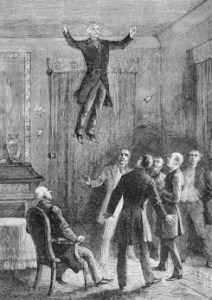
witchoflimeOctober enters as a liminal month. A few remaining hours of lingering summer but more shortening days of winter’s encroaching wolf. A time of harvest and celebration. Lengthening nights bearing strange noises. It was a couple of Octobers ago that I noticed The Witch of Lime Street either on Amazon or some bookstore shelf. I knew I’d read it this time of year, but I had to find the time to appreciate it appropriately. David Jaher’s debut book, subtitled Séance, Seduction, and Houdini in the Spirit World, spins a story appropriate to this time of year. The story of Mina Crandon, aka Margery, is as misty as the ghost she apparently conjured during the roaring ‘20s. The story is all the more remarkable in that the medium who’d attracted so much attention has been all but forgotten now that mediums and psychics tout their wares “for entertainment purposes only.” No one wants a fraud misdemeanor on his or her record, just in case.

Margery emerged during a contest set up by Scientific American that offered $2500 for any medium whose effects could not be explained by science. A board of experts, including Harry Houdini, was established and the contestants tried their best. Unlike most mediums Margery was from a secure household, being the wife of a surgeon. In other words, she didn’t need the money. Some of the feats she performed, according to the records scoured by Jaher, are truly amazing. So amazing that she had nearly convinced the prize committee that she deserved the prize. Houdini, however, led the opposition. During the course of all this she had, at points, convinced Harvard faculty that she was genuine, and submitted herself to controlled conditions. Some very intelligent men, including Sir Arthur Conan Doyle, believed she was authentic. Never actually caught in trickery, evidence suggests that she faked some manifestations, but many educated observers nevertheless believed in her powers.

This engaging account has as many twists and turns as a corn maze, and features several prominent players. Houdini and Doyle clearly top the charts, but for those who’ve read about the history of parapsychology there will be some familiar names throughout. The one who is least known is Margery herself. Being an historian, Jaher can’t proclaim his own verdict on the medium’s claims. His account, however, is even and provocative. Based on the many records that were available on the subject before seances became artifacts of a more gullible age, this book will leave you scratching your head. Then, you may wonder, were those my fingers or those of someone else doing the scratching?


Thinking about Feeling

There’s a scene in Shrek where Lord Farquaad tells Princess Fiona “You don’t have to waste good manners on the ogre. It’s not like it has feelings.” That scene came to mind recently as I was pondering how we often use feelings—emotions—to claim superiority over others. During a course on Howard Thurman in seminary, we watched a video where he retold a story that appears in his autobiography With Head and Heart, where a young white girl was sticking an African American with pins because she believed they didn’t have feelings. Although it may be dangerous to attribute motive—let me call it interpretation then—Shrek is a movie about prejudice. Ogres are misunderstood. It’s a parable, if you will. Unfortunately there are people who still believe those not like themselves lack feelings.

This is a particularly disturbing idea for many reasons. Not only does it keep alive the unacceptable social situation where African Americans are shot when unarmed, and frequently in non-criminal situations, it perpetuates the idea that others are different in a way that makes them less than human. We can take this even further since one of the mainstays of science has been to deny feelings to animals, claiming that you need rationality to experience pain. Or at least suffering. Ironically, it’s the “reptilian brain” that provides us with emotions, and rationalists are quick to downplay emotions as a form of thinking. It’s easier just to kill a snake and ask questions later.

We deny others feelings as an excuse to mistreat them. Then we deny that feelings are important at all. Even Mr. Spock got angry once in a while. In a society that regiments an economic system that really benefits only a very few, we daily bask in the midst of this paradox. It’s clear that all it takes to have presidential aspirations threaten reality is money. Spend enough and anyone will believe whatever lies you happen to trumpet. After all, that feeling of superiority that fascism promotes is exactly the way to win a mass following. You’ll have to excuse me if I’m feeling just a bit out of sorts. It’s only a feeling, and it will pass. Unless we pay close attention to our emotions, however, we will never realize justice. We know that Shrek does indeed have feelings. It’s just that we’ve forgotten how to interpret parables.

Think about it.

Think about it.


Read Long and Prosper

“Live long and prosper,” Mr. Spock was (or will be, depending) known for saying. Many of us know the regimen for healthy living: don’t overindulge on the food and drink. Get some exercise. Try to eat the right foods. Sleep once in a while. When we go to the doctor’s office, it’s generally a physical cause that we want explained or treated. It seems, however, we might have been overlooking a way to live longer. Reading. An article from last month’s Tech Times explains that book reading—sorry folks, reading this doesn’t count—correlates to longer life, according to a Yale study. The article by Alyssa Navarro explains that concentrated reading for three-and-a-half-hours a week can be connected to living longer. Those of us who read may not have that fringe benefit in mind, but it does stand to reason.

img_2947

Since people love correlates that sound alike, the way that we describe aspects of our lives is often quantity verses quality. In terms of quantity, consciousness seems to drive us to claim as much life as possible. It’s hard to let go. Connoisseurs, however, often prefer quality to quantity. While there may well be other options than these two q’s, it seems to me that those of us who read tend to do it for the quality issue. Quantity may be a fringe benefit. My job requires a long commute most days, and I bury myself in books. If I pick one that really captures my interest, I’m amazed at how quickly even an intractable commute can go. On those days I work at home, I have to admit, I miss the reading time. I try to read with the same level of concentration when I power the laptop down, but there is something about being in a situation where you’re forced to read that somehow enhances the level of concentration. It’s training, I suppose. We often think that once we’ve figured out how to read then it’s just a matter of doing it. To really get into a book, however, requires effort.

If I’m at home and I sit down for a marathon reading session, I inevitably get sleepy. Since I awake quite early this isn’t something I think I need to see my doctor about. Of course I get sleepy on the bus, but I’ve seen how ridiculous most people look when they sleep in public, and I don’t want to be one of those. If the book I have is a good fit, I barely notice how tired I am, surrounded by my aluminum walls and the wheels that go round and round. Maybe that’s because my mind is elsewhere. I don’t commute for my health. On the days when I don’t take the bus I try to get out and jog. My healthcare regimen, I think, could use a little more book reading. At least that’s as good an excuse as I can come up with for what many people, ironically, consider a kind of illness. May we “bookworms” read long and prosper.


Reflecting Ourselves

There once was an old man from New Hampshire. No, this isn’t a limerick. He was famous enough to get his face on the state quarter, back when they were doing that state quarter thing. Then he fell. The Old Man of the Mountain was no more. We like to see ourselves in stone. On a trip with my wife and a couple of friends in my post-grad days in Edinburgh, we were driving around the Isle of Skye. The largest of the Inner Hebrides, the island has a mysterious natural beauty. One of the most famous monuments on Skye is the Old Man of Storr. Postcards always show it to be a rock pillar jutting up by itself at the base of a mountain. As we approached the old man from the north, I got the joke. My friends still dispute it, but if you look at the mountain crest above the pillar, it forms a perfect profile of an old man’s face. Then what is the rock pillar? It’s just the right distance from the old man’s face to be, well, you get the picture. I’m convinced that those from Skye laugh at all the tourists taking a picture of the old man’s naughty parts.

The technical term, as I’ve discussed before, for seeing that which isn’t really there is pareidolia. Some people call it matrixing. Our brains, wired to see other people, often see them where they don’t exist. The Old Man of the Mountain formed a passable human face before the rock face collapsed in 2003. This past week I read an article in the Washington Post of the collapse of Duckbill, a rock formation in Oregon’s Cape Kiwanda State Natural Area. Like many cases of pareidolia, this rock pillar was only seen as a duck by those whose brains make the connection. People like to go see that sort of thing. It makes us feel less alone.

Do you see it?

Do you see it?

The article by Cleve R. Wootson Jr., however, points out that Duckbill didn’t jump. He was pushed. A group of eight guys, caught on video, rocked the pillar until it toppled. This is why we can’t have nice things. The deliberate destruction of monuments is a crime, and the culprits are being sought. Make Way for Ducklings, the Robert McCloskey children’s classic, was cast in bronze in Boston’s Public Garden. In 2009 vandals stole one of the ducklings, which was quickly replaced. It’s difficult to understand the mentality of those who wish to destroy our duckbilled friends. Yes, Duckbill was only rock. No, I never had the chance to see it. As long as the Old Man of Storr lies recumbent in the Scottish highlands, however, we will have grounds to wonder.


Pay Attention

hiddenplainsightIt happened in seventh grade, but I remember it vividly. It was music class. I’ve always enjoyed music but have never been able to make it without the assistance of a device that plays recordings. This particular day, however, Mr. Butler gave us the assignment to write down whatever we heard for about ten minutes. He told us to start and I began listening. Hard. I didn’t want to miss a thing. When time was up he asked some people for their answers. The first person said the sound of Mr. Butler’s footsteps as he walked to his desk after saying “start.” I was utterly shocked. How had I missed that? More answers emerged and my sense grew that I was completely inept at hearing things—well nigh deaf—since I had only heard the sounds that I was listening for. Hidden in Plain Sight: The Social Structure of Irrelevance, by Eviatar Zerubavel, makes me feel a little better.

A lot has happened since seventh grade. I have now realized that I’ve missed most of it. We filter out stimuli constantly. What is really interesting about a sociologist’s look at what we fail to notice is that we often miss important things in life by assuming that figure is more important than background. Or that space between things is less important than the objects themselves. Or that we can indeed listen for silence instead of sounds. It is a matter of how we perceive things. There are millions of stimuli bombarding you right now. I’m flattered that you’re even bothering to pay attention to my musings here. Are you also feeling the clothes you’re wearing? The shoes on your feet? The taste of either your last meal or the toothpaste that might have followed it? We shove things into the “background” all the time, including other people. We can’t pay attention to everything.

Interestingly, Zerubavel raises the issue of moral inattention. We do sometimes consider things outside the realm of moral consideration. But should we? What are morals if not an indication of what society has taught us to value? Indeed, social attention, or inattention, teaches us from our earliest days what is safe to ignore and to what we must pay attention. It helps us survive. Reading this little book, however, has left me wondering about all the things I have habitually missed through the years. Some of them may have been important. Sitting in a silent room, after all, I failed to notice the sounds of my own pencil scratching on paper, writing down all the sounds I was hearing.


Intelligent Life

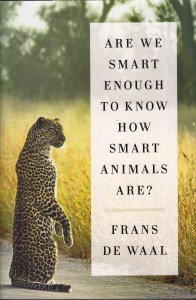
arewesmartPerhaps the most pervasive trait of religion is its ability to construct worldviews. Even when the religion is eventually abandoned, the worldview remains. Most scientists would deny that religion lies behind their perspectives, but in the case of human exceptionalism it remains the most logical cause. I always eagerly await new books by Frans de Waal. Ever since I read his book on empathy and apes, I couldn’t wait for the next one. His latest book, Are We Smart Enough to Know How Smart Animals Are?, although the title is a mouthful, does not disappoint. As I’ve noted before about his works, de Waal is perhaps the most sensible person writing in science today. He considers the evidence and takes his own biases into account. In a competitive world where science money is often doled out to those who can exclude others, de Waal is willing to leave the door open when the evidence demands it.

What is really ironic is that evolution has become the line in the sand between biblical literalists and science. As de Waal points out, the idea that people are different from the animals from which they evolved—in some qualitative way—is an idea based on religion. Many scientists still hold to it in a way that can only be described as, well, religious. This is very strange when evolution works by gradual changes over long periods of time. When did humans gain whatever trait that separates them from “the animals”? When I was a child it was tool use. When that was disproved, it became language. When that was disproved it became consciousness. The latter is the safest since nobody really knows what it is. As de Waal amply demonstrates the Behaviorist school was clearly wrong about animals (including humans). What no Behaviorist wants to admit is that the idea that we alone are conscious comes from the cultural interpretation of the Bible.

Are We Smart Enough to Know How Smart Animals Are? is, like many of de Waal’s books, full of wonderful observations of the ways animals actually behave. They solve problems. They learn from experience. They anticipate the future. In some cases they have been shown to outperform humans on cognitive tasks. And yet we still insist that people are somehow different. Better. Interestingly this is one area where religions and science tend to agree. People are just more important than animals. I wonder if one of the underlying reasons—not addressed by de Waal—is that we have come to depend on a lifestyle that unfairly exploits animals. After all, we eat them, use them for work, and even experiment on them. If we admit that they are intelligent we would need to, yes, rethink all of this. Given what’s happening in the world today, it is perhaps time to admit what we don’t really know.


The Neighborhood

583px-Ptolemaicsystem-small

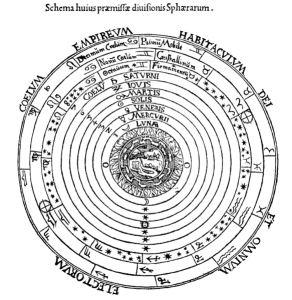
Let me send out a warm welcome to the neighborhood, I think. Not that I officially represent Earth—or anything for that matter. I’m just friendly, I guess. Now that astronomers have strong evidence that the nearest star to our own, Proxima Centauri, likely has a planet, it’s not premature to head over with a casserole. It’s not every day that a new solar system is discovered. We don’t know for sure that the planet’s there, but chances are pretty good. In reading about this discovery I learned that the orthodoxy has changed since I took astronomy in college. It seems now standard wisdom teaches that most stars likely have a least one planet. I can’t even count the stars—I usually start to trail off after I get to about ten—so I can’t imagine the number of potential planets out there. And where there are planets, there are gods.

Let me rephrase that. If there are billions and billions of planets it is very likely that there’s life out there. I know I’m racing ahead of the evidence here, but let me have my fun. If there’s life, there’s a chance, a glimmer of a chance at least, that given enough life we’ll find consciousness. I’ve always thought it was a touch arrogant on our part to assume we were the only ones out here. Perhaps it’s because the stakes are so, ahem, astronomically high we seem to be afraid to admit the possibility. We don’t really want to be alone in this cold, vast, universe after dark. Enter the gods. Conscious beings—even arrogant ones—have no trouble supposing that there is an even greater presence out there. I suspect this isn’t an earth-bound bias. I should hope that conscious life looks toward the stars with wonder, and even after they discover that there’s no lid on their planet they might still ponder what else might be out there.

Let’s suppose there are other creatures out there with other gods. When the meeting takes place we’ll need to have that discussion. You know the one I mean. We’ll need to ask whose deity is really real. Is it yours or is it ours? Hopefully we’ll enter into this with an open mind. I suspect it will depend on who’s in the White House, and all the other big houses, at the time. There are certainly those who claim their own almighty brooks no rivals. If it turns out that we can’t agree, I hope it doesn’t come to blows. There will always be other planets to explore, and maybe even new orthodoxies to accept. It’s an infinite universe, after all.


Not Quite Dead

Duria_Antiquior

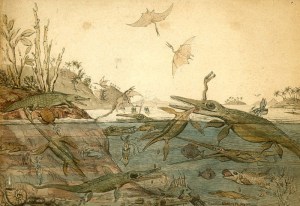
Extinction is a cause of fear. Having evolved a certain level of self-aware consciousness, we fear becoming the next tyrannosaurus-rex or spinosaurus, or whatever the next top predator turns out to have been. We’re here to stay. So we like to think. Data have been known to interfere with comfort zones, however. Take religion, for example. America has always been a religiously diverse “country,” but many people suppose it has a Christian beginning. Moreover, the historically uninformed suppose that generic Christianity to have been Protestantism (which is not really a single religion) and white (which isn’t really a race). Now, it seems, that white Protestantism is slowly going extinct. An article in the Washington Post by John Sides contains an interview with Robert P. Jones of the Public Religion Research Institute. Jones has written a book about the end of this particular hegemony.

Demographics tell the story. The powerful cultural force of the mainstream Protestant churches hasn’t disappeared, and really isn’t likely to become extinct. It has, however, diminished. As soon as we began to embrace technology this was a more or less inevitable trajectory for the human race. We made oceans smaller and came to see that we’d evolved different religions in different regions. And that Christianity wasn’t quite unique as we’d thought. “Orthodoxy” was actually a form of prejudice for a past that may never have been. We saw the writing on the wall and went on scribbling. Making claims the data don’t support.

One of the drivers—and this is a complex phenomenon—behind this shift has been the ossified positions of religions in the light of increased understanding. For example, most people see no problem with homosexuality. They believe shooting someone because of their race is wrong. Women, they radically suggest, should have the same rights as men. The hold-out positions on these issues have historically been religiously based. Just listen to the rhetoric of televangelists and see if it has changed. Meanwhile, the world moves on. Many religions are holding still. Or racing to see if their diminishing number of feet might make the world spin backwards after all.

Religion is a human invention. Many protect themselves by claiming direct revelation by a God who used to live in a glass ceiling above our heads. Trips to the moon, probes to Mars, and out of our solar system have proven that view false. If the view of something as basic as the universe was wrong, what else might’ve been a mistake? Jones’ new book will no doubt cause some panic. Extinction, at least not imminently, doesn’t seem to be in the cards. Protestantism seems to have reached a stasis. Religion still has an important function in society. When it takes the lead on issues of equality, we may begin to see a miracle.


Mars Bars

It brings tears to my eyes. A little guy millions of miles from home. The only spark of acknowledged intelligence on the entire planet. It’s his birthday and he’s singing “Happy Birthday” to himself. It’s downright depressing. The guy, however, is the Mars rover Curiosity. It is a machine. The headline, however, jerks an emotional response from all but the coldest of individuals: “Lonely Curiosity rover sings ‘Happy Birthday’ to itself on Mars.” It’s that word “lonely.” It gets me every time. Then I stop to think about machine consciousness again. Empirical orthodoxy tells us that consciousness—which is probably just an illusion anyway—is restricted to people. Animals, we’re told, are “machines” acting out their “programing” and not really feeling anything. So robots we build and send to empty planets have no emotions, don’t feel lonely, and are not programed for sadness. Even your dog can’t be sad.

Amazing how short-sighted such advanced minds can be.

We don’t understand consciousness. We’re pretty wowed by our own technology, however, so that building robots can be brought down to the level of middle-school children. We build them, but we don’t understand them. And we may be losing part of ourselves in the process. An undergraduate I know who works in a summer camp to earn some money tells me a couple of disturbing things. Her middle-school-aged charges are having trouble with fine motor skills. They have trouble building basic balsa-wood airplanes. Some of them can’t figure out how paperclips work. One said she couldn’t write unless she had access to a computer. This camp worker’s supervisor suggested that this is typical of the “touchscreen generation.” They’re raised without the small motor skills that we’ve come to take for granted. Paperclips, it seems to me, are pretty intuitive.

Some 34 million miles away, Curiosity sits on Mars. An exile from Earth or an explorer like Henry Hudson? Or just a machine?

pia20602_sol1338_take7frontlook

Machines don’t always do what you tell them to. I attended enough high school robotics sessions to know that. Yet at the local 4-H fair the robots have a tent next to the goats, the dogs, and the chickens. We’ve come to love our devices. We give them names. They seem to have personalities. Some would claim that this blog is the mere result of programing (“consciousness”) just as surely as Curiosity’s programmed singing to itself out in the void. I’m not for turning back the clock, but it does seem to me that having more time to think about what we do might benefit us all. This constant rush to move ahead is exhausting and confusing. And now I’m sitting her wondering how to get this belated birthday card delivered all the way to Mars.


Simply Beautiful

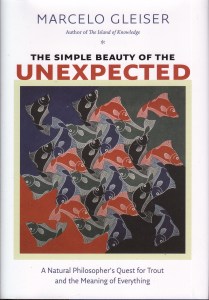
Simple BeautyThe scientific method has been a boon to humanity. Knowing how to sharpen the rational faculties has demonstrated its benefits time and time again. Sometimes, however, overemphasis on rationality contains hidden costs. Humans are not always rational, and sometimes this is a very good thing. Culturally we’re told that reason trumps emotion and that evolution has somehow led us to this. That’s only part of the story. Marcelo Gleiser’s excellent The Simple Beauty of the Unexpected serves as a wonderful corrective to this one-sided view. Although I’ve been trained in rationalistic thinking, my humanities background lacks the credibility of similar training in the sciences. Gleiser, as a physicist, demands respect. As he notes throughout this book, physics asks the hard questions. The only proper response, he rightly declares, is humility. Arrogance in any human endeavor may make for a good story, but it is bad citizenship on this planet.

I have to confess to being one of those poor souls who really doesn’t care about fishing that Gleiser mentions early on in his book. That doesn’t mean that I don’t agree with his outlook and mature thoughts on the subject. Using fly-fishing as a kind of bait, he draws the reader in to consider some deep and meaningful questions about life. Although he describes fishing literally, he clearly has a metaphorical usage in mind as well. Rare is the scientist who will admit that science can’t answer all questions, and moreover, wouldn’t want it to. Showing the limits of rational thought can feel like taking one’s clothes off in front of a crowd for those wedded to empirical evidence. Applied science clearly works very successfully. That’s not the same as having all the answers. Gleiser beautifully illustrates this, acknowledging that the spiritual has a role to play even among the rigorously trained and actually employed of the intelligentsia. This is a very important book.

Admitting that some things happen for which there is no rational explanation, Gleiser advocates for appreciating the wonder rather than trying to force science into situations where its explanatory power fails. This doesn’t happen often—indeed, rarity is what makes the unexpected so wondrous—but when it does happen we need to, like a fisher, accept it as part of the way the art unfolds. In Gleiser’s terms, not every fishing trip is successful. If you always had success, what would be the point in trying? He ventures into the murky waters of religion a time or two, but this is catch-and-release, not for the kill. The Simple Beauty of the Unexpected is an example that includes itself. Those who read it will learn what this means.


Mature Monsters

When I first began this blog, generally focused on religion, I felt the need to justify posts about monsters. Now, some seven years and several books later, I have come to assume monsters and religion are close kin. Many scholars who explore monsters are those in that amorphous field of “religious studies” who’ve come to realize that terror and the sacred are not far apart. In fact, the Bible contains many stories that could be understood as horror, if taken literally. When my wife sent me a story in The Guardian, “Guillermo del Toro: ‘I love monsters the way people worship holy images’” I once again found the connection reinforced. In the article by Jordan Riefe, del Toro comes more than once to religious themes as he describes his fascination with the macabre. Here’s a guy about my age who’s not afraid to admit that he likes the scary stuff and has, indeed, become famous for it.

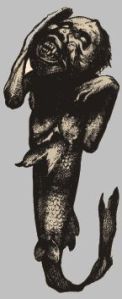
Feejee_mermaidI have to admit that Guillermo del Toro has a way of pressing my buttons. I’ve watched a number of his films and they can be scary even with subtitles to read. Perhaps the reason is that del Toro understands implicitly the tie between religious thinking and the monstrous. An invisible man of infinite power whose revealed will comes in contradictions is certainly a source of fear. So is a child who wears a burlap sack painted like a mask over his head. Known for his fear-inducing creatures, del Toro was raised a Mexican Catholic. He ties this upbringing with monsters in this story. Riefe records him as saying, “I felt there was a deep cleansing allowing for imperfection through the figure of a monster. Monsters are the patron saints of imperfection.” In a mythical world where perfection rests only with divinity and people are told to be perfect, monsters are certain to emerge.

Until quite recently horror was considered a lowbrow genre by academics. As such it wasn’t really worthy of exploration. Perhaps it isn’t surprising, then, that scholars of religion—the new lowbrow—were among the first to take their disfigured friends seriously. Science tells us there are no monsters. We live in a rational world with evolution taking logical steps—if unguided—to more efficient means of survival. That doesn’t stop us from lowering the shades as night draws on. The monsters may be in our heads, but we might also find them in our souls. When we’re informed that such souls are nothing more than imagination we have a very good reason to be afraid indeed.


Spirit of Equality

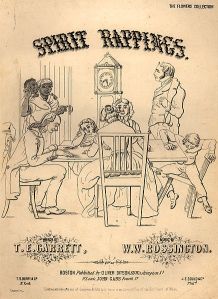
A few weekends back I watched the new Ghostbusters in the theater. Since tuition bills loom larger than life, it takes a powerful draw to get me to spend the money to see a movie in its natural setting. As my regular readers know, I loved it. Critics have tended to, well, criticize the movie, largely for its main drawing feature—the female leads. A thoughtful piece in by Colin Dickey in New Republic points out some of the unusual dynamics at play here. Looking at the history of Spiritualism as the basis for the modern interest in ghosts, Dickey suggests that women have been involved in the long-term fascination with the dead from the beginning. Their motive, however, was generally communication. Women wanted to relate with ghosts to make a connection. The original Ghostbusters movie represented a male, rationalistic approach to ghosts. As Dickey points out, instead of communicating, the men hunt and trap rather than trance and rap.

436px-Spirit_rappings_coverpage_to_sheet_music_1853

Ghostbusters, in all three cinematic presentations, is for laughs. Sometimes classified as supernatural comedy, the film is meant as humor while, admittedly, leaving the door creaking open for some serious thought about the implications. In a reductionistic world there’s no room for ghosts. It’s not possible to say, scientifically, what they might be. From the perspective of traditional belief, however, ghosts are the lost spirits of the departed. Traditional Christian theology places the dead squarely in Heaven or Hell, and they shouldn’t be wandering around down here. That hasn’t stopped people from reporting ghosts. They’ve been recorded almost as long as there has been writing. Today “Ghosthunters,” arms defiantly crossed, use “science” to try to prove the entities exist. This is lightyears from the traditional seance. A ghost under a microscope isn’t very scary.

One of the reasons I found the new Ghostbusters so compelling is that it managed to tiptoe that line between science and spirit that is so rare in the real world. The women, downgraded though they are in the story, are academics. They know, and experience, the dangers of taking haunting seriously. The movie is seriously funny. Like most truly funny efforts, there is a great deal of truth hidden in the humor. Dan Aykroyd’s cameo is one of the scenes that plays on its own loop in my head. “I ain’t afraid of no ghosts,” he says before he drives off toward Downtown. Women, in the film, have a healthy respect for the departed. Not exactly afraid, but not exactly unafraid, they handle ghosts as persons. This may be one of the points Dickey is making in his article. To understand a human one must be human. Spiritualist or Ghostbuster, women have always been superior guides to what is truly important. If only men could learn to listen.


Things Unseen

The reductionistic mind doesn’t care for mystery. Unlike a lover, the unknown is a problem to be solved so that the march of nice, neat solutions may continue to march on, unabated. Fear of fuzzy thinking leads to a coldness that those of us experiencing life find not a little unsettling. Take the cougar, for example. Right now I’m in one of the few habitats of the grizzly bear in the lower 48. It is also home to mountain lions (pumas, panthers, ghosts of the Rockies). Just a week before I came here a local website posted a rare photo of a cougar caught unawares. These creatures are seldom seen, and are officially extinct for most of the country east of the Mississippi. That doesn’t stop them from existing, however. Reports from my native Pennsylvania continue to be filed. I saw tracks when I was a child, but never saw an actual cat. A friend in West Virginia had seen one shortly before we visited that state some years back. Even New Jersey still gets the occasional sighting. Officially these are misidentifications.

I recently read a couple of books that addressed the beast of Dartmoor, in the United Kingdom. Dartmoor is a wild and remote area and for many years an uncomfortable story has circulated about an unknown creature that haunts the moors. The story is older than Sherlock Holmes as Sir Arthur Conan Doyle had the detective face the hound of the Baskervilles in that region. Those unhappy with the unknown have sought a rational explanation and now some are claiming that escaped cougars are the basis for the tale. A zoo owner even declares that some of his escaped in the 1980s, causing the stories to arise. The fact that the beast had been part of folklore for over a century already at that point suggests that this may be a little too little a little too late. It’s better than mystery anyway.

DSCN0740

My minimal experience on Dartmoor didn’t lend itself to seeing folkloristic beasts. Even my somewhat extended time in this wilderness hasn’t led to a cougar or grizzly sighting. The mysterious gains its reputation by rarity. The thrill of seeing a relatively common moose is akin to theophanic. I know it’s just a big deer. It’s more than just a big deer. Wonder is an essential part of the human condition. Without it we become as soulless as the mechanistic universe some so desperately want to explain neatly, according to the rules. Cougars escape. Cougars escape detection. What else might we be missing in a universe we’ve only just begun to explore.


Leaving Town

After grousing about having too little time, today begins a trip out of town. Changing time zones, forsaking civilization, resting at a mountain lake. And I’m thinking of all that I’ll accomplish without having to go into the office for an entire week. I made similar plans last year. I’d lined up all the projects that had been piling up and figured that being away for a while would be perfect for getting them done. On the flight across the country, however, my laptop died. Gave up the electronic ghost and died. I grieved, and I was in shock. Thoughts of buying a replacement came to mind, but then, I told myself, I justified buying all my past laptops because of teaching. I carried my PowerPoints with me to class. We’d become a two, then three, computer family. I remembered the sign-up sheets they used to use when you needed an hour on the computer in the library. I’ve practically become a single entity with my hardware, how would I survive without?

Last year, survive I did. Concerned family members kindly offered to let me borrow their laptops so that I could post my daily ravings here. I was surrounded by nature’s majesty—mountains, a pristine (or nearly so) lake, huckleberries, fresh air—and my thoughts turned to the Borg. I’d read about transhumans, and now, I could see, I was becoming one. I don’t want the internet plugged into my brain. In fact, sometimes I don’t even want it sitting on my lap.

All of this is my long-winded way of saying to the ether that my usual posting pattern may be disrupted. It was at the lake, however, that this blog was born. I’m sure that those who first suggested it are a touch disappointed at the way it has grown up. Initially it was supposed to be mostly podcasts. My servers for those casts, however, charged for the service of holding my voice bytes. I used to get paid for sending that same voice out over a classroom full of students only to fall on the wrong side of politics and economy. So it is that I await my flight to remote reaches—remote reaches with Wifi, if the elements allow. If you don’t see my usual musings at my usual time, this will likely be the reason. Although, this time around, with a new top for my lap, I hope I’ll remember to get outdoors every now and again.

IMG_2362