Spirit of Equality

A few weekends back I watched the new Ghostbusters in the theater. Since tuition bills loom larger than life, it takes a powerful draw to get me to spend the money to see a movie in its natural setting. As my regular readers know, I loved it. Critics have tended to, well, criticize the movie, largely for its main drawing feature—the female leads. A thoughtful piece in by Colin Dickey in New Republic points out some of the unusual dynamics at play here. Looking at the history of Spiritualism as the basis for the modern interest in ghosts, Dickey suggests that women have been involved in the long-term fascination with the dead from the beginning. Their motive, however, was generally communication. Women wanted to relate with ghosts to make a connection. The original Ghostbusters movie represented a male, rationalistic approach to ghosts. As Dickey points out, instead of communicating, the men hunt and trap rather than trance and rap.
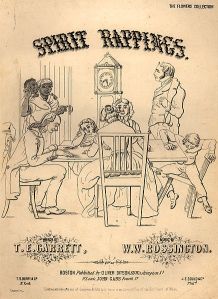
436px-Spirit_rappings_coverpage_to_sheet_music_1853

Ghostbusters, in all three cinematic presentations, is for laughs. Sometimes classified as supernatural comedy, the film is meant as humor while, admittedly, leaving the door creaking open for some serious thought about the implications. In a reductionistic world there’s no room for ghosts. It’s not possible to say, scientifically, what they might be. From the perspective of traditional belief, however, ghosts are the lost spirits of the departed. Traditional Christian theology places the dead squarely in Heaven or Hell, and they shouldn’t be wandering around down here. That hasn’t stopped people from reporting ghosts. They’ve been recorded almost as long as there has been writing. Today “Ghosthunters,” arms defiantly crossed, use “science” to try to prove the entities exist. This is lightyears from the traditional seance. A ghost under a microscope isn’t very scary.

One of the reasons I found the new Ghostbusters so compelling is that it managed to tiptoe that line between science and spirit that is so rare in the real world. The women, downgraded though they are in the story, are academics. They know, and experience, the dangers of taking haunting seriously. The movie is seriously funny. Like most truly funny efforts, there is a great deal of truth hidden in the humor. Dan Aykroyd’s cameo is one of the scenes that plays on its own loop in my head. “I ain’t afraid of no ghosts,” he says before he drives off toward Downtown. Women, in the film, have a healthy respect for the departed. Not exactly afraid, but not exactly unafraid, they handle ghosts as persons. This may be one of the points Dickey is making in his article. To understand a human one must be human. Spiritualist or Ghostbuster, women have always been superior guides to what is truly important. If only men could learn to listen.


Things Unseen

The reductionistic mind doesn’t care for mystery. Unlike a lover, the unknown is a problem to be solved so that the march of nice, neat solutions may continue to march on, unabated. Fear of fuzzy thinking leads to a coldness that those of us experiencing life find not a little unsettling. Take the cougar, for example. Right now I’m in one of the few habitats of the grizzly bear in the lower 48. It is also home to mountain lions (pumas, panthers, ghosts of the Rockies). Just a week before I came here a local website posted a rare photo of a cougar caught unawares. These creatures are seldom seen, and are officially extinct for most of the country east of the Mississippi. That doesn’t stop them from existing, however. Reports from my native Pennsylvania continue to be filed. I saw tracks when I was a child, but never saw an actual cat. A friend in West Virginia had seen one shortly before we visited that state some years back. Even New Jersey still gets the occasional sighting. Officially these are misidentifications.

I recently read a couple of books that addressed the beast of Dartmoor, in the United Kingdom. Dartmoor is a wild and remote area and for many years an uncomfortable story has circulated about an unknown creature that haunts the moors. The story is older than Sherlock Holmes as Sir Arthur Conan Doyle had the detective face the hound of the Baskervilles in that region. Those unhappy with the unknown have sought a rational explanation and now some are claiming that escaped cougars are the basis for the tale. A zoo owner even declares that some of his escaped in the 1980s, causing the stories to arise. The fact that the beast had been part of folklore for over a century already at that point suggests that this may be a little too little a little too late. It’s better than mystery anyway.

DSCN0740

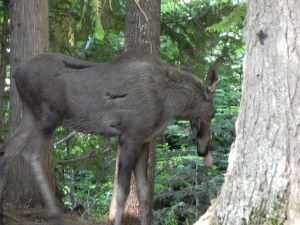
My minimal experience on Dartmoor didn’t lend itself to seeing folkloristic beasts. Even my somewhat extended time in this wilderness hasn’t led to a cougar or grizzly sighting. The mysterious gains its reputation by rarity. The thrill of seeing a relatively common moose is akin to theophanic. I know it’s just a big deer. It’s more than just a big deer. Wonder is an essential part of the human condition. Without it we become as soulless as the mechanistic universe some so desperately want to explain neatly, according to the rules. Cougars escape. Cougars escape detection. What else might we be missing in a universe we’ve only just begun to explore.


Leaving Town

After grousing about having too little time, today begins a trip out of town. Changing time zones, forsaking civilization, resting at a mountain lake. And I’m thinking of all that I’ll accomplish without having to go into the office for an entire week. I made similar plans last year. I’d lined up all the projects that had been piling up and figured that being away for a while would be perfect for getting them done. On the flight across the country, however, my laptop died. Gave up the electronic ghost and died. I grieved, and I was in shock. Thoughts of buying a replacement came to mind, but then, I told myself, I justified buying all my past laptops because of teaching. I carried my PowerPoints with me to class. We’d become a two, then three, computer family. I remembered the sign-up sheets they used to use when you needed an hour on the computer in the library. I’ve practically become a single entity with my hardware, how would I survive without?

Last year, survive I did. Concerned family members kindly offered to let me borrow their laptops so that I could post my daily ravings here. I was surrounded by nature’s majesty—mountains, a pristine (or nearly so) lake, huckleberries, fresh air—and my thoughts turned to the Borg. I’d read about transhumans, and now, I could see, I was becoming one. I don’t want the internet plugged into my brain. In fact, sometimes I don’t even want it sitting on my lap.

All of this is my long-winded way of saying to the ether that my usual posting pattern may be disrupted. It was at the lake, however, that this blog was born. I’m sure that those who first suggested it are a touch disappointed at the way it has grown up. Initially it was supposed to be mostly podcasts. My servers for those casts, however, charged for the service of holding my voice bytes. I used to get paid for sending that same voice out over a classroom full of students only to fall on the wrong side of politics and economy. So it is that I await my flight to remote reaches—remote reaches with Wifi, if the elements allow. If you don’t see my usual musings at my usual time, this will likely be the reason. Although, this time around, with a new top for my lap, I hope I’ll remember to get outdoors every now and again.

IMG_2362


Monkey Puzzle

One of the unexpected consequences of Christian theology is the ongoing insistence in science that human beings are qualitatively different from other animals. Actually, it goes back to the Hebrew Bible and the concept of “the image of God.” As the absolute line between human and beast continues to blur (intelligence, tool use, language use—you name it) mainstream teaching has trouble admitting that our special differences aren’t that different. A Washington Post story by Darryl Fears describes how capuchin monkeys have been using tools to extract cashews from their toxic husks for at least 700 years. These monkeys use a two-rock system to get at cashews, which, in their natural state, are inedible. The surprise here is that this makes these monkeys denizens of the Stone Age and capable of teaching complex behavior to their offspring.

Animals watch parents to learn to eat—it might seem to be a simple idea. In reality it’s more complicated than that. As I watched a doe and fawn foraging the other day, it occurred to me that what we call “instinct” is a way of getting around admitting animal intelligence. Why would a newborn (“unconscious”) animal seek to feed, or flee from predators? We call it instinct, but what we really mean is a form of will, a desire to survive. This “will” pervades nature well below the human-animal divide. Plants strive to thrive, and exhibit a “will” to live. By just taking all this for granted and calling it “instinct” we’ve further cut ourselves off from the organic world of which we’re all a part.

Christian culture gave rise to scientific method. No doubt this is an embarrassing scenario for those who believe science should reduce all the wonder of being alive to mathematical equations. Can’t we just pretend that rationality was creeping in from the beginning? Aristotle was going that way wasn’t he? But his work was “lost,” only to be recovered by Muslims who saw the value of such logical thinking and Christians—in an over-simplified history—wanted to catch up. Meanwhile, in the Dark Ages monkeys were using an intricate system to extract tasty nuts from toxic casings without the benefit of any religion at all. The Stone Age, we easily forget, was the first recognizable step on the road to the technological world we inhabit today. And we continue to use an outmoded paradigm to understand our place in that world.

391px-Organ_grinder_with_monkey


Consciousness Times Eight

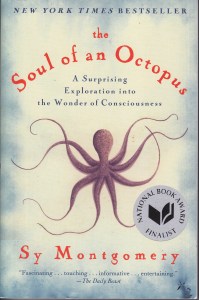
SoulOctopusPerhaps the characteristic that marks our species most distinctly is its arrogance. Conscious of who we are (we think) we stake the claim for minds for ourselves alone while all the evidence points away from that very conclusion. Naturalists are castigated for “anthropomorphizing” animals by stating that they have consciousness too, or—oh the heresy!—personality. Any of us who’ve spent time with two or more of the same non-human species, however, know that personality is a given. Animals think and feel and, yes, act on their own view of the world. I have to admit I fell in love with Sy Montgomery’s The Soul of an Octopus. I’ve read animal books from my youngest days, but finding an author so forthright about the feeling of getting to know another species is rare. And I learned tentacles full of information about octopuses. I had already known that octopuses are intelligent—I hadn’t realized just how smart—but since my interactions have only been with sleeping cephalopods on the opposite sides of aquaria glass, I had little to go by.

Throughout her charming book, even if the evidence is anecdotal, Montgomery reveals the personalities of the octopuses she got to know at the New England Aquarium. The reader can be left with no doubt that these are animals with personality, different from one another and strikingly conscious. We can’t define what consciousness is, but I tend to agree with Montgomery that it is what many people call “soul.” She admits that her religious tradition would likely frown upon her willingness to share such a valued commodity with an animal—an invertebrate, no less—but surely she is right. Many, if not all, animals have a form of consciousness. Heaven will be a much more interesting place for it.

Please don’t confuse my enthusiasm with sentimentalism. Those of you who regularly read this blog will know that books on animal intelligence by a variety of scientists make up a steady part of my literary diet. Biology, however, often has a difficult time in a world where physics and chemistry are treated with reductionistic glee. I was strangely satisfied when Montgomery mentioned that Stephen Hawking signed the Cambridge Declaration on Consciousness which proclaims humans alone are not the guardians of this phenomenon we don’t even understand. The Soul of an Octopus was one of those books that I couldn’t wait to keep reading, even if it meant being on my long commute each day. And I can’t help but think of how much intelligence we squander by claiming that only our own kind possesses it.


Minding Souls

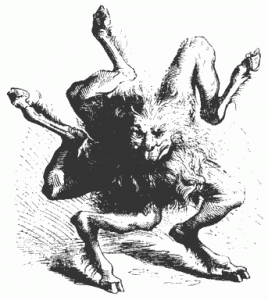
The mind, despite nay-sayers, is real. It isn’t an illusion. Emergent phenomena are often larger than the sum of their parts. One of the problems with the non-physical is that we can’t parse it precisely. “Mind” may be called “soul” may be called “personality” may be called “spirit.” You get the picture. Many scientists would answer “none of the above” to the question of which of these exist. Other scientists, not on the fringe, are beginning to see that the answers aren’t quite so simple. A recent piece in the mainstream Washington Post, dares to say what we all feel. Or at least many of us feel. There are realities that religions have recognized for millennia, that demonstrate the existence of the non-corporeal. “As a psychiatrist, I diagnose mental illness. Also, I help spot demonic possession,” an article by Richard Gallagher, is worth reading. Gallagher, with a hat-trick of Ivy League-awarded degrees, believes in demons. They’re rare, of course, he says, but real.

The standard story—in large part correct—is that ancients misdiagnosed epilepsy and some forms of mental illness as demons. Undoubtedly their standard threshold was too low. Occasionally, however, they may have been right. Unlike what we’re sometimes told, the ancients recognized at least some mental illness when they saw it. There were non-functional people then, and while some may have blamed demons, others saw them as people who don’t think like the rest of society. Then there were the possessed. As Gallagher notes, humans with superhuman strength, speaking languages they never learned, and yes, even levitating, have been witnessed by credible viewers. Very rare, yes. But also very real.

Despite the need that many feel for freedom, we are, as a species, fond of laws. We want to know the rules and we’re quick to call out those we catch cheating. We’re so fond of laws that we apply them to nature and claim that natural laws can never be broken. Well, at least not above the quantum level. A friend shared that this concept of applying legal language to nature is a fairly recent development in human thought. The idea of a law, however, requires someone to oversee and enforce it. One of the subtleties here is that any enforcement that takes place requires a measure of value, and value, as much as we all treasure it, simply can’t be quantified. Is gold more valuable than silver? It depends. The value comes in assessing its usefulness. Laws separate good behavior from bad behavior. And, if many credible people are to be believed, the behavior of mind sometimes defies the laws of nature.

Buer


For the Dogs

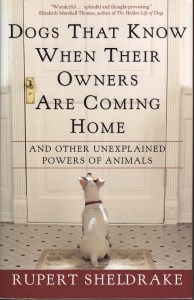
DogsThatKnowYou know that feeling of being dropped into a very strange place?  Sure, it’s disorienting for a while, but once you get used to it, you start to enjoy your surroundings.  Now ask yourself: what if my entire way of looking at life is based on a faulty paradigm?  Many, I suspect, will drop out at that point.  There’s strange, and then there’s going too far.  For those wedded to the idea of finding the truth, however, weirdness is part of the journey.  I just finished reading Rupert Sheldrake’s Dogs That Know When Their Owners Are Coming Home.  Yes, it felt like the room was spinning (actually, I read it on the bus, so that might’ve been true a time or two), but it confirmed something I’ve suspected for many years.  The reigning, mechanistic universe paradigm is wrong.  Please don’t take this as an anti-science statement.  Sheldrake is a bona fide scientist, and I’m an avid reader of science books.  It’s not so much that science is wrong as it is that science doesn’t go far enough.  Ever since the Industrial Revolution—not coincidentally—we’ve been informed that the universe is really a giant machine.  We can figure out how it works using this squishy stuff in our heads that insists we can find Pokemon everywhere we look when it’s not busy solving the riddles of the mulitverse.

Sheldrake, who is given a wide berth by many scientists, states what any of us who grew up with pets knows: they know more than they’re saying.  Admitting up front that much of the evidence is anecdotal, Sheldrake provides empirical studies to demonstrate what folk say.  Dogs do know when their owners are coming home, before they are within sight, hearing, or smelling range.  His study, however, isn’t limited to dogs or to knowing when someone’s coming.  Animals, by virtue of their own minds, have abilities that we do not.  Since they don’t speak our language, we assume they are dumb.  In fact, as this book shows, a great many animals know a great deal more than we do.  The question is, if this is the truth why don’t we hear more about it?

We prefer, it seems, our truth to be qualified.  There’s a lot at stake here.  The reigning paradigm keeps us plugged into this corporate machine we’ve devised.  Our lifestyle cannot subsist without the subordination of animals.  We can’t give them abilities we lack, apart from tastiness.  If the universe isn’t a machine, it might open the door for a broader view of reality.  Maybe it is better to be post-Christian, but religion has proven benefits to humans (and perhaps animals).  Why does religion remain in a mechanistic universe?  Perhaps what we call “souls” are the same as “minds” and perhaps they aren’t the same as brains.  If we really do have minds, it is in our best interest to care for them, develop them, and improve them.  It may seem like a strange world indeed where your dog informs your view of reality.  Read Dogs That Know When Their Owners Are Coming Home, however, and see if you don’t find yourself wagging your tale, just a bit.


Things Remembered

IMG_2839 copy

Freedom. Independence Day is our celebration of liberty. Yesterday I happened to find myself at Bethel Woods, the out-of-the-way location in New York where Woodstock was held. Probably no one in 1969 realized just how formative Woodstock and its message of peace, love, and music would become for American culture. Those of us who came of age in the ‘70s learned about it as recent history (I was only seven at the time and, I’m sure, would’ve found the whole thing somewhat unChristian had I been here then). Much has changed in the intervening years. Not many peaceful events get so much airtime any more. Upwards of 400,000, basically unpoliced, youth, gathered in Bethel, New York, for three days of music, chaos, and peace. The Vietnam War was still draining our nation of its youth and murdering its idealism. Fear of the other, racial inequality, and male superiority were part of the context that led to the need for Woodstock. Freedom was free.

Often on this blog I reflect on the sacredness of place. Events that take place in a location leave their impression on the land. Bethel Woods Center for the Arts, the current administrators of the property, have left the field largely intact. As my wife and I stood at the top of the hill and tried to imagine almost half-a-million people here, it was strangely quiet. The nearby museum had plenty of music playing, but standing where it actually happened, there were only ghosts of an event studied in school and which, even today, kids can generally identify. I couldn’t have named every act that played the concert and, although the music was clearly important, it was the gathering that is most remembered. Self-governing youth getting along in an area so remote that still today you have to drive a couple miles to find even basic necessities, sent a powerful message. It was an event that, I fear, can never be replicated. The snake has spoken.

Nearing fifty years later, we’ve become so paranoid that anyone who looks Middle Eastern is under suspicion. Guns, which children of the sixties shunned, have proliferated and may now be carried, wild-west style, in many states. A fear-mongering candidate bellows fascism before the Grand Old Party. Remember, Nixon was president during Woodstock. I may have lived hundreds of miles from here, occupying myself with the matters that seven-year-olds find so pressing. But Woodstock happened. By the time I got to Woodstock, everybody else had gone. I see others milling about the museum, slightly older than me. Perhaps some of them were here for the event itself. We all seem to be searching for something here. The festival had its problems, for sure, but with a sincere belief in freedom, it makes the pre-seventies United States feel like a strangely foreign county. How do we get back to the garden?


Kidnapped by Religion

The title is, unfortunately, not mine. My wife sent me a story on NPR entitled “Humility Is Embedded In Doing Science, But What About Spirituality?” by Barbara J. King. The piece is largely an interview with physicist Marcelo Gleiser about his new book, The Simple Beauty of the Unexpected. Of course, now it’s on my reading list. The interview treads the well-worn path of science versus religion. Science is presented as humble (which I don’t doubt, when in the right hands—or the right minds, rather) while religion is arrogant, claiming to know everything. Gleiser states that spirituality has been “kidnapped by religion” but still has a place in the life of a scientist. I wish there were more of them like Gleiser.

Now, I have to admit my data are limited. I read science books—I have since I was a teenager—but with a layman’s eye. My scientist dreams were dashed against the unyielding rocks of complex mathematics, something evolution cruelly withheld from my gray matter. I wouldn’t have survived high school pre-calc without my younger brother’s help. I’ve nevertheless read the pre-chewed, partly-digested science regurgitated for the formulaically challenged, and find myself, like Glieser, awed at the wonder of it all. Still, I also find many scientists—at least those with the loudest voices—claiming that what they’ve discovered is all there is. There is only matter, and we with our three-pound brains have figured it all out, by the gods, without the gods! We know all that can possibly be known will conform to the system our brains have developed, and there are no gods out there and no spirits in here and that pang you’re feeling in your gut is merely physiological, not spiritual.

I haven’t read The Simple Beauty of the Unexpected, but I have found many scientists walking the same trail I’m on. We are those who are seeking the truth, and who don’t assume the answers. Religion need not be arrogant. At its best, it’s not far from science. As a species, we have developed rationality extremely well (even if we fail to use it). Much of biological existence, however, is emotion, or feeling. That we sometimes leave behind. It participates in reality as much as rationality does. I’m reminded of this every time I hear someone in the business world refer to “soft” skills. What mere humans bring to this rationalistic business of making money. We’re just the squishy stuff that CEOs can’t live without because wealth mean nothing if you can’t compare it to someone else’s. Humility? I agree, Dr. Gleiser, we must maintain a sense of wonder. For those of you who say we’re just a number waiting to be quantified, I would humbly ask for 42, if it’s not already taken.

DSCN0633


True Fiction

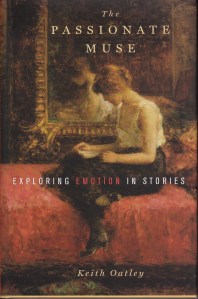
PassionMusesIn this world of rational materialism, people still turn to fiction. Some prefer it in the form of movies, television, or internet, but those of us “old school” like our fiction in print. No matter how we take it, fiction appeals to that part of us that makes us human—our range of emotions. This became clear to me in The Passionate Muse: Exploring Emotion in Stories. As a typical human, I spend a good part of my mental energy trying to make sense of things. Our social existence can be quite confusing and isn’t always rational. If you doubt this, read the headlines. Keith Oatley offers insight into psychology, or mental life in general, with this little book. We read stories because we like to find ourselves caught up in emotions. Successful writers can draw us into the fictional world not with reason, but with feeling. We seek emotional satisfaction and what we can’t do in fact, we can in fiction.

This aspect of human existence also plays into religious texts. Those of us raised to read sacred texts literally lose a lot of what they have to offer. Fact may tell us what to believe, but fiction helps us learn to feel. Thinking, as many cognitive scientists now believe, incorporates both rational and emotional information. Reality, in other words, isn’t purely reasonable. We interpret things. We interpret with our guts as much as with our heads. This combination of different ways of understanding the world—and the society—around us blends into a distinctly human milieu. We can’t reason our way out of emotions. They are who we are.

While teaching full-time I found myself turning to novels to recover from all the research I was doing. Reading only non-fiction (which, I suppose, is what The Passionate Muse might be) can lead to a lopsided view of life. I’ve had colleagues tell me that fiction is for others—non-academics, those who don’t have the weight of the intellectual world upon their shoulders all the time. Interestingly, since I’ve allowed myself to read more fiction I’ve discovered that the wisdom embedded in stories often surpasses that of erudite monographs. Scholarly literature, of course, has its place. Still, it leaves room on the plate for desert as well. Oatley builds his academic study around a fictional story he wrote to show what he wanted to tell. The rational meets the imaginative. I feel more human already.


Human, Nature

Wild EarthSomeone recently told me that a city blocks a certain vibration that people draw from contact with the earth. I know that vibration often sets off “new age” alarms, but this person was rational, scientific, and had grown up in New York City. I grew up in a town on the edge of the woods. We didn’t live on concrete. In fact, the floor of our shack was so thin in some places that you could see the actual soil underneath. Even our driveway was gravel. Although it was a dysfunctional family, I felt more connected to my planet back then. Wild Earth, Wild Soul: A Manual for Ecstatic Culture, by Bill Pfeiffer, is just what it says. It’s a manual for how to get back in touch with nature. Basing his ideas on those of indigenous cultures world-wide, with a healthy dose of shamanism, he explores the vibrations of the earth. I had, at times, to force myself to listen. He’s right about so much that I stayed with the narrative to the end.

Civilization comes with a price tag. A very high price tag. The rates have been set by a small group of “progressives” who operate with the idea—mistaken—that all nature is a machine. Physics, they claim, and chemistry, show that all of life is mathematical. Nothing in the universe doesn’t add up. But biology, as Pfeiffer repeatedly shows, often doesn’t. The mistake is as fundamental as it is reductionistic. Life isn’t quantifiable. Biology messes up the nice, neat system we’ve invented. Indigenous peoples, while not idealized, lived in much better harmony with the land, not over-exploiting. It was a sustainable existence. What “civilized” people wanted was more. More of everything. A surplus, in fact. Without that surplus there is no business, right? Capitalize on that!

We’ve lost touch with nature. Our “leaders” want to exploit it. Mine it, refine it, and make it “useful.” When’s the last time I looked at a tree just to appreciate it as nature? Civilization can’t envision a tree without an axe. If it grew it can be improved. Even our food has to be genetically modified because obviously nature can’t make a profit on its own. No, Wild Earth, Wild Soul hasn’t made the impact on the world it might have. I’d never have found it if it weren’t for a used book sale. That doesn’t mean, however, that it isn’t right. We need to dismantle. We are not electronic devices, as much as the internet tells you otherwise. I knew that as a child. And as my feet ache from walking over acres of concrete on my way to “work” I know it’s true. There are indeed good vibrations out there, but here they’re too deep under my feet to feel.


Man’s Best Fiend

While reading the Hull Daily Mail (don’t ask), I came across an article entitled “Rock legend Alice Cooper ask questions about the Beast of Barmston Drain.” Apart from that lovable Britishism of making groups into grammatical plurals, this brief article gave me much to wonder about. After all, Paul Simon’s most recent album features a song entitled “The Werewolf,” (about which I recently wrote) and here is another rock performer from my youth raising the question about a similar beastie. According to the piece by Amy Nicholson, the Beast of Barmston Drain is a new urban legend about a creature half-man and half-dog. No doubt, werewolf reported sightings have been in the ascendent over the past few years, but how such an insignificant beast drew the attention of Alice remains unknown.

800px-Lycaon_Transformed_into_a_Wolf_LACMA_M.71.76.9

Many who know me—and those are few—are shocked to learn that I grew up listening to Alice Cooper. A fundie kid listening religiously to the father of shock rock? Songs about monsters, spiders, female maturation, and necrophilia? Perhaps it was because Welcome to My Nightmare just summed my childhood up rather nicely. Whatever the reason, to this day Alice Cooper is the only big name rock act I’ve even seen in concert. And that was only about six years ago, when I was still teaching at Rutgers. I had trouble hearing student’s questions in class on the next Monday night. Alice and werewolves in the same headline feels so much like yesteryear that it makes me want to believe in shapeshifters all over again. No wonder Hull is set to be the City of Culture. (Hey, Glasgow had it’s turn, so fair’s fair.)

To me, werewolves reveal much about a culture that strives to be far too civilized. We suppress our inner animal to become tie-wearing, wine-swilling sophisticates only to wonder where the wonder’s gone. And we start seeing werewolves lurking in culverts and drainage ditches. At least people are getting out at night. I’ve followed American tales of the dogman for years now, reading all of Linda Godfrey’s books on the subject. Even if it doesn’t exist, we stand to learn much of the creature that just won’t go away. Of all the transformations people talk about, that to the wolf is the most compelling, and among the most ancient. It may only be a dogman that people are seeing at the moment, but given some time it will evolve back into the wolf from which the story had its very beginnings. The answers, as always, probably lie in our childhood.


Virgil’s Vigil

IMG_2798I can never keep Virgil and Beatrice straight. I blame Dante. Allegories can be so tiring. So, sitting under a tree in Princeton, enjoying a root beer float prepared at The Bent Spoon, I ponder the empty bottle before me. Virgil’s root beer. So good, it states, that I’ll swear it was made in Heaven. It is good, I must say, but didn’t Virgil lead Dante through the other place? You see, I’ve just spent a pleasant morning at Grounds for Sculpture, the outdoor museum set up by Seward Johnson, a sculptor that some accuse of kitsch. Others come by the busload to see what it’s all about. Johnson’s cast sculptures of people are so lifelike that it isn’t unusual to find yourself staring at an actual person sitting on a bench, wondering if they’re real or not. I spend a lot of time pondering reality, and this place makes that question explicit.

Descartes said “I think therefore I am,” but what if I am really the thought of another? How would I ever know? As I wonder around among the sculptures, a different face of reality shows itself. Many of Johnson’s pieces are sculptures based on paintings. To get behind the surface you have to imagine what the unshown side must’ve looked like. That which the original artist left out. Any art is a matter of perspective. Unseen realities—isn’t there something Dantesque about all this? Is Virgil the guide through Heaven, or is that Beatrice?

These statues, in quotidian poses, are so real. If they’re cast from actual persons, maybe they are. After all, this camera I carry is capable of capturing souls. And if you don’t make it through the first time around, there’s always Purgatory as a safety net. This bottle in my hand causes me confusion. Is my tipple divine or diabolical? How much difference is there between them, really? Princeton is a place that needs no one, after all, except those who have already made a success out of life. A place with expensive root beer on offer. A vice for which I’m willing to pay. Maybe life is a divine comedy after all.


Grasping for Meaning

DSCN6301

How often we’re told—and writers on biblical topics are especially guilty of this—the meaning of a story. Despite what materialists say, we are meaning-seeking creatures. We want to know why. When we read a story we want to know what it means. I occasionally dabble in the pool of fiction. Many times I read the emerging story and wonder what it means. Sometimes the meaning changes over time. Sometimes it means many things at once. Recently I read someone explicating the meaning of the story of Noah. The meaning? No, a meaning. That little article makes all the difference. Definite or indefinite, we need constantly to remind ourselves that stories bear meanings. Plural. They mean nothing otherwise.

Those of us who spend a lot of time with sacred texts see that it suggests something specific to us. Those who manage to gain followers start their own religions. The problem comes when one meaning is fixed to a text. I often saw this growing up as a Fundamentalist. I also saw it frequently at Nashotah House. This verse means this. Nothing other. Any interpretation outside this particular one is heresy. Heresy is, of course, punishable by death. Lest you think this is just the idle musing of an underemployed biblical scholar I must remind you that wars have been fought over such things. People have died. All for someone’s mistaking an indefinite article for a definite. There are those who say certain canons of the Mass must not exclude the definite article or otherwise all you’re getting is a very cheap and meager lunch out of the deal. For this you put on your best clothes?

We read stories for entertainment, but if they mean nothing they are quickly forgotten. Dreamtime stories, as David Abram reminds us, may lack plot but they have place. They take us to a place where we aren’t physically present. Or if we are physically present, we need to be taken there in mind as well as body. They give life meaning. Ironically, as a culture, fewer and fewer people find meaning in their work. Living for the weekend, they find their sense of fulfillment by what they do when not on the clock. And some of that time has traditionally been demanded by those who offer worship experiences. After all, weekends were their idea in the first place. There may be some meaning in that. If there is it is only one meaning among many. And even while attending, it is best to keep an eye or ear open for something other than the meaning which the ordained may insist is the only true one.


Nature’s Voice

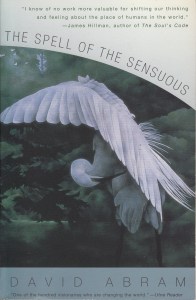
SpellSensuousCivilization isn’t all it’s cracked up to be. Sure, it’s got its moments—modern medicine, indoor plumbing, Honey Boo Boo—but often it’s artificial. It’s like somebody made up a set of silly rules and those who dare violate them are treasonous barbarians. Over the past few years I’ve been reading books that consider our biological development and what nature seems to indicate about how people might exist more holistically in the world. I don’t mean New Age outlooks, although, surprisingly, such treatments often aren’t far off base. I’d never heard of David Abram or his book The Spell of the Sensuous. (For those who think sensuous means only one thing, the subtitle is Perception and Language in a More-Then-Human World.) Although somewhat dated, this is an insightful book. The basic premise is that we are, by nature, part of a much larger world but we have, like spoiled children, decided to take it all for ourselves and isolate our species from all others, claiming a superiority that none dare challenge. In the process we’ve lost much of what it benefits us being animals, and have separated ourselves from the wonders of the world all around us. Working in Manhattan, I have to agree.

Basing his observations on having lived among aboriginal peoples, Abram notes that although anthropologists have denied the tenets of Christian missionaries on the religious front, they have continued in that teaching concerning biases against nature-based belief systems. Peoples who live close to the land observe things which seem superstitious to the “civilized,” but which are, in reality, simply astute realizations based on watching how the world works. Like Thomas Nagel, he notes that consciousness pervades the natural world. Animals, plants, even the earth itself displays forms of awareness that we ignore in our rush to exploit and gain “wealth.” In reality, we suffer for having made ourselves something we’re not.

There’s a lot in this book, far more than a single blog post can say. I don’t agree with all the points Abram makes—that writing may be responsible for our dilemma is a bit of a stretch—but there is great wisdom in this tome. At several points I had to stop and ponder the implications of what he was saying. Yes, nature speaks. Creating a world where “success” is measured in removing yourself as far from nature as possible requires elaborate rules. As far as I can tell, obeying the rules means that if you’re one percent of the one percent you’ll have nothing to complain about. If you have enough money—itself an artificial construct—you can run for president with no other qualifications. Meanwhile, nature suffers at our hands and may only recover once the world is forced from our hands and the sensuous once again takes over, doing what it has always done.