To Be, Or

Science and Nonbelief

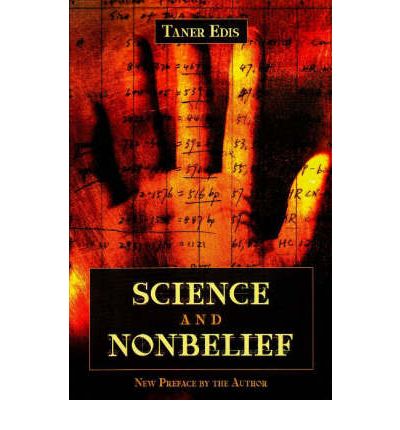
Science is, according to Taner Edis, ambitious. While Science and Nonbelief is somewhat sympathetic to the religiously minded, Edis demonstrates how science aggressively tackles the issues steadfastly claimed by religions, and ultimately triumphs. Interestingly enough, early on in the book Edis notes that “truth” is a philosophical concept, and science operates on the principle of the best explanatory theory of the moment. So far I am in complete agreement. I guess the part that gives me the most trouble is the assumption that reason is the only way of knowing. Perhaps I’m just not enough of a scientist to know such things, but it appears to me that all “lower” animals appear to get along very well in the world without great doses of “reason” that supposedly catapult humanity far above the other species. Scientific observation would seem to confirm that many animals feel emotion—after all, what is fight or flight if not an emotional response? And since we are animals, I reason, have we lost something when we leave feeling aside as a way of knowing?

Edis is quite fair-minded. He notes that science has no way to prove or disprove the existence of a deity, or deities, but he also states that the empirical method is so successful that a spiritual world is no longer required. He may be correct. The vast majority of the people in the world feel he is wrong, however. I may state this since we know, statistically, that most people in the world believe in some form of religion. Rational or not, here they come! It would seem that evolution has endowed us with religion, or an awareness of something we feel rather than reasoning out. And yet, we are told, science takes no prisoners.

I often ponder the fact that no one person has all the answers. Part of the human condition involves possessing limited resources for specializing in too many fields. Polymaths become rarer each year as specialists grow more and more precise. In this great mix of human learning, science often steps in and claims all the marbles belong to it. The rest of us have lost ours, apparently. There’s no denying that applied science has been very successful in bettering our understanding of our universe and our lot in the world. That doesn’t mean that all will believe in it. The title of Edis’ book is apt; belief is the real issue in attempting to fit religion and science into the same world. It is quite clear that religion doesn’t explain much in the way of the natural world. I wonder, however, if science is really capable of encapsulating all of what it means to be human.


Z War to End

World_War_Z_posterWorld War Z is playing in theaters and I haven’t even had time to stock up on water and canned goods. Zombies are everywhere. And we can’t say that we didn’t see them coming. As movie critic Stephen Whitty points out, there are over 900 movies featuring zombies and the vast majority of them are recent productions. Major news corporations have been analyzing this undead interest for a few years now. No doubt the zombie is a populist monster, but why does it have such a potent effect on the modern imagination? Stepping back from the screen a minute, I think perhaps an answer is very obvious.

We live in an essentially programmed society. Philosophically we believe in free will, but economically much of our lives are predetermined. Among the happiest years—speaking strictly from the point of view of what I have been required to do for work—of my life were those of adjunct teaching. I had finally broken into the realm of the major university, and I had class after class of students who wanted to learn. Many disparage undergraduates. I never did. They come to college with what they have been taught, and that teaching comes at the behest of a society that informs them college is all about money. Who needs to really learn to not split infinitives? Or reason out that even if you know that Genesis 1-3 is a myth that evolution is not about religion at all? Who needs to learn to think when your boss will not want criticism? Do what you’re told. Be a good citizen. Be a zombie.

Our children are not stupid. I had many intelligent conversations with many bright young people at our state universities. I learned from them, and I hope they learned from me. The voice of the adjunct instructor, however, is nowhere near the decibel level of higher earnings. Is not the price of being a zombie worth having an adequate home, crippling debt, and access to wifi? The zombie, after all, is the antipode to the life of the mind. Zombies are, by definition, mindless. They carry around a carcass that does only what, in the classical sense, it is told to do. And so, if I loved that bohemian life so much, why did I hypocritically leave it? I have a family that requires healthcare. I have a child to support through college. I have a retirement fund that will not support a modest lifestyle for more than a single year. Yes, I too am a zombie. World War Z is indeed already here.


Time in a Bottle

Portmann On of the intangible tangibles of my humble job is seeing a book move from an idea to a published product.  A little bit of joy rained down on my day yesterday as my first Routledge book appeared.  It also helped that this is an important book and no matter what the reader feels about the conclusions, it will be crucial in getting the question out in the open.  John Portmann’s The Ethics of Sex and Alzheimer’s places a face squarely on an issue that will only increase as time without a cure for Alzheimer’s grows.  As a culture, we don’t like to acknowledge aging.  We know it’s happening constantly, but we somehow think if we avoid it long enough, it might somehow, miraculously, disappear.  Portmann, an ethicist and religious studies scholar at the University of Virginia, puts the question boldly: what happens to marriage when one of the partners no longer recognizes the other?  This is a thorny issue.  And that’s an understatement.  We are conditioned to assume that wedding vows, with their origins in an era before people lived long enough for Alzheimer’s to become a plague, must still apply.  Portmann isn’t so sure.

I won’t spoil the book for you by giving away the conclusions of his carefully argued case, but I would like to consider for a moment the importance of ethics.  The religion in which I was reared knew little in the way of uncertainty about right and wrong.  Gray areas were scarce, and often diabolical.  I’ll never forget when I took my first ethics course as a religion major.  It was if someone had thrown open a door to a sunny Arctic day while I was seated in a warm, dark den.  It was blinding.  And disorienting.  I hadn’t thought of issues in that way before.  Simple answers wilted and died by the thousands.  Figuring things out, ethically, was costly and required an awful lot of mental energy.  No matter which answer I chose, there was a good case for an alternative choice to be made.  Morality is seldom black and white.  That’s why when Dr. Portmann pitched me his book, he had my attention from page one.

Ethics is the process of trying to figure out the best way to decide on the right course of action, given any alternative.  Little ethical issues crop up constantly: should I pretend I didn’t see that homeless person stealing an apple?  Should I tell that person who got the job that I wanted when he’s got a mustard splotch on his beard he can’t see?  Should I hold the elevator for that woman down the hall when I really want to get to work a few seconds early today?  Issues-issues everywhere!  Alzheimer’s forces the issues.  We know it is right and good to continue to care for the sufferer.  It’s no sin to forget who you are or when you are.  But what of the partner who’s not ill?  Immediately our moral sensibilities kick in.  And with a population rapidly aging (I know I’m doing my part in that department) the question will likely continue to press on our collective consciences.  Ethics reaches its fingers into those dark spaces we’d rather not put our hands.  There might be spiders in there, or bugs.  It might be something far worse.  Not everyone will agree with Portmann’s answers, but I think we can all agree that he has raised a very necessary, if prickly question.


Holy Hostage

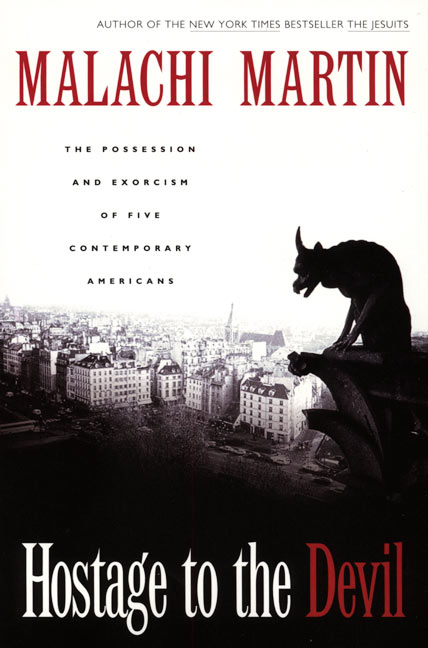
HostagetotheDevilA chance glimpse at a textbook shelf in a university bookstore made me aware of Malachi Martin’s Hostage to the Devil, although it is several years old. I was intrigued that a major, secular, state university would offer a course requiring a book about demonic possession. I’m not completely naive about college students, but this seemed just a tad extreme. Nothing is more dangerous than a book dangling in such a context, like the Necronomicon of Abdul Alhazred. The world of the demonic is freighted with arcane rules and a decided Catholic superiority. Even to the rational it can be insanely frightening. As I read Martin’s account, I frequently found myself puzzling over the unseen world he so meticulously describes—after all even the Bible has little to say about it. And Martin is a great lover of verbosity, detailing more than the reader needs to know about the five exorcisms he elaborates. If you want to know what a dying priest looks like, in great detail, you’ve come to the right place.

Perhaps the most jarring aspect of reading such a book is how such obviously intelligent people can come to such diametrically opposed worldviews while looking at the same evidence. Here was Malachi Martin, convinced that demons lurk about the world in great numbers. There is Richard Dawkins, convinced that we are nothing but particles and proteins walking around. Manhattan—the haunt of countless demons, or the febrile accident of firing synapses that means ultimately nothing? Although much of what Martin describes could probably be mental illness, one has the distinct impression Dawkins has never attended an exorcism. Both write with great authority and even greater conviction.

Hostage to the Devil is not an easy book to read. Martin’s style is smooth, like a novelist, but the length of his book keeps demons on your mind for a protracted period. Rationality can be worn down by attrition, and even the non-believer can be made to wonder. Would priests and their chosen attendants lie? Do the possessed really levitate, and contort, and cause objects to fly around the room in defiance of the physics so highly valued by atheists? For over 450 pages Martin will keep you wondering. You’ll also find out what an exorcist ate for his boyhood breakfast back in Ireland decades before facing the Prince of Darkness. Hostage to the Devil is a deeply disturbing book where the monsters we’ve all learned to shove deeply into the closet come springing back out. And the only effective help in the known world is the Catholic priest who happens to be an exorcist. And who can argue with that?


Whatever Happened to Whimsy?

American Gothic is one of my favorite paintings. I’ve never seen the original, and I know of no other paintings that Grant Wood produced, although I’m sure there are some. The mood in what has been called “the most famous American painting” is unsettled. There’s something not quite right here. When one of my authors wanted to use the image on a book cover, it led to quite a bit of serious discussion. I was a bit surprised by the negative impressions—not of the painting, but of its use on a serious academic book. The discussion seemed to turn on money rather than on wit and whimsy. I confess to being a dreamer, and I admit that the aspects of life that truly inspire me are never financial. When I crave wealth it is so that I might free up some time for creativity. That’s not the way business works.

Sometimes I feel a stranger in my own country. The unquestioned triumph of unbridled capitalism means that you can go from city to city to city and not really be able to tell much of a difference. If you want to buy a bit of tubing or a piece of wood, it’s Home Depot or Lowe’s for you. Office supplies—Office Max or Staples are your only choices. If you want to buy intelligent books, well, you’re just plumb out of luck unless you go to Amazon. The big financial corporations have won. Just admit it. Every time I visit my hometown I come away depressed at all the vacant stores and lost hopes of the small businesses that offered something just a little different. Something to tickle my fancy. Something to tempt me to wonder. Something with a tinge of American Gothic.

AmGoth

The messages we receive from every angle echo Madonna’s hit song, “Material Girl.” Only this includes all genders. Reductionistic materialism tells us that we’re just proteins walking. Mind is an illusion. Soul is a myth. I work a job where the money I’m paid is transferred electronically and if I want to see some of it in paper form I face a robotic ATM rather than a human face. I went to the mall last night and wept. Call it a mid-life crisis if you will. Say nostalgia has no place in a forward-looking society. I just want a few more options besides the plastic, the smart-chipped, and the sterile. The world needs more whimsy. Maybe that’s why I insisted on American Gothic on the cover of the first book I put under contract.


Sacred Gaze

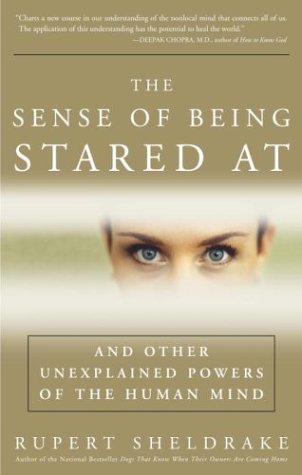
SenseofBeingStaredAt Rupert Sheldrake raises the ire of some of his fellow scientists. Science has increasingly allied itself with a strict kind of materialism, although, as Sheldrake repeatedly points out, evidence for such absolute materialism is lacking. This is not to challenge science, but simply to note that we may not yet have all of the data. The Sense of Being Stared At considers possible scientific explanations for unconventional situations we all experience from time to time. Who hasn’t felt eyes on them and turned around to find somebody looking? A number of other “impossible” scenarios also find their way into this intriguing book. Sheldrake suggests that such phenomena can start to be explained scientifically if we allow that the mind is not the same thing as the brain. Sure beats a Christmas party with B. F. Skinner, where every present is inevitable.

Materialism feels threatened when spooky action at a distance occurs. As Sheldrake points out, however, we are willing enough to accept it if an invisible “field,” one that we can’t even feel, is posited. Take magnetism, for example. Few people doubt that magnetism is a real force. We’ve never actually seen it, but its effects are clearly visible. Taking this as a starting point, Sheldrake suggests that various psi phenomena involve such fields. The scientific studies that have been undertaken on many of these “spooky” scenarios show statistically that chance may be safely ruled out. And, if the experience of many ordinary people counts for anything, even our pets and other animals may possess minds.

Ironically, the mind (with its taint of being associated with religious concepts such as the soul) is one of the most contentious phenomena in science. Many materialists deny its existence, suggesting it is merely some epiphenomenon of our brains’ electro-chemical processes. Yet these scientists still, one presumes, insist on being treated with respect and being paid for their work, although these mere trifles are just odds and sods clinging to the edges of a materialistic abyss. To me, work like that of Rupert Sheldrake is crucial for an honest assessment of the evidence. Maybe not everyone accepts that dogs know when their “owners” are coming home, and maybe Sheldrake’s morphic fields have yet to be confirmed, be it is clear, when all the evidence is considered, these phenomena do actually happen on occasion. Instead of simply dismissing something because it shouldn’t be, or can’t be, according to materialism, why do we find accepting the evidence so frightening? Is it perhaps the fear of being watched?


Curing Fundamentally

Despite the many problems with Richard Dawkins’ religious reasoning, he correctly notes that children are religious because they are taught to be. (That’s actually further than Dawkins is willing to go, since in The God Delusion he states that children are not religious at all, but are only claimed to be so by parents.) Belief is something that we are only beginning to understand, but it is clear that children are taught their religion, generally, by those who raise them. By the time most of us finish high school or college, however, we have learned that religion is limited to a relatively brief segment of our otherwise busy, secular lives. Over the years I have met many people whose religion I have studied in more depth than they, mainly because it was of little interest to them. God made no sudden appearances in their lives, the miraculous never occurred, and so life is business as usual. Religion was for Sunday morning (or whenever).

481px-PhrenologyPix

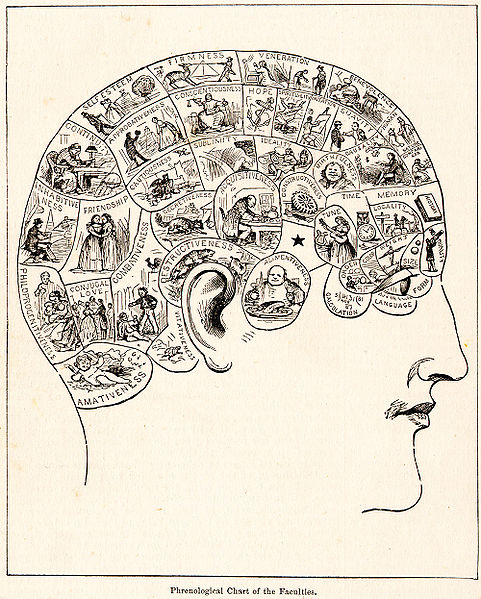
I was raised as a Fundamentalist. Although my readers may clearly see that I am no longer one, I do know that this bundle of neurons in my head has been made what it is, at least in part, because of that early training. Now a neuroscientist is suggesting that such thinking might be a curable mental illness. In an article in the Huffington Post, Kathleen Taylor, a neuroscientist at Oxford University, suggests fundamentalism may be a treatable disease. Looking over the secular headlines, there is no doubt that much of the misery in the world is caused by religious literalists acting out their fantasies in deadly ways. The suggestion that they might be treated for mental illness, however, raises profound—exceptionally profound—questions. Since I work in a city of millionaires and billionaires, I ponder how it is that extreme selfishness is not counted a mental illness. The desire of an individual to acquire far more wealth than one person can ever use seems to be an illness. Aesop might call it being a dog in the manger. No one is suggesting their brains be reprogrammed.

The even larger issue is who has the right to decide “the new normal.” Richard Dawkins may be correct that children reflect the religion of their parents, but as soon as adults declare what religion is acceptable we find other adults colonizing new continents, with the attendant misery that such migration entails. Where do we draw the line? If Fundamentalism programmed out, will Baptist neurons be allowed to remain? Methodist? Presbyterian? Mormon? The issue raised by Dawkins must be placed in context; if parents decide on a child’s beliefs do other adults have the right to decide on what is the correct belief? (Orthodoxy means precisely that.) Is a strict rationalist mentality what we want? A life without Hayden, Picasso, or Charlotte Brontë? What would Mr. Spock do? Will the real Randle Patrick McMurphy please stand up? Our rich fantasy lives are what make us human. If we are going to program out religious freedom perhaps the brave, new world is already here.


Super Stition

SuperstitionElijah is a folkloric character. Despite the common misperception, most of us who study religion know the difference between myth and reality. There are, nevertheless, lots of engaging traditions about Elijah. Even in our secular culture we joke about leaving a door open or an empty chair available for the disappearing prophet.

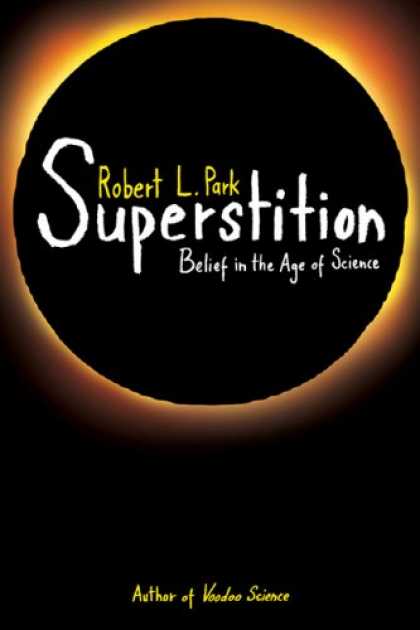
It is difficult not to like Robert L. Park. Reading his Superstition: Belief in the Age of Science was often a pleasure. I read Park’s Voodoo Science a few months back, and I enjoyed his supreme rationality very much. Many of the weird beliefs he decries clearly deserve his denunciatory treatment. Like many among the New Atheist movement, he believes that rationality, scientific thinking, will eventually displace religion completely. The final line of his book, “Science is the only way of knowing—everything else is just superstition,” however, maybe overlooking some vital information. In the first instance, scientists are humans too.

There’s no question that much of what Park writes makes perfectly good sense. The God of the gaps is gasping, indeed, dying. Double-blind prayer experiments just can’t work. Evolution does work. Quantum mechanics are abused by many New Agers. This all makes sense. There are, however, some gaps that rationality misses as well.

It has always bothered me that reality is much more than human senses reveal. Rationality is based on the premise that we have, or can discover, all the facts. There is an unseemly arrogance to it. We know, rationally, that “lower” animals experience sensory input unavailable to us. In many ways, Spot is more intelligent than his human “owner.” We use bloodhounds to find people for precisely that reason. We know that “bird brains” navigate in ways impossible for humans to emulate. Even a bee drunk with nectar can buzz its way home. And these are only the life forms that evolved on earth. Our rational knowledge is only a tiny fraction of all possible knowledge. And I’m not convinced that science is really the only way of knowing it. I just feel it in my gut. It’s a big universe out there, full of possibilities we haven’t yet encountered. Is the evolved human brain, limited as it is, the sole arbiter of reality? Is there some form of thought we have not yet reached? I will continue to enjoy reading books like Superstition. I will also, however, continue to leave the door open just a crack, in case Elijah does show up after all.


Inhumane Society

AnimalsMatter“I’m a member of PETA,” I’ve had more than one wag say, quoting bumper sticker wisdom as if it were profound, upon learning I’m a vegetarian. “People Eating Tasty Animals,” they then spell out with a smirk. I stopped eating animals at about the turn of the millennium, and since then I’ve discovered more and more reasons that it was the correct decision. I’ve just read Marc Bekoff’s Animals Matter: A Biologist Explains Why We Should Treat Animals with Compassion and Respect. It saddens me that in our world where nothing escapes being posted on Facebook, people still tend not to notice the suffering we impose upon animals as a matter of course. I’ve always been inclined to look closely at things, including animals. Watching them, it is clear that humans are indeed animals only differently evolved. Our mannerisms, our emotions, even our expressions, can be found among our animated kin. We share a planet on which we all evolved together, so why do we find it so easy to exploit other creatures?

One of the reasons Bekoff notes, without being judgmental, is that some religions inform us that people alone are special because we bear the image of God. Although God is supposed to be altruistic, we don’t wish to share that exalted status with any other species, apparently. Even in the twenty-first century many otherwise intelligent people still claim that animals feel no pain. Can’t reason. Are mere machines. We’ve been taught to distrust common sense that informs us that if an animal in distress acts like a human in distress that it experiences the same anxiety. The more we study animals the more human they become. The theology of Genesis has much for which it will be called to answer.

It seems, however, that the Bible is used as a mere excuse here. We exploit other animals because we can. We have taught bovines and ovines to trust us so that we may more easily slaughter them. Perhaps this is an exercise in divine image bearing, but somehow I doubt it. Reading Animals Matter in many ways felt like listening to a scientist who has taken the message of the Lorax to heart. We treat animals the way we do because we don’t understand their language, but we are morally obligated to speak for those who have no tongues. Although accessible to younger readers, Animals Matter is nevertheless a profoundly disturbing book. What does it say about the highly evolved when they exploit their relatives who’ve not learned the language of humans? Or, more accurately, who’ve not learned to vocalize like humans. Other animals speak, just like people sometimes, if we would only translate their actions into words.


Tell-Tale Hearts

StorytellingAnimal As a sometime dabbler in the fictional arts, I was intrigued by Jonathan Gottschall’s The Storytelling Animal: How Stories Make us Human. I read the book because of my own fascination with fiction—it is a transcendent activity to read it, but more so to write it. I‘ve always wondered why. Gottschall, a fellow academic making a living as an adjunct instructor, is a lucid writer and a great storyteller. His book opens with the unusual fact that even the most logical and rational of humans are addicted to stories. Our brains work to spin unrelated events into narratives. Even while we sleep, our minds continue to tell fictitious accounts of weird adventures. To be human, Gottschall clearly demonstrates, is to be in love with stories.

In chapter 6, “The Moral of the Story,” Gottschall turns his attention to religions. That far into his book it is no surprise that we find religions are largely based on story. Those who’ve studied mythology plainly see the story-ridden origins of religions. Religions, after all, have nothing if not great explanatory value. They tell the tales of why we’re here—the technical name is “etiology,” stories of origins, but also tales of what the gods, the tao, or the force demand of us. Believers often take such fanciful narratives literally, missing the point of it all, the proverbial moral of the story. The story is the moral. We find the deepest truths in fiction.

Many of my friends are fiction writers. Most have never been published or struggle to find representation. None simply give up. The draw of narrative is as palpable as the need to eat or sleep, as strong as the urge for sex or recognition. It is far stronger than the desire for money since nothing material can substitute for our desire for stories. After a busy day we send our children off to bed with a nighttime tale. Many of us climb into bed with a book—the more fictional the better—to end our conscious hours each day. We dream our way through the night and spend our long days fabricating a narrative we call “my life.” Those of us who indulge in fiction are sometimes solitary individuals, but we crave the awareness that we are not alone. Others too, as Gottschall clearly proves, are alone with us. In fact, all humans are gathered around this campfire of the storyteller. Thank you, fiction, for coming to the rescue.


Backyard Wisdom

From where I was sitting, the robin appeared to be asleep. It was an overcast and chilly spring morning, so I had to admit that I was a little envious. Our back yard is divided from the neighboring landlord’s property by a kind of picket fence with square-topped stanchions every ten feet or so. The robin was sleeping on the stanchion closest to an old maple tree. A wiggle of movement caught my eye. Further down the fence, maybe seven or eight pickets back, sat an impatient gray squirrel. It was sitting up on its haunches, and flashing its bushy tail in an obvious attempt to draw attention to itself. The robin sat, implacable. The squirrel looked around like a nervous commuter who will be late for work. It hoped a picket or two closer. Up on its haunches, looked around, jiggled its tail. Still the robin sat. The squirrel turned toward the maple tree and reared back, preparing to jump. It was too far. The squirrel turned back to look at the bird. The robin, flapping its wings a time or two, hopped into the air and landed on a picket two further down beyond the stanchion. The squirrel climbed onto the now vacant spot and leapt into the tree. The robin flew back to its original post.

This little exchange brought home to me once again the intelligence of animals. I don’t know what was going through the minds of these two different species, but they obviously both wanted to be at the same place at the same time. Perhaps some moral imperative passed in unspoken form between them. The squirrel needed to be close enough to make the leap into the tree, and the robin was clearly comfortable where it was sitting. Something had to give. I don’t know if robins peck on squirrels when nobody’s looking, but the rodent, larger than the bird, was obviously cautious. In the end, a compromise was reached and each ended up where they wanted to be.

More than a show of intelligence, I also saw this as a parable. I imagined how differently it might have worked out if the robin were a Christian and the squirrel a Muslim. Would there be any giving way? Any acknowledgement of the need of the other? A few wing flaps, a little leap to the left, and the squirrel found its sanctuary. The robin simply returned to where it was. They both wanted the same sacred space. They didn’t raise voices or argue—the whole exchange was terribly polite. Behavioral biologists often suggest that we can learn much by watching animals. As I watched what must have been only a minor incident in the backyard world of robins and squirrels, I felt as if two of the great teachers of our many religions were enacting a parable for humankind. If only we would pay attention.

IMG_0675


Shaman Shifting

Shapeshifting I confess that I haven’t read Confessions of an Economic Hitman. Being incurably drawn to the weird, however, I picked up a copy of John Perkins’ earlier book, Shape Shifting: Shamanic Techniques for Global and Personal Transformation at the recent Hunterdon County Library Book Sale. I also confess that I fear being classed as one of those irrational sorts who’ll believe anything. It’s pretty obvious to anyone who’s been to college or university that a Ph.D. is no protection from the strange ideas that waft through human gray matter. Many years of teaching convinced, I hope, at least a few of my students that I approach the study of religion in a reasonable—dare I suggest?—rational, way. Despite appearances to the contrary on this blog, I weigh evidence carefully. Sometimes the evidence suggests we don’t yet have all the data. So it was with an open mind, but also a dose of skepticism, that I read through Perkins’ book. And yes, he does suggest that cellular-level transformation is possible.

Before breaking out your hooey-meters, however, consider that John Perkins is a successful businessman. Money speaks, n’est-ce pas? So I’m reminded every rational working day. The human mind, however, plumbs realms on which empirical method sheds little light, even to this day. Psychologists still debate whether there is a subconscious mind at all. And then there’s that troubling question of what exactly reality is. Historically, people have answered such questions with religion. And religion quite often permits entry where science declares “no gods allowed.” So did John Perkins really transform into a ball of energy and float across both time and space and see such disturbing sights as he describes? Did Richard Bach really astro-project with his partner, as recounted in The Bridge Across Forever? Are we really rooted to this mundane world where politicians and entrepreneurs make all the rules?

Perkins recounts his experiences with shamans of the Amazon, and like Jeremy Narby, his experiences with ayahuasca, a consciousness-altering plant. He even recounts transforming into an “inanimate object” so that his wife could not see him. Is it real? Can science measure such events? Does anything escape the penetrating stare of the electron microscope? We will have our Richard Dawkinses on one hand declaring an unequivocal “No!” The other hand, however, may be generating the sound of clapping for those who have ears to hear. Or at least for those who have eyes to read. At the end of this book, truth comes down to a matter of belief.


Paging Dr. Asimov

Who remembers Rock ’em Sock ’em Robots? Plastic “robots” in the boxing ring trying to knock each other’s block’s off was a form of entertainment for kids of the ‘60s before such things as humanoid robots actually existed. So when Boston University’s alumni magazine had an article about dancing robots, I had to see what was up. As regular readers will know, I’ve been exploring some of the problems with reductionism lately. This idea, that humans and animals are just fleshy machines, breaks down when we try to design robots that can do some of the most basic of human activities. Sometimes we dance and we don’t know why. Apart from Wall-e’s dance with Eve, robots have trouble getting the concept. Graduate student John Baillieul notes that this isn’t about “some high school guy who had trouble getting a date, so you get a robot. The ultimate goal is to understand human reaction to gestures and how machines may react to gestures.” Having actually been a high school guy who never even got to the prom, I’m wondering how depressed our robots get when the fem-bots all look the other way.

Rockem Sockem

The reductionistic outlook suggests that we can eventually program robots to respond as humans would, responding fluidly to situations, allowing them to over-ride their “instinct,” which, the article implies, equals programming. We have no idea what instinct is. It is something all biological creatures have, from the heliotrope following the sun to the human dancing her heart out. Do we want machines to replicate our most intimate emotions? Even our most reliable chip-driven devices sometimes freeze up or rebel. My car has recently got the idea in its mechanistic brain that the right-hand side rearview mirror should be rotated as far to the right as possible. We bicker about this all the time when I get in to drive. Well, machines know best. They, after all, are the shape of the future.

So programming robots so that they can react in real time to non-verbal cues, like all sentient beings do, is a desideratum of our mechanistic Weltanschauung. Notes Rich Barlow, the article’s author, “bats, for example, camouflage their motions so that they can sneak up on insect prey, a fake-out familiar to anyone who’s tried to swat a pesky fly.” My question is who is the pesky fly in this robot-human scenario? Who acts irrationally and unpredictably? Isn’t our instinct to smash the fly a result of our annoyance at it landing, yet again, on our sandwich with its dirty feet? And what is that stupid dance that it does when it’s all over our food? Reductionism must, by definition, reduce instinct to the level of a kind of genetic programming. Even this aging blogger, however, knows what it is to dance without knowing why. He also knows what it feels like when your date goes home with somebody else, something to which he’s not convinced that we want robots calculating an “instinctual” response.


Campbell’s Swansong

InnerReachesofOuterSpace Joseph Campbell may not be the best reading for the bus. Despite the many signs and placards gently suggesting to passengers both in the Port Authority Bus Terminal, and on the buses themselves, that keeping quiet is courteous, we are a people in love with noise. We are used to annoying electronic beeps, squawks, and farts. People find it difficult to sit more than 20 minutes without talking. I’m trying to read. At the Hunterdon County Library Book Sale I picked up Joseph Campbell’s last book, The Inner Reaches of Outer Space. It requires some concentration. Campbell was a brilliant comparative mythologer. I was reared in the scholarly hermeneutics of doubt, however, especially when it comes to comparing myths from different cultures. Campbell has a great appreciation for Jungian concepts, and soon minor details are blurred and the similarities stand out in stark relief. Still, as I always do with Campbell, I came away with plenty of rich concepts over which to mull.

Campbell, the great inspirer of Star Wars, the original series, was that rare breed of scholar who appreciated without participating. He is recorded as stating he was no mystic, and certainly not any kind of conventional religionist, but he couldn’t get enough of mysticism or mythology. Religion, he implies, is just mythology taken literally. He is, I believe, very close to the truth here. What we know of indigenous peoples today is that they don’t have that sharp and hard line between literal reality and story that marks much of western civilization. We tend to think fact and fiction cannot be of a kind. Looking around, we find no gods, so our choices are not to believe, or to believe too literally. And those who believe literally differently, we tend to want to kill. This is the history of religion in the western world, in a Campbellian nutshell.

Apart from the little gems I located scattered throughout The Inner Reaches of Outer Space, the main theme I found applicable was the driving force of chapter two, Metaphor as Myth and Religion. Metaphor is our way of interacting with a reality we just can’t experience directly. As human beings, we experience the physical world through the mediation of our senses, filtered by our brains. If there is something deeper, more profound than nature, we are even further removed. Our experience of meaning is metaphor. Joseph Campbell may have been a little too swift to spot congruities that are probably best left apart, but he clearly recognized the fact that our religions are not so different from our mythologies, and that both are narrated in the form of metaphor. This is not to devalue them, for metaphor is one of the most potent substances in our chemistry set. Now if only I could find the vial that has the stuff to make people want to keep quiet on the bus, we might all be able to get a bit more reading done.


Dog-gone Belief

A recent book I read, I can’t remember precisely which one, suggested that one reason the average citizen has trouble with science is the fault of evolution. We evolved, at least some of us have, to rely on common sense. We trust appearances to intimate reality, and act accordingly. The problem is that science, almost in principio, informs us that things do not operate according to common sense, but according to laws that are inscrutable to most of us and involving math way beyond our limited ability. Even with a calculator. For example, the earth is spinning really, really fast and hurtling around the sun so quickly that I think I’m going to be sick. Really? Common sense tells me that I’m stationary, and my inner ear only gives me true peace when that is the case. QED, as my high school pre-calc teacher used to say. But it’s not the truth. We are spinning and jetting through space.

IMG

An article in Time magazine recently brought this disconnect home on a very poignant level. “The Mystery of Animal Grief,” by Jeffrey Kluger, explores the animal grieving process. Many species have been observed to react to the death of one of there own very much like humans do. Physical attitudes of bowed heads, actions that signal depression, and even rudimentary burials are all documented among animals. Some scientists disagree: reductionism declares that this is all appearance (like common sense), and if the professor on Gilligan’s Island taught us anything beyond building with coconuts and bamboo, it is that there is a rational explanation for everything. Animals grieving? It takes a human to do that. Well, actually, it takes a human to declare with such certainty that our animal cousins can’t feel like we do. Although our only current pet is a hermit crab—and perhaps many uninvited spiders—I grew up with dogs, cats, guinea pigs, and assorted other creatures. They express real affection. If they didn’t, I can’t think people would keep them.

I wondered, as I read Kluger’s article, when religion was going to come into the discussion. It wasn’t a long wait. Religion, he notes, is a human mechanism for coping with the finality of death. Dead is dead, after all. Animals can’t be religious, so they can’t experience the emotions we do. Or so science would mostly declare. I struggle with reality on a daily basis. My experience has taught me that things are not often what they seem, but sometimes my path lies in a direction diametrically opposed to that of Dr. Heisenberg. We are animals. Animals are part of our family. I’ve experienced people who show no emotion when their close associates are suffering. I’ve also experienced a dog that would cuddle up next to me and lick my face when I was sad, an encouraging look in his canine eyes. Animals are smart and empathetic. They have some understanding of death—it’s just common sense. I write this as I’m hurtling through space at 660,000 m.p.h. while spinning at a thousand miles an hour. If my reasoning seems suspect to you, consider the circumstances.