Beyond Science

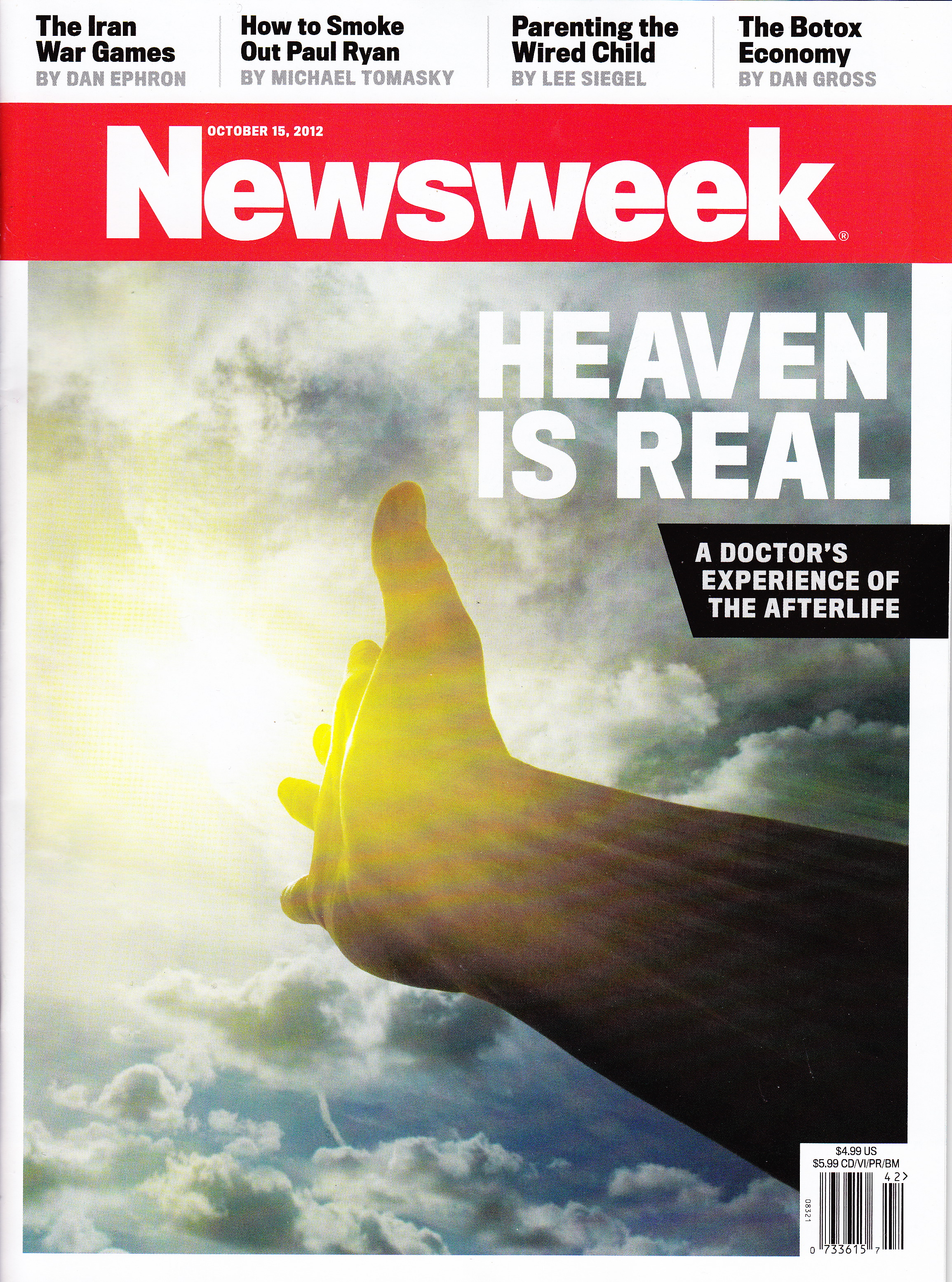
The nature of reality is not easily parsed. As a society we are still under the spell of rationalism, that wonderful left-brain system that seems to explain everything. Until we break down in tears and don’t know why. Like the proverbial chicken-and-egg, reductionists say it all comes down to electro-chemical reactions in the brain, to which non-reductionists reply “believe that if you want to.” Knowledge and belief, belief and knowledge. The truth is nobody knows. So when I see Heaven on the cover of Newsweek, I can’t resist wondering what’s inside. Dr. Eben Alexander, a Harvard-educated neurosurgeon, has just written a book called Proof of Heaven. In the Newsweek article he explains how during a week-long coma he had the most vivid experience of his life. While his brain was shut down. It might be more accurate to say he had the most vivid experience of his afterlife.

The classic debate for Near Death Experiences—so common they have their own acronym, NDEs—revolves around timing. Reductionists say the thought could have happened very, very quickly, just as the brain was shutting down. We all know how dreams can feel like they last far longer than we’re asleep, and how vivid they are. Those who accept the reality of an afterlife argue that many of the classic symptoms such as seeing your own body from above, or being able to describe in detail what was happening in another room at the time, count as evidence. It is the problem of the occasional phenomenon again. This is something no lab can measure, but it happens just often enough to make you wonder. The shaman might say, along with Inception, that the dream is the reality. That might explain why so much of “real life” is unpleasant.

As comfortable as the belief that reality is solid, material, quantifiable, may be, it does not count for the totality of human experience. Alexander’s heaven may not be the same as mine. Reality may not be one. Maybe Occam was wrong. Reading about shamans over the past couple of weeks, it became clear that some believe humans have more than one soul. (I can hear the reductionists rumbling—one soul is already too many!) Some cultures recognize as many as seven souls in a single individual. These, they suggest, account for the uncanny experiences of human life. Why do some people see ghosts and why are dreams so vivid and how does faith healing work? Reductionism calls them all illusions, tricks of the brain. Until his coma Dr. Alexander would have agreed. Now the newsstands suggest a different paradigm may be emerging. Dare we believe that the truth is out there?



Shaman on Us

My reading habits are unorthodox. I don’t follow a fixed plan, but hope for something that will keep me engaged for the fifteen or so hours I spend commuting each week. I began October with a book about werewolves and followed it up with a book on the Hmong. Apropos of neither and both, I turned next to Shamanism: An Introduction, by Margaret Stutley. While not the best organized book, it does provide a smorgasbord of shamanistic traditions, principally from Siberia, where Shamanism was first recognized. Before I’d finished, I’d read about both epilepsy and werewolves.

Shamanism is not a “religion” per se. There is little agreement among scholars about what a religion is at all. Shamanism is very much a local set of beliefs and practices that have only very basic elements in common (shamans being one of them). It is a good example, however, of how moral heathens can be. Shamans often accompany egalitarian societies who do not require governments and religious leaders telling them to be nice to each other. No, this is not the noble savage myth, but it is a clear indication that major religions are not required for morality. It evolves on its own. Often shamanism is not constrained by overly left-brain influence, and sees connections science can only deny. The plight of Lia Lee was explained here in a way physicians could access—epilepsy and other diseases are problems of the soul as much as the body—if only they read books about religion. Healing involves calling the soul back. Treatment of the body misses the point. And sometimes the dead become werewolves.

We live in a world where real suffering is caused by lack of understanding about religion. Assuming a cultural hegemony of Christianity, or Islam, and sometimes even other religions, we discount those who believe differently than we do. The New Atheists frequently overlook just how seriously people take the world of the emotions and belief. That realm is a large part of what makes us human and it plays by no logical rules. Nor does it care to. In a country, such as the United States, where money is believed to be the very warp and woof of the good life, shamans sometimes secretly cut the thread. Still, don’t ask universities to expand the study of something as insignificant as religion because all intelligent people know that nobody really believes that stuff any more.


Babel’s Gate

Up north past Edinburgh, beyond the Cairngorms, on the shores of the chill North Sea lies the village of Cromarty, Scotland. A death occurred in Cromarty, according to CNN earlier this week. And why would CNN be concerned with a single death in a small village in a remote corner of Scotland? Because with Bobby Hogg’s death, his language also died. Hogg was the last speaker of Cromarty. Having lived in Scotland for over three years, I heard many an impenetrable accent, but even as I strained to understand, I loved it. The loss of Cromarty is part of an on-going, world-wide extinction of languages. Sure, the big ones survive, thrive even. The small ones pass away, often forgotten. Those who unabashedly champion “progress” take no time to mourn the passing of the idiosyncratic, the individualistic, the non-conformist languages. Dominoes are easier to stand, after all, if they are all a uniform size and shape.

I taught Hebrew to my students for many years. Those who wish to be clergy should be able to read God in his original tongue, it stands to reason. As complaints began to simmer, as they always did, at the difficulty of learning a semitic language, I liked to remind students that a language is far more than a collection of vocabulary and a smattering of grammar and syntax. Languages are worldviews. We don’t know who invented language, but we do know that it evolves more rapidly than biology, once human populations are separated. As in the case of Cromarty, languages often reflect lifestyles—they preserve the words and phrases necessary for distinct ways of life. Automation, however, prefers one-size-fits-all. Those who can’t understand are less efficient players in the colonialization of the world by capitalism. Languages allow for diversity and specialization. Cromarty was the language of fishermen.

Yes, multiple languages reduce efficiency. You don’t have to read too far into your Bible to discover that. Yet even efficiency comes with a price. Year by year, the cacophony of human expression becomes more uniform. Yesterday there were a thousand languages, today only nine-hundred-ninety-nine. Yarns were spun in Cromarty, just as surely as they were in Hebrew. Young ears will never hear that ancient language, and with it a way of looking at the world also died. Yawn if you will, but if all the minor languages disappear the one remaining worldview will be all the poorer for it. Yiddish to Aari, languages reflect who we are—and Mr. Hogg’s passing is a loss to all humanity.

Do you hear what I hear?


Deadly Morass

Swamplandia! is a novel ensconced in the reality of death. It is one of those books that I knew I would need to read as soon as I heard about it.  Alligator wrestlers, ghosts, and even a biblical-sounding Leviathan theme park based on hellish imagery create an eerie, almost supernatural feel to the narrative.  At the same time, it is a very human story of loss, assimilation, growing up, and more loss that might be gain.  I’ve read many novels where the characters and events faded relatively rapidly after I closed the back cover.  The cast of Karen Russell’s Swamplandia! has stayed with me, wraith-like, for several days.  As I’ve tried to work out why the story sticks so close at hand, and I think it may be because so many of the characters—the entire protagonistic family—are outsiders.  The loss of the mother spirals a carefree, largely off-the-grid family in a Floridian swamp into a forced confrontation with the mainland.  In these times of economic hardship, the loss of a dream is something too many people can understand.  I certainly can.
 
Death, in whatever form it may appear, is a religious issue because it deals with ultimates.  Paul Tillich, a theologian of the last century, famously declared that God was that on which a person staked their ultimate concern.  For many people today, by this rough definition, death has become a kind of god.  In the ancient world s/he was literally so. Of course, death is entirely natural.  Consciousness is the factor that makes it seem foreboding and dreary.  Swamplandia! deftly ties death and love, hope, and a kind of diminished redemption together in a tale where a young girl travels through an unlikely underworld to rescue a sister who saved her own life by her doubt.  It may not be the most profound novel, but it is certainly a moody one.
 
On my campus visits I’m increasingly hearing that novels are favored by some instructors to get at deep truths that textbooks miss.  Indeed, the analytical urge is strong, but not omnipotent.  Sometimes the truth can best be experienced by letting yourself go and just feeling what is happening rather than thinking it through.  Swamplandia! does a bit of that. Thinking back over my own long, academic tenure, I realize that the teachers I enjoyed most were those who had me read what were, at the time, unexpected things. In a world where education has become nothing but job training to produce satisfied cogs in the corporate machine, death as a character in our own stories can’t be far from the truth. Sometimes even alligators and ghosts aren’t the scariest features of our non-fictional landscape.


Pipe Dreams

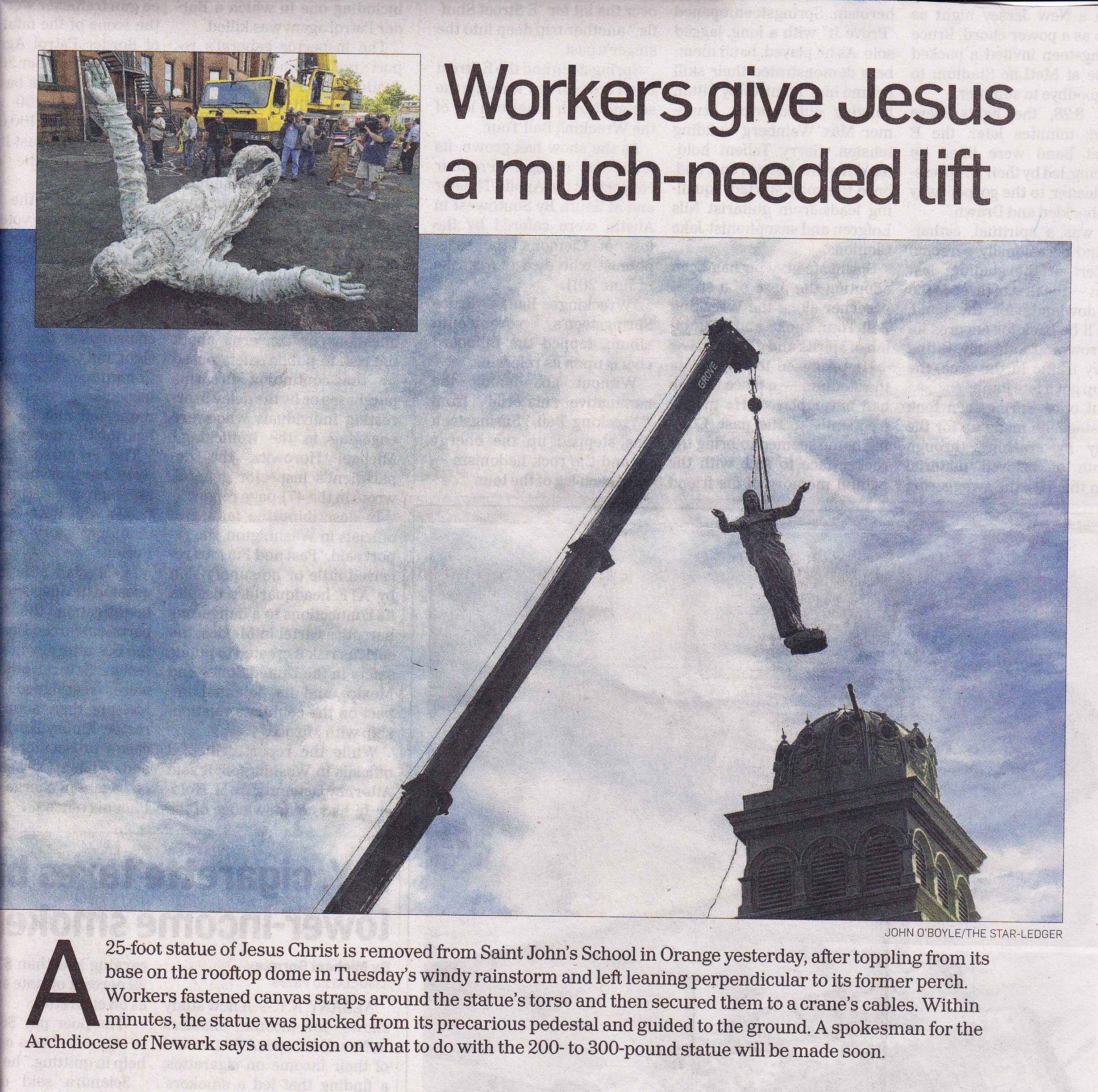
While I was off in Indiana, Jesus was coming down in New Jersey. Well, at least a graven image was. My wife saved the front page of Thursday’s New Jersey Star-Ledger that had a front-page, above the fold headline, “Workers give Jesus a much-needed lift.” The caption notes that in a gusty storm on Tuesday the 200-300 pound Jesus (this is America, after all) tumbled off his pedestal at Saint John’s School in Orange. A crane hoisting the fallen Lord dominates the first page. Clearly a bit of irony on a slow news day, the social commentary is thick indeed. Despite Magritte’s assertion, we still say the painting is a pipe. The representation is the object. This is the native logic behind the “idols” of old—to capture an image is to somehow to encompass some of the essence. This is precisely why the Hebrew Bible forbids images to be made.

I realize that “essence” is a disputed concept these days. Some scientists have declared that no such thing exists, along with souls, deities, and free will. Nevertheless, most mornings I wake up aware that I am me and not you, that my physical body is relatively near where I last remember it being, and that it faces the same hopes and limitations it did the day before and before and before. Perhaps this continuity is an illusion, but I can’t afford to treat it as such. It’s hard for an identity-less person to hold down a job. As usual, it is money that comes back to define us.

We recognize that it is disrespectful to mistreat representations of what we hold sacred. Does Jesus suffer any real harm for his image laid out on the ground? The nuance necessary to separate likeness from reality is something we obviously possess, but as we deal with the physical world the distinction frequently fades. Religion may have lost much of its explanatory value for the material world we inhabit, but images of a fallen savior demonstrate that we still operate otherwise. Much of our religious life concerns appearances. And for many people that step between appearances and reality is a very small step indeed.


Kermit’s Secret

When I was a post-graduate student in that Gothic city of Edinburgh, I decided to spend some time reading Umberto Eco’s Foucault’s Pendulum. It was intended as harmless entertainment, but as anyone who has read it knows, the story soon unravels into an unbelievable world of dark religions that haunt a naive protagonist. While I was reading it, a packet, hand-addressed to me, with no return address, came to my student mailbox. The contents consisted of several tracts, in German, warming of the dangers of Satanism. No letter, no explanation. Foucault’ s Pendulum had me paranoid already, and this strange package completely unnerved me. Well, I’m still here to tell the tale. While reading Victoria Nelson’s brilliant The Secret Life of Puppets, I learned that she had a strange episode while reading the same novel. It was an apt synchronicity.

Nelson is a scholar who should be more widely known. I found her because her recent Gothicka was prominently displayed in the Brown University bookstore in May. I saw it after taking a personal walking tour of H. P. Lovecraft sites. Synchronicity. I had read, in a completely unrelated selection just a couple of months ago, Jeffrey Kripal’s Authors of the Impossible. Synchronicity. For many years I have honed my Aristotelean sensibilities, following devotedly in the footsteps of science. Problem is, I have an open mind. It seems to me that to discount that which defies conventional explanation is dirty pool in the lounge of reality seekers. I have always been haunted by reality.

I’m not ready to give up on science. Not by a long shot. Like Nelson, however, I believe that there may be more than material in this vast universe we inhabit. Indeed, if the universe is infinite it is the ultimate unquantifiable. The Secret Life of Puppets is alive with possibility and anyone who has ever wondered how we’ve come to be such monolithic thinkers should indulge a little. For me it was a journey of discovery as aspects of my academic and personal interest, strictly compartmentalized, were brought together by an adept, literary mind. Religion and its development play key roles in the uncanny world of puppets. Those who wish to traverse the realms they inhabit would do well to take along a guide like Nelson who has spent some time getting into the puppets’ heads.


Believing is Seeing

A story has long circulated that as Christopher Columbus approached the coast of the “New World,” Native Americans staring out at the water—straight at his ships—could not see them. This instance of perceptual blindness has been adequately explained, of all places, in the Fortean Times. The best explanation: the natives could see the ships but did not have the referential framework to know what they observed at first. The story still circulates, however, that to them the ships were invisible. An interesting analogue arose when I was reading about Thomas Edison recently. The phonograph was first developed for speaking voices, not music. It was not an immediate success. One of the observations that Edison made also applied to the telephone: when people first heard it, not knowing what it was, they could hear voices but couldn’t make out what they were saying. Once it was explained to them what was going on—a voice had been recorded and was being played back, or a person’s voice was being carried over a distance through a wire—they immediately comprehended what they heard. Not exactly perceptual blindness, but very human indeed.

When people encounter something completely unexpected, surprising, they don’t quite know what to make of it. So we see anthropological pictures showing natives replicating airplanes from grass and twigs, ascribing to these strange birds some kind of divinity. Imagine an iPad in the hands of Moses. Neuroscientists are rather new to the coterie of specialists trying to explain the origins of religion, but a gap remains between perception and science. Active areas of the brain can be traced, but what the experiencer feels remains utterly subjective. It is a realm into which science cannot go. Perception, it is supposed, is simply an evolutionary tool to find food while avoiding being eaten, oh, and also to reproduce. The experience of the perceiver is much more profound. Consciousness, a sense of selfhood, why some are poor while few grow rich, these are facets of life that add dimension to perception and make me wonder just how far down the rabbit hole it goes.

Religion is all about perception. The problem is not that no one tells us how to interpret our experiences, but rather too many interpreters are only too eager to step forward. Perception, it is said, is reality. When encountering the unknown our best road-guide is our senses. In the case of religious phenomena, that guide is supplemented by tradition. What do you see when you look out on that horizon? The answer will indicate what you believe.

I saw three ships?


Goats and Sheep

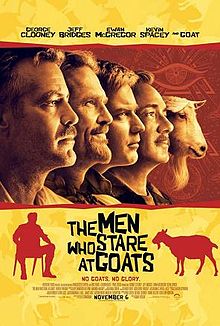
Having missed the movie, when I found a cheap copy of Jon Ronson’s The Men Who Stare at Goats, my curiosity was piqued. With such a title I had assumed it to be fiction, but, proverbially it turned into the truth stranger than. The book explores the weird world of the X-Files chestnut, the super-soldier. There is no doubt that despite science’s discomfort with the paranormal, government agencies have utilized psychics for some years now, hoping to gain some advantage over the other guy. Not everyone agrees on how effective such tactics are, but they exist nevertheless. The Men Who Stare at Goats (TMWSAG) provides a rare glimpse into that world where no one knows who is telling the truth (otherwise called “government”); we live in an era when truth has become negotiable.

One of the accidental recurring themes in my recent reading has been the horrendous abuse of power at Guantanamo Bay and Abu Ghraib. Far from placid eyes, the land of the free advocates torture to get prisoners to talk. After years of government bungling, it is no surprise that misguided efforts at torture on the part of a democracy would invariably be discovered. It would be easier to doubt that governments kept lethal secrets if they didn’t keep getting caught in flagrante delicto. Who can you trust when governments, ruled by gods of their own making—in their own image—preach the gospel of torture? TMWSAG weaves this sordid story in with 9-11, Uri Geller, Branch Davidians, Heaven’s Gate and Deuteronomy 18—what’s not to like?

I’ve been alive long enough to know that some supremely odd stuff goes down. TMWSAG provides a service in demonstrating that the government takes some of this mysterious reality seriously. It also shows the twin surfaces of resistance: religion and science. Science has a difficult time admitting what can’t be seen; with few exceptions psychic phenomena are considered not even worth the bother of a lab test. Religion, at least in its biblical, American incarnation, lumps all spooky stuff together with the devil, something Jon Ronson declares that even high-ranking generals in the military believe. So when I put this little book down I was left scratching my head. It may just be me, but where have all the sheep gone?


The Naked Vicar

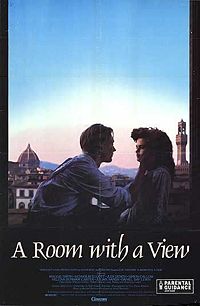
In a fit of nostalgia, for lack of a better excuse, I recently re-watched A Room With a View. I suspect I saw it with my wife near the time it first came out since I had trouble recalling having viewed any of it before. Until the skinny-dipping scene. Even then, it was unfamiliar until Mr. Beebe, the vicar, jumped into the pond. Now perhaps in the Victorian era same-sex cavorting was permitted for the young, far from repressed eyes, but it was the implications of seeing a priest in the nude that was particularly jarring. As Lucy Honeychurch comes primly along with her fiancé, she is scandalized to see the boy she truly loves unclothed, but the minister in similar state is a laughing matter, a novelty. In the light of the many church scandals that have become public knowledge since 1985, this particular scene has perhaps accrued additional, unintended freight.

Embodiment is a popular topic for theologies these days. I’m no theologian, but as a member of the human race I do participate in the embodiment question. Everyone from biologists to psychologists seems to be rethinking the implications of the soft machine. Some theorists are already preparing to leave behind their bodies to have their consciousness electronically preserved. Their new bodies may be robotic or simply virtual, but I suspect they will find the experience deeply disappointing. We are closer to the cockroach and the goldfish than we are to the disembodied divine. Our bodies are who we are, and embodiment analysis is the attempt to make sense of it all. At the same time, some neuroscientists are speculating that human brains work perhaps in closer concert than we generally suppose. We human beings are more like cells in a great organism that encompasses all of us. The Portuguese Man O’ War, which resembles a human brain in some respects, is a communal organism and not a single creature. The implications are worth considering.

Our rules for getting along with biological bodies include some pretty straightforward permissible behaviors. We don’t penetrate the body of another person without their express approval. They have to be competent enough to give valid approval. We don’t end the existence of another human being’s life unless they’ve been convicted of being exceptionally naughty and they live in the United States (the only “first world” country where the death penalty is still routinely carried out) or unless we are mentally unstable or emotionally overwrought and have easy access to firearms. Bodies are limited, and so are brains. Although, since I’ve upgraded my operating system I notice that my laptop has now claimed my name as its own identity—(if anything looks weird, please let me know!) In the Victorian era it was assumed that the brains of the clergy were attuned to higher things. The naked vicar accepts the good-natured laugh at his expense because he is no threat to either young ladies or young men. In the technological era we are more savvy and less carefree. And given the choice, the religious would prefer a room without a view, thank you.


Coexistence

Sometimes I think I’m a punching bag. Not uncommon among scholars of religion, I suppose. I have read my fair share of overt attacks on religion: Hitchens, Dawkins, and even Jillette, and sometimes limp out of the ring wondering why I even bother. Still, science doesn’t completely explain the universe I inhabit either. Thus is was with some glimmer of hope that I read a story in Monday’s Chronicle of Higher Education entitled “Does Religion Really Poison Everything?” There can be no doubt that religious behavior has a track record of some execrable atrocities—some very bad behavior has been engendered by fervent religious belief. At the same time, those who despise religion have a hard time explaining it. As the Chronicle piece points out, religion is likely an evolved trait. There is some survival value in it, otherwise it would, by natural selection, disappear. Religion is seldom a rational enterprise. That doesn’t mean that it can’t be rationally studied, but rather that religion is primarily experienced as an emotional phenomenon. We find ourselves motivated by feelings, although reason will often drive us to do things we don’t feel like (like going to work). And emotion is necessary to be truly human.

It is often difficult to respond to those who castigate religion as an evil or poison, not for lack of reason, but because of feelings. Having spent most of my life with religion, it is not surprising that attacks on it often leave me feeling ashamed. But ah, that is an emotional response! It seems rational on the surface, but really, shame and embarrassment are typical emotional responses. This is the realm of religion. Reason may indeed indicate with great accuracy the way the universe works—of this I have no doubts. At the same time, I’m not sure the entire universe is something that humans can adequately comprehend. I have a hard time remembering what’s on a short shopping list if I accidentally leave it at home. Our brains aren’t equipped to the task of comprehending universes. Feel overwhelmed when facing a physics test? That overwhelmed feeling is an emotional response. With considerable cheek, might I suggest it might even be a little bit religious?

The Chronicle is a high-profile source for academic rectitude. I am pleased to see Tom Bartlett pointing out that the line-drawing in the sand between religious Fundamentalists and pro-science New Atheists will not solve anything. Religion is often guilty as charged. It is not, however, pure evil. There is enough evidence out there to suggest that religion is a tremendous coping mechanism for billions of people. And coping is not a bad thing, all things considered. Wisdom that is often attributed to the Greeks suggests that “all things in moderation”—the golden mean as it’s known—is the way to human happiness and success. The idea is older than the Greeks, and indeed, can even be found in the Bible for those who are willing to look. One need not be religious to see that, like most human inventions, religion has both good and evil uses. Evolution gave us religion, and it gave us science. It also gave us brains divided down the middle and strong reasoning that must dance with creative emotion in a tango that frequently makes abrupt shifts of direction. Our job, as humans, is to learn the steps to the dance.

Different, but equal.


NDEs

I love science. Like many young boys, I was probably enticed to science through science fiction. While I didn’t follow science to a career, I used it to study religious texts. Those who’ve never undertaken the challenge of trying to figure out what something written thousands of years ago—on clay!—really says may be surprised to learn just how much science is involved. Nevertheless, as comforting as reductionism may be, something just doesn’t feel right about it. Science is how we explain and understand our world, and it does a spectacular job of it. The problem arises when science becomes what Stephen Jay Gould called a “magisterium.” Magisteria have all the answers. Yes, science explains how matter and energy work and interact, but it has yet to explain satisfactorily what it feels like. Most days I feel like the person I’ve become accustomed to show to the world. That person is very much like every other—being born, eating, breathing, dying. Medical science can explain most of it, but what about the parts it can’t?

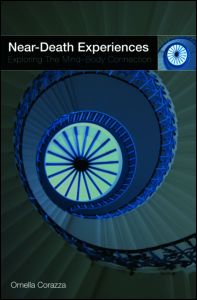
I just finished reading Ornella Corazza’s Near-Death Experiences: Exploring the Mind-Body Connection. I remember when the craze about this hit in 1981 with the release of the movie Life After Life. I was fascinated and terrified by it. Since a materialistic view of science dismisses anything that has the residue of spirits or souls, the phenomenon of the resuscitated dead reporting seeing their bodies from above, shooting through tunnels into the light, and sometimes meeting the dead (or God), were explained as last nano-second hallucinations as the brain prepared to shut down or reboot (upon resuscitation). That’s that. The answer, however, didn’t satisfy everyone. What about those cases where the dead person reported, in detail, what happened in other rooms, or things they couldn’t have seen in their own room, had they been conscious? Corazza takes these considerations seriously and tries to understand what may be going on. Obviously, her explorations will not convince a reductionist, but they may give pause to some of us.

What makes her approach so interesting is that Corazza takes into account an alternative way of looking at consciousness. While the facts of science are, by definition, universal, the contexts within which those facts are viewed are not. Having spent considerable time with Japanese scientists exploring consciousness, eastern ideas of the body inform her research. In the western world we have an easy familiarity with the Cartesian dualism of body and soul that does not fit into other worldviews. Corazza takes the interesting step of asking what if we apply an eastern paradigm of the body (one that understands soul as body, and not just in a materialistic sense) and apply it to the question of Near Death Experiences. The results are mind-stretching. I feel as if my consciousness got up from months of laziness and ran a marathon (or at least a 5-K). It’s a bit winded and parts of it are starting to ache a little. No reductionists need worry, however, because in that worldview none of this exists.


Danger de Nuit

I am on a boat—maybe it’s the Titanic. Far from land. For some reason, vaguely unclear, the ship is sinking. There’s panic—people are running and flailing, trying to save themselves. I’m frozen with terror as the icy water encroaches. I can’t swim. I prepare to die. So goes a nightmare I had several times in association with a former place of employment. Nashotah House felt traumatic to me with forced liturgies and daily reminders of my inferior status. The terror of the nightmares was very real, and the day I was fired did nothing to improve them. As a child I was plagued with phobias and frequently experienced horrific nightmares. They still come once in a while, but since I’ve left the employment of the church, they have become, gradually, less frequent. Nightmares are just dreams gone bad, and I’ve always been a dreamer.

Last month Time ran a story on nightmares. The subject of nightmares has now caught the attention of the military because of cases of Post-Traumatic Stress Disorder. When the military decides to show its humane side, it doesn’t fear backing it with big bucks. Soldiers confess to frequent nightmares after witnessing the atrocities of war. (One psychologist said that many at Nashotah House seemed to be suffering from a similar phenomenon.) Theorists now suggest that nightmares might lead to mental illness, and sleep deprivation, as we all know, can lead to bad judgment. Not a good thing on the battlefield. Or behind the wheel of a car. Or, in a recent real-life nightmare, while flying a jet.

In many ways nightmares seem like minor annoyances—they don’t physically hurt anyone, and they end when you wake. Time probably wouldn’t have reported on them if it hadn’t been for the military angle. This seems a paradigmatic situation. A common problem goes ignored until it affects the military, then it is deemed worth research funded by tax-payers. I am well acquainted with nightmares. As a child they became part of my identity. I am heartened that serious research is considered worthy of federal money. It seems, however, that perhaps a better way to end battle-induced nightmares would be to stop the horrors of warfare. When war ends, some nightmares will cease. Of course, I’ve always been a dreamer.

Is all that we see or seem
But a dream within a dream?
-Poe


Your Brain on Plastic

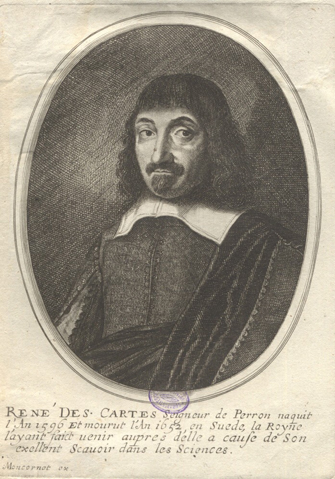
“Cogito ergo sum,” Descartes famously, and apparently erroneously, wrote. As technology races wildly ahead, those of us of biological origin are left feeling somewhat insignificant. An article in Monday’s Chronicle of Higher Education on “The Strange Neuroscience of Immortality” touches on many of the issues that are the very pulse of religion. Revolving around the theory of Dr. Ken Hayworth that a preserved brain, sealed in plastic instants before death, may in the future be thoroughly mapped and resurrected, Evan R. Goldstein explores the idea of immortality. Hayworth’s belief is that a thoroughly mapped brain, reconstructed artificially, would be the ego of cogito. The self. Despite all our advances in science, we don’t know what it is.

As Goldstein makes clear in his article, this transfer of consciousness and possibility of immortality is not mainstream science. In fact, most scientists rapidly distance themselves from it. Many cite the unscientific nature of the very enterprise, but I wonder if it might not have a more religious basis. Immortality is the ultimate of religious ideals. Christians generally recognize it as resurrection, and other monotheistic traditions offer a heaven after death (sometimes, to some people). Is that not all at stake here? If we manage to assure some kind of human immortality, have we not just robbed ourselves of heaven? Quite apart from the technological hurdles and uncertainties about what the self/mind/soul is, is not immortality what separates gods from humans?

The problem with gods is that they don’t get to go home at the end of the day. Would Heaven be so great if you just left another tough day in the universe full of sadness, violence, and pain? Hayworth suggests that a reconstructed brain placed in a mechanical body (robotic, probably) would have the potential of lasting forever. It will, however, be expensive. That means that only the very wealthy will be able to afford the procedure, if it ever works. Imagine that world: a planet full of immortal, wealthy entrepreneurs who can spend eons without sleep, trying to acquire yet more for themselves while knocking the competition on its metal rump. It really doesn’t sound like Heaven to me. But then, what would I know? To me cogito sounds like a snack food.


Gothic Religion

Every great once in a while, you run across a book that seems to have been written just for you. I’m cheap enough to wait for most books to be issued in paperback (and storage is getting to be an issue in our cozy apartment), but sometimes the urgency is too great and I can’t resist. In Providence a few weeks ago, I visited the university bookstore—one of my favorite places in town. On the new arrival table was Victoria Nelson’s Gothicka. For what seemed inexplicable reasons, I always found Gothic tales among my favorite growing up. Poe was a standard, but he was accompanied by other stories that elicited the same cocktail of sensations, accompanying a dark and mysterious atmosphere with a suggestion of menace. Transfixed by even the mere presence of this book, I knew I was in the power of a force to which I would eventually succumb. And, unexpectedly, the book helped to explain part of my childhood.

Not every book I read has to do with religion. Far from it. I expected Nelson to discuss literature and movies and culture—all of which she does—but not necessarily religion. The first three chapters proved a revelation in that regard. Nelson deftly explains how Gothic largely overlaps with the characteristics of religion, bringing the supernatural into human lives and insisting that we tremble before it. Perhaps best explained by pastor Rudolf Otto in The Idea of the Holy; the transcendent is something that terrifies as well as compels. In a culture where organized religion appears to be losing ground, Gothic offer the opportunity to tremble before the supernatural, and many people find it almost a religious experience. As becomes clear, the “almost” may appropriately be dropped.

Tracing the trajectory of my own reading interests, Nelson next provides an insightful chapter on H. P. Lovecraft. In many ways the initiator of worship of the dark divine, Lovecraft’s Cthulhu and kith and kin represent an undisguised secularization of deity. At the same time, the trembling is still very much present—indeed, it is a native part of the experience. Lovecraft, who was an atheist, understood the literary utility of gods. They frightened and haunted him with their very non-existence. That is power. Gothic acknowledges and embraces that power while never relinquishing its darkness. Nelson’s Gothicka holds the potential of a journey of self-discovery. As she ranges deeper and deeper into that world, the reader discovers just how much it is part of being human in a world tormented by fallen gods.


Lies, Damn Lies, and Statistics

“The fear of the Lord is the beginning of wisdom,” so the books of Psalms and Proverbs agree. It must be true. Religion and fear walk happily along hand-in-hand. Some have suggested that religion began as a human response to fear. So this week I felt a little conflicted as I read Daniel Gardner’s The Science of Fear: How the Culture of Fear Manipulates Your Brain. The book had been recommended to me by one of my brothers. As a child fear defined me—it seemed that in a world where God was meant to be feared (for I was a literalist) that fear was the basic operating system for life itself. Gardner’s book is a fascinating exposé of the culture of fear. Gardner doesn’t really suggest that fear should be eliminated, but he does show how many of those in power manipulate fear into a faulty perception of risk management, for their own advantage. Beginning with 9/11 he demonstrates how the irrational responses of people to the tragedy led to even more deaths that quickly became buried in the white noise of everyday society. Comparing Bush’s response to FDR’s “the only thing we have to fear is fear itself,” Gardner demonstrates that the United States emerged from the depression and Second World War weary but confident and strong. After Bush’s two terms, the country is cowering and weaker. Why? The Bush administration heavily mongered fear.

Funnily enough, the release from fear comes from two main sources: statistics and psychology. Statistics reveal the true odds of common fears—these can be inflated so as to create an atmosphere of threat. People, as herd animals, will gladly give more power to the alpha male when serious treat is perceived (don’t kid yourself, politicians have long known this). Psychology enters the scenario because people think with both reason and emotion. Our immediate, visceral response (the “gut reaction”) is instantaneous and powerful, developed from millennia of evolution. It is, however, irrational. Reasoned responses, often better for us, take longer and people do not like to force themselves to think hard. We have a whole educational system to prove that. Faced with hard thinking or quick solving, which do you prefer? Be honest now!

Ultimately The Science of Fear is an optimistic book. Being made aware of the problem is half the struggle. Garden-variety fear is fine. Systemic fear paralyzes. Religion is often defined as one of the building blocks of culture. Instead of offering release from fear, religions frequently add their own ingredients for recipes of even greater fear. The concept of Hell is a great example: think of the worse thing you possibly can. Multiply it by several orders of magnitude. Repeat. And repeat. You’re still not even close to how bad Hell is. There’s your motivation right there. Place that religion in the midst of a society rich with natural resources and led by schemers who know that xenophobia increases power, and voila! Paradise on earth for some, a life of fear for the rest. Manipulation characterizes both the evolution of religions and societies. Gardner doesn’t directly address the religious side, but that’s the beauty of reason: he doesn’t have to. The cycle can be broken; think of Mark Twain’s words I’ve selected as a title. Think hard.