Daniel in the Lyin’s Den

Yesterday I found myself. Online, that is. I was cited ambivalently as “some guy” in the Uncommon Descent blog comments, noting my Creationism’s White Box podcast. For those unfamiliar with Uncommon Descent, this is a blog hosting many posts by William Dembski, a leading creationist. Finding myself there, I instantly recalled that Daniel was never masticated in the lion’s den.

Not being one to judge without good cause, I read the critique with care. It read: “Some guy I read in the last few days here [link to my podcast] has suggested (to the approval of a few clerics) that creationism is an early 20th century phenomenon but all he’s really done is conflate creationism with the Creationist movement that grew out of, or was associated with, the publication of ‘The Fundamentals’.” Since academics like to split hairs (and even atoms), I thought I’d use today’s post to explain, in History 101 style, the problems with this assertion.

Creationism, like any other human enterprise, has a history. Christianity was born in a literalistic age, of sorts. Early Christians took the Hebrew Bible (pretty much The Bible in those days) literally. Belief in a flat earth and mythic beings still predominated the upper cortices of early brains too. My detractor could have been correct had the conflationism charges been laid at my door prior to the Enlightenment. The fact is that everyone born since the eighteenth century (academically speaking) has had access to science and the facts we’ve ascertained about our world. One of those sets of facts has had to do with evolution, and another with the history of the Bible. Interestingly, both of these sets of facts coincide perfectly: biological evolution took place and the Bible was a product of its environment. These truths have been available for centuries for any who would look at them.

The veracity of this statement is attested by the nearly universal acceptance of evolutionary theory by Christians in the western world in the late nineteenth century. Creationism, as such, did not exist at this time. It was in reaction to a number of social and theological factors that Creationism first hatched around the turn of the twentieth century. It was a new bird (I’ll avoid saying “hopeful monster”). Any claim that it was a default version of Christianity is strictly Retro — any such claim is tantamount to declaring that the Enlightenment never happened. I’m not a supporter of revisionist history, so I just can’t accept this flimsy construct. Fact is, Creationism is relatively new.

There is a great bibliography out there for anyone interested in getting the actual facts. Start with Ronald Number’s The Creationists: The Evolution of Scientific Creationism (University of California Press, 1992) and read on. Otherwise, feel free to believe in a flat earth — you can find good proof of this in central Illinois or Kansas.
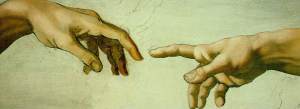

God-Adam! Is That What it Really Says?

GodAdam

While reading a recent article on the origins of the abstract art movement I was struck by this quote from Wassily Kandinsky, widely considered to have been one of the founders of the movement: “the contact between the acute angle of a triangle and a circle has no less effect than that of God’s finger touching Adam’s in Michelangelo.” Apart from putting me in mind of Edwin Abbott’s Flatland, this statement emphasized once again the power of one of Genesis’ creation stories. It also made me aware of a new dimension of the distressed pleas of Creationists for a reversal of science and a resetting of the hands of time itself. It seems that there is so much to lose.

Michelangelo’s Adam, as I always tell my students, has bestowed a disproportionate influence on all subsequent biblical interpretation. Rather like the case with Handel’s Messiah and Isaiah 9, modern readers find it exceptionally difficult to climb over Renaissance images to peer directly at the ancient sources themselves. Isaiah was writing about Hezekiah ben Ahaz rather than Jesus of Nazareth, but just try to convince any holiday shopper of the fact! Art has made the decision for us; there can be no questioning of Handel. Michelangelo was a brilliant painter, indeed, a genius by any stretch of artistic imagination, but he was no Bible scholar. Even if he had been, the tools available now were not available then.

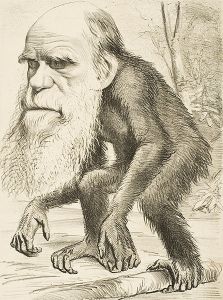
I sense that Creationists fear the loss of the literal image (if it can even be considered literal) of Michelangelo’s God and Adam. How threatening it is to ponder that God is not a bearded white man! What blasphemy to consider that instead of an insouciant Adam we have promiscuously procreating ape-like hominids hopping around!

One of my favorite movies has always been 2001: A Space Odyssey, Kubrick’s coming of age. The iconic monolith with early, distinctly apelike humans cavorting around it, timidly daring to touch it, to become something more — this abstraction felt like creation to me. Indeed, much of the film is abstract art. Creationists fear the demise of classical art; however, abstract artists do not destroy classical art, but rather build on it. It is humanity growing up. Like abstract art the biblical images leave much to the imagination. Is it better to remain firmly mired in what we know cannot be true or to allow human progression to continue? Even Wall-e reaches a mechanical hand out to the light (image copyrighted, all rights reserved).


Sex and the Single God

In my Ancient Near Eastern Religions class we have been discussing Egypt. Students have been giving their deity reports and have been shuffling their feet in an embarrassed way when they have to discuss some of the gods’ various sexual activities. I have to assure them that this is not “dirty talk” or pornography — it is simply a pre-Victorian way of looking at the world. Understanding of the mechanics of conception and fertilization, involving, as they do, microscopic gametes, has only fairly recently emerged. Ancient people knew that sex led to kids, but they didn’t know how. When you can’t explain it, pass it along to the gods and forget about it!

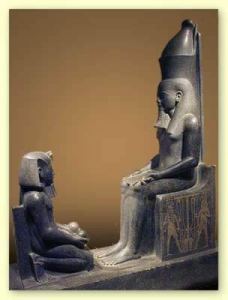
Ancient Egypt is often where this disjunction appears most clearly. Various gods in a constellation of creation myths (Atum, Ptah, with others probably standing in line) onanistically generated the matter that makes up either other gods who reproduce sexually or the very stuff of the universe itself. This explanation of the world was not profane or vulgar; indeed, it was the very sacred act that brought all of this into existence.

When we look judgmentally on earlier religions we are condemning our own ancestors. It has become abundantly clear in recent years that ancient religions freely borrowed from each other and developed their own distinctive traditions without wholesale rejection of the earlier cultures they knew. It has even been suggested the Psalm 8 might reflect this very form of creation as an echo in the Hebrew Bible! So instead of looking nervously at our feet, or trying to find a big stone to throw at the heathen while our eyes are down there, it is best to recall that religions grow out of unions and parturitions of other religions. Unless they are created single-handedly — and this is what originates the concern in the first place.

Atum teaches Horemheb the facts of life

Atum teaches Horemheb the facts of life


Noah’s Lark

This podcast deals with the myth of the great flood. It begins with a consideration of why modern expeditions do not find anything (nothing to be found), and considers the reasons the story is so appealing to present-day readers. The Sun Pictures productions on the flood story are reviewed, along with the story of the hoax played on Sun in their 1992 made-for-television movie. The history of the flood story is briefly narrated, beginning with George Smith’s 1872 discovery of the Mesopotamian flood story, back to Atrahasis and the Eridu Genesis from Sumer. The flood story is one of the earliest religious stories known.


Science Me This

I’ve just finished going over the creation and flood myths in Genesis 1–11 with my students. By my reckoning, this is about the twentieth time I’ve taken this journey. One comfort of walking a well-known trail is you know what to expect. The fact that always sticks in my mind is how good of a job the Creationists have done. In every setting where I have taught I have many students who unquestioningly accept that Genesis 1–11 was written as science by some kind of Mosaic mosaic of scientist, law-giver, and prophet, a regular Bronze Age Renaissance man. Since biblical scholars do not communicate well with the public (nor do they play nicely with each other), most students come into class wondering why the Creationist viewpoint is even under question.

I want to suggest something radical here: in our culture where science, technology, and finance are highly valued, we neglect to educate our kids in the basics of literary study. Schools push the technological envelope, and this is not a bad thing, but the kids come home and are shuffled off to church where the Bible is revered and a basic disconnect forms in their minds. A compartmentalized Bible, factually true, resides in one region of the cortex while in another scientific theory lurks. And when fact clashes with theory, fact always wins. They know they have to tell biology teachers that they understand evolution, they simply don’t believe it. They come to collegiate religion classes expecting Sunday School part 2.

Just this summer a grown man, Randall Price, director of Liberty Uni-, Univ-, University’s (sorry, I always choke on that one) Center for Judaic Studies once again made the weary trek to Mount Ararat to find Noah’s Ark. If he’d read Atrahasis or even Gilgamesh, he might have known he was looking in the wrong place. Nevertheless, he received coverage from a major news network (FOX, of course!), and those who never studied ancient mythology cheered him on. If we could teach children that the Bible is a literary document, teach them that it can be studied seriously, and that the Big Bang and “let there be light” are not the same thing, we might make some progress. Until then, we will have to contend with silly cartoons trumping hard-earned education.

Jack Chick has more publications than any Bible scholar

Jack Chick has more publications than any Bible scholar


Clergy Letter Project

A few years back I had the privilege of working at the same university as Dr. Michael Zimmerman, currently a biology professor at Butler University in Indianapolis. In my temporary stint as a Lecturer in the Religious Studies department at the University of Wisconsin Oshkosh, I discovered that Dr. Zimmerman, then the Dean of the College of Letters and Science, was the very man responsible for the Clergy Letter Project. I had read about the project before; in an attempt to demonstrate that Creationism is not mainstream Christianity (nor science, for that matter), the Clergy Letter Project was attempting to acquire a few thousand signatures from the ordained of various denominations who were willing to admit that evolution posed no threat to their religion.

As an occupational hazard of someone with my background, I know many, many clergy. I offered to solicit some help in reaching the goal on the list and spent the rest of the semester contacting various sacerdotal practitioners who rightfully saw the Creationist ploy for what it was and continues to be. Creationism is nothing short of an attempt to break through the church and state separation clause and attain federal support for a particular religious viewpoint. That particular viewpoint is not shared by the majority of informed Christians, but the population is easily swayed by Creationist rhetoric. Creationists do not deserve sympathy, for they are much more aggressive than they pretend to be. Subterfuge in the cause of truth is a contradiction in ethics.

Religion may be hardwired into human brains, but it need not seek to pick fights with factual truth as it is learned. At each stage along the progression of human achievement, various religious believers have felt that the new knowledge discovered confronted their faith with unsurpassable barriers. Faith, however, is a belief system, not a factual construct. If faith requires proof, as even the Bible itself says, it is not really faith at all. If you know any clergy who are willing to sign on for common sense and belief in the rational world in which we find ourselves, please send them this link and ask them to weigh in on the question. Nearly 12,000 clergy have signed to date. There are even separate lists for Rabbinical and Unitarian-Universalist clergy. Don’t worry about the Creationists. They will always be back for more.

An early Creationist attempt at intelligent design

An early Creationist attempt at intelligent design


Fundamentalist Foibles

Podcast 11 deals with the phenomenon of Fundamentalism, particularly biblical Fundamentalism, and its history. The podcast begins by setting the historical parameters, in the early part of the twentieth century, and considers some of the reasons that the movement may have begun. German biblical criticism, Darwin’s theory, and the First World War among them. A brief sketch of the movement is then offered, starting with the Niagara Bible Conference and the publication of The Fundamentals. The basic tenets of the belief system are summarized, again with suggestions as to why this may have been the case. A cautionary conclusion ends the presentation.


Intelligently Deceived

One of the most difficult things about the life of the academic gypsy is having tons of books. Literally tons. Having been cast from institution to institution in search of that mythical full-time teaching post, we’ve put books in storage and sometimes even forgotten that we’ve had them. So it was that when I was looking for a copy of Great Expectations for my daughter’s English class assignment, I was in the dusky attic, hoping the upstairs neighbors didn’t burst in on me, up to my armpits in boxes of books, that I rediscovered a treasure. Taking a leaf from Dr. Jim’s Thinking Shop, I decided I would review a few of the Creationist books I grew up with. Fortunately I had the presence of mind to keep them although I’d long dismissed their facile, often juvenile, point of view. They have provided great entertainment and even some poignant instruction in the ways of manipulating the minds of the young. Fear of Hell is a great motivating factor to a kid who sees ghosts in every corner and finds bats on his pillow!

So, without further ado, I present the top 5 creationist books of my youth. (Those that I purchased as an adult I bought from used bookstores so as not to add any royalties to the fundamentalists’ already bursting coffers.)

Textbook

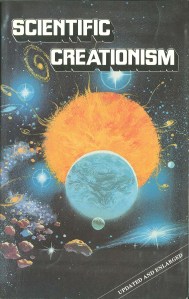
We’ll begin with the textbook. Scientific Creationism makes no pretense, such as the “Intelligent Design” school does, about being non-(necessarily-but-we-all-just-happen-to-be)Christian specific. Here Henry Morris begins with the assertion “the Bible and theistic religion have been effectively banned from [public school] curricula” and offers the present book as a corrective to the situation. A better title for the content, however, might have been Scientific Fiction.

GenFlood

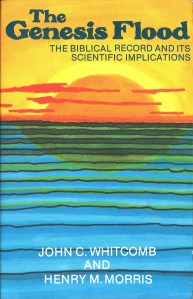
The work that really opened the flood-gates, so to speak, was The Genesis Flood. This craftsterpiece was penned by Henry Morris (again) and his compatriot John Whitcomb. Both proudly proclaiming themselves “doctors” they point out “evidence” designed to confuse the unsavvy into believing that there is a physical way the world could be entirely flooded. They even make room for dinosaurs on the ark, noting that they would have been juveniles of the various species. I’ve been in academics long enough to know that a Ph.D. does not guarantee credibility (or even sanity) on the part of the holder. The fact that Whitcomb’s doctorate is from Grace Theological Seminary ought to speak quite plainly as to its objectivity.

Gish

Written by Duane “the Fish” Gish, Evolution, the Fossils Say No! is an attempt to demonstrate that since not every single phase of the fossil record has been uncovered, the whole theory of evolution is in shambles. Gish, one of the few authentically scientifically credentialed Creationists, should have been able to see that his “back-and-fill” technique was going to fall on hard times as new fossil forms were discovered. As the fossil record grows more complete each year his book becomes more and more outdated.

EvolutionHS

Evolution and the High School Student terrified me in my delicate years. This booklet intimated that when I reached high school the unending assaults of the atheistic non-believers would be unrelenting. I feared for my very soul. Instead, in high school I found nose-picking, pocket-pool playing, and chalk-print-on-the-pants-seat teachers were among the openly committed Christians. Some even kept Bibles on their desks. (This was a public school.) The book lost its teeth.

GooZoo

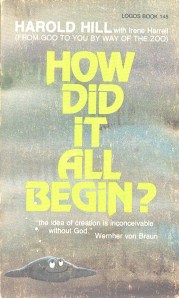
My personal favorite is How Did It All Begin? (or From Goo to You by Way of the Zoo) by Harold Hill (obviously when he was not out swindling River City, Iowa folk of their hard-earned cash to start a bogus boy’s band). This booklet, complete with cute, cartoon drawings, convinces grade-schoolers that evolution answers no questions at all. He had me going as a kid, until I got to the part where he claimed scientists had invented a machine that could indicate if you were “saved” or not. Even as a gullible child I couldn’t buy that.

The efforts of the Creationists are tireless. Even this brief survey of books that I happened to chance upon is nowhere near a comprehensive survey of what is out there. What it does serve to demonstrate is that all reasonable people should be wary. After all, even Jesus knew that a person in the wrong, if persistent enough, could convert even a hard-hearted judge.


Bible Land

Once upon a time I took a trip to visit a friend in West Virginia. I made the drive from New Jersey across parts of Pennsylvania and Maryland. Having grown up in Pennsylvania I never supposed it to be considered part of the “Bible Belt,” but it seems that some of the spillover may be making its way north of the Mason-Dixon line.

Interstate 78 has recently struck me as being highly evangelized. I saw a billboard reading “Blessed is the nation whose God is the Lord” and remarked at how out of context this verse was taken. Last time I checked, the Bible tended to be concerned with Israel, not the United States. Further along I saw a church near Bethel, PA called the Assembly of Yahweh. Not being aware that there was confusion as to who the God of the Israelites was, it amazed me to see that they have their own radio station called “The voice of the Assembly of Yahweh.” This struck me as a missed opportunity; the real message could have come through more clearly with “of the Assembly” left out. Yet further along was an ominous billboard from a local Mennonite Church that sounded eerily like Amos. “You Will Meet God” it announced.

Storm's a-comin'

Storm's a-comin'

As I entered Maryland the sales tactics intensified. In Frostburg there was God’s Ark of Safety Church where an actual replica of Noah’s Ark is being built right along Interstate 70/68. Since the steel frame is all that was currently finished, I was glad that it hadn’t recently been raining. Perhaps a more recent translation of the Bible has updated gopher wood to Bethel steel. Further along I spotted a lighthouse atop a hill over a hundred miles from the nearest substantial body of water. This was the World Lighthouse Worship Center. While visiting an actual lighthouse on Lake Superior a few years back the docent informed me that lighthouses were now considered superfluous with the advent of Global Positioning Systems. (Shhh — please don’t inform them that science has again trumped a quaint piece of folklore! I can imagine that the lighthouse may be useful when the new ark is completed.) Along route 219 in McHenry, MD I saw “A House of Love Gathering Place” that I just couldn’t dissociate from the B-52’s for some reason. Just about on the border to West Virginia was the Fresh Fire Church of God.

The United States is truly an impressive reservoir of biblicism. Perhaps university administrators who believe the study of religion isn’t worth the meager salary of an assistant professor should take a road trip. It would be a learning experience.