Fall Silent

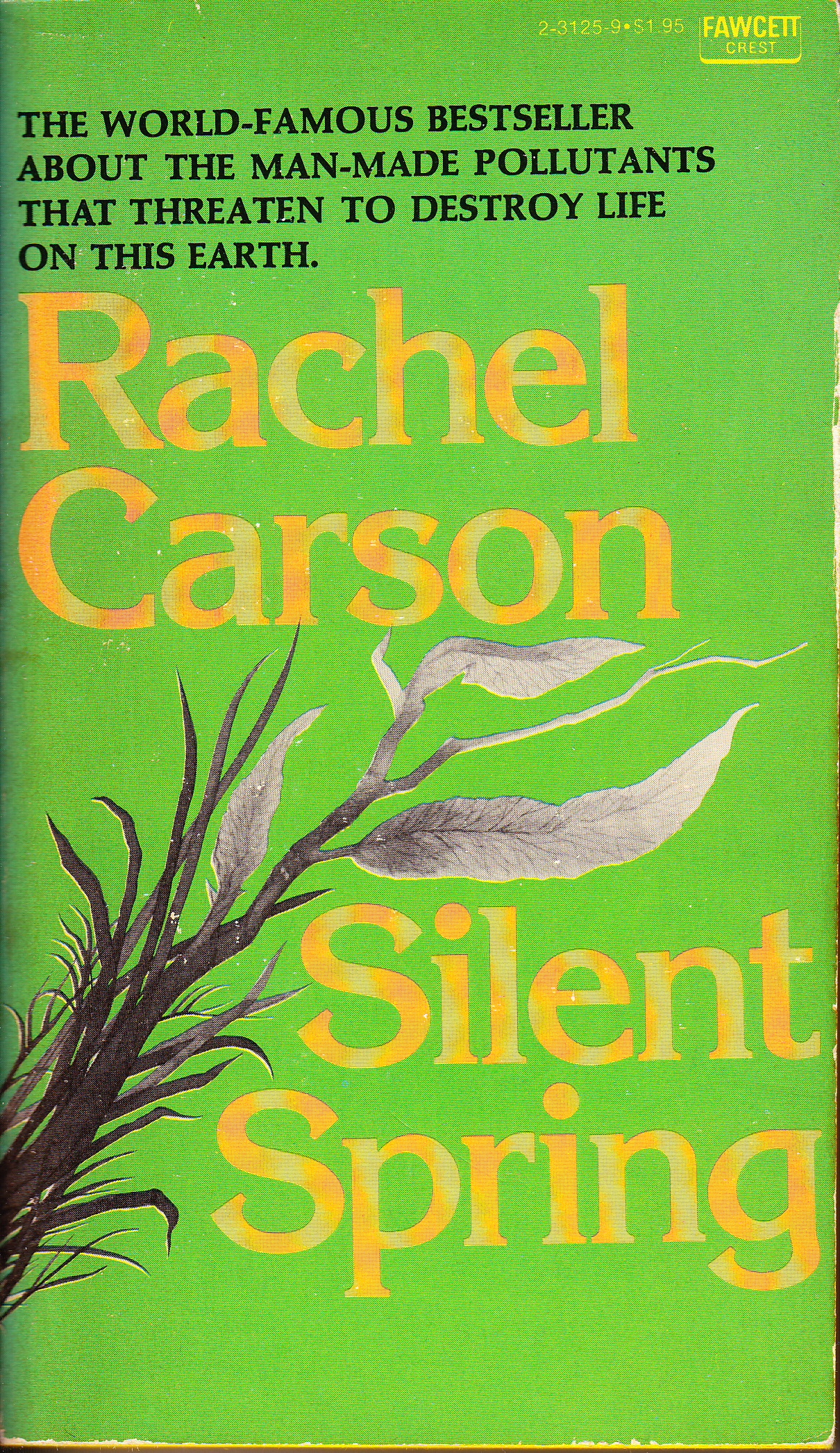
Some books impact an individual profoundly. Others are powerful enough to influence an entire society. Rachel Carson was the author of both. Tributes to the fifty year landmark of the publication of Silent Spring have appeared this month, and although the players have changed, the plot remains the same. Bryan Walsh’s tribute in Time a few weeks back captures the essence of the situation: an environmental danger is discovered, “industry” will at first deny it, then attack the science, and then try to frighten the population with the inevitable escalation of costs. Sometimes common sense wins, but only after a long tantrum by those whose main desire is personal enrichment.

Silent Spring is credited with starting the ecological movement. Until the early 1960s the world seemed vast enough to absorb our filthy, toxic run-off. We were only on the cusp of understanding that the world is much smaller than we had ever imagined. Disney had not yet published the theme song that would get through to the American imagination. We had yet to stand on the moon and look back at just how tiny our troubles were in an infinite universe. Using pseudo-religious backing, industries often claim the planet was made for us. In truth, we evolved to adapt to this planet. The sad story after sad story of those who’d figured out how to line their pockets at the expense of the health, and often the lives, of others constitutes an ignoble hall of shame. Rachel Carson, who truly deserves the title of prophet, was considered the enemy of progress. Better living through chemicals—who hasn’t heard the phrase?

The science behind DDT, which nearly drove the bald eagle to extinction, is not the culprit. The radium that rotted the teeth, mouths, and jaws of young women employed to paint it on watch hands, had always been radioactive. The coal still burning under Centralia suffers from properties properly discovered by science. In case after case we find greed running away with the science. Science unlocks the secrets of our universe, but it also gives ideas to those who are always looking to make a buck. It may be that Rachel Carson knew she was slinging stones at giants when Silent Spring was published. This one biblical metaphor might come in useful for those who are able to see the larger picture. We’ve only got one planet and if we want it to survive we’ve got to make it last. Giants should come to fear the disadvantaged who know how to use slings, whether with rocks or words.


The Future of Theological Education

It is almost like stepping into a time warp. To be honest, it is difficult for me to admit that I graduated from Boston University School of Theology a quarter of a century ago. Standing here outside 90-92 Bay State Road, where I once lived, is like looking into a shattered mirror. Behind those doors much of what made me who I am took place. Perhaps I left some of myself there. I don’t even know if the property is still the single student “dorm” for the school of theology or not. Kenmore Square has transmogrified from an area that felt like Times Square in the ’80’s to an upscale dogtown. When I stepped into 745 Commonwealth Avenue, it was like being hit in the face with a combination of nerve gas and roses. The hallways look wider now then they did back then. The hallways where so many of my assumptions curled up and died. They still have chapel and community lunches. The Boston Book Annex is closed.

Boston University has sure poured a lot of money into the Back Bay redevelopment. Whence that sense of personal offense when I see a multimillion dollar new building there and recall the financial aid interviews where I was told, like in a Bruce Springsteen song, “we’d like to help you out, but we just can’t”? Has social justice come to live in these halls? In those days anyone who didn’t have an oppressed status was a minority. And I learned as much about hate as I did about love within these implacable walls. Is it ghosts that I feel rushing through me as i walk down Bay State Road, and stare out over Storrow Drive? I’m not sure of the future of theological education. Until schools of theology can lay down their swords and become truly ecumenical, can any change truly occur?

Theology is an exercise in the unknown. When I donned my red robe and graduated here, the world seemed to be full of possibilities. A lot of erosion can take place in twenty-five years, you know. I thought I was contributing to the future of theological education when I studied the Bible so minutely that no single letter existed that didn’t have a prehistory deep in the realm of pre-Israelite society. I assumed that truth was the end goal of theological inquiry. Problem is, for many, the end goal was written two millennia ago and we of the lost generations ever since have as our task simply to reinforce the crumbling foundations and assure our benefactors that we did have it right, we have had it right, all along. As I write this a very able colleague at another seminary is undergoing what can only be considered heresy trials for teaching the truth. Is theological truth so fragile? Maybe this is why it has taken a quarter century to return. Maybe this is the future of theological education. Those of us who still believe in theological education seem to be a dying breed, along with the ghosts of Bay State Road.


Oil City Millionaires

Oil City Junior High School. Ninth grade. As a kid who grew up politically naive, Mr. Baker’s words felt like the Gospel. “People will never elect a president against their own economic interests,” he once said. Then came the Reagan years with “trickle down” bs, and, let’s be honest, the working class has been hurting ever since. Reading the political headlines, I’m frankly distressed that politicians no longer have any clear idea what working class life is like. Online I see working-class friends following, zombie-like, the richest man to ever run for President, daily proving Mr. Baker wrong. I’m not naive enough to think that most career politicians of either party know what it’s like to struggle for a living, but I have seen time and time again the Democratic Party trying to stretch out safety nets for those who receive no trickle down hand-outs. I do know what it is to struggle, and I do know that getting an education does not equate to getting a job. I also know that no Republican since Eisenhower has tried to be fair to the working class.

I grew up just outside Oil City, Pennsylvania. It was a town founded by potential millionaires because petroleum had been discovered in the region. Many get-rich-quick schemers settled these pleasant hills and valleys, but the oil pools were as shallow as a politician’s sympathy, and some of the towns in the region became ghost towns. The Oil City I knew was working class families, trying to get by; many grasping religion when politics never ceased to disappoint. We were children of Damocles. Somehow the message has morphed from when I was a child paying attention in school. The issue is now, “I’m not well off, but I sure as heck don’t want the government helping those worse off than me!” Trickle down indeed. To me it seems obvious why the wealthy skew “pro-life”—their schemes cannot succeed without a constant stream of desperate workers. Keep those kids coming!

Because as a child I read all the time, I knew there was a life outside Oil City. Paying my own way through college with crippling debts, I managed to get out and earn an advanced degree overseas, just to be fired by a Republican who thought my advocacy for fair treatment had no place in a seminary. Yes, I’ve felt the barbed lash of unemployment. I spent years wondering what might become of my small family as trickle-downs began defying gravity and wormed their way back up to the wealthy. I’ve never owned a house; none has ever trickled down to my income level. Those Oil City millionaires never gave me any handouts. But Oil City did give me an education. I learned to see through those who say they are protecting me and my future. The only thing they are protecting is securely tucked into their back pockets. I’ve seen their ads castigating Jimmy Carter, a president who is actually out there building houses for the poor. I’ve heard them blaming Obama for not filling in a trench that took Bush the Less eight years to dig. I say let’s just let trickle-down fill that hole. I’m sure the Oil City millionaires will be glad to kick in a greenback or two; after all no one ever votes against their own economic self-interest.

Trickle down.


Beyond Science

The nature of reality is not easily parsed. As a society we are still under the spell of rationalism, that wonderful left-brain system that seems to explain everything. Until we break down in tears and don’t know why. Like the proverbial chicken-and-egg, reductionists say it all comes down to electro-chemical reactions in the brain, to which non-reductionists reply “believe that if you want to.” Knowledge and belief, belief and knowledge. The truth is nobody knows. So when I see Heaven on the cover of Newsweek, I can’t resist wondering what’s inside. Dr. Eben Alexander, a Harvard-educated neurosurgeon, has just written a book called Proof of Heaven. In the Newsweek article he explains how during a week-long coma he had the most vivid experience of his life. While his brain was shut down. It might be more accurate to say he had the most vivid experience of his afterlife.

The classic debate for Near Death Experiences—so common they have their own acronym, NDEs—revolves around timing. Reductionists say the thought could have happened very, very quickly, just as the brain was shutting down. We all know how dreams can feel like they last far longer than we’re asleep, and how vivid they are. Those who accept the reality of an afterlife argue that many of the classic symptoms such as seeing your own body from above, or being able to describe in detail what was happening in another room at the time, count as evidence. It is the problem of the occasional phenomenon again. This is something no lab can measure, but it happens just often enough to make you wonder. The shaman might say, along with Inception, that the dream is the reality. That might explain why so much of “real life” is unpleasant.

As comfortable as the belief that reality is solid, material, quantifiable, may be, it does not count for the totality of human experience. Alexander’s heaven may not be the same as mine. Reality may not be one. Maybe Occam was wrong. Reading about shamans over the past couple of weeks, it became clear that some believe humans have more than one soul. (I can hear the reductionists rumbling—one soul is already too many!) Some cultures recognize as many as seven souls in a single individual. These, they suggest, account for the uncanny experiences of human life. Why do some people see ghosts and why are dreams so vivid and how does faith healing work? Reductionism calls them all illusions, tricks of the brain. Until his coma Dr. Alexander would have agreed. Now the newsstands suggest a different paradigm may be emerging. Dare we believe that the truth is out there?


Babel’s Gate

Up north past Edinburgh, beyond the Cairngorms, on the shores of the chill North Sea lies the village of Cromarty, Scotland. A death occurred in Cromarty, according to CNN earlier this week. And why would CNN be concerned with a single death in a small village in a remote corner of Scotland? Because with Bobby Hogg’s death, his language also died. Hogg was the last speaker of Cromarty. Having lived in Scotland for over three years, I heard many an impenetrable accent, but even as I strained to understand, I loved it. The loss of Cromarty is part of an on-going, world-wide extinction of languages. Sure, the big ones survive, thrive even. The small ones pass away, often forgotten. Those who unabashedly champion “progress” take no time to mourn the passing of the idiosyncratic, the individualistic, the non-conformist languages. Dominoes are easier to stand, after all, if they are all a uniform size and shape.

I taught Hebrew to my students for many years. Those who wish to be clergy should be able to read God in his original tongue, it stands to reason. As complaints began to simmer, as they always did, at the difficulty of learning a semitic language, I liked to remind students that a language is far more than a collection of vocabulary and a smattering of grammar and syntax. Languages are worldviews. We don’t know who invented language, but we do know that it evolves more rapidly than biology, once human populations are separated. As in the case of Cromarty, languages often reflect lifestyles—they preserve the words and phrases necessary for distinct ways of life. Automation, however, prefers one-size-fits-all. Those who can’t understand are less efficient players in the colonialization of the world by capitalism. Languages allow for diversity and specialization. Cromarty was the language of fishermen.

Yes, multiple languages reduce efficiency. You don’t have to read too far into your Bible to discover that. Yet even efficiency comes with a price. Year by year, the cacophony of human expression becomes more uniform. Yesterday there were a thousand languages, today only nine-hundred-ninety-nine. Yarns were spun in Cromarty, just as surely as they were in Hebrew. Young ears will never hear that ancient language, and with it a way of looking at the world also died. Yawn if you will, but if all the minor languages disappear the one remaining worldview will be all the poorer for it. Yiddish to Aari, languages reflect who we are—and Mr. Hogg’s passing is a loss to all humanity.

Do you hear what I hear?


Science Friction

What hath CERN to do with Jerusalem? It might seem that the House Committee on Science, Space and Technology would be a reasonable place to look for members of Congress with a grip on science. But then, I often live in a fantasy world where things make sense. It is with some sadness, but no real surprise, that I read about the words of Georgia Representative Paul Broun, lambasting evolution and the Big Bang as theories from the Devil. Broun is a medical doctor who, under conviction of his Fundamentalist faith, has rejected the basic tenets of science. According to the Associated Press, he told a Baptist church congregation, “All that stuff I was taught about evolution and embryology and Big Bang theory, all that is lies straight from the pit of hell. And it’s lies to try to keep me and all the folks who are taught that from understanding that they need a savior.” Sounds like Satan had a very busy pre-history.

Anyone who knows me knows that I begrudge no one their personal religious beliefs. Someone who does not believe in embryology, however, might have selected a career more commensurate with his religion than medicine. Election year does tend to bring out the shock value statements in politicians. Having to convince their constituencies that they are just simple folk, they deny what their faith belies every time they accept an inoculation. If evolution is a lie, so is vaccination—something most medical doctors would have to have understood before facing medical school examinations. In the United States, however, such wrong belief is a generally apt qualifier for Congress. Especially among the Tea Party. Broun hails from the ironically named Athens, Georgia.

Over the weekend I watched the Star Trek (original series—please, I’m a connoisseur) episode, “The Mark of Gideon.” It is one of the episodes I don’t recall from childhood, but then, with Kirk and all that “mushy stuff” of being alone on the Enterprise with a woman, well, maybe it just didn’t stick when I was in my tender years. In any case, the symbolically named Gideonites have overpopulated their planet to the point of disaster by good clean living. They attempt to hijack themselves a disease “inadvertently” to reintroduce population control. Captain Kirk asks why they don’t use safe methods of birth control, even volunteering the Enterprise to be a kind of inner-galactic condom-dispenser. The Gideonites explain that they believe all life is sacred, and that preventing life is a great crime—regardless of the misery it causes. I had to smile to myself. Sounds like the people of Gideon may have had been lectured by a Georgia medical doctor who had gone off on a peculiar flight of fancy.


Bart’s Gospel

One of the near constants of the entertainment world is the social commentary on The Simpsons. The morality issues that get frequent play had led to a book entitled The Gospel According to the Simpsons some years back. And since Americans like their morality straight from the popular media, The Simpsons is not a bad place to look. The episode “My-Pods and Boomsticks,” although a few years old now, raises issues that are still current in our culture. I watched it with my daughter recently and she commented, “It’s just like Zeitoun.” My family read Zeitoun this summer (some high school reading programs have a way of involving more than just the student) and the revelation of just how deeply suspicious the nation is of Muslims disturbed us all. This particular Simpsons episode involves a Muslim family from Jordan moving into Springfield. Although Bart befriends their son, Homer just can’t get over the assumption that Muslim equals terrorist. In the end, however, it is Homer who ends up dynamiting a bridge rather than believing Muslims can be good citizens.

Apart from being the longest running primetime animated feature in history, The Simpsons bucks the convention of veering away from religious topics. Indeed, many episodes foreground religion and feature Hinduism, Judaism, and Buddhism as well as Christianity and now Islam. The religions may be gently chided, but they are not mocked, and we are given a glimpse into our own religious biases. Islam, as a religion, is not evil or bent on destruction. Like Christianity, it has many varieties and believers range from the sacred to the profane. It is not the religion that is a problem, but the society that gives the lie to true equality. Believe what you will; harm no one.

At work the other day I received an office memo about lunchtime Yoga. Whenever I see such notices I consider how this religious practice, in American minds, has become completely secular. The same may be said of some of the martial arts which, in original contexts, have a deep base in eastern spiritualities. These things do not bother us because we do not bother to learn about them as religious activities. Even Kung Fu Panda has a spiritual undertone. Religions display a wide variety of expressions throughout the world. Going to church one day a week and condemning those who believe differently all seven, many people do not stop to think of the contributions that other religions have made to our society as it exists today. American culture, while predominantly evolving from a Christian base, has strong elements of most of the major religions that go unrecognized or packaged as secular self-helps. We could still stand to learn a thing or two from Springfield.


Dracula’s Dinosaur

It must be October when a dinosaur with a parrot’s head, porcupine quills, and fangs is announced. Yesterday’s issue of Time online featured a drawing of the creature and a nifty animation of reconstructing the aptly named Heterodontosaurus. Well, that’s actually the genus name. The species goes by the delightful name Pegomastax africanus. Last I checked, however, space on the ark was filling up. Dinosaurs create a unique embarrassment to Creationists. One suspects that if they didn’t have kids they’d dismiss dinosaurs all together, but the troublesome fossils just won’t go away. What’s more, although they’ve been extinct for 65 million years, they keep producing new species for us to recover, describe, and name. When I was growing up (and I have it on good authority that the argument is still used) Creationists told us that no transitional forms had ever been found. Therefore evolution simply could not have occurred. This was generally followed up by a reference to Genesis. Excuse me, a fanged porcupine-parrot? If that doesn’t count as a transition, what does?

Religion loses nothing by admitting to an ancient earth. Nothing but literalness. One of the joys of reading is the exploration of metaphors, similes, and hyperboles—writing delights us with its constant surprises. Even those who claim to read a text literally are engaging in a form of interpretation even earlier than the first wedge mark pushed into clay. Written texts give us something to ponder, to think about, and occasionally, to obey. Just when it looks like the cover has slammed shut on the black book we find a new set of dinosaur tracks running across our clay tablet. The literal-minded might not see these as being a message from God, but surely the endless variety of creatures that have walked this planet more than make up for it.

We used to have a pet parrot. His name was Archie, named after Archaeopteryx, the feathered dinosaur. Although Archie was cut off by disease in the prime of life, he was a curious bird and when I reached into his cage to try to get him on my finger he would dole out what he meant as a painful bite. I always took it as a sign of affection. Had our little friend had the fangs of Pegomastax africanus, I would’ve thought long and hard before risking the finger-perching trick. I like to think it would have reaffirmed my fascination with the amazing adaptability of nature. Evolution, unlike God, has no purpose. An endless tinkerer, it gives us thousands of differing dinosaurs that had been gone many, many millennia before Moses ever even thought of Noah. Pegomastax is safely extinct now, and the only ones who have to worry about this perfect Halloween dinosaur are those who think that one particular view of one particular book is the only way to find truth.

We still miss you, Archie.


Ban This

It should be a scarlet letter week. In honor of Banned Book Week, I’ve started to re-read Kurt Vonnegut’s Slaughterhouse-Five. Somehow I made it through high school and college without having been exposed to Vonnegut. A friend started me reading his works when I was about ready to start my Master’s degree, and I’ve always enjoyed coming back to him. When my daughter asked me why Slaughterhouse-Five had been placed on The List, I honestly couldn’t guess. Banning books, of course, is a scheme chiefly intended to keep children unexposed to ideas that adults find uncomfortable. We can’t go around telling other adults what not to think (although that hasn’t stopped many a religious tradition from trying), so some individuals figure that we can protect our unthinking young by putting in the corner literature that asks awkward questions. More radical conservative elements suggest destroying them. These are the true grapes of wrath.

Ideas can be wonderfully dangerous things. We now face a brave new world of internet access where ideas float lightly on the web and unless we watch our children constantly, we can’t control what they might see. Ideas as traditionally expressed in literature go through a tremendously long and convoluted birth process. We even use the language of conception to describe how they begin in one’s mind. Ideas implant, gestate, and grow. For the writer this might represent weeks, months, or years of writing, erasing, re-writing, and yes, parenting the idea. The written book has to meet the approval of publishers and only after yet another editing process are they pronounced fit to see the light of day as books. Having passed through many hands, many heads, such ideas become part of their culture. If we find them objectionable, well, isn’t that just part of life? Perhaps that is the largest message to be gleaned from the world of books: no one will be pleased with them all. Even the diary of a young girl will raise alarm.

Some of the finest literature to escape human minds has been challenged or banned. Ironically, in the land of the free and the home of the brave fear of books runs at a fever pitch seldom encountered elsewhere. Afraid of mice and men. What has made this country such a wonderful experiment—the embracing of diversity—has somehow morphed into a neighborhood where nobody feels safe if there are objectionable words on the bookshelf. Ironically Ray Bradbury’s critique of banning books, Fahrenheit 451, is itself a banned book. What most proponents of stopping literature probably don’t realize is that according to OCLC, the source for library data, the most banned book of all time is the Bible. To be honest, those who’ve read it know that it has sex and violence and many other adult situations. In the original languages there are even “swears.” Maybe it’s time people just grew up. The best way to accomplish that is to read a book. Hey, it’s a jungle out there.


Who’s Got the Keys?

Having grown up Protestant, I assumed that was normal. Adults, who have the benefit of years of negotiating with other adults in ways that may seem unsavory to children, have the definite advantage here. Children believe what their parents tell them, and should the matter come down to eternal life or everlasting damnation, you sure want them to have your back. Sunday’s New Jersey Star-Ledger has a perspective piece by Tom Moran, whose parents raised him Catholic. Catholics and Protestants are Christians divided by a common religion. As I have studied the teachings of each over the years, it has sometimes felt impossible to fit the two together in any meaningful way. They both think Jesus is cool, but beyond that, the disagreements almost immediately begin. Moran notes that in the US fewer than one in four adults identifies as Catholic although one in three was raised in that tradition. His article goes on to outline how Catholicism has frequently aligned itself with law at the sacrifice of compassion. Sounds like religion to me.

Religionists place great, perhaps even eternal, stock in being right. The Catholic Church has traditionally considered itself expert in issues of reproduction, a conceit that is only more bold when it is regulated by celibate men. And the source can’t really be the Bible since there are plenty of places where the good book is a little naughty. The biblical understanding of reproduction was a conclusively unscientific postulate. When microscopes, not telescopes, revealed what was going on at the microscopic level, theology should’ve blushed and excused itself from the room. Instead, the church proclaimed that it knew better than any bespectacled intellectual; after all, unwavering tradition must count for something. This bears the imprint of a system with little left but theological bluster. And it’s losing its thinking members.

Moran interviewed Newark Archbishop John Myers, a man concerned with the sanctity of marriage and who has a questionable record of reporting abuses, for his story. As Moran pointed out, Myers has not been the outspoken advocate of the poor, but he does back the candidate with sacred underwear. I’m not sure when the last time was that the good Archbishop took a drive around Newark. It is hardly a little piece of heaven on earth. Even waiting for a train in the station can fill a customer with a sense of despair. God’s will, apparently, is somewhat more narrowly focused on what consenting adults do behind closed doors. The level of disjunction is enough to throw the Popemobile out of alignment. Of course, I write all this from the sidelines. I was raised Protestant, and no matter what the Mormons or the Catholics say, I was taught from my youngest years that they’re just plain wrong.

Those are some big keys…


Watch, and Pray

Religion is a lucrative business. There is likely a deep, evolutionary urge for fair play nestled somewhere in primate DNA. Monkeys and apes seem concerned about it, and certainly nothing gets people more upset than a cheater who does prosper (unless he, less often she, is the protagonist of some gangster movie). Most of us work pretty hard to make a living, often doing tasks that push us beyond our comfort range in order to ensure some kind of success. The same is true of clergy. Yes, stories of lazy or lackadaisical ministers abound, but many work long hours under often stressful conditions. Most are not paid very well. Their eyes, according to unwritten writ, are turned toward a larger prize. In an economy that has become a nearly universal capitalism, everything has a price. People want to feel that they are pleasing God but there are oh so many rules and regulations! The Hebrew Bible alone has 613, and then add the Christian Scriptures and two millennia of ecclesiological dogmatism and you’ve got one hefty bill. We don’t mind paying a bit of that for a religious specialist to take care of the details while we get on with the real business of life.

Now add a little math. How many people does it take to add up to a small fortune? Already by the Middle Ages the Catholic Church, really the only show in town across Europe, had amassed a real treasury. Although individually the clergy could claim to own nothing, collectively they were flush. Even today the wealth (and therefore power) of the Vatican is nearly beyond comprehension. A colleague recently pointed me to a story I had missed back in April. This involved the computer age and lucre in an unexpected place. Russian Orthodox Patriarch Kirill I was photographed sitting at a high-gloss table, wearing a Breguet watch valued at $30,000. There was an outcry. The Russian Church, long under the pressure of a communist state, could hardly be described as opulent. Well, liturgical vestments and accouterments are expected to be costly, but personal items such as watches, are expected to be modest. Thirty-thousand dollars is a lot of money to be reminded of when to show up for mass.

In response, some church leaders turned to technology for a solution. The watch was Photoshopped out of the picture and, as if a miracle, the scandal disappeared! Except they forgot the glossy tabletop—the reflection of the watch, like Dorian Gray’s portrait, remained as evidence. (The story may be found here, along with the damning photos, if you can stand the snarky writing.) Owning such a watch may be considered bad form among the humble clergy, hiding it, however, is even worse. I don’t mean to single out Patriarch Kirill—the Russians have had a pretty rough go of it, what with Stalin and Reagan and all—but religions seldom like to have their coffers examined. The laity will pay handsomely to avoid the extra work salvation demands. Herein lies the rub: salvation has become less tangible as material wealth has expanded. Many people have mistaken one for the other. It’s just that they don’t want to get caught enjoying a little too much of the one at the expense of the other.

Now watch this, for time is fleeting


The King’s Bible

Thumbing through last week’s Time, I found a Bible. Actually, stories of religious interest appear frequently in Time, but this was one of those small blurbs of human interest. It appears that Elvis Presley’s Bible just sold for $94,600 in the UK. Of course, Elvis was known for his gospel recordings as well as his formative role in rock-n-roll. A boy from the south in those days would have known his Bible. What struck me as worthy of comment is the reason the artifact was priced so high—not because it is a religious book, or the putatively divine content, but because of who once owned it. The Bible is a common enough item—billions have been printed—and in our world of value based on rarity, it is hardly a specialty item. In fact, they are often given away.

We have all felt the draw of fame now and again. We wonder what the lives of the rich and famous are like. Sotheby’s and Christie’s thrive on people wanting to possess articles from their deceased heroes. Studies have been conducted to demonstrate just how much laundering devalues clothes worn by both the famous (bad) and infamous (good). In the case of a Bible, perhaps one is put in touch with the spiritual residue of the owner. According to Time, Presley scribbled many notes in his Bible. Perhaps there is some eternal message there? A message untainted by years of study. A message from Graceland.

The King (of kings?)

Elvis Presley was not acclaimed for his great intellect. He had a singing voice and swinging hips that changed an entire culture, but his was not the world of the library and study. Naturally it is the more flamboyant that capture the imagination of the largest numbers. I can imagine the (a) Bible of Rudolf Bultmann, Charles Briggs, or William F. Albright on the auction block. There would be a flurry among some scholars, for sure, perhaps to pool their money enough to make a bid some order of magnitude less than Presley’s sequined presence of the auction table demands. Probably it would not even be worth the effort of the auctioneer. After all, no matter what doggerel he might have scribbled in the margins, the King always outranks the mere pawns.


Pipe Dreams

While I was off in Indiana, Jesus was coming down in New Jersey. Well, at least a graven image was. My wife saved the front page of Thursday’s New Jersey Star-Ledger that had a front-page, above the fold headline, “Workers give Jesus a much-needed lift.” The caption notes that in a gusty storm on Tuesday the 200-300 pound Jesus (this is America, after all) tumbled off his pedestal at Saint John’s School in Orange. A crane hoisting the fallen Lord dominates the first page. Clearly a bit of irony on a slow news day, the social commentary is thick indeed. Despite Magritte’s assertion, we still say the painting is a pipe. The representation is the object. This is the native logic behind the “idols” of old—to capture an image is to somehow to encompass some of the essence. This is precisely why the Hebrew Bible forbids images to be made.

I realize that “essence” is a disputed concept these days. Some scientists have declared that no such thing exists, along with souls, deities, and free will. Nevertheless, most mornings I wake up aware that I am me and not you, that my physical body is relatively near where I last remember it being, and that it faces the same hopes and limitations it did the day before and before and before. Perhaps this continuity is an illusion, but I can’t afford to treat it as such. It’s hard for an identity-less person to hold down a job. As usual, it is money that comes back to define us.

We recognize that it is disrespectful to mistreat representations of what we hold sacred. Does Jesus suffer any real harm for his image laid out on the ground? The nuance necessary to separate likeness from reality is something we obviously possess, but as we deal with the physical world the distinction frequently fades. Religion may have lost much of its explanatory value for the material world we inhabit, but images of a fallen savior demonstrate that we still operate otherwise. Much of our religious life concerns appearances. And for many people that step between appearances and reality is a very small step indeed.


Whirling Spirits

A photograph and video of a “fire tornado” in Australia have been lighting up the web the last few days. Well, technically there is no such thing as a fire tornado, although that term serves perfectly well as a colloquial expression for the phenomenon. Having spent several years studying vortices for a project on weather language in the Bible, I came to know tornados particularly intimately. Dust devils, caused by surface heating, look and act like tornados, but a true tornado is cloud-based. The fire tornado is probably better termed a “fire whirl” or a “fire devil”—an expression that has a particularly ominous tone. Such vortices occur in wildfires in other parts of the world as well, and they are, obviously, very dangerous. When my wife pointed out the comments on this site (which also has a photograph and a link to the video), however, the implications for a blog on religion became clear.

One of the points I made in my weather work was that severe weather is almost always attributed to God. The comments on boingboing affirm that the concept retains its currency. Now, reading comments on most websites reveals just how juvenile the web readership generally is. On many sites the comments are so annoying that even Spongebob Squarepants would seem an intellectual heavyweight by comparison with the writers. Nevertheless on boingboing, by comment seven God had been brought into the conversation. In this instance, reference was aptly made to the movie The Ten Commandments, with others chiming in that nature here far outdid Cecil B. DeMille’s efforts at a realistic fire devil to represent God. The comments then move on to the guiding of the Israelites by a pillar of fire in the wilderness. Intermingled with the biblical references are meteorological comments attempting to classify the whirl a bit more precisely.

When something out of the ordinary occurs, our default seems to be God. This in no way discounts the scientific discussion for what is really going on. The religion and science comments simply talk past one another—they have the same referent, but entirely different levels of engagement with it. Although not the scientific names, “devils” and “tornados” represent different, if visually similar, phenomena. Vortices seem natural on a round planet that follows a round orbit while rotating swiftly on its axis, and yet they remain comparatively rare. The name “dust devil” probably goes back to indigenous traditions associating the whirls with ghosts or spirits. For Christians encountering these concepts, heathen gods were devils (as is evident in the name Devil’s Lake, Wisconsin, named “Spirit Lake” by the Native Americans. The same applies to Devil’s Lake, North Dakota, but I haven’t been there.) It seems to me that these vortices neatly summarize religious sensibilities: an awe-inspiring event is one culture’s deity, another culture’s devil, and a third culture’s natural phenomenon empirically explained.

A real tornado


A Cougar’s Mother

While on a stroll between appointments at Indiana University in Bloomington, I came across a tree with flowers laid underneath and a memorial plaque at its base. I glimpsed the name Mellencamp, and for a fan of rock, it didn’t take much imagination to tie it to John Cougar. Indeed, the memorial is dedicated to his mother, an artist, who died earlier this year. I first came to know of Indiana University because of music. I married a musician who, like myself, had to sacrifice a career doing what she loved in order to “get by.” Although she hadn’t studied at Indiana, my wife knew the reputation of the campus well. At a sunny moment between appointments I sat outside one of the music buildings listening to students practice through the open windows and read about Marilyn Mellencamp. An article in a local paper explains that this week an exhibition of her art is on display in Bloomington. When I read the quote from Waldron Arts Center Gallery Director Julie Roberts that the arts “are viable ways to make a living and they are vital part of being a happy and alive person,” I felt a renewed sense of hope. There are others, it is clear, who see that the arts are called the humanities for a reason. In a culture where only money matters, there is no culture. Think about it.

Since the industrial revolution we’ve been told that the measure of a human is how much money they are able to make. Something profound has been lost since then as great universities cut programs for the arts and humanities while business departments build new facilities. Talk about gaining the world but losing your soul—business cattily replies, “I have no soul.” While John Mellencamp never rivaled the biggest bands for income, his work, particularly Scarecrow, is full of human empathy. I listened to that album over and over in 1985, recounting the farm crisis and the demise of those not driven by corporate greed. And looking at this maple tree I wonder when the last time was that someone honestly mourned the death of a corporate mogul.

It is the mark of a deeply schizophrenic society that we all aspire to what fails to inspire. Our economy is driven by the material—money—and not that which speaks profoundly to what it means to be a human being. We keep the arts alive because the wealthy require something worthwhile upon which to spend their lucre. Is not buying art buying part of another person’s soul? We can’t define souls materially, science must conclude they don’t exist, but every time you say, “I feel happy/fulfilled/satisfied” you belie the facts. Souls may not be material, and they may never be found in laboratories. They are nevertheless part of the human constitution, and I for one, would lay a flower under a tree and know that it is more than just fertilizer for the next growing commodity.