Admit This

I thought about writing a letter to the New York Times, but I know my chances of getting it accepted.  A piece run yesterday in said periodical on elite college admissions policies, which favor the affluent, presented an argument frequently used in defense: high-performing colleges are faced with the problem that the highest achieving students are affluent.  I’m here to call shenanigans on that.  I don’t often state explicitly what my background is here on this blog, knowing as I do that I had white privilege on my side, but this admissions reasoning is elitist to the hilt.  I grew up in a poverty-level household and yet when I reached college it was only to have professor after professor marvel at how well I did in their classes.  My GPA at graduation was 3.85, partially brought down by “freshman orientation” and senior ennui.  After graduating summa cum laude, I graduated seminary magna cum laude.  My doctorate was with a major European research university that didn’t use the cum laude system.

In short, a guy from a non-affluent background can succeed academically.  Professors who think otherwise don’t know what they might be missing.  There is a bias against the poor that assumes that intelligence is bred, not an innate ability.  My academic track-record demonstrates that this bias has no expiration date.  Despite my record of achievement, I was routinely passed over for positions at universities and colleges, many of them elite.  I used to keep my rejection letters but the file was getting pretty heavy to lift.  An academic unknown, I didn’t have connections in “the club” and was asked to check my working-class abilities at the door.  I’ll confess when I see such reasoning as “we can’t afford to take chances on the poor” my blood begins to boil.

Some of the smartest people I know never attended college.  Even as a child I could tell if someone was capable of deep thought or not.  I didn’t know many college-educated people; my social circle was among blue collars.  Clergy were the few exceptions, and not all of them had attended college.  Nevertheless, I could see what admissions committees (I used to serve on one) call “special intelligence.”  I also saw how terribly petty the discussions could be when it came to admissions.  Try as I might, I just can’t feel sorry for those in higher education who feel trapped by their own success.  There are gems located in mountains, even if they tend to be buried under tons of plain rock.  Admission teams admit those most like themselves.  Thus it has always been.  And we are poorer as a society because of it.

Not singling out UVA!

Who Are We?

I wonder who I am.  Beyond my usual existential angst, I tried to access some online learning modules at work only to have so many barriers thrown up that I couldn’t log in.  Largely it’s because I have an online presence (be it ever so humble) outside of work.  Verification software wants to send codes to my personal email and my company has a policy against running personal emails on work computers.  Then they want to send a phone verification, but I don’t have a work cell.  I don’t need one and I have no desire to carry around two all the time because I barely use the one I have.  By the way, my cell does seem to recognize me most of the time, so maybe I should ask it who I am.

Frustrated at the learning module, I remembered that we’d been asked to explore ChatGPT for possible work applications.  I’d never used it before so I had to sign up.  I shortly ran into the very same issue.  I can’t verify through my personal phone and I found myself in the ironic position of having an artificial intelligence asking me to verify that I was human!  I know ChatGPT is not, but I do suspect it might be a politician, given all the red tape it so liberally used to get me to sign in.  Not that I plan to use it much—I was simply trying to do what a higher-up at work had asked me to do.  So now my work computer seems to doubt my identity.  I don’t doubt its—I can recognize the feel of its keyboard even in the dark.  And the way my right hand gets too hot from the battery on sweltering summer days.  It’s an unequal relationship.

My personal computer, which isn’t as paranoid as the work computer, seems to accept me for who I say I am.  I try to keep passwords secure and complex.  I have regular habits—at least most days.  I should be a compatible user.  I don’t want ChatGPT on my personal space, however, since I’m not sure I trust it.  I did try to log into the learning module on my laptop but it couldn’t be verified by the work server (because the computer’s mine, I expect).  Oh well, I didn’t really feel like chatting anyway.  But I did end the day with a computer-induced identity crisis.  If you know who I am, please let me know in the comments.  (You’ll have to authenticate with WordPress first, however.)


Release the Wicker

One of the many fascinating things about The Wicker Man is that even its release date can cause confusion.  There should be nothing so simple as to look up when a movie first hit theaters, but especially in trans-Atlanic efforts the dates are often different between the UK and the US.  The Wicker Man had a limited UK release on June 21 (quite close to Midsummer, it turns out) of this year.  It’d been released before, of course.  The initial UK release date was December 6, 1973 (twenty days before the US release date of The Exorcist).  Making its way to the US, it was first released on May 15, 1974—not long after May Day.  One of the features of the curious history of the movie is that it lacked support from its own studio.  Not surprisingly, it performed better overseas, particularly in America.

Release dates can be important, and can make a difference in a film’s success.  Again, the quirkiness of The Wicker Man reveals this—although set in late April-early May, it was filmed in November.  Actors had to suck on ice chips to prevent their breath from being visible.  And who’s thinking about May Day when getting ready for Christmas?  All of these factors swirl around in a mythology that the movie has developed.  My book went to the printer yesterday.  It should be out in August-September, hopefully in time to catch the interest of those who’ve gone to see it in theaters again.  I’ve lost track of how many times I’ve seen it.  I’ve watched all three released versions.  It feels like an old friend.

From the beginning, the plan was to release my book this year, due to the fiftieth anniversary of the movie.  It’s funny how simply surviving half a century can make something interesting to people.  There are plenty of 1973 movies that aren’t getting any particular boost this year.  The thing about The Wicker Man is that it became a cult classic.  Although it was never a mainstream hit, it has sent out its tentacles far and wide.  I notice references to it is unexpected places.  If you’re attuned to this you say to yourself, “that movie really made an impact.”  And it did.  When I first pitched this book idea to the editor of Auteur, I told him I’d do whatever I could to make a 2023 release.  Of course, I started writing it before Nightmares with the Bible came out.  My next book after the Wicker Man doesn’t have an anniversary release in mind.  That’s good, because like a moon-shot it’s nerve-racking to aim for such a narrow target, years in advance.


Parthenogenesis

It’s only a matter of degree, isn’t it?  I mean between reptiles and mammals.  While our common ancestor was quite a bit older than Lucy, we’re still fam, right?  I’m not the only one, I’m sure, who read with interest the New York Times story about the female crocodile who recently gave birth without the help of a male.  It’s called parthenogenesis and, according to the article, it’s not as rare as we might think.  Birds and amphibians do it.  Some fish even change gender under reproductive pressure.  And if you’ve seen Jurassic Park you know the implications might be larger by an order of magnitude or two.  My mind, however, wanders to mammals.  Then primates.  Then humans.  If our distant cladistic cousins can do it, can we?

The key appears to be males leaving females alone long enough.  As Malcolm says, “life will find a way.”  Life amazes me.  While we can’t count on it happening for each individual, life has a way of reemerging when you think it’s gone.  Previous owners of our house neglected a green ash tree growing in a location far too close to the house itself for many years.  Granted, it was on the north side where you seldom have any reason to go, but that tree sent out progeny that I’ve had to try to eradicate for five years now.  As much as I love trees, when they’re growing into the foundations of your house, they’re a bit of a problem.  I snip off the water shoots whenever I find them but they keep coming back.  I’m sad to cut them but I admire their persistence.  Life’s persistence. It’s will to carry on.  It continues even when we think it can’t.  Never forget the water bears!

Just a few days later the Times ran an article about the strong possibility of life on Enceladus, one of Saturn’s moons.  Personally, I wouldn’t be surprised.  I’m absolutely certain there’s life elsewhere.  It makes no sense for it not to be.  Life evolves to a point, it seems, where the “intelligent” variety seems to become arrogant.  I embrace our reptilian and amphibious and piscine cousins.  Even our insect and arthropod family.  Our plants and fungi.  Life is amazing and we seldom stop to ponder just how wonderful and mysterious and resilient it is.  A lonely female crocodile decides to have a family.  Phosphates spewing from an ice-cold moon whirling around a colossal planet that wanted to be a star.  Life!  How can we not be stunned into trying to admire it in its many, many forms?


Baptist to the Future

Setting aside their smartphones and MAGA hats for a moment, the Southern Baptist Convention voted to exclude women pastors this week.  The photos seem to show a rather dour delegate pool that seems ready to head to the apothecary for some leeches to take care of this headache.  The conservative mind is a curious place.  I can understand wanting to slow change down—it is moving at a scary pace, leaving many of us concerned and confused.  Yet the idea that nothing has changed in two millennia isn’t only demonstrably wrong, it’s something that history demonstrates is a relatively recent, and reactionary, idea.  The fundamentalist brand of religion that elevates the Bible to godhood has only been around for about a century.  It’s a reaction to a hundred-year-old modernism that, in spite of all the evidence, closes its eyes.

Fear is natural enough.  Some of us actually watch horror movies voluntarily, after all.  But when fear overtly drives your religion isn’t it time to stop and ask what you’re doing?  The Southern Baptist Convention ejected its largest church, Saddleback, which had achieved national influence under Rick Warren.  According to the New York Times, Warren himself addressed the Convention citing none other than Billy Graham in his defense of women pastors.  The convention overwhelmingly voted to excise its most successful church for fear of that dreaded slippery slope of liberalism.  We’re fixated at some sexual level, it seems, and afraid of what might happen if we admit that even as AI is taking over our world, things may have changed.  At least a little.

The Bible is a sacred document with a context.  That context was patriarchal and it held considerable sway for about two millennia.  Power is difficult to relinquish.  When you get to call all the shots you don’t want to be reminded that those shots are wounding and killing innocent people.  “It was just better that way,” people think, ignoring the very Bible they worship.  It’s a point of view I understand, having grown up in it.  I remember reading with the juvenile furrowed brow of some tender twenty years how C. S. Lewis simply couldn’t see how women could be priests.  And then noticed how Baptists and other Protestants embraced Lewis although they condemned his idolatrous Anglicanism.  Sometimes it’s difficult to believe we’re actually in the twenty-first century with AI knocking at the door.  And we still can’t get over women wanting to be in the pulpit.

What would Roger Williams say?

Kenyan Mourning

We ignore religion at our peril.  I may be a voice crying in the wilderness here, but just because church numbers are declining it doesn’t mean religion still can’t motivate.  And in large numbers.  A New York Times story tells how 179 Kenyans starved themselves to death because their preacher told them they’d meet Jesus that way.  It’s amazing how many demons pose as angels of light, even if well-meaning.  All it takes is to hold up a Bible.  People are religious by nature and they tend to believe what they’re told.  Jonestown and Waco taught us nothing about religion.  Universities continue to hack away at its study, declaring it no longer of importance.  Meanwhile useless deaths still occur because of something that “doesn’t matter.”  Religion is so easily weaponized you’d think the Pentagon might want to get in on the action.

How am I to read without an interpreter?

Our world is increasingly secular but that may not mean what it seems to.  Belief, whether in traditional religions or not, is still belief.  We may believe we know certain things, but knowledge is a lot rarer than we often suppose.  Religion evolved—co-evolved, more accurately—with our species.  We need it, even if its gods have lost their divine luster.  And if we don’t have people who can teach us about it without resorting to mere metrics we may be on our way to perdition.  You see, here in America we tend to be a pretty literalist bunch.  I don’t know what it is about our culture, but we’re uncomfortable with metaphor.  Even so we believe in all kinds of things and then deny that we do.

My mind keeps going back to those Kenyans who, trustfully believing, starved themselves to death.  No doubt the introduction of the Bible, without proper instruction, into their culture, meant that such interpretations would eventually arise.  Perhaps inevitably.  Religious thinking isn’t a bad thing, but taking sacred texts from thousands of years ago as roadmaps for today is.  We so want answers in black and white—we want someone to tell us that life isn’t this complex and that “it’s all really quite simple.”  But it’s not.  Religion does help us get through this complex world.  Even though he was a Transcendentalist, Henry David Thoreau tried the monastic approach.  It works for a while, but if we all did it there’d be untold suffering in the world.  In other words, there’s no easy answer.  There never likely will be.  Until such a time as that, we should be studying religion more, not less.  And trying to make lives better, not worse.


Denver Memories

It may be a strange thing to say (or write, as the case may be) but I was kind of hoping to spend some extra time at the Denver Airport.  When I traveled to Denver for a conference last year, I arrived to a workload (attending AAR/SBL as an editor is all work, not play).  I had no time to hang around the airport.  I knew, however, as a recent New York Times piece states, that the airport has a reputation for the paranormal.  While the Times article focuses on Luis Jimenez’s sculpture “Mustang” to start, it quickly moves on to “conspiracy theories.”  And the parts of the airport passengers never see.  The place has a reputation for being weird.  During construction in recent years, the usually anodyne partitions that block construction from the view of passengers, housed images of aliens, bolstering rumors that Denver, and its airport, have some connection with our extraterrestrial neighbors.

The Times story points out alien graffiti in parts of the Denver Airport where travelers can’t go.  And it also points out that although the fiery red eyes of “Mustang” are to represent Jimenez’s father’s start in the neon business, they give the giant horse a demonic aspect.  The artist died working on the sculpture.  A piece fell during construction, severing an artery.  But the conspiracy theories began earlier.  The southwest has a reputation of being the home of the shapeshifting reptilians that have made it onto mainstream television.  Is it any wonder that Trump stands a possibility of getting the nomination while yet more crimes are actively stacked on his record?

Of course, I was in Denver to work.  I claimed my bag and got a taxi on a snowy southwestern morning.  While there I worked, of course.  It was cold, in any case, back in November, so getting out to see the sights didn’t particularly appeal, especially since it was getting dark by the time the book stalls were closing and I was there alone.  I always want to be on time, and since I’m an early riser, and since Thanksgiving was just a couple days away, I went to the airport three hours before my flight home.  I was thinking I might have some time to do a bit of X-Filing while waiting.  Alas, it was not to be.  The helpful flight attendant put me on an earlier flight and I ended up with a three-hour layover in Chicago.  But I also knew that several “mothman” sightings had taken place at O’Hare over the preceding months.  When you’re a traveler, however, they keep you away from the interesting parts of the airport.


Reading Early America

Reading about Washington Irving is reading about early America.  And reading about early America is to read about what’s happening in politics today.  One thing that’s very clear, even among the founders of this nation, is the fear that politicians like those we have today would arise.  You see, nothing like America had happened before—a nation deciding to govern itself without a king or queen.  A democracy.  The founders weren’t blind to human weakness, however.  They repeatedly warned against what we now have—a two-party system (which will naturally deeply divide a people) that backs ambitious, wealthy individuals who crave power rather than the good of the country.  Instead of bravery, we elect cowards who dodged the draft because of their personal wealth, and then called veterans “losers” when they’re elected.

There’s some comfort in this long view, however.  The fear we all constantly feel is nothing new.  From 1776 onward, those who were architects and analysts of this republic have warned that we’re always on the brink.  Reading about such things at the same time as reading about the history of Russia is enlightening.  Russia was a monarchy.  It’s sometimes hard to remember that it has only been a hundred and five years since the Romanov family was executed and “rule by the people” became the norm in that nation.  That Mikhail Gorbachev was the first leader of post-Soviet Russia and that was only less than 25 years ago.  We are all part of history.  And history is very old.

America only works as long as those who lead it are dedicated to the nation, not to themselves.  What is the sense of a nation if not putting the needs of others on the same level, or even above, your own?  Sacrificial thinking is behind what used to be called “servant leadership.”  Instead, we tend to see those who find out how to game the system rising to the top through money, grift, or high self-regard.  And when multiple nations have such people in leadership roles we find ourselves in the situation that we face in the twenty-first century.  But we faced it also in the twentieth century.  And in the nineteenth.  People, it seems, do not change.  Monarchs, through no right other than extreme wealth, rule nations.  The idea never dies.  The thought that wealth equates with worth is a poison to all political systems.  This is something you learn by reading about early America.  Today’s an election day.  If you support democracy, make time to get out and vote.


Lost at Sea

Where do books come from?  It still comes as a surprise to many authors, but books tend to be shipped by, well, ship.  When publishers use overseas facilities, it’s far too expensive to send books across the ocean by air.  I had many people express disbelief when I explained their books were delayed by the Suez Canal blockage, but if most of the world’s international goods are sent by ship (and they are) what might seem like a quirky news story has very real ramifications worldwide.  I was reminded of this by a recent NPR story of two new cookbooks having been lost at sea.  The ship from Taiwan, bound for New York, ran afoul of a storm in the Azores, resulting in the loss of 60 shipping containers—including those holding the newly printed books.  There is a worldwide shortage of shipping containers (seriously) and one of the problems is they keep falling off ships.

Photo by Elias E on Unsplash

If you haven’t googled “cargo ships” and looked at the image options, do.  You’ll see astonishingly large ships with what look to be entire cities worth of cargo containers stacked on the deck.  Many of these containers are lost at sea.  Current estimates are that about 1,000 containers fall off of ships per year.  Although the authors of these particular cookbooks took a lighthearted approach to the news, the book that really brought this home to me was Moby-Duck, which I blogged about some years back (you can read it here).  That book was about trying to follow the plastic “rubber duckies” that fell off a ship back in 1992.  This isn’t, in other words, a new problem.

Videos posted of these massive ships being tossed about and losing cargo are impressive in their own right—they make the ocean seem omnipotent.  But the fact is, we’ve littered it pretty badly.  Books, in their defense, will decompose naturally.  We live in a society defined by consumerism.  We see things and we want them.  In order to make them inexpensive, American companies buy the items from overseas where labor costs are much cheaper (and where many nations have socialized medicine, I might add, making employees cheaper to pay).  As ships grow larger we might expect these kinds of accidents to increase.  The older I get, the more I pay attention to economics.  The dismal science does hold a macabre fascination, especially when entire printings of a new book end up at the bottom of the ocean.  Authors, if they’re curious, ought to consider where books come from.


Learning from Mother’s Day

Looking back over the past year, I see that we’ve still got a lot of progress to make.  It’s only been about five millennia of “civilization,” but we still haven’t figured our that women are just as important as men.  Probably more.  This Mother’s Day we stop to think of our moms and many of us wish we were closer to home so that being there this day were possible.  Even the spineless men who degrade women are probably on the phone to their moms today, or maybe sending flowers.  The real truth emerges tomorrow.  Did we learn the lesson?  Are women to be accorded the same rights as men?  And who, really, has the right to decide who’s more human than anyone else?

Born as human beings, we need our mothers to survive.  They nurture and comfort and provide for us, even if fathers step out of the picture.  I’m reminded of an experiment that I learned about in some science class along the way.  A baby monkey (I can’t recall the species) was given a choice of two artificial “mothers.”  One, made of wire, monkey shaped, had a bottle where the baby could feed.  The other had no bottle, but was covered in fur.  The picture of that poor monkey clinging to the bottle-less but “comforting” fur-covered mother has haunted me ever since.  The look of desperation on its face makes me want to weep.  Why can’t we treat all people equitably?  We require no experiments to reveal the truth here. I look forward to the day when such messages will no longer be needed.

Too often we allow our holidays to assuage our guilt over poor treatment for the rest of the year.  Churches used to be plagued with those living sinful lives making it to Sunday’s absolution only to start it all over again.  If only we would learn the lessons Mother’s Day has to teach us.  People depend on one another to survive.  We like to think of ourselves as independent and not requiring help from anyone.  That’s a lie on a Trumpian scale.  We need each other.  Every live deserves fair treatment.  The same wage for the same work.  The right to protect their bodies and their health.  The right to show us a better way of being in the world.  It’s Mother’s Day, and if you’re reading this you have a mother to thank for this very modest possibility.  When a new sun arises tomorrow, let’s remember what we learned today.  Thank you, Mom!


Final (not) Thoughts

One thing I’ve noticed as I’ve aged is that I pay attention to necrologies a lot more.  Few people from my college and seminary days stay in touch, and the same is true of my teaching days.  People are busy, I know, but I always look at alumni magazines memorial pages.  Whenever I get on the Society of Biblical Literature website a morbid curiosity draws me to the list of departed members.  I’ve known several of them in past years.  Still, it was a shock to see Michael S. Heiser on the list recently.  For one thing, Michael was younger than me, and for another, I knew him for a long time.  Theologically we were pretty far apart, but that never stopped us from being friends.  We both lived in Wisconsin and we both ended up in academic-adjacent jobs.  We shared an interest in unusual things and we were even blog buddies for awhile.  Michael died back in February.

I hadn’t heard because SBL moved its recently deceased list off the home page (I suspect that’s not the best marketing), so you have to click through.  But when I did I was saddened to see Michael there.  Then I notice two colleagues even younger who’d died in the last few months.  It gives you pause.  There are no guarantees in life, I know.  Those who manage to make it to my age are fortunate, but can generally expect to have a few more years.  That’s not a promise, however.  Having watched a lot (possibly too much) television in my life, it brought to mind a Frasier episode where a colleague the famous psychologist’s age died, sending Frasier into a search for reasons why.  That’s something those older than me tell me that I’d better get used to.

We tend not to want to think about it, but I’ve had both a parent and parent-in-law say how strange it is to find yourself old while still thinking like a young person.  It is bewildering.  And it’s one of the reasons I write so frenetically.  It was after I finished my third book, I think, that I realized I didn’t have all the time in the world left.  I have lots of books I want to write, many of them already started and slumbering on my hard drive.  Michael was also a prolific writer, and a more successful one than I have become.  His blog had more followers.  And it seems like only yesterday that I ran into him at an SBL meeting and he did an impromptu interview with me.  Life’s too short not to stay in better touch.


Wicker Wondering

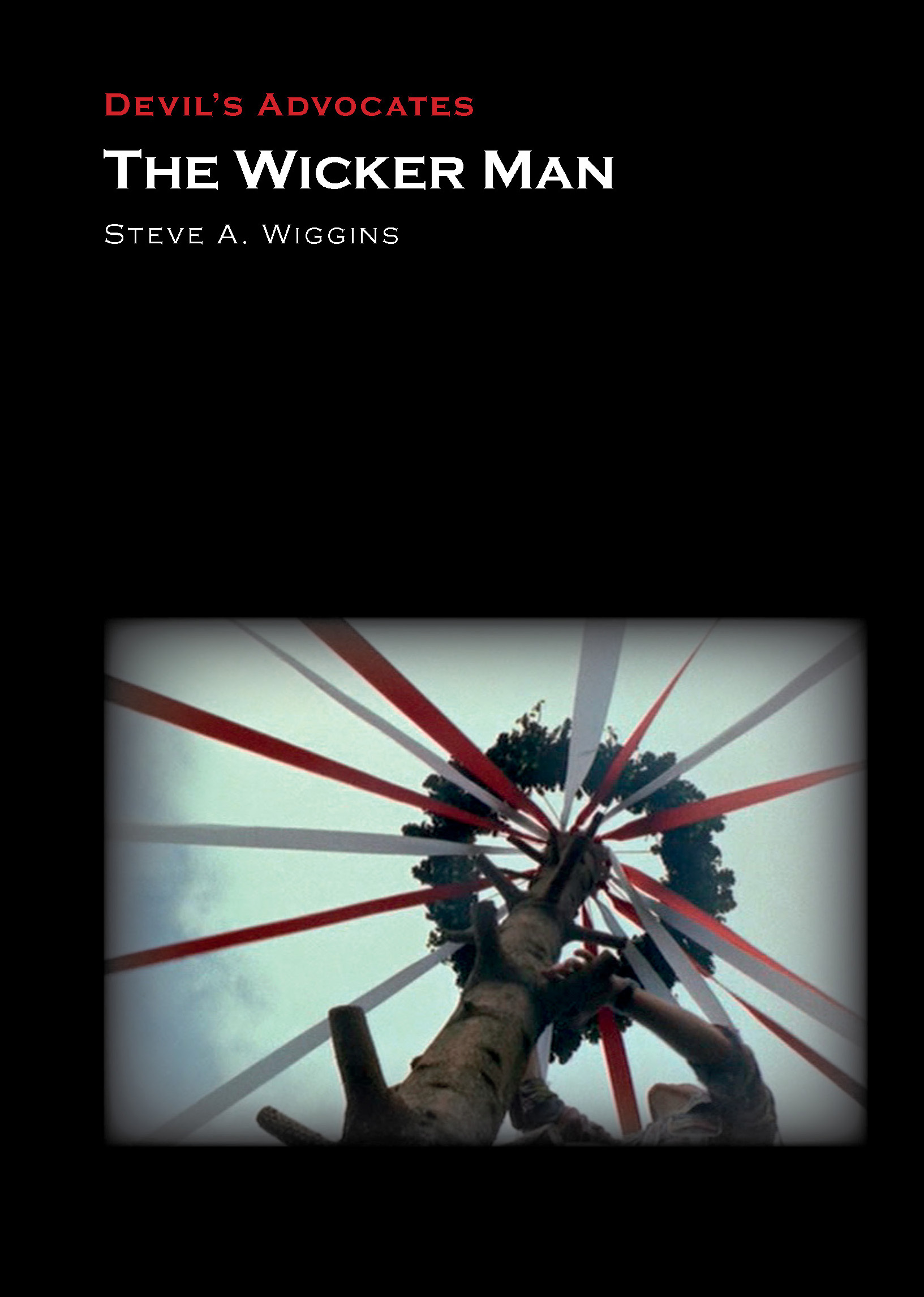
Why The Wicker Man?  It’s a fair question.  My book is now starting to appear on Amazon and other venues (it’s on Goodreads!), so it’s time to try to get the word out.  The BBC ran a recent story, “Why The Wicker Man has divided opinion for 50 years,” and that offers a springboard into the “why” question.  I’m not Scottish, but my wife and I lived in Scotland for a little over three years.  That’s one reason.  While there I did some research into Scottish folklore—historians of religion are curious people—and traveled widely, and that’s another.  As one of those writers who’s never been able to break out of the academic market, the third and most direct reason is that I’d begun a book on holiday horror.  A friend pointed the series Devil’s Advocates out to me.  Back then the series books were priced in the twenty-dollar range, but the pandemic put an end to that!

I’ve always thought The Wicker Man derived its fear from the strangeness of the holiday.  I’ve also often wondered why Anthony Shaffer and Robin Hardy didn’t make more use of “Beltane” in the dialogue.  Maybe the unfamiliar was too unfamiliar?  I suggest a different reason in my book, but I won’t reveal that here.  Writing a book on The Wicker Man would allow me the opportunity to share my thoughts about holiday horror without trying to convince an agent that people actually do like to read about horror as well as reading horror itself.  Come on, agents!  It’s called pop culture because it’s popular!

I pitched the idea and the series editor liked it.  So did the reviewers.  They were tired of hearing/reading about The Wicker Man as folk horror, as if there was nothing more to the movie.  Like most films that grow an afterlife, this one is complex and can be approached from many angles.  In fact, there’s another book, one by John Walsh, coming out on the movie just weeks after mine.  I wasn’t the only one who knew the fiftieth anniversary was on the horizon like a Beltane sunset on Summerisle.  For those who prefer a more television-like explanation, I’ve posted a video on The Wicker Man on my YouTube channel.  This blog, I realize, doesn’t get enough hits to drive traffic that way, but it’s nevertheless part of the package.  Why The Wicker Man?  The answers likely lie in several posts on this blog, a few years in Scotland, and a love of strange movies.


Coronation Bible

The scene from The King’s Speech doesn’t show it at all, but there was even more drama around the coronation of George VI than the movie reveals.  It may not be obvious, especially to Americans, but there is a great deal of prestige in being the supplier of a coronation Bible.  The two ancient presses in the United Kingdom, Cambridge and Oxford, vie for that honor.  In 1937 Oxford had won out.  Coronation Bibles are works of art and are extremely rare.  You’ll never find one at your local library’s used book sale.  As a recent Oxford University Press blog post indicates, the Bible at George VI’s ceremony was a last-minute replacement.  What could possibly go wrong with a ceremonial Bible, of all things?  Quite a lot, but this one had to do with an aging cleric.

Despite being the eve of war time, an elaborate Bible had been designed and manufactured.  Symbolism is important.  Britain faced not only the aggression of Hitler, but also the abdication of Edward VIII.  Instability was in the air.  In such times, as we’ve seen in American politics, leaders look to the Bible for support.  Printed on special paper, chased with gold on its cover, the coronation Bible was a work of art.  However, the Bishop of Norwich, Bertram Pollock, couldn’t lift it.  At 73 he wasn’t in the best of health, and he had a role in the ceremony.  At the last minute a lighter, replacement Bible was sent.  According to the OUP blog post, the Archbishop of Canterbury issued a rare apology to the press, but also noted “I cannot but wish that you had given some more consideration to the physical infirmities of those who would have to carry it.”

A big Bible

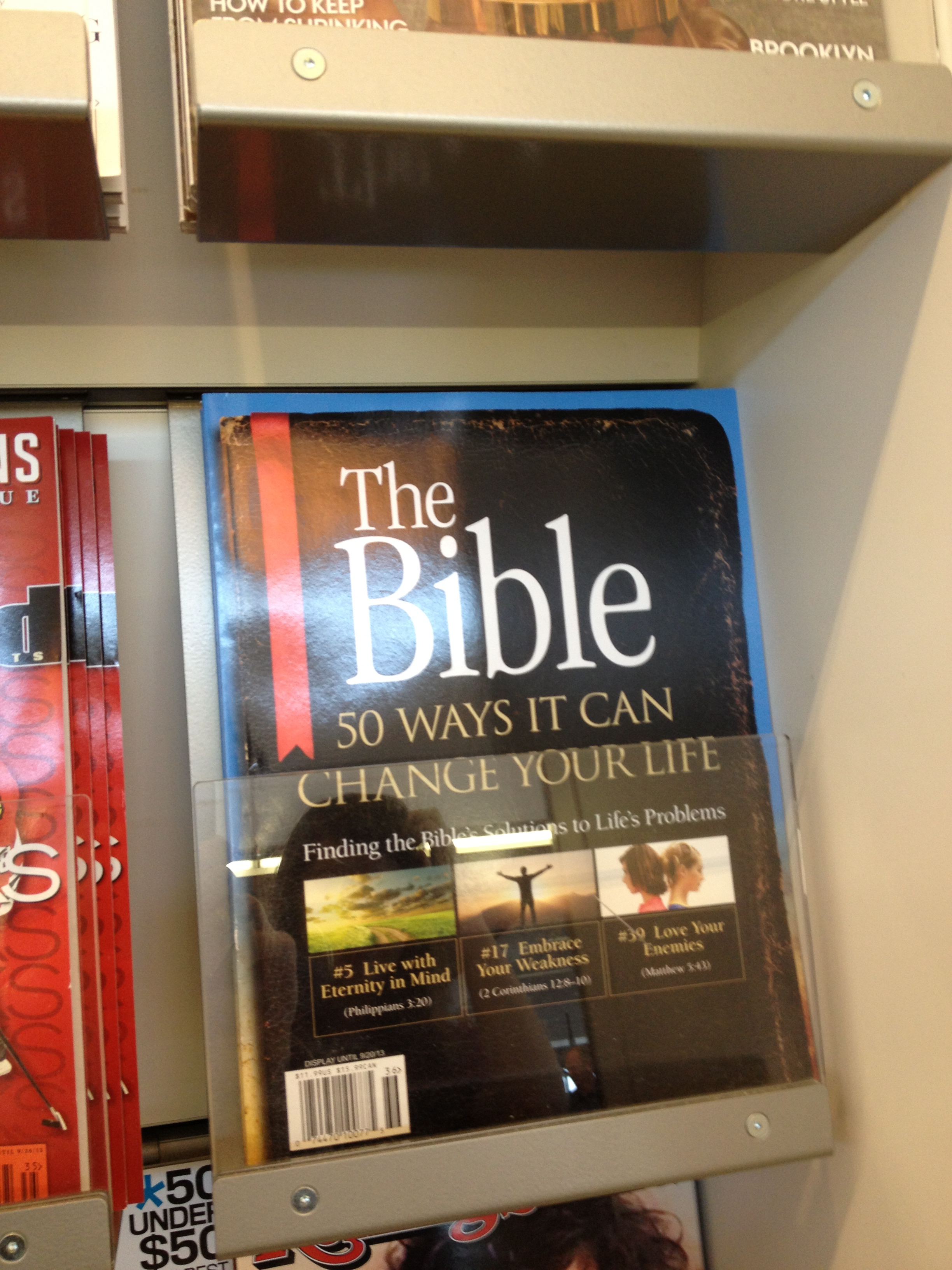
Swearing on the Bible is an archaism that seems likely to persist into the foreseeable future.  The future of the British monarchy (which I do not follow) itself seems in doubt, but to quote the Good Book, “The grass withereth, the flower fadeth: but the word of our God shall stand for ever.”  As long as many people believe this, such swearing will persist.  Even if such belief fades, the solemnity of swearing on a Bible is likely to continue.  The Bible has, in its tangible way, become a stand-in for God.  And as another archaism, a king, is sworn in today, it is to be hoped that the bishops involved have kept their muscle tone intact.  At least to heft, for a little while, a ceremonial Bible.


Surviving AI

A recent exchange with a friend raised an interesting possibility to me.  Theology might just be able to save us from Artificial Intelligence.  You see, it can be difficult to identify AI.  It sounds so logical and rational.  But what can be more illogical than religion?  My friend sent me some ChatGPT responses to the story I posted on Easter about the perceived miracle in Connecticut.  While the answers it gave sounded reasonable enough, it was clear that it doesn’t understand religion.  Now, if I’ve learned anything from reading books about robot uprisings, it’s that you need to focus on the sensors—that’s how they find you.  But if you don’t have a robot to look at, how can you tell if you’re being AIed?

You can try this on a phone with Siri.  I’ve asked questions about religion before, and usually she gives me a funny answer.  The fact is, no purely rational intelligence can understand theology.  It is an exercise uniquely human.  This is kind of comforting to someone such as yours truly who’s spend an entire lifetime in religious studies.  It hasn’t led to fame, wealth, or even a job that I particularly enjoy, but I’ll be able to identify AI by engaging it with the kind of conversation I used to have with Jehovah’s Witnesses at my door.  What does AI believe?  Can it explain why it believes that?  How does it reconcile that belief with the the contradictions that it sees in daily life?  Who is its spiritual inspiration or model or teacher?

There are few safe careers these days.  Much of what we do is logical and can be accomplished by algorithms.  Religion isn’t logical.  Even if mainstream numbers are dipping, many Nones call themselves spiritual, but not religious.  That still works.  We’ve all done something (or many somethings) out of an excess of “spirit.”  Whether we classify the motivation as religious or not is immaterial.  Theologians try to make sense of such things, but not in a way that any program would comprehend.  I sure that there are AI platforms that can be made to sound like a priest, rabbi, or preacher, but as long as you have the opportunity to ask it questions, you’ll be able to know.  And right quickly, I’m supposing.  It’s nice to know that all those years of advanced study haven’t been wasted.  When AI takes over, those of us who know religion will be able to tell who’s human and who’s not.

What would AI make of this?

Golem Events

Public domain, via Wikimedia Commons

It doesn’t have a title yet.  At least not one that’s announced.  Still, when a friend pointed out this article that Daniel Handler, better known as Lemony Snicket, is writing a horror film about a golem, I sat up straight in my chair.  Since I don’t tend to dwell on children’s topics here, it may not be obvious that I was a real fan of A Series of Unfortunate Events, by Lemony Snicket, back when they came out.  Alerted to this series by a cousin who was my daughter’s age, we made this bed-time reading for a few years.  Handler, in the early days, did a pretty good job of keeping his identity secret.  He’s written some adult fiction, and those of us who write know that readers want more of the same thing from a writer—if you want to survive you do what they ask.

I’m a very eclectic reader—that may be one reason I don’t have many followers on this blog.  People like the same thing time and again.  (I’ve always been suspicious of genres.  One of the reasons, I suspect, that my students found my lectures interesting is that I drew from my eclectic reading, but that’s ancient history now.)  In any case, A Series of Unfortunate Events was formative in my own writing.  The movie remains one of the most gothic available, but it pales next to the novels.  Yes, they’re written for young readers, but they’re also very well written for young readers.  I discovered Snicket, or Handler, was Jewish when he wrote The Latke Who Couldn’t Stop Screaming.  And now he’s turned his attention to one of my favorite monsters.  The golem has been part of horror from the earliest days of the genre (that word!).

Paul Wegener and Henrik Galeen’s The Golem, part of a trilogy, came out in 1915.  Before the Universal monsters.  Even before Nosferatu.  The legend of the golem—which may have inspired Frankenstein—has a long history.  While not biblical, the golem does go back many centuries.  Unfortunately these early horror films are lost, or mostly lost.  The Golem and the Dancing Girl, from 1917, is a lost comedy horror.  The third film, The Golem, How He Came into the World, from 1920, survives and is sometimes called “The Golem.”  I wrote earlier about the excellent 2018 film The Golem by Doron and Yoav Paz, sensitive to Jewish issues in the seventeenth century.  This sub-genre of golem movies may be starting to come into its own.  It remains to be seen what Handler will do with it, but if his previous work is anything to go by, we may be in for a real treat.