Jefferson’s Legacy

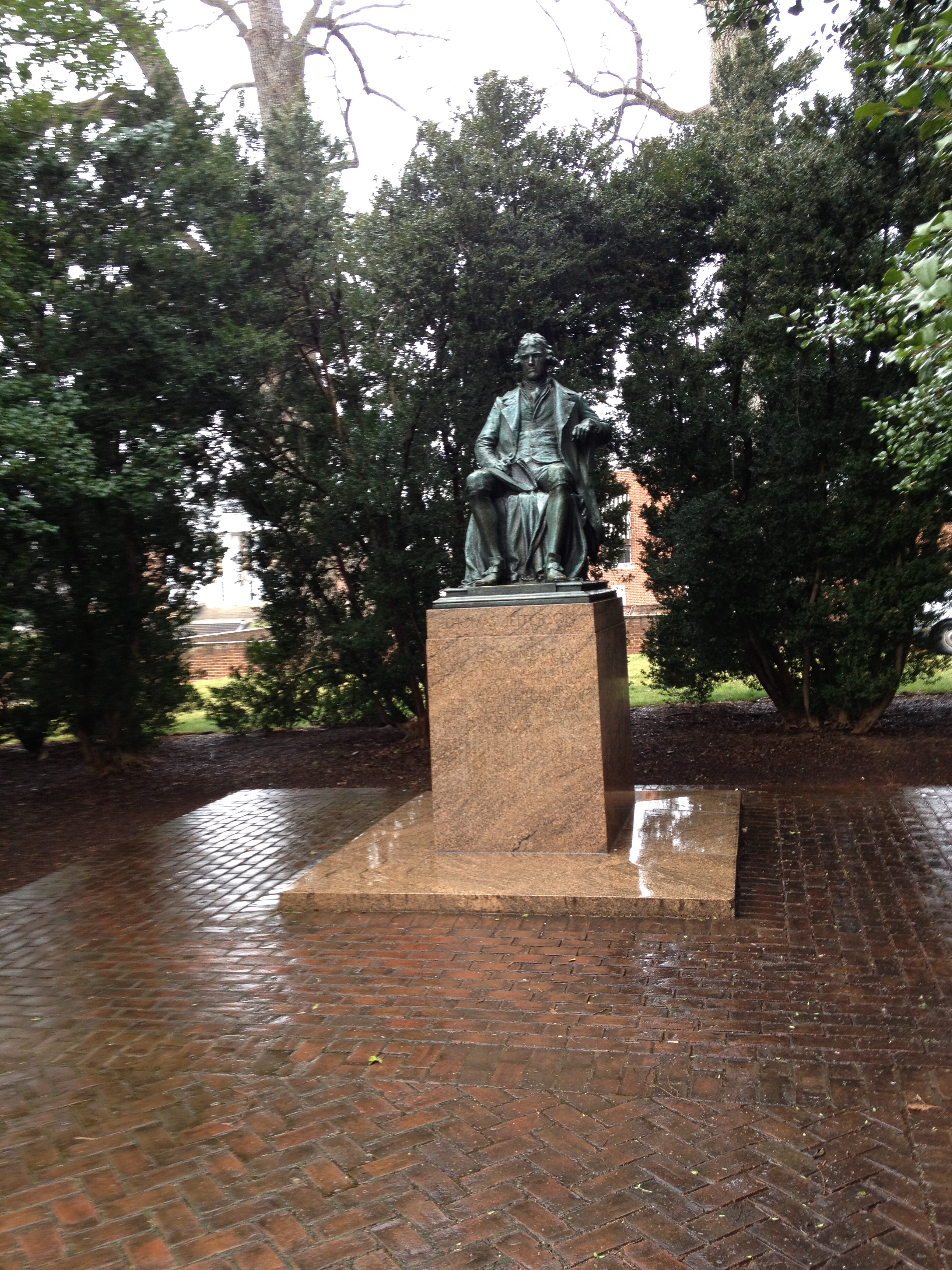
With the gears grinding in the political machine and candidates for the GOP nomination each trying to show they are more righteous than the others, the name of Thomas Jefferson gets used quite a bit. Jefferson’s famous Bible, literally cut-and-pasted together by one of our better presidents, removed miracles from the picture, and Jefferson’s writings leave open the question of whether Deist or Atheist is a more accurate description. I’m in Charlottesville, Virginia right now, home of that paean to Jefferson, the University of Virginia. For a state university, UVA has perhaps the largest religion department in the country. I noted with some irony, that the religion department is housed just above the political science department in Gibson Hall. While waiting for my first appointment, I sat in an alcove where two students began talking about politics. (This was in the religion department.) My chagrin grew as my grin faded with their lament about how poor the Republican candidates are, “but we have to get Obama out of the White House.” In order to do so, they’d elect a man whom they believe unqualified for the office.

Winston Churchill is often quoted as saying a person who doesn’t start out as a liberal has no heart, but who remains a liberal as an adult has no brain—or some such nonsense. The fact is, compassion never should go out of style. It seems to me that somebody changed the terms and what they mean. “Conservative” used to equate to a fiscal position that, while it favored the wealthy, still had sympathy—or even empathy—for those less well-off built in. Now it has come to define “selfish disregard of those different than me.” We see it all the time, not just in political speeches, but in acts passed in the name of Christianity. Jefferson’s Bible is being trampled underfoot. And we are told repeatedly that America was founded as a Christian nation. Of the students discussing politics here, the more conservative of the two was the woman.

Does she not realize that without the liberalizing tendencies of the suffragettes her own future would be limited? That does not excuse in any way the patriarchy that made suffrage necessary in the first place, but it does speak to how quickly we are taught to forget. Even in the land of Jefferson, there are those who would protect privilege and call it divinity. “It does me no injury for my neighbor to say there are twenty gods, or no god. It neither picks my pocket nor breaks my leg.” The words of Thomas Jefferson. In our great universities those who actually do learn are sometimes taught that empathy is weakness and fiscal gain is god. Unless it’s an election year. With great wealth going into the carnival we call the nomination process, we might legitimately ask what’s to become of us if those with no empathy are elected. After all, what are we, apes?

One of the few presidents worth casting in bronze


Love, Factually

Whet has Jerusalem to do with Trenton? As marriage equality is debated in New Jersey—with a governor as compassionate and reasoning as Captain Ahab determined to stop it—three local religious leaders have the courage to lay their cards on the table. When Bishop Beckwith (Episcopal, Newark), Bishop Riley (ELCA, New Jersey), and Rabbi Gewirtz (Millburn) penned a piece entitled “Religion shouldn’t sway Trenton in this debate” in the New Jersey Star-Ledger, it almost restored my faith in religion being capable of some good. The three leaders, from different theological perspectives, agree that the Bible can’t be used for a one-to-one correspondence to modern society on this issue. They correctly point out that theologians disagree and that the remit of the government is not to uphold the view of any one of those traditions. When church leaders start making sense, I begin to tremble.

Politicians are never among the most astute of theological thinkers—and I would include those clergy elected to public office in that number. The rare public official who is qualified to think about such things intelligently frequently has trouble swaying his (almost always his) colleagues who have visions of pork barrels dancing in their heads. Marriage is about commitment, not sexuality. Studies have indicated many sexless marriages exist, yet we applaud them for their consistency. For those with a different orientation, we outlaw formal recognition and call them sinners. In the name of a government sworn not to uphold any one religion. It is time our legislators awake from their snoozes and realize that many mainstream religions have gotten over homophobia, and their religion is discriminated against by such petty power plays.

I applaud the efforts of religious leaders to point this out to a governor who has gone on record saying he’s not one “who changes positions with the grace of a ballerina” (propriety forbids me from finishing that thought). If that chunky ballerina, however, has ended his twirl facing the wrong direction, doesn’t the audience expect him to hike up his tutu and correct his error? I note that our Roman Catholic compatriots did not sign the letter. If ever a church showed the signs of centuries of sexual neuroses, would we trust it to make informed decisions on who might sleep with whom? Is that what marriage has been reduced to in the minds of the celibate clergy? It’s all about sex? Maybe if politicians and unenlightened theologians could pry their minds out of other people’s bedrooms and learn to treat them as complex, descent human beings we might actually see New Jersey leading the world in the right direction for once.

What's love got to do with it?


Adrift

We all have the gift of critical thinking to thank for the world of relative comfort in which we live. That doesn’t mean we always appreciate the source of the gift; in fact, America has had a long history of anti-intellectualism, a distrust of those educated “European style.” Nevertheless, universities in the United States far outnumber those in most nations. Overall they represent a tiny fraction of our culture and workforce, however, and when any institution become elite trouble will follow. I just read a review of Richard Arum and Josipa Roksa’s Academically Adrift in the Chronicle of Higher Education. Arum and Roksa, sociologists, have done a study of university outcomes in the United States and the results are failing. More specifically, a large proportion of students emerge from college having learned little and heavily in debt for their effort. Having just learned of the book, I haven’t had the chance to read it yet, but Kevin Carey, in his review, notes that the disparity breaks along the lines of privilege.

Those students who enter college from well-to-do backgrounds, having attended fine schools, learn a great deal and are very unlikely to end up unemployed. The other group, by far the larger of the two, is comprised of students from schools mediocre or worse, hails from somewhat humble financial circumstances, and will like find unemployment at the end of four years with little true education. There can be no excuse of ignorance, for universities have known of this for many years. In the words of Carey, “Academe was so slow to produce this research because it told the world things that those in academe would rather the world didn’t know.” Some of us emerged from higher education in profound debt, but even with good study skills, lack of connection equals great uncertainty. Classism is alive and well in America, but unfortunately universities have been quietly playing a supporting role.

The truly sad part is that many people already assume the worst about higher education. We like to claim education to be a great equalizer, but that will never change the fact of who your daddy is. The upper crust looks out for its own, and when it comes to the tremendous costs involved to maintain universities, the bulk of the tuition comes from those who benefit least. How long before university presidents with their pseudo-corporate salaries start asking for a federal bail-out? How many times can those who have too much cry that they can barely make ends meet? It can cost a lot to ensure your kids get the jobs they deserve. Universities have increasingly modeled themselves on corporate America, and the product has become shoddy and cheap. Perhaps those who distrust intellectualism have been right all along. Perhaps the logo outside campus should read “buyer beware.”

A rare view.


Divorced from Doctrine

Spirituality and religion have never been so far apart while being so close together. While many people describe themselves as non-spiritual in any sense, whether it be for materialist, humanist, or atheist sensibilities—a great number of people still feel the compulsion to believe in something more than the everyday world we all know. In Sunday’s New Jersey Star-Ledger columnist John Farmer laments the disparity that continues to persist between women’s opportunities to benefit from religious dictates while religious leadership continues to remain a male preserve. As Farmer notes, it is a thinly disguised case of men determining what options are open to women. He notes the recent government about-face exempting religious organizations from the new health plan as a case in point. Does the mewling. special pleading of Catholics oh so concerned about the rights of unborn males outweigh the right of women to unfettered healthcare? You betcha!

Election-year politics are among the most ripe for those who wish to keep women “in their place.” Appear too progressive and you’ll lose the Catholic vote for sure. Of course, despite officially teaching that evangelicals are not real Christians, Catholics will be glad to glom onto their votes, taking advantage of their Hell-bound compatriots in order to keep women from ever truly enjoying freedom. The theology behind their reasoning is late and based on such convoluted logic that a layman can’t hope to follow it. Isn’t it just easier to accept that Rome declares it so? One gets the sense that longing for the old Roman Empire isn’t as rare as good-old human compassion.

Does it not seem ironic that anytime a bill comes forward to promote true equality among humankind the first to stand it line to bring it down are the religious? Christianity likes to trace itself back to Jesus who never intimated that women were inferior and who never spoke a word about homosexuality. He did, however, advocate free health care. Church leaders long since discovered that the first stone is easy to throw, and after that the others come with even more celerity. The cost to spirituality, however, has never been calculated. The same church that consistently declares sexuality is only for reproduction has never made a public outcry against Viagra. After all, we must leave some room for miracles.

These keys were made for lockin'


Witch Crazy

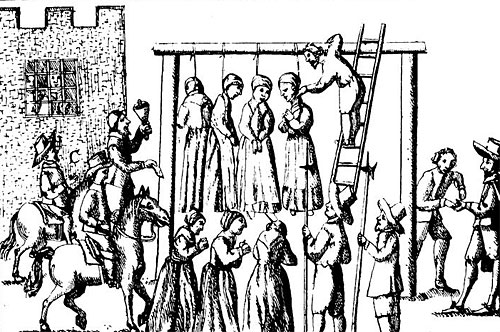
The self-destructive tendencies of human societies should be of major interest to those who study the mind. Why a highly evolved species would forego reason—or create an entire false logic—to give itself an excuse to mass-murder its own is among the greatest trials of theodicy. Can God be justified in such circumstances? With or without divine approval, God is nevertheless implicated. One of those homicidal events, the European witch craze of early modern history is a prime example. Anne Llewellyn Barstow’s Witchcraze: A New History of the European Witch Hunts is a disturbing book on many levels. For a human being with any level of empathy, reading about the torturous destruction of at least 100,000 people—generally women—is hard going. We don’t want to be reminded that we were ever so naïve as to believe that women slept with the devil, flew through the air to meet with other witches, and were trying to bring down society. The “upright,” as Barstow makes very clear, feared for the church. Concern for the ways of God excused—demanded even—the death of the innocent. Many of the victims confessed, under torture, that the godly men had got it right.

Barstow contends that economic stresses and fear for the sanctity of the church, along with a generous dose of native misogyny, fueled this holocaust. She notes that it happened in the same society that would initiate another holocaust a mere three centuries later. But why women? Coming out of the medieval period, societies were strengthening centralized governments. Roles of power that belonged to women were highly individualized, and therefore considered threats. The healer, in absence of a medical profession, was often female, frequently a midwife. In days of high infant mortality, they were sometimes blamed for performing abortions, something men in power simply couldn’t accept. Barstow points out that population increases were stressing the economic production of the period. The newly minted Reformation advocated a very active devil in the world. Since the devil, like God, was a guy, well, women satisfied his lust.

The most disturbing aspect of reading this book for me, however, is the fact that our society has come to resemble that one once again. Strong centralized governments control what citizens do through fear—what else would compel us to allow Patriot Acts to pass? They target women as scapegoats—otherwise the issue of abortion would not command such male attention. Fear for the sanctity of God is repeatedly invoked. Sometimes these modern witches are persecuted on the basis of ethnic background as well as gender. And in both the witch hunter society and that of today an elite class has collected the wealth and sits back to let the remainder incinerate itself in the name of God. Witches don’t fly through the night to meet a fictional devil. The real threat to society is right here among us, but its not who the powerful want us to think it is. And it is very human.


Ultimate God

In a recent op-ed piece in the New Jersey Star-Ledger, Ben Krull published a satirical piece entitled “Strategizing God’s election campaign.” While some, no doubt, took offense at the piece, it is less an indictment of God (Krull is a lawyer) than it is a broadside against those who use God to get elected. As portrayed in the Bible, God is not always a likeable character. As Krull points out in so many words, God is a guy with “issues.” Would he ever be elected on a family values platform? What is happening here is that God is being recast as those who most vociferously claim him an ally want him (always him) to be. Using Yahweh as a springboard, they vault over the compassionate Jesus and land firmly at the disapproving God of Jonathan Edwards, who, along with the God of John Rockefeller, wants them to be rich. It’s not as much an election as it is a catalogue where you can order just the deity you want. The God they claim America follows is a god of their own making.

Paul Tillich, a theologian, once famously declared that God is a person’s ultimate concern. While other theologians instantly and continuously disputed this, the idea still has some currency. The distorted versions of Christianity that we constantly see in the political and sports scenes today is a god that adores the free market and loves football, especially when the Broncos are playing. Somehow, incredibly, he couldn’t get tickets for the Super Bowl. If you listen closely you’ll see this god resembles nobody so much as Mitt Romney, Rick Santorum, Newt Gingrich, Herman Cain, Sarah Palin, Michele Bachmann—wait a minute… has god packed up and gone home? Since undisputed God sightings are as rare as undisputed UFO sightings (maybe even rarer) we are free to fill in the enormous lacunae with our ultimate concerns. Ourselves.

At least in the world of polytheism you had a choice of gods and a ready source on which to blame unpleasantness. If Baal’s not answering your prayer, maybe Anat is standing in the way. Ancient folk were not conscious of the fact that they were making gods in their own image, after their own ultimate concerns. But modern Christians, trapped with the God of the Bible, feel that they can at least give the big guy a makeover. This is God on-demand. The beauty of this deity is that he is a poseable action figure who is a picture-perfect image of one’s personal ultimate concerns. A God so malleable, so fluid, and so idiosyncratic should have no trouble getting elected. To find the God of popular politics, just look in the mirror.

Who does your God look like?


And Then There Were None

Whatever happened to evil? There was a time—when I was being reared in a conservative, evangelical, Republican household—that certain kinds of behavior were considered evil. And not all of them took place in the bedroom. Some of the most blatant acts of evil included using others for your own advantage, putting yourself first, and valuing things above people. Somewhere in the decades that I’ve been alive, all of that has changed—from a politician’s eye-view, anyway. Now that we’re in what’s passing for winter, some days are decidedly chilly. Seeing the homeless hunkered down in the Port Authority Bus Terminal (where there is even an organized, charitable group that tries to help them out), or sitting on subway vents to catch some of the warm air, or shivering on a street corner day after day, I wonder where the evil has gone.

In the neo-evangelical world of cheap prosperity and cheap family values, the name of Jesus gets bandied about like an over-inflated beach-ball. Many who utter his name obviously don’t read his life story. According to the Gospels, Jesus spent his adult life as a homeless wanderer who was particularly sympathetic to the poor. He doesn’t refer to them as evil, but he does have very harsh words for the privileged establishment. Such words harsh the euphoria built upon our own self-importance. As I see the homeless in the winter’s chill, it occurs to me that their lifestyle is much closer to that of Jesus than is the that of the executive who works 33 floors above them. Their demands on life are minimal. Their stares should make us uncomfortable.

And yet, look at those running for office. The amount of money they spend to make each other look bad is obscene. They try to make themselves look righteous for the Tea Party crowd, but their assets weigh them down. I shiver for the homeless. I shiver when I see the news about the ultra-wealthy bragging about who can dig up the most mud. Most of them would have no idea which end of the shovel to use. I’m afraid that having grown up in a modest setting has forever biased me against posers and average guy wannabes. I’ve had jobs that have involved shovels, sledgehammers, and hard scrubbing. The average person struggles and shivers sometimes. The average person spends some time on his or her knees and sometimes ends up on the ground. And even though the average person falls down more than our shining leaders, we never get quite so dirty. Politicians don’t sling the mud at us. To be honest, I think they don’t even see us.

The son of man has no place to lay his head


Don’t Let Them Frack You

One of the consequences of having been born into a post-industrial society is the sense that others have managed to set the parameters even before I became aware of them. In the summer of 2010 I learned about the Deepwater Horizon accident. Prior to that, I had no idea that semi-submersible, deep-water drilling was even possible, let alone already happily lining billionaires’ pockets. I felt violated. This is my planet too. That same year, while attending a FIRST robotics competition in Trenton, the high school kids were greeted after the event by a lone protestor wearing a sandwich board warning of the dangers of fracking. In New Jersey it is very easy to find people protesting. Sometimes their nemeses are purely delusional. “What’s fracking?” I asked one of the kids (all of whom are arguably smarter than me). He didn’t know. I looked it up once I got home, and once again had the feeling that somebody was messing up my planet without me knowing.

Sure, human habitation has a tremendous impact on the environment. It is part of the curse of consciousness. Nevertheless, at some level we must know that our actions threaten not only other species, but also our own existence as well. A story on CNN about fracking, back in my own oil-industry state of Pennsylvania, demonstrates the dangers all too clearly. I grew up in the shadow of a petroleum refinery—Pennsylvania is where the oil industry began. Unfortunately it also has a history of poisoning its own environment. The CNN story highlights the dilemma of Dimock, a tiny town with water contamination caused by fracking. Not even a hundred miles away to the south lies Centralia, still slowly asphyxiating from its fifty-year old mine fire. Our lust for fossil fuels—and more importantly, the wealth they bring—has bankrupted our sense of responsibility to our planet and to each other.

I am certain free-market entrepreneurs would characterize what I sense to be injustice as mere complaining. But there comes a point at which we have to ask if the extra energy is worth the cost. Maybe we could do with a little less. I know that’s blasphemy in capitalist ears, but it is a truth whose scars scrawl across the landscape of this nation. Just about 150 miles southwest of Dimock lies Three Mile Island, a testament to our love of power. Over on the western edge of the state sits the ghost town called Pithole. An oil boom town, it ran out of steam when deeper pools were discovered elsewhere. When I stand in its deserted streets, returned to nature after the many decades of neglect, I realize that it is a silent symbol of human ambitions. We should not give up on our earth, lest it give up on us. It is not too late. Yet.

Borrowed from the National Fuel Accountability Coalition


A Long Way to Go

“One of the greatest injustices we do to young people is ask them to be conservative.” The words are those of Francis Schaeffer. The Francis Schaeffer. Among evangelical circuits, Schaeffer has a status right up there with James Dobson, Ronald Reagan, and Saint Paul. At Grove City College he was viewed with such veneration that hagiography would be an understatement. Few realize that Schaeffer was a mover and shaker in the hippie movement until Roe v. Wade caused what might have been akin to a breakdown. Schaeffer transformed into what he once despised, the ultra-conservative trying to protect the unborn. While Catholic groups had been unsuccessful at capturing Jerry Falwell’s sympathy for fetuses, Schaeffer would win. His book, A Christian Manifesto, published the year I started college, was required reading for religion majors. Abortion had now been taken on as an “evangelical” issue.

Fast forward a few decades. Karen Handel, erstwhile Georgia gubernatorial hopeful, becomes senior vice-president for Susan G. Komen’s The Cure. Handel ran for governor on a pro-life platform. The Cure (temporarily) withdraws funding from Planned Parenthood—the idea that every child should be loved and esteemed is less important than every child should be born. With those little tiny feet. And as it turns out, hopefully with little tiny penises as well. Divide and conquer. Women against women. The Margaret Thatcher syndrome. Call it what you will, but abortion as a religio-political issue revolves around women’s rights. Anti-female legislation has had a long and sordid affair with Christian theology, reaching back to medieval witch-hunts and Catholic sacerdotal declarations. What is sometimes excused as ignorance in less developed societies where women are routinely brutalized is given a Gospel air brush job and called “anti-abortion” in the United States. The real issue, the literal elephant in the room, is women’s rights.

The evidence on this is incontrovertible for anyone who is willing to open their eyes. In order for our culture—men hurling themselves at each other during the Superbowl while women are preparing food in the kitchen—to survive, outmoded gender expectations must be kept firmly in place. Even if you want to cure breast cancer—largely a plague against females—you do it so they can live to produce more males. Being raised with an absentee father, I learned very early that women had every right to equal treatment with men, but I also learned that it did not happen. The trick has been to get women on board to vote against their own best interests. Raise them up to think their religion, their God, demands them to be subservient. And if a man wants sex, it is a woman’s duty to comply. And abortion undoes all a man’s hard work in the bedroom, or backseat, or dark alleyway. Yes, these issues are complex and myriad aspects play into them. I say we call a quorum on the debate until one-half of the human race is truly given a chance to find its voice.

What does he have that half the human race doesn't?


Frozen Falls

Some weather we’ve been having! New Jersey has just completed its mildest January on record. Weather has always been a favorite mode of resort to the divine since it is one of those things we people just haven’t been able to control yet. And it makes perfect sense. The atmosphere is, by definition, bigger than the planet’s surface itself, and we people are pretty tiny, all things considered. I’ve stood next to some trees in the northwest that give me a flea’s eye view of the world.

I remember one of my teachers telling us that Niagara Falls doesn’t freeze over. When I told my mother this, her response was to pull out these photos and send them to school with me. Someone in the family back in my grandfather’s younger days owned a photography business. The photos are unfortunately not dated, but they have been iconic images for me ever since that day in grade school. Yes, even Niagara Falls can freeze over. My best guess for the dates here must be sometime around 1920.

Back when we still had television, I was an avid fan of the PBS Naked Planet series. One of the episodes was on Niagara Falls. In the late 1950s and early 60’s the hydro-electric potential of the falls had been tapped to such an extent that now between 50 and 75 percent of the water flow of the thundering falls is diverted upriver. I first visited Niagara Falls as a child, but I have never experienced the falls with the full force that nature intended. Likely no one ever will again, at least as long as we are in charge of planet.

These pictures remind me of the awe of nature. They were taken when the falls were pretty much at full flow, and yet they are frozen solid and people are walking around on a river that boasts class 6 rapids, the highest the whitewater scale goes. Sometimes when people assert too much control on their planet, it is nice to be reminded that our tired orthodoxies aren’t always what they seem to be. It may be an unseasonably mild winter this year, but nature may still have a few tricks up her sleeves.


Revealing the End

I knew the end of the world was near when I saw the phrase “butt crack” in the Chronicle of Higher Education. As I turn over the February page in my 2012 Apocalypse Survival Guide calendar, I find that the Romans predicted an end of the world to arrive at 634. B.C.E. I’d say the Romans are still waiting, but they are long gone, the only residue remaining of their empire being the Vatican and its spiritual, rather than political, power. So why did the Romans think the end was near? It had, according to my calendar, to do with a dozen eagles being seen at once. In the spirit of Hal Lindsey we can parse that vision a bit. 634 was just 32 years after the infamous 666 B.C.E. Of course, no one knew it was 666, or even B.C.E. for that matter. Nevertheless, when God picks his super-three he stays with it. Thirty-two turns out to be nearly the traditional age ascribed to Jesus, but minus one year. Keep that in mind.

Eagles make occasional appearances in the Bible, but since God is a forward-thinking deity, the reference is surely to the United States! And how many colonies were there originally? Was it not 13? Again, the significant number is off by one. In some cases we might count this up as poor arithmetic, but with the subtle destroyer of the universe we know it is not only intentional, it is also significant. So, Rome saw the 12 eagles—the United States—in 634. What they really meant was the Maya, obviously. That would account for the missing one, since central America is less than the greatness that is the United States. And besides, there were twelve apostles, but when Judas was replaced by Matthias there were 13. What more proof do we need? These dozen eagles were indeed a divine sign. Only the world did not quite end in 634.

Maybe the problem was with the Julian calendar, or maybe the eagles were just confused. As my calendar says, “Antichrists been and gone” and yet we are still here. The transient nature of apocalypses never dampens the truly hateful spirit. We can’t comprehend this cobbled-together doomsday without at least trying to understand the evangelical despising of the world. This view is based on a quasi-biblical determinism that emphasizes God’s ultimate plan to destroy the universe that is only revealed in piecemeal fashion throughout select books of the Bible. But God is like a mystery writer who sadistically leaves out the last chapter of the book. The tension is unbearable. How much more before we begin to crack? But isn’t that what started this whole apocalypse in the first place?

The horsemen close in


Best Prayer in the Air

With my current job I travel quite a bit. With all the attendant time hanging around airports, I have time to think back to pre-deregulation days when flying meant some kind of care in the air. It has been in the news the last few days that Alaska Airlines is removing the prayer cards from its trays during meals. When I saw that, the real surprise to me was—airlines serving meals? When did they start doing that? A couple years back I flew coast to coast on Alaska Airlines with nothing more than a sack of peanuts. I would have been happy to have had a prayer card to eat. I agree with those who pointed out to the airline, when it served these alleged meals, that paying customers shouldn’t be proselytized. You can get enough of that by watching GOP debates. And I certainly hope the message wasn’t that the plane only flew on a miracle.

I’m sure that some people will say there’s no harm in a little non-invasive sermonizing. Therefore I must make my own confession; I was a teenage evangelical. Although I never actually did tracts myself, I hung out with kids who did. Once, on the way home from a youth meeting, a carload of us stopped to get a bite to eat in a diner. Now, we were high school kids, not flush with money, but even I knew it was right to tip—waitresses have to put up with a lot for little pay. One of my friends told us that if we really wanted to help the young lady out, we should leave a tract as a tip. What reward could be better than salvation? Surely that would help to feed her family or buy her kids a new pair of shoes. Indoctrinated as I was (and I hadn’t even been to college yet, Mr. Santorum), it seemed like a good idea. Still, I felt bad when we left.

These two situations are not dissimilar. In both cases someone would rather print cheap words on cheap paper with free sentiments rather than giving a person sustenance. It’s been a few years since I’ve darkened a pulpit, but I do seem to recall Jesus insisting that the hungry be fed. I don’t recall what he said about tracts and prayer cards.

Religions have a way of focusing on the forgettable minutiae while overlooking the real need right in front of them. In November I flew from New York to San Francisco, subsisting on a tiny bag of peanuts and some airline orange juice. If old Deutero-Isaiah were sitting next to me he might have said, “why spend money on what is not bread?” But I was thinking that maybe the karma of that tipless waitress was simply coming back full circle.


Three Degrees Below Zero

Rick Santorum has turned his attack on intelligence against American universities, according to a story in the Huffington Post. He claims the left uses colleges for indoctrination to keep themselves in power. Sounds like somebody’s been sipping a little too much communion wine. I know many people who might have a right to make such claims, but Santorum isn’t one of them. Santorum earned a Bachelor of Arts, with honors, from the wicked, indoctrinating Pennsylvania State University. He then succumbed again to the indoctrination when he, apparently accidentally, earned a Master of Business Administration from the University of Pittsburgh. Somehow he stumbled onto a J.D. with honors from Dickinson School of Law. A man this indoctrinated, I say, has no business being president.

During these senior moments (not to offend any seniors who might actually make that claim) Santorum seems to have missed that universities are among the most under-funded, crisis-ridden institutions on American soil. With rare exceptions, universities are cutting programs, canceling positions, and slashing budgets. Don’t get me wrong, I’ve vented a fair amount of criticism on our universities and I know, firsthand, that they aren’t perfect. I rage because I love. It seems that some children of privilege like to rage because it’s in fashion. If you’re going to take on those smarter than you, at least try to get the facts straight. Higher education is such a small segment of the American employment force that the only reason you’d go after them is that, well, you’re in a church. Baptist Catholic Santorum made his remarks while at a church in Florida, a state which, despite insidious power-mongering, boasts some of the finest universities in the country.

Taking stabs at Obama, Santorum claims the president wants all kids to go to college, and that’s a bad thing. You don’t want an educated electorate. It is harder to get educated people to march in goose-step with everybody else. Talk about indoctrination! Vote for me, because I will keep you safe from the horrors of an education of which I couldn’t stop my self from taking advantage. Don’t send your kids to law school. There can be real danger even in sending them to grammar school, for there they learn to spell. I wonder, if in the course of earning his three degrees, Mr. Santorum ever learned to spell the word “hypocrite.”

Just an average guy, hanging with his buds.


Cookie Time

All right, who wants to be the big meanie now? The fact that politics manage to besmirch just about any human enterprise, no matter how noble, is a lesson many of us learn on our slow trek to adulthood. I sadly came to realize that the church is incredibly political, and that universities could rival congress for the backstabbing and posturing that goes on. In the midst of all this politicking, one of the truly good NGOs left in the world is Girl Scouts. Sure, there will always be some councils with personality issues, and some troops will have a difficult scout or parent with which to cope, but the organization is based on the principle of giving girls the confidence and assurance they need to be successful in life. What could be wrong with that?

My wife pointed out a story on Salon.com that reveals some anti-abortion groups are now claiming that Girl Scouts supports Planned Parenthood. This is patently not true. Even if it was, it would hardly be a crime to teach girls reproductive options (after all, when is the last time a Pope or President carried a pregnancy to term?), but since people don’t think with precision, it seems best to keep girls in the dark. Some right-wing groups are boycotting Girl Scout cookies as if the devil himself were the baker. Not to be outdone in perceived self-righteousness, some Catholic Churches are kicking out Girl Scout troops for supporting abortion! All of this based on a lie. The road to the unconscionable position of the Catholic Church toward reproduction has been long and mentally torturous. Anyone who has taken the trouble to trace the church’s strange love affair with the fetus may be surprised to learn how recent the concern became an issue and how very androcentric it is. The church’s claims here rely on nothing more than good old testosterone-generating glands and the love thereof. To punish the Girl Scouts for a fictitious association with an unapproved organization shows just how mature the largest church in the world truly is.

The male bias in the majority of the world’s societies is bad enough. The United States likes to hold itself up as an icon of fairness and equality. It is the spirit upon which this nation was founded. Except when it comes to females. We don’t want our girls to have reproductive autonomy because that might make men look somehow less masculine. As for those wimpy guys who like to read, the Bible backs them up completely on this issue. God is a guy, and made guys to be in charge. No matter how much education you offer, you won’t be able to change that one-book-fits-all outlook. What will we have lost if we seriously and honestly treat both genders equally (and even those intersexed individuals)? Only the apparently fragile male sense of superiority. I say, in the spirit of America vote for equality! Buy Girl Scout cookies!

Deliver us from evil.


Religious Capital

Eric Weiner’s book, Man Seeks God, surely received a boost with an article in Sunday papers (originally written for the Los Angeles Times). In this piece, Weiner comments on the American fluidity of religion, how people pick and choose the spirituality that works for them. His observations are based on the results of a Pew Trust study that indicates about a third of Americans change their religion during their lifetimes. This is a departure from the age-old tradition of being born into a religion, something that still seems to apply to two-thirds of the American population. In his article Weiner suggests this is not entirely a bad thing, since people are consciously deciding on that to which they will commit themselves. I haven’t yet read Weiner’s book, but the situation described here has a potent underlying implication.

Religions tend to make claims based on certitudes and assertions of absolute truth. When religion becomes merely a matter of choice, has it not lost its very foundation? This may not be a bad thing, but it does change completely the essence of religion. No longer can religion be considered an inviolable truth handed down from on high if the truth is a matter of choice. Or, more troubling, perhaps we no longer seek truth. In a population based on personal satisfaction, religion becomes an extension of personal comfort. In a society where non-faith is suspect (most atheists still complain of being considered “evil” for their non-belief), people need to believe something—anything. We can’t test the truth in any empirical way, so we all have to admit to some guessing. When born into a religion, questioning is a sign of doubt. When shopping for a religion, questioning is a smart economics. Does this religion work for me? Is there one that suits me better? Is it worth the extra costs?

The center of focus has shifted from seeking the one, unwavering truth that is beyond us to seeking a belief that we can stomach. Religion is a commodity. Perhaps this development is inevitable in any society so dedicated to the free market that even common decency is labeled socialism. Is it possible for people who constantly think in terms of supply and demand to understand an absolute in one tiny sector of their lives? Choice becomes an all-or-nothing proposition. Its pragmatism indicates its origins. When people can choose a religion without consequences, it should be obvious that this is a human construct. Instead, we want to believe that our religion is the right one because that’s the way we like it. Perhaps the question we should be asking is whether our lifestyle is authentic or simply a fabrication made to suit our wishes. Our treatment of religion as a product to purchase and use reveals more about what we believe than does any creed.