Contriving the Rapture

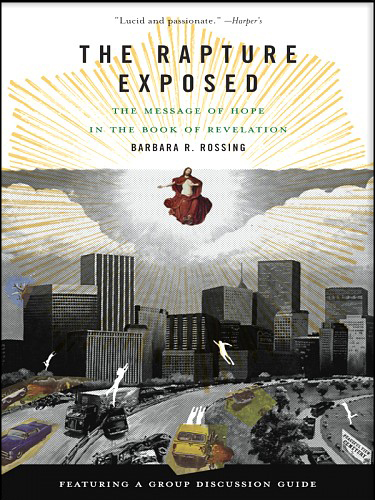
In the light of last month’s failed rapture attempt, I decided to read a book that I picked up some years ago that had been written in the wake of the millennial scare. Having grown up with nightmares of the rapture, I learned during my first college class on the book of Revelation that it was relatively modern meme, invented in the nineteenth century. Barbara Rossing’s The Rapture Exposed seemed a good way to refresh my memory without having to go through all those boxes of books in the attic to find my original textbooks. Rossing, a Lutheran minister and New Testament professor, brings to light some very important facts beyond the historical roots of this theological fabrication—facts that should concern religious and secular alike. The rapture was invented by John Nelson Darby, a founder of the Plymouth Brethren and convoluted biblical scholar. Basing his roadmap of the future singularly on Daniel 9, he concocted the rapture to make sense of his apocalyptic epiphany. Drawing diverse sections of Paul’s letters to the Thessalonians, the Gospel of Matthew, and the book of Revelation together, he mixed thoroughly, half-baked it, and pulled the rapture out of the oven.

The idea caught like wildfire. Today young people who’ve never read the Bible and who’ve seldom attended religious services know what the rapture is. What they do not realize is that nearly all of the Christian tradition rejects it, seeing it for what it is—a Johnny-come-lately of amateur theology that sees the Bible through the lenses of dilettante-sensibilities like those of Michael Drosnin (The Bible Code man). Instead of seriously reading the Bible and trying to understand it, society prefers to see it as a little bit of magic in the midst of our scientific and technical world view. It is a safe place where bits of the supernatural are preserved and that defies rational explanation. Rossing’s book does a good job of exposing the wrong-headedness of LaHaye’s Left Behind conclave, but she overlooks an important feature of this coterie: they have an unconfessed agenda.

The unspoken agenda is best summed up by Lt. Frank Drebin of Police Squad when he says, “blowing away a fleeing suspect with my 44 magnum used to mean everything to me. I enjoyed it, well who wouldn’t?” Rossing misunderstands Fundamentalism when she expresses surprise at the bloodlust present in the Left Behind novels. What she doesn’t take into account is that, as a collective, Fundamentalists thrive on self-righteousness. Feeling the same violent urges that others do—all humans experience violent emotions—they sublimate that aggression and save it for the unrighteous—God’s enemies. When the gloves come off in the apocalypse, that hatred bursts out in good, old-fashioned bloodletting—albeit with combat helicopters and high-tech weaponry. Of the Christians I know who own guns, the Fundamentalists are most avid in their rights to do so. In college I met my first Christian survivalists and I learned that the rapture was a ruse. It is a deadly mix, especially when this warped theology makes it into politics. Although Rossing’s vision of a new earth in the second half of her book may not appeal to everyone, Americans should read at least the first few chapters to learn why the rapture will never occur.


Floods and Fairytales

Never mind that the Bible gives only a cursory description of “Noah’s ark.” Never mind that the story in Genesis is clearly derivative from Mesopotamian originals such as the epics of Ziusudra, Atrahasis, and Gilgamesh (the Utnapishtim version). Never mind that all species of animals cannot survive within a single, extremely limited biosphere without evolving afterward into the diversity that the world currently hosts, even counting extinctions. Never mind that not enough water exists (with apologies to Kevin Costner) to cover all landforms without every mountain being pounded flat and stacked neatly on top of the ocean floor. In short, never mind reality—people will continue to build replicas of Noah’s ark. As a literary trope the ark has proved invaluable; many of my posts demonstrate how it appears and reappears in books and movies as a symbol of human irresponsibility. And yet, in order to demonstrate the veracity of an ancient myth, we continue to build fundamentalist arks.

Yesterday my wife pointed me to a msnbc story of an ark being built—and sailed—in the Netherlands. Certainly those in the “low countries” have global warming to deal with more immediately that those on higher (geologically, not morally, speaking) ground, and the engineer of this particular ark does not strike the viewer as a rabid literalist (he is a little too unkempt for that, and his shirt is not white and he wears no tie). John Huibers, however, worries about a more localized flood in the Netherlands. The ark may be overkill since polar bears, koala bears and panda bears are rare in Amsterdam, at least when one is not medicated. Arks, however, make great tourist attractions.

In Hong Kong the Kwok brothers built an ark replica in 2009. Greenpeace has one in Istanbul. A Christian theme-park featuring a full-size ark is under development in Kentucky, and just two years ago I drove past a roadside ark being built in Maryland. Most of these arks, interestingly, follow the design in the Sun Pictures’ production In Search of Noah’s Ark rather than the more traditional, mythic design in my children’s Bible. It is a natural human tendency to mistake form for substance. The story of Noah is a cautionary tale that has taken on daunting real-life implications in our treatment of our planet. Water is the signature of life, but for us land-dwellers too much is not a good thing. Thankfully, should a flood come, there will soon be enough arks around the world that would-be Noahs may find themselves in a buyers’ market.

Still my favorite ark


Literary Floods

Oryx and Crake ends with a cliffhanger. I read the book at the suggestion of a friend and found a dystopia that simply continues along present trends. Naturally I had to read the second part, Margaret Atwood’s The Year of the Flood. I had picked up this book first, not realizing that there was a previous novel, because I supposed the eponymous flood to be that of Noah. I was not disappointed on that score. In keeping with her strong biblical awareness, Atwood has given readers the creation in Oryx and Crake, and the deluge in The Year of the Flood. Set in the same forlorn future, those who survive the pandemic described in the first book seek to survive in a world where most of the people are gone. Many of the survivors, as we learn in the second installment, are former members of an alternative religion, God’s Gardeners. This quasi-cult, led by Adams and Eves, prepares for the waterless flood (pandemic) by caching Ararats—supply stores—around the broken-down city they inhabit. As in Genesis these Noahs and Mrs. Noahs are replications of Adam and Eve.

Not only is Atwood an engaging author, she supports the green causes advocated by her books. This is a more honest form of religion than most sharply chiseled theologies that do nothing to improve the lot of a suffering world. Academic religionists like to tell us exactly what God is like while shrugging shoulders over the destruction of everything he putatively made. In Atwood’s world, those who believe in God express it through care of their planet. As always, however, they are the modest voices easily drowned out by the unconscionable greed of the powerful. In the words of John Dickinson from the musical 1776, “Don’t forget that most men with nothing would rather protect the possibility of becoming rich than face the reality of being poor.” Rare is the person willing to take the higher road and set aside his or her own wants for the benefit of others.

Ethics, at one time, meant seriously considering the implications of what we do. With the morals of our “leaders” it is pretty difficult to hold to that illusion any longer. Yesterday I sat through another round of ethics training and learned nothing that I hadn’t learned in Sunday School as a child. Be nice to others, don’t use them for your own advantage, help those who need assistance. It really isn’t that hard. Newt Gingrich with his highly unethical treatment of his ex-wife, Anthony Weiner’s peccadilloes, Sarah Palin’s revisionist reality—these scarcely inspire confidence. The flood is upon us. I think I might rather live in a world the Margaret Atwood would envision, as long as she was there too, to show us how to survive.


Stranger Tides

Yo, ho, ho and a plate of spaghetti

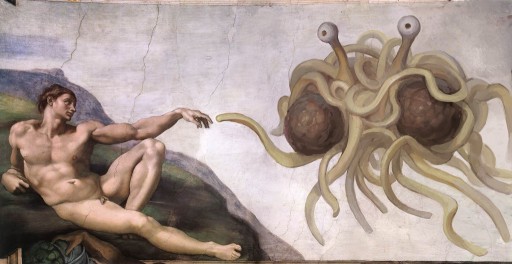
The closest I’ve come to appreciating pirates is the command of the Flying Spaghetti Monster that its devotees must wear pirate costumes. Nevertheless, being only human, I was curious about the fourth installment of Disney’s Pirates of the Caribbean series although the old storyline had mercifully died out. This weekend my family joined a handful of others still showing interest and went to watch Captain Jack Sparrow’s antics on the silver screen. Perhaps it was because this movie actually followed, loosely, an actual book instead of a theme-park phantasmagoric pastiche, but I found the movie surpassed my expectations. I’m discussing it here because of the heavy dose of religious concepts brought into the story by the inclusion of a missionary.

In typical Pirates fashion, the character introductions are unconventional, and so it is with Philip, the missionary. Tied to a mast on Blackbeard’s ship as a kind of human talisman, the poor man is cut down by Sparrow and a crewman during a mutiny. The crewman declares to Philip, “You are either for us or against us!” to which the missionary replies, “I am neither with you, nor am I against you!” The crewman asks Sparrow if that is possible, to which Captain Jack replies, “He’s religious, I believe it’s required.” This was possibly the funniest line in the movie, but it was so because of the underlying truth. The sarcasm here is directed at a representative of a church that will ultimately lead to the destruction of eternal life. Granted, the agents of that destruction are Catholic, presumably.

Once the fountain of youth is discovered and Blackbeard and Barbossa engage in their swordplay, Spanish troops arrive and promptly destroy the pagan fountain declaring that the church (presumably Catholic) is the only means to eternal life. The Protestant missionary, meanwhile, in an act of self-sacrifice returns to free a misunderstood mermaid. (This is Disney, after all.) The dialogue is difficult to remember from a single viewing, but the addition of religious elements beyond the supernatural lent a gravitas to this final Pirate film that the others lacked. Even placed among the fantastic, the religious elements grounded it in a reality where faith, sacrifice, and fortitude became intrinsic to the story. I doubt I’ll head off to the Spanish Main any time soon, but I appreciate movies that offer a bit of substance along with their entertainment on that transatlantic crossing.


The Big Man

“When the change was made uptown/And the Big Man joined the band…”

Clarence Clemons (from WikiCommons)

Among the earliest markers of religion in human culture is the advent of music. While still disputed, bone “flutes” from about 40,000 years ago seem to indicate that early humans knew the value of music. Driving around now that the weather has warmed up, it is clear that people still find music so important that they like to share it from their open car windows at a volume I find uncomfortable even across the street. Like religion, music is an intensely personal aspect of life. Although I mention bands I like occasionally in this public forum, I never parse my music tastes too much because they are a little too revealing. With Clarence Clemons’ death yesterday, however, it is appropriate to pause and give my respects.

Those who know me sometimes wonder at the fascination I have with Bruce Springsteen; I am not an idol-worshipper and not all of Springsteen’s work appeals to me equally, but he represents an appreciation of the ordinary person. What first drew me to his music was the fact that he understood blue-collar mentality and angst generated by an unfair society. In an interview on his Born to Run special edition, Springsteen notes the seminal change that Clarence Clemons made in the E-Street Band, as reflected in the opening quote from “Tenth Avenue Freeze-Out” above. The playing of Clemons’ saxophone was so distinctive that even my very untrained ear could often pick it out on other artists’ albums even before reading the credits.

The E Street Band, of course, changed over time and lost a first-generation member with Danny Federici’s death three years ago. Although Bruce Springsteen is alive and well, and still active in causes to help those who are victims of an uncaring system, the E Street Band will never be the same without Clarence Clemons. The old camp song says that music never dies, and that is a hope we can hold out for the impact of remarkable performers as well. When I walk into a classroom with kids who have no idea who the Beatles were and who’ve never heard of Alice Cooper, Deep Purple, or Pink Floyd, I feel my age. But it is okay as long as I can still listen to the music once I get home (I never play the stereo while driving—I prefer to concentrate on the music a little too much). It is like a religious experience. I am sure the cosmos is a more harmonious place for having hosted Clarence Clemons, even if just for a little while.


Zombie Friday

New Jersey is known for its zombies. Last October Asbury Park gained admission to the Guinness Book of World Records for the largest zombie walk (exception is made, of course, for daily life in Washington, DC). The movie zombie, in its now classic form, was reborn in western Pennsylvania, but New Jersey is the place where strange afterlives appear to gravitate. Yesterday Stephen Finley was sentenced. Finley, a mortician, had been convicted of selling the healthy organs of his dead customers to earn a little extra on the side. Given that the governor, Chris Christie, might rival Vlad the Impaler in his zeal for chopping, this really does not surprise me at all. Is it not the ultimate triumph of the free market to consider human beings commodities to be packaged, used up, repackaged and resold? Moral rectitude is on the side of the strong arm.

As someone who has been on the receiving end of the chop more than once, and reduced to a zombie-like state of perpetual job-insecurity, I think I know how the undead feel. Not having a place in the normal world of the living, but not quite dead, the zombie wanders about looking to feed on brains. This idea of brain-lust seems to stem from the cult classic The Return of the Living Dead, although, not being a film specialist, I would welcome correction on this point. Nevertheless, like the modern zombie I hail from western Pennsylvania and nothing satisfies me like a good brain (metaphorically, of course).

The idea of harvesting the organs of the powerless dead also suggests the endlessly referenced Soylent Green. Here the staunch NRA promoter Charlton Heston fights against the establishment that is turning (spoiler alert) people into Soylent Green, the ultimate solution to food shortages! For, after all, are people not just commodities? America’s thirst for zombies reflects our growing sense of victimization: the zombie is primarily a creature without a will, brought back by powers beyond its control. In the original vodun context the zombie was a source of cheap labor. Is it any surprise that West African slaves brought the concept to the New World with them? Today, of course, those with the cash may simply purchase the organs they desire, cutting out the middle man and going straight to the source.


Funny Faith

The entertainment industry is a window through which we might see what it is we value. After all, our mad-money and disposable income are often channeled toward the things we want, as opposed to what we really need. Living near New York City, it is clear that entertainment is also big business. Last night Spider-Man opened on Broadway to decidedly lackluster reviews. The web-slinger has had quite a journey from comic book to the musical stage—sometimes making it big, other times getting squashed. Earlier this week, however, it was The Book of Mormon that was making the news. Winning nine Tony awards, this musical is the first thing to pop up on a Google search when “Book of Mormon” is typed in (at the moment), I suppose, much to Mitt Romney’s chagrin.

A friend recently asked me why people take religion so seriously. To me it seems that it is a matter of historical development. Most religions developed before the culture of leisure took over. As I tell my students each semester, even in the early part of last century most people lived on farms rather than in cities. Time for leisure was rare and life was taken seriously: all work and no play. If we push that back a century, when the Church of Jesus Christ of Latter Day Saints was started, the effect was even more widespread. Go back to the days of Muhammad, Jesus, or Moses and the struggle to survive gets increasingly more difficult. Religion is a coping mechanism. When worries about food and shelter become less onerous, we can laugh at the path that led us here. Along the way few of us have met radioactive spiders, but most of us have been warmed, singed, or wholly consumed by religion in some form.

Well, in the entertainment industry talent also plays into it. But it has to be the right combination of talent. Matt Stone and Trey Parker have been making the social commentary A-list for several years now. (Bono and the Edge have too, but Broadway just doesn’t seem to be their genre.) Maybe trying to convert those of vastly different culture to white-shirt-and-tie, clean-cut American values is inherently funny. I suspect there is something more at work here. We are allowed to laugh at Mormonism—the other white religion—without too much recrimination. It is safe. What I doubt we’d ever see on Broadway is The Book of Common Prayer: the Musical. On the other hand, I wouldn’t be surprised to see the Incredible Hulk lurch onto stage and burst into song.

Everybody dance!


Bread Alone

The sad story of the death of an eight-year old girl from Irvington, New Jersey bears uncanny echoes to a case a year and a half ago of a mother who starved her children believing God would provide. The current case of Christiana Glenn’s death is heart-wrenching and the outlook is not improved when it appears that the girl’s mother had religious motivation to abuse her child. Christiana died from untreated physical wounds and malnutrition, prompting columnist Kathleen O’Brien to write about how food and religion often come together in unusual ways. As O’Brien points out, religions generally safeguard children from food privations, but less scrupulous leaders of what are frequently termed “cults” do not have the same strictures. The only real difference between a religion and a cult is society’s attitude toward it—religions tend to be larger and with finer pedigrees, but beliefs are beliefs. When religions seek control over believers’ lives, they often delve into the practice of deprivations, generally mild. More extreme groups take the idea to fatal limits.

Even the Bible records from near the very beginning that deprivations are part of the religious expectation. One of the most complex and frightening stories from Genesis is that of Abraham’s near sacrifice of Isaac. No matter how theologians wash it, this story retains its stain of an adult—whether directed by God or not is a mute point—attempting to harm a child in the name of faith. The story, many centuries later, still sent Søren Kierkegaard into a tailspin that came out as Fear and Trembling. What kind of deity asks for a child to be harmed, even in jest? For Christiana Glenn, there’s no taking it back. The Bible tells us nothing of how the interior life of Isaac responded to this episode.

Food and religion are among the most common elements abused in American society. For our bifurcated (if not bipolar) outlook, one sustains body and the other sustains soul. While science still lacks evidence for the soul, the body remains the only basis upon which we have to base our ethics. Even biology dictates that care of one’s own young is an evolutionary imperative. It is tragic indeed when a religion overrides what all cultures respect as the ultimate “should” —take care of your children. In a world overpopulated by religious experts the street value of the soul will never face a recession. Believers, characterized my many religions as sheep, will go wherever their leaders tell them to go. As a culture suspicious of funding the study of religion, it may not be food that is reaped at the end of this harvest.

Thou shalt not...


Now Locusts?

With the same page of the newspaper lamenting flooding in Iowa and drought in Florida, it seems that nature has turned against us in an almost biblical way. A more biblical plague than locusts would be hard to conceive, however, so when my wife pointed me to a current video of a locust invasion in Russia, I took notice. In the United States we seldom consider locusts since they have largely ceased to be a problem with the extinction of the Rocky Mountain locust for unknown reasons, last century. One of the more interesting books I’ve read over the last few years was Jeffrey Alan Lockwood’s Locust: The Devastating Rise and Mysterious Disappearance of the Insect that Shaped the American Frontier. Because the locust is not an American problem, biblical literalists like to transform biblical locusts into something else. The transformation is not necessary. We’ve eliminated the large predators from our planet, and the small ones often go unnoticed.

Each year as I lecture on the book of Joel, I spend a little time with locusts. The Asian varieties of locusts tend to reproduce rapidly and prolifically in the desert. Quickly exhausting the sparse food supply, they take to the air and fly for, literally, greener pastures. They can fly for three days without stopping which means they are suddenly there and eating everything. They look like divine judgment. Each locust eats its own body weight in green matter daily, and when a swarm can contain over 100 billion locusts, that can add up to 50,000 tons of food a day. Like poorly mannered house guests, locusts stay until all the food is gone, then leave. They are fully capable of devastating entire nations.

An actual biblical locust, vintage 1915.

Hal Lindsey famously converted Joel’s locusts into military helicopters, claiming that they presaged the end times. Decades later we are still here and so are, apparently, the locusts. They are part of evolution’s great machinery. The biblical view that we are the purpose behind that machinery has caused endless problems for the ecosystem. Locusts are a problem because they consume the food that we would otherwise eat or waste. In the struggle for survival, as Joel attests, it is not always the biggest that win.


Faith Value

An interesting op-ed piece by Doyle McManus of the Los Angeles Times appeared in today’s newspaper. McManus notes that twenty-eight of the forty-four Presidents of the United States have come from just four mainstream Protestant denominations. This year’s Republican front-runner list contains no mainstream Protestant denominational candidates at all. This McManus takes to reflect a growing tolerance among the American populace, but also shows how deeply rooted religion is in what has become, in a covert way, a theocratic state. Religious sentiment rules politics and savvy politicians know how to play the religion card to achieve the power they crave. As McManus’ column makes clear, when campaign season rolls around candidates begin attending church again. Of course, the average American accepts their sincere proclamations of religious faith at face value.

McManus also points out that the front-runner for the GOP, Mitt Romney, will face some difficulty as a member of the Church of Jesus Christ of Latter Day Saints. Most evangelical Protestants reject Mormonism from their fold, claiming that they follow a different shepherd or just see everything through rose-colored glasses. Mormonism, however, is among the fastest growing denominations in the country (the claim for fastest is staked by far too many to get an accurate count; it is a safe bet, however, that it is evangelical). Mormons tend to come down on the right side of conservative social issues, but without the seal of mainstream approval, the bid for presidency remains a difficult goal.

The other corollary that McManus points out is that mainstream denominations are losing their place of social prominence. Today it is far more likely that a person refers to a Pentecostal or non-denominational believer (or even a Catholic!) as a “Christian” than they would refer to a Methodist, Presbyterian, or a Lutheran as such. Both the political and religious rules have changed. Americans want a Christian President, but they have lost sight of what that actually means. In the mud-slinging that accompanies any campaign season, suspicions cast on a candidate’s political orthodoxy will be sure to score big points. It is an open question whether a democracy and a theocracy can truly coexist.

WWJ(S)D?


Ouch!

Now in a dentist office near you!

Sitting in the dentist’s office may not be the best place to be reading about pain. Nevertheless, as I was anticipating my fillings (worn enamel at this stage, not cavities) I picked up the June edition of Discover magazine and noticed a story on the brain. Since pain and brain rhyme, I took it as a kind of omen. I actually subscribed to Discover for many years as a teenager, but with the vicissitudes of the job market as an adult, and the perpetual lack of storage space in apartments, I have let my magazine subscriptions lapse. The article, which I did not have time to finish, suggested that neurologists are on the cusp of being able to pin down whence chronic pain is experienced in the brain. If a chemical inhibitor can be found for this specific region it will be like turning off a light switch. There will be no more pain (rather like John’s vision of the New Jerusalem).

As I was called back to the dentist’s chair to the accompaniment of the whine of a dental drill, I reflected on the loss of pain. Being the sensitive sort, and probably more empathetic to others than may be healthy, I never wish pain on anyone. Life is difficult as it is, and even those who wish me harm do not deserve suffering. Nevertheless, I wonder if we could thrive in a world without pain. This is all the more relevant with the growing whispers among the AI community that brains can be simulated by computers. If they are programmed not to experience pain (as seems only sensible) then what becomes of humanity when pain is abolished? Some of us identify with the pains of mental agony even if the physical does not directly impinge on our lives. It is what makes us human. When I see another person in pain, my immediate reaction is to want to help. Being a religionist, however, my options are often limited in this regard.

After a very painful termination a few years ago, I had to give in to anti-depressants for a while. The very idea depressed me. My life, including its full array of mental anguish, defined who I was. Take that away, and what was left? Funny thing was, those in the church who initiated this particular pain showed no empathy whatsoever in the face of it. I weaned myself of the medication after a few years and occasionally the pain returns—particularly acutely when yet another religious employer let me go—but it is part, a very deep part, of the human experience. Could we thrive in a world without adversity? We are often at our best when we are helping each other. That to me seems to be what true religion is all about.


Vulcan’s Anvil

Volcanoes have long been the prerogative of the gods. Saturday’s eruption in the Puyehue-Cordon Caulle volcanic complex in southern Chile joins last month’s outburst from Grimsvotn in Iceland for divine fire-storms. In the days before geology, the only explanation for these impressive explosions was the gods. The concept of Hell was fairly late in the development of ancient Near Eastern religions, otherwise volcanoes might have been labeled as Hell breaking loose, literally. Many historic eruptions have influenced the course of history, most notably Thera and Vesuvius. Ancients would have been hard pressed to see such spectacular—and obviously divine—displays as “natural.” Indeed, the concept of “natural” events was itself slow in evolving since the gods were always lurking in the dark corners of the evolving human psyche.

Fortunately, beyond disrupting some air travel, these two latest outbursts have been fairly benign from a human point of view. This too is an evolved perspective since we tend to see ourselves as the overlords of the natural world. Watching industrialists poke new orifices in the planet’s crust for personal gain even in rare and delicately balanced ecosystems, who can doubt that we are masters of our own domain? Much of the misdirected sense of such entitlement comes from interpreting the Bible as declaring the planet ours from the days of mythical Eden. Some of the more perverse applications of this principle include those who try to force the hand of God into sending the Second Coming due to their creating conditions appropriate to an apocalypse. Others declare that since said Second Coming is nigh, why not trash the environment? We won’t be needing it much longer.

Apart from the obviously failure of logic here, the anthropocentric view is also misguided. The earth was not created for us—we simply evolved on it. The corollary also stands true: long after any human intelligence is here to read these words, our planet will continue on its weary track around the sun until it blossoms into a red giant and consumes our final cinders. There are no horsemen in the clouds, but this planet is all that we have (even the space station depends upon it) and when we grow too arrogant, the planet unconsciously gives us a spectacular display to remind us that we are mere guests upon this globe. We need to treat it with respect.


A Tribute

Judith Mills Gray, 2009

The death of a friend always covers life with a hazy gauze of disbelief for some time. In my fitful career I’ve taught several hundred students, and of those several hundred a handful have become friends. When the painful debacle of Nashotah House took place and I was reduced to a weeping mound of incoherent impulses, those who were friends tried to console me. Some had fortunately moved on by that point. Judith Mills Gray was one of those who had become a friend although she had made it to safety before me. Readers of this blog will likely not recognize her name—she never earned lots of money, the measure we use assess a person’s importance these days—but she was an artist, a deeply spiritual woman, and one of the kindest people I have ever known. In a day when the seminary actively discriminated against women, she managed to hang onto a place among the boys and did so with good humor. After my short stint as Registrar, she came along to lift that burden from my shoulders. When she left the seminary, my tiny family sat in her tiny house and wished her the joy that Nashotah could never offer.

Just two years ago we went to visit her in her native West Virginia. She was proof to me at that point that recovery from institutional abuse is possible, but I could see there were still scars. Many of those who suffered through years at the seminary left very bitter—I count myself among them—but Judith rose above it all. She was not perfect—none of us are—but she was a person determined to leave this world a better place than she found it. That is a tall order when the church, the putative bastion of good, turns all its guns on you. As Judith and I shared what would become our final reminiscences together, I sensed that ultimately she had come out the winner.

We are all born into a life with far more questions than answers. Jesus seemed to have had the idea that it was good to console those in difficulty, heal wounds, and try to make your fellow sojourners happy. Judith followed that path without the benefit of having the answers. Along the way we shared many laughs and quite a few tears. We both had experienced the face that the church carefully hides from the wider public, the face that finds Jesus a little too idealistic and hate and revenge a simpler and more effective option. Judith never returned hate for hate. She continued trying to find a path where, although not ordained, she could still minister to others. For those few of us fortunate enough to know her, she was an example of how to make gold out of lead. In my case, I know that there will be lead in my life for quite some time now that she is gone. I also know that lead can, and sometimes does, turn to gold.


I Can Haz Edukashun?

Myths are alive and well. One of the most pervasive myths, along with the one that says clergy only work on Sundays, is the concept that educators take the summer off. Undoubtedly some do, but the summer is traditionally the time for professors to conduct research without having to break up their concentration with several classes a day. Those were the halcyon days. This morning’s newspaper slapped me like a fistful of razors as I read the story of Rutgers University’s president’s resignation. I knew about the resignation, but being fumblingly employed part-time by his mighty university, and having to take annual ethics training for the pittance I’m allowed, I blanched as I read these two sentences: “McCormick earns $550,000 a year as president and is eligible for a $100,000 yearly bonus, though he hasn’t taken the money in recent years due to the university’s budget troubles. Ralph Izzo, chairman of the board of governors, said he thought McCormick would be worth his [continued] $334,000 professor’s salary.” A few pages later the headline tells how Chris Christie, New Jersey’s cut and bleed governor, took a state helicopter ride to get to his son’s baseball game. Also, he wants to prevent state employees from making a viable living.

In this twilight zone of an educational nightmare, a guy with professional ethics training just wants to close his eyes and make it all go away. For what are we educating our young if not for greed? What professor is worth more than 100,000 dollars to any university? In the old days, back with ethics had intestinal fortitude, the term for such folks was “sell outs.” Is there really any drive for excellence at such pay scales? It is no wonder we are raising the “entitlement generation.” Actions used to speak louder than words. State-mandated ethics training has now corrected that little oversight. Higher education used to be about ideas; today it’s “show me the money.”

The truly sad part of all this is that we keep pretending. We preach the myth to a public easily pacified and crucify those who beg to differ. Back in my Nashotah House days a trustee once hushed me so that the board might listen to a student with “fire in his belly.” My belly’s a blackened cinder by now. Is anybody listening? Mythology, particularly in the Greek world, revolves around the concept of hubris. It is a concept with which modern university folk are clearly unfamiliar. It goes something like this: like most people I think I am better than others. In order to prove it, I’ll increase my blandishments until there is no longer any doubt. Is that Olympus straight ahead? I might as well take that as well!

I’d love to stay and lecture some more, but I’m apparently entitled to more state ethics training.


Eye in the Sky

No one is safe. The calamitous tornadoes that have been devastating the south are indeed tragic. Some years ago while working on my weather in the Psalms book, I experienced a brooding fascination with tornadoes. Since I was living in Wisconsin at the time, this was natural enough, but the facet that always gleamed the darkest was the arbitrariness of it all. Tornadoes are notorious for destroying one building while leaving the one next door unharmed in a rapture-like abandon. And there are those who claim the righteous survive while others soberly state the good die young. The fact is life always ends in death, and if tornadoes don’t get you, earthquakes, comets, or microbes will. Our religions help us cope with the fact that consciousness leads to a sense of victimization—things are always after us. Religions teach us that something (God, spirits, Tao, karma) will balance it out. We so hate to see the bad guys win.

Tornadic devastation does have the divine edge, however. Apart from the randomness are the celestial origin, the sharp distinction between those reaped and those sown, and, of course, the angry brow of the frowning wall cloud. What is purely a natural event feels like punishment from our species-specific view. And who doles out the punishment if not a parent stronger than the cowering children? Does religion reassure in this case? The one who is begged for comfort is the same one who sent the storm. As humans the best we can do is help those who are within reach.

The photos emerging from Joplin, Missouri are heart-rending. The more we build the more we stand to lose. Long before European settlers laid claims to this land, cool, dry air masses tumbling over the Rocky Mountains collided violently with warm, moist air flowing in from the Gulf of Mexico. For as long as prevailing weather patterns have been established, there have been tornadoes. Believing in God’s protection and blessing we build on dangerous fault lines, in drought-stricken plains, and in the shadows of biding volcanoes. Disasters are a matter of perspective, for they are as natural as the air we breathe. Perspective transforms them to divine chastening and us into helpless children.

Coming for you?