Odyssey in Blue

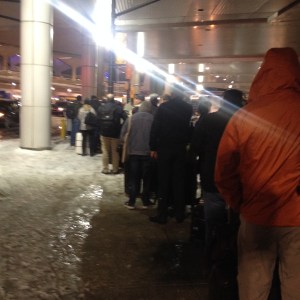
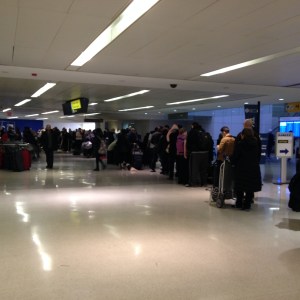
Now I have the United bastardization of Gershwin’s “Rhapsody in Blue” stuck in my head.  This comes from listening to the same recording approximately a quarter-gazillion times while on hold.  I expected to awake this morning in Denver, but instead I learned a very valuable lesson about refugees.  It went down like this: yesterday’s east coast storm over-performed while United Airlines under-performed.  Seeing the forecast, I changed to an earlier flight to try to beat it out of Dodge.  I arrived in Newark only to have my flight incrementally delayed until it was cancelled around 9:30.  By this time all the hotels within 11 miles of the airport were booked solid from earlier cancellations.  Taxis were running into Manhattan only.  Access to New Jersey Transit was not possible.  I’d been awake since the 4 a.m. text alert from United that said bad weather was on the way.  Finally, around 1 a.m. I found an unoccupied piece of floor and slept next to total strangers.

The experience opened my eyes to the plight of refugees.  Weary airline employees (probably worried about getting home themselves) were not friendly and didn’t welcome questions.  The line for rescheduling flights was, by no exaggeration, at least 400 individuals long, one of whom told me this morning she’d waited 8-hours to talk to someone.  Since cancelled flight baggage is not checked, it had to be retrieved, and the line for doing such was equally as long as the rescheduling queue.  United was under-staffed, stressed, and not in control of the situation.  Nobody wanted to listen to you.  You were just another stranger with a sad story and all of us have problems, don’t you know.  The refugee has no place to go.  Nobody to care.

With my aging cell phone dying, my lifeline to those who cared was fading.  The shops closed, cutting off access to food.  Ground transportation was not responsive.  Hundreds and hundreds of people were stranded, relying on their own wits (or in my case, lack thereof) to decide what to do.  I just wanted someone to say “Go here.  Do this.”  Instead I found myself wrapped in tweed, using my carry-on, Jacob-like, for a pillow.  I felt for the strangers around me.  They were suddenly friends as we were all in the same category—displaced people.  This nightmare lasted under 24 hours for me, but I am now keenly aware that it never ends for some.  Refugees need a caring glance.  A kind word.  And it would help if the powers that be would leave Gershwin alone.


Eternal Return

For those of you who don’t live, eat, and breathe academic religious studies, it’s my duty to point out that the American Academy of Religion and Society of Biblical Literature (AAR/SBL) annual meeting begins this week.  For those of us in the biz it’s like the sun holding still at Makkedah as we try to prepare for our various roles.  This year the conference is in warm and sunny Denver, so be sure to dress in layers.  The meeting was held in Denver many years ago now, and I remember very little of it other than it being the year my final published paper from my Nashotah House days was read.  Or started to be.

I don’t know whether it was the altitude or the time of year, but I wasn’t feeling well the last time we met in Denver.  Although it may not show on this blog, I’m really into geology and the city has a great mineral collection in the Denver Museum of Nature and Science.  I went out to look at the collection the morning of my paper and had the great embarrassment of being sick while in the museum.  I went back to my hotel for a nap and when it was time to read my paper I had to excuse myself because running my eyes across the lines of text made me nauseous.  Concerned-looking philologists didn’t know what to do as I sat through the session with my head between my knees.  That’s how I remember Denver.

Perhaps this year will offer redemption.  You see, it’s very different attending the conference as the representative of a press instead of an institution.  Your time is completely booked.  People want to discuss their book ideas with you.  For a few short days of the year you’re one of the popular guys.  But for me, there are colleagues from every stage of my career on hand.  Not too many people from Nashotah House come, although there are more now than there were when I was about the only faculty member who went.  I see those I knew from Oshkosh and Rutgers, Gorgias and Routledge.  Those I knew as friends before we became professional colleagues.  They’re not after me to publish their books, and sometimes that’s all it takes to make three days of popularity really count.  Later today I’m off to Denver and I won’t have time to see the sparkling minerals this time around, but hopefully I’ll remember it more fondly when its over.


Paying Troll

There was a time, should the media of my youth be believed, when a man insulted another man’s wife at his peril.  A barroom fight, or perhaps a sober brawl, would ensue.  Such chivalrous days are likely over and the internet makes nasty comments so easy to disseminate (how terribly masculine!) for all the world to see.  Hiding behind assumed names, avatars, or delusional fictions, you can feel like a big man by saying unkind things to a person you’ll never meet.  Such is the world of Trump’s America.  Although he may think himself divine, Trump didn’t invent Twitter or the internet.  Neither did Al Gore.  Still, the distasteful political rancor leading up to the midterm elections led to a man (I presume) trolling my wife behind a mask of Facebook anonymity.

It’s hard to tell how to react.  Feminism doesn’t always want a man to step in and defend, but we’re all raised with tales of princesses and those who honor them.  Having been raised by a woman with an absentee husband, I have nothing but admiration for strong women.  Although categorized as a “white man,” I can’t see my own brand as better than any other.  We are all human beings, and with some rare exceptions, we deserve respect.  Like all evolved creatures, however, I sometimes reach deeply back into my primate roots and the tropes of my childhood begin to simmer.  Who trolls another man’s wife over politics?  Who doesn’t stop to consider that every woman is a daughter and many are mothers and sisters?  If you want to pick on someone, well, you know how the saying goes.

The midterm elections brought some much-needed balance to a government way off kilter.  There are still trolls under the bridges, however.  The storybooks tell how knights vanquish trolls and even the liberated male can’t help but imagine himself on that proud steed.  What kind of man takes a keyboarded cheap-shot at another man’s wife?  The quality of his discourse speaks volumes.  Those on the left believe in equality and can’t respond in kind.  It is, ironically, a far more biblical response than trolling on the right.

I’ve lost readers of this blog due to politics.  Some of my former readers have even told me so.  I appreciate their candor.  We can’t all agree, I know.  What we can do, however, is be civil.  Those who put themselves in elected office know that they are opening themselves to criticism.  It is very hard to slander a United States president, in the words of the Good Book, “how the mighty are fallen.”  Those with thin skin should think twice (or even once) before running for the most criticized office in the world.  Most, until now, knew that what they said would set the tone for the nation.  We’re all entitled to an opinion, and, for the time being, are free to express it.  Still, I’d think twice before insulting another man’s wife.  But then, I’ve always been a hopeless idealist.


Goddess Lore

From where I sit to write this blog in this particular season (when it’s too cold to sit in an unheated attic) I watch Venus rise in the eastern sky.  While it is still dark, I notice a bright yellow glow appearing over the top of a business located on the eastern side of the block.  It hovers there a moment before disappearing briefly behind various rooftop accoutrements of the building across the street, appearing again minutes later on the other side.  The planet rises rapidly before sunrise, and with the unnatural markers of human structures, it’s fairly simple to keep track of her progress with occasional glances out the window.  Venus is, as I’ve mentioned before, both the morning and evening “star” of antiquity.  We now know her identity as a planet rather than a goddess, but we’re becoming more attuned to planets’ roles as mothers, or at least we should be.

Some ancient peoples considered our own earth as a mother.  It is the womb in which we gestate as living beings.  Without the warmth she gives we could not survive, and even our forays into nearby space are possible only with the replication of her body heat through artificial means.  It may be metaphor, yes, but metaphors may be truer than bald statements of chemical compositions and mathematical formulas.  Scientist, politician, or theologian, none of us survive without our planetary nurture.  This thought is sobering in the light of government policies over the past two years, which have denied that human pillaging of nature is problematic.  The Republican Party, which collectively lacks respect for our earthly home, has followed thoughtlessly in the tracks of a man proud of his refusal to read.  And so I look to Venus.

Venus is beautiful.  We know, however, that her surface is hot enough to melt lead.  Soviet-era probes landed there and melted.  Planets, it seems, can unleash fury that mere humans can’t hope to withstand.  One of the forgotten graces of nature, it seems, is the warning sign.  Even as the rattlesnake warns before striking, our mother has been sending messages that we’ve been going too far.  Hurricanes are growing stronger and threaten to scour us off the very face of the land we disrespect and exploit.  Venus, it turns out, is too hot to handle.  Mars, whom the ancients feared for his propensity to irrational war, is too cold.  It’s difficult to imagine where politicians think we might go when our own mother turns us out.  I would invite them over to watch Venus perform her morning dance outside my window, but to see it you must first believe in goddesses.


Centuries

Although it may not be obvious, history marks us as hopelessly shortsighted.  As a species we’ve only been keeping written records for about four millennia.  History, as we know it—without the intervention of gods—is an even more recent phenomenon.  Since living a century is a rarity (although becoming more common), a hundred years seems like a very long time.  Our lives spin out over a brief span of active decades until we run out of energy and let others make the important decisions.  We hope, against hope, that they will have learned from our collective mistakes.  Learning isn’t always our strong suit as a species.  In just one century we forget and arrogantly refuse to read our history.

One hundred years ago the War To End All Wars ended.  World War One was a slaughter on a scale unimaginable, involving nations around the world distrusting each other and hating one another enough to threaten all the advances of millennia of civilization.  When the war was over we thought we’d seen the last of conflict.  Two decades later it started all over again and the Second World War wiped out millions of lives.  The aggressors, known collectively as fascists, were strong nationalists, believing in racial superiority and privileged rights for those in power.  When that war ended, just about seven decades ago, a stunned world took little for granted beyond the awareness that fascism was, at least, gone for good.

Today we stand on the brink of a chasm that spans one century.  Fascists are in power in the United States and elsewhere.  International tensions are running high and the “leader of the free world” openly eschews reading history.  Protests against the war in Vietnam were largely prompted by the real-time coverage on television.  Now we have a world-wide web, but no basis for truth beyond the tweets of madmen.  For many people the decade-and-a-half that they spend in school seems a long time.  We used to believe that it took that long to learn what our restless youth need to survive in a complex society.  We teach them, among other things, history.  The need to learn from our past is perhaps even more important than technology.  My generation of academics, reaching over half-a-century now for many of us, has been taught that lifelong learning is the value we must instill in students.  Given that we’ve collectively had a century to learn, and that we’re still edging toward the same collapsing precipice, a hundred years seems not nearly long enough.


And Found

For a kid who grew up on a steady diet of television, I have to admit being out of practice.  A combination of Gilligan’s Island and Dark Shadows informed much of my young outlook.  Starting all the way back to our days in Edinburgh, my wife and I had stopped watching TV.  We were in our twenties then, and it was a matter of not being able to afford the luxury.  Back in the States, cathode-ray tubes were ubiquitous, but cable was expensive and my employers not generous.  We had a television but only watched very occasionally, and then only what fuzzy programs we could pick up on the aerial.  So it continued.  We’re now at the point of not having had television service for over half of our lives, and we understand from the younger generation that a good internet provider makes cable superfluous anyway.

This prologue is simply a way to introduce the fact that we have finally, after two or three years of watching (we still have little time for it), finished Lost.  Now, I don’t get out much, but I had heard people talking about it when it originally broadcast.  More importantly, I’d read about it in books published by university presses.   I knew going into it—spoiler alert for those even more behind the times than me!—that the castaways were in Purgatory.  That seems to have been the point all along, but when money keeps rolling in because the story is compelling, you don’t want to reveal your hand too quickly.  Last night we watched the final episode where what was suggested back at the beginning was made clear: the passengers of Oceanic flight 815 had died in the crash and were making up for past sins.

The role of Jack’s father (Christian Shephard) as leading the passengers to the light may have been a bit heavy-handed, but the church where they finally meet has the symbols of many world religions, conveying the message that there is more than a single path.  The truly surprising aspect of all this is how popular the series was.  There were religious overtones from the beginning, but since the series wasn’t preachy, viewers apparently didn’t mind.  Yes, as the star character’s surname indicates, people don’t mind being led.  In fact, the names of many of the characters are indicative of some of the paths up that mountain.  I have to wonder if those who vociferate loudly and longly about their religion being the only way might not learn a lesson from television.  Even if the suggestion only comes from someone who grew up watching Gilligan’s Island.


Giving a Hand

A friend sent me a news story that really spoke to me.  A bookstore in England, forced to move because of rent, asked for volunteers to help move their stock to a new storefront.  The response?  They had to start turning people away after 250.  A human chain was formed to pass books down by hand to their new home.  Book people, it seems to me, are like that.  I spent a recent weekend looking at downtown Easton—one of the triplet cities that make up “the Valley” (Allentown and Bethlehem being the other two).  Surprisingly, I found two used book stores within blocks of each other.  The proprietors (especially of the first) were friendly and helpful.  They were book people.

I mentioned to said first proprietor that two of the books I was buying were to replace copies ruined during our move.  The look of alarm and sympathy on her face was genuine.  Book people know that look.  They can feel each other’s pain.  They will freely give of their time to hold knowledge in their hands, if only briefly, to pass it along to others.  Now, like most bookish people, I’m aware that I’m considered odd by the average guy who enjoys sports, mechanical stuff, and money.  I’m content with a book, either reading or writing, and the occasional foray out among the more active and boisterous.  I like to think that if I lived in Southampton I’d have given up a vacation day to help out.  Saving books is saving civilization.

Book people know there’s more to life than themselves.  Ironically, such readers are often quiet and sometimes thought to be stuck up.  If you go to help move books by hand, I suspect that gives the lie to feeling above other people.  Reading is thought of as a passive activity, but it makes the mind more active.  There’s a reason our species have large brains.  It’s not that all books are for everyone—I’ve had plenty of disappointments in my reading life—but the unread book is full of potential energy.  And often that already read rewards us when we turn back to it.  Books, you see, are the ultimate givers.  Those who sell them may make a profit, but the return on investment tends to be quite high for the buyer.  If you have to move and you hire a moving company chances are they’ll complain about your books.  You’re better off asking book people for an unstinting hand.


The Myth of the Extra Hour

The selling point of an extra hour of sleep is, unfortunately, a myth.  I’m not talking about young people who can sleep on demand, but your average, everyday working body who adheres to a schedule set by the man.  Like many Americans I probably don’t get enough sleep.  Long years of habit are hard to break, and besides, I still have to commute into New York City.  Not every day, but every couple of weeks.  Still, my sleep-deprived brain knows that means awaking early on those days and since getting up extra-early is hard, why not maintain the status quo ante?  Habitual early risers don’t really benefit from setting the clocks back.  You see, you’re never given something without it being taken away again elsewhere.

Humans can’t seem to help themselves from messing with nature.  There’s always something to do on the farm, and other creatures don’t keep clocks.  Interestingly, standardized time (instead of the more natural local time) only came into being with the railroad.  Trains were scarce and to make sure those down the line didn’t miss one, time had to be synchronized.  Even earlier, the process of navigating the oceans required knowing what time it was back home—local time could be determined by the sun—to determine one’s longitude.   With railways, however, the nine-to-five could become the accepted norm so that business could be conducted and time could be divided into profitable and domestic.  And everyone knows which one is more lucrative.

No doubt some will wake this morning well rested.  Others will have stayed up later, knowing they’d have an extra hour this morning.  For the rest of us, biology moves us along the same trajectory it’d been keeping ever since March.  Daylight Saving Time could be instituted all year, you know.  When we set the clocks back in March we could just keep them there.  The slow, steady rhythms of time would adjust.  Yes, the gods of Greenwich would be annoyed, but mean time could mean time that is useable.  The modern commuter lives by the clock.  Work depended on that train or bus or camel.  You don’t want to miss it.  And if you think camels are an odd addition to the list, it could be that the present writer isn’t getting enough sleep.  No matter what longitude, or mass transit schedule, nothing beats a good night’s sleep.  And changing clocks doesn’t help.


Last Call

The alarm that wakes you in the middle of the night.  There’s something primal, something visceral about that.  We humans, at least since our ancestors climbed down from the trees, have felt vulnerable at night.  If our sleep is constantly interrupted we don’t think clearly.  We build secure houses. Lock our windows and doors at night.  Say our prayers before we go to sleep.  Last night I discovered that the homeowner has even greater concerns than the humble renter.  While 11:30 may not be the middle of the night for some, for early risers it is.  And there’s nothing to strike terror into the heart of a homeowner like a tornado warning.  Especially here—our realtor laconically told us that they never have tornadoes in eastern Pennsylvania.  The weather warning system disagreed with him last night.

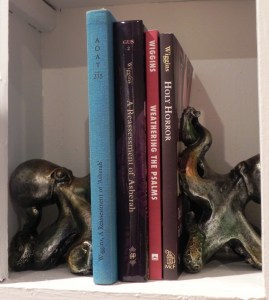
Getting up as early as I do, first light is hours away.  Hours before I might check for damage with the light of old Sol.  My wife had to work, no less, at a venue some distance away and we both had to rise early and wonder what the damage might be.  We knew, of course, that the pointless ritual of changing our clocks would occur tonight, but that does alleviate concerns about whether the roof was still on the house or not.  You can’t take anything for granted, not even the continuity of time.  Thus my thoughts returned to Weathering the Psalms.

Severe weather led to that book.  If I were to rewrite it now it would come out quite differently, of course.  No one would write the same book the same way after a decade and a half.  Still, there may have been some things I got right in it.  The weather is a cause of awe and fear.  The sound of the wind roaring last night was impressively terrifying, even in a technological world.  Especially in a technological world that relies on an unwavering power grid and constant connectivity.  In the midst of a wakeful night, alone with thoughts too haunting for the day, the weather has a power with which we’re foolish to trifle.  Global warming is a myth if it gets in the way of profits.  Then darkness falls and we realize just how very small we are.  In the light of dawn, the damage was not too bad.  A frightened car meeping its mewling alert.  And a strange justification that perhaps my book contained some truth after all.


Leftovers

It looks like I forgot to click “publish” yesterday, so my blog post never appeared.  With apologies for doubling up, I need to complete the trilogy today.  So here goes…

Unlike All Saints Day, which, we were told, was a day of obligation, All Souls Day, today, was not.  It was kind of a leftovers day.  Ironically, it developed into Día de Muertos—the Day of the Dead—along with Halloween and All Saints.  Yes, there are many who declare, and rightly so, that Día de Muertos is something different.  It is and it isn’t.  Cultures around the world have always felt that at this point in the year something odd was going on.  The carnal summer was becoming the spiritual autumn.  Thoughts of those who’d died come back.  So it is a three-day celebration—not officially recognized in the United States (it would interfere with business, which is, as we all know, a thing not to be imagined)—has become a commercial boon.

Still, not being among the saints, I have to wonder if the leftovers—All Souls—are somehow second-class citizens in the afterlife.  Does the social stratification we experience daily here carryover to there?  The view of Heaven among the poor is generally one of comfort and equality.  Fairness, which is in very short supply down here, will finally see the end of the moral arc of the universe, to borrow from a departed sage, bend toward justice.  And sharply.  The idea is ancient and powerful.  Primates of other species don’t object to having leaders.  They do, however, reject leaders who abuse power.  And so it is that we’ve evolved beyond that.  Civilization teaches us our place.

The Day of the Dead has become commercial, along with Halloween.  Why not stretch out the profits, which, after all, come from the leftovers?  There is a capitalist vision of Heaven, you see, and it is one we see working out on earth these days.  Those with money take power and use their money to buy more power that in turn leads to more money for them.  We call it “making a living.”  Those who are wise, however, recognize something deeper in Día de Muertos.  It is the time when we welcome family home, indeed, when family becomes more important than job, or status, or power.  It is a very human, if supernatural, holiday.  All Souls, it seems, has received less than its fair share of attention.  The Day of the Dead, in its own way, warms up those leftovers.


Like One of Us

Some envision America as a nation of—God help them!—only people like themselves.  This is Trump’s America, and therefore, the America of the Republican Party.  We can’t quite say it’s a white male America because there are many white males who simply don’t share that vision, but it is hate-filled enough to rouse bombers and shooters and Mitch McConnell.  American terrorists, in a word.  Yesterday, the Sabbath, saw a shooter in my familiar city of Pittsburgh who left 11 dead.  The response of Trump?  The synagogue should’ve had armed guards.  I propose that we ought to put walk-through metal detectors outside churches—better yet, full body scanners like they use at airports.  Might as well see everything the faithful bring with them.

Apart from the obvious tragedy of the innocent victims, another disturbing element of this horrific event is that Trump can’t see that his own rhetoric encourages it.  His mouth may say we shouldn’t hate, but his mouth says a lot of things.  Most of them lies.  His public posturing as the angry white man, the “Christian” bully, the Rambo of the Lord, has jarred people across the world.  When you rail against the media daily from the highest position in the land, you’ve got to expect sycophants (e.g. Republicans) to try to please you with their own acts of outrage.  What more cowardly way can one devise than to shoot those at worship?  Does 45 not understand that armed guards would make a very mockery of what goes on inside?  What do they teach at his church?

Coming up on two years ago, after election day, many people warned that just this sort of thing would happen.  Knowing that the Manchurian candidate they’d nominated couldn’t think for himself, the GOP decided it was a good time to polish up their hit-list.  Those who don’t belong in their white bread, white face, white male country.  This is evangelicalism gone wild, no, Rev. Graham?  Those who can think for themselves are not welcome in a party run by hatred so pure and rife that decent people feel they must take a shower after they leave its presence.  And what of the dead?  For the “party of Lincoln” they have died in vain.  They should’ve had armed guards, as if worship were some kind of dangerous, subversive activity.  The party of the NRA, formerly known as the GOP, has never watched The Witness.  It has never shed a tear for the dead.  And it most assuredly has never been to church, or synagogue.

Image credit: Musée d’art et d’histoire du Judaïsme, via Wikimedia Commons


Café Américain

What with the Republican approved method of mailing bombs to Democrats (and, interestingly, not vice-versa) I have to wonder if democracy is gone for good.  I recently watched Casablanca again with my wife.  What struck me about it this time around was how, although many of the characters clearly hated one another, they were civil—downright polite—unless safely locked out of sight by the Nazis.  It also struck me that in the 1940s Nazis were bad whereas now they are the legitimate nickname of the GOP.  It used to be calm, collected enemies playing by the rules even with their hatred intact.  Now politics has become gaming the system itself so that the other side can’t win to the point that Major Strasser looks like Colonel Klink.

I suppose what’s most distressing about all of this is that moderate Republicans have so quickly acquiesced to Trump’s agenda of hatred.  Not one speaks out against him, fearing his money.  Somehow they manage to sleep at night.  I’m guess that if they watch Casablanca they don’t see what some of us do.  There comes a point, when a game gets too serious, that most of us know to back off and do something else for a while.  When we were kids we knew it instinctively.  What began as playful rivalry started to feel like hatred.  The twelve year old knows that at this point it’s time to back away, otherwise it will come to blows and we will feel regret.  There is no regret in the Grand Old Party.  They only regret that Tricky Dicky didn’t get away with it.  Welcome to the most unfair democracy in the world.

Ah, but I digress from Rick’s.  It we come downstairs we will hear Victor Laszlo leading the band in “La Marseillaise,”a national anthem far more robust than bombs bursting in the air.  These, after all, are patriots, not panderers after personal power.  Even Major Strasser doesn’t start lobbing pipe-bombs in Rick’s Café Américain, and he orders Captain Renault to find a legal reason to shut the place down.  This is the rule of law, no matter how crooked.  In the end, however, Victor Laszlo and Ilsa Lund are on a plane to Lisbon, and Rick and Louis are planning their flight from the city to take on more noble pursuits.  The swamp in the desert has been left by those of any integrity, save the underground.  Casablanca, after all, translates to “white house.”


Headline News

Some headlines just can’t be resisted.  George Knapp: Christian Fundamentalists in the Pentagon Shut Down Government Paranormal and UFO Probes Due to Demon Fears” is one such headline.  It appears on the blog of Jason Colavito, a name I recognized from the book The Cult of Alien Gods: H. P. Lovecraft and Extraterrestrial Pop Culture that I read several years back.  Skeptical of many strange claims made, Colavito criticizes journalist George Knapp for some sloppy reporting.  If you go all the way down the rabbit hole, you will end up in some very weird places indeed!  What caught my attention here, however, is the connection between demons and UFOs.  More than that, the claim that government funding was deep-sixed for fear of the Devil.  (Has anyone else noticed that it’s October?)

This isn’t the first time I’ve read about this.  Having grown up Fundamentalist, I often heard talk of the Devil’s wiles.  One of the things he had his demons do, I was told, was fly around in UFOs to deceive people into thinking demons were aliens.  If this sounds far-fetched to you, remember that God made dinosaur bones to plant in the ground to test people’s faith in Genesis 1.  That’s just the kind of universe we live in.  Better get used to it.  The real problem, and one with which Colavito concurs, is that high ranking military officers (and other government officials) believe the Fundamentalist screed.  This is a matter of documented truth—much of our government policy is dictated by the evangelical agenda.  Stranger than fiction.

In 1952 there was a UFO flap in Washington DC.  No matter how you choose to explain it, this is an incident on the public record, and the Air Force responded with its famous temperature inversion explanation.  At the same time, some Fundamentalists were thinking that demons had improved on the bat-wings they’d been using for millennia.  They now zipped around in silvery discs with the same object as they’ve always had—to dis the Almighty.  As entertaining as such a story may be, it becomes scary when it might indeed be the motivation for government action.  I don’t know about you, but when I look at just how much of my meager paycheck goes to the powers that be, I want to know that rational people are spending it wisely.  Wait.  Well, I thought some of them were rational until a couple of years ago, about this time.  In any case, we do get some entertainment value for our cash, which is some comfort I suppose.  Keep watching the swamp!


Insecticide

Although Halloween is more about spiders than insects, a real fear seems to be swirling around the latter.  For the second time in a year, a study has been published indicating a precipitous drop in the numbers of six-legged creatures worldwide.  This is alarming because everything’s connected.  Loss of insects means loss of vertebrates that feed on them and that leads to loss of species upon which we depend.  The problem with “humans first,” simply “America first” writ large, is that all species are interconnected.  The loss of one will lead to the loss of others—that’s the way connections work—until the entire picture changes.  And it won’t be prettier.  Even for lack of bugs.

Scientists aren’t sure of why this is happening, but the likely culprit seems to be global warming.  Temperatures are changing so rapidly that evolution can’t keep up.  And since those in political power don’t believe in evolution—America first!—they have difficulty seeing how global warming—a myth!—could possibly pose any threat.  Just ask the wooly mammoth.  The fact is that the very small frequently offer the answers long before it’s too late.  The problem is you have to pay attention.  And that attention must be not on America, or Trump, or Kavanaugh.  The Supreme Court is jobless if there are no people left.  We are part of an ecosystem, and the silence of that ecosystem is very loud indeed.   Decades ago Rachel Carson wrote Silent Spring to warn of the dangers of pesticides.  In our short-sighted way, we responded by banning the most dangerous of them and turning up the heat.

We like to focus on the negative aspects of religion these days, but one of the overlooked benefits of it has been religions’ ability to shift focus.  Christianity, for example, has been an advocate of thinking of others before thinking of oneself.  Now certain elected officials seem constitutionally unable to think of anyone but themselves, but the fact is none of us would be here if it weren’t for the insects.  They work to keep our planet neat and tidy, even if we regard them as a sign of uncleanness in our houses.  Maybe not the lowest, they are one of the essential building blocks of the world we know and recognize.  And they are disappearing.  As Carson recognized decades ago, the loss of insects leads to a silent spring because the birds that feed on them will disappear.  And what about pollination—whose job will that become?  I suppose we could assign it to migrant workers, but we’re sending them away too.  America first will be America the silent and hungry.  Unless we listen to what the insects tell us.


October’s Monsters

Blood and vampires go together like October and, well, vampires.  Although I don’t understand manga, I do know it’s extremely popular, and a friend has been lending me the volumes of Hellsing by Kouta Hirano.  In the past couple of weeks I’ve read numbers 4 and 5.  Hellsing sets up a world where the Catholic church destroys vampires, as does the English, Protestant organization Hellsing Organization.  The latter, however, has as its secret weapon the vampire Alucard who, in nearly every number, gets dismembered in some bloody way before pulling himself back together to overcome the enemy.  In the latest issues I’ve read the Catholics and Protestants have to cooperate against the threat of neo-Nazis (and this was before Trump was elected), who also employ werewolves.  (It’s October, remember.)

Having been pondering the vampires of Maine, I decided to read the next in my own generation’s vampire hero, Barnabas Collins.  I’ve been reading the Dark Shadows series by Marilyn Ross to try to find a lost piece of my childhood.  There was a scene in one of these poorly written Gothic novels that made a strong impression on me that I finally re-encountered in Barnabas, Quentin and the Nightmare Assassin.  Interestingly, in this installment Barnabas, the gentleman vampire, is cured of his curse while traveling back in time with Carolyn Stoddard.  The story doesn’t explain how some of the characters from the twentieth century appear a hundred years earlier, but it does bring an early encounter of the vampire against the werewolf—an idea monster fans know from its many iterations such as Hellsing or, famously, Underworld.

You might think vampires and werewolves would get along.  In both the Dark Shadows and Hellsing universes the personalities of both come through clearly.  Both monsters have deep origins in folklore and people have believed in them since ancient times.  Just because they’re not human, however, is no reason to suppose they’ll get along with each other.  As soon as Universal discovered that monsters translated well to film the idea began to develop that monster versus monster would be a great spectacle.  We had vampires and werewolves clashing on cheap budgets with fog machines.  A new orthodoxy was created that the undead just don’t get along.  It’s a idea that continued into the relatively bloodless Dark Shadows series, and on into the violent and gleefully bespattered Hellsing.  And since it’s October nobody should be surprised.