Keeping Up

Perhaps this has happened to you.  When you reach a certain number of decades, it’s sometimes a challenge to keep everything in mind.  I confess to being impressed by young brains.  I admire the confidence of youth because truth does seem to depend on when it’s discovered.  In any case, I don’t always recollect where I’ve put things.  Online this can be a real problem—I have so many bookmarks that I could open my own bookstore.  The place that it really bothers me, though, is email.  Perhaps somewhat foolishly, I use email as my reminder.  I file or delete emails when I have time to do so, but the volume is often difficult to keep up with.  Most of it isn’t personal, of course.  People don’t wonder how you’re doing with all this email, probably because they’re trying to keep on top of their own.

In any case, many organizations like to send out reminders that your membership is about to expire many weeks in advance of it actually happening.  I’m not exactly flush with cash and I like to renew the week before expiration.  If I had a pile of gold I’d be glad to pay a month to six-weeks in advance, but I live in the real world.  So I let the reminder sit in my email pile, figuring, naively, that I’ll see it in time.  Well, I wouldn’t be writing this post if I actually did.  No, other emails keep on coming, forcing my reminders off the top page and into internet purgatory.  It takes at least a holiday weekend to have enough time to file all my accumulated emails and then I find them, cowering, shivering and cold, under the weight of tons of other, less urgent emails.

Some have suggested that I put them on my Calendar app.  The thing is, I forget to look at it.  Or I could “set a reminder”—that’s not a bad idea, if the email doesn’t arrive with a bunch of others so that I don’t forget about it before it gets bumped too far down.  You see, different people think in different ways.  We’re only really starting to recognize that.  Some of us function better when the reminder is sent closer to the deadline.  It’s not like you need the time to take out a loan or anything before making what still feels, to me, like a big-ticket item.  The regular bills, they keep on a-comin’ and they can’t be ignored.  To people of a certain number of decades, it’d be helpful to remind us a bit closer to the deadline.  It’s not like you even have to wait for the payment to arrive through something that used to be called the mail.


Evolving Holidays

Holidays evolve.  I noticed this Thanksgiving that protests against the origins of the holiday have grown.  The same is true concerning the “Christmas Wars” every single year.  Some holidays (of which we have relatively few in this country) are disappearing altogether.  What seems to have been overlooked, or forgotten here, is that holidays change over time.  Public analysts and early holiday promoters encouraged government recognition of holidays as a means of bringing the nation together.  It’s easier to do this if we recognize that holidays evolve and the general trajectory is toward becoming more and more inclusive.  There will always be those who protest the “secularization” of holidays, but they share a large part of the Venn diagram with those that believe the Bible is a science book.  Things change.  Evolution is real.

I’m not just writing this because Thanksgiving and Christmas represent holidays from my tradition.  It’s true that they represent what was the majority religion (Christianity) at the time they were established here, but I would be glad for holidays from other traditions to be added as well.  Americans need more time to rest and recharge.  Anyone who’s studied the history of Christmas, say, realizes that its origins aren’t really Christian.  It’s a combination of a Christian alternative to Saturnalia, the recognition of St. Nicholas (December 6), Germanic Yule, and the festival of Roman Calends to start the new year.  Among other things.  Early Christians didn’t celebrate Jesus’ birthday.  Nobody had any idea when it was, but a tradition grew and as it grew from diverse roots it became more and more inclusive.  Why should we protest a day when we can acknowledge its troubled past and look for ways to make it better?  Something for everyone.

Holidays bring people together.  I’ve been researching them for years and I’m amazed to see how those that survive eventually catch on and bring people together for a common purpose.  Think of Halloween.  Masking disguises who we are.  It’s a day when everyone is welcome.  There are those who protest it, of course.  But holidays need not be seen as triumphal celebrations of some past misdeed.  (Here’s a hint from history: almost no historical event is seen as positive from everyone’s point of view.)  Instead, why not embrace those few red letter days that we have and use them to seek a common purpose?  Why not encourage those in positions to make decisions to consider the good of a few more holidays?  Trouble can always be found, but holidays, if done right, may help heal.  It’s the way of evolution.


Reflecting Thanksgiving

Thanksgiving, the newest holiday horror movie, was released last Friday.  No, I haven’t seen it—I barely have time to do whatever it is that I do normally.  I suspect, however, that many will object because Thanksgiving is still a quasi-religious holiday.  If we’re giving thanks we must be giving it to someone, or something, that may or may not govern our lives.  Ironically, in many business calendars it is the only annual four-day weekend.  Christmas could come on a Wednesday, so we can’t go giving time away!  Ironically, Thanksgiving was fixed as the fourth Thursday of November (moved from the last Thursday) to ensure about four weeks of shopping time before Christmas.  Me?  I’m just glad to have a couple days off.  2023 has been a challenging year on a personal level and having a couple days out of the office is just what the doctor prescribed.

Photo by Priscilla Du Preez on Unsplash

It may seem strange to be thankful for horror movies, but I know I’m not the only person whom they help.  I also believe that the genre has been misnamed.  When you think of all the different kinds of films that get lumped under the moniker it really is odd that we have any idea at all what we’re talking about.  What are horror movies, then?  The common equation with slashers is patently wrong.  There’s nothing slash-like in the old Universal monster movies that started the whole thing.  Time and again critics point out that “horror” is generally intelligent, and often funny.  And not infrequently therapeutic.  Yet it has a bad name.  Some even consider it satanic although it produces good.  Being satanic is a matter of how you look at things.

Thanksgiving is a time for reflection.  Reflection without the distraction of work constantly trying to poke holes through our concentration.  The holiday season properly starts at Halloween and sadly ends at New Year.  It’s our reward for having made it through another one.  The holidays that fall into this season all have a great deal in common.  Early Americans celebrated Independence Day, Thanksgiving, and sometimes Christmas and New Years.  We’ve reached the point now where we have a distinctive string of holidays like stones across a rushing river.  We can just make it from one to the next.  From Halloween we can see to Thanksgiving.  From today Christmas is on the near horizon.  New Years follows only a week after.  And it’s a time for reflection and thankfulness.  Even if what we appreciate isn’t the same as everyone else.


Not What It Seems

Now for the local news.  The ironic thing is I know very few people locally and even though folks are friendly around here nobody really wants to get to know you, it seems.  But that’s not unique to this area and it’s off point.  No, locally some months ago The Satanic Temple (which I’ve written about before) tried to start an after school club in an eastern Pennsylvania school in response to an explicitly Christian after-school club receiving sponsorship.  Of course it caused local furor.  That’s what the Satanic Temple intends to do.  The members do not believe in, let alone worship, Satan.  They exist to try to counter Christian hegemony, often in the form of courthouse lawn Christian imagery, or, as in this case, biased treatment to Christian groups wanting to use public property, such as school facilities, to promote their religion.

The reason I’m bringing this up is to show how the Christian agenda raises your taxes.  According to the ACLU, this school district, after challenged in court, has agreed to pay $200,000 and it must allow the Satanic Temple to meet if it allows Christian groups to meet.  That hefty chunk of change (enough to buy a house in this area) has to come from taxpayers because the school board (until a recent election) was controlled by a right-wing group that played the Christian narrative and apparently supposed the Satanic Temple was really a Satan-worshipping group.  It’s not.  The Satanic Temple is a national organization whose goal is to maintain freedom from religion in government and publicly funded spheres.  “Satanic” causes shock and panic and the sheep scatter.  And local citizens foot the bill.

Although I understand what they’re doing, I really don’t like to see my taxpayer dollars having to be spent to coddle the egos of groups who spread the narrative that Christianity is the only religion allowed in America.  In fact, one of the truly fascinating things about this country is the wide varieties of religions that exist in it.  Although the melting pot metaphor has fallen on hard times lately, I’ve always felt this was one of America’s biggest charms.  We’re a Frankenstein’s monster of a nation that’s just like the creature—not really a monster, but not like anything else you’ve seen.  Cookie-cutter populations seem to lead to wars and hatred.  Celebrating difference, indeed, encouraging it, leads to peace and shared prosperity, if we’ll let it.  It’s only when we want to keep all the good stuff for ourselves that things begin to break down.  And your local taxes go up because a faulty narrative is on the agenda.


Buy Books

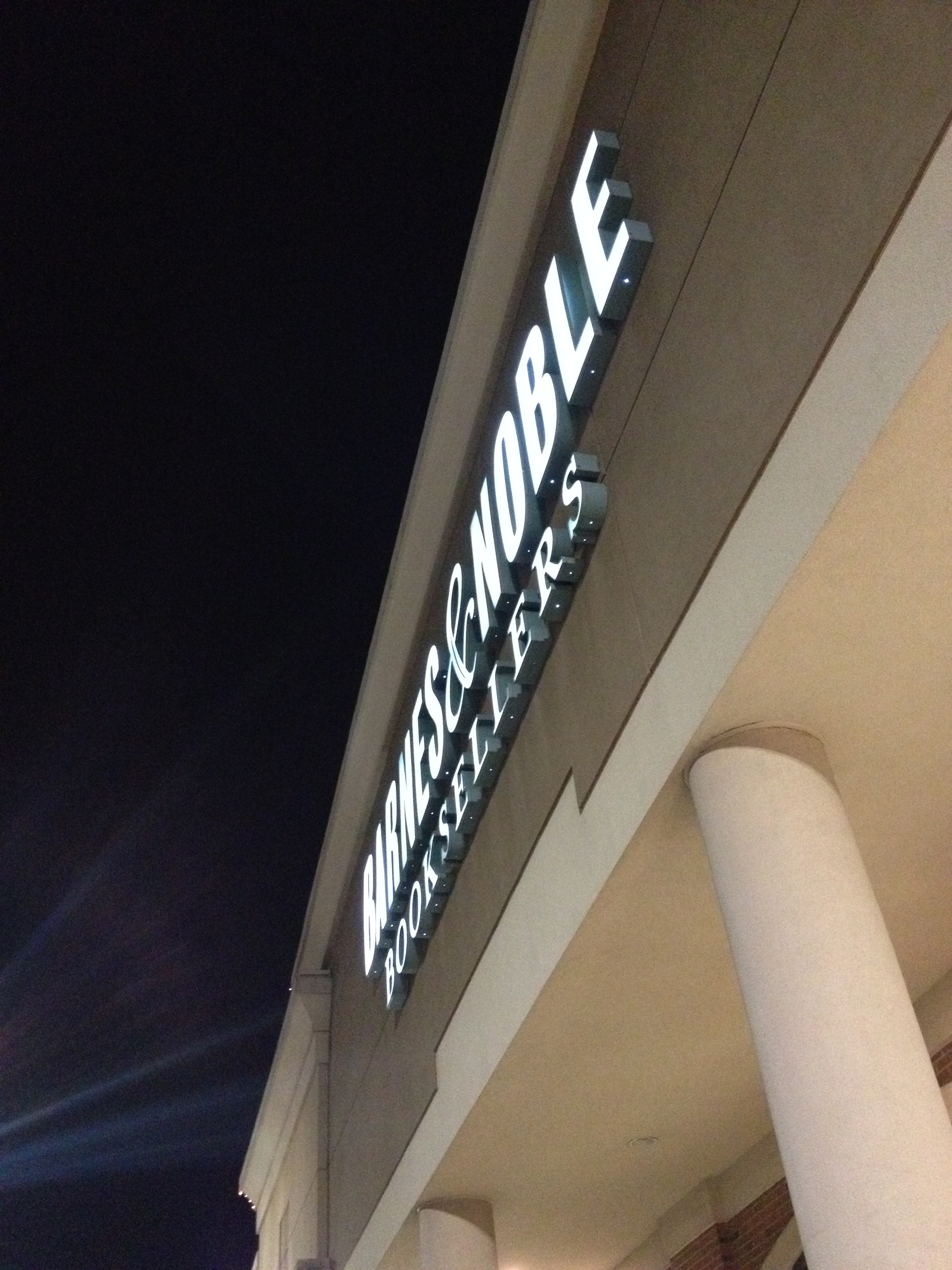
It’s funny how the bad guy can become the good guy in new circumstances.  I’m thinking in the bookstore context.  Now, I love independent bookstores.  I shop in them whenever I can.  Still, I had a genuine fondness for Borders.  My wife introduced me to Borders when I moved to Ann Arbor to be with her.  Borders was headquartered in Ann Arbor and it was our go-to for browsing.  (This was before Amazon, of course.)  Compared to Barnes & Noble it was intellectual and inviting.  B&N had gone for the corporate stodgy aesthetic that drives me frantic.  We literally mourned when Borders closed, spending hours in the New Jersey stores as they were selling off stock.  There was a long time when Amazon seemed the only game in town.  Our part of New Jersey had no indies, but the B&N sat on the hill.

Then B&N started having trouble.  By now I worked in publishing and seeing the only brick-and-mortar outlet crumbling was scary.  We need to fight the ebook invasion.  To do this we need bookstores!  (Fortunately we have a few good indies where we live in Pennsylvania, but even so, at least two of them have closed in the last five years.)  Then something happened.  James Daunt bought Barnes & Noble.  Daunt was known as an innovative British bookseller.  His stores (I’ve only seen pictures) are the thing of dreams.  Could he steer this corporate stodgy ship into open waters?  It seems to be working.

A piece in a recent New York Times praises the new B&N effort.  Instead of stamping “one size fits all” all over his business, Daunt wants his stores to take on local flavor.  Not look like every other B&N.  And it seems to be working.  I still prefer my indies, but the last time I was in the local B&N I noticed subtle changes that can come when a corporate overlord hands a local manager a bit of autonomy.  The stores are looking better.  And folks, let me be frank here.  Christmas is coming and books, real books, need your help.  Silicone Valley is trying to force us onto our screens for even more hours of the day.  I get off work and pick up a paper book to read.  To look at something real.  To connect with the actual world.  Support your indies, but don’t feel guilty about ducking into B&N.  It may not be the place you remember.


A Century of Horror

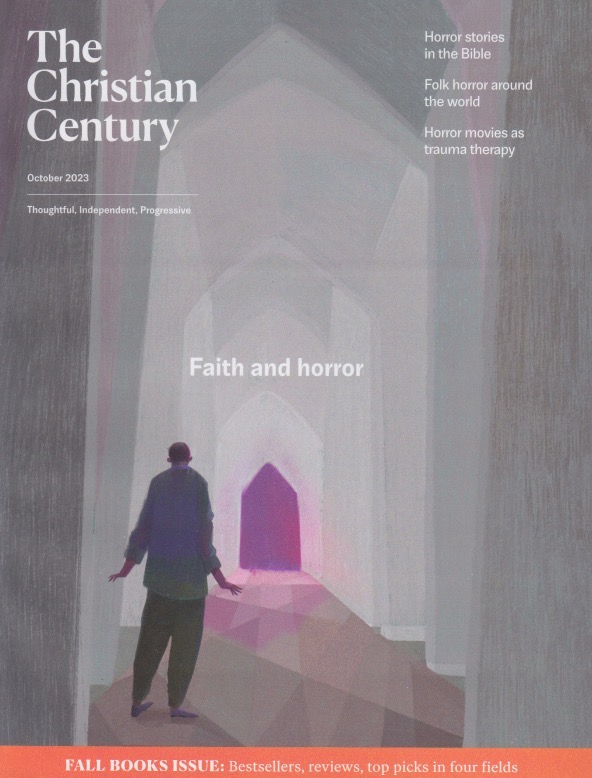
I’m not a magazine reader.  When I go to a waiting room (which is quite a bit lately), I tend to take a book.  The October issue of The Christian Century, however, caught my eye.  As a more mainstream/progressive Christian periodical, CC used to circulate in the office of one of my employers since it features books, the way progressives generally will.  This October, however, it featured five articles on “faith and horror.”  I had to take a look.  I know three of the five authors, one of them without realizing he was a horror fan.  An article by Brandon R. Grafius, “The monsters we fear,” discusses the commonalities between fear and religion, ground that he treats in Lurking under the Surface.  “The wisdom of folk horror” was written by Philip Jenkins—I didn’t know his horror interest—and it engages, briefly, The Wicker Man.  He’s making the point that folk horror is often about somebody else’s religion.

It was “Horror movie mom” by Jessica Mesman that really hit me.  Mesman was traumatized in her youth, and like many of us who were, has turned to horror for therapy.  This is a moving piece and is worth the cover price of the magazine.  Gil Stafford’s “A theology of ghosts” also gave me pause.  Stafford is an Episcopal priest who considers ghosts to be more than just woo.  In this very personal piece he thinks about what that means.  The last feature, “God’s first worst enemy,” is by Esther J. Hamori, one of the colleagues who talks monsters with me.  The piece is adapted from her recent book, God’s Monsters.  Taken together these pieces are quite a mouthful to chew on.  While numbers in mainstream Christianity are declining, Christian Century is still a pretty widespread indication of normalcy.

When I wrote Holy Horror I only knew about the work of Timothy Beal and Douglas Cowan as religion professors writing on monsters and horror.  That book admitted me to a club I didn’t know existed—the religion and monster crowd.  Since I’m not welcome in the academy, I’m particularly drawn to pieces like Mesman’s since she’s writing from the heart (as is Stafford here).  I’m just glad to see this topic getting some mainstream coverage.  I know I’m a guppy in this coy pond, but I do hope they’ll consider, over at the Century, turning this into the theme for their October issues in coming years.  If they do, they can count on at least one extra counter sale.


The Jonah Treatment

A kayak on the ocean might’ve seemed to be a safe place during a pandemic.  In November of 2020, however, two women ended up getting the Jonah treatment.  While it happened some time ago, the story appeared in Slate just in August, so the world is learning about it after a few years.  At least those of us who hadn’t seen the viral videos before.  Julie McSorley tells how she and a friend were paddling out to see some humpback whales along the California coast.  Then, like a scene from Finding Nemo, bubbles started to well up around them and they found themselves briefly in the whale’s mouth.  They escaped unharmed since humpbacks don’t eat mammals, being baleen whales.  Apart from the natural fascination of the story, what caught my attention was the reference to Jonah in the log line.  As Heather Schwedel notes, few people “outside of storybooks and the Bible” have actually been inside a whale.

Image credit: Gustave Doré, Illustrations of Baron von Münchhausen, public domain via Wikimedia Commons

The typical biblical scholar response is generally somewhere along the lines of, “the Bible says ‘great fish,’ not whale.”  This may be true but we don’t possess a biblical glossary for the animals, real and imaginary, in the Good Book.  Ancient Israelites were neither great seafarers nor precise describers of nature.  There are many strange references to animals in the Bible with no certain referents in the world we know.  Not being oceanographically inclined, biblical authors wrote “great fish,” a term that was still used to describe whales up to Melville’s time.  But we now know there are other big fish as well.  Whale sharks, for example, and if you’ve ever watched River Monsters you’ve likely seen catfish large enough to send shivers down your spine. 

The funny thing about the book of Jonah is that the point of the story is often overlooked for the splashy action.  There’s a moral to the story.  It’s all about not judging others because they don’t belong to your group.  Jonah has already condemned the Ninevites as godless idolaters.  The book teaches that such judgment isn’t a human prerogative.  But we simply can’t get past that image of a whale, or great fish, swallowing a guy and digesting him for three days.  Like Jonah, Julie was spit back out by the whale.  It took only a matter of seconds since, despite what Pinocchio shows, the interior anatomy of most whales won’t allow living space for a long weekend away from home.  Julie McSorley and her friend emerged relatively unharmed.  McSorley even says it was a transformative experience.  One might even suggest it could be a spiritual one.


Asking Questions

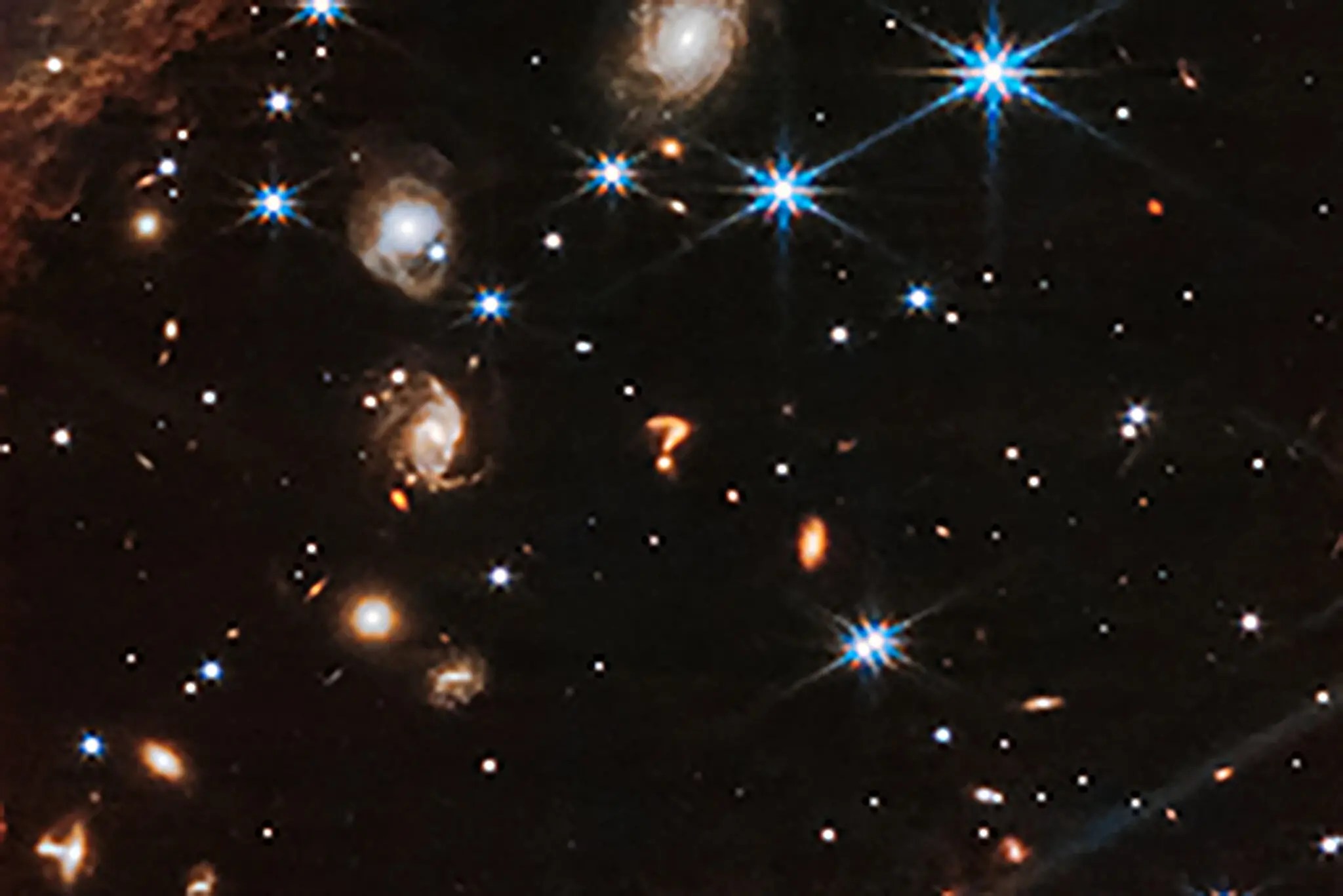
Strangely appropriate pareidolia is one of those oddly specific things that generates a lot of internet interest.  I was late to find out about the “question mark” in space photographed by the James Webb Space Telescope.  Okay, a couple of things: photographs, like the one below, taken by U.S. Government agencies are in the public domain (thanks, NASA!).  This one can be easily enlarged on the James Webb Space Telescope webpage.  To see the “question mark” you need to start from the center red star and look down to the two bright blue stars just to the left of center.  The image I’m using has been enlarged so that it’s obvious.  Serious news outlets have discussed this, but it’s clearly a case of pareidolia, or the human ability to attribute specific meaning, or design, to something that’s random.  We see faces everywhere, but question marks are somewhat less common.

Photo credit NASA: public domain

Given the state of the world—people like Trump able to continue scamming millions of willing believers for his own benefit, hurricanes hitting California, Putin going to war against the rest of the world, capitalism, war in the Holy Land—it’s no wonder that people like to think a big question mark is hanging over everything.  Looking into the sky we expect to see God.  Isn’t it a little disconcerting to see a huge query instead?  I, for one, think it might be best if we learn to recognize false signals rather than seeing some giant message tucked away in some small corner of the universe in the hopes that we’ll turn our seeing-eye telescope that way.  What font is it anyway?  Does it violate some cosmic copyright?

Some signs are, I’m convinced, for real.  I think they tend to be on a much smaller scale.  Way down here where  we can see them.  What appears to be, from our viewpoint, a question mark may be seen as an exclamation point from a different angle.  It’s all a matter of how we look at things.  One of the most important lessons of life is that people see the same thing from different points of view.  If we can accept that, others don’t seem so threatening and strange.  In a small planet plagued with xenophobia, it’s important to discover strangely appropriate pareidolia every now and again to get us thinking about the deeper issues.  We may not find the answers, but often asking the question is the more important thing to do.


The Good Lurid

It takes a lifetime to make a reputation.  In high school my teachers and classmates knew mine well: religious and full of integrity.  Going on to do three degrees in religious studies confirmed all that (at least the former).  Something that nobody seemed to pick up on was that I liked watching monster movies.  I did less of it in college, but still watched some heavy-duty fare (including David Cronenberg) when I was in seminary.  Once I married life looked more optimistic and I really didn’t feel the need to watch what is called “horror” any more.  Sure, we occasionally saw films everyone was talking about, but in general I moved away from the genre.  It took Nashotah House and its aftermath to bring me back.  In any case, my reputation seems to be such that now when people who know me see religion and horror together they think of me.  I’m touched.

A regular reader of my blog sent me an article from The Guardian titled, “Schlock horror! Meet the family who made lurid movies for the Lord.”  It should be pretty clear, if my integrity is intact, that what I’m trying to do is figure out how these things fit together, religion and horror.  That they do is obvious, but how?  In any case, this article plugs a book by journalist Jimmy McDonough, The Exotic Ones.  The book explores the Ormond family and their odd filmmaking.  The father, mother, and son triad, made a living producing cheap, questionable films.  After a plane crash, which they survived, they became religious only to find their minister wanted them to keep making their bad movies for evangelistic purposes.  The films they produced for the church had religious themes, but used well recognized horror tropes, anticipating, if you will, Left Behind and its ilk.  Like a Thief in the Night scarred many of my generation.

I’m probably not alone in not recognizing any of the movies the article discusses.  If I’m reading correctly, Tim Ormond, the son and sole surviving family member, stopped making these films after the death of his parents.  In any case, I have been developing a fascination with bad movies.  The fact that they’re even made and released is incredible to me (mostly the released part).  Many of us end up reacting to life rather than following the plans we had for it.  Fate—call it what you will—has a way to stepping in.  For one family, however, fate led them to a church that paid them for what they wanted to do.  Many of the rest of us find just the opposite and we end up watching horror to try to understand.


What Message?

The search for autumnal horror movies is a never-ending one.  Can it really be that auteurs just don’t—drenched in the California sun—get that October feeling?  There’s something in the turning of the leaves and the appearance of pumpkins that changes everything.  And it works every year.  So it was that I thought of The Messengers.  I’d watched this years ago but found it somewhat unremarkable.  I seemed to recollect that, being based on a farm, it was autumnal in character, so I decided to try it again.  I remembered once more why I hadn’t watched it for years.  It’s a serviceable movie, but it is really set in summer (short sleeves the whole way through) and although August farm visits put me in the fall mood, this one is incoherent enough to prevent that feeling from catching on.

Jess is a girl with a past.  Driving under the influence, in Chicago, she was in a crash that rendered her baby brother mute.  In response her parents decide to move to a sunflower farm in North Dakota.  There the crows (actually ravens) attack them.  A stranger arrives and offers to help out.  Of course the house is haunted because of some past murders, but when the crows attack the hired help, it spurs him into a relapse—he’d lived here before and had killed his family, and so he decides to kill this new one too.  Being PG-13, they survive and the house swallows up the murderer from the past.  It’s never quite clear what the crows (the presumed messengers) really want to convey.  Are they trying to warn the family?  Are they trying to awake a killer’s memory?  What do they want?

This is an early Kristen Stewart movie—she’ll go on to more sophisticated horror films.  William B. Davis, with only cameo appearances, offers echoes of The X-Files.  Casting the generally congenial John Corbett as a killer is a bit of a stretch, however.  More intriguing, in this more global world, are the directors—the Pang brothers.  Known for their east Asian movies, including award-winning horror, they took on this American-themed, shot in Canada, project.  It had the backing of a few production companies and a reasonable budget.  Still, it struggles to be memorable.  I seem to recall that the prequel might’ve been a bit better.  But was it autumn-based?  I can’t recall and it’s that time of year when seeing falling leaves and a pumpkin or two make for essential viewing.


Final Thoughts

You feel kind of special running stop signs and red lights.  I’ve never driven in a funeral cortege before but this one is somehow taking place on an obligingly rainy October afternoon.  Although I was in that kind of emotional shock that you feel at the death of a close family member (it isn’t my first), I couldn’t help but consider all those behind the scenes who work in the death industry.  From the mortician at the Gardinier-Warren Funeral Home—where my grandmother’s funeral was also held—to the undertaker getting soaked in the chilly rain, everyone was friendly and kind.  I also reflected that watching horror movies is homework in a world where death is inevitable.  As a child I already knew about death, and although I’m not afraid to die, I’m not eager to have that particular experience just yet.

Horror movies are all about learning to cope.  Not so different from the book of Job, they’re reflections on why “the good life” doesn’t continue as it sometimes does for various stretches of a human life.  And as we age, death more and more naturally comes to mind.  I’ve written before about the therapeutic aspect of my odd avocation.  One of the realities of growing up religious is that my mother—may she rest in peace—taught me early on that this would be my bodily fate.  I found it disturbing seeing my grandmother in her casket.  I remember distinctly Mom telling me, “this is just her shell,” that her soul had moved on.  That didn’t prevent nightmares of that shell rising and walking again.  Is it any wonder I grew up watching horror films?

Reflecting afterwards with my brothers on our physical ailments—we aren’t young any more—my thoughts wandered back from time to time to horror movies that had made this just a little easier for me.  Life is full of opportunities to do our homework.  As I grew up reading the Bible and watching horror, I didn’t think of it as studying, but it was.  Many kids with whom I went to high school have died over the years.  I tend to look at the alumni magazine necrologies even as medical science improves our chances of surviving some of nature’s more dreaded diseases.  Life comes with no guarantees and horror films reinforce that it’s not a bad idea to think of some of these things ahead of time.  Afterwards, at one of my mother’s favorite local overlooks, I reflected on how I have a lot yet to process.  Homework never ends.


Personal Psalms

I haven’t heard it yet, but a New York Times article encourages me to.  Paul Simon has joined the ranks of those aging music stars to record albums presaging their deaths.  The article was about Simon’s latest album, Seven Psalms.  And, yes, the religious reference is pretty hard to miss.  Like most kids from the sixties, I grew up hearing Simon and Garfunkel on the radio.  We didn’t have money for albums, but I always liked their songs when I heard them.  After their breakup I really didn’t pay much attention to Simon until Graceland, and since then I’ve listened with half an ear.  You see, I’m wired in such a way that I can’t listen to music while I write.  Or read.  My mind grips one thing at a time.  That means I don’t listen to background music much.

That doesn’t mean I don’t appreciate music.  I do.  Almost religiously so.  On occasion I come back to Simon, with or without Garfunkel.  I posted about his song “Werewolf” some years back.  I eventually listened to that album, and I’m not sure I got it.  Artists are that way.  Some pieces you like, others are just okay.  I am curious about Seven Psalms, though.  I’ve posted about David Bowie’s Blackstar, Leonard Cohen’s You Want It Darker (both discussed in the Times article), and Bruce Springsteen’s Letter to You.  No longer young myself—these guys were young when I was a kid—hearing them reflect on death is powerful, and, if the mood is right, peaceful.  We fear death because it’s unknown.  And also, we all know, deep down, that we’re flawed.

Psalms aren’t necessarily biblical, of course.  Sinead O’Connor’s “Take Me to Church” is a psalm.  So is “Sounds of Silence.”  Artists have been writing psalms for as long as they’ve been writing songs.  The biblical psalms are among the most quoted bits of literature in the western world.  They were likely originally sung as well, but we can only guess what they may have sounded like.  We know that across the world people turn to song to express strong emotion.  I’m not sure what Paul Simon’s Seven Psalms might be, but it seems that thoughts of mortality go naturally enough with emotion.  I don’t write much about music because it’s so deeply personal.  I try to be intellectually honest on this blog, but if you want to talk music you really have to get to know me first.  Then I’ll reveal my psalms.


Mom

Mom

I just became an orphan.  I tend not to write about other people without their permission, but I have a few words to say about Doris Ruth Miller.  First of all, she was a saint.  I’m often accused of putting the needs of others before my own, and this is something I learned from Mom.  She set me on my lifelong course of reading the Bible, determining, in some inexplicable way, what I call a career.  Mom was born April 7, 1935 in New Jersey.  She was the youngest, and last surviving, of five siblings, and the only girl.  When I reached that age when children (as adults) get curious about their parents, I asked what town she was born in.  By that stage she couldn’t recall, but at one point she told me Cherry Hill, and at another, Asbury Park.  She never finished high school and never had any job training.  But she always believed.  She was faith personified.

She married to get away from a difficult relationship with her own mother.  My father, who died twenty years ago, was an alcoholic.  They had three sons together.  Mom, very aware of Dad’s condition, didn’t believe in divorce and stayed with him until she no longer felt safe doing so.  Not for herself, but for her sons.  Her life revolved around her children.  She eventually remarried and her final son was born.  This marriage involved a move to Rouseville, Pennsylvania—I’ve written about it before—my last childhood home.  Neither of her marriages were happy ones, but she was determined about two things: maintaining her faith, and caring for her children.  She believed unquestioningly and the only book I ever saw her read for herself was the Bible.

I only found out over the weekend that she was in rapid decline.  Circumstances (medical and financial) had kept us away for far longer than I would’ve liked or hoped.  I talked to her on the phone nearly every other day and told her with joy just about a month ago that we had finally got a car that would enable a visit.  We were planning on spending Thanksgiving with her.  The universe, which operates on its own timetable, had different plans.  Mom was a remarkable woman.  She was not afraid of death and she embodied these famous words from Paul of Tarsus: “O death, where is thy sting? O grave, where is thy victory?”  Mom lived eighty-eight difficult years.  She dedicated her life to others and lived the Gospel by example.  I miss her terribly, but I have no doubts about her being among the saints.  Thanks for life, Mom, and for showing how to love unconditionally.


Down to the Sea in Ships

On the final day of our Charleston odyssey we toured the USS Yorktown, an aircraft carrier dry-docked at Point Pleasant.  One of my uncles served on the Yorktown between the Korean and Vietnam wars and was able to show us around.  What really struck me, as often does with military matters, is just how advanced our engineering is when it comes to war.  The aircraft carrier was invented to meet a belligerent need: to convey aircraft close enough to other nations to support air strikes against “targets” there.  These targets consist of living, breathing human beings, at least in part.  But the technical problems, where I’d rather focus this post, were formidable.  How do you land a plane moving at 200 miles per hour on a moving ship with limited runway?  And how do you do it without tearing the plane apart from the sudden deceleration?

Carriers have steel cables stretched across the landing strip.  A tail hook on the plane, or later jet, would catch a cable, wound several times below deck to increase the ratio of force (as with a pulley), to add enough play to stop a plane without the forward motion tearing it apart.  Five cables stretched across the deck and the ideal was to catch the third one for an optimal landing.  Each landing (which could take place 30 seconds apart) was filmed and analyzed for improvements.  Listening to the technical nature of all this, and knowing that such things had been invented some eighty years ago, made me wonder, yet again, at how creative human beings are.  And made me ponder why so much of our creativity goes toward war machines.  Just think of the problems we could solve if we all worked together!  Instead, Putin covets Ukraine, Trump covets everything, and we fall in line behind them.

I’ve written on such topics before.  I took a self-tour of the USS Midway while in San Diego as part of a business trip back in 2014.  The tech there was perhaps a bit more advanced as this was a nuclear carrier.  Standing on this deck, however, thinking how this one ship costs more than I will earn with a lifetime of education and employment, leaves me a bit reflective.  Those who push for wars are often those on their knees praying for the second coming.  The rest of us, content with the first coming, think how the message of love and peace seems to have been swallowed by a whale.  But this ship is larger than any whale, and, I’m told, much, much more expensive.


Waiting for the Sun

Waiting.  It’s difficult in the best of circumstances.  It’s even harder when dealing with multiple sources of delay.  For example: it has been unseasonably cool around here for a few months.  Looking at the US weather maps, it looks like we’ve got just about the coolest temperatures in the lower 48.  September is usually reliably a month where you don’t need the furnace in these here parts, but that’s not the case now.  A slowly moving weather system has blocked the sun for days and our poor old house just can’t warm up.  I feel like Noah waiting for some sign of hope.  The weather apps all say, “oh, two or three more days…”  Endurance, I remind myself.  Stoicism.  Still, we need some sun about now.  But that’s not all.

In addition to wearing three heavy layers and my fingerless gloves (in September—and this will last until May!), I’m also doing my prep for a colonoscopy.  In case it’s been a while—that means a liquid diet for a day.  I need to wait until this time tomorrow to have anything to eat and my teeth are on edge because the allowable fluids tend to be sweet and I really need something salty with a bit of crunch about now.  I see I’m allowed ice pops.  But did I mention that it’s cold in here?  If it were a normal year at least one of these two things wouldn’t been an issue at this point in time.  Nobody that I know of looks forward to a colonoscopy.  I know I’ll barely sleep tonight and the whole situation ends up looking downright Dickensian.  Chilly, hungry, persistent rain.  All I really need at a time like this is just some indication that the following days might improve.  Don’t look to the Weather Channel for support.  No, rely on your Stoicism.  Endure.

The trick I usually use on myself is to dangle a small carrot—lunch will be in just three hours!—to get through a long, chilly day.  (You’ll be able to eat something hot…)  I suppose giving up caffeinated beverages a few years back (when the last colonoscopy was well forgotten), might’ve been a poor decision.  I sure could use a Thermos of coffee right about now.  And one of those solar headbands that tricks you into believing you’re getting some sun.  Hey, September’s my second favorite month, after October, so shouldn’t waiting be just a smidge easier?  I’ve been waiting for September since last November.  And still I wait.  Such is the human lot in life.  Endurance is important, I know.  But a peek of sunshine (haven’t seen anything like it for three days) in September—is that too much to ask?  Or at least a hot meal.  What would Zeno do?  (Of course, he did live in sunny Greece…)