Excavating Religion

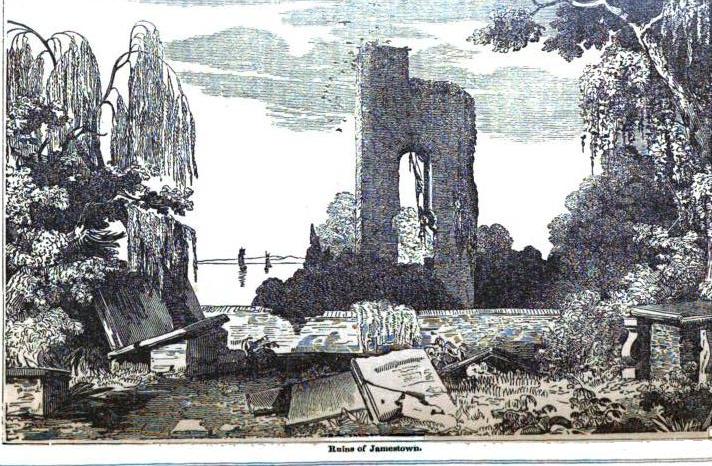
Jamestown, Virginia has the distinction of being the first British American colony to have survived. I’ve only been to Jamestown once, and that was about two or three years before the site was scheduled to celebrate its four-hundredth anniversary. William Shakespeare was still alive back in the home country. The King James Bible was not yet available. It was a gray day when we drove to the site and there were no other people around. Without a guide there was not much really to see—just a sense of being in touch with history by standing where the first English would eventually remake the land in their own image. Even the pilgrims tried to reach Virginia, but missed and landed in Massachusetts instead. Jamestown, however, lays a claim no other site can make.

A recent BBC article describes four graves lately found at the site. Located in the church, those buried were men of status. One of them was Reverend Robert Hunt, a clergyman of the Church of England and the first Anglican minister in North America. Interestingly, the BBC story points out, the Church of England was only half a century old at the time. Having spent many years among the Episcopalians at Nashotah House, I learned a great deal of the church’s history. The fact that the Episcopalians made it to America so shortly after their establishment is something I never heard emphasized. Concerned that the Catholic Church, under Spain, was collecting so much territory, the C of E wanted to stake a claim in the New World early on. Partially because of their persistence, we speak English even today. Church and empire were hand-in-glove in those days, and both the church in Spain and in England were state sponsored. Having God on your side can be pretty handy when you want to claim something that really doesn’t belong to you.

The reverend was buried west, facing the people he served, and, according to the article, this helped initially identify him as clergy. The church, in the service of the government, supported the conquest of new lands. The implicit belief that God was on the side of the strong has never really gone away. Mega-churches measure their spiritual assets in terms of fiscal influence. There are those today who believe that the Almighty wants the righteous to be rich, of course, at the cost of the wicked. Jamestown may have, at least partially, set the tone for a new nation that wanted to take more land than it needed. Land that others had occupied, and indeed, still lived upon. Only with the backing of a deity could such claims be made. The biggest god, after all, wins the day. Jamestown tells us more than we might suppose about what we’ve become as a nation. The early years are often the most formative of all.

Jamestown_Virginia_ruin


Time and Again

One score and ten years ago, I graduated from college. I also enrolled in seminary and worked in a United Methodist summer camp. I bought my own car and worked as a bag boy in a grocery store. I also met my future wife. Last night we watched Back to the Future, the sleeper hit and highest grossing film of 1985. There’s been a bit of buzz about it because, discounting the sequels, Doc Brown wants to travel thirty years into the future, yes, 2015, which seemed impossibly far off back then. I have to think his envisioned 2015 was more advanced than what we’ve actually managed. Technology, instead of sending us to Jupiter like Arthur C. Clarke imagined, has instead focused on the incredibly tiny. We now do finally have Dick Tracy wrist-phones with real-time images, but we’re still pretty much earth-bound and our rockets are aimed at other people rather than outer space. Instead of fighting aliens with lasers, we’re shooting fellow humans while at church, synagogue, or mosque. Instead of presidential candidates who want to see how far we can go, we’ve got a stagnant pool of people who want to turn the clock back to, well, 1955.

Back_to_the_Future

Don’t get me wrong—this is a fascinating time to be alive. Just yesterday I sat down to recollect the number of computers we’ve purchased as a family and what each could and couldn’t do. Our first couldn’t connect to the internet since no such thing existed. Our first laptop—which we still have—weights as much as a current desktop and has a black-and-white screen. Now we walk around with the internet in our pockets, never really disconnected from a web in which, I’m sure, lurks a huge spider. But back in 1985 you could make quite a few, as it turns out, false assumptions. Church attendance was healthy and would always continue so. We had space shuttles and were looking to walk on other planets. Rock had matured into a provocative mix of selfishness and social protest. Despite the president of those years, things seemed to be improving.

In Back to the Future, Marty McFly returns to the same Hill Valley he left. A fictional town, I noticed last night, that had a seedy downtown square with adult themed stores and movies. The 1955 square had bullies and manure trucks, but a cleanness that was only on the surface. When Marty’s DeLorean reappears in the square in 1985, he crashes it into a Church of Christ. Although this detail had escaped me before, now it strikes me as somewhat prophetic. Thirty years into the future and, like Marty, we are backing out of the church into an age of nones. Our nones not only refer to our religiously unaffiliated, however. We have nones who’ve lost faith in our government, our economy, and our worldview. Instead of going to Jupiter, we stare at our palms. And like Doc Brown, we look back thirty years with nostalgia and wonder at how wrong we are when we believe in the status quo.


Last Chance to Sea

I wasn’t brave enough to don swimming trunks in front of academic colleagues and climb into the Dead Sea. Instead, I dipped a finger in an touched it to my tongue. I’m not sure if it was the bromides or some other toxic minerals, but I immediately wretched and knew that I wouldn’t be putting any Dead Sea salt on my chips. Years later, for comparison, I tried a bit of the Great Salt Lake. Disappointing, to say the least. Already by the time I’d visited the Dead Sea it was dying further. In a recent article on NBC entitled “Thousands of Sinkholes Threaten Dead Sea’s Tourism Industry,” the fate of a sea already dead grows even worse. Water is always an issue in dry climates, and the only real source for renewing Dead Sea water is the Jordan River, which is being dammed and used for human purposes, robbing the Dead Sea of its renewal. The sinkholes are a result of underground salt deposits being dissolved by fresh water as the salty matrix gets siphoned away for industrial chemical farming. Dead Sea levels have dropped 100 feet since 1980.

The Dead Sea is one of the most striking regions on the planet. It is as far as you can go below sea level and still be on dry ground (at least on the shore, that is). The air smells like sulphur and the thickness of the atmosphere at that depth protects you from the sun’s rays, despite the heat. The water is so saline that only bacteria can live there. (The article, ironically, states, “it is very difficult for animals and plants to thrive there.”) By comparison the Great Salt Lake is practically drinking water. Famously, people are unable to sink in the Dead Sea, as its salt enhances buoyancy, so that you can read a newspaper while floating on your back. Like most natural wonders, humans are destroying it. The sinkholes are prophetic, I fear.

363px-Dead_Sea_Galilee

Great evaporating beds line parts of the Dead Sea shore where minerals can be obtained without having to dig into the earth. You can buy some as cosmetics at the local mall. These mineral salts are what make the Dead Sea what it is. And it is shrinking. Satellite imagery of the Sea can bring salty tears to my eye. We’ve slowed the flow of Niagara Falls, and we’ve begun melting our polar caps. Even so, we can’t get enough water to sustain our lifestyle. It has been said that the next major war will not be over oil, but water. Even a glance at California can make me thirsty. In a rare show of cooperation, Israel, Jordan, and the Palestinian Authority are building a pipeline to bring Red Sea water into the shrinking Dead Sea. I hope that this might bode well for the future in the region. Although there is no love lost between these neighbors, they all realize that something unique lies on their border, and when it’s gone it will be a loss to the entire world. That is the real Sodom and Gomorrah.


Martian Ethics

MartianIf you need a boot of optimism, look to Mars. Or, more specifically, read Andy Weir’s The Martian. Not that it’s the greatest literature ever produced, but it is a story brimming with humanity. Mark Watney is accidentally stranded on Mars. His crew-mates, in the midst of their multi-month-long return journey, adjust their course to go back for him. Naturally, nothing goes as planned. Although much of the story is far beyond the believability scale, Weir has the technical background to make it all sound plausible. As an engineer, Watney fixes most problems with an optimism that would leave many humanities specialists weeping in the dust. Time after time a potentially fatal situation develops that is solved by technological ingenuity. Relying on his will to survive, and good humor, the protagonist makes a remarkable journey across the surface of the Red Planet to a potential means of escape. I shouldn’t throw too many spoilers into this post since the book is fairly new. I will say it left me feeling good about being human.

Part of being human is thinking about larger issues. Often, throughout the book, Watney wonders about belief in God. Not enough to make it a main theme, but enough to merit mention on this blog. In a somewhat humorous moment, one of the mission controllers says that he’s Hindu, so he believes in lots of gods. In contrast, Watney, alone on Mars, has a vastly different perspective. Without divine intervention, or even any aliens, he finds a way to persevere when the Fates (or the author) have stacked the odds against him. Mark Watney believes in himself, and he believes in human goodness.

The decision of his crew-mates to return for him is one of potential self-sacrifice. There are no guarantees that they’ll survive. Nevertheless, there’s no second thoughts. When they learn Watney is alive, they decide to go back, no matter what might happen to them. The story awoke a strange optimism in me. Although people are capable of horrendous acts against each other and the planet, I do believe that we are basically good. The bad ones make it into the news. We could all be better, I’m guessing. Still, we will help others when we can, even if all we get from it is the good feeling that we’ve done the right thing. Unfortunately, the only people, it seems, that don’t have the best interests of others at heart are our politicians. Watching the posturing before the primaries I do have to wonder if one wouldn’t stand a better chance abandoned on Mars than in the land of the free. This may be one of the times, it seems, that trusting in human goodness might well be equated to a prayer.


The Reign of Rain

I’m on vacation for a week. My job is such that taking vacation is becoming a rare commodity, what with precious few allotted days and move-in, move-out schedules of a collegiate child, and so on. And also company policy about keeping employees in the office between Christmas and New Year. Anyway, now that I’m here I should be kicking back and enjoying the beautiful lake and getting out to do the things inmates of the city seldom do. It has, however, rained every day that I’ve been here. Not all-day rains, of course, but just enough that plans have to be interrupted or changed at the last minute. I end up sitting in the cabin playing Solitaire when I should be out getting some fresh air. So it goes.
Ironically, I am staying in the drought-stricken west. The western United States, I learned when researching for Weathering the Psalms, has been ensconced in a decades’ long drought. In fact, prior to my family trip here it hadn’t rained in quite a while. Our arrival with the clouds was, after all, mere coincidence. Still, it’s hard not to take the weather personally. I know that the weather is larger than any one person’s needs or desires. I also know that water is a commodity even rarer than vacation days, largely because of our misuse of the limited supply that we have. California’s plight has been in the news. We have large cities in water-challenged environments and people treat water like there’s no end to its abundance while the opposite is the case. Just thinking about it makes me thirsty.
There are many things a person can go without, some of which feel absolutely essential at the time. Many vacations, I know, are extravagant. Fancy hotels, high-priced entertainment, exotic locations. Work can feel so crushing that vacation my become the one island of sanity in the midst of a hostile ocean of obligation. For me, vacation is time with family in a stripped-down, natural setting. Of course, we do indulge in some of the comforts of home, but having nothing in view outside the window beyond that which nature dictates is a transcendent experience. From where I sit, I can see nothing of human artifice. I do see clouds, however. I know that more rain is on the way. And I know that it is a gift, complain as we might, of the highest magnitude.


Ancient Tech

I feel like scraping Roman numerals on the wall of my cave with a sharp rock. One for each day I have to spend without my laptop. I’ve been working on this blog, born in this very cabin in which I sit, for six years now. With some exceptions, I’ve posted something new (and, I hope, thoughtful) every day. Even holidays and weekends. Most of those posts have been written on the deceased laptop that’s sitting in my carryon, electronic carrion. This has caused me to stop and consider that the most lasting words—the ones we all quote or at least recognize—tend to come from a far older form of communication technology: the pen and paper. Of course, there are older technologies yet. The Sumerians figured out that clay of the right consistency keeps marks made by a pointed reed pressed into it while it was still damp. Cuneiform writing lasted for millennia as the most advanced technology humanity had devised. The results, however, were bulky, heavy, and fragile. Few could learn the technique. It was an elite skill.

Nobody quotes the Sumerians anymore. Well, maybe the occasional quip from Gilgamesh will work its way to memory, but not much else readily does. The Bible, perhaps the most quoted book of all time, at least in western culture, wasn’t written on clay. By the time the earliest books of the Bible came along, scrolls had been developed. Probably suggesting itself from the way that papyrus naturally rolled up, this early form of paper—indeed, the word “papyrus” gives us our word “paper”—could be marked up with styluses or brushes and ink. Prepared animal skills, or parchment, sometimes called vellum, could also be used, but they were expensive. Pens at this period were sharpened objects dipped into ink, but the most famous words, well, penned by humankind were passed down in that medium. Copied, recopied, memorized. Electricity hadn’t even been discovered yet.


Printing presses and their children—typewriters and the consequent qwerty—have led the way since they were invented. Until, however, the 1980s at least, professors would accept only the old fashioned manuscript for papers. Indeed, the medium had given its name to the end result. We still write academic papers, although they are more often published and read electronically. So here I find myself in a cabin on a beautiful lake, surrounded by nature, worried about a communication device that can speak with the stars. There may not be workable clay here—the soil is far too sandy and I don’t have the patience to look up how to make clay on my phone—but there is paper. Pens are scattered everywhere. I am at home in the matrix that has given us the great ideas of humankind.


Musical Magic

IMG_2327


In-flight magazines aren’t a place I turn for inspiration. Having been raised in poverty, I’ve never found the jet-set interests to be at all engaging. I can’t turn my brain off, however, even when on vacation. Still, I hate to miss anything and I know I’ve got plenty of time in the air ahead of me. I was flying Alaska Air, so the in-flight magazine possessed a native exoticism. This particular issue focused on music. Music reveals a tremendous amount about the interior life, it seems to me. Some people live their lives to a constant soundtrack, while others listen to music seldom. Music, like religion, has the capacity to stir profound pleasure centers in the brain and, if I might be so bold, where your music is, there your heart is also.

One of the music festivals highlighted in the magazine was Voodoo Music and Art Experience in New Orleans. Right across the page was Sasquatch! Music Festival in Washington state. This unusual juxtaposition caught my eye. New Orleans, in the popular imagination, at least, has an association with the “exotic,” hybrid religions of the Caribbean. Voodoo is particularly feared by those who believe that somehow the supernatural can break into this mundane realm. Magic, although difficult to define, persists even in Richard Dawkins’ neatly ordered world. What better way to celebrate it other than music? There’s a homespun charm to it. Magic, despite the best efforts of many, won’t go away.

Since I was flying to the Pacific Northwest, the Sasquatch! Festival demanded my attention. Sasquatch, while disputed, has become the gentle giant frequently connected with magic. The stigma associated with believing in a New World ape has been eroding slowly, although it’s still on the list of “woo” factors for many. Like Voodoo, Bigfoot is an American concept that keeps a belief in magic alive. Well, we were in the air by now, and many had their earbuds in, passing the time with their own soundtracks. For me, music is often looking out the window while making no demands on that probable harmony the rational know as magic.


Social Media and Persia

A story appeared on the BBC recently about “sin free Facebook.” The website, which started in Brazil, is based on the idea that users don’t like having swear words and violence among their friends. According to the story some 600 words are banned from use, making me think that I’m seriously behind the times. With an “amen” button and a keyword of “bless” Facegloria has been growing dramatically. Some 100,000 friends are now on board. Of course, the concept of friends in a religious conceptual context goes back to the Quakers, but they tended not to use computers, if I remember my history correctly. The odd thing, to me, is that on social media you get to select your friends already. If you don’t like what they post, why are you friends?

Sin is going through a resurgence of academic interest these days. One of the features that emerges from all this exploration is that sin is not as clearly defined as we might think it is. Wrong and right. White and black. Things in their proper order. In the biblical world the word “sin” seemed to mean missing what you’d aimed at. From there it grew to cover all kinds of infractions. Today most people think of sin in sexual terms—those things you aren’t allowed to do. Ironically we call other things phrases like “hate crimes” rather than “hate sins.” And crime is supposed to make it worse, since sin is often not illegal. Or if it is illegal, it’s not often brought to the law.

800px-Forbidden_fruit

I have a Facebook account, but I have to confess to not looking at it much. My days are busy and although the marketing departments of publishers use Facebook, those of us with editorial roles are seldom encouraged to spend time on it when we could be doing something more valuable. I arrive home so late I don’t even check my email before bed. I guess I haven’t had the time to notice the sin on Facebook. Yes, a few of my friends use what Spock might term “colorful metaphors,” but I seldom feel the need for confession after reading a post or two. My friends, like me, are fallible and many of them are in less-than-ideal circumstances. I really don’t think social media with further restraints would help the situation. Of course, I could use an “amen” button on this blog, I suppose. I think I’d rather have it read “verily,” though.


One Flew Over Cthulhu’s Nest

Pluto is a metaphor for the ultimate of outer limits. Just one of many largish objects in the Kuiper Belt, Pluto for a while held the status of the final planet in the solar system. With the photos from New Horizons coming in, we’re discovering a world more complex than most have imagined. It’s not just a snowball after all. With discovery, of course, comes naming. The planets are all named after Roman gods, just as our weekdays are named after Germanic deities. The features on our celestial neighbors often bear more prosaic names, such as those of astronomers or decidedly non-mythological human beings. As the rules of nomenclature go, the first to find claims the privilege to christen. What shall the new features of Pluto be called?

I was gratified when the New York Times photos displayed the informal names by the New Horizons’ team. There is a large area called “the Heart,” but lurking to the lower left there’s a feature being called “the Whale,” or, more appropriately, “Cthulhu.” The internet breathed new life into H. P. Lovecraft’s literary fame. Like most writers, he remained obscure for his entire life, finding really only one publisher who favored his work. Genre fiction has always been considered the bargain basement of literary artists, and Lovecraft wrote in the lowest part of that basement, horror. (Okay, well, romance might be further down, on purely literary grounds.) Only within the last few years has horror literature begun to be recognized by academics as worthy of serious exploration. Nevertheless, it was as the Monster Boomers grew up—or failed to—that Lovecraft reemerged. The world-wide web has become the lair of Cthulhu and of his minions.

Far out in the most remote reaches of our solar system, Cthulhu awaits. Lovecraft fans know Cthulhu is one of the Old Gods, but that he is also a being from the stars. His murky, dark presence has thrived on the underworld of the internet, and now has fired imagination on the darkest planet of an obscure solar system. What more could a writer dream? A fictional creation being suggested as the name of a planetary feature. H. P. Lovecraft lies decomposing under the loam of Providence, Rhode Island. His imagination, however, has reached as far as, at least to date, humanity can possibly go and find some kind of land beneath our feet. And that land, appropriately enough, is peopled with monsters. The Old Gods lie dead but dreaming, and they will rise again.

15-152


For the Sake of Fighting

Different opinions can be used for discussion or destruction. In the formal context of government, the declaration of war is—or should be—an option of last resort. Increasingly language of belligerence is status quo ante when religion is the topic. “Culture Wars” is a thinly veiled reference to the profound disagreement between social conservatism, associated with Evangelical Christianity, and progressive policies, often affiliated with nones and mainline Christian traditions that don’t wish to be left behind. For years, decades, no one side can declare victory, for example, in the debate over whether America was founded as a Christian nation. Two news stories I saw this past week addressed just that question. Fox News ran a story about a Baptist Church in Shelby, North Carolina, that has decided to fly the Christian flag over the stars and bars until, well, I guess the Second Coming. Protesting the legalization of gay marriage, the congregation wants the message, aided by Fox News, to spread that in at least this corner of the country, God comes first.

The other story, on CNN, asks the question directly: “Was American Founded as a Christian Nation?” With five professors answering the question there’s bound to be differing opinions but all agree that this isn’t a simple yes or no answer. The even larger question, it seems, is how can the founders’ religious orientations help us to avoid cultural wars? Isn’t the fact that we’re still searching historical documentation over two centuries later an answer in itself? Maybe they didn’t tell us directly because it was none of our business. Washington, Franklin, and Jefferson are quoted on both sides of the debate. Their cultural context was Christian, but as all the five scholars agree, the question didn’t become a live one until the nineteenth century. Seems that we got along a century without knowing.

The “Culture Wars” may have been there, of course, but the need for a term only arose in the late 1980’s and early ’90’s. The divide had been simmering since the end of the ’50’s, however. Leave it to Beaver versus Star Trek: the Next Generation. The media has never been shy about telling us what to think. Difference of opinion is as natural as a pre-frontal cortex. Peaceful coexistence, however, doesn’t sell newspaper or commercial airtime or space. We want the thrill of danger, the chance to declare that, unlike the adversary, we are clearly in the right. Maybe if we changed the metaphor the rhetoric might catch up. In the meanwhile, battle comes to mind. Ironically, the Bible is a place that suggests peaceful solutions to many disagreements, but neither side thinks to look there for guidance.

438px-Husité_-_Jenský_kodex


The Last First

Pluto_by_LORRI_and_Ralph,_13_July_2015

Pluto used to be a planet. Humans, in our unfaltering confidence, have downgraded it to a sub-planet, a dwarf planet, as if we know how big a planet ought to be. Even so, the arrival of New Horizons at the mysterious ice world has us all interested once again in the has-been wanderer. For ancients looking into the fixed stars of the night, the planets were all mysterious. They move against the backdrop of the stars that always maintain their places. When the planets came to be named, the gods suggested themselves. Our modern names, of course, reflect the Roman borrowings of Greek gods. Many of the Greek deities go back to ancient West Asia, where even Zeus has a strong counterpart in Hadad, or Baal, and Aphrodite is recognizable as an aspect of Ishtar.

Pluto, or Hades, was the ruler of the underworld. He was known to be decidedly rich since, well, if you can’t take it with you, someone has to inherit. Pluto, like the devourers of Ugaritic mythology, was forever hungry. Insatiable. This association of wealth and death gives us our word “plutocracy,” rule by the rich. As Bruce Springsteen sang, the poor want to be rich, and the rich want to be kings. “And a king ain’t satisfied til he rules everything.” Who says mythology isn’t true? As New Horizons flies by, we will learn more about the hellish world perpetually frozen so far from the sun. We wonder if perhaps we’ll learn more about ourselves by peering into the farthest rock from our star, Sol’s youngest child. Hades was the brother of Zeus, the king of the gods. Even Zeus had to dispose of the Titans to claim that title. In a scenario going back to ancient times, the younger generation—those we recognize as gods—struggled to make it to the top. As the paper describes it, Pluto is the last first—the last “planet” that is being closely examined the first time.

I grew up in a nine-planet solar system. I recall learning of Clyde Tombaugh’s discovery of Pluto, marveling at the math and patience required. Now that we’ve reached the outer fringes of our solar system, our little piece of the galaxy, we’re still uncertain how to occupy the earth. Many claim that science will vanquish religion completely, and that those who believe are hopelessly superstitious and uncritical in their thought. And yet, if we were to take a close look inside New Horizons, this technological wonder that has reached the farthest point of our sun’s gravitational influence, we would discover a small package of Clyde Tombaugh’s ashes inside. The man who discovered Pluto is the first to actually go there, although he’s been dead for nearly two decades. Even the most stoic of scientific minds must pause for a moment and appreciate the profound symbolism of this illogical gesture.


Headliners

I sometimes wish I was a journalist. Just this past week a couple of people questioned my journalistic skills for an opinion piece I wrote for Religion Dispatches. I’m fully capable of professional research, but who has the time? Still, being a journalist might be fun. Thinking up clever headlines would be challenging day after day, but nevertheless, it might be enjoyable. Editors who lay the articles next to each other on the page must have a sense of irony. This past week in the New Jersey Star Ledger the central headline read “Killer tightens its grip on N.J.” The column to the right began “Christie to mingle with the uber-rich.” Having lived in New Jersey under Christie’s entire reign, I’m no fan. I’ve despised bullies since I was a kid, and rich bullies are worse than the working class variety. New Jersey certainly seems no better off to me. Now he wants to be President.

FullSizeRender

The real headline, however, about the killer in New Jersey is not yet another prison-break story. It deals with heroin overdose deaths. According to the article, per 100,000 people in the U.S. 2.6 deaths are from heroin overdose. In New Jersey the figure is 8.3. New Jersey, as the most densely populated state (1200 people per square mile, I once read) has its share of problems. Most of us like to pretend that drugs are somebody else’s issue, but I’ve known addicts and they are not evil. When life offers you unrelenting recession after recession and all attempts to better yourself run up against the 1 percent, frustration is inevitable. Even earning a doctorate will only lead to jobless misery. What more can you do than get an education? Heroin is dangerously addictive and it makes the user feel great, I’m told. Society doesn’t offer many other options. At least in Rome they had bread and circuses.

He who would be President, however, can’t be concerned about that. The uber-rich must be fed. And fed. And fed. Those whose ambition to high public office is naked power would be foolish to ignore their fellow plutocrats. Down here on the streets, things look a little dicier. Although I think I understand why many turn to chemical relief, I’ve never been tempted by drugs myself. One of the reasons I turned to religion was the prevalence of drug use in the town where I grew up. There seemed to be no future in substance abuse. I may not have chosen the most promising of ways to move ahead either, in retrospect. Now I find myself living with a governor who represents all that’s wrong with government. And if you’re going to die of drug-related despair, it seems like his particular state is the place it’s most likely to happen. Long live the king!


Forbidden Words

800px-Norsemen_Landing_in_Iceland

In keeping with the spirit of freedom, just before July 4 the BBC broke the story of Iceland’s blasphemy laws having been struck down. Although the state Church of Iceland (Lutheran by denomination) supported the move, other churches have been grumbling. It’s an odd notion, that blasphemy should be illegal. Part of the oddity revolves around disagreement of what blasphemy is. Even if taking the name of God in vain is used to define it, several questions remain. Which name of God? Certainly “God” is not a name, but a title. Is taking the title of God in vain blasphemy? What does it mean to take a name in vain? If you don’t mean it? I’ve surely heard many invoking the divine in curses that were most certainly sincere. Were they blaspheming? Does blasphemy really mean failing to believe in God? And, pertinent to Iceland, which god is protected under such laws?

Religious pluralism is the clearest threat to those supporting blasphemy laws. Underlying to very proposition is the idea that there is only one true God and that is the God of Christianity. Judaism might be tacked on there, as might a reluctant Islam, but the notion of blasphemy does not seem to bother the deities of other cultures as much. Honoring and respecting belief in deities is fine and good. In fact, it is the decorous way to behave. Still, privileging one deity as the “true god” protected by state statutes is to bring politics into theology. Since when have elected officials really ever understood what hoi polloi believe? In Iceland the old Norse gods have recently come back into favor. Should they be respected to? Why not as much as the Christian God?

It is perhaps ironic that the Pirate Party put forward the successful bid to strike down the law on blasphemy. According to the BBC, the Pirate Party began in Sweden and has now established itself in 60 countries. Since it’s fight for accountability and transparency in government, it’s sure to have a hard time in the United States where bullies can run for President unashamed. What is clear is that although governments make and enforce laws, the will of the people seldom makes itself heard. We may have won some victories in recent days, but there are many entrenched ideas that benefit those in power and not their underlings. Sounds like the Pirate Party may become the Democratic Party of tomorrow. If it does, however, when it loses sight of the ideals that launched it, we may need a new party to board the ship and ask for the people to be heard. Politely, and without swearing, of course.


Only Takes a Spark

Fireworks have been the main event for Independence Day celebrations ever since I was a child. The fourth of July is a day for playing with fire. As a child I remember spending the meager allowance I had on sparklers and snakes. I haven’t seen one of those ash snakes for decades now, but the impression they made remains strong. A plug of some kind of carbonish material—you’d light the top with a match and it would flame and hiss and start to grow into a long, twisting exoskeleton of ash. They left a blackened circle on the sidewalk, and when they were cool enough you could try to lift the fragile snake in your hand, but it almost always broke apart before blowing away in the breeze. We also wasted our money on smoke bombs with their multi-colored smoke, but we never had actual firecrackers. Given the trouble we could make with an ordinary roll of caps, that was probably a wise decision on our mother’s part. All of this, however, was just a prelude to the fireworks.

As I sat under a cloudy sky last night wondering why every July fourth seems to rain, it occurred to me that fireworks are a violent form of celebration. Indeed, they are designed to imitate the sounds of battle—before the nuclear age—and we all know the thrill of when the loud, bright burst of pure light sends a shock wave through you. It is like a canon rocking your soul. Like many stirring experiences, fireworks had religious overtones from the beginning. Invented in China, fireworks were used for religious festivals. They were believed to be effective at driving away evil spirits and bring good fortune. Pyrotechnics, however, clearly have military applications as well. It is this strange nexus between religion and violence that makes, I suspect, fireworks displays so compelling.

IMG_2287

The local display here in Somerset County, New Jersey, was impressive for a region without large cities. I couldn’t help pondering the strange aesthetics of contained violence as the colorful explosions took place over my head. Illusions, I know. We always talk afterward about whether some of them are meant to represent anything. Did you see a smiley face, the United States, or even New Jersey? It depends on your angle of view. Is this a religious display or a celebration of violence? Looking around at the amazing diversity of peoples gathered here in this park with me, I feel strangely satisfied. I hear languages I don’t understand, and see people from all over the world here for a good show. Although thousands of us try to get to our cars at the same time, spirits are positive, for the most part, and all go home in a celebratory mood. Maybe the ancient Chinese were right and these pyrotechnics do drive away evil spirits after all.


Ethics for Rent

Ironically, the Bible is the basis for the western preoccupation with land ownership. What with commandments against stealing and coveting, the Israelites had a sense of being promised a land by God. It was their land and no human motivation—including imperial conquest—could trump the divine will. In the western world, so heavily influenced by the Bible, the concept of private property is itself considered sacred. If enough land to sustain yourself is good, even more land than you need must be better. That’s logic. Land-grabs by the powerful are nothing new. In America (land stolen from the original owners) no better symbol of affluence exists than property ownership. Like many things biblical, this is often a myth. Although I’m a white, Anglo-Saxon, straight, Protestant, I grew up among renters. My family couldn’t afford a house. When my mother remarried, my step-father owned his house and it was in such bad shape that as soon as he moved out to a rental property, it was immediately razed. On my own, I’ve always been a renter because I couldn’t ever afford to be anything else.

After Nashotah House, my wife and I considered buying. Wisconsin, apart from having no jobs, seemed like a nice place to settle. We researched. Your mortgage payments should be no more than 30 percent of your income, we learned. Living in suspended animation since those days, we’ve rented in a variety of places and the 30 percent figure has also turned out to be a myth. Affordable housing, in the United States, is set at that benchmark. A recent news byte in the Christian Century notes that in not one of the fifty united States is it possible to rent a one-bedroom apartment on 30 percent of minimum wage. 49 hours of work a week would be necessary to meet that benchmark in South Dakota, the state with most affordable housing. I know professors of Bible who own summer houses. That’s in addition to their regular houses. Meanwhile, many who would like to own something much more modest can’t afford even that.

The biblical worldview is an idealistic one. Recognizing that greed is inseparable from human will (even among a chosen people) the hope was that the poor would be taken care of by those who had more than their share. As the statistically inclined like to say, the numbers don’t lie. Housing, one of the most basic of all human needs, is exploitatively expensive. Many renters can never break out of the cycle of paying too much in rent so as not to be able to save up enough to make a down-payment on a place of their own. Yet prices go up while raises don’t keep pace with inflation. It’s all about ownership. Laws are in place to protect those who take (“legally”) for themselves. The rest pay into the system at three times a tithe. And even this, the numbers say, isn’t nearly enough.

Rent