Another Picnic

It’s curious, the desire to see a movie based on a novel you’ve already read.  I was intrigued to see how Peter Weir might handle Picnic at Hanging Rock.  As my post about the novel points out, the book, as it stands, is ambiguous about what happens to the missing girls.  It was only as I saw the film that I realized just how complex a story was crammed into a relatively brief novel.  Film directors have to make choices and although this one follows the book to quite a large extent, some elements were more clearly implied in the cinematic version.  The suspicion on Michael Fitzhubert was clearer, as was the fear that the girls had been molested.  The character of Mrs. Appleyard, although not exactly kind, is treated somewhat sympathetically.  It’s not implied that she might’ve killed Sara, for example.  Her treatment of the orphan, however, does lead to suicide.

This story isn’t simple to untangle even in the book.  Being literature, it isn’t clear exactly what is happening throughout.  It allows for ambiguity.  The novel never explains how the girls went missing or what happened to them.  Hanging Rock is presented as mysterious, almost a portal.  One way the movie deals with this is by invoking Poe.  It begins with a voiceover reading “Dream within a Dream.”  Indeed, the movie is shot with a dream-like quality.  The roles of the male characters is, appropriately, understated.  The story is about women and coming of age.  It’s often considered an example of dark academia.  Appleyard College isn’t a school at which fair treatment is doled out and Miranda, the most accomplished student, is compared to an angel, adding to the dreamlike quality of it all.

Using Poe to frame a film may not be entirely fair.  It does signal the viewer that what follows may or may not be reality.  Although Wikipedia can’t be considered the final authority—anyone can edit it—it lists (as of this writing) the movie Picnic at Hanging Rock as an adaptation of Poe’s famous poem.  Maybe by implication, but the story is clearly that of Joan Lindsay’s novel.  She presented this, in the sixties, as an account of an actual event, which it is not.  I found it interesting that dialogue was added to the film that doesn’t appear in the novel.  Overall, however, this seems to work as an art film.  The movie has been hailed as the greatest Australian movie of all time, and just this year was rereleased in theaters.  I’m glad to have seen it, but remain curious.


Writing, as We Know it

Times New Roman, I believe, is the font of this blog post.  I grew curious about how our fairly long-lasting Roman letters came to be in this form we use today.  The Romans, like the Greeks, tended to write in uncial form—what we call “upper case” because printers literally kept them in a case above the “lower case” or minuscule type.  Apparently the reason all caps faded from popularity wasn’t that people felt they were being shouted at all the time, but they took too long to write.  You’ve probably seen examples of medieval manuscripts where the letters are an odd mix between uncial and minuscule forms.  These eventually settled into what is called Roman half-uncial, a font that eventually favored minuscule to majuscule—a name for uncial that has very small, or no, ascenders (as in lower case b or d) or descenders (like lower case p and q).

As the power of the Roman Empire waned, a variety of scripts developed in different parts of Europe.  One that eventually came to have influence on the nascent Holy Roman Empire was scriptura Germanica, or the German script.  Under Charlemagne, the Holy Roman Emperor, the favored, and widespread form of writing Roman letters was carolingian minuscule.  This isn’t too difficult to read for modern people but it’s not the script we use.  Carolingian minuscule was eventually replaced by blackletter.  This heavy, Gothic-looking script isn’t always easy to read.  (It was used for German publications until 1941; I used to have an old German book written in blackletter.)  Keep in mind that during all this time there was no printing press in Europe; manuscripts were handwritten and read by few.  Literacy was rare.  Even so, the difficulty of reading blackletter eventually led writers to go back to carolingian minuscule to develop a new writing style, influenced by blackletter as well.

Blackletter. Image credit: Arpingstone, public domain, via Wikimedia Commons

The new writing style, called humanist minuscule, also known as “whiteletter,” is basically what we use today.  It comes in several different fonts, of course, but the basic idea of capital letters beginning sentences and proper nouns, but most letters being minuscules, has become the standard for most typefaces based on Latin letter-forms.  This history of writing, let alone individual scripts, is amazingly complex.  Today fonts have to be licensed to be used by publishers of print materials and techies can invent new fonts to license or sell.  I still have a soft spot for the “Roman” style, which is why this blog post, at least on my screen, is in Times New Roman. 


Dark Romance

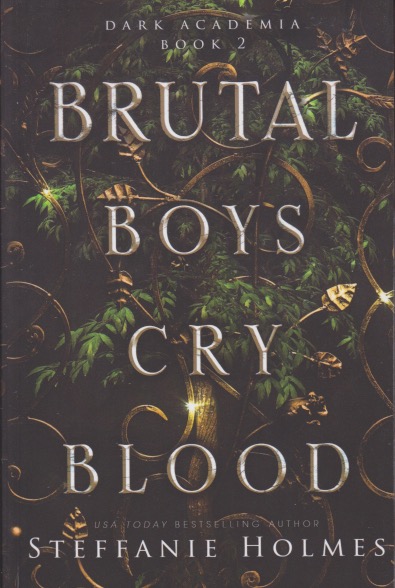
My study of genre leads me to believe that there really may be no such thing.  Or at least many aspects of genre are open to question.  In the case of Steffanie HolmesPretty Girls Make Graves, there’s no doubt that one genre is dark academia.  Indeed, this is book one of a duology titled “Dark Academia.”  Although self-published it is quite well done.  There’s a lot of backstory, and George (Georgina) Fisher, the protagonist and narrator, is a character from a previous series by Holmes.  Another genre that fits here is romance, although this novel is more than that.  Maybe a bit of the story will help.  George is a new student at Blackfriars University in England.  From California, she has trouble fitting in among the blue bloods that are the usual make-up of the student body.  She soon learns about the Orpheus Society, the secretive organization that pulls the strings on campus.  Then her roommate, the girlfriend of a prominent Orpheus Society member, goes missing.  George decides to investigate. 

Consciously aware of dark academia, Holmes aims directly at the heart of it and offers a compelling story that keeps readers interested from cover to cover.  I was never quite sure what was going to happen, and I do have to add a warning—this first book does end on a cliffhanger, so be ready to commit yourself to book two.  George is so well drawn that it’s not hard to care for her and start rooting for her against the secret society types who can buy themselves out of anything, including murder.  (I have to say, that part is a little too close to reality in the current US of A, so it may be a trigger for some.)

My regular readers (if any) know that I’m on a dark academia kick at the moment.  There’s so much to like in the genre.  Holmes makes clear the close ties between dark academia and horror; they share a common ancestor in the form of gothic literature.  The sheer variety in the novels classified this way means that not all of the books will contain every element associated with the genre, but Pretty Girls Make Graves comes close.  Holmes also effectively writes the ostracism of the outsider into the tale.  Anyone who’s had trouble fitting in (or may still have trouble fitting in) will recognize the scenario and its fallout.  Let’s hope, though, that they don’t end up like George at the end of volume one, even when they enjoy reading the book.


Dark Introduction

Since I’ve discovered that I live in dark academia, I’ve grown curious.  Kara Muller has put together The Little Book of Dark Academia as a kind of first step in the discussion.  I have learned that some academic articles on dark academia are starting to appear, but this is pitched more toward those who maybe need some tips on how to get started.  By the way, this is a full-color, heavily illustrated book.  In practical terms, that means it doesn’t take too long to read it.  It’s also self-published, so less expensive than many books, but without editorial shaping.  It begins with history and definitions.  The term came into use in 2015 but the concept had been around much longer than that.  Sometimes a label is necessary to bring together thought on something that’s been floating around for a while.  As Muller points out, it tends to revolve around books.

My imagination isn’t so constrained as to believe that ebooks have no place in dark academia; they have their own special kind of darkness.  Still, the setting for these stories often takes place in real life, in studies and libraries full of books.  This is not a Star Wars paperless universe.  Muller gives a list of acclaimed dark academia titles with a brief paragraph or two about them.  In other words, a reading list.  And also a movie viewing list.  She also includes some television series that fit the aesthetic.  If you’re in the mood for dark academia, you’ll find plenty of places to indulge your hunger here.  The lists aren’t comprehensive, of course.  A bit of searching online indicates that many such lists exist, not all of them in full agreement.

Muller then presents a section on style and design.  Dark academia is, in many ways, like cosplay.  There’s a look and feel to it that can be emulated.  And I can’t help but say it’s backward looking.  A longing for classical education, the way that it used to be.  To me, this seems to be behind much of the current fascination with it.  This lifestyle is rapidly disappearing.  Even professors are now using AI instead of getting their hands dirty in the library.  And publishing online rather than in print form.  Showing up to class in tee-shirts and jeans.  Some of us, and I count myself in their midst, miss the feel of armloads of books and professors that wore tweed and could read arcane languages.  And nobody was trying to cut their funds because, well, the world was smarter then.  And everyone knew education was important.


Missing the Rose

It was Edinburgh, my wife and I concluded.  That’s where we’d seen The Name of the Rose.  Edinburgh was over three decades ago now, and since the movie is sometimes called dark academia we decided to give it another go.  A rather prominent scene that we both remembered, however, had been cut.  If you read the novel (I had for Medieval Church History in seminary), you knew that scene was not only crucial to the plot, but the very reason for the title.  In case you’re unfamiliar, the story is of a detective-like monk, William of Baskerville, solving a suicide and murders at an abbey even as the inquisition arrives and takes over.  It isn’t the greatest movie, but it does have a kind of dark academic feel to it.  But that missing scene.

Of course, it’s the sex scene between Adso, the novice, and the unnamed “rose.”  Sex scenes are fairly common in R-rated films, often gratuitous.  But since this one is what makes sense of the plot, why was it cut in its entirety?  Now the internet only gives half truths, so any research is only ever partial.  According to IMDb (owned by Amazon; and we’d watched it on Amazon Prime) the scene was cut to comply with local laws.  More to the point, can we trust movies that we stream haven’t been altered?  I watch quite a few on Tubi or Pluto and I sometimes have the sneaking suspicion that I’m missing something.  How would I know, unless I’d seen it before, or if I had a disc against which to compare it?  There was no indication on Amazon that the movie wasn’t the full version before we rented it.

The movie business is complex.  Digital formats, with their rights management, mean it’s quite simple to change the version of record.  Presumably, those who’ve pointed out the editing (quite clumsy, I’d say) in reviews had likely seen the movie before.  Curious, I glanced at the DVDs and Blu-ray discs on offer.  The playing time indicated they were the edited version.  Still, none of the advertising copy on the “hard copy” discs indicates that it is not the original.  Perhaps I’m paranoid, but Amazon does run IMDb, and the original version is now listed as “alternate.”  Now that I’ve refreshed my memory from over three decades ago, it’s unlikely that I’ll be watching the film again.  I’ll leave it to William of Baskerville to figure out why a crucial scene was silently cut and is now being touted as the way the story was originally released.


Dark Poetry

Playful.  Serious. Weird.  Very intelligent.  These are the words that come to mind.  Adrienne Raphel’s Our Dark Academia is a poetry book unlike any other I’ve read.  The poems take many forms from impressionistic reflections on life to a crossword puzzle.  From cutout paper-doll clothes to a faux Wikipedia article on dark academia.  It’s quite difficult to summarize since it’s more of an experience than anything else.  It’s the kind of book that makes you want to get to know the author.  Economy of language and an ability to manipulate words are required for poetry, and although I still dabble in it now and again, my tortured mind finds long-form prose a bit easier to produce.  I do try to keep these blog posts short, but I write a lot of other stuff as well.  In any case, Raphel’s keen intellect is obvious throughout this collection.  And she holds a doctorate from Harvard.

I’ve been exploring what is now being called dark academia pretty much my entire life.  And it has an articulate spokesperson here.  The academic life, although I love it, isn’t always the cushy existence it’s thought to be.  It requires a lot of work and long hours.  Those jealous of the lifestyle probably know it by fantasy.  It has taken a hard turn towards the political since about the seventies, something I didn’t know as I enrolled in a doctoral program in the next decade.  You learn by experience, and it’s clear Raphel has that.  The life of the adjunct instructor, which I tried to live for two years, demonstrates the inhumane things educated people can do to one another.  Of course it’s because of money.  In a late capitalist society, what else really matters?

One thing I know about myself is that I tend to take on the characteristics of authors I read, while I’m reading them, if they have distinctive voices.  Thought processes carry on in the mind even after a book is put down.  I find reading endlessly fascinating and wish I could share this enthusiasm with everyone.  I have to stop and remind myself, however, that our society only works with those who are doers as well as thinkers.  It works best, it seems to me, when those who are thinkers are in charge.  But not all thinkers are good.  My solution, at the moment, would be to have them read Our Dark Academia.


Club Frankenstein

Reading YA novels once in a while reveals that younger folk have quite a good selection of literature from which to choose.  Goldy Moldavsky’s The Mary Shelley Club is a good pick for horror fans as it takes several cues from horror movies and mixes them with the anxieties of high school.  Rachel Chavez is a new student at Manchester Prep in New York City.  Her mother moved her there after a break-in and attack at their old home on Long Island.  With really only one friend at her new school, she finds out about the secretive Mary Shelley Club which meets to watch horror movies—or so she thinks.  Rachel then learns that the club’s real raison d’être is to play a game called Fear Test in which a targeted student is frightened, sometimes to death.  Rachel settles in the the club, being a horror fan, but grows increasingly uncomfortable with the game.

I won’t say much more than that about the plot, but I will say it is compellingly written and a page turner.  I didn’t quite buy the resolution, but that’s often true of horror movies.  It captures well the anxiety of high school, and of moving to a new location.  And Moldavsky certainly knows her horror movies.  I sometimes ponder what makes a novel YA.  I suppose it’s the focus on high school/college kids and a restrained vocabulary, shall we say.  While there’s no explicit sex scenes, there is some making out with intent here (this isn’t a romance), and there are a few f-bombs dropped.  And there is a body count.  Still, for horror, it doesn’t feel as gristly as “adult novels.”  Young people seem to lack the more developed evil of their elders.

My motive for reading it, apart from the horror aspect, was that The Mary Shelley Club is occasionally cited as an example of dark academia.  It’s easy enough to see why.  An exclusive school, wealthy families, and a dark subtext involving a secret society.  These are often hallmarks of the genre.  Dark academia may blend with horror, as it does here, or other genres.  That’s part of its appeal.  In this case the school, Manchester Prep (the name borrowed, it seems, from Cruel Intentions) may not be the center of the story, but it is what brings the main characters together, even if the horror is extra-curricular.  It was a fairly quick read, despite its size, and it bodes well for other good reading while exploring this particular aesthetic.


Philadelphia Story

I’m guilty of a little home-state pride when I consider Philadelphia as a seedbed for diverse filmmakers.  Perhaps the most famous is M. Night Shyamalan, but I recently watched Tayarisha Poe’s first feature, Selah and the Spades.  Poe (and Edgar Allan also lived in Philly) is an African-American woman, and like Shyamalan, writes and directs her own movies.  Selah and the Spades came out in 2019, just as we were settling into pandemic life, but it is a gentle kind of dark academia.  A coming of age story set in a fictional Haldwell Boarding School, it features three African-American leads.  The violence is mostly offscreen, but there is a darker story here.  Selah heads the Spades, one of five factions of student-led extracurricular life on the elite campus.  She’s a senior who doesn’t want to face college—she enjoys her power and doesn’t want to appoint a successor.

The factions plan communal pranks, and each has its own specialization.  The Spades supply the alcohol and drugs to the student body.  This involves some violence, as is to be expected.  Selah has a record of ruining her protégés before they can become her successor.  The movie focuses on Selah’s relationship with Paloma, a transfer to the school who seems a promising new leader.  But Selah has difficulty letting go and the drama plays itself out in a student-led prom after the administration cancels the official prom due to the factions’ actions.  There are lingering shots and some art house elements to the film, making it a drama rather than a thriller.  Dark academia encompasses several genres and this is, as I say, a tamer one.

Philadelphia is a city with a generational history for me.  My mother, who was born in New Jersey, lived in Philly for some time as a child.  She found the city a scary place and unwittingly passed that fear onto me.  I’ve been to Philly several times, of course.  My main concern is driving there—the traffic is always intense and I don’t know my way around very well.  It is a diverse city.  While it’s too early to tell if Tayarisha Poe’s work will center around eastern Pennsylvania (I can’t find a summary of her second movie, The Young Wife, that states outright where it is set), it does underscore that the cinematic world is reaping some benefits from the city of sibling-like love.  And such things happen best when diversity is given a place to shine.


Fighting over Chocolate

It’s really a teen movie, The Chocolate War is.  That may be the sweet spot for dark academia.  I’m maybe a bit old for such things, but being old tends to mean remembering how it was.  Not exactly how it was, though.  Chocolate War takes place in a Catholic boys school, Trinity by name.  Perpetually underfunded, the students have to sell chocolate (now we’re in territory I recall—remember me, Gertrude?) to help keep it running.  Meanwhile, the Vigils, a secret society, have a considerable amount of pull on campus.  Led by a prescient and overly mature boy for his age, Archie, the Vigils assign select students difficult tasks in a kind of high school hazing.  Jerry, a freshman whose mother recently died, is assigned to refuse to sell chocolates for ten days.  He then decides (for reasons never explained) not to sell them at all.

The refusal leads to a financial crisis for the school.  The Vigils try to force Jerry to sell, engaging in harassment tactics.  Nothing works.  Then Archie coerces him into a “boxing” assembly where students pay to have their specific punches thrown by one of the boys (a bully or Jerry) at the other, who simply has to take it.  Before the match begins, Archie, the Vigils’ leader, is tricked into taking the bully’s place.  Jerry, who’s on the football team, knocks him out, sending some teeth flying (probably why the film got an R rating).  In the end, Archie is demoted, but Jerry realizes that with his refusal to comply, he led to the result he was protesting against (the harassment and boxing match led to selling all the chocolate despite his refusal to participate).

Dated, yes (1988), Dead Poets Society, no.  Still, there’s much to ponder here.  Bullying—used by very high offices in this land—seems to be a growing problem.  And yes, when you get a bunch of adolescent boys together, trouble can arise.  It’s believable.  Although considered a flop, critics were kinder than the box office.  There are dark messages to decode here.  The price of nonconformity—an issue that doesn’t disappear with adulthood—and, perhaps looming larger, its effectiveness.  The teacher temporarily running the school, Brother Leon, is part of the problem, as is often the case in dark academia.  He’s not evil, however.  The film places the abuse of power on Archie, although he doesn’t condone violence.  Ultimately violence is used to unseat him.  With the result that the system (Trinity) prevails nonetheless.  Worth considering.


Letting Go

I should’ve known from the title that this would be a sad story.  Kazuo Ishiguro’s Never Let Me Go won the Nobel Prize in Literature, despite being speculative.  It’s only mildly so, but enough that it is sometimes classed as science fiction.  It’s appropriate that a twentieth anniversary edition was released because it is an extended consideration of the price of technology as well as dehumanization.  I’ll need to put in some spoilers, so here’s the usual caveat.  I read this novel because it’s often cited as an example of dark academia and it certainly fits that aesthetic.  It starts out at a private school called Hailsham, in England.  The students are given some privileges but their lives aren’t exactly posh.  Most of their possessions are purchased on days when a truck sells them things they can buy with money they earn by creating art.  They aren’t allowed to leave the school.  Spoilers follow.

The special circumstances of the children are because they’re clones being grown for replacement organs.  The public doesn’t want to know about them or interact with them.  In fact, most people believe they don’t have souls, or aren’t really human.  They’ve been created to be used and exploited until they die, always prematurely.  While this may sound grim, the story is thoughtfully told through the eyes of one of these children, Kathy.  She becomes best friends with Ruth and Tommy, who later become a couple.  Ruth is a difficult personality, but likable.  As they grow they’re slowly given the facts about what their life will be.  They’re raised to comply, never to rebel or question their role.  Most simply accept it.  Kathy, Ruth, and Tommy, in a submissive way, try to get a deferral regarding their “donations.”

I suppose it’s presumptuous to say of a Nobel Prize winner that it’s well written, but I’ll say it anyway.  Ishiguro manages to capture the exploratory friendships of youth and reveals what you need to know in slow doses, all told with a compelling, if sad and accepting voice.  Although the genre could be sci-fi, it’s set in the present, or, more accurately, about twenty years ago.  The technology, apart from the cloning, is about what it was at the turn of the century, or maybe a decade or two before that.  With what we see happening in the world right now, people should be reading books like this that help them understand that people are people, not things to be exploited.  And that Nobel Prizes should be reserved for those that are actually deserving for their contributions to humanity. 


Publish, Perish

Publish or perish has been around for quite a while and I feel for younger scholars who are trying to publish their collected essays as their second book.  Collected essays, in case you’re not familiar with dark academia, are generally what senior scholars do before they retire and they can’t be bothered to rewrite everything into a proper book.  Or maybe the topics are disparate and don’t easily fit together in one category.  When I was teaching the general rule was an article a year and a second book for tenure.  I was able to do this without a sabbatical, and with a heavy teaching load and administrative duties at Nashotah House.  It’s a lot of work.  My biggest challenge was coming up with ideas for new books.  Eventually I published my collected essays on Asherah in the second edition of my dissertation.

I’d written a 50-page article on Shapshu, the Ugaritic sun deity, that was intended to be my second book.  Then J. C. L. Gibson retired and I had to have something for his Festschrift.  There it went.   It was about that time that I started Weathering the Psalms.  That was my “tenure book.”  There was over a decade between that and Holy Horror, for a number of reasons.  The main one was that I was trying to cobble together a career between Gorgias Press and moonlighting as an adjunct at Rutgers University.  There was no time for research and publication.  Ironically, that only came after I gave up academia to enter the commercial world of publishing.  I see younger scholars now expected to produce that second book, and some of them go for the collected essays approach.  I understand.

Back when I was applying for first jobs—and the scene was already very tight, I assure you, despite promises just a few years earlier—I applied for everything.  One search committee chair wrote a scolding letter saying I wasn’t senior enough to apply.  By the end of his dressing down, he concluded with something along the lines of “unless you’re applying because there are so few positions, in which case it’s understandable.”  He was right.  So few jobs and so much student debt!  I landed at Nashotah and began cranking out the articles.  In a moment of weakness I offered to write some further academic treatments after my horror movie books appeared.  They don’t do anything for my career, of course.  And they take away time from popular writing practice.  Who knows?  Maybe some day I’ll gather them into a book.  Then again, maybe I’ll find myself growing younger too.


And Bones

Often making lists of dark academia movies, The Skulls plays right into that territory.  A secret society, an elite college, and something’s definitely gone wrong.  It’s not a great movie, feeling somewhat contrived, but it fits the mold pretty well.  Things are a little too pat in the film, and the writing isn’t the best.  It’s entertaining, if overblown.  The story begins at an unnamed Yale (actually University of Toronto) with working-class Luke being invited to join the Skulls after an impressive rowing competition victory.  From the first, the Skulls meetings seem to lack gravitas.  Rich and powerful, they are above and beyond the law.  The problem for Luke is that his friends, Will and Chloe, are being edged out of his life.  Will, who writes for the school paper, breaks into the Skulls headquarters but is caught by Caleb, Luke’s “soul mate.”

Will is killed in what follows, and Luke wants to get out but it’s too late. Caleb’s father is the head-honcho for the Skulls and decides to have Luke committed to an asylum when he refuses to cooperate over his friend’s death.  Chloe and the second-in-command of the Skulls, Senator Levritt, rescue Luke and he challenges Caleb to a duel.  I’ll leave it off there so as not to spoil too much.  That gives you a sense of the darkness, in any case.  But the film doesn’t feel that dark.  Yes there is a murder, and there are bad guys, but something I can’t define prevents it from having the tone that you might expect from a grim tale.  As I say, things are a little too pat.  The characters’ emotions are a little too close to the surface.

The movie did well at the box office, but the sequels were released direct to video.  As far as the academia side goes, there are, no doubt, secret societies.  Privilege doesn’t let go once it gets a grip.  But the above-ground “Yale” sees a bit too light and airy.  Maybe more classroom and library scenes might’ve helped.  Likely it would’ve been better had it been based on a novel.  Films that are based on books have a solid development on which to stand and it’s often a matter of figuring out what to omit.  The writer and director had gone to Yale and Harvard, respectively, and wanted to portray what secret society life is like.  But that’s the thing about secret societies—you can’t really know, can you?  It’s a matter of imagination.  And dark academia is where such things fit.


Death in Cambridge

In an effort not to give too much away, I’ll try to give only the bare bones and some impressions.  The Maidens, by Alex Michaelides, is considered a dark academia novel.  It revolves around a series of murders in Cambridge and the informal investigations by a psychologist (Mariana), whose niece attends St. Christopher’s College.  There is, not surprisingly, a lot of psychological tension.  It’s also a good illustration of the human condition—our psychology can often be disrupted by those closest to us.  We’re a complex lot.  The whole story is also set against the backdrop of classic Greek tragedies.  Mariana is half Greek herself, living in England.  She’s also a widow and, although not a minor, a woman without parents or siblings.  As a psychologist, she tries to help others sort out their lives.

Perhaps some of us are born prone to trauma through some combination of naiveté, innocence, and neurodivergence.  It’s well known that what simply rolls off one person will traumatize another.  People sometimes comment that it’s surprising that I watch horror, but the fact is that it’s generally removed from my personal traumas.  Looking back over some sixty years, I see quite a lot of trauma and I empathize with Michaelides’ characters who experienced such deficits, some of them without even knowing it.  This really stood out to me while reading the novel.  With the exception of some of the maidens, just about everybody is hurting.  Who are these eponymous maidens?  A group of students who have coalesced around an American professor of ancient literature.  And they’re also the ones who tend to get bumped off.

This is a book that moves along.  Part of the reason is that it has short chapters, something I’ve come to appreciate over my life as things get busier and busier.  Long chapters can be a challenge.  A novel I read recently had no chapters at all (but at least there were scattered extra-spaces between collections of paragraphs).  But what really keeps the pages turning is the story.  Michaelides is very good at misdirection, which is why I didn’t describe the plot in any detail.  You have to read it to see how things unfold and I don’t want to spoil that for anyone.  A literary murder-mystery, it has no speculative elements, apart from a few coincidences.  It does, for at least some readers, have quite an impact.  For me, it influenced my thought process for the rest of the day after I finished it.  At that, with all the books I read, is pretty rare.


Dark Lovecraft

There is no shortage of Lovecraftian horror movies out there.  I watched The Unnamable because I found it on a list of dark academia movies.  And also, well, it’s horror.  I’ve most likely read Lovecraft’s original story at some point in time, but I didn’t remember it at all.  The dark academia part comes in because it involves college students and a haunted house.  A low-budget offering, this is hardly great cinema.  It’s not sloppy enough to qualify as a bad movie.  That puts it somewhere around “meh.”  The film opens with Joshua Winthrop being killed by the monstrous daughter that he keeps locked in a closet of his house.  Then, in the present day (the movie is from 1988) three college guys talk about it and the skeptic decides to spend the night in the house to disprove the monster tale.  He is, of course, killed.  Although his two companions don’t go looking for him, others end up in the house.

A couple of upperclassmen looking to score with freshmen coeds, talk two women into going to the house with them.  As they start to enact their plan, the monster kills them one-by-one, leaving the virginal final girl alive.  Meanwhile, the other two students whose friend was killed, also come to the house.  They manage to rescue the final girl and escape the creature by invoking the Necronomicon’s spells.  The music cues are often comical, suggesting that this isn’t to be taken seriously.  They also spoil the dark academia atmosphere.  For me, a horror film works best if it’s either clearly horror or clearly comedy horror.

It did, however, raise a question in my mind.  Dark academia and horror do have some crossover.  H. P. Lovecraft often had professorial types as his protagonists.  Was he writing a form of dark academia?  It’s difficult to say.  Lovecraft’s work was known as “weird fiction” in his time, and it has become its own kind of genre.  (Just try to publish in the rebooted Weird Fiction without your Lovecraft cap on and see how you fare.)  I’ve been pondering genres for quite some time, and since I watch movies because they’re free or cheap, often, I see some unconventional fare.  There’s no question that The Unnamable is horror.  When the movie ended I was sad for the monster.  She’d been living according to her nature, and really didn’t deserve the treatment she received from a bunch of trespassers.  Not a great movie, it nevertheless made me think.


Hugo’s Invention

After watching Hugo, and wishing that the story were history, I found a copy of Brian Selznick’s The Invention of Hugo Cabret.  Martin Scorsese’s adaptation is fairly close to the book but there are, of course, additions and omissions.  One key character is left out and some subtleties to the book didn’t find their way obviously into the movie, or at least not until having read the book.  The story of Georges Méliès’ life in the book is largely accurate.  Hugo, however, and Isabelle, are fictional.  As is the automaton around which the story is based.  The lovable train station vendors in the movie are quite a bit less lovable in the book.  And the station inspector isn’t shown until late in the story and he doesn’t have the leg brace that lends a kind of steampunishish vibe to the film.

Apart from being a tale of redemption—in real life Méliès’ rediscovery didn’t lead to an end of his poverty—the story is an exploration in psychology.  Méliès lost his dream job due to competition after the First World War.  The book makes clear that the clicking of heels drives him to rage because his films were reputedly melted down to make shoe heels.  The story in the book goes so far as to say that ghosts follow those who clack their heels loudly.  The ghosts, of course, are those of Méliès’ lost success as a filmmaker.  One of the reasons this story appeals to me is that I too lost a job that gave my life a sense of purpose.  My writing largely does that now, even if it doesn’t sell.  I can relate to a man who is ready to retire but can’t, daily reminded that he once had a satisfying job but now has to sit behind a desk all day.

The Invention of Hugo Cabret is a book for younger readers.  About half of the book’s 500-plus pages are illustrations.  The images include stills from Méliès’ surviving films, but mostly drawings by Selznick.  The focus on the young people makes this a children’s book, but the truths it tells of adults with lost dreams are especially appropriate for those who’ve learned that life isn’t always kind to dreamers.  The book, like the movie, inspires me to seek out the surviving films of Georges Méliès and think of what can indeed happen to those who dare to dream, even when the world has already discarded them as irrelevant.