Water Monsters

Chaos is a monster.  More than personal opinion, that’s a biblical view.  If, like many modern people with theological training, you’ve been taught that Genesis narrates a creation out of nothing, you’ve become a victim of this monster.  You see, although ancient Israel had no “systematic theology”—the Bible can be quite inconsistent if you’re willing to read what it says—the view that chaos was constantly lurking outside the ordered realm of creation was a common one.  One of the more intriguing episodes in Ugaritic mythology involves a broken text where the god Hadad, aka Baal, refuses to allow a window in his palace.  The reason?  Apparently he feared chaos (in the form of Yam, the sea) might slip in and kidnap his daughters.
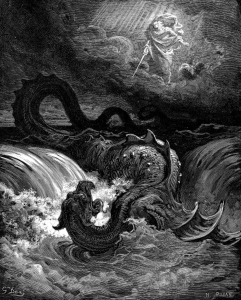
More than a theological statement, the story of creation was actually a singular episode in Yahweh’s ongoing struggle against chaos.  Step outside and look at the sky.  If it’s blue it’s because there’s unruly water being held back by a great dome over our heads.  If it’s gray, it may be raining, or it probably will be soon.  Stroll to where the land ends.  What do you see?  Water.  That water is lapping at land, trying to take it over.  Although the ancients didn’t have geologic ages (the Mesopotamians came close, with ancient kings living thousands of years) rivers eroded land and they had tendencies to flood.  The thing about chaos is that it makes you start again, from the beginning.

One of the many unfortunate things about biblical literalism is that it loses sight of this biblical truth.  It exchanges something everyone can understand for a theological abstraction that makes no sense in the world that we experience.  Ancient belief held that the human role in the world was to fight chaos, not to get to Heaven.  In fact, in the Hebrew Bible there’s no concept of Heaven at all.  Instead, the commandments were all about order.  You can’t build on the water.  What you do build water tries to wash away—Israel has a rainy season, and one of the characteristics of such seasons is the occasional violent storm and heavy rains.  Although we need the water from the heavens, heavy rains cause, well, chaos.  In ancient thought, this was the monster hiding in plain sight.  That blue sky is a reminder that a dragon awaits.  Rather than starry-eyed Heaven-gazers, the ancient biblical person was a monster-fighter.  And that’s the biblical truth.


Hidden Origins

This blog was born at the very lake I’m about to leave.  Although it’s relaxing, there’s an element of chaos to a family vacation that stirs up creativity.  Tomorrow’s long day of travel back east, however, will mean another day without a post.  Flights leave so early that you barely have time to slither out of bed to the shuttle, and the airport hotspots want your money to connect.  I’d rather maintain radio silence for a day.  That doesn’t mean I won’t keep my eyes open for religion hidden in the interstices of American life.  Since religion and mythology share sleeping quarters, I’m reminded of something I saw up here in the northwest the other day.  While in a local grocery and souvenir shop (for all groceries in this area carry souvenirs) I saw sasquatch dolls.

Such cryptids are unknown to science, of course.  Even if they really exist, their liminal status now places them firmly in the realms of mythology.  Being in the wilderness can be an uncanny experience.  Long accustomed to dwelling in cities and towns, we feel vulnerable out in the open.  Taking walks in the woods might just put you in the path of black bears, grizzlies, or mountain lions.  Who knows what else might be hiding in these woods?  It’s easy to believe in our myths here.  Vacation, in addition to being the ultimate reality, counts as time borrowed against work and its punishing rationality.  Religion thrives in the quiet moments when you’re not sure what might be hiding just out of view.

Did ancient people devise belief in such circumstances as this?  (Well, without the wifi and indoor plumbing, of course.)  It’s not hard to feel the spirit of the lake.  Standing chest-deep in the water, being rolled by the waves, there’s a kind of secular baptism taking place.  In the quiet unearthly voices can be heard.  No television or newspaper tells you that it can’t be happening.  Listening is much easier with no distractions.  These woods are vast.  Human access to them is limited to marked and maintained trails.  Beyond these borders, who knows?  Science comforts us with the assurance that there are no monsters out there.  Standing isolated from any other human beings, surrounded by ancient trees, you might begin to wonder if such assurance is as certain as it sounds.  The sasquatches are children’s toys, and the sense of the numinous you feel can, like all extraordinary things, be explained away.


Holy or Not?

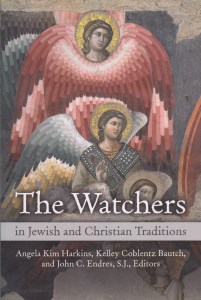
The ancient divine world was a slippery place. When you stop to think about it, this makes sense. The deities and demons of antiquity were invisible. Different opinions existed as to what they were. The idea of “the Bible” that contains infallible information didn’t exist. Apart from the books now accepted by Protestants, the “Apocrypha” and even more fun Pseudepigrapha contained many more traditions than the average reader might guess. I’ve been a student of that ancient divine world for decades now, and I learned quite a bit from The Watchers in Jewish and Christian Traditions, edited by Angela Kim Harkins, Kelley Coblentz Bautch, and John C. Endres, S.J. Appropriately divided into three parts (origins of fallen angels, Second Temple developments, and Jewish and Christian reception) these collected essays explore different dimensions of these mysterious beings.

Watchers are seldom mentioned in the Bible, in just a few verses of Daniel. In some traditions they are high angels—think the hymn that includes the word “ye Watchers and ye holy ones”—but mostly they are fallen angels. If you limit yourself to the Good Book you really get only four verses of Genesis 6 to explain them. Other ancient writers, some of whom likely influenced the New Testament, took up the subject. The book of 1 Enoch contains a section called The Book of the Watchers. Here the Watchers come down to earth with a couple of purposes—to share forbidden secrets with humanity, and to mate with human women. The offspring of these matings are giants, Nephilim, or demons. Perhaps all three. These events are retold in Jubilees and are taken up by early Christian writers especially.

Although this book isn’t a monograph with conclusions based on all the information it contains, it nevertheless gives a very good sense of the various traditions that developed around these Watchers. Even when reading through the Bible as a child, the Genesis 6 episode caught me off guard. The story isn’t highlighted in children’s Bibles, and the way it’s told in Hebrew leaves a lot of ambiguities in the adult reader’s mind. It’s almost as if this brief account is bing kept deliberately obscure. The Good Book drops this bomb then blithely goes on its way without mentioning it again. This episode reminds us just how little the Bible clarifies. It wasn’t written to be the “inerrant word of God,” and those heady days just after Eden were full of stories that it never bothered to tell. The Watchers, meanwhile, made their way into popular culture because the silence of Scripture allows readers to fill in the blanks with either angels or demons.


Of Gears and Gods

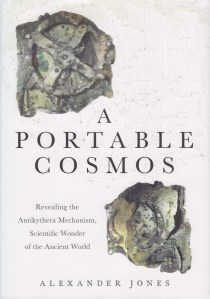
We develop pictures in our minds of the kinds of things that belong together in different eras. Dinosaurs, for example, don’t belong with our own species, no matter how much we may occasionally wish it were so. Horseless carriages don’t populate the seventeenth century and complex machines, we tend to think, didn’t really come about until medieval Europe (and then they were often used for torture). Our view of the world is, of course, one of comfort with the certainties of history. That’s why the Antikythera Mechanism is such a fascinating artifact. A very sophisticated device with gear trains and cranks and dials, it astonishes those who first encounter it in that it was made before the Common Era somewhere in the sway of ancient Greece. It is, in essence, a kind of computer. Long before Joseph met Mary.

Alexander Jones’ A Portable Cosmos: Revealing the Antikythera Mechanism, Scientific Wonder of the Ancient World is a pretty thorough introduction to the device, including the mechanics of how it works as well as how astronomy works. You see, the Antikythera Mechanism was designed to demonstrate the relative motion of the planets, including the sun and moon. For a device in the geocentric world of ancient Greece, that’s pretty remarkable. It predicted eclipses and showed the phases of the moon. It also makes me ponder the fact that most ancient people considered the planets deities. Long before Newton, then, some were recognizing that even the gods could be made to work according to a crank and gears.

Science and religion coexisted peacefully in those days. Although only one such device has been discovered, it’s virtually certain that more existed. Gods and gears both had a place in such a world. Along the centuries, however, the idea grew that if gears worked, we no longer required a deity. Occam’s razor has its uses, to be sure, but it can shave a little too closely from time to time, nicking delicate flesh. The idea that one side only can be right—and since we can see with our eyes that science works—tends to favor the mechanistic universe. There’s no disputing that science makes our lives easier and that its method is self-correcting and generally effective. The hands that cranked that ancient geared device, however, likely belonged to a believer in gods. Such belief didn’t prevent progress, but then some kind of Fundamentalists killed Socrates for his own form of heresy. Perhaps the true answer lies in balance. It may also be the most difficult of principles, scientific or otherwise, to achieve.


Measuring Immeasurables

Are demons getting more active, or are people just believing in them more? Quite apart from what’s happening in the District of Columbia, there’s been a surge of requests for exorcisms. This is according to a WBUR story my wife sent me. I’ve been researching demons for a few years now. Initially my concern was avoiding Hell (something I’d still like to do), but as an adult trained in rationalism, I wondered why people still believed in them. Trying to keep an open mind, I read accounts. Yes, misperception is possible. Alternative interpretations. But still…

Fundamentalists say that demons have to exist because Jesus said so. Historically speaking, people have recognized demons from the earliest writing cultures and probably before. What they thought demons were differed pretty wildly from place to place. A good case has been made that demonic possession, as we recognize it today, became popular after The Exorcist. William Peter Blatty researched the topic, and most of what he uses for Regan MacNeil’s symptoms came from medieval accounts. Although some of the descriptions are somewhat extreme, the actions themselves aren’t new to either movie or novel. In other words, according to the eyewitness accounts we have, such things do happen. And when they do, who ya’ gonna call?

Exorcists were mostly extinct by the 1960s. A decade later, after the movie’s release, reports began to increase in number. Malachi Martin’s Hostage to the Devil, which I reviewed here some time ago, was a bestseller. It reinforced the idea planted by Blatty. And the number of exorcism requests hasn’t started going down yet. Are there more demons about, or are we all imagining things? It’s a question not easily answered.

The fact is science can’t measure phenomena that don’t consist of matter or energy. Occam’s razor shaves away the whiskers of the spiritual. Perhaps nature intended for us to be a bit hairier. Spirit is something that has always resisted science and its metrics. We know it when we see it in someone. Or perhaps when it impacts a person’s actions or motivations. It doesn’t impact a scale. It has no visible spectrum. Conventional wisdom says if you can’t see it, hear it, or otherwise sense it, it must not be there. We know this to be shortsighted thinking, however. “There are more things in heaven and earth,” Shakespeare wrote, and we would do well to pay the bard his due. Are there demons? I can’t say. I do know that people have been asking for the services of exorcists more and more. For that there is ample evidence.


In God’s Name

If anyone ever bothers to go through my personal zibaldones (if the word’s unfamiliar, please use the search box for my post on it) they’ll find my personal shorthand. It’s not extensive since I’m a firm believer in explaining things and if I don’t write things out I often can’t decipher what I meant. One of the shorthand marks that I do use is the Greek letter theta. Those who know me will have no trouble guessing that it stands for “God.” Or more appropriately, “theos” the Greek word for God. This particular Indo-European lexeme has a venerable history and appears in such forms as deus, Zeus, and deity. Although in a case such as Zeus it can be used as a personal name, it is, in fact, a title. Somewhat like “president” used to be. And it can be used for any number of divinities.

In the Bible there exists a well-placed concern not to dis the Almighty. God—to use his title—had a temper and was known for not being afraid to show it. Among the Ten Commandments is one not to take God’s name in vain. Scholars argue over what exactly that means, but Judaism, on the ground, had to make decisions about it in a practical way. The best way to avoid divine wrath was never to say the divine name at all. God’s name isn’t “God.” That’s a universal word, applicable to any garden variety divinity. God’s personal name, we think, was Yahweh. To ensure the keeping of the commandment whenever this noun was encountered in the Good Book, the word “Lord” was used. That’s the convention behind Lord in small caps in some Bible translations. If you don’t say the name you can’t break the commandment.

In more recent days, in print culture, a further caution has been introduced. In academic writing it’s common to see “G-d.” I can guess the origins of this convention, but I have to admit that concern can lead to obfuscation. Nowhere does Scripture proclaim that you can’t use the title of the ineffable one. I can’t help but think this is following the conservative tendency to see the use of “God” in exasperation as swearing. The fact that another common swear abbreviates itself as “G. d.” might caution against using this particular combination in an effort to preserve the sanctity of the title. No one ever doubted that Baal was a god—but note the carefully lower case “g”—or for that matter, Mars or Zeus. Or, just to be safe, B-l, M-rs, and Z-s. May I suggest, based on personal experience, that theta might be used instead? But only if referring to the true G-d.


Re-reading the Rite

I’ve written on The Rite before. My current book project, however, led me to reread this account after watching the movie based on it a couple of times. The film dramatizes, of course, the somewhat understated demonic activity in the book. The protagonist loses about 30 years in age and isn’t yet a priest. As is usual, the book is better than the movie. Matt Baglio’s story follows Fr. Gary Thomas from parish ministry in California to his discovery of possession and appointment as an exorcist. As part of the Vatican initiative to have an exorcist appointed in every diocese, Fr. Thomas was sent to Rome to take a course on exorcism. His experience was all academic until he began to attend actual exorcisms with an unconventional Capuchin monk. Very little described in the book is difficult to believe.

This time around the curses nabbed my attention. Among exorcists of the Roman Catholic stripe, there is a strong belief in the reality of curses. Not only the reality of curses, but the belief that curses can lead to demonic possession. Knowing that Catholicism has struggled with accusations of being unsophisticated and behind the times, the fact that this isn’t more widely known is pretty self-explanatory. Growing up Protestant, I was always taught that curses are make-believe. They don’t really have any influence on a person’s life. The world of demons, however, is a supernatural one and the concept of curses still holds sway in this universe, as the book shows.

Another arcane aspect that resurfaced when I reread this book is just how elaborate the Catholic backstory is. Many Catholics, it’s clear, distance themselves from such topics as the Devil and demons, but there’s no escaping the Virgin Mary and the drama of Jesus versus the powers of evil, as well as the intercession of saints. The problem is that many of the players are personified in the Bible. It’s pretty hard to say the Good Book got it wrong. That worldview lends itself to belief in supernatural impingement on this sphere. Not that that’s a bad thing. Many people, however, would rather believe in a materialist world with physical cause and effect being the main operating paradigm. Demons complicate all that. But then, so does the idea of Mary being a perpetual virgin, and even the patrilineal heritage of Jesus himself. The Rite brings to the light something many would perhaps prefer to be kept under a bushel. Strange things do happen in this world, and they do tend to respond to the backstory that’s been told. That makes such books difficult to classify, even with the backstory.


Upstate Goddesses

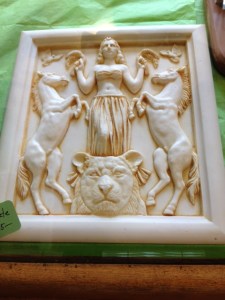
Goddesses give you connections. Here in Ithaca, all kinds of specialty shops abound. University towns are like that. This one had lots of goddesses. Ever since writing my dissertation on Asherah I’ve been interested in female divinities. Part of the reason for this is that I fail to understand how many men don’t see the power of women in their lives and insist that men should rule. Goddesses remind us that women have as much to contribute as do men, and they should be honored and respected just the same. Deities, after all, are projections of humanity. In any case, I found myself in a shop with many goddesses. The proprietor noticed my interest and struck up a conversation. This was ironic because where I live no one asks about my academic background; I have to travel to find interested takers, I guess.

She told me of an upcoming conference that would like to hear my thoughts on the topic of Asherah. Since my book on the goddess has been plagued with high prices, it remains hidden down three or four pages on Amazon, while lower priced dissertations easily float above it. My conversation with this stranger brought out that I had planned to write on other goddesses. A friend had done his dissertation on Anat, so I began working on book on Shapshu, the Ugaritic goddess associated with the sun. Some cultures made the sun male, the people of Ugarit, however, knew the true nature of brightness. I was going to make an academic career of goddesses.

Every great once in a while an academic will ask me about Asherah. Chances are their book or article will fail to cite my work, but they do seem to know to make queries. In my hopes to get a job beyond Nashotah House I followed the advice of colleagues to write a biblical book before finishing another book on “pagan” deities. In the career vicissitudes that followed, goddesses had to fall by the wayside. Although there can be money in deities, as this shop in which I stood proved, they aren’t really a marketable commodity in the realm of making an academic living. Now that I’ve found my way back to writing books again, perhaps I’ll return to my goddesses. That brief encounter in an Ithaca store resurrected some of the fascination of learning about the inner lives of divine women. The need to remind the world, it appears, has only become greater since I first wrote about Asherah decades ago.


Bearing Light

Jeffrey Burton Russell knows a devil of a lot about the Devil. I’ve just finished the third of his five books on the subject, Lucifer: The Devil in the Middle Ages, and I certainly learned a thing or two. As someone who considers himself an historian of religion, being exposed to a concept over several volumes has a way of making me feel humble. The theme of this series, at least so far, is that the Devil is a conceptual way of dealing with evil in the world. In the days of polytheism a single source of evil wasn’t needed, but no matter how you slice it, monotheism implicates God in the fact of evil in the world. The Devil is one way to try to lift some of that burden from the divine shoulders.

Lucifer is an interesting installment because ideas of the diabolical really took off in the Middle Ages. Russell’s previous volume, Satan, became heavily theological and there’s a bit of that here as well. While there’s no doubt some average people in the Dark Ages tried to figure out where Devil came from, the officials sponsored by the church were those whose ideas were written down and preserved. Those ideas, unsurprisingly, were theological and complex. Scholasticism, which began in the Middle Ages, launched what was to become known as systematic theology in the modern era. Among the many topics with which it concerned itself was the Devil, and evil. Ranks of angels, both fallen and un, peopled the atmosphere. Galileo’s perspective would eventually change this cosmology by making it both simpler and more complex at the same time. Lucifer, however, still survives.

One of the stranger developments of the Devil in this time period is as a form of light relief. The idea of plays (which had been around since classical times) also took off in the Medieval Period. In these plays Lucifer and his demons often took on a comical cast. Even when the tone was serious (and what morality play isn’t?) the Devil could be used for laughs. An incredibly rich mythology had been adopted by the church at the time—think Star Wars with more religious characters—that assured the laity that Satan’s doom was sure. Besides, we like to make fun of the things we fear. Think Washington, DC. Now that I’m halfway through Russell’s oeuvre on the subject, I’m curious where his next volume will go. No matter how much you think you might understand evil, as we’re daily finding out, there’s always so much more to learn.


Exercising Exorcism

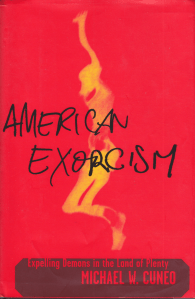
About the last people, ironically, that you’ll find researching demons are religion scholars. That’s perhaps a slight exaggeration, but there’s an embarrassment to the topic that serious academics just can’t shake. Nobody wants to be thought truly believing in that stuff. Michael W. Cuneo, who teaches sociology and anthropology at Fordham University, isn’t afraid to look. His American Exorcism: Expelling Demons in the Land of Plenty is a user-friendly, often witty look at what is an amazing phenomenon. Exorcism had pretty much gone extinct by the middle of the twentieth century. Then The Exorcist happened. Cuneo makes no bones about it—Hollywood wrote the script on what was to become a somewhat bustling business through the end of the millennium and beyond. And it wasn’t limited to Catholics. Protestants, mainly of Evangelical stripe, cottoned onto Deliverance ministry and joined the fray against the demonic.

American Exorcism reflects Cuneo’s personal account of attending exorcisms. As he puts it at the end, no fireworks occurred. In fact, he’s skeptical that demons exist and he strongly suspects exorcisms work in the same way that a placebo does. He’s well aware that the majority of people he met and talked with in the making of this book disagree on that point. Cuneo himself attended at least fifty exorcisms, both Catholic and Protestant, and shysters among the exorcists were rare. Most were sincere, devoted people who are helping others in distress for no fees, no glory, and no promotion. They see a need, believe they know the diabolical cause, and take the devil by the horns (metaphorically speaking).

There is a solid mistrust between academics with their studied skepticism and exorcists with their eyewitness accounts that defy belief. Cuneo suggests that even what they think they see may not really be happening in the real world. My question, coming down to the end of the fascinating book, revolves around what exactly this real world is. There can be no doubt that present day concepts of exorcism are largely based on “the movie.” Cuneo seems just a bit reluctant to say what I also declared in my forthcoming book—pop culture, the movies, dictate reality for many people. At least in the realm of religion. Sacred institutions have lost their authority to make ex cathedra pronouncements about what is real and what is not. Few bother to, or can, delve into the tedious work of reading academic studies on the subject. It’s far easier to let the unseen presences behind the camera take over. Isn’t that what possession is about, after all?


Who’s Hungry?

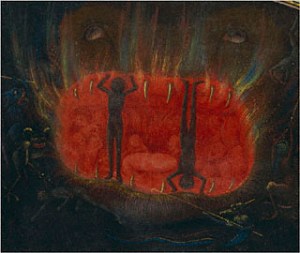
I flatter myself to think that some people enjoy my daily musings, although they’re sometimes grim. Religion often is. One curious example of this is the “Hell-Mouth.” Some time back a friend sent me a link to a British Library blog post “Highway to Hell.” The story is about illustrated medieval manuscripts depicting the Hell-Mouth—a monster with wide, gaping jaws and a gob crammed full of human souls bound for eternal torment. Not a pretty picture. The BL post reasonably suggests that the image originates in early Anglo-Saxon literature. We know the Teutonic penchant for the gothic, so all is fine and good. In fact, however, the image is far older than that.

In sorely neglected and almost forgotten Ugarit there is a fascinating mythological text. Known to ancient northwest semitic nerds as KTU 1.23, the text is strange even by Canaanite standards. El, the chief god whose name translates as, well, “god,” seduces two young goddesses (presumably). The young ladies give birth to monsters—devourers with one lip reaching to the heavens and the other to the underworld. Every living thing is swept in. What is this if not a Hell-Mouth? Indeed, if I might indulge in my past passion for Ras Shamra just a touch more, the deity Mot (whose name translates to “Death”) is portrayed with an equally voracious appetite. Everything gets gobbled up, even Baal.

These lurid images of all-consuming mouths, however, aren’t direct ancestors to the Hell-Mouth. Although some of the ideas from Ugarit survived in the culture that would eventually emerge as the Israelites, the city itself was destroyed for the last time before Moses picked up his chisel. The people of Ugarit were long gone before he licked his thumb and applied his quill-pen to Genesis. Ideas, however, may be the closest to eternity that humans can come. The Bible doesn’t describe any Hell-Mouths as such, but Revelation can come close. Ras Shamra was only rediscovered in the 1920s, so no Anglo-Saxon had access to its vivid images of the Hell-Mouth that existed even before Hell itself became a thing. Humans are endlessly inventive. Ideas go underground for centuries at a time only to reemerge when the moment’s propitious. The Middle Ages with their Black Deaths and highly stratified society and burgeoning witch hunts and inquisitions were such a time. Looking over the current landscape I have to wonder if the recent revival of the Hell-Mouth might not have something to do with the time in which it has gained renewed interest as well. Some appetites will never be satisfied.


Frankenfear

While re-reading Frankenstein the uncomfortable thought kept recurring that our tendency to save lives leads to undiscovered fears. I’m not suggesting that we should just let people die, but even from my own experience of doctors, the sense of personal agency has become somewhat eroded. You go to the doctor and s/he tells you, “You should have this done.” I’m still too busy trying to figure out what this box that’s attached to my TV should be called, so how am I qualified to assess a professional opinion about my health? We mend bodies with plastic and metals and chemicals. Some modifications, like fillings and glasses, seem no brainers. But what about plastic tubes and computers to regulate body functions? They’re all good, but have we thought this through, I can hear Mary Shelley asking.

Religion, which is now also eroding, was a traditional way of coping with the fact of our own mortality. Everyone dies. From the beginning of the world, with the possible exception of Elijah—and even he had to come back—everyone has died. Religion traditionally said that it wasn’t the last word. The body wears out, and in a materialist world there’s nothing that can be left. Technology can prolong life, but some may not want it to be prolonged beyond a certain point. I’m not being morbid; I just don’t like arguing with what can’t be changed. Religion, it’s easy to forget, is about finding peace. Some people misunderstand that, for sure, but that doesn’t change the facts.

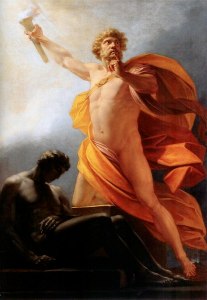
Did Prometheus overstep his bounds? Mary Shelley seemed to think so. In her recollections the story was intended to scare, not to predict. Victor Frankenstein creates the monster simply because he can. He does it alone, without thinking through the consequences even with a convenient Igor. Religion has often been cast as that annoying, moralizing sibling to science. (Philosophy could well join the ranks too, as some prefer it to religious thinking.) Without that sibling, however, how can we make informed decisions? Science, by its very definition, can’t tell us what should be done. The only values it knows are quantifiers. We live in a piecemeal world where some parts have been removed while others have been added. We don’t know if this is right or wrong since religion is one of the pieces excised without being replaced. Prometheus, ironically, translates to “forethought.” The problem with Frankenstein is precisely that Prometheus is missing.


Emulating Icarus

According to a story by Sarah Kaplan in the Washington Post, NASA is preparing to send a probe closer to the sun than any human-made object has been before. If you’re like me, this might conjure those childhood fascinations of being blasted by impossible heat—maybe in a science fiction story of a colony on Venus, or a crew hurtling out of control in a capsule being pulled inexorably toward the inferno of the heavens—on a hot summer’s day. The Post story makes an inevitable reference to Icarus, the character from Greek mythology who flew too close to the sun. The tale has long been a parable for human overreach, but this time it seems that scientists are taking it literally. The technology used to shield the craft from Old Sol is incredibly impenetrable, and it may have applications as we try to figure out how to escape this planet we seem bent on ruining completely.

Earth flies around its personal star in what’s become known as the Goldilocks Zone—that place where it’s neither too hot nor too cold for life. But don’t wander outside in the northern hemisphere in February without a coat. The weather down here can be fatal. We live on that teeter-totter of the extremes in which our frail bodies can survive. Temperatures range from -88 degrees at Oymyakon, Siberia (at this point whether Celsius or Fahrenheit hardly matters, but for the record, it’s -126 F) to 136 in the Libyan Desert. In this incredible range of 262 degrees people can be found at all shades between. Stepping out my front door one January in Nashotah, Wisconsin the thermometer read -42. That was without wind chill. It was the kind of cold you could feel immediately through all the layers. Humans can’t survive it without artificial means of heat. And yet we have a star overhead where temperatures reach 27 million degrees in its core. Out beyond Pluto our universe reaches near absolute zero, at -459 and change, on the Fahrenheit scale.

It’s a universe of extremes. That friendly sun in the sky was recognized as a deity from earliest times. Even the Bible retains hints of clandestine solar worship. Icarus, however, lost his fear of extremism. There was nothing too outrageous to try. As long as wings of wax can hold you aloft, why not attempt to reach all those zeroes? Millions sound great until they’re exceeded by billions. At that point even the sun isn’t hot enough for some.


Breakfast of Champions

In my efforts to become vegan, I’m finding dairy to be the hardest element to replace. I’m reminded of this every morning since the day begins with cereal. Most people don’t realize that cereal for breakfast is largely of religious motivation. The original Kelloggs were Seventh-Day Adventists, and therefore vegetarian. To promote both health and animal-free diets, they gave a big push to the idea the day should start with cereal. It’s a touch dry, however, and water on your flakes leads directly to paste. So I’ve been experimenting with alternate milks. Often I use soy milk, but it has to be the right brand. Some of the offerings on the market have that oily aftertaste characteristic of soy beans. Not sure of the legality of hemp milk these days, I recently tried oat. Oat milk should taste like oats, i.e., it shouldn’t have much taste at all.

The moral crisis came as I poured it into my oatmeal. You see, there’s a biblical injunction to cooking a calf in its mother’s milk. This is the reason meat and dairy can’t be mixed in kosher settings. Scholars debate the basic concept behind this regulation. Like eating a bird and its eggs, some suggest, this depletes nature and should be avoided. At least one generation should have a chance to avoid exploitation. At least until it grows up. But what of the oats and their oat milk? Have I gone too far? What hidden principle am I violating, however unintentional, here? This is the problem with any religious thinking—taken to extremes it begins to break down. Some of the earliest gods, after all, were agricultural deities.

Agribusiness is huge. People gotta eat, right? And it is one of the most massive environmental hazards humans have ever concocted. Industrial farming is the largest producer of methane and the largest user of potable water, by far. Keeping animals for our food is literally destroying our planet. Religions, interestingly, quite often concern themselves with eating habits. It’s strange how most of them in this country are silent regarding what is obviously an ethical issue. After all, we adapted to the cereal for breakfast lifestyle because of religious conviction. It’s difficult to change eating habits. That’s my current struggle. I could pour the oat milk over corn flakes, I suppose. But then again, the Bible forbids mixing fabrics from different plants. What’s an aspiring vegan to do?


Middle Age Demons

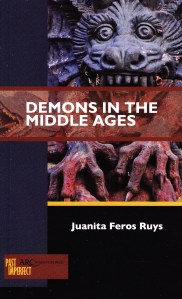
One of the consequences of watching horror movies is the interest in the origins of various monsters. Since many such films feature demons, their backgrounds and origin stories have always been a point of curiosity. Time is always an issue and Juanita Feros Ruys obliges that hurried sense by packing a lot of information into her short book Demons in the Middle Ages. Covering the basics in the introduction, she moves on to discuss demons in the desert—the bane of the early monastic, and demons in the monasteries of populous Europe. A chapter on the Scholastics describes how early science was applied to incorporeal beings, and a final chapter on learned magic, i.e., raising demons via magic books, finishes off this brief study.

What is particularly striking here is that the Bible says surprisingly little on the topic. It says, however, just enough to kickstart the Late Antique and Medieval interest in the subject. Vast amounts of speculation were raised in the Middle Ages concerning what exactly demons were and what they were made of and what they could or couldn’t do. Ruys points out the trajectory of the male necromancer giving way to the female witch just as early modernity was getting started. The results, we all know, were horrific. Throughout it is remarkably clear that belief in demons was strong. People took them very seriously—the Bible says they’re there, so there. Belief, as always, has consequences. Beginning with the Scholastics, however, a reasoned understanding of the spiritual world was deeply desired.

Reason and faith aren’t really the strangers they’re often portrayed to be. Medieval monks could be quite clever and scientific in their outlook. Human mental faculties, created, as they believed, by God, were necessarily good. Something I’d never considered, but which Ruys explores, is the belief that God cannot experience emotions. Being an “unmoved mover” meant not experiencing emotion (which, she points out, includes a noun of movement). This also meant that demons, according to some, had no feelings. This is a very cold spiritual world, particularly when it’s put into conflict with the human one. Spiritual, rational beings subjected to emotions, we’re the ones at the mercy of supernatural beings more powerful than us, yet incapable of the warmth we crave. About a millennium and a half of shifting beliefs in demons crowd this tiny book. Although not intended to be especially profound, it gives the reader plenty to ponder. Including why some of us watch horror movies at all when religion can do the trick all by itself.