Interior Theodicy

Photo credit: Richard from Canton, Wikipedia Commons

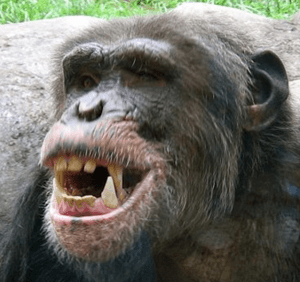
Speaking of theodicy, I have a dentist appointment today. Now, if you were raised with the Protestant guilt that used to be so pervasive in this nation, you’ll understand. I do brush my teeth twice a day. I even use floss and that mouthwash that burns away a layer of mouth lining every night. But there’s always more you could do. I’m not particularly good about visiting the dentist, though. Partially it’s a memory thing, partially it’s a pain thing, but mostly it’s a time thing. No matter how far back I jam the toothbrush, well beyond my gaging threshold, cavities seem to appear. And I don’t even have a sweet-tooth. What kind of deity allows cavities in a person who eats very little sugar and brushes so assiduously that last time the dentist told him to ease up a bit since he was scraping away the enamel? (People tell me I’m too intense.)

One of the real ironies of all this is that for all the trouble teeth give us during our lifetimes, they are our most durable parts after we die. Archaeologists find mostly teeth. In fact, it seems that Neanderthals might have practiced some primitive dentistry. I wonder what they thought of their neanderthal deity? So teeth are pretty useful, no matter whether the gray matter above them is dead or alive. I can explain this to my dentist, but he only seems interested in me as a specimen of carnassial curiosity. Maybe it all goes back to my belief that fillings were meant to last forever. Or all those root canals that seem to come in pairs that cost as much as a semester at a public university. Mostly it’s the memories.

In Edinburgh I had a tooth go bad. The Scottish dentist was surprised. “You’ve got a twelve-year molar erupting,” he said (you’ll have to imagine the accent). I asked if that was unusual. He owned that it was as I was a post-graduate student in his late twenties and the twelve-year molar was so precise in its timing that child labor laws used to be built around its presence. Years later in Wisconsin a different dentist asked about one of my fillings. I told him it was from Edinburgh. He called all the other dentists in announcing, “You wanna see a real Scottish filling?” Or maybe the fears go back to my earliest dental nightmares where the cheap doctor seemed unaware that teeth actually had nerves in them. I always left with a guilt trip. “You should brush —“ (more, better, longer, with a more gentle touch) you fill in the blank. I’m afraid of another kind of filling. And I know as it is with Protestant guilt, so it is with teeth. There’s always more you could be doing.

The One Who Seeks

Academics and social media are, at times, an uneasy fit. In my work as an editor I come across many of the professorate who have virtually no web presence at all. If you’re wanting to write a book these days and you aren’t yet famous, you need what they call a “platform.” That is to say, you need to be easily found on internet searches, you have to have “followers” on various social media, and people have to know where to look to find information about you. A starter site that does fairly well is the for-profit venture called academia.edu. Because of that final “edu” extension, many suppose this is an educational site with no money in mind, but that’s not really the case. Still, it’s free to post your academic papers there and many intellectuals, public and otherwise, have vested some of their effort on getting academia followers.

J. C. L. Gibson, someone, and Nicolas Wyatt

My own profile on academia, which has copies of most of my papers available for free downloads, at one time was in the top 2%. I felt so special. Being kept out of academia for so many years, one does begin to wonder. In any case, one of the features of the site is that when someone lands on your page you receive a notice telling you how they found you. More detailed information is available for a fee (this is one of the not not-for-profit aspects I was mentioning). Sometimes they will provide you with the search terms used and the paper found. My site has quite a bit about Asherah. I wrote a book on the goddess, still largely overlooked, and several discrete papers. The other day I received a notice that someone found my page with this notice of how:

Someone from India found “A Reassessment of Asherah:…” on Google with the keyword “sex photos hd com R A N ilaku.”

I have the feeling someone left my site keenly disappointed. Although my book does discuss sexuality a little—you kind of have to with Asherah—I did wonder about the “photos” and “hd” and “ilaku” parts of the equation. You must be pretty desperate in your pornography quest to stumble across my academia page. Not that I’ve replicated the search, but I must be thousands of pages down in the results. Still, someone found my first book that way. And that’s the lesson—an internet platform may bring your work unexpected fame. Whether or not that fame is ill, will, however, remain an open question.


Devil of a Time

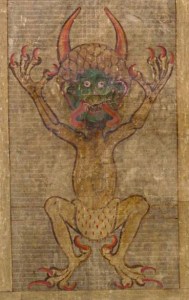
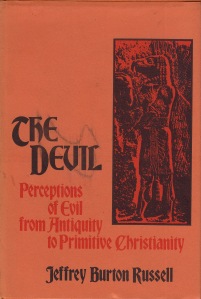
thedevilOne might be excused for thinking so much about the Devil these days. Displays of lies and evil intentions are on pretty obvious display at the highest levels. Indeed, the current political situation has me reassessing my skepticism about the Antichrist. One of the truly well thought out books on the subject is Jeffrey Burton Russell’s classic, The Devil: Perceptions of Evil from Antiquity to Primitive Christianity. The first in a series of books Russell wrote on the topic, The Devil opens with evil. Noting that the Devil defies easy definition, Russell begins rather disturbingly with literary descriptions of acts that can only be described as evil. This allows him to point out that real life events often surpass those that authors can get us to read, intimating that something is seriously wrong with the world.

Having noted that, the emergence of the Devil is not an easy one to trace. Evil has been recognized in many cultures and it has been explained in many ways. Some have personified it, but even that took a long and circuitous route to the dark lord we know today. Bits of Greek philosophy and Zoroastrian cosmology combine with an emerging monotheism among the Israelites and their kin until eventually we have an embodiment of evil appearing. Even so, the Bible has no clear image of who “the Devil” is. This took further developments beyond the New Testament and the image that eventually won out, so to speak, borrowed heavily from classical mythology. Eventually Old Scratch emerges in a recognizable form.

Belief in the Devil still runs high in American culture. I suspect it will run even more so in months to come. At the end of Russell’s well researched study, the Devil comes down to the blatant disregard for the suffering of others. One might think of the mocking of the disabled or the favoring of the wealthy over the poor. Evil may be known by many names but it is easily recognized by those not caught up in its worship. This became clear in the biblical quotations sprinkled throughout the book. “Woe unto them that call evil good, and good evil,” for example. Or “when an ungodly man curses Satan, he curses his own soul.” Mirrors may serve multiple purposes. The vain look into them and see only beauty. Those who believe in the Devil can’t help but know who it is that stares back.


Unseen Worlds

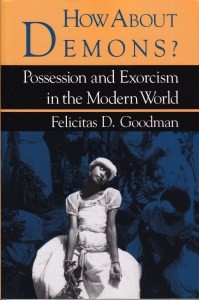
howaboutdemonsA few weeks ago I wrote about re-watching The Exorcism of Emily Rose. In anticipation of the inauguration I was in the midst of a spate of possession movies. I watched several others, including The Rite and The Possession. This got me thinking I should read Felicitas D. Goodman’s book How About Demons? Possession and Exorcism in the Modern World. Goodman was an anthropologist who’d done fieldwork among groups that practiced possession—keep in mind that many religions believe in good spirits as well as evil ones. Her book is one of the few that takes the larger picture seriously. Many writers simply dismiss the “demon haunted world” as naive and superstitious, but Goodman makes the point that possession is a real phenomenon and we don’t know the cause of it. Indeed, it’s impossible to say with certainty what the agency is because spiritual causes can’t be studied empirically. That said, science deeply informs her analysis.

I’ve observed people speaking in tongues before. It’s an uncanny experience. No matter what you decide the origin might be, it’s strange and not a little unsettling. It’s related to possession, as Goodman shows. So is multiple personality syndrome. Unlike most scientists, however, she doesn’t make the unwarranted leap that since these are all related they’re all the same. Speaking in tongues is usually considered a good thing while demonic possession is not. Interestingly, recordings of glossolalia—speaking in tongues—show the same pattern globally. This indicates that whatever it is, it originates biologically from human brains in a mostly predictable way. Many world religions allow for possession by good spirits or gods and alternate states of consciousness are accessible by learning how to reach them. Anyone can do it, but some have the gift of doing so easily. Those who do overlap with the pool of the possessed.

As the White House shows, we like simple answers. Possession, however, is a complex phenomenon. Throughout, Goodman refuses to equate it simply with the physical manifestations that have been observed and recorded. She was a true scientist. Reductionism is related to our love of simple explanations. I wanted to read How About Demons? because it contains one of the few serious academic studies of the case of Anneliese Michel, the young woman on whom The Exorcism of Emily Rose is based. I was expecting, since this is an academic treatment, that the cause would be nailed down simply and efficiently. I was pleasantly surprised when it wasn’t. Well before the movie Goodman interviewed those involved in the case and wrote an entire book on it. Although she clearly believed in science to explain our world, as this book demonstrates, she didn’t give it more explanatory power than it actually has. In a complex world we need as many subtle minds as we can get.


We Are an Island

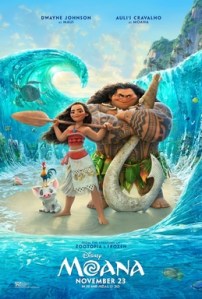
moana_teaser_posterApropos of both building your own deity and Disney, my family went to see Moana. Now, I have to admit up front to being a bit behind on my Polynesian mythology. Scholars of the history of religions feel terribly insecure if they don’t read the languages or haven’t spent time with the culture first-hand. I’ve seen the Pacific Ocean a few times, but never from the point-of-view of an islander. In fact, one of the areas of growing interest in biblical studies is the interpretation of Holy Writ by islanders. Their perspective, it seems clear, is different from others in more populated land masses. So Moana, which delves into Pacific islander mythology, was a brand new world for me. More than hearing about the demigod Maui, it was a chance to consider what destruction of our ecosystem looks like to those who have more limited resources at hand. Those who, when global warming really kicks in, will be the first to become homeless.

One of the strange things about living in the post-truth world (defined as the world after 11/9) is that many movies, novels, and other creative explorations I encounter seem to underscore the demon we’ve invited in. Moana is about a girl who saves her people, but she only does so by defying the man in power. Had she not journeyed beyond the reef, her people would’ve starved on their island. Meanwhile the big white man prepares to assault the White House and all that our founders held dear: an educated leadership. Progress. Fair treatment for all. Someone needs to remind these short-sighted individuals that every landmass is an island.

As we approach the end of 2016 it’s time to think of where we’ve been. At the theater, an ad by Google showed the newsworthy events of the year. There could not have been a better rendering of the high hopes with which we began and the sorrow with which we’ve come to an end. Our scorn of education has caught up with us and we’ve asked “the man” to please destroy our world and enslave our women and deport anyone who’s different. We need a lesson in how to build better deities. We need to be willing to admit that a girl might know more than her father. We need to learn the wisdom of the islanders.


Build a God

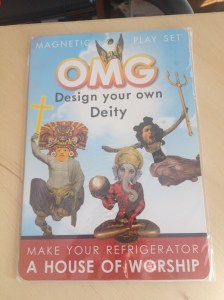
One of the more amusing gifts to find its way under my tree was a Design Your Own Deity magnetic play set. Since I have roughly only this brief holiday break for play in the entire year, I hope to make the most of it. Nevertheless, things like this always suggest something a bit more profound than they were possibly intended to do. The origin of deities is, by its nature, an unresolved question. Partly it’s because regardless of the reality of gods, religions are human constructions. Claims for revelation are frequently made, but the implementation is always our own. We can’t help but think that divinities are motivated by the same kinds of things that people are. I suspect that’s because we make gods in our own image.

img_3116

Historically there are few religions that were admittedly made up. We tend to treat with scorn more recent religions since we’ve become skeptical of a make-your-own deity talking to a person in the post-Enlightenment world. It’s much easier to believe if we say it happened long, long ago. Before we had the reassuring uniformitarianism of science, much could be left to the meddling of deities. Once we had a naturalistic paradigm, the door seemed to have slammed shut on supernatural explanations. Gods, who had been persons, now became symbols and symbols seemed to be less important than the real thing. Hadn’t we been designing our own deities all along? Now don’t we feel silly!

One of the common misconceptions of modernity is that ancient people weren’t very smart. We believe that because they lacked our technology. Looking at the way technology now demands most of my time, I wonder if that’s right. In the light of gadgets, deities have been squeezed out. I’m quite aware that the career choices I’ve made—involved with thinking about gods in some description—are hopelessly outmoded in the technological world. Still, as I look at the political landscape I see that we are still in the process of making our own deities. My play set includes some pretty exotic divinities. One that it seems to be lacking is Mammon. Of course, it’s best not to offend the currently reigning god, even if it is just a symbol.


Giving Trees

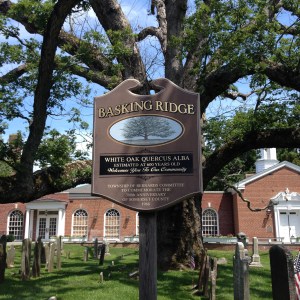
They’re not exactly worshipping the tree, but the Basking Ridge Presbyterian Church is holding a memorial service for the old oak tree. I’ve written about the Basking Ridge oak before. I learned about it only in January, and I visited it this summer. Some say it’s the oldest tree in the state, while others make that claim for the Great Swamp oak, which isn’t too far away. The climate change we’ve introduced, as well as natural aging, appear to have doomed the tree. It had leaves this summer, but not in the profusion that signals health to botanists. The decision has been made to take the tree down before any massive branches fall and cause injury or damage. In the light of these sad developments, holding a service seems perfectly natural. The tree is older than the church over which it presides, after all. It’s even older than John Calvin who started the Presbyterian tradition.

img_2878

My first book was on Asherah, the goddess often associated with trees by scholars. As those who’ve read my book will know, I’m a bit skeptical, on the basis of the actual evidence, that Asherah was a “tree goddess,” but it is also clear that trees are ancient objects of veneration. From the human perspective, they can live a very long time. There is a bristlecone pine in this country that dates back to before Noah’s flood (something the creationists conveniently ignore). With that much life-force, which, we’re told, is really a fiction, these trees deserve special respect. After all, they were in the neighborhood long before we got here. Still, the Basking Ridge oak has been artificially preserved before. It’s been on life support for years. Concrete was poured to support the massive trunk, and many ponderous branches are shored up by support rods. We respect our elders.

Maybe it’s not tree worship. Maybe it’s worship beside a tree instead of worship of a tree. Prepositions can make all of the difference. Nevertheless, it’s an occasion to stop and consider our place on the planet. The fear many of us feel regarding this week’s election is a mere second in arboreal memory. The independence of this country came after the oak had been here centuries already. It may not be tree worship, but we should respect the memories of such a tree. A country young and optimistic rather than old and jaded. Maybe this tree knows a secret that it’s willing to bequeath to those of us whose lives are but a few leafing seasons in length. Good-bye, Basking Ridge Oak. It was a pleasure to meet you.


The Grammar of Evil

I stepped into a devil of a situation. Elevators are strange spaces. Given the choice, I’ll take the stairs any time. At work, however, as one of the many quirks of Manhattan, our elevators only stop on certain floors and we’re not able to use the stairs unless it’s an emergency. After a meeting on a floor where the only option was to elevate out, I stepped into a crowded elevator where a conversation was going. “You always capitalize Satan,” someone was saying. The usual questions among non-religion editorial staff ensued. Why is that? What about “devil”? “It’s never capitalized,” came the reply. My profile at work is about the same as it is on the streets of New York. Not many people know who I am or what I do. Although I’ve struggled with this very issue before, on a professional level, I kept silence and waited for my floor.

So, was the elevator authority right? “Satan” has become a name, rather along the lines of “Christ.” Both started out as titles. In the Hebrew Bible “satan” is “the satan.” The accuser, or the prosecuting attorney—something like that. As one of the council of gods, the satan’s job was to make sure the guilty were charged of their crimes. Diabolical work, but not evil. By the time of early Christianity, however, Satan had evolved into a name. It is therefore capitalized. It was specifically the name of another title, “the Devil.” Or is it “the devil?” Do we capitalize titles?

The Devil wears underpants.

The Devil wears underpants.

In seminary and college the received wisdom among those of my specialization was that there is only one Devil and the title should be capitalized. My elevator colleagues were discussing the number of devils when I stepped out. Traditional theology says there’s only one. Not that the Bible has much to say about the Devil—he’s surprisingly spare in sacred writ. Demons, however, are plentiful. Some people call demons devils, just as many believe that when good people die they become angels. The mythology behind demons seems to be pretty well developed in the biblical world, but again the Bible says little. Demons can be fallen angels or they can be malign spirits who cause illness. Either way they’re on the Devil’s side. But should we capitalize his title? The Oxford English Dictionary doesn’t help, giving examples of both minuscule and uncial. I suppose that’s the thing about the Devil; you never really know where you stand.


Godnapped

“Has anybody seen my god?” So we might imagine an ancient victim of godnapping wailing after a hostile takeover raid. We might smirk to ourselves, knowing that gods only really come in paper or plastic. The only godnapping that goes on these days is when someone hacks our credit card number. These were my thoughts when a friend sent me a link from ASOR’s website, “‘Godnapping’ in the Ancient Near East” by Shana Zaia. Stories of godnapping are known from the Bible, like where the Philistines defeat the Israelites and take the ark of the covenant to the temple of Dagon. It’s easy to congratulate ourselves in this post-theistic age that we’ve developed more spiritualized versions of deities to disbelieve. At least we didn’t believe some hunk of wood was an actual god. We at least had a person nailed to it.

I used to ask my students what the difference between an “idol” (not the American variety) and a “god” was. The usual understanding is that an idol was made out of something like wood or metal. The ancients weren’t so naive, however, as we suppose them to have been. Before any carven or graven image could be considered a “god” it would have to undergo a ritual to make it one. Elaborate ceremonies attended the process in which even ancient sophisticates realized that this piece of rock or wood wasn’t actually the fullness of the deity it represented. It was a symbol. A symbol invested with power, to be sure, but a symbol nevertheless. What was an “idol” then? Merely a modern way of degrading another religion. “Idol” can never be a neutral term.

img_0188

Imagine the ark of the covenant in the temple of Dagon. It was a box overlaid with gold, on top of which sat cherubim. Two of them. Images, but not “idols.” Inside, depending on what passage you read, you might find the original ten commandments, a jar or manna, or Aaron’s rod. Or all three. You might find nothing inside. The point was in the power of the symbol. Godnapping was a real fear in ancient times. A deity captured left its people vulnerable to the whims of others. Today we may rely on the high priests of encryption to keep our divine numbers safe from those who hack at the new idols. Gideon, after all, was the original hacker, and we all know how he ended up. Those who destroy others gods often fall into worshipping them once the hewing is done. The only question left is if one prefers paper or plastic.


My Fellow Americans

It’s important to keep the old gods happy. By now everyone probably knows that Stephen King composed a tweet suggesting that Donald Trump was Cthulhu. In response an angry tweet came from Cthulhu himself, since, as we know, he declared his intention to take over the world long before Trump. Cthulhu is no stranger to this blog, being the brainchild of H. P. Lovecraft. As I’ve suggested before, however, it is really the internet that gave life to the ancient one. His name is instantly recognizable to thousands, perhaps millions, who’ve never read Lovecraft or his disciples. In parody or in seriousness, the worship of Cthulhu is here to stay.

I’ve often wondered if the internet might participate in the birth of New Religious Movements. In an era when a completely unqualified plutocrat can run for president just because he has other people’s cash to burn, anything must be possible. Cthulhu, as we all know, lies dead but dreaming beneath the sea. His coming means doom for humankind, or, at the very least insanity. It seems that Stephen King might be right on this one. I’m getting old enough to recognize the signs; after all John F. Kennedy was president when I was born. I’ve seen the most powerful office in the world devolve into a dog-and-pony show where lack of any guiding principle besides accrual of personal wealth can lead a guy to the White House. At Cthulhu’s tweet indicates, reported on the Huffington Post, at least he’s honest. Unlike some political candidates, many people believe in Cthulhu.

img_2791

Perhaps the interest in Cthulhu is just a sophisticated joke. Long ago I suggested to a friend of mine in Edinburgh that perhaps the Ugaritians were writing funny stories (i.e., jokes) on their clay tablets, imagining what future generations would say when the myths were uncovered. Like Cthulhu, they were the old gods too. Like Cthulhu, there are people today who’ve reinstituted the cult of Baal and the other deities that would’ve led to a good, old-fashioned stoning back in biblical days. New Religious Movements are a sign that we’re still grasping for something. Our less tame, or perhaps too tame, deity who watches passively while charlatans and mountebanks dole out lucre for power must be dreaming as well. Of course, Lovecraft, the creator of Cthulhu, was famously an atheist. Belief is, after all, what one makes it out to be. At least Stephen King’s father reinvented his surname with some transparency. And those who make up gods may have the last laugh when the votes are all in.


Finite Gods

Just how many gods are there, anyway? Well, that’s not really a fair question. For one thing, do I mean “real gods” or gods that people believe in? Do I mean “believe in” or made up? Do I mean “made up” or intentionally fabricated? And the nesting questions could go on and on. Over the years in my professional capacity as an erstwhile teacher, I accumulated books listing the deities of various cultures with brief descriptions. I once even argued that using “god/goddess of” (the divine-genitival construct) as a phrase distorted ancient concepts of divinity. The fact is people have believed in many gods in many different ways. As modern scholars of religion we’ve only begun to reach the heavens (or underworld, or anywhere in between, for deities may be found anywhere). This issue comes to mind because a friend recently shared a story from IFL Science about a new Etruscan goddess. The piece by Ben Taub mentions a stone recovered from Poggio Colla, a site in Italy, written in Etruscan. The stone seems to mention a new “fertility cult” goddess. And once again religion and science have met, but not quite kissed each other.

Photo credit: Jastrow (2006), Wikimedia Commons

Photo credit: Jastrow (2006), Wikimedia Commons

Let’s begin with the Etruscans. Before the Romans, Etruscans lived in Italy, giving Tuscany its name. We know very little about them, as their language (Etruscan) is rarely found and imperfectly understood. Some of the classical gods may go back to Etruscan originals, and the Etruscans seem to have known of at least some of the cultures of the ancient Near East, or ancient West Asia. We have no idea how many deities the Etruscans recognized. Polytheism, for all its heathenish exuberance, never had a problem with adding more gods. Interestingly, the “new” goddess mentioned here, Uni, is someone I used to talk about in my Rutgers classes on ancient Near Eastern religion some five-plus years ago. Pardon my crowing—I seldom get to suggest I was ahead of my time.

What really interests me here is that websites that advocate science still take an interest in religion. Although belief is relegated to inferior minds (generally) science does admit, from time to time, that it’s interesting. The study of religion, in at least some schools, is a scientific enterprise. No, we don’t put gods under microscopes (telescopes might be more useful) but we use the same techniques as empirical studies of nature use in order to try to draw some conclusions about religion. Despite the fact that the vast majority of humans on the planet are believers, higher education has consistently under-funded or disbanded departments who apply rational thought to religion. We suppose that someone else can pick it up and study it, coming to useful conclusions without putting in all the homework. Don’t mind me, though. I’m just basking in the light of having known about Uni years before she was discovered.


The Neighborhood

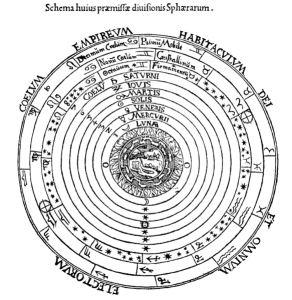
583px-Ptolemaicsystem-small

Let me send out a warm welcome to the neighborhood, I think. Not that I officially represent Earth—or anything for that matter. I’m just friendly, I guess. Now that astronomers have strong evidence that the nearest star to our own, Proxima Centauri, likely has a planet, it’s not premature to head over with a casserole. It’s not every day that a new solar system is discovered. We don’t know for sure that the planet’s there, but chances are pretty good. In reading about this discovery I learned that the orthodoxy has changed since I took astronomy in college. It seems now standard wisdom teaches that most stars likely have a least one planet. I can’t even count the stars—I usually start to trail off after I get to about ten—so I can’t imagine the number of potential planets out there. And where there are planets, there are gods.

Let me rephrase that. If there are billions and billions of planets it is very likely that there’s life out there. I know I’m racing ahead of the evidence here, but let me have my fun. If there’s life, there’s a chance, a glimmer of a chance at least, that given enough life we’ll find consciousness. I’ve always thought it was a touch arrogant on our part to assume we were the only ones out here. Perhaps it’s because the stakes are so, ahem, astronomically high we seem to be afraid to admit the possibility. We don’t really want to be alone in this cold, vast, universe after dark. Enter the gods. Conscious beings—even arrogant ones—have no trouble supposing that there is an even greater presence out there. I suspect this isn’t an earth-bound bias. I should hope that conscious life looks toward the stars with wonder, and even after they discover that there’s no lid on their planet they might still ponder what else might be out there.

Let’s suppose there are other creatures out there with other gods. When the meeting takes place we’ll need to have that discussion. You know the one I mean. We’ll need to ask whose deity is really real. Is it yours or is it ours? Hopefully we’ll enter into this with an open mind. I suspect it will depend on who’s in the White House, and all the other big houses, at the time. There are certainly those who claim their own almighty brooks no rivals. If it turns out that we can’t agree, I hope it doesn’t come to blows. There will always be other planets to explore, and maybe even new orthodoxies to accept. It’s an infinite universe, after all.


Simply Complex

What does it mean to be a man? Or a woman? Or intersex? As a society we seem to spend quite a lot of political time thinking about this. We want to regulate something we don’t even understand. An opinion piece by Rabbi Mark Sameth in the New York Times raises this question to a new level. “Is God Transgender?” the title asks. The Bible, which most of the belligerents in this battle claim to follow, doesn’t present as hard and fast a rule on sex as it might seem. As Sameth points out, the language of a number of passages seems “gender confused” and even the gods of olden times could slip from female to male and back. The Ugaritic deity of Athtar could be called Athtart, depending on her or his gender at the time. We human beings prefer our genders to be fixed, but nature doesn’t always agree.

IMG_2578

Not only gender identity, but gender itself occurs on a spectrum. In cases of “ambiguous” gender doctors often make the decision at birth. Gender is assigned, and sometimes made surgically. And lawmakers will use an outdated binary system to assign bathrooms. We make industrial, multi-occupant bathrooms because they’re cheaper. At the same time we raise our children telling them that bathroom use is a private function. Of course, when money’s involved the story changes. We thought we understood what gender was. Like most aspects of life, however, our understanding is only partial. Some species have such complex reproductive techniques that the term “gender” just doesn’t apply. Some species naturally change gender in the course of their lives. Which bathroom should they use? Nature doesn’t support our laws here.

For human beings the experience of gender is no doubt important. More important, it might seem, would be the acceptance of difference. A rainbow doesn’t have sharp divisions of color. Light blurs from one hue to another and we say it’s beautiful. When it comes to sexes we only want two. Black and white. As the rabbi points out, however, nature prefers the rainbow. The acceptance of difference in the face of the evidence would appear to be prudent. But many people read the Bible only on the surface (although even here it’s not as straightforward as it might appear at first). The biblical writers probably thought of gender in binary terms. In those days congenital “defects”—at least those visible to the naked eye—were cruelly set aside as a divine curse. We’re at last learning to see this “curse” as a blessing of diversity. As long as we don’t have to share bathrooms.


Sky Gods

One of the unspoken prompts for writing Weathering the Psalms was the unscientific idea that God is somehow associated with the sky. To my mind this has more to say about what religion is beyond the recognition that Anu, El, Nut, and kin were primordial deities of the celestial sphere. We’re all drawn to the sky. One of the earliest fictional pieces that I polished had to do with our desire for the sky—it’s something we deeply crave but cannot control. We dream of flying. Although flight seems almost casual these days, it is anything but. We still refer to satellite photos as being “God’s eye view” of the earth, knowing full well that the ancient cosmology of the three-tiered universe was simply a misconstrued view of how nature really works. Still, we want to embrace the sky.

Perhaps the cruelest aspect of work in the commercial sphere is the prevalence of “workstations” with no outside views. I’ve held two jobs since leaving academia where my “cubicle” was/is in a windowless room. Cut off from the sky, I’m supposed to focus on the glowing screen in front of me as if that could ever inspire me like a mountain sunrise or the silent crescent of the moon gracefully arcing across the sky. It could be night or day, snowing, raining, or brilliant sunshine, and for eight hours of each day I would never know. We call it efficiency. I think back to that story I wrote as a child about wanting the sky. If there are gods anywhere, it’s up there.

DSCN6374

The perspective from above can change everything. On a small plane tour at 7000 feet, you can get a sense of what you’d never expect from the ground. Sharing the view of gods and angels, the land is laid out before you. “Distances,” our pilot says, “are very deceptive from up here.” Indeed, a few minutes aloft and it’s easy to forget what things looked like on the land. Pedestrian. Street-level. Quotidian life. Up here, isolated in a different way, I am seeing what the ancients could only imagine what the gods might see. For the moment I’m one with the sky. For the moment the world of everyday life is far away. That dark and gloomy cubicle no longer exists. In fact, from the sky I cannot see it in its windowless dungeon. We can’t own the sky. Being up here I start to suspect that neither can the gods.


Literally Smitten

FfordeWomanDiedJasper Fforde is one of those writers who blends nonsense, deep thought, constant plot twists, and polished writing into compelling novels. His labors are always fun to read and often leave me with something profound to ponder. I haven’t followed his Thursday Next stories in any kind of strict sequence, but I figure that I can sacrifice a few of his abundant references to previous events to read through the latest installment I can get my hands on. The Woman Who Died a Lot was the most recent of these books for me. Thursday Next is a literary detective and her exploits often lead, certainly intentionally, to a feeling that in Fforde’s world libraries and reading are even more than fundamental. Everyone wants to be prided on literary achievement. His universe wouldn’t exist without books and those who love them.

In The Woman Who Died a Lot (and since I haven’t read all the books in the series I have to confess that this theme might’ve been developed earlier) in Fforde’s Swindon, religions have been united into the Church of the Global Standard Deity (GSD) and this GSD drives much of the plot. As Thursday races to solve the latest literary crime, the GSD has decided to smite Swindon. A number of global smitings have already taken place and everyone knows what to expect. A plasma-like discharge, of precise dimensions, wiping out a specified sinful part of the city. The sin here is greed and such smitings have lead to new kind of tourism where the morbidly curious gather outside the boundaries to watch the show, much like Jonah outside Nineveh. As in most Fforde novels there is both a touch of ridiculousness and social critique combined here. I can’t tell you how the smiting ends or you might not read the novel yourself.

The story is populated with peculiar religious orders that always evoke a laugh, and even a Ministry of Theistic Defense charged with finding a way around the smiting of a God willed into existence by the very people the GSD will destroy. I sometimes wonder if Fforde was ever a seminarian. We fabricate our own doom in this literary universe. It’s all in good fun and is reverently irreverent. Virtue is rewarded and in many respects the religion is conventional. The deity can be bargained with, but the law, once laid down, is inviolable. Casuistry is, of course, always an option. It’s a story told with tongue solidly in cheek, but also with brain fully engaged. Fforde is an author not afraid of religion. Indeed, he knows it can lead to a remarkable plot with consequences that will leave a reader scratching one’s saintly head.