Animal Rains

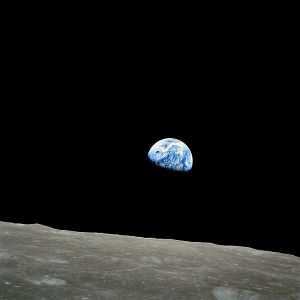
We may have been to the moon—if not personally, collectively—but we still don’t control the weather down here.  It’s probably not news that the eastern part of the country has been getting a lot of rain lately.  One of the factors that led me to write Weathering the Psalms was the overwhelming tendency for humans to attribute weather to the divine.  It used to be that we couldn’t reach the sky, so placing deities there seemed a safe bet.  Now that we’ve shot through the thin membrane of atmosphere that swaddles our planet, we’ve discovered beyond a cold, dark space liberally sprinkled with stars and planets but mostly full of dark matter.  The deity we thought lived beyond the sky somehow wasn’t anywhere our probes flew and recorded.

Still, down here on the surface, we live with the realities of weather and still think of it in terms of punishment and pleasure.  When we don’t get enough rain, God is destroying us with drought.  Too much rain, and the Almighty is washing us away with flood.  The true variable in all of this is, obviously, human perception.  Sure, animals experience the weather too, and they sometimes look to be as disgusted as humans when it snows too early or too late, or when the rain just won’t stop.  I have to wonder if somewhere in their animals brains there’s the seed of an idea that the bird, or squirrel, or woodchuck in the sky is angry at them for some unspecified faunal sin.

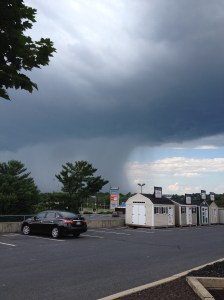
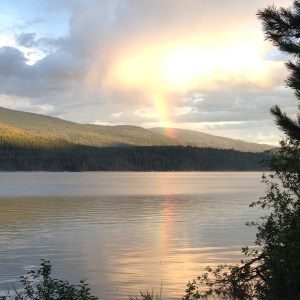
While heading to the store yesterday, after weather reports assured us the rain was finally over for the day, the skies told a different story.  The vistas around here are never what they were in the midwest—or what they are in Big Sky country—but the approaching storm was pretty obvious.  An opaque drapery of precipitation was coming our way and although a rainbow would cheekily show up afterward, knowing that we’d been caught away from home with our windows open felt like punishment for something.  Perhaps the hubris of buying a house when all I really require is a corner in which to write.  Somewhere in my reptilian brain I translated a natural event into a supernatural one.  When we got home to discover the storm had gone north of us, it felt like redemption.  I spied the birds sheltering in shadows from the sun’s heat.  Were they thinking it was some kind of divine avian displeasure, and hoping for some rain to cool things off for a bit?  If so, was our religion correct, or was theirs?


Hidden Origins

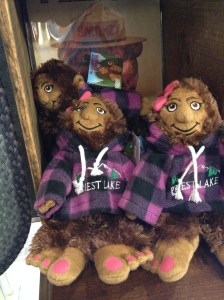
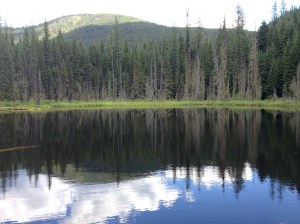
This blog was born at the very lake I’m about to leave.  Although it’s relaxing, there’s an element of chaos to a family vacation that stirs up creativity.  Tomorrow’s long day of travel back east, however, will mean another day without a post.  Flights leave so early that you barely have time to slither out of bed to the shuttle, and the airport hotspots want your money to connect.  I’d rather maintain radio silence for a day.  That doesn’t mean I won’t keep my eyes open for religion hidden in the interstices of American life.  Since religion and mythology share sleeping quarters, I’m reminded of something I saw up here in the northwest the other day.  While in a local grocery and souvenir shop (for all groceries in this area carry souvenirs) I saw sasquatch dolls.

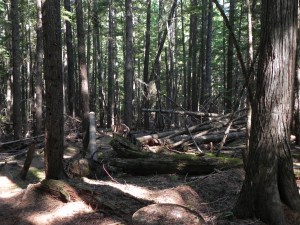
Such cryptids are unknown to science, of course.  Even if they really exist, their liminal status now places them firmly in the realms of mythology.  Being in the wilderness can be an uncanny experience.  Long accustomed to dwelling in cities and towns, we feel vulnerable out in the open.  Taking walks in the woods might just put you in the path of black bears, grizzlies, or mountain lions.  Who knows what else might be hiding in these woods?  It’s easy to believe in our myths here.  Vacation, in addition to being the ultimate reality, counts as time borrowed against work and its punishing rationality.  Religion thrives in the quiet moments when you’re not sure what might be hiding just out of view.

Did ancient people devise belief in such circumstances as this?  (Well, without the wifi and indoor plumbing, of course.)  It’s not hard to feel the spirit of the lake.  Standing chest-deep in the water, being rolled by the waves, there’s a kind of secular baptism taking place.  In the quiet unearthly voices can be heard.  No television or newspaper tells you that it can’t be happening.  Listening is much easier with no distractions.  These woods are vast.  Human access to them is limited to marked and maintained trails.  Beyond these borders, who knows?  Science comforts us with the assurance that there are no monsters out there.  Standing isolated from any other human beings, surrounded by ancient trees, you might begin to wonder if such assurance is as certain as it sounds.  The sasquatches are children’s toys, and the sense of the numinous you feel can, like all extraordinary things, be explained away.


Lions, Bears, and Caribou

The place I’ve been spending this week is the habitat of grizzly bears, caribou, and mountain lions, none of which I’ve ever seen here.  Two of these species view us as potential, if troublesome, prey.  In actuality, even here in the wilderness we’ve made the human presence felt and wildlife sightings are somewhat rare.  I saw more deer in New Jersey than I’ve ever seen here.  Kind of makes you wonder about the human reputation among other creatures.  We like to look at them in zoos, but we don’t see them in their natural surroundings.  I like to think that it’s because they have so much space out here to wander—we see plenty of evidence of moose, for example, without an antler or dewlap making an appearance.

The environment, as created in our won image, has become somewhat sterile.  Kind of the angry, old white man’s view of government.  One color is all you need.  Variety is too challenging, and threatening.  We’ve driven the wolves to extinction around here, so you won’t see any of those.  Won’t hear their plaintive howls on a moonlit night.  You’ll see motorboats aplenty, and cars with fancy technology, and airplanes buzzing overhead.  This will have to do for wilderness, since other places are fast developing into surveillance states to protect the rich men’s money.  Wilderness means nothing to such people, unless it can be exploited for personal gain.  The thing is, once it’s gone for them, it’s gone for us all.  I found a sardine tin shining like silver in the silt on the bottom of our lake.  Our fingerprints are everywhere.

The problem isn’t new.  Even some monks in late antiquity found that when they headed into the desert for heroic feats of spirituality, they were followed by the curious.  Crowds would sometimes gather to watch them being holy.  Would that break a saint’s concentration?  Do I even need to ask?  The forest service asks us to stay on the trails.  The trails are well trod.  Out of sight, but never far from mind are the bears and cougars.  We’ve driven them out of our path and then congratulate ourselves on becoming the top predators.  Once the beasts are gone we turn our instincts on our fellow humans.  To flush them out into the open we must tame their wildness. And when it’s all gone the only rule will be, in this distorted vision, that of rich white men.  An angry grizzly bear would be far more congenial.


Hearing Nature’s Voice

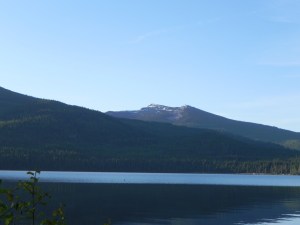
Silence is a rare treat.  I enjoy music and witty repartee just as much as the next guy, but silence is revelatory.  At home and in hotels I sleep to the sound of a white noise generator.  You can’t predict the sounds of neighbors, and my hours are askew from those of the rest of the world.  Here at the lake, things are different.  I awake early, hoping to catch the sun as it trips over the mountain tops across the way, lighting successive peaks before it reaches the near horizon.  It is utterly still.  Perhaps it’s the interference of humans in the habitat, but crepuscular animals seldom wander past.  The stillness is divine.  For some the lake means loud jet skis and buzzing motorboats.  I come here seeking silence.

Our daily lives lack peace.  Even when things are good there are always more things to be done.  We cram as much as possible into days impossibly short, giving at least eight out of every twenty-four to those who deign to pay us for our efforts.  Sleep is troubled and interrupted.  There are noises in the night.  You can’t hear your soul.  As the first rays seep into the valleys across the lake the birds begin to greet it.  Their conversation may interrupt the silence, but it doesn’t break it.  Silence is finding one’s place in nature.  Taking time to be still.  To listen.

Thirty years ago I first came to the lake.  My wife had been coming here for years already before that.  There have been many changes even in my short time here.  I can, however, hear eternity in the silence, for forever is a whisper, not a shout.  As I watch the morning mist arise, skate, and dance over the surface of the water as still as the very mountains that cradle it, I strain my ears to catch any sound.  The twirling wraiths are as silent as they are ephemeral.  They spin away the last minutes before the whine of an early morning fisherman’s boat begins its sleepy journey to the deep water in the middle of the lake, herald of other daylight noises to come.  I will await tomorrow’s unction of silence, and although the baptism may be secular it’s redemptive after all.  Nature knows far more about the human soul than any measurements might reveal.  You only have to listen to hear it.


Traveling Unplugged

Those who pay close attention, or who have nothing better to do in July, may have noticed that I missed a day posting on this blog on Saturday.  That hasn’t happened for a few years now.  I think maybe I ‘m growing up.  Or learning to resist.  Saturday was a travel day—the first I had to make from Pennsylvania, back to Newark in order to fly to Washington state and drive a few hours to the lake.  All in all, it turned out to be a long day in which I didn’t even notice that I was unplugged.  I had a book that I read along the way.  Although it’s against my religion—(call it Moby)—(but I jest)—I even fell into a cat nap or two on the plane.  I didn’t have a window seat and strangers don’t like you staring in their direction for five hours at a time.

Upon awaking, eyes refusing at first to work in tandem, in the chill mountain air, I realized I’d spent the entire day off the internet.  We had to pull out at 2:30 a.m. to meet TSA requirements, and you have to pay for the privilege of connecting to the web in airports and on board jets.  I’ve become so accustomed to being wired that I feel I have to explain why I wasn’t able to post a few thoughts when circumstances were so adverse to getting tangled in the world-wide web.  Yes, it still has a few gaps where one might buzz through without being caught.

It was remarkably freeing to be unplugged.  I believe Morpheus may be correct that they want us to believe reality is otherwise.  I feel guilty for not checking email manically.  What if someone requires something right away?  Some sage response to a communique that just can’t wait until I’m back from vacation?  Some reason that I must ask to be inserted back into the matrix if just for a few moments, to hit the reply button?  We’ve perhaps been exposed to what The Incredibles 2 calls the Screenslaver, the force that draws our gaze from even the beauty of a mountain lake to the device in our hand, whining for attention.  We have wifi here, of course, for the fantasy of living raw is sustainable for only a few hours at a time.  Reality, as you know if you’re reading this, is electronic.  But until I have to reinsert myself at the cost of my soul, I think I’m going to take a dip in the lake.


High Places

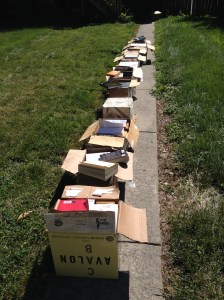
I have gotten me away unto an high place.  No, that’s no biblical, but it sure sounds psalm-like.  Part of the anxiety I felt about the literary loss over the past few days is that it happened just before a long anticipated, and paid for, vacation.  As Thursday dawned, I knew I had only two days to try to rearrange the undamaged books and try to salvage what I could of those that were soaked.  And I had to do it quickly and then leave, only to see the results when I returned.  Not yet having met any neighbors, and not really being in a position to prevail upon their presumed good will, it was a test of personal endurance.  Our garage has an upper floor that remained dry.  I made well over an hundred trips up those stairs, book boxes in hand.  One cares for ones friends.

For now, however, I am at my favorite high place, in the mountains.  On a lake.  I’m having to reconcile myself with my old foe H2O, for here it is placid welcoming.  It stays outside the cabin and we remain friends.  And truth be told, there is a kind of idolatrous element involved in my visits to the lake.  You see, I covet peace.  Since childhood violence and bullies have led me to a quasi-monastic life—Paul Simon reflected that perfectly in his early song “I am a Rock.”  Even Superman had to have his fortress of solitude.  Some fear being alone with their thoughts.  Although I struggle with them, they are, like my books, who I am.

Dawn’s early light; and it only got worse as the day went on.

Prophets and deuteronomists railed against high places.  Such were locations where the God of Israel grew jealous of the attention lavished on other deities.  Perhaps religious promiscuity comes naturally to people, but we need our high places to regain perspective.  To breathe pine-scented air and feel the chill of a July morning at altitude.  Yes, even to reconcile with the splash of water that is here to make life possible rather than to destroy that which you have worked to acquire.  Ironically some of the destroyed books had been with me since college—theological classics such as Niebuhr, Gutiérrez, and Tillich, lying on the unmown grass beneath a healing sun.  Perhaps they were trying to warn me of the idolatry of such retreat.  But here I am, reflecting on loss and hope, and praying that somehow we might just all get along.


Fair Weather

“I just saw God up on your ridge.”  (Kudos to anyone who can name the source of that quote!)  Many years ago I read Stewart Guthrie’s remarkable Faces in the Clouds.  The idea that he presents is that pareidolia—seeing faces or people where they don’t actually exist—may account for the belief in God.  Early people, not knowing any way to interpret such obvious examples of humans writ everywhere thought they were gods or spirits.  Since reading this book, I’ve taken to trying to capture incidents of pareidolia where I can.  The other day as I was working away in my home office, I noticed a literal face in the clouds.  I thought “I just saw God outside my window.”

Now I know this isn’t really what I saw.  I know matrixing (mistaking noise for signal) when I experience it.  I hope.  Nevertheless, the resemblance was detailed—brow ridge, nose, distinct lips, chin.  The lighting in the fair weather cumulus will likely make this difficult for you to make out, and you might see a face other than the one I saw.  Not everyone thinks of the Almighty in the same way.  Looking at the picture I snapped I can see at least two faces stacked on top of one another—the council of the gods?  Who am I to tell deities what they can or can’t do?   Or to prevent imagination from going where it will?  Religion seems to be an evolved characteristic of our biological makeup—our eyes show us what to believe about the world around us.  The rest is hermeneutics.

Gods and the skies naturally go together.  We can’t reach the heavens nor can we control them.  We can increase greenhouse gases in them, though, threatening the very illusion we see in the clouds.  The glimpse of the divine we once saw there can easily dissolve into acid rain.  Heaven and Hell, according to the story of Dives and Lazarus, aren’t very far apart.  Even as we gaze into the cerulean sky seeking serenity, others are bending laws to allow them to destroy it for profit.  There’s a reason Dives is simply called “the rich man.”  Does Scripture defend the practice of environmental destruction?  Dives’ friends claim the planet was given to us to use and use up and Jesus will swoop out of those clouds we’re manipulating at the last minute and rescue us from the mess we’ve made.  Looking into God’s face in the clouds, I interpret this all as a mere excuse.  To destroy the environment is to side with Dives as he makes his flaming bed of nails in Hell. This is why windows in an office are divine.


Extra Baggage

So, I’m packing.  Have been, on and off, since January.  One of the most dreaded moments of packing is the closets.  You know how in horror movies the villain often hides in closets?  We have no danger of that.  Any monster foolish enough to try it would be suffocated under tons of stuff.  Some houses may have walk-in closets, but I am inclined to call a mining company whenever I need to find anything in ours.  Our closets have led full lives.  It’s almost 100 degrees outside and I’m excavating.  We’re at that stage of “absolutely need to keep?” instead of “do we want this?”  Then I came upon it.  The layer of SBL tote bags.  Like a paleontologist of ancient academia.

If you’ve been a member of the Society of Biblical Literature you know what I mean.  Every year the Society wants you to realize value for your money, and they give you a tote-bag to help you haul home the books you’re going to buy.  Long-time attendees know to pack an empty suitcase inside their regular one just to accommodate the books.  (That could also account for about ninety percent of my packing—we have more books than a small town public library.)  But it’s not the books that are the problem today, it’s the bags.  I’ve been attending SBL since 1991.  Do the math.  I seem to recall that they didn’t do tote bags back in Kansas City, but soon after they became part of the agenda.  And I have an impressive pile of them in my closet.

Too small for groceries—especially in the early editions, back when we could meet in smaller venues—and too impractical for anything other than books, they multiply in our closets.  What professor doesn’t have his or her iconic briefcase already?  Reduce, reuse, recycle they say.  At least half of my totes have never been reused.  Zippers?  Who thought of that?  Pulling handfuls out of the closet, I marvel at their colors.  I can’t remember everyone walking around with a red bag—what year was that?  (San Francisco, 2011.)  The black leather edition—remember that one?  (SBL, n.d.)  The bags aren’t really useful for packing, on a movers’ scale.  You can imagine the burly guys outside their truck scratching their heads at this impractical conveyance.  Like so much else in life they’ve become mere souvenirs.  From the French word for something like “remembrance,” souvenirs are meant to take us back to the place in vivid detail.  I fear that many past meetings have run together into a blend of biblical arcana.  I’m sure that’s just me.  Still, I’m responsible for this new discovery.  I’d I’ll need shortly to decide whether these totes go into the museum or back into the landfill that moving inevitably creates in a throw-away world.


Melting Psalmists

With weather like this, I could use a Psalm or two.  Of course, in my mind, weather and Psalms are closely connected.  Here in the mid-Atlantic states, we’ve been experiencing a heat wave.  Unlike many parts of the west, such heat here in the east is accompanied by very moist air, meaning that cooling down is only possible in a large body of water or air conditioned interiors.  We have neither readily available at our place, so we try our best to keep cool and compose psalms, mostly imprecatory, I fear, about the weather.  Although it was thunderstorms that stirred my interest to write Weathering the Psalms, I included a chapter about temperature, for the Psalter sings of hot and cold as well as lightning and thunder.

The world of ancient Israel was quite different from that of North America.  There are mainly two seasons in the Levant—dry and rainy.  The dry season isn’t always as hot as we tend to imagine it, although the day I visited Masada the air temperature was about 120 degrees.  Enough to make a dip in the Dead Sea look inviting.  The Bible often views high heat as a form of divine punishment.  Although we human beings have expanded to fill just about every ecosystem our planet has to offer, we thrive in central California conditions.  Not all of us can live there, however.  And it’s a good thing that global warming’s a myth since it’s awfully hard to function when it is over 90 degrees for days in a row.  WWDD?  What would David draft?  Perhaps, “I’m melting”?

The interesting thing about the global warming myth is how real it feels.  I suppose the solution is to use more fossil fuels to help keep cool.  Fans, arctic air conditioning, lingering languidly at the open freezer door.  I stand here sweating, wondering what the Almighty could possibly find wrong with a country that is now great again.  One that takes children from their mothers yet insists birth control is evil.  One that loudly and punishingly insists guns should be in every home.  One where the elected head of government is involved in over 3,500 lawsuits, yet gets to appoint justices in the Supreme Court.  David got caught, if not in flagrante delicto, at least within a couple months of adultery with Bathsheba.  Instead of paying her off, he had her husband murdered.  But then—and here’s the key difference—he humbled himself and repented.  The sweet Psalmist of Israel might yet have something to teach us yet about weather and the Psalter.  Until the United States becomes the chosen nation again, I think a cold shower will have to do.


My Heavens

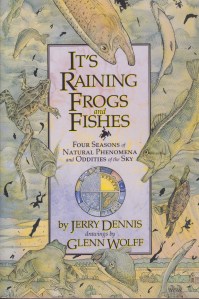
The details escape me. I was a student at Grove City College, working on a paper. In the library I ran across an article about a rain of fish. Always interested in the unusual, I was surprised to see such a piece in a reputable journal, and up until that time I’d never heard of Charles Fort or his gathering of such accounts from around the world. That paper was in my mind when I picked up It’s Raining Frogs and Fishes by Jerry Dennis and Glenn Wolff at a used bookstore. Subtitled Four Seasons of Natural Phenomena and Oddities of the Sky, it was published by the mainstream Harper, so I figured it wasn’t too far afield from reality. It turned out to be more the subtitle than the title, but an engaging read nevertheless.

There is a small section on rains of fish and other strange objects, but the book is really a tribute to the sky. Although I’m not an anthropologist, I have long been intrigued by the fact that people everywhere associate the sky with the divine. From the human perspective, it’s massive and all-encompassing. No matter where you stand on this planet, the sky extended over you, engulfing the horizon and implying even more beyond. It is responsible for our weather, and without the buffering of our atmosphere no life would’ve evolved on the earth at all (and that would be a pity because I enjoy writing this blog). Perhaps even before there were humans proper, our ancestors thought there was something divine about the sky.

While the firmament can’t be contained in a book, this one tries to consider just about everything you might find in the celestial realm. From extremes of weather to meteors to strange things falling from the sky, it tells of rain and snow and sunshine, insects, bats, and birds. The four seasons don’t really function as the best conceit for the book, since the sky is eternal and many of the aspects discussed are present all year long—the moon is with us always and the sun rises and sets even in winter. Nevertheless, this strange and alluring book demonstrates how the sky makes us what we are. Even though it was written in the last century it warns of global warming—then merely an idea—and shows how humans are capable of destroying that which gives them life. That article back in college suggested that the impossible happens, and that, given how the world is going, causes me to look upward with wonder.


Lazing Around

I was a science nerd as a kid. Well, at least I had a real soft spot for charismatic megafauna, but who doesn’t? We had those cheap, plastic figurines of dinosaurs that we incongruously mixed with our mammoths and cavemen—wait, no. We weren’t allowed cavemen because people didn’t evolve. Nevertheless, we didn’t see any problem putting glyptotherium in combat with t-rex. Pleistocene or Triassic didn’t matter—they weren’t here now. Extinction is the great equalizer. One of the figurines that always intrigued me was the giant ground sloth. I mean, here was a creature bigger than it needed to be. Not hurting anybody, it just wanted to eat leaves and laze around. A lifestyle that sounds attractive to this day.

Photo credit: Postdlf, from Wikimedia Commons

Human beings, in a process that is still continuing, wiped out animals bigger than themselves. The story is poignantly told in footprints discovered in White Sands National Monument. A Washington Post piece by Ben Guarino tells how paleontologists discovered a human footprint embedded in that of a giant sloth. Reading the story I couldn’t help but wonder if this was the very last one in existence. What if we’d uncovered the story of extinction in real time? Sloths, apart from being named after a mortal sin, never harmed anybody unprovoked. Simple vegetarians—principally vegans, apart from the occasional accidental bug, actually—they were the ultimate victims of human greed. It is virtually certain that we drove them extinct just like we did the dodo and the fiscally conservative Republican. Not exactly fast food, sloths couldn’t really outrun us, and like good Trumpists, we took advantage of their weakness to our own gain.

Or loss. There are no giant sloths left. We’ll never thrill to the sight of a living eucladoceros, or wonder at chalicotheres roaming the savanna. We’ll never run for our lives from an African bear otter (the mind reels). Our world becomes poorer for our presence, it seems. We moved from huddling in fear in our caves out to take on the beasts with our technology. Once we cottoned onto the concept, we refined it until we could drop an elephant with the single pull of a trigger. Our destruction of megafauna continues at an alarming and accelerating rate. Evolution does have quite an imagination, after all. Like human beings, it can take sins and make them larger than life. And “thou shalt not kill,” we say, applies only to our species.


A Parable

Once upon a time, in a land far, far away, there was a holiday known as Earth Day. Now, Earth Day was a poor holiday. She didn’t prostitute herself to commercialism, she wasn’t attached to any religion, and people didn’t even get the day off work. Still, she was an optimistic holiday. One of her prophets was a woman named Rachel Carson. A science writer who could see that our rampant greed and fatal shortsightedness were leading to environmental catastrophe, Carson wrote books of warning. People began to take heed. An ecology movement was born. New concepts like “sustainability” and “stewardship” and “moderation” became part of national consciousness. Other nations joined in. Earth Day was born. She was a happy child.

But there were demons in this land. Huddled in filthy holes in the ground, these demons cared only for owning as much of the earth as they could. They wanted to heat the planet so much that Earth Day couldn’t survive. They would drown her in the waters of her melted ice caps—her very tears. These demons couldn’t do it alone. They lived in the dark and since they cared for no one else, they had to find a Devil among them. A Devil who could quote Scripture. Such a Devil, they reasoned, would make the followers of the dead God join them. The followers of the dead God were like sheep without a shepherd. And the demons had all the money in the world. So they decided to kill Earth Day. Nobody would stop them.

With Earth Day gone, the weather went wild. Winds constantly blew. Hurricanes of new and intense savagery emerged year after year. The demons laughed, for when the people’s things were destroyed they would have to buy replacements. The demons would become even richer. The followers of the dead God clapped their hands in glee. But the demons and their Devil didn’t know that Earth Day couldn’t die. They did as they pleased, taking what they wanted from the what they supposed was her corpse. Then the weather, Earth Day’s dearest friend, began to do what it would in its rage. The demons awaited summer when they might feel hot again, but summer only comes after Earth Day. Oblivious, they lived their lives of plunder and greed until the followers of the dead God were all gone and they had no one left from whom to steal. Rejoicing in their acquisition of all the earth, they failed to notice the storm. Earth Day was returning and all their wealth could not save them.


Testamental Annihilation

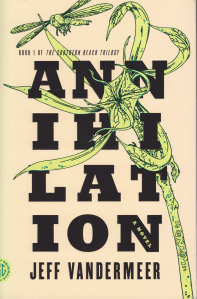
I’d be a hypocrite if I didn’t tell you there may be spoilers below. The book to which I alluded last week—the one made into a movie—was Jeff Vandermeer’s Annihilation. I first saw the book in a Green store in Ithaca, New York. I figured it must have a planet-friendly message if it were being sold at such a venue. I’ve finally had time to read it. There may be spoilers, so if you plan to see the movie, be warned.

Set in a kind of edenic dystopia not far from now, the novel gives none of its characters names. The narrator is the biologist of a four-member team sent into Area X—a region in the south from which no expedition has returned. Clearly intended to be part of a series, the novel does leave quite a few things hanging. Among the many unanswered questions is what has happened here. One of the problems with having Bible-radar is that you can’t overlook references to the Good Book. Without going into too much detail, the story has mysterious writing on the wall. That itself is a biblical trope, of course, but when the biologist discovers notebooks from previous expeditions, she considers that the writing is like something from the Old Testament. This description made me pause and ponder. The Hebrew Bible has, in the popular imagination, been cast in the role of a harbinger of doom and gloom. Granted, there are many passages that have earned that reputation, but on the whole it’s a very mixed bag. Still, in popular culture “Old Testament” means things are going wrong.

While not a horror novel, there are elements of horror here. People transforming into plants and animals, sloughing human skin. And resurrection—how New Testament! This made me think that maybe a penchant for horror isn’t such a strange thing for a guy who spent a decade and a half teaching the Hebrew Bible. My motivation for going in that direction had more to do with my interest in origins, but nevertheless, I also grew up watching monster movies. Maybe, unbeknownst to me, I was bringing the two together in this field of study. It’s difficult to tell at the end of book one what the overall message will be. But since I’m discussing the Hebrew Bible maybe I’ll take a stab at prophecy and predict that the second book of the series will be in my future. And I wouldn’t want to be a hypocrite.


Sky Mercies

While in a used bookstore recently, I was going over the science titles. I like to read accessible science since I often find it approaches religious ideas in secular terms. Once in a while even the terms of these disparate disciplines coalesce. I spied a volume on the top shelf titled The Mercy of the Sky. The spine showed a purplish cloud-bank, and the very concept set me wondering. We’d just been through a bomb cyclone the day before with wind bellowing through our apartment. Many trees were down and power was out for several people I’d overheard talking that day. I stared at the spine, thinking perhaps this would be a good follow-up to Weathering the Psalms, but as I already had books in my hands, and since I’m not the tallest guy around, it seemed beyond my reach. Of course, after I left I thought more about it.

The previous day’s nor’easter had revived that sense of a storm as divine anger. Strong winds, my wife commented, are generally disturbing. They make it difficult to sleep. It’s hard to feel secure when the heavens are anything but merciful. Although the wind is easily forgotten, it’s among the most easily anthropomorphized of natural phenomena. And it’s ubiquitous. Everything on the surface of the earth is subject to it. Indeed, the atmosphere is larger than the planet itself. Is it any wonder that God has always been conceptualized as in the sky? The quality of the mercy of the sky, we might say, is strained.

Danger comes from the earth below us, the world around us, and the realm above. Like our ancient ancestors staring wonderingly into the sky, it is the last of these that’s most to be feared. The wind can’t been seen, but it can be felt. It cuts us with icy chills, drenches us with dismal rain, even flings us violently about when its anger compresses it into a tight whirl. We can’t control it. Unlike other predators it requires neither sleep to refresh nor light to see. Its rage is blind and it takes no human goodness or evil into account. After a great windstorm, the calm indeed feels like a mercy. Elijah on Mount Sinai stood before a mighty wind, tearing the land apart. It was the still, small voice, however, that captures his imagination. There’s a calm before the storm, but it is the stillness in its wake that most feels like the mercy of the sky.


Heavens Above

When things get bad down here we start to turn our eyes to the heavens. A couple of news stories in the past few weeks have encouraged such star gazing. We’ve read about Curiosity’s long look back over five years on Mars, and the possible discovery of planets billions of light years away. The thing about other planets is that we still haven’t learned how to live on our own without ruining it. Endless thoughtless “development” doesn’t make major religions rethink their declarations on birth control even as we destroy our arable land to make way for more shopping malls. People may starve to death but you can always count on the survivors shopping. Those who collect the money at the end always look so strangely familiar. Have I seen your portrait on some currency or other?

Curiosity has been five years on our most similar neighbor. Having long outlived its life expectancy, it seems to be a harbinger with an important message to tell us, if we were willing to listen. Mars is a beautiful wasteland. Some look at it and think it could become another earth. A little on the chilly side, perhaps, but nothing you can’t fix with fossil fuels and shopping venues. Who needs to go outdoors anyway? Amazon can deliver it right to your airlock. We can hurl disco balls into orbit and still pass legislation that strips basic human needs from large swaths of the population. Space, they say, is the final frontier.

At the same time we’re discovering our universe is chock full of planets. So much to acquire! Of course, with each new planetary discovery we have to think that maybe there’s life out there somewhere. Since Homo sapiens are the measure of all things—if you don’t believe that you haven’t been listening to the White House—we are entitled to exploit anything we can reach. It’s called capitalism, stupid! The assumption is that anything can be owned. And if flying saucers are buzzing around our military jets like metallic mosquitoes we say they can’t be from out there because the universe is for our exploitation, not for sharing. “Now I know,” Victor cries “what it’s like to be—“ as thunder covers that last bit. There are billions of galaxies out there, made up of billions of stars. Many of them have their own planets. Some surely have intelligent life. And we wonder why aliens don’t land on the White House lawn. Appropriately named, Curiosity sits on Mars and stares backward in wonder.