Brave Old World

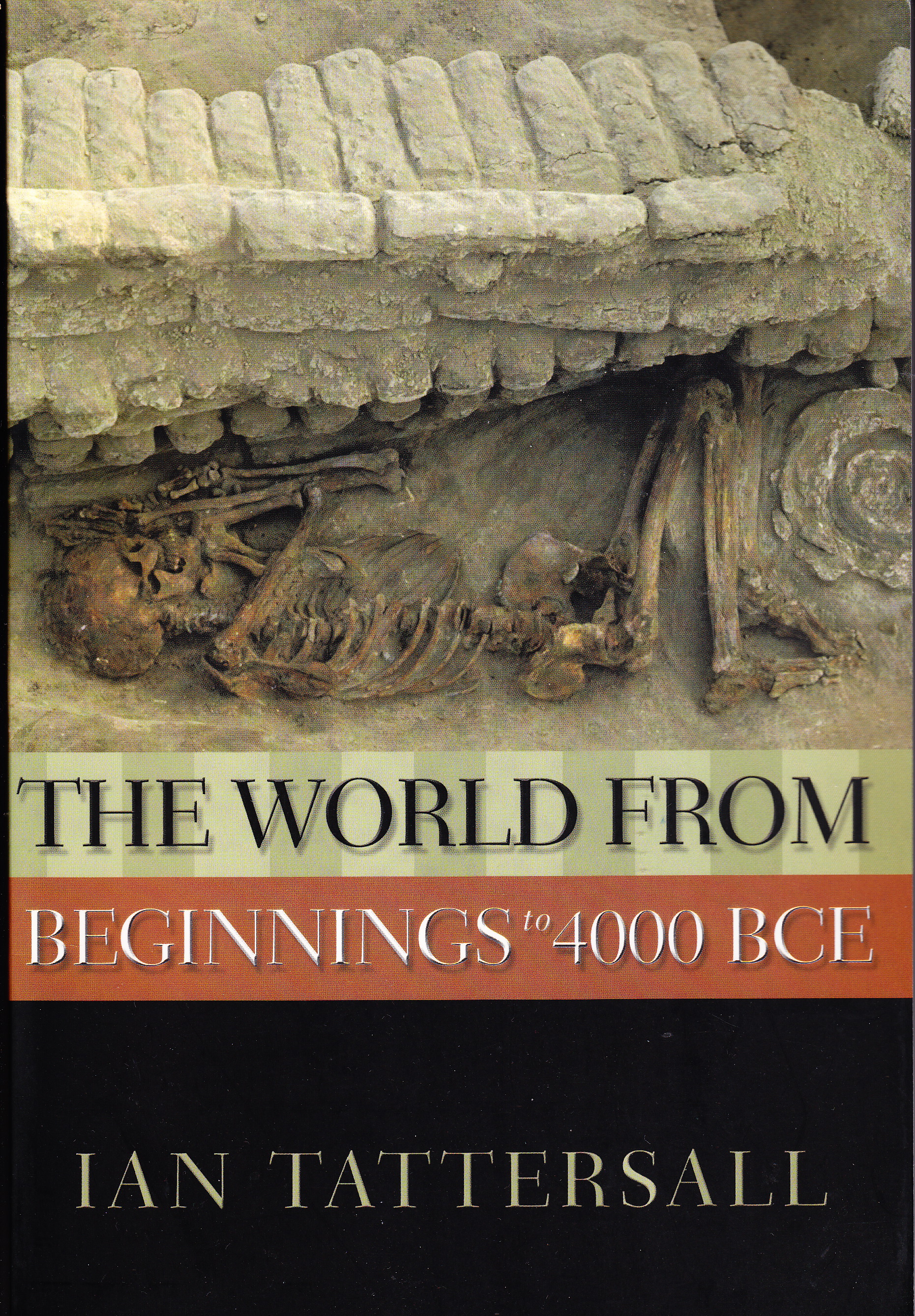
WorldFromBeginningsAs we continue to evolve, it is helpful to learn where we’ve been. Besides, the title, The World from Beginnings to 4000 BCE is difficult for an old Genesis reader to pass up. I knew Ian Tattersall’s book was about human evolution—a subject that has made me feel naughty ever since being raised to believe, quite opposite of reality, that evolution was a myth and Genesis fact. I remember the strange disconnect from my earliest years. Standing under the 13th Street Bridge, just before French Creek joins the Allegheny River, the main tributary of the Ohio, and, in turn, the Mississippi, my brothers and I would look for fossils. And find them we did. If you found the right kind of rock, preferably with a recent fracture, you could find the impressions of dozens of sea shells jumbled together in a glorious, fluted profusion. These were the exoskeletons of animals dead for millions of years, and thinking myself a budding scientist, I stared at them in awe, not quite sure what to make of it all. At church I learned the earth was young—not even a teenager in geologic terms—and yet, in my hand, encased in rock, contrary evidence.

Indeed, Tattersall begins his book, as many college-level texts do, apologizing to the culture that still somehow believes that the earth is just 6000 years old, despite the Tyrannosaurus towering over your head at the Carnegie Museum. Humans are latecomers on this scene, however. Tattersall gives a solid introduction to the current human family tree. Instead of being ashamed of our heritage, I’m more inclined to feel a little pride. Our ancestors, prey to large carnivores, took a distinctive evolutionary track that enlarged our brains to help us outwit our natural enemies and learn how to destroy the very planet we inhabit. Well, maybe pride is a little too strong a word. Good and evil, it seems, always stroll hand-in-hand. So we evolved, but not yet to perfection.

Evolution always makes me think of the future. A strange sense of accomplishment makes prominent thinkers, particularly those who declare themselves bright, marvel at our greatness. I can’t help but to think that something better must lie ahead. We’re told that evolution has no direction in mind—traits that help to survive until reproduction are all that really count—and yet, having the minds we do, it seems that something more might be going on. Have we built all this merely to have sex and die? Glorified May-flies? Isn’t the future a wonder of what we might become? Evolution takes so long, even with punctuated equilibrium, that we’ll never live to see it. I have a suspicion, however, that if we give it enough time, we might offer our as yet unimagined offspring a world as full of wonder as it always has been. And they’ll still be standing by the river, staring in amazement at animals made of stone.
Apes and Atheists

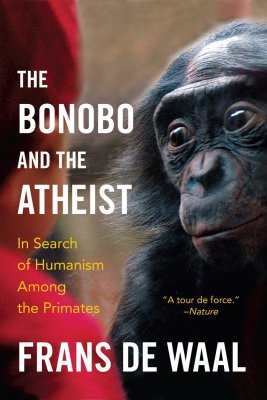
Bonobo&AtheistFrans de Waal is among the sanest of popular science writers. I’ve been following his non-technical work since Our Inner Ape through The Age of Empathy to The Bonobo and the Atheist. As de Waal himself explains, he tended to leave religion out of his earlier works since, for a scientist such topics are generally taboo. His direct address to religion in The Bonobo and the Atheist is refreshing and enlightened. As he notes, de Waal does not believe in God, but he doesn’t believe in the abolition of religion either. This sets him against his fellow biologist Richard Dawkins, who is so bright that the rest of us are burnt out dimmer bulbs by comparison. As de Waal soberly asks: what does science offer in place of religion? What is the point of taking away something that has evolved from our early primate days without offering anything to fill its spot? Even an ape would object.

What makes The Bonobo and the Atheist so engaging, apart from de Waal’s writing, is the openness of his outlook. De Waal suggests that the origins of morality and empathy can be glimpsed in apes and monkeys. He cites the reaction of chimpanzees to rain storms and even waterfalls that hint at early religious development. As I’ve suggested on this forum before, religion may even be allowed to animals. Their experience of religion is certainly not the same as ours, but there is evidence of both thought and feeling. When these are brought together they form religious belief in Homo sapiens. Why not in our ancestors and fellow animals? No, animals don’t develop elaborate doctrines or precious rituals. They do, however, reverence the powerful, ponder death, and feel emotion. Some of our great thinkers are ready to cast all that aside in the name of progress. More humbly, and circumspectly, de Waal considers that evolution is telling us something. And when evolution speaks, its children should pay attention.

Descriptions of reactions and behaviors that we consider unique to humans among the animal world draw me to de Waal’s books. As a scientist de Waal has to draw logical conclusions, and those conclusions point to an inner world that is not so much unique in humans as it is evolved. Religion, I believe, is one of those traits. If animals show some of the early stages of religious development, including a basic form of ethics, how does that devalue our human efforts to explain our universe? Religion is in good company, along with opposable thumbs and basic language comprehension. Looking at how we treat each other, I consider being related to animals a compliment most of the time. Without a doubt some of the ethics Frans de Waal illustrates among the bonobos exceed those I’ve experienced at the hands of many who think of themselves as made in the image of God.


Star Tracks

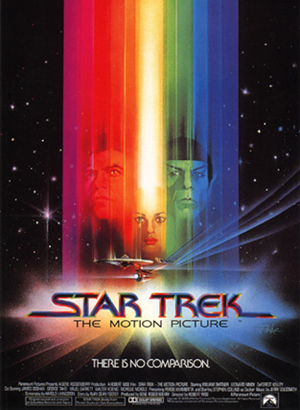
Star_Trek_The_Motion_Picture_posterLong ago in a galaxy far away—1979 in rural western Pennsylvania, to be precise—the local inhabitants were surprised to learn that James T. Kirk was now an admiral. Two years earlier Star Wars had thrilled us with special effects first mastered in 2001: A Space Odyssey but a more accessible plot. Robert Wise, who had not only given the world The Sound of Music, but also The Day the Earth Stood Still, took the helm for the new Star Trek: The Motion Picture. Star Trek geeks, of which crowd I do not count myself, hadn’t really taken their cliched role in the emerging high tech society, and CGI was still a few years off. Nevertheless, rumors in school had it that the movie featured a bald woman and had boldly gone where no man had gone before. The original crew was all there. So on a Friday night I dutifully made my way to the Drake Theater to watch and left saying, “is that all?” Star Wars was action-packed and fun, filled with archetypes and wise-cracking robots. Star Trek had Voyager 6, like E.T., trying to phone home. In a word, the movie was forgettable.

On a tour of the original Star Trek world, I finally sat down to watch The Motion Picture, with its grandly archaic-sounding name, last night. I shuddered to think I’d last seen it 35 years ago—that makes me as old as the crew was starting to look—but this time I was able to see things I hadn’t before. Spoiler alert! Voyager 6 is looking for God. The original Voyager 1 reached the end of our solar system a couple years back, but in 1979 there was no reason to suppose that we wouldn’t try again and again to reach out to parts unknown. We were rapidly become materialistic, and the universe could be a known quantity. Three centuries in the future, Voyager 6 is headed home, having been rebuilt into an unstoppable living machine. When the creator—humanity—doesn’t pick up the phone V’ger poises to wipe out the carbon-based infestation until it learns how to physically, biologically merge with a human being (cue the bald lady and otherwise superfluous Captain Decker). Lots of colorful lights and we can all go home.

Even now I can’t muster the courage to say the movie is profound, but it does touch on an issue that has only grown over time—we have voluntarily left our deities behind. In our rush to reduce the world to the least common denominator, we have pulled the plug on the cosmic phone. The Voyager program ran out of steam as the Cold War was heating up down here on earth and we were being told we were all just a bunch of atoms fooling around anyway. The machines, in the meantime, had come to believe. I probably won’t survive another 35 years to watch Star Trek: The Motion Picture again, but I do hope that in that time we may become more aware of our humanity. And I do hope that if someone divine does happen to call, that we’ll at least pick up the phone.


Prehistoric Steps

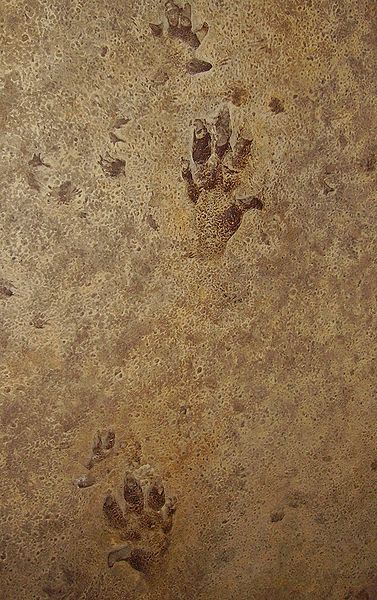
Britain has always had a share in the great events of the past (speaking strictly from a western hemisphere point of view). Not only did the ten “lost tribes” of Israel end up there (according to some, with apologies to Joseph Smith), but young Jesus traveled there with Joseph of Arimathea (according to others, with no apologies). While these stories are obviously non-historical, Britain does have an illustrious heritage that has left Stonehenge and the Cerne Abbas giant in its wake. It is thrilling to read, then, that fossilized footprints from some 850,000 years ago were recently discovered. Coastal erosion, similar to the event that revealed Skara Brae to the world, uncovered the footprints for a short time in Happisburgh, near Norfolk. About 50 footprints were discovered, according to The Independent, with a group comprised of women, men, and children. They were walking alongside a stream, apparently looking for the Pleistocene version of carry-out fish-n-chips at least 844,000 years before Adam and Eve.

The British landscape boasts an ebullient antiquity. Our years spent in the British Isles involved exploring everything from Lanyon Quoit in Cornwall to the Ring of Brodgar on Mainland, Orkney with our friends. It is a land where the past lives on into the present. No wonder some speculated that the biblical past made its way here as well. At least now we know that some very early humans did as well. Homo antecessor, the makers of the prints, visited a Britain replete with elephants, hippopotami, rhinoceri, and hyenas. It is speculated that they may have domiciled on off-shore islands to keep safe from the predators that roamed pre-Roman England. One thing we know for certain about people is that they do get around.

Chirotherium storetonense  trackway, photo credit: Ballista

Chirotherium storetonense trackway, photo credit: Ballista

Homo antecessor is an extinct species. Many of the hominids that contributed in some way to the possibility of our existence are long gone, creating endless headaches for scriptural literalists. Their lives, as The Independent speculates, may have involved being preyed upon by large predators and the constant search for food. They also liked to walk on the beach. I wonder how far they had come on the road to religious belief. Constant fear of predation must surely have played into it. We don’t know how far back the evolutionary chain religion goes, but we do know that it is a profoundly human outlook. You can’t stand beneath the towering Neolithic menhirs of the Ring of Brodgar and not feel it. Sometimes a walk along the shore is all it takes.


Raptor Attention

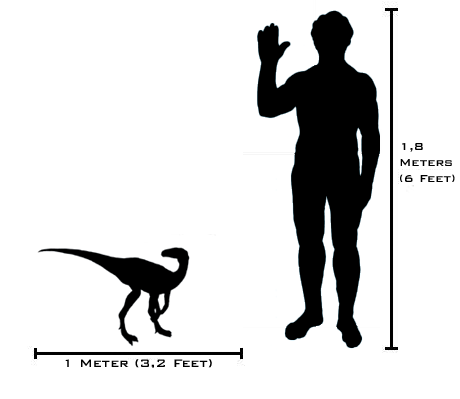
Comments on internet sites are quite revealing. Not that many comments ever make their jolly way to this blog, but, like many people I spend too much time on the internet, and you can’t help but read a few now and again. My wife sent me an ad for the Jesus-raptor tee-shirt offered by Six Dollar Shirts. The image has been floating around the web for some time now, but I haven’t been able to determine its origin. It could be from creationist groups that believe dinosaurs coexisted with people as an end-run around evolution, but more likely it represents an effort to belittle that view. Creationists are the ultimate backward-looking crowd. Fearful of Hell, they see evolution as tantamount to damnation, and must eradicate the biological evil for the sake of their immaterial souls. Reading through the comments on the Six Dollar Shirts page, I had to wonder. Why are we so concerned with getting the past right?

Don’t get me wrong—I have an undying interest in the history of religions and the origins of religious thought. Nobody wants to get the past wrong, otherwise the present is incorrect. Dinosaurs, however, are the great corrective to a major historical error. It is easy to assume that homo sapiens represents the highest point possible on the earthly scale of measures. Dinosaurs remind us that anything can happen. Up until about 65 million years ago, there would have been no reason to suppose that dinosaurs wouldn’t be here forever. Of course, Adam was over 65 million years in the future, and even if he evolved, his primate lineage was tiny and trying to avoid the gigantic footsteps of their distant Jurassic cousins at the time. Some scientists theorize that if the asteroid never hit, the dinosaurs may have evolved distinctly humanoid features. After all, we’re clearly at the top.

The past must always be approached with humility. Relativity may tell us that it is still here, but I can’t even access the moments just seconds ago as I typed these words. The delete key is a dangerous thing. Science has pretty much unequivocally demonstrated the evolution is a fact of life. It is our past. No matter what Ken Ham says, I’m pretty sure even Moses would’ve noted the spectacle if dinosaurs trudged aboard the ark. So Jesus never met any raptors in real life. Some of the commentators on the tee-shirt page appear offended at the blasphemy of the joke. Or maybe they’re just being ironic. In either case, that’s now the past and the best that any of us can do is comment on it and watch out for the big feet that are stomping this way.

Image credit: Dropzink, Wikicommons

Image credit: Dropzink, Wikicommons


A Toy Story

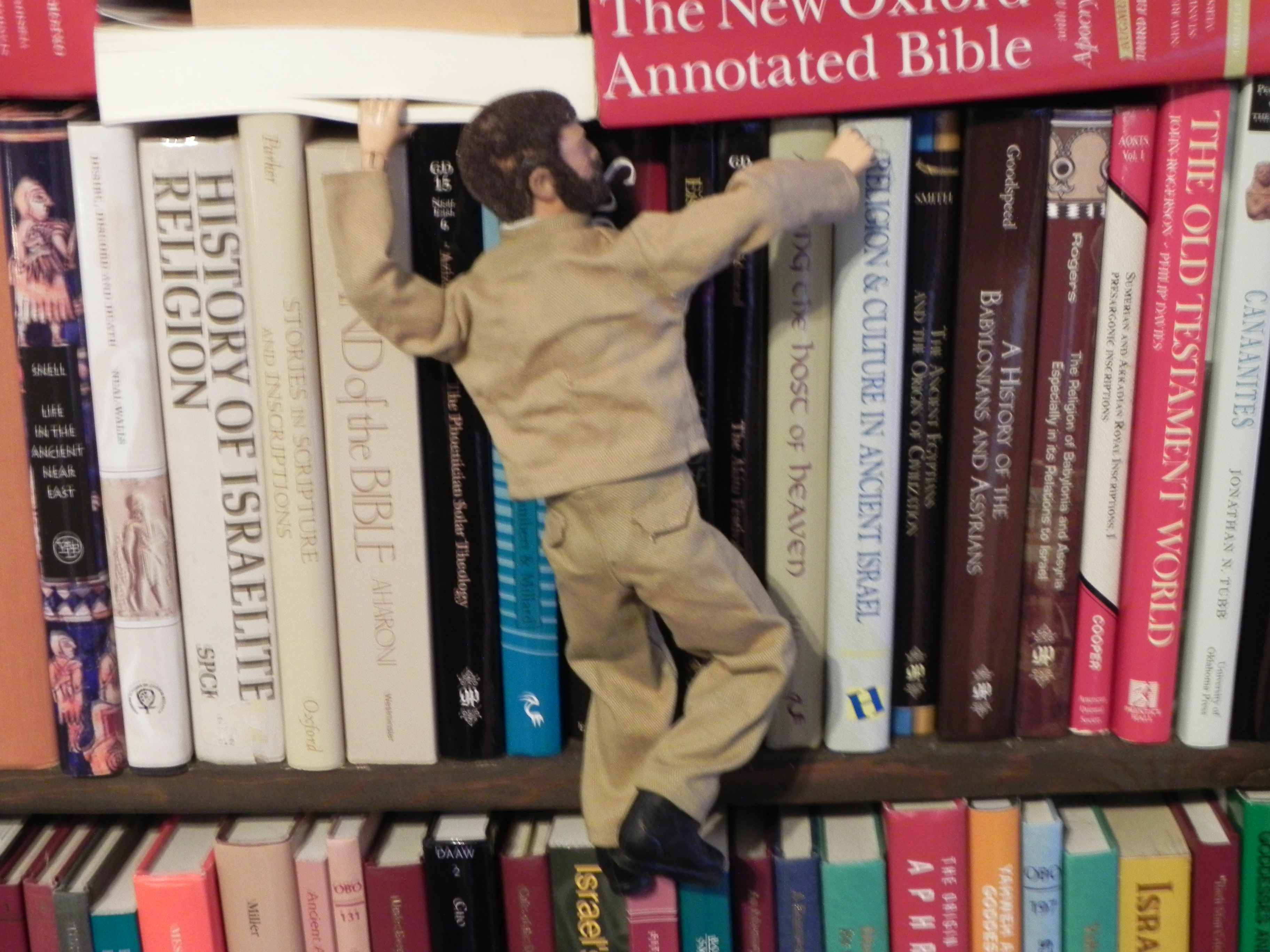
As a life-long pacifist, it might seem strange that I find myself waxing sentimental over a military-themed toy. You see, I just found out that G. I. Joe is turning fifty. For those of us who grew up in the 1960s, G. I. Joe was the acceptable “boy doll” (now, technically, “action figure”) that all the guys had. Some of us had several. We didn’t have much money, but Christmas always gave an opportunity to accessorize Joe with either the latest developments (life-like hair in a buzz cut, pull-string vocalizations, “kung-fu grip”) or the many vehicles that could be purchased separately. As the Vietnam War wore on, Joe turned his interests to science and humanitarian causes, but boys like to anthropomorphize as much as girls do, and Joe continued to get himself into many bizarre adventures. At least in our apartment he was known for fighting dinosaurs, robots, medieval knights, and even General George Custer. Joe was a fighting kind of guy. He had guns and gear and shoes that were almost impossible to remove when you wanted to change uniforms (only when Mom was out of the room). So G. I. Joe has been around for half a century now. I can’t remember childhood without him.

G. I. Joe often had near fatal encounters in our home. One of them, the talking one with life-like hair, suffered a severe war wound that left his bottom half completely dissociated from his top. I don’t think we kept the lower abdomen and legs—there was something slightly unnerving about plastic buttocks—but I did keep his top half, the talking bit. It shocked me when my Mom asked if she could take him to church. We were a “Bible believing” family since it was the days before people much talked about Fundamentalists. My mother was a Sunday School teacher. (Thus my early amazement at the magic of flannelgraphs, still primarily used for religious teaching.) We didn’t believe in evolution, and we certainly thought war was a bad thing. I did wonder, though, why Mom wanted to take a toy to church, particularly a dismembered, violent one.

Being the son of the teacher did have some perks. I knew enough to read my Bible and learn the lessons, but we were not given sneak previews for Sunday School. Seeing the trailer might make actually attending superfluous. So when Joe went to church I learned why: people are not animals. The pull-string voice box, although the sounds emerged from holes in his perforated chest, was proof. People talk, animals don’t. We didn’t evolve after all. The other kids were seemingly impressed by my evangelistic Joe. Who would’ve thought that “G. I. Joe, U.S. Army, reporting for duty” could have ever converted a lost soul? On Ebay, I see, some of these vintage talkers can fetch up to $600. Mine, I’m sure, ended up in a landfill somewhere in rural Pennsylvania where, I have no doubts, he is still preaching to the other toys about the dangers of evolution.

The ultimate adventure...

The ultimate adventure…


Ham on Nye

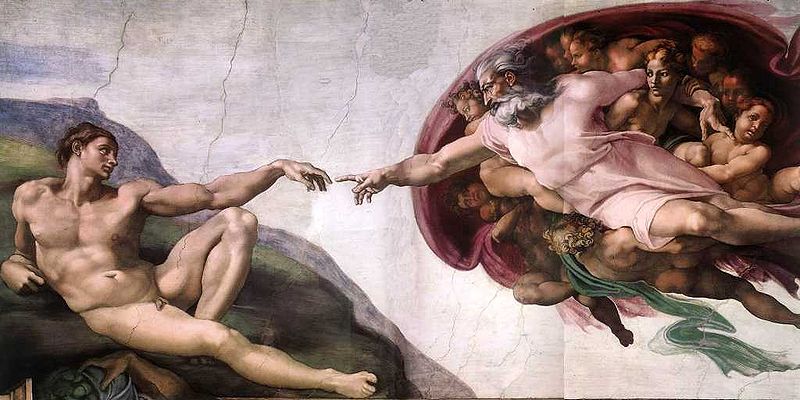
Bill Nye, the Science Guy, comprised a good part of my thirties. My daughter was young and we were living in a religious environment sometimes openly hostile to science. Nye is funny and fastidious, and completely devoted to the empirical worldview. His videos (yes, it was that long ago) were fairly inexpensive in VHS format, and even as parents we learned a thing or two. When Bill Nye came to the New Jersey Green initiative conference (I don’t recall what it was called) we were in the audience to see him live. It was rather like an epiphany. Despite his wit and charm, many of his colleagues are now advising him that he’s made a wrong turn. According to NBC, he is set to debate Ken Ham of Answers in Genesis in a no-win debate, that of creation versus evolution. Some of the top lights of science have been bloodied by lower profile conflicts because—and this is the crucial point—religion and science do not agree on basic ground rules. It’s a schoolyard scrap, and those who try to adhere to laws of reason are often ill equipped.

800px-The_Creation_of_Adam

The debate isn’t really over the question of how we got here. The real prize is power. Creationists cannot win on purely scientific grounds; anyone who’s tried to read Henry Morris’s books knows that you can’t get very far without a curious hand raking your head. The science is flawed but the conviction is solid. Truth, the creationists know, is not open for debate. His scientific colleagues fear for the intrepid science guy, noting that this is just another instance to give creationism faux credibility in what is really a public relations scam. Ham’s creationist museum has dinosaurs on the ark, which, in an unrelated story on NBC, is drawing righteous ire from the self-same Ham. (I’ve posted on the round ark before, and likely will again.)

If I understand the first article correctly, the debate will be taking place tonight. If I understand science at all, the world will continue to evolve tomorrow. Creationism has a curious relationship to the world, viewing it through a Bible-shaped lens. A close look at the Bible reveals that it does not support the creationist viewpoint in any literal way. Too many dragons and contradictions make implausible any but a heavily harmonized version of Genesis 1. Biblical scholars, however, are among the worst of sinners, according to the creationist camp. We might be the very ones exposing their children to Bill Nye and other questionable truths such as television and electricity that don’t even exist in the Bible. I’ve got my fingers crossed for Bill Nye, but then, superstition has nothing to do with it.


Who Loves You?

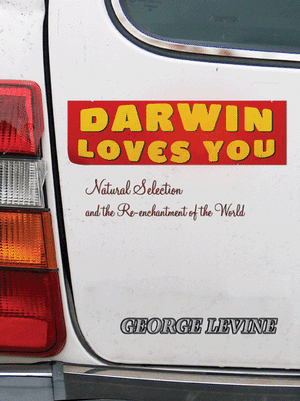
DarwinLovesYouWonder is too easily lost in a reductionistic world. Even when we get to the level of quantum mechanics we’re told, “it’s just physics.” How depressing. Such ideas seem to have been in the mind of George Levine as he wrote Darwin Loves You: Natural Selection and the Re-Enchantment of the World. Don’t get me wrong, Levine does not back away from the secular starkness of biology. What he does, however, is ask whether or not evolution by natural selection shouldn’t create a kind of secular enchantment. Almost from page one Levine has to address religion, the tyrannosaurus in the room. Religion, for all its shortcomings, has provided people with a sense of purpose, even enchantment, from days long before any temples or priests existed. The materialist response of “buck up, there’s nothing more than biology going on here,” has proved to be of little consolation to the vast majority of people on the planet. One of the reasons, and I speak only for myself here, is that it just doesn’t feel true.

Truth is a slippery concept. In origin the word seems to derive from something like “to have good faith.” In terms of factuality it also has the meaning of conforming to reality. Reality, however, is equally perilous when it comes to authoritative definitions. Reality means nothing if it is not perceived. Perception may actually bring something to the table, if particle physics are to be believed. Empirical method is pragmatic—I believe that every time I grudgingly climb aboard an airplane, or turn on a computer. At the same time I sense that there may be more to it than that. No matter how much science I read, that perception simply won’t go away. The professors of materialism have learned to quash that still, small voice. The hollow feeling with which it leaves me, however, may be significant.

Evolution and religion are inextricably interwoven. Religion, although poorly defined, has to do with finding meaning in a world that is often harsh and cruel. No doubt such feelings evolved, and some of our animal kin may share them with us. When molecules break down into atoms, they generally lose the characteristics of the molecule. We now know that we can keep breaking even the invisible apart until we’re left with only theory as to what might be below. This may be true. At the same time, the wonder with which we might stand before a cyclotron or a little robot rolling around the surface of Mars, the question of truth emerges like a rock that wasn’t there just a few days before. A gnawing sense that we don’t have the full picture. A sense that no matter how far we tear apart, the total will always be far more than the sum of parts. Levine is right; evolution can induce wonder. And truth, at its very heart, is a matter of faith.


Eleventh Hour

Religion, as many a charlatan knows, makes a very good investment. History has demonstrated time and again that the confident huckster can easily siphon the money from the gullible in the name of God. What follows does not make any assertions about the character of the people involved. It is, however, a fascinating story.

Cyrus Ingerson Scofield did not have an exactly stellar career. He was raised Episcopalian (which may explain some of it), but upon being drafted into the Confederacy during the Civil War, deserted to become a lawyer in St. Louis. Scofield was forced to resign from his law post because of “questionable financial transactions” which may have included forgery. He was a heavy drinker and abandoned his wife and two daughters. The year of his divorce he remarried. Then he had a conversion experience. Conversion is the ultimate clean wiping of the slate. Any life of dissipation may be excused following a religious experience, eh, Augustine? And furthermore, in the sanctified state the motives of the former reprobate are never questioned.

Scofield went on to join the Congregational Church and to grow wealthy from his Scofield Reference Bible, still a perennial seller, despite his lack of formal theological training. This notoriety was largely because Scofield had adopted another unlikely scheme, dispensational premillennialism. This end-time scheme grew out of the work of John Nelson Darby and later evolved into what would be called Fundamentalism. The idea was that the Bible contained an esoteric roadmap to the future, culminating in the book of Revelation, whereby the blessed could figure out exactly how the end of the world would unfold. As a child I bought a literal roadmap to the end of the world, but having survived several such putative apocalypses, I have grown a tad skeptical about the efficacy of my chart.

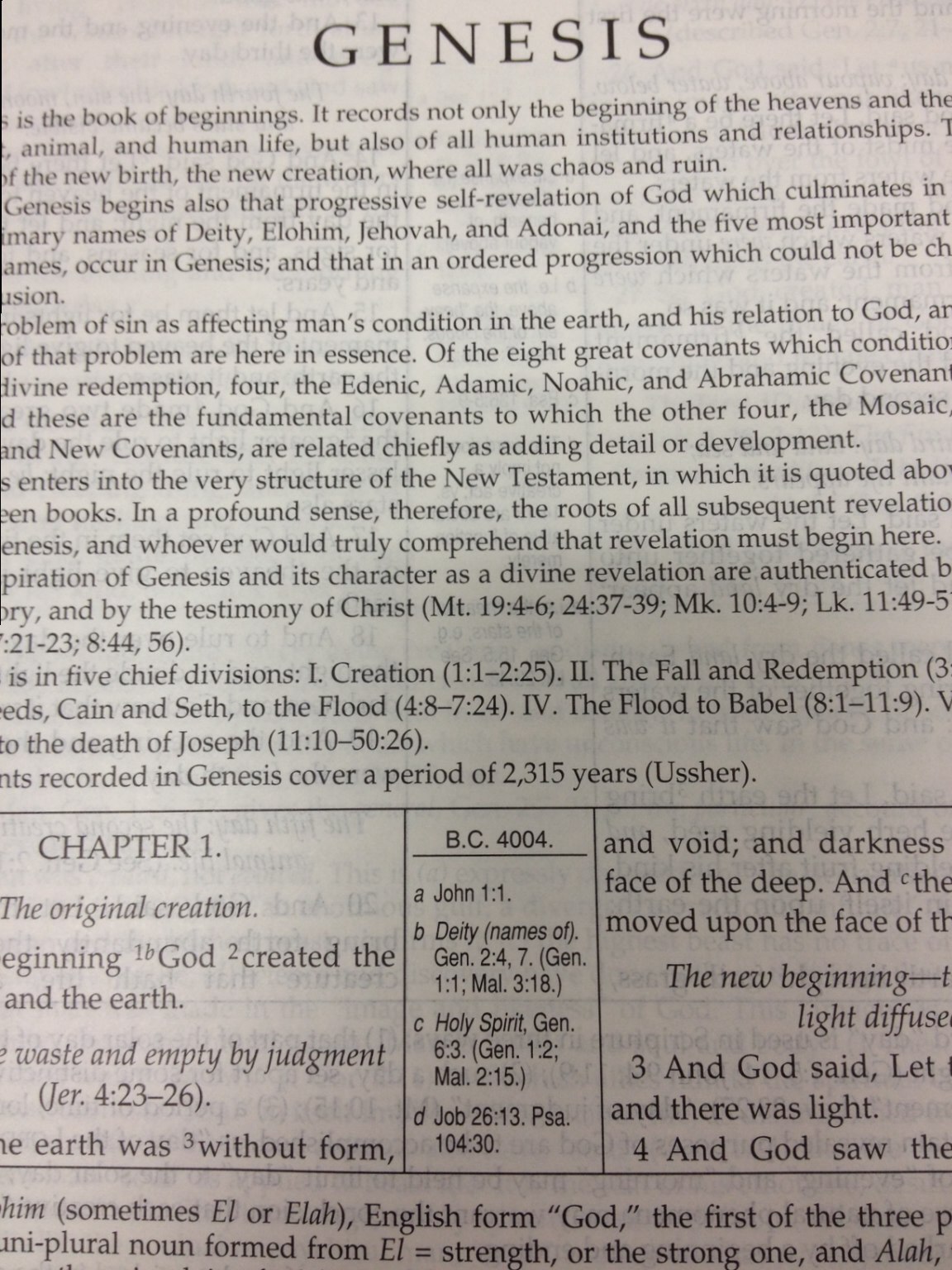
Any number of religious leaders have a background of self-promotion and more than a whiff of Phineas Taylor Barnum about them. A converted soul, however, is never to be questioned. Cyrus Scofield adopted Archbishop James Ussher’s dating scheme for the creation of the world in 4004 “BC” and placed it in his reference Bible, forever putting the cast of scriptural authority to a date that would come up in court cases even through the twenty-first century in Dayton, Tennessee, Little Rock, Arkansas, Dover, Pennsylvania, and Washington, DC, wasting tax-payers’ money on a myth of biblical proportions. Often creationists use “stealth candidates” who don’t exactly tell the truth before school board elections. I don’t doubt the depth of the convert’s belief, but I smell money here. And once upon a time literalists believed that it was the root of all evil.

The reason most Creationists cite 4004 is Scofield...

The reason most Creationists cite 4004 is Scofield…


Religious Education

The elephant in the room is exposed in a New York Times op-ed piece last week. “Indoctrinating Religious Warriors,” by Charles M. Blow, puts a finger squarely on the pulse of the ailing science stance of American religious believers. Noting that the Republican party has made no secret of its attempt to capture conservative votes by touting the religious intolerance of the theological right, Blow points out that more Republicans now believe that humans were created separately from animals than accept the scientific fact of evolution. And not just human origins suffer—our future will as well. The same mentality attends denial of global warming and advocating against fair treatment of committed, loving couples (depending solely on the visible sexual equipment). It is all of a piece. Blow points out that white, evangelical Protestants make up only 18 percent of the US population, but 43 percent of the Republicans who are classified as staunchly conservative. This imbalance leads to one of the world’s wealthiest nations being sidetracked from serious global issues while we continue to debate whether the Bible in inerrant or not.

I would add a further note of concern to what Blow says: higher education refuses to take religion seriously. As a life-long sideliner who has never been permitted fully into the halls of academe, I have watched as business schools have grown from the rubble of religion departments that have at best stagnated—when they have not been actively dismantled. In the worst case scenarios, universities have closed such departments down. With the exception of evangelical institutions. Very large departments of confessionally indoctrinated religionists thrive across the country. I am not the only religion scholar to have been kicked out of the academy for an intellectually honest approach. The wider society, with eyes wide shut, has decided that religion is a passing fancy while statistics indicate the exact opposite. We as a society will continue to be manipulated by religions as long as we continue to pretend they don’t pose a real concern.

Religion serves a purpose.

Religion serves a purpose.

Nor does castigating all religion, as Richard Dawkins, Sam Harris, and the late Christopher Hitchens do/did, solve any problems. Science itself appears to indicate that religion is part of the human condition, as surely a product of evolution as our opposable thumbs. Basic psychology would dictate that such direct challenges to religion will only result in retaliation. In fact, this is something that I recall learning from kindergarten. Until our society learns to go back to school and study the four R’s—yes, religion has to be there among the basics—we will continue to suffer from those who have vested interest in using religion for their own ends while those who could educate us on the subject continue to suffer the cut jobs of those who might be part of the solution. Charles Blow wonders if he is being too cynical. I suggest that he’s not nearly cynical enough.


Revelations

BeringWhyIsThePenisSex. Religion. Death. One of these things is not like the others, if Sesame Street taught me anything. But in this case, the three actually are of a piece. In my teaching days I pointed out that every religion, without exception, tries to deal with sex and death—the two great, towering markers of human experience. Nevertheless, I cowered close to the window on the bus, choosing the left-hand side so the cover wouldn’t be visible, to read Jesse Bering’s Why Is the Penis Shaped Like That? From the first sentence you’ve got to like this guy. Although irreverent, Bering is never obnoxious as he asks questions about the basics of human existence that few would be willing to take on in the name of science. It’s a fascinating book, and, as I knew it would, it addressed religion and death as well as, well, you know.

Bering is an evolutionary psychologist, and he tends to lean toward a materialistic universe. His book raises a very important point, however; the belief in determinism statistically correlates with anti-social behavior. That is to say, those who believe they have no free will tend, to some extent, not to care about society. As Bering also points out, perspective is very important. I wonder if truth is subject to perspective. Actually, I’m rather certain that it is. I have fought determinism from my youngest days, although I generally feel out of control of my own life. I first encountered determinism in that insidious theological position known as predestination. The deity of a universe that predestines most people to Hell is a monster, no matter how saintly his/her portrait. One professor conceded after a vigorous debate in class: “on philosophical grounds free will wins, but on scriptural grounds, predestination does.” I disagreed. Still, he could go home happy—my challenge had, after all, been predestined.

Worse yet were the “double predestinarians.” They were those who believed that every little detail of life was predestined. I actually had a professor say, “if you fail an examine, it was predestined.” Already the illogic of it all struck the same timbre of distaste that materialistic determinism does. By its fruits you shall know it. As much as I enjoyed Bering’s book, I wondered how anyone obviously so intelligent could believe that this magnificent mental world we inhabit is nothing more than sparks tickling chemicals in our brains. Or even the biological wonders he explores. As I huddled up in a ball on the bus, my book close to my face, I knew that this behavior wasn’t natural at all. Not even science could have predicted it.


Not Knowing

WhatIDontKnowAboutAnimalsBegin with a basic premise: we cannot know what a creature without language thinks. Add in the thoughtful anxieties of a post-domestic writer who knows about animals and you have What I Don’t Know About Animals, by Jenny Diski. Part biography, part science, part philosophy, wholly human. I knew from the day the book was released that I would read it since, like the author, I am one haunted by the relationship between the exploited and the exploiter. Diski’s confessions are difficult to read at times, veiling herself, as she does behind the curtains of one’s most private experiences, but she reveals plenty to those who read on. We can’t know for certain what another person thinks, so how can we know what a sentient animal thinks? Some, following Descartes and Skinner, would declare that animals don’t think, they simply do as programmed. The rest of us know that they are wrong. The evidence accumulates more each year that animals think and feel, but, as Diski repeatedly points out, we need to drive with the brakes on. We can’t get inside them to actually know if human experience corresponds at all with animal experience. We’ve shared the planet for millions of years, but we’ve lost track of our common origins.

As I suspected, the Bible came into the discussion. The book of Genesis lurks in the background of most human-animal rationalizations. The divine division into separate “kinds” must be kept discrete at all times. The problem is, nature won’t always play along with that game. One type slowly morphs into another and some biologists are even questioning the usefulness of “species” at all. Fear of bestiality, as Diski points out, is found already in the Bible. Best to keep everything in its proper pigeon-hole, whether that’s where it belongs or not. Genesis gives us the right to exploit, and so we continue to use animals for our own purposes. Although the feline, it turns out, may have figured out how to set this order on its head. In some cases.

What I Don’t Know About Animals is not a defense of vegetarianism or of radical, thoughtless abandon. Diski writing on spiders will cause many heads to nod in agreement, and her rage against the loss of the common lady-bug struck an amazingly responsive chord with this reader. The lady-bug’s demise came at human tampering, importing asian beetles as pest control—beetles that eventually edged out the harmless lady-bug, replacing the Volkswagen of beetles with a biting, omnivorous, massing pest. In Wisconsin the southern side of our faculty house was literally blanketed with them in the spring. Diski uses the same word I did then: biblical. Swarms seem to be the way that the Almighty has of telling us too much of even a good thing will go bad. Although I couldn’t agree with every statement Diski makes, I have the feeling this is a book I will reread more than once. Wisdom often comes in the form of admitting just how little we know.


Almost Human?

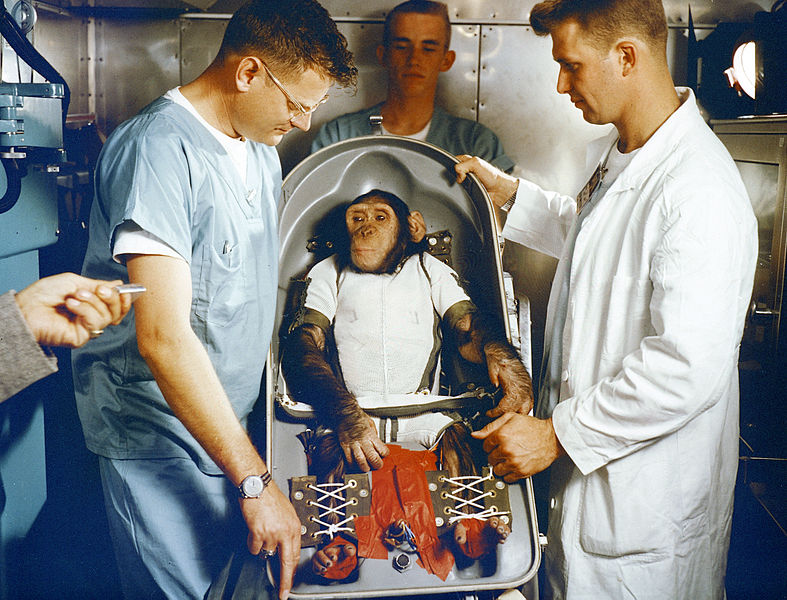
Last week the New York Times ran a story on the efforts of the Nonhuman Rights Project to have chimpanzees declared “legal persons.” Naturally this has set many legal persons at arms, given the unstated, biblical origin of the concept of human superiority. Without the biblical mandate we simply have to admit that we rule over animals on the basis of “might makes right,” a philosophical concept that never makes it far either in the classroom or the courtroom. We hold animals captive and experiment on them because we can. They can’t speak, can’t register protest, so we assume their silence as complicity and carry on. Research over the past several years, however, has pushed the human-separatists harder and harder. Animals are more like us than we are willing to admit. We acknowledge that we’ve evolved from them, but we suppose that at some point—probably the vocal cords—we surpassed them and therefore if they can’t speak they can’t think and they can’t feel. Even today many people still hold to the biblical orthodoxy that animals are merely here for our enjoyment and exploitation.

Considering how we treat other human beings, this is probably, sadly, no great surprise. In a world where many nations still allow women to be treated as property, putting a chimp in a cage and labeling it “mine” doesn’t appear so odd. Only the most crass of chauvinists would dare say that women are not human, but far too many, based mostly on religious biases, have no problem stating that women are inferior humans. Again, “the Bible tells me so.” This kind of thinking, prevalent even up until the 1950s in “civilized” countries like the United States, has yet to die out fully. What is it about the male psyche that insists on its own superiority? The Bible, it seems, has much for which to answer when found in the hands of men.

What makes us think that we are all evolving toward the “high point” of white males? Some of us in that class know that it is long past time that this glass “ceiling” should have been irreparably shattered. Nonsense, however, has staying power. Some of us even feel inferior just knowing such distinctions were ever made. Not that long ago Africans were said, by some, to be closer to apes than Caucasians. Women were said to be closer to snakes than men. What has been lacking is a sense of balance. Common sense. Genders and races equal but variable. Until that minimum bar is reached, how can it be hoped that fair treatment of nonhuman persons can ever be achieved? Some animals have been taught to read, at least in basic, symbolic ways. They understand that certain symbols stand in for defined rewards. Given time it might even be that this most human of inventions could be shared among nonhuman persons. If they do not learn to read the Bible with more sense than some human persons, however, we face a future of many other layers of distressing oppression.

787px-Chimpanzee_Ham_in_Biopack_Couch_for_MR-2_flight_MSFC-6100114


Crowing Up

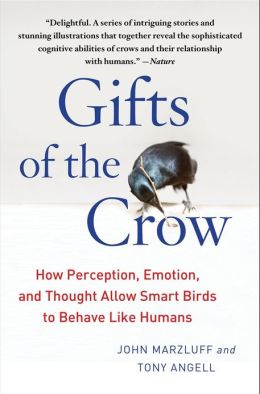
GiftsOfTheCrow Whether we climb up or down the evolutionary scale, one factor remains constant—our human sense of superiority. Despite the castigation of biblical-era thinking in the eyes of many scientists, few are willing to relinquish that Genesis-bestowed sense of being the pinnacle of nature. We know the universe is vast, but we assume we’re the best and brightest in it. Climbing down the ladder a bit, we like to distance ourselves from our fellow creatures because of our superior mental capacity. That is why I am so engrossed by scientists who explore animal intelligence. We find we are not so different after all. Gifts of the Crow: How Perception, Emotion, and Thought Allow Smart Birds to Behave Like Humans, by John Marzluff and Tony Angell is such a book.

If you’re like most people in this electronic age, you probably haven’t given much thought to corvids. Corvids are the members of the crow family: ravens, jays, magpies, and, of course, crows. Scientists have long known that these birds are exceptionally intelligent, and Marzluff and Angell have written a spell-binding little book that shows a remarkable level of intellect among the birds. Documented cases of tool making and use, conscientious interaction, and perhaps even language, have occurred among the corvids. We try to shoo them from our crops with “scarecrows” and we poison them en masse when they become “pests,” but when we take the time to understand them, we find that we may be far darker than the crows.

Not that Gifts of the Crow is all that easy-going. There is plenty of brain physiognomy and quite a bit about brain chemistry here as well. Knowing that not all of us are scientists, though, Marzluff and Angell include a generous portion of narrative description of what corvids have been observed to accomplish. For three days in a row I climbed off the bus stunned, scanning the skies for crows, just to see for myself. In this suburban jungle outside the New York City metropolitan area, crows aren’t so abundant as they were when I lived in the Midwest. They will, however, serve to remind me, when I see one, that our privileged place in nature has more to do with our thumbs than with our intelligence. When I saw a solitary crow atop a tree during a neighborhood stroll after finishing the book, I stopped, smiled, and bowed. Nature belongs to each and every creature, and there sat one intelligent enough to appreciate it.


Darwinian Dawkins

Richard Dawkins seems like he’s probably a nice guy in person. You can tell quite a bit about somebody from their writing, and even when Dawkins is being abrasive in script, you can almost see a gleam in his eye. When I read The God Delusion, for example, I found myself nodding in agreement quite a bit. Not that I agree with everything he wrote; as an academic I can’t, in principle, agree with everything anyone writes. Nevertheless, Dawkins expresses himself with passion and clarity, if with a bit over overstatement. I was interested to read the interview with him in the 10 Questions section of this week’s Time magazine. When one is building a case, it is easy to pile on rhetoric, and pretty soon the force of an argument takes on its own life and sometimes a few casualties are left bleeding in the wake. Still, it is a good exercise to sharpen the mind.

Wikipedia Commons, photo credit: Mike Cornwell

Wikipedia Commons, photo credit: Mike Cornwell

The last of Time’s 10 questions deals with how Dawkins can be certain there is no God. Dawkins, in a conciliatory move, declares that there is much of which we can never be certain. Noting that future science will discover realities that we simply don’t foresee, he suggests, “it’s extremely unlikely that it would happen to home in on an idea from a Bronze Age tribe in the desert.” I found this final sentiment a touch off-kilter. We have plenty of scientific developments that have come out of the “Bronze Age tribes,” but God is not one of them. “Desert tribes” gave us metal smelting, bovine and caprid domestication, and, perhaps most importantly of all, writing. God, however, comes from a much earlier evolutionary strata. In fact, by the time that the Sumerians appeared, multiple gods were already in their train.

In fact, evolutionary scientists seem to indicate that our brains have contrived some need for God/gods. That God isn’t a semitic desert mirage, however, is attested by people all over the world developing the idea independently. Not only did the Israelites and their forebears have deities, so did the Vedic cultures that we now call Hinduism. So did the Native Americans, indigenous African religions, and those who developed in isolation on Australia. Gods evolved everywhere. It doesn’t take a scientist to figure out that this means that we have some need of them. I like what Richard Dawkins writes. I enjoy his candor and passion. We do, however, have to credit the desert tribes with much of the thinking that leads to science, but the gods, they are far more ancient than that.