Virtually Religious

“Which god would that be? The one who created you? Or the one who created me?” So asks SID 6.7, the virtual villain of Virtuosity.  I missed this movie when it came out 24 years ago (as did many others, at least to judge by its online scores).  Although prescient for its time it was eclipsed four years later by The Matrix, still one of my favs after all these years.  I finally got around to seeing Virtuosity over the holidays—I tend to allow myself to stay up a little later (although I don’t sleep in any later) to watch some movies.  I found SID’s question intriguing.  In case you’re one of those who hasn’t seen the film, briefly it goes like this: in the future (where they still drive 1990’s model cars) virtual reality is advanced to the point of giving computer-generated avatars sentience.  A rogue hacker has figured out how to make virtual creatures physical and SID gets himself “outside the box.”  He’s a combination of serial killers programmed to train police in the virtual world.  Parker Barnes, one of said police, has to track him down.

The reason the opening quote is so interesting is that it’s an issue we wouldn’t expect a programmer to, well, program.  Computer-generated characters are aware that they’ve been created.  The one who creates is God.  Ancient peoples allowed for non-creator deities as well, but monotheism hangs considerable weight on that hook.  When evolution first came to be known, the threat religion felt was to God the creator.  Specifically to the recipe book called Genesis.  Theistic evolutionists allowed for divinely-driven evolution, but the creator still had to be behind it.  Can any conscious being avoid the question of its origins?  When we’re children we begin to ask our parents that awkward question of where we came from.  Who doesn’t want to know?

Virtuosity plays on a number of themes, including white supremacy and the dangers of AI.  We still have no clear idea of what consciousness is, but it’s pretty obvious that it doesn’t fit easily with a materialistic paradigm.  SID is aware that he’s been simulated.  Would AI therefore have to comprehend that it had been created?  Wouldn’t it wonder about its own origins?  If it’s anything like human intelligence it would soon design myths to explain its own evolution.  It would, if it’s anything like us, invent its own religions.  And that, no matter what programmers might intend, would be both somewhat embarrassing and utterly fascinating.


Back to Normal

The western philosophical tradition is built on the idea that permanence is reality.  From the Greek philosophers on, the idea has been to identify the basic, unchanging building blocks of reality to get at what’s really real.  The eastern philosophical system posits that change is reality.  Permanence is illusion, and that which we think of as unchanging is a deceptive projection of our own minds.  This dichotomy keeps coming back to me when things change and I keep waiting for them to go back to “the old way” or “the usual way.”  Most recently, for example, the shift to or from (I can never remember which) Daylight Saving Time.  This was followed closely by a mandated trip to San Diego, three time zones away, that lasted five days.  While there I met with potential authors later into the evening than I generally stay up on eastern time.  Now that I’m back home I keep waiting for things to go back to the way they were.

My response to all of this is to wonder if maybe I have the wrong philosophical disposition.  Problem is, the entire western world is built on the proposition that permanence is reality.  The things that worry us are, in eastern thinking, part of the constantly changing flux of reality.  While away from the usual constant connectivity of life at home, bills still come electronically.  Websites ask you for passwords that, like eastern thought, are constantly changing.  I play along, even to the point of “buying” property so that it will always be mine.  Right now lots of things are up in the air in the western world—the future of democracy itself is uncertain—and I keep waiting for things to get back to normal.

Part of the problem is that I keep too busy.  It is easier for me to maintain this illusion if I slow down and have time to think it through.  Things change too quickly for that, however.  Using time as a pole star to navigate this constantly heaving sea, I’ve become a little confused about my longitude.  I’m settling back into eastern time at the new hour they tell me that it is, but I feel as though I’ve left lots of things behind.  I’ve had a little time off work over the holiday and there’s a tremendous amount of change awaiting me once I fire the laptop up again.  I want to go back to where I was before I boarded that plane, back before I “gained” an hour.  Back before I had to learn everything you need to know to “buy” a house.  I look to the east and nod.


The God Test

Humans don’t mean to be cruel, I’m pretty sure, when they test animals for intelligence.  We’re a curious lot, perhaps a bit too self-absorbed, but we want to know how other animals are like us.  Of course, we reserve actual thinking for ourselves, given how well we’ve managed to conserve our only environment, but we grant some special spark to our biological kin.  So we devise tests for them.  Since we can’t get beyond human experience, many of these tests are devised for creatures like us.  When animals fail our superiority is reconfirmed.  Then it’s back to the lab.  I’ve got to wonder how it feels to the subject of the experiment (or is it object?).  Some being that has mastered the art of capturing you, perhaps with the aid of alien technology, is trying to get you to understand something that’s only clear from its (the captor’s) viewpoint.  You need to suss out that viewpoint and solve the puzzle in the same way.

This makes me think of many forms of religion.  We’re born to a lower species (human) as the experimental subjects of gods, or a God, who watch(es) to see how we figure things out.  There’s a right answer, of course, but we’re only given hints as to what it is.  We’re given toys to play with—some of them dangerous—and we’re allowed to select clowns and buffoons to lead us.  We can kill off unthinkable numbers of our own kind and the only clue that we’ve succeeded is some tasty treat at the end.  Of course, we have to assume that the intelligence governing this whole farce is much greater than our own.  Doesn’t feel so good, does it?

Holism is the ability to see a continuity in all of nature.  And nature doesn’t just mean this warm globe on which we find ourselves.  It’s vast and mysterious and some parts of it are very cold and others very hot.  There are places we cannot go, and others that seem inevitable, given the choices.  Like the victims of bullies we don’t think about the larger system, but seek to impose our wills on those who see things differently than we do.  Some tote guns while others pack books.  All of us will shoo away insects that buzz too close.  Most of the animals “beneath” us will simply eat them.  Is this all a game?  Or is it some kind of experiment where we have to guess the answer, but with only a fraction of the information required?


Fly Away

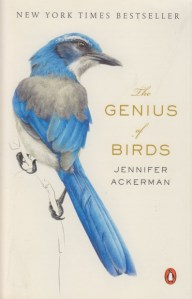
Humans can be quite likable, but we have some nasty traits.  One is that we tend to think of ourselves as the only intelligent beings on the planet.  The funny thing about evolution is that it gave us both big brains and opposable thumbs—a winning combination to destroy the planet.  (Just look at Washington, DC and try to disagree.)  Jennifer Ackerman’s The Genius of Birds is poignant in this context.  Page after page of nearly unbelievable displays of intelligence among birds demonstrates that we are hardly alone on the smarts scale.  Birds make and use tools, have better memories than most of us do, and can solve problems that I even have trouble following.  We tend to take birds for granted because they seem to flit everywhere, but the book ends soberly by noting how global warming is driving many species to extinction.

Homo sapiens (I’ll leave out the questionable and redundant second sapiens) like to think we’ve got it all figured out.  We tend to forget that we too evolved for our environment—we adapt well, which has allowed us to change our environment and adapt to it (again, opposable thumbs).  Many scientists therefore conclude that we are the most intelligent beings in existence.  Ironically they make such assertions when it’s clear that other species can perceive things we can’t.  Ackerman’s chapter on migration states what we well know—migrating birds can sense the earth’s magnetic field, something beyond the ability of humans.  We lack the correct organ or bulb or lobe to pick up that signal.  And yet we think we can rule out other forms of intelligence when we don’t even know all the forms of possible sensory input.  We could learn a lot from looking at birds, including a little humility.

The Genius of Birds explores several different kinds of intelligence.  What becomes clear is that birds, like people, have minds.  Like human beings they come on a scale of intellectual ability that doesn’t suggest only one kind is necessary.  For our large brains we can’t seem to get it through our thick skulls that we need biodiversity.  We need other species to fill other niches and our own remarkable ability to thrive has only been because we are part of a tremendous, interconnected net encompassing all of life.  Other species have contributed to our evolution as we clearly do to theirs.  When we end up thinking that we alone are smart and our own prosperity alone matters we are sawing away at the branch on which we sit.  Further up the birds look at us and wonder if we really know what we’re doing.


Permanent Change

Maybe you’ve experienced it too.  The sense of change in a large city like New York is palpable.  Although I don’t commute in much any more, I noticed it when I made daily treks to the city—change is constant.  If the skyline’s forever evolving, on street level things are more than keeping pace.  In the seven years of my daily commuting I saw buildings built and razed in the same location.  Scaffolding is a constant hazard.  Public art pieces are placed and then replaced.  Change.  I was reading about Yijing, better known as I Ching, the other day.  One of the spiritual classics of China, this “Book of Changes” reflects a worldview common in eastern Asia that is quite at odds with that that developed in ancient Greece.  Many Greeks believed permanence was reality, those in China who read the spiritual masters believed that change was reality.  The older I get the more I think the author(s) of Yijing got it right.

I’m not an expert on the religions of southern or eastern Asia, but I have studied the major ones.  To those outside the field of religious studies, it may be surprising that the field is as large as it is.  In the United States alone there are an estimated 40,000 denominations, and that’s just within Christianity.  To be an expert in any one takes years of study.  Add in the many religions of other locations, such as Africa and Asia, and you’ve got more than one lifetime’s worth of work lined up.  A common—the most common, in fact—course in collegiate religion curricula is “World Religions.”  I’ve taught it myself.  The problem is nobody’s an expert in all of them.  Still, I found reading about what used to be called “eastern religions” (with that poisonous cultural bias that the unchanging west is the correct vantage point) full of surprises.

Scientists well into last century liked the idea of a steady-state universe.  Permanence.  When Edwin Hubble noticed other galaxies were moving away from ours (and, by the way, first noticed that there were other galaxies), the Big Bang theory developed to explain this motion.   Change, it turns out, is constant.  It may be slow at times, and at others it’s like the skyline of a major city like New York, shifting several times in a single lifespan.  I’ve read some of the spiritual classics (in translation) and I always come away with a new sense of wonder about the many ways of understanding the world.  And I ponder what it will take to change the attitude that religions aren’t worth studying.


Burger Impossible

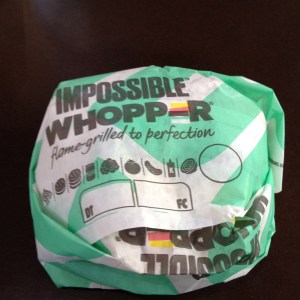
On the way home from Ithaca, we’ve learned the hard way to avoid I-80 through the Poconos on a holiday weekend.  Past experience indicates that about 80 percent of the population of New Jersey (to be fair, a percentage of that may be those from New York City) tries to squeeze through the Delaware Water Gap at just about dinner-time the day before work starts again.  There is a longer alternate route, I-476, the turnpike, which you catch north of Scranton and exit in Allentown.  The only issue with this plan is that, unless you want to exit the turnpike to try to find food in rural Pennsylvania, there’s only one travel plaza between our entrance and exit.  It’s a nice enough stopping point, but for a vegan on the road options are limited.  As we pulled in we noticed there was a Burger King.  Would they have the much touted “impossible burger”?

It turns out that they did.  Having last had a whopper well over two decades ago, mouth memory may have faded a bit, but I can honestly say this was like the whopper I remembered.  If you hold the cheese and mayo, you have a vegan version.  This discovery made me strangely happy.  For years at remote locations (and some urban) we’ve stopped when the only other options are meat based and had the BK veggie burger.  It’s not too bad most of the time, but if you want to think you’re eating meat while not contributing to the massive environmental degradation of industrial farming, the impossible burger seems like a reasonable option.  This is one area of technology that I’m glad seems to be catching up with ethics.

I often ponder how much our western point-of-view is based on the Bible.  Our reluctance to include animals in our ethics is another example of how the hard line between species has been applied.  Even scientists are susceptible to worldview bias.  When we realize we’re all part of a continuum of biological relatedness, it’s a lot more difficult to argue for our special place in the divine eye.  At the same time, insisting one’s ethics be applied to all is a form of fascism.  I’m just glad my conscience can be assuaged with some plant-based food options.  After all, I’ve been on the road for a few hours and I’m sitting here happy to be eating at Burger King.  It’s a matter of perspective.


Funny Business

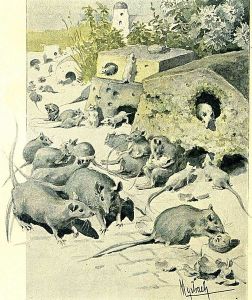
Do animals laugh?  The question sounds innocuous enough, and when my wife played me a RadioLab episode on that very question, the conclusion, although cautious, was that at least rats and chimpanzees do.  This is an instance in which the very question strikes me as terribly speciesist.  Despite the fact that evolution suggests otherwise, Homo sapiens are constantly seeking that fabled northwest passage that will separate us from animals once and for all.  One by one, over the decades, the defining traits have fallen aside.  Animals make and use tools, they build dwellings with ornaments, they solve puzzles, they communicate, and they laugh.  Were we not so obsessed with our own greatness (and consider whom we’ve elected over the past few years!) we might easily recognize that we have evolved to be what we are.

Perhaps it’s because we wish to retain our right to exploit animals.  After all, eating animals is big business and it’s harder to eat someone who’s not so very different from you.  In our culture certain animals are taboo for fodder: dogs, cats, and horses, for example.  This isn’t universally the case, and knowing that animals laugh might just make it a little worse.  We like to think animals “react” using “instinct” rather than respond with genuine emotion.  Until we fuss and fawn over Rover, and accept his affection as genuine.  Consciousness can be quite a burden to bear.  Funny, isn’t it?

We accept evolution up to a point.  Is it any wonder then that creationists still are a force with which to contend?  Often we fail to recognize that science, as it has developed in the western hemisphere, gestated in a largely Christian context.  The reason for drawing a hard line between animals and humans is ultimately, in this setting, biblical.  We’ve moved beyond the idea of God creating each separate species one-by-one, but we haven’t gotten beyond the literal truth of Adam naming and dominating them.  If we don’t consider the biblical origins of these ideas they continue unchallenged, even into the laboratories and sterile rooms of today.  It makes us a bit uncomfortable to consider just how influenced we still are by the Good Book.  At the same time we consider its meta view on the biological world, even as the evidence continues to pile up that little, if anything, really separates us from our faunal kin.  Try explaining that to the rats.  That sound you can’t hear without special equipment, by the way, is their laughing.


Evolving Tales

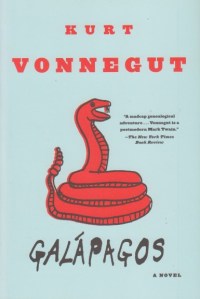
There’s nothing like a six-and-a-half hour flight to get some reading done.  I’d made good progress on Kurt Vonnegut’s Galápagos before leaving for England, but the plane ride gave me time to finish it.  While nobody, I think, can really claim to understand Vonnegut, there are clearly some trends in this novel that demonstrate his struggle with religion.  There may be some spoilers here, so if you’ve been saving this book for later you might want to wait before reading the rest of this.

As the title suggests, it’s a story about evolution.  Charles Darwin had his first divine epiphanies about evolution while visiting the Galapagos during his voyage on the Beagle.  Land creatures isolated from others of their species adapted to the environment in which they found themselves, and over eons passed on useful traits to their progeny.  If humans only had as much foresight!

With his trademark cast of quirky characters about to set out on a cruise from Equador to the Galapagos, Vonnegut has war break out.  Riots and pillaging take place.  Vonnegut takes broad aims at capitalism and business-oriented thinking, and how these represent the devolution of our species.  Of course, being Vonnegut, he does it with wit and verve.  Vonnegut was a writer not afraid to use the Bible in many ways, including what experts would call misuse.  As the surviving passengers make their way onto the stripped, but functional ship, he notes that they are like a new Noah’s ark.  They end up populating Galapagos with humans that evolve a million years into the future.

A thought that caught me along the way was a line where he wrote that in the long history of David and Goliath conflicts, Goliaths never win.  This kind of sentiment could do the world some real good right now.  In fact, although the book was written decades ago, one of the characters, Andrew MacIntosh, reads very much like a foreshadowing of 2016, down to the descriptions of how he regularly mistreats others.  In Galápagos MacIntosh gets killed during a rebellion, showing that grime doesn’t pay.  The cruise goes on without him.  Galápagos is a book that points out the evils that our system encourages, or even necessitates.  There can be another way.  The survivors land on the barren islands and set about adapting because they have no other choice.  A more egalitarian scenario evolves largely because females are in mostly charge.  While not intended as an actual solution to social ills, Galápagos is nevertheless not a bad guide, especially when shipwreck seems inevitable.


Selection, Natural or Not

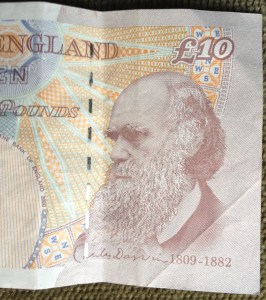
Darwin is extinct, it seems.  At least in the UK.  Perhaps I ought to explain.  I do not travel to England often, and I’m not always good about changing cash before I go.  Usury doesn’t sit well with me, and someone taking a cut just because I have to travel (usury actually doesn’t sting so much when you make a trip by choice) seems unethical.  When I discovered I was required in Oxford, my wife suggested I take some cash.  I went to the attic and rummaged through papers from a trip sometime within the last decade (my passport is still good, so it had to have been in this time frame), and found some ten-pound notes with Darwin on them.  They didn’t smell bad to me, so I said “I’ll just take these.”

I suspect that, like most people, I keep a pocketful of change as a souvenir when I travel to foreign shores.  So I had a few bank notes that hadn’t seemed worth changing back at the time.  Bread cast upon the waters, and all.  I had to make a small purchase in Oxford and the clerk said, oh so politely, “That’s old money, I’m afraid I can’t accept it.”  Interesting.  I had no idea money had a sell-by date.  She said “The bank will change it for you.”  Banks handle all kinds of money.  I walked to the nearest bank and the polite young man (all the bank tellers carry tablets here, like iPads at the Apple Store) told me that banks don’t do that service unless you’re an account holder.  “The good news,” he said, “is that the post office will do it for you, and it’s less than 300 metres from here.”  I was up to a 300 meter walk, so I went.  The British post office isn’t just a place to mail letters, I knew from living here years ago.  The woman at the counter frowned.  “I don’t know why banks send people here,” she said.  “We can’t exchange pounds for pounds.  I can change it into dollars for you.”  Of course, there was a charge to do so, just as there was a charge to change the notes from dollars to pounds in the first place.

Sadly I handed Darwin over and received American faces in turn.  Such is natural selection.  Ironically, just a few days ago I was at a farmer’s market (in the United States).  The man next to me received a silver note in change—he commented that these bills are somewhat more valuable than a standard Washington.  They are still accepted however, as legal tender.  In fact the last time I went to a US bank to turn in change, the bank officer looked at some very eroded coins and said, “As long as I can verify it’s US currency I can accept it.”  I still find occasional old coins in circulation.  Updating currency and then charging for having old money seems like it ought to count as usury.  But then, perhaps my ethics are simply outdated. 


The Lagoon

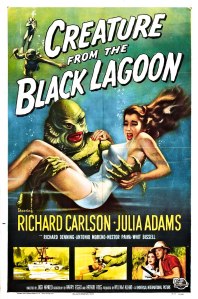
My current book project has me watching The Creature of the Black Lagoon again.  One of the Universal monsters—indeed, arguably the last of them—the Gill-man fascinated me as a child.  There was a strange contradiction here.  The creature had evolved in the Devonian Era and remained unchanged into the 1950s.  But the movie opens with a voiceover of Genesis 1.1.  There’s a mixed message here, appropriate for scriptural monsters.  Watching the film again brought back many of the innocent perceptions of youth, as well as the trajectory of my own life.  I don’t often get to the theater to see horror movies anymore, but at the same time the Universal monsters aren’t quite the same thing as modern horror.  As a genre it had to evolve.

Strangely, as a fundamentalist child, the evolution aspect didn’t bother me.  I was after the monster, you see.  The backstory was less important.  Growing up, at least in my experience, means that the backstory becomes more essential.  It has to hold together.  There are, of course, inaccuracies in the story—many of them, in fact.  Still, within the first three minutes Genesis and evolution are thrown together in a happy harmony that belied what I was being taught at church.  The Gill-man is a monster mainly for being a creature out of time.  When modern humans invade his lair, he defends his territory.  The story might’ve ended there, had he not spied Kay.  He doesn’t so much want to kill her as get to know her better.  For a movie posthumously rated G, it has a body count.  Five men die but the Gill-man apparently just wants to evolve.

There’s been a recent resurgence of interest in Creature from the Black Lagoon with both the publication of The Lady from the Black Lagoon and the death of Julie Adams this year.  The Gill-man seldom shows up in the same billing with Dracula or Frankenstein’s monster, or the Wolf-man.  He’s a bit more inaccessible in his watery abode.  Both cold and hot-blooded, he represents how science and Scripture might get along, at least on the silver screen.  The film holds up remarkably well, if a modern viewer can handle the pacing.  Underwater filming was pretty new back in the day, and watching humans swim in many ways suggests the truth of evolution in its own right.  These aren’t the childhood observations of the movie, but rather the reflections of a guy wondering if there might not be some hidden wisdom in the monsters of yesteryear.


Identified or Not

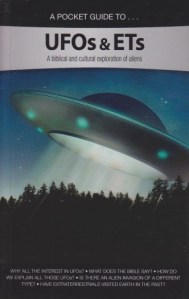
Okay, so this will require some explanation.  It came about like this: I was in a used bookstore.  (This in itself requires no explanation, of course.)  I noticed a slim book, cover out, called A Pocket Guide to UFO’s and ETs: A biblical and cultural exploration of aliens.  Biblical?  I picked it up only to discover it was from Answers in Genesis.  Please note: I do not buy books or paraphernalia of Fundamentalist groups unless I can get it used.  I don’t want to support this particular weirdness in any way.  Well, the money for this used book was going to support a used bookstore and not a religious aberration, so I figured it would be good to see what the Fundies have to say about a topic that seems to have started to engage public interest again.

The book begins by helpfully pointing out that if there’s life on other planets the Bible doesn’t mention it.  And since the only way it could’ve got there is by evolution—for surely the Almighty would’ve said something about it in his book, if he’d invented it—the whole idea is a non-starter.  Evolution, as everyone knows, is a satanic idea meant primarily to challenge the Bible and secondarily explain the diversity of life forms on earth.  And since earth is the only planet the Bible recognizes, it is the only one with life.  So, UFOs, it stands to reason don’t exist.  Well, that’s not quite fair.  They do exist but most can be explained away and those that can’t may well be demonic.  Since there can be no aliens, and since some sightings can’t be otherwise explained, then demons—which the Bible does mention—must be responsible.  They (demons) can also explain why other world religions exist.

There’s plenty in here to offend just about everyone apart from the Answers in Genesis crowd.  The screed spends quite a bit of time knocking down ancient astronaut ideas, and taking Erich von Däniken to task.  Science is useful in explaining how pyramids were built, but not in how the rock used to build them was formed (it takes far too long to make limestone the old fashioned way; God simply used a variety of different rock types to make the one inhabited planet more interesting geologically).  And those UFO religions?  Inspired by demons, no doubt.  In fact, even reading a little book like this could lead you to become interested in the subject, so be careful!  In fact, the safest thing of all (and I’ve only got your well-being in mind) is to leave it on the shelf.


Youth Evolving

Picture a picture.  A photograph.  I’ve got a specific one in mind, but it’s likely one you’ve not seen.  Any photograph will work for this lesson, but if it’s one of your own, one from your youth works best.  Your teenage years.  The photograph that I’m imagining is one of a slightly older friend of mine.  It shows him as a teenage machine-gunner in Vietnam.  I didn’t know him at the time, of course; I was too young to be sent off as a national sacrifice for a police action to protect capitalism.  In any case, I got to know this friend later, after he’d survived the conflict, wounded but alive, and I was struggling to survive puberty.  Emotions at that time were off the charts, but I never saw the photo until I was an adult.

Why am I asking you to think of old pictures?  I was recently reading a discussion where intelligent people were wondering why, throughout human history, we have idealized youth.  I suppose there’s no single answer, but I have a suspicion that it has to do with evolution.  We often wrongly assume that we can get at the naked truth.  As if we could somehow get outside of our own frame, our personal point-of-view, and look at reality objectively.  Our brains, however, evolved to help us survive in an often hostile environment.  The “point”—if you’ll allow me to hypostasize a bit—of evolution is to survive long enough to reproduce.  Many species with young that can care for themselves simply die at that point.  Mission accomplished.

As human beings (and mammals) our young need parental care to survive, at least for a few years.  Biology would seem to dictate that by the time we can reproduce—that self-same puberty which is such a difficult age—is the point at which we’ve reached our evolutionary goal.  There’s something deeper going on here, of course, but I wonder if this might not be behind the question of why we idealize youth.  We remember with a sharp pang—don’t need to see a doctor about that one—the incredible and unsurpassed discoveries we personally made at that age.  There will be other surprises as life goes along, of course, but nothing will ever equal our biologically determined goal.  I’m oversimplifying, I know.  Still, this may be one mystery that is less mysterious than it seems.  I know this because I have a photograph of a young man.  It matters not if it is of someone I know or me.  We have made it through our most awkward age, and we reflect on how it made us into who we have become.

Was I ever that young?


The Reboot

It lied to me.  My computer.  Don’t get me wrong; I know all about trying to save face.  I also know my laptop pretty well by now.  It was running slow, taking lots of time to think over fairly simple requests.  A lull in my frantic mental activity led to the opportunity for me to initiate a reboot.  When it winked open its electronic eye my screen told me it had restarted to install an update.  Untrue.  I had told it to restart.  I gave the shutdown order to help with the obvious sluggishness that suggested to this Luddite brain of mine that my silicon friend was working on an update.  There’s no arguing with it, however.  In its mechanical mind, it decide to do the restart itself.  I was merely a bystander.

Technology and I argue often.  Like JC says, though, authority always wins.  I should know my place by now.  I’ve read enough about neuroscience (with thanks to those who write for a general audience) to know that this is incredibly human behavior.  We are creatures of story, and if our brains can’t figure out why we’ve done something they will make up an answer.  We have trouble believing that we just don’t know.  I suppose that will always be a difference between artificial intelligence and the real thing.  Our way of thinking is often pseudo-rational.  We evolved to get by but machines have been designed intelligently.  That often makes me wonder about the “intelligent design” crowd—they admit evolution, but with God driving it.  Why’d our brains, in such circumstances, evolve the capacity for story instead of for fact?

As my regular readers know, I enjoy fiction.  Fiction is the epitome of the story-crafting art.  Some analysts suggest our entire mental process involves construing the story of ourselves.  Those who articulate it well are rewarded with the sobriquet of “author.”  The rest of us, however, aren’t exactly amateurs either.  Our brains are making up reasons for what we do, even when we do irrational things (perhaps like reading this blog sometimes).  Stories give our lives a sense of continuity, of history.  What originally developed as a way of remembering important facts—good food sources, places to avoid because predators lurk there—became histories.  Stories.  And when the facts don’t align, we interpolate.  It seems that my laptop was doing the same thing.  Perhaps it’s time to reboot.


Frankly

Even in the 1960s, if I recall, Dracula and Frankenstein really weren’t that scary.  I mean this in the sense of the 1931 Universal movies that began the entire trend of “horror” films.  They were, nevertheless, monarchs among those of us who claim the sobriquet “monster boomers.”  (I’ve never considered myself as part of any generation, but there’s so many people that you’ve got to sort us somehow.)  Recently I talked my wife into watching/re-watching these two films with me.   The pacing makes it seem like everything in the 1930s was stuck in slow motion.  The frights are difficult to feel, given what we’ve seen in movies since then.  And they are both, it occurs upon reflection, movies in which religion is the norm against which we measure monsters.  God is assumed.

Dracula, of course, fears the crucifix.  His chosen home in England is a ruined abbey.  Although the source of his monstrosity is never discussed, he is intended to be an embodiment of evil, draining the life of innocents.  Renfield craves flies and spiders in order to ingest their life.  Christianity can’t tolerate such evil and Dracula must be staked (off screen).  Frankenstein’s monster is much more obviously theological.  Opening with a warning to the audience that the film may shock due not only to its frights, but also because of Henry’s desire to create life, the film has philosophical discussions between Henry and his associates, and ends with the moral dilemma of what to do with an evil created by human hands, yet clearly alive like other people.

Metaphorically speaking, these first two horror films set the stage for later developments in the genre.  It isn’t so much fear and startles that define the genre as it is a deep dread of offending the powers that be.  Childhood was so long ago that I can no longer recall just which movies I saw on Saturday afternoons, but these two were among them.  Even as I was beginning the spiritual journey that would assure my job was never far from the Bible, I recalled with fondness the frissons of watching Dracula and Frankenstein—and then the host of other Universal monsters such as The Wolf-Man, The Invisible Man, and The Creature from the Black Lagoon (the last being scary in the classical sense).  The world in which they operated was deeply religious, for even the gill-man was an implicit condemnation of evolution.  These monsters were informing a religious outlook that would last a lifetime.  Going back to Dracula and Frankenstein is like turning back to the first page of Genesis and beginning again.


Evolving Intelligence

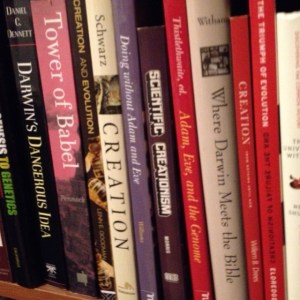
In the process of unpacking books, it became clear that evolution has been a large part of my life.  More sophisticated colleagues might wonder why anyone would be concerned about an issue that biblical scholars long ago dismissed as passé.  Genesis 1–11 is a set of myths, many of which have clear parallels in the world of ancient West Asia.  Why even bother asking whether creationism has any merit?  I pondered this as I unpacked the many books on Genesis I’d bought and read while teaching.  Why this intense interest in this particular story?  It goes back, no doubt, to the same roots that stop me in my tracks whenever I see a fossil.  The reason I pause to think whenever I see a dinosaur represented in a museum or movie.  When a “caveman” suggests a rather lowbrow version of Adam and Eve.  When I read about the Big Bang.

The fact is evolution was the first solid evidence that the Bible isn’t literally true.  That time comes in every intelligent life (at least among those raised reading the Good Book).  You realize, with a horrific shock, that what you’d been told all along was a back-filled fabrication that was meant to save the reputation of book written before the advent of science.  The Bible, as the study of said book clearly reveals, is not what the Fundamentalists say it is.  Although all of modern scientific medicine is based on the fact of evolution, many who benefit from said medicine deny the very truth behind it.  Evolution, since 1859, has been the ditch in which Fundies are willing to die.  For this reason, perhaps, I took a very early interest in Genesis.

Back in my teaching days it was my intention to write a book on this.  I’d read quite a lot on both Genesis and evolution.  I read science voraciously.  I taught courses on it.  I’d carefully preserved childhood books declaring the evils of evolution.  To this day Genesis can stop me cold and I will begin to think over the implications.  When we teach children that the Bible is a scientific record, we’re doing a disservice to both religion and society.  This false thinking can take a lifetime to overcome, and even then doubts will remain.  Such is the power of magical thinking.  I keep my books on Genesis, although the classroom is rare to me these days.  I do it because it is part of my life.  And I wonder if it is something I’ll ever be able to outgrow.