Anat, Kali and the Violent Femmes

“Women and men,” runs the chorus of the They Might Be Giants song of that same title, “… everywhere they go love will grow.” Women and men. Thus it has always been. The Sumerians seem to have speculated, on a broken tablet concerning the creation of humanity, that some six varieties of gender had been ordained by the gods. This story reminds me of just how dicey gender definition can be. Despite the howls of protestation from man + woman = marriage crowd, the concept of gender is actually complex and diverse. The lowly slime mold of the genus Physarum has a combination of multiple sex-controling genes mixed with several different types of sex-cells, leading to a bewildering 500 different sexes. You’ve got to wonder what the Physarum bar-scene is like! So the whole women and men combination seems a little tame by comparison.

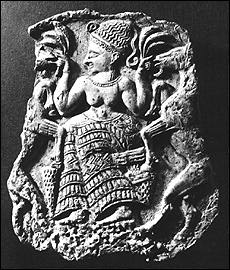
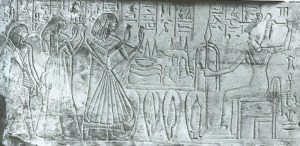
The ancients did, however, toy with standard gender role concepts. The Ugaritic goddess Anat, sometimes described as a “tomboy,” was perceived as a literal femme fatale, joining her in the company of Ishtar and Kali as warrior women-goddesses. She was a proto-Amazon (before they laid aside their male-bashing and set up a very lucrative web-site). Anat wears the severed heads and hands of slain warriors and stomps in blood-puddles, laughing all the while. Where did the ancients derive such violent feminine images as Anat and Kali? Some sociologists suggest that these myths were intended to solidify gender roles, although they seem to confuse the violent male with the shy and retiring female stereotypes. Perhaps the Ugaritians and other ancient folk knew deep down that gender is only a vague attempt to classify something that is really far more complex than it seems. Just when gender is nailed down you find yourself in a bloody mess as Anat swats at you again and again.

Anat ready to smite Egyptians who just don't understand the Violent Femmes

Anat ready to smite Egyptians who just don\’t understand the Violent Femmes

Nashotah is not far from Milwaukee where the folk-punk, genre-defining band the Violent Femmes started out. In college many of my overtly Christian radical friends told tales of how the Violent Femmes were a closet Christian rock group, based on some of the religious themes in Gordon Gano’s lyrics. When I listen to their CDs, however, I hear the same old angst that has plagued humankind for ages — what does a guy have to do to impress a girl (the same question may be reversed, turned upside-down, or dis-and-re-articulated, depending on whether you are female, male, or slime mold). At Ugarit they would have understood the Violent Femmes — listen to “to the kill” and tell me it’s not so! I would suggest that Gordon and the guys aren’t as much closet Christians as closet Ugaritians, struggling with the Anats and other violent femmes of their world and trying to make sense of it all.


Man and Womandrakes

With the recent release of Harry Potter and the Half-Blood Prince in theaters, young minds (or at least juvenile ones!) turn once again toward things magical. Anthropologists find difficulty in distinguishing between magic and religion, and many kids have been introduced to religious themes through this series of books and movies. I admit to having read the books and even having seen some of the films, and one of the memorable mythical sub-supporting characters that captured my attention was the mandrake. My first exposure to this herbological wonder was, naturally, the Bible. (Well, after Mandrake the Magician, of course.)

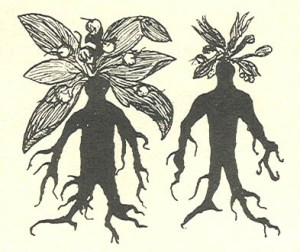
The tale of Reuben’s mandrakes in Genesis 30 shows a hint of that old white magic. Rachel bargains sex for mandrakes and the next time she is mentioned she becomes pregnant. Mandrake roots are often claimed to have anthropomorphic qualities – just how anthropomorphic depends on the imagination and how many the viewer has ingested. In the Middle Ages, the roots were classified as mandrake and womandrake!

Womandrake and Mandrake from a 12th-century manuscript

Womandrake and Mandrake from a 12th-century manuscript

Even in ancient times they were revered as aphrodisiacs. The Bible has plenty of these quasi-magical moments, often explained away as “folk beliefs” by literalists with a nervous laugh. To me they are part of the charm of a Bible unashamed of its roots.

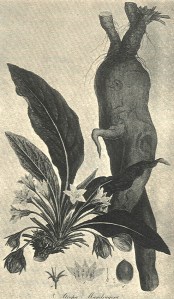
The mandrake (mandragora officinarum) is a Mediterranean plant that had medicinal, and likely “religious” usages in the ancient world. A natural narcotic, the plant is poisonous in sufficient dosages, and it was used as an ancient kind of anesthetic, having been available long before whiskey. When a mandrake was uprooted, its humanesque tuber was thought to emit such a horrendous cry so as to drop the uprooter dead. Dogs were therefore tied to mandrake roots and prodded or urged to run, extracting the plant and dying in the process. Before calling the good folks at PETA, please note that no dogs were harmed in the writing of this post! Although this legend has a distinctly medieval bouquet, it is a method of mandrake hunting actually cited as long ago as Josephus. The mandrake has long arrested the human imagination. From Rachel to Pomona Sprout, the mandrake has not lost its potency for mystical mischief.
"Man"drake, 'nuff said (from Sibthorpe's Flora Graeca, 1808)


Here Comes the Sun, and Is She Ever Hot!

As I enjoy my Kellogg’s Raisin Bran at breakfast, a benevolent sun smiles down on me from the box. I know from social conditioning as a child (courtesy of television), that the smiling solar disc converted the healthful grapes into equally healthful raisins so that I could grow up to be big and strong. While there is no doubt some truth to this solar myth, it does demonstrate how pervasive solar personification is.

A persistent myth to minds conditioned by trinitarian concepts of early Christianity is that the ancients recognized three major goddesses. Although their names are distinct in the original languages, in English three of them begin with A and form a delightful Trinitiess: Asherah, Anat, and Astarte. So this feminine triune godhead is considered to represent the female power triangle of the ancient Ugaritic world. (Ugaritic, I know, is a far too limited term for what was a widespread idea. On the other hand, “Aramean” and “Canaanite” are inherently problematic!) It has been my contention for years that this construct is A) modern, and B) false.

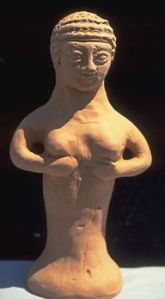
Throughout the ancient world the sun was considered a major deity. And although deities frequently overlapped in their spheres of interest, the principle Ugaritic deity in charge of the sun is Shapash. (With apologies to Nicolas Wyatt, I simply can not find Asherah in her.) In the surviving Ugaritic mythology, which we know for sure is only a portion of a larger corpus, Shapash appears frequently to enlighten both gods and humans. She guides the dead to their repose in the underworld and provides them with some kind of light while the world sleeps unknowingly above. She even seems to have the ability to cure snake bites. Now in the heat of summer, there is no question of Shapash’s ability to turn our grapes into raisins. She even kept many indoors in India last week as the longest solar eclipse of the 21st century crossed that country (chalk one up for Yarikh). Let’s give the sun her due!


Not Lion

Being raised without much of a paternal presence, I frequently wondered at how church services were always presided over by men but populated by women. When I grew up (well, part-way at least) I became interested in feminist interpretations of the patriarchal Bible. The idea that just half of the human population seemed to have all the interpretive privileges simply struck me as unfair. Being a man myself, however, I wasn’t sure where to go with feminist interpretation, or even if I was qualified! This penchant no doubt vexed many an official in my Nashotah House days, but the conviction only grew stronger there.

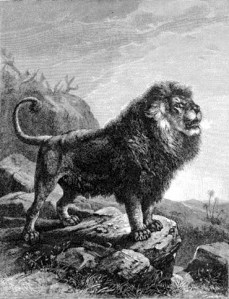
While preparing class materials on the prophet Amos, I recalled how fond the prophet was of leonine imagery for Yahweh. Amos characterizes Yahweh as roaring, hunting for prey. Curious about lions in Israel, my research revealed that the great felines are extinct in that part of the world. The Barbary lion, extinct in the wild, was the biblical lion. As usual, we kill off what we don’t comprehend.

Further research revealed that lions like to sleep even more than most teenagers. It is not unusual for a lion to sleep 20 hours a day! When they have to wake up, however, they are hungry. And here was the interesting tidbit — when lions hunt it is usually the females that do the work! Once a kill is made, the male struts in and takes the proverbial lion’s share, but the lionesses are the hunters. In the ancient world, before television, ipods, or even mindless Ann Coulter drivel, people were keenly aware of their environment. Ancient writers often made astute observations of nature. Would Amos, the shepherd, have known that it is the lioness who makes the kill? Was Amos the first feminist in the Judeo-Christian tradition?

Compare the lions.

Compare the lions.


Which is scarier?

Which is scarier?


Asherah Begins

Back in the Dark Ages when I was working on my dissertation on Asherah, web research had not been born, or even conceived. Its parents might not have even met yet at that stage! When Gorgias Press decided to print a second edition of my book on the goddess a couple of years back, I utilized the opportunity to peruse the web to find out where the old girl is these days.

It seems that Asherah worship is alive and well, according to the internet. I suspect that the ancients would be scratching their heads — and not just because of the omnipresent lice — at the ways she is portrayed these days. The matronly bearer of the gods of Ugarit is a lithe and whimsical girl, walking on the water just like so many other ancient divine figures. She has become a patroness of witches and is identified with any number of pet causes. She is chic, sexy, and alluring.

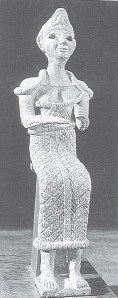
Unfortunately, what we know of the actual goddess is quite a bit less exciting than all that. Asherah is best attested at Ugarit, a city on the northern coast of Syria that has been extinct for 3000 years. Here she is matronly, passive, and interested in doing the laundry. Her role in the mythology is small, despite being the mother of the gods. She does become notorious in the Hebrew Bible and still has the power to inspire the “bad girl” dreams of many a rebellious youth. She is a fascinating figure — some pundits even think she might have been the main squeeze of someone very high on the spiritual food chain!

Perhaps this is one of those “disconnects” that pop-up like toadstools during a wet and rainy summer. Technology has outstripped reality. A goddess once feared and revered as the ancestor of the gods has become a pin-up girl in a digital era. If a mirror could be held up to time itself, I’m not sure that Asherah would recognize herself even if she long gazed into it.