Yankee Doodle

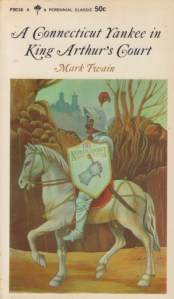
Some books stay with you in a way that hits very close to the nerve.  Since I read Mark Twain’s A Connecticut Yankee in King Arthur’s Court many years ago, memories of how it left me feeling prevented me from re-reading it.  That’s pretty unusual for Twain, in my experience.  I’ve read some of his other novels and there’s not a similar feeling toward them.  The racist elements are disturbing, but overall the stories manage to overcome some of the darkness with either levity or sarcasm.  The scenes that scared me off from re-reading Connecticut Yankee were the two episodes in which young women were murdered.  I realize Twain was simply being honest here regarding the cheapness of life in medieval times, but I found both these instances so saddening that I had a difficult time coming back to it.

Now, some two or three decades later the book speaks to me in a new way.  Something else I recently read reminded me of it, and I was struck at just how much Twain’s Arthurian peasants resemble the unthinking crowds of Americans who simply accept what people like Trump say.  One of Hank Morgan’s banes is how the uneducated refuse to question what they’re told.  In many ways this is humorously narrated but a dark undercurrent remains behind.  Twain had clearly supposed that nineteenth-century America had overcome this brainless gullibility.  A century and a half after Twain’s Connecticut Yankee we’ve clearly been involved in retrograde motion.  Twain levels much of the blame on the church.  His choice comments in this regard also still apply.

“I was afraid of a united Church; it makes a mighty power, the mightiest conceivable, and then when it by and by gets into selfish hands, as it is always bound to do, it means death to human liberty and paralysis to human thought.”  So Morgan states in chapter 10, and indeed, in the novel it is the church that largely leads to the downfall of the civilization Morgan had built.  Or again, in chapter 17: “I will say this much for the nobility:  that, tyrannical, murderous, rapacious, and morally rotten as they were, they were deeply and enthusiastically religious.  Nothing could divert them from the regular and faithful performance of the pieties enjoined by the Church.”  Twain couldn’t admit in public,  even in his own nineteenth-century life, what he really thought about organized religion.  It’s pretty plain in his fiction, but disguising fact as fantasy is a tried and true method of getting at the truth.  If I weren’t so sensitive to the human plight, I might read it more often.


Biblerama

Perhaps you’ve heard—the New Revised Standard Version is being updated.  Stop the presses!  I’m sure that everyone has been anticipating this as much as biblical scholars have!  If you’ve not been able to feel the buzz maybe it’s because you’re not in the Bible publishing business.  As the discussions have been going on (rights holders are of course consulting with publishers, because that’s where the money is) a great deal of energy goes into deciding what exactly to call it.  And since Christianity is so fragmented there have to be different versions of the versions.  Some include the apocrypha and others do not.  Some prefer British spelling and others American.  Imperial interests are important, even when it comes to Scriptures.  What may be overlooked in these developments is the connection to the most influential English translation, the King James.

The King James Version was not the first English translation of the Bible, but it was the version that captured the imagination of some as directly inspired by God.  Strangely enough, King James onlyists can seldom name the translators who apparently had the divine mouth to their ears, but never mind that.  The KJV held immense sway especially among literalists because it is so quotable.  In the 1950s it was revised.  (There are, by the way, several differing versions of the King James Version, and the original included the apocrypha.)  That first major revision came to be known as the Revised Standard Version.  Translators seldom begin their task with what original language manuscripts they can find; new translations are based on existing translations in families.  It’s okay, we’re all related.

Bible closet

When I was a kid the RSV (Revised Standard Version) was considered pretty good by many.  Hardly an overwhelming affirmation, but still, it’s something.  The real concern began when the New Revised Standard Version (NRSV) came out in the eighties.  The reason?  It used inclusive language!  See what happens when you allow women to read?  Ironically, the book that has been used for centuries to liberate white men is something you want to keep out of the hands of women and non-whites unless you make it clear that everyone from Adam to Jesus and Paul was a white man and this is his story.  Now the New Revised Standard Version is being updated.  Nobody’s quite yet sure how it will be denominated.  And this is only one family in a vast genealogy of Bible translations.  If you’re not in the Bible business, you’re missing all the excitement.


Favorite Color

Blue has always been my favorite color.  Even growing up Republican, I preferred it.  Like many Americans I awoke last Wednesday to a national map mostly red and pink, and watched gradually as more and more states turned blue.  I don’t mind confessing I wept when Biden took the lead in Pennsylvania.  These past four years have been torture against all that’s descent and humane.  White people killing blacks and being told there are very fine people on both sides of the issue.  Watching a virus run out of control here like nowhere else in the world because one man can’t be bothered with the troubles of 330 million (stop and think about that number) people.  A man personally enriching himself while not paying his own taxes and getting breaks for those wealthy like himself.  Endless lies.  Loud, brash, and crude.  Groping women as if they are commodities to be owned.

We have, at the embarrassingly late age of 244, finally elected a female vice-president.  Many other nations have realized that gender should not be the basis for electing leaders.  Poisoned by various forms of Christianity that assert male superiority, our culture has feared female leadership since it has become a real possibility.  I voted for Geraldine Ferraro as much as for Walter Mondale in that fateful year of 1984.  We’ve actually reached Orwell’s vision of it in 2016, but now it seems there might be legitimate hope.  I could never have imagined a presidency that would make me think Nixon, Reagan, and Bush weren’t so bad after all.  (And they weren’t good.)  This reconstruction of the Republican Party has been courtesy of the religious right, which is really neither.

Today, however, I’m enjoying my favorite color and thinking that hopefully we’ll have some peaceful years to work on true equity and the ideals on which this nation was founded.  I’m hoping it will signal to the other fascists of the world that gaming elections only works if people with consciences are complacent.  I’ve been told that many Trump supporters think Democrats incite violence.  The Dems I know are tree-hugging, owl-saving, vegan types.  We value all people, even Republicans, and ask only that all people be accepted.  We don’t tote weapons to state houses or threaten those who are counting ballots.  Yes, we may fear election outcomes—we’re just humans—but we believe in the process.  The many protests in which I’ve marched over the past four years have all been peaceful.  And I breathe, as I tear up again at the sight of blue, dona nobis pacem.


Really Celebrate

It’s a dilemma.  How do we celebrate Mother’s Day during a lockdown?  The COVID-19 pandemic has changed a lot of things.  Given that it was snowing around here yesterday (not to be blamed on the virus), even May doesn’t seem very cooperative this year.  On Friday night I made an emergency trip to Target for essentials.  One of my ulterior motives was to purchase a Mother’s Day card for my wife.  Given the lack of social distancing at the card rack, I wasn’t the only one who had this in mind.  The remainder of the store had shelves of daily necessities picked clean.  How to celebrate moms during a pandemic?  I guess by trying to stay alive.

Those of us far from childhood homes can’t visit our mothers.  Even if we could we couldn’t take them out for dinner.  If we send flowers we can’t send gloves to protect their fingers—the stores are out of those.  If we send flowers to plant we have to send plastic to cover them too, having had four nights with freeze warnings in a row.  Talking to my Mom yesterday she recollected the year that it snowed on Memorial Day.  I shouldn’t complain.  Mom would rather I didn’t.

Perhaps the best we can do for Mother’s Day is to start treating all women better.  One commemorative day a year doesn’t make up for a lifetime of second-class citizenship.  Our mothers are the reason all of us are here.  Isn’t that reason enough to see we’re all part of a single family?  Women put up with a lot to take care of us.  Even so we deny them an amendment granting them equal rights.  Politicians are saying “Happy Mother’s Day” even as they continue to withhold basic human rights from women.  We could celebrate Mother’s Day by putting our sentiments into action, transforming daily life into equal pay and equal protections.

There’s a pandemic outside.  There’s some snow out there too.  But there’s a warmth inside and for that we have our mothers to thank.  If we really mean it when we send our mothers cards and flowers, if we really mean it when we call, if we really mean it when we give her a hug, we’ll show it by our actions every other day of the year.  We need to be sincere when we say it, or don’t say it at all.  Happy Mother’s Day!


Learning To Fly

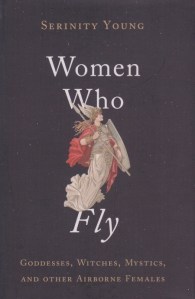
It’s perhaps the most deeply rooted human dream.  Flying.  Women Who Fly, by Serinity Young, is a fascinating book.  Subtitled Goddesses, Witches, Mystics, and Other Airborne Females, the book covers all of these and more.  The dream of flying is played out in many ways here, but often the narrative comes back to how patriarchy imprisons women.  Is it any wonder they want to fly?  Very wide in historical scope, the book can’t cover all cases in equal depth.  It nevertheless demonstrates how pervasive the idea is.  Beginning with ancient female figurines bearing bird-like features, Young moves through the related concepts of captivity, transcendence, sexuality, and immortality, showing how female characters are related to these idea in universal and unrelenting ways in the form of flying females.

There are many lenses through which to view patriarchy.  It can be explained as a consequence of settled agricultural existence with its subsequent division of labor.  Such a scenario raises questions of whether women dreamed of flight before that, and I believe the answer must be yes.  For as long as we’ve observed birds and associated the sky with gods we have longed for flight.  Although birds make it look easy, it is an incredibly difficult and costly adaptation.  Still, women dream of travel without obstacles (let the reader understand) to the realms where deities dwell.  It is difficult to summarize a book that covers so much historical territory.  Young doesn’t limit herself to western religions but also spends a fair bit of time among Buddhist, Hindu, and Daoist ideas of flying women.  She covers mythical, folkloristic, human, and historical flying females all the way up to modern astronauts.

As I was coming to the close of the book the real message hit me—I can be thick at times, although much of my own writing is metaphorical—men have actively tried to clip women’s wings for a long time.  Often under the auspices of religion.  Think of it: for centuries of existence the major monotheistic traditions have refused female leadership.  The one (inevitably male) god has set up a boys’ club of sacerdotal leadership.  As Young points out, even the named angels in the Bible are male.  I used to comfort myself with the explanation that male leaders were simply too self-centered to consider others, but it is becoming clearer, the more I read, that men have always had a tendency to try to keep women down.  And thus they fly.  There’s much in this book for both women and men to ponder.


Making Frankenstein

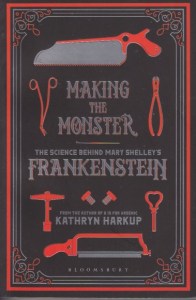
Some days ago I mentioned reading a book about Frankenstein.  This was Making the Monster: The Science behind Mary Shelley’s Frankenstein, by Kathryn Harkup.  I’ve read several books like this, many of them written about on this blog (search “Frankenstein”—there is a search box out there!), about the context of Frankenstein.  The base story is all the more compelling for having been written by a teenager who’d eloped with a married man who would eclipse her literarily.  Mary Shelley never got rich off Frankenstein, but it is one of the best known novels of the nineteenth century.  It had an impact during the author’s lifetime and has continued to have one these centuries later.  Harkup, however, is a scientist.  Her specific interest, apart from being a female writer herself, is in the science of the story.

Arranged thematically, Making the Monster covers several of the developments which would’ve been “in the air” at the time.  Mary and Percy Shelley both read science also, and knew many of these things.  There was the question of reanimating the dead that coincided with the early dissections of humans that made the modern study of anatomy possible.  There were medical breakthroughs—some of the more difficult parts of this book to read—and there were experiments with electricity.  There were cases of children raised in the wild that had been found and their subsequent stories documented.  There was evolution (in the form known to Charles Darwin’s grandfather Erasmus), there was revolution.  It was a time with so much happening that Frankenstein became a cathartic outpouring of the human soul amid the science that both Shelleys atheistically accepted.

Much of this book is fascinating, even after reading other similar accounts to the background of the novel.  What really brought it all together for me, however, was reading through the chronology at the end.  It takes me several days to read books.  What with the monster of daily work I often forget some of what I’ve read along the way from introduction to conclusion.  Having a chronology at the end reminded me of just how much information is packed in between these covers.  The narrative covers about a century (longer, if you include the alchemists), and shows how Mary was using fiction to address some very real science.  Harkup never loses track of Mary Shelley’s personal experience, however.  Estranged from her father, constantly on the move, widowed fairly young, losing several children, treated poorly by aristocratic in-laws, hers was a story of perseverance and ultimately influencing the western canon.  It shows that science and art can assist one another to make us all more human.  And the monsters left behind endure.


Half of Us

Today is International Women’s Day.  We need to pause a moment and think.  We can’t change the past, but we can improve on it.  I think it’s fair to say that historically—before the Enlightenment anyway—domestic arrangements were the product of evolution rather than intention.  Like religion, however, domestic arrangements have a difficult time keeping up with change in real time.  By the time healthcare improved and women’s chances of surviving childbearing grew, men had become set in their ways.  Even now we still have trouble getting a female on a presidential ballot in “the most advanced” country in the world.  The week before International Women’s Day Elizabeth Warren stepped out of the race.  The rational world is so desperate to get the anomaly out of the White House that it hasn’t really dawned what a lost opportunity this was.

Although for most of history their roles have been hidden, half the advances of the human race belong fairly to women.  Males often have difficulty admitting that they require help, or had any assistance getting to where they are.  In fact, though, we know they had mothers and those mothers helped make them who they were.  Many of them had spouses who kept the situation stable enough that they could go on and follow their preoccupations.  History, unfortunately, would record only the names of the men.  In the western world this was often reflected in the changing of names during marriage.  Domesticity comes with a price, but it can be balanced out.

Capitalism, it seems to me, rewards the greedy.  Instead of evening things out so that those who don’t have the same opportunities can be cared for, our economic system rewards selfishness.  I often wonder if women would’ve been so suppressed had a more humane measure of human worth been adopted.  When I think of billionaires whose names I’ve never heard of before, I always mentally add, “they wouldn’t be billionaires if the rest of us refused to play the game.”  It’s only because we agree to an arbitrary and artificial valuing system that we allow the obscure to “own” far more than the rest of us.  Women, it seems to me, would know the realities of this way better than most men do.  What if the value system we shared measured worth in having had a mother?  It’s something we all share.  Yet in this nation we still haven’t passed the Equal Rights Amendment.  The time has come to ask ourselves what’s really important.  Today should be the answer.


Ash + Hera

I’ve obviously been reading about the Greek gods.  Apart from being borrowed and renamed by the Romans they’ve remained pretty much unchanged through the millennia.  Those who read a blog like this will recognize the names of many Olympians and would recognize the name of the head honcho as Zeus.  The name of Zeus is Indo-European—this is a linguistic group, and not necessarily an ethnic one.  That is to say, the languages of ancient India and ancient Europe are related.  Zeus, it has been postulated, is related to the word Deus, familiar to many Catholics as a Latin word for God.  In antiquity most gods had personal names as well as titles, but this is something we see a little more clearly in the Semitic linguistic realm.  The texts of the Bible and its surrounding cultures often preserve titles as well as names.

Photo credit: Marie-Lan Nguyen, via WikiMedia Commons

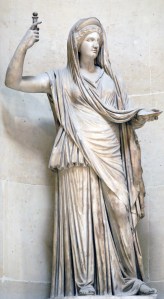
Hera is widely recognized as the consort of Zeus.  It’s a bit of a misnomer to refer to divine couples as “spouses” since they really don’t comport themselves according to human-style conventions.  In any case, Hera in Greek mythology is an underdeveloped character.  She’s jealous of Zeus’ many affairs, and she sometimes punishes his children by other women or goddesses.  Her name is a bit of a mystery, and the other day I was trying to remember where I’d read that she may be a shortened form of Asherah.  My research on Asherah is now nearly old enough to fit in with the classics, but much of it still remains fresh in my mind.  In any case, the reasoning went like this: Asherah always appears as the consort of the high god.  The Greek Zeus was clearly influenced by Semitic ideas associated with Hadad, or Baal.  And while Asherah was not Baal’s consort, Zeus is clearly the high god so his main squeeze should be that of the highest order.

Greek, as a language, had trouble beginning words with a vowel followed by the “sh” sound, like Asherah.  The argument went that if you knock the “as” off the front of that divine name you’re left with Herah, and the final h isn’t pronounced anyway.  This line of reasoning always made sense to me.  Deities in antiquity were defined more by what they did than by what their names were.  In a patriarchal world, being the consort of the highest male was about the most a goddess could aspire to.  Still, we all know of the more colorful individuals who take a more forward position: Athena and Artemis—both powerful virgins—and the somewhat more naughty Aphrodite.  All those names beginning with alpha!  They could teach us something today, I suspect, if we read our classics.


Human HU

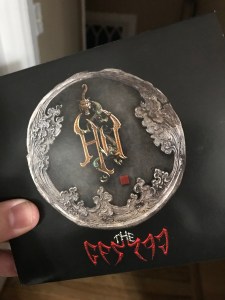
In these times of extreme xenophobia, we desperately need to understand those who are different.  When my brother recently shared his discovery of The HU’s album The Gereg, I was at first a little concerned.  That deep-seated childhood evangelicalism suggests anything that unfamiliar is bound to be satanic.  How unfamiliar?  Mongolian throat-singing unfamiliar.  Songs sung in Mongolian, unfamiliar.  Album art that could be heavy metal.  I’d never come across anything like it.  I suppose it’s a natural, knee-jerk reaction to say anything so unfamiliar is potentially demonic, and it shows just how paranoid a culture can be.  We think of 1950’s America as “the norm.”  I wasn’t alive then, but I’ve seen pictures.  Buzz cuts still give me the willies.  I trust Mongolians more.

I don’t know if The HU is a deliberate play on The Who or not, but the word roughly translates to “human.”  Like many ancient practices, nobody thought to write down the origins of throat singing.  Traditionally it was what Inuit women did when men were out on the hunt.  Like many aspects of hunter-gatherer society, it fascinates.  Some cultures reported that when Christian missionaries came, with their cultural imperialism in tow, they suppressed throat singing.  It looks like I wasn’t the only one raised to be suspicious of that which is different.  I learned, however, of my own cultural biases.  I learned that ones’ own assumptions must be interrogated.  If humanity is to survive, we must learn to try to understand one another.

Although the actual roots of throat singing are lost in unwritten times, I strongly suspect it has a religious, or if you prefer, spiritual, origin.  When women gather it isn’t the same as when men consolidate power and institutionalize violence.  I’ve read that when women rule there is a strong impulse to cooperate, to suppress aggression.  Men can learn this.  Indeed, as those white, male missionaries took up their positions in far-flung parts of the globe they spread the idea that men alone held the divine right of, if not kings, priests.  Conversion, you see, is seldom gentle.  Making the world in your own image, if you’re a man, runs into certain obvious problems right away.  HU means human.  When I feel the cold paranoia of my own government creeping up on me, I cue-up the soundtrack of my life.  I’m no longer a young man, and I don’t fear the different as much as I used to.  I need to hear something different, something human.


Shifting Perspectives

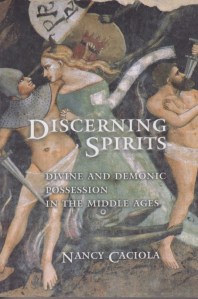
Perspective.  The ability to change it is vital to understanding.  I’ve been working with the idea of demons for a few years now.  My perspective, however, has been aided by Nancy Caciola’s Discerning Spirits: Divine and Demonic Possession in the Middle Ages.  Noting something that has long been a puzzle—behaviors attributed to saints were also recognized among the demonically possessed—Caciola suggests a solution.  In the Middle Ages very few female saints were canonized.  Delving into records from the period Caciola noticed that when saintly behaviors exhibited by men were experienced by women those behaviors were deemed demonic.  In other words, from a perspective that saw masculine experience as normative, when supernatural events were encountered in women they were seen as diabolical.  Using Hildegard of Bingen’s frame of an “effeminate age,” Discerning Spirits explores the idea of how the Medievals told good from evil.

 My own experience of “discerning spirits” came about through a United Methodist curricular study on spiritual gifts.  I was in either junior or senior high school, and deeply involved in the church.  An adult study (I was close enough) on spiritual gifts explained the laundry list compiled by Paul in 1 Corinthians 12.  The apostle from Tarsus notes that discerning spirits is a divine gift.  I trembled as a teen, wondering if I might possibly have it (that was the point of the study).  It seemed like an immense responsibility.  The issue, it turns out, was nothing new.  Since codified in the Bible it had to be true, but what was it all about?  Smarter people than me were struggling with it.

There’s plenty of provocative and explanatory information in Discerning Spirits.  From ancient times it was understood that gods could possess people.  By the New Testament demons clearly could too.  We hear less and less about divine possession as time goes on.  In fact, it becomes a kind of heresy in itself.  Demonic possession was never really in doubt.  It fell out of favor with the Enlightenment, but it didn’t really disappear.  This book shows a clear trajectory from women’s possession as being demonic straight toward the witch craze that erupted in Europe toward the end of the Middle Ages.  It was no coincidence that the majority of accused witches were female.  The perspective had shifted with the fortunes of the church during the Medieval period.  Fear of schism and fear of unsupervised spirituality in a world where only men could be priests led to results that, in hindsight, look inevitable.  Caciola’s book is an important source for not only ages past, but also a mindset all too prevalent in our present world.


Memories of Scotland

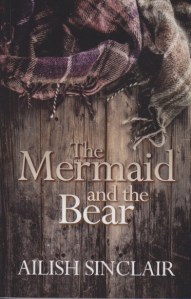
I admire those who follow their dreams.  I have been writing fiction for over forty years now, and although I’ve had some success placing short pieces my novels haven’t found much interest.  So when I see the published work of someone who obviously loves writing as much as Ailish Sinclair does, it warms my heart.  Her debut novel, The Mermaid and the Bear, is the kind of historical fiction tinged with a little fantasy, all set in Scotland.  Having spent three happy years in Scotland myself, I like to read native writers.  One of the categories in this year’s Modern Mrs. Darcy’s reading challenge is a debut novel, so all these things came together in this one little book.  There may be a little spoiler info below, so proceed with caution!

Sometimes I read a novel without knowing much about it in advance.  That was the case with this one.  I read Sinclair’s blog posts and appreciate the fact that she doesn’t compose long, rambling essays.  Her posts often make me stop and think.  Her novel follows a love story that turns into a witch-hunt.  Unlike that claimed by those who have the whole world watching them, this was a real one.  The historical notes tell a bit about the characters based on women actually tried in Scotland during those dark times.  In fact, when one of my doctoral advisors gave my wife and me a walking tour of Edinburgh early on in our time there, he pointed out where the witch trials had taken place.  Sinclair captures the rage and frustration of women who had no recourse once such accusations flew.  A religion only too ready to believe the worst about people, women in particular, showed no mercy based on what was only hearsay and jealousy.

It’s difficult to imagine what life would have been like in such times.  Castles and lairds make us think of fairy tales, but reality must’ve been somewhat harsher.  It’s fun to pretend about witches around Halloween, but there’s a sadness that’s difficult to escape as an adult.  That sadness is all the more profound for finding claims of witch-hunts on the lips of abusers and others who do their best to perpetuate inequality.  They dishonor those who actually did die so that men like them could feel smug self-satisfaction in the past.  The Mermaid and the Bear brought a number of these thoughts to mind.  Our society has made some strides towards treating all people as human beings but we’re yet a long way from where we need to be.  Books that remind us of that are always to be welcomed; dreams are worth pursuing.


Space Farce

Okay, so “Space Force” sounds like a gimmick that you’d see in a 1950’s ad geared to dungaree-wearing boys.  These boys, who’d be named “Dick” would show the girls, named “Jane,” just how it was done.  So as I read about the furor of dedicating a King James Bible from the Bible Museum as the official Bible for military branches aimed at the stars, I had to think how very small we actually are.  So 45 thinks, like Reagan thought, that we need outer-space defenses.  These guys need to read more science fiction.  Actually, some plain old science would help.  If there are most advanced civilizations out there—and such seems increasingly likely, given that our understanding of science is subject to change—we are nothing more than cosmic mosquitoes buzzing close to our own planet where we can wail on each other in the name of lucre.  And we call it “Space Force.”

An article on NPR points out the hypocrisy of swearing in the military on a Bible.  One guy in there, I’ve heard tell, was called “the prince of peace.”  He’s somewhere near the back.  The public loves a good warmonger, though.  We can send our tentative rockets into orbit where bug-eyed aliens laugh with bemusement, and say “Just you try something.”  Or we can make business deals with Russia with one hand while pointing our missiles in their direction with the other.  Is that a missile or am I misreading something, Dick?  I can’t ask Jane, because she just follows along.  Maybe we’re inheriting the consequences of those who grew up reading Dick and Jane.  Boys with their rockets, girls with their dolls.

Bringing religion into the military is nothing new.  German soldiers marched out into a couple of World Wars with “Gott mit uns” inscribed on their waists.  Millions died.  No lessons were learned.  So now we want to take conflict so far over our heads that we can’t even see.  Ancient people knew the gods were fighting far above.  That’s how they made sense of the world.  Some, like Erich von Däniken took those stories literally and thought our alien observers were the reason.  Now that we’ve got drones we have no need of UFOs anymore.  All that sci-fi I watched as a kid wasn’t wasted after all.  Only I grew up reading that Bible instead of swearing on it.  I was pretty sure that war wasn’t a good thing, as he rode on a red horse with his sword pointing upward.  Time to dust off William S. Gray and get back to watching Space Force. 

From NASA’s photo library


Bodies and the Fall

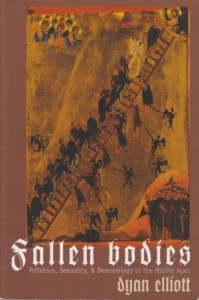
Less common than it once was, the term “Dark Ages” was formerly used to denote what in Europe was known as the Medieval Period.  We now know that the pervasive darkness ascribed to the time was only partial: science, legal thinking, and rationalism were well underway.  Nevertheless, the sway of the church was enormous, and even until and beyond the days of Isaac Newton, the supernatural was assumed to exist.  Dyan Elliott’s Fallen Bodies: Pollution, Sexuality and Demonology in the Middle Ages is a fascinating journey through this contradictory time.  Elliott explores how the mysteries of sex (nocturnal emissions and menstruation loom large among them) played important roles in the development of Catholic theology that ultimately led to the close association of demons and witches.  Concerns with priestly purity, largely due to concerns about transubstantiation, led to enforced celibacy and the (further) denigration of women.

It would be difficult to summarize this insightful book.  Although relatively brief, it packs a wallop.  Concerns about purity go back to the Bible and before.  Ancient cultures had recognized aspects of contagion and knew that some diseases spread by contact.  Their perception of biology was “scientific” according to their current understanding, but it lacked microscopes and knew no shortage of supernatural entities.  Demons had great explanatory value in such a world.  As Elliott shows, they often appear in disquisitions about sex.  How can spiritual beings engage in physical relations with human bodies?  What were they made of?  Were they all bad?  Although demons had explanatory value they also raised many questions.

Fallen Bodies draws correlations between the dismissal of priests’ wives and the evolution of witches.  As the Eucharist became more and more holy, stricter controls had to be placed on consecrating hands.  Sex was the great source of pollution, and the Virgin Mary became rather less human through her own miraculously sterile conception.  The implied misogyny may not have been so much intentional as a reflection of the struggle to understand what modern medical science generally explains materially.  We still grapple with the mystery of life.  Conception can be viewed clinically, and biological responses can be “explained” scientifically (anyone who’s been in love will admit to the mystery of it, though).  Denizens of the Middle Ages worked with the tools they had to make sense of a world often bewildering.  Even physics still has to deal with quantum realities.  History teaches by its unfortunate missteps.  Someday those who “govern” the world may learn to read it and exorcise demons now otherwise readily explained.


Protest Day

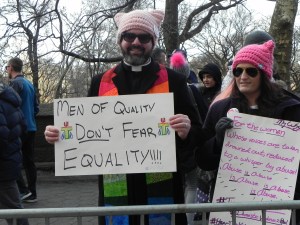
Today should be known as Protest Day.  Three years ago with over a million others I marched in Washington.  The media still routinely underreports the numbers there, despite the metrics used on the ground.  “They’re only women,” it seems to say.  I marched the last two years in New York City.  The protest can never stop.  Once a democracy has opened the door to evil, it can never rest again.  It’s cold outside.  There’s a winter storm in the forecast.  Women everywhere are out marching.  This mansplained world must come to an end.  We must hear all voices.  Despite having control of all branches of government, the Trump message isn’t being heard.  Perhaps there is justice in nature.  I like to believe it, even when it’s hard.

Patriarchalism wears many disguises, such as biblicism.  If all you take from the Good Book is the idea that men are more important, then you’ve missed the point.  The Bible is a book with a context and those who can quote it without knowing what it originally meant are left wondering why so many other Christians disagree.  The message must be heard.  Liberation theologians long ago realized that Jesus’ gospel had been drowned in the voices of legalism.  They did what we all should be doing today; they protested.

Signs of national and international weariness are everywhere evident.  Trump-supporting senators strike out with ad hominem attacks for all reason has failed them.  Used to be if you aided and abetted a criminal you’d get in trouble.  Now you just get bumped to a more influential committee.  So we protest.  History hasn’t forgotten Watergate.  It will never forget the disaster of 2016 when a political party sold its soul.  

A restaurant not far from here is owned and operated by a young woman.  A sign on the register says “The Future Is Female.”  I hope it’s so.  Our hunter-gatherer sensibilities have been suborned by the possibilities of agricultural surplus.  Where there’s surplus there’s mammon to be made.  In the Middle Ages mammon became the name of a demon.  Today it’s inscribed on the hearts of those who follow cash, no matter where it may lead.  Once upon a time a man from Galilee said the wealthy wouldn’t inherit the kingdom.  Like Caesar they dedicate the temple to themselves.  We may not all be able to get out to march today, but we can make our consciences heard.  Women deserve every right men have.  It’s time to learn to share.  Until that happens, we must protest. 


First Christmas Parable

The Christmas story is full of surprises.  This year near Bethlehem, a parable occurred to me.  Like many parables, it raises questions.  A question for all you men out there: when’s the last time you were pregnant?  Was it because some woman—who can’t be responsible for her urges—didn’t take proper precautions?  Isn’t this the way God punishes people for having the sexual intercourse he created?  Since God gave you an anatomy just like his, you certainly have priority in the cosmic scheme of things, but this pregnancy of yours—what are you going to do with it?  Oh, and don’t look to Onan for answers to your own urges; God stuck him dead for that kind of thing.  But that troubling “what if”… What if Mary had had a choice?  According to the Good Book she did.  “Be it unto me,” Mary said.  She could’ve said “No.”  Many men in your *ahem* delicate condition did not.  The problem with virginal conceptions is that people will talk.

Many people don’t remember at this time of year that Mary and Joseph were immigrants to Egypt.  Had the Nativity occurred today in these States that follow God’s word, Mary, Joseph, and the baby Jesus would’ve ended up in separate cages.  Wasn’t he born in a cage?  Oh, cave!  That’s definitely an improvement.  One wonders how the Gospel might’ve gone from there.  And what of those annoying buzzing creatures overhead calling for peace on earth?  Shoo!  Trade wars!  Tariffs!  Nuclear threats!  These were the gifts of the three wise men, were they not?  Or perhaps we should get biblical and follow Herod’s mandate.  Killing two-year-old boys isn’t abortion, after all.  After giving birth they’re your problem, not God’s.  You’ve got to get them born—that’s the most important thing.  And since women can’t possibly know what it’s like to be pregnant what are you going to say when they walk out and tell you, “It’s not my problem”?  “Be it unto me,” said Mary.

Shepherds, it should be noted, were the poor.  Ironically that first Christmas the good news was first revealed to them.  Herod, half-insane, kept shifting members of his government around.  He had put away his previous wives—perhaps because they made him pregnant—and assassinated all his rivals.  Unless that’s fake news—the old fox was known for that.  So the immigrant family thought it was safe to return after Herod was removed from office.  Jesus grew to espouse the message of love and acceptance—extending it even to foreigners.  The state, believing itself established by divine right, had him put to death.  It’s Christmas, and we’ve seen all this before.  If only those with eyes would see.  But parables, it seems, have gone out of style.