All in This Together

The rain falling from the dark sky is barely liquid.  The thermometer reads 33 as we step out into the early evening—this is not the kind of night I’d want to be outside, but this is important.  When we arrive in Bethlehem there are already maybe a couple hundred people lining Rose Garden Park with signs.  We park and join them.   Many of the signs are clever and to the point: “I shouldn’t have to miss Nixon,” and “Vichy Republicans—shame on you!”  This winter of discontent, crumbling democracy, we are here as warm bodies on a cold night to protest what has gone on far too long.  The impeachment vote is scheduled for today and across the country people have come out—supper hastily eaten or yet to be started when they get home—to say enough is enough.

Now Pennsylvania isn’t the bluest of states.  I wasn’t sure of what our reception would be on the busy corner of 8th Avenue and Union.  I was amazed.  Large numbers of cars, and even some commercial trucks, honked their horns in support as they drove by.  Thumbs up out windows in the cold air.  Long blasts on horns.  For sure, many drivers remained silent, but only three that I counted bothered to roll down their windows and shout support for Trump.  They were treated respectfully and cordially by the protesters, many of whom were considerably older than my wife and me.  I listened to snatches of conversations as my fingers and toes grew numb.  Vietnam vets, and even one from the Second World War.  Retirees who should be spending December nights in their warm homes.  We all had something important to do.  We had to stand and be counted.

Because of a childhood incident, I suffered mild frostbite on my fingers and toes.  It is excessively painful for me to be out in the cold to this day.  We could only stay for about an hour and a half.  It was a work night after all.  There were many stalwarts still holding signs and chanting as we headed back to our car.  Around a sign for the park where other, more temporary signs stood, a protester said, “Someday maybe we won’t have to do this anymore.”  A younger man corrected him.  This happened because we failed to be vigilant.  Vichy Republicans are a real thing and although the elections are about eleven months away, we need to get ready.  We need to get everyone out to vote.  If the signs of support we saw last night reflect the feelings of Americans, it’s time for us to become a democracy again.


Aging Goddesses

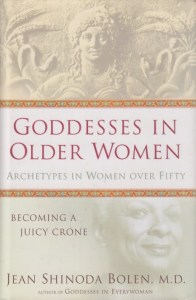
While not a woman, I am over fifty and I have both a personal and professional interest in goddesses.  Some friends recently asked how I came to write a dissertation on a goddess, and thinking about that has revealed some aspects about my outlook, but those will need to wait a little.  We read Goddesses in Older Women by Jean Shinoda Bolen because my wife wanted my opinion on it.  We read books together while washing dishes—we’ve been doing this since we married over thirty years ago—and despite my not requiring the subtitle, Becoming a Juicy Crone, I was game.  I have been curious about the experience of others since I was quite young.  Since half the others in the world are female, it makes sense to be in dialogue and to be willing to learn.

Bolen uses classical goddesses as Jungian archetypes to help post-menopausal women sort out their feelings and spirituality in what has been called the “crone” phase of life.  This is part of an antique triad that many would rather dismiss: virgin, mother, crone.  Still, Bolen embraces it as fairly common in women’s experience.  Men, although they can be elected to the White House while doddering old fools, don’t pass through such distinctive stages.  In fact, some never mature.  Women’s lives are defined by reproductive capabilities in ways men’s simply aren’t.  Instead of dismissing half of human experience as irrelevant, we should listen to the accumulated wisdom of women.  Bolen, who is an M.D., isn’t an historian of religion, but her remarks about the various goddesses explored (Asherah isn’t one of them) are insightful.  I listened as my wife read, and this was quite a learning experience.

We have, as a species, often failed our females.  Males, using that “might makes right” physiology and theology, have often assumed masculine agendas are the only ones that matter.  Look around the world today and see where that’s gotten us.  We’re killing our own planet in the name of greed and ignorance just so that nobody can be richer than me.  I think it’s time we let the women have a chance to run things.  Even though ancient mythologies often reflect the patriarchies under which they were written, many allow women more powerful and authentic roles than they currently have.  Even El, the head of the Ugaritic pantheon, could change his mind when approached by Asherah.  I learned much from this book, just as we learn so very much by listening to those who differ from ourselves.  And the goddesses, almost always, are the ones who possess true wisdom.


Sister Monsters

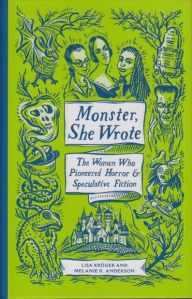
Every once in a while you read an inspirational book.  I’m hoping readers will keep in mind that inspiration comes from different locations for some of us.  Monster, She Wrote: The Women Who Pioneered Horror and Speculative Fiction, by Lisa Kröger and Melanie R. Anderson, is a source of inspiration.  With the usual Quirk Books touches, this isn’t a tome heavy on literary criticism, but it is a wonderful compendium of brief bios on women who walk(ed) on the dark side.  I find books like this encouraging in a number of respects.  First of all, these are women who did what they loved and were recognized for it.  Secondly, it gives the rest of us some hope that getting through the establishment to actual publication isn’t as impossible as presses would have us believe.  And third, it’s also a lot of fun.

It isn’t often pointed out that women played a major role in the development of the horror genre.  Some of the earliest Gothic novels were by Ann Radcliffe and Margaret Cavendish.  Probably the first fully fledged horror novel was Frankenstein, by Mary Shelley.  The real learning kicks in when the other names come out—many women found, and continue to find, the genre compelling.  Most of them, like most of us, are lost to history, but many of them have been rediscovered.  Here again is cause for hope; those of us who write, I think, have our eyes set on the far distant future.  We’re inscribing our “Kilroy was here” on paper—I still can’t think of ebooks as actually existing—in hopes that those down the road might know us a little better.  The fact that some of our sisters have been found suggests that we too may be resurrected some day.

There’s no plot here, and the point isn’t to present some great discovery.  This is a book that encourages women to be who they are through example.  The fact that it involves monsters and horror is simply a bonus.  As a non-female reading this it struck me time and again that women have long been informed of what they should or could do by men.  Men don’t like to see women knowing as much as they do about the shadow side of human existence, even as they relegated them to the shadows.  It’s my hope that this book will inspire women to be themselves.  And if they want to invite monsters along, so much the better.


Hidden Monsters

I don’t think much about having been born male.  I’m starting to realize that that’s because I don’t have to.  The same is true of being caucasian, although I’ve always objected to the labels of “white” and “black” as being polarizing and wildly inaccurate.  Although I grew up in poverty, my “social markers” put me in a place of privilege, even if others sharing my demographic have locked me out of the club.  These thoughts were raised by Mallory O’Meara’s excellent The Lady from the Black Lagoon: Hollywood Monsters and the Lost Legacy of Milicent Patrick.  As soon as I saw the book announced, I knew I had to read it.  As O’Meara would doubtlessly not find surprising, I had never heard of Milicent Patrick before.  I’m not surprised that a woman designed the Creature from the Black Lagoon, however, because woman create memorable monsters (can I get a “Frankenstein”?!).

The reason I don’t think about being male is because the crumbling society built by males assumes that it’s the default.  Men have always been shortsighted, I guess.  Having been raised by a “single mother” (she was technically not divorced because a male-made religion said it was sinful), I always believed women to be protectors, capable heads of families, and far more empathetic than the men I met.  I didn’t realize at the time that we lived so close to the brink because men devalue women.  Milicent Patrick grew up in a family where this was much more obvious.  A talented artist, she incurred her family’s lasting wrath by going to Hollywood and doing what was then movie makeup work.  That she designed the beloved Gill Man makes sense to me.

O’Meara’s book is sure to make thoughtful readers angry.  Not at the author, but at the behavior of men.  Perhaps due to my unbalanced upbringing, it has taken many years to see what others probably notice much more readily: women have to struggle for that which someone like myself can simply claim.  Bud Westmore, Patrick’s boss at Universal, claimed her creation as his own work.  There are monsters in this book, and I’ll give you one guess as to their gender.  Still, I’m glad to have read it for I know I’ve found another monster fan.  O’Meara’s clearly aware of how those of us who admit this odd passion are marginalized in a world that prefers super heroes and those good with finance over those who see monsters everywhere.  This is an important book; read it and you’ll see them too.


Ghouls and Dolls

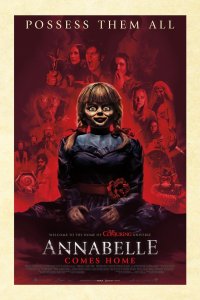
It was my plan—as if plans ever really work out—to see Annabelle Comes Home on opening weekend.  July got away from me but I finally found my way to the theater yesterday.  My current book, Nightmares with the Bible, deals with demons in cinema.  One of the chapters covers The Conjuring universe, and since this is the sixth film in that diegesis (with one tangentially attached spin-off) watching the movie was as much research as it was fun.  While the demon utilizing the doll Annabelle is clearly the main villain, the film, as in most of the franchise, interjects any number of entities.  Ed and Lorraine Warren, in real life, kept a museum of occult objects in their house.  This room contained items that had figured in their cases—they maintained demons didn’t possess objects, but people—including the doll Annabelle.

The new film maneuvers three girls (Judy, the Warrens’ daughter, her babysitter, and a friend) into the house alone.  One of the girls releases Annabelle from her blessed case, and a nighttime of terror ensues.  The demon behind Annabelle animates several of the haunted objects, so the girls have to deal with many ghoulish threats.  The film knows it is following tropes such as a car breaking down by a cemetery at night, and the idea of a babysitter being attacked by monsters, and at times it gives a slow wink to fans of the genre.  Still, there are plenty of genuinely creepy moments and a few jump startles.  It also shows the clearly demon in its “true form” at the climax of the film.  When it does so, it matches traditional renditions.

Set to become the highest grossing horror series of all time, The Conjuring universe mixes films that claim to be “based on a true story” and others, such as Annabelle Comes Home, that use real settings but without claiming to follow actual events.  What I found engaging about this particular movie was the fact that the youngest girl, Judy Warren, was the one who figured out how to re-capture the demon.  There are holes in the plot, of course, but featuring a young woman not requiring a man’s help to trap a demon is somewhat unusual in a Catholic diegesis.  True, she doesn’t perform an exorcism, but Judy does contain the evil without a priest, or even her father’s direct help.  As this diegesis wends its way into American folklore, moments like this are increasingly important.  Even though there are demons here, the women don’t require men to do the heavy lifting. 


Sighs

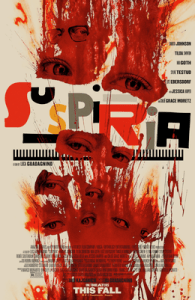
Suspiria is a movie intentionally difficult to follow.  The original 1977 version was an Italian film about witches posing as dance instructors.  After watching it, I felt I didn’t have enough backstory to understand the action.  Then a remake was released last year and I felt I needed, like a dancer, to try again.  I have to confess I’m not a dancer.  Luca Guadagnino’s remake left me scratching my head again, although it underscored a point I make in Holy Horror: in horror films with remakes the role of the Bible changes.  Now, it’s been years since I’ve seen the first Suspiria, but I don’t recall the Bible appearing.  It does, however, in the 2018 remake.  The protagonist, Susie Bannion, is an American enrolled at a German dance school.  She is, in the remake, a Mennonite from Ohio.

Not only does this situation allow religion to take once again an important role in a horror film, it is also the opportunity to show the Bible visually.  Susie’s mother, who objects to her daughter engaging in such a showy profession as dancing (and given the performance of Volk in the film, the nature of this objection can be easily guessed), is dying as the film begins.  Her Mennonite community watches and prays over her, sitting with Bibles clutched in their hands.  To take a page from Holy Horror, this suggests that the Good Book is powerless to save.  While the movie itself is a little confusing on this point, it seems that Susie’s mother dies as her daughter becomes the head witch of the dance academy.  Since Holy Writ famously contains verses condemning witches, the impotence of Scripture is underscored.

Italian folklore about witches appears to be remarkably robust.  From Strega Nona to Suspiria, the wizened women of society have power against which men are powerless.  Some of the bleakest moments in the film (from the point of view of the male gaze) are when the witches taunt powerless, naked men who cannot in any way defend themselves.  Turnabout, of course, is fair play—at least if folk sayings have any validity.  Here it’s worth considering that if male religions hold females down—the Mennonite women are shown in bonnets and uncomfortable clothes—then being a witch is remarkably freeing.  Indeed, there is the energy of a life-force evident in the dancing of the young women and the academy is closed to men, apart from public performances.  I’m still scratching my head over Suspiria, but it seems that the direct engagement with religion and the power of women makes this a movie worthy of rewatching and attempting to understand.


Witch Way from Here?

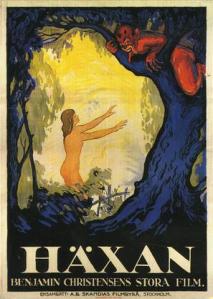
Häxan is often considered a horror film.  Produced by Benjamin Christensen, it was released in 1922, the same year as Nosferatu, eine Symphonie des Grauens.  Both are silent films and the term “horror movie” didn’t exist that early.  Framed as a documentary of sorts, Häxan deals with witches, or more precisely, with ideas about witches.  Taking a remarkably modern view, it presents how the church led to the persecution of women during the witch hunts.  It had been on my “to see” list for many years before I realized it is now in the public domain and is rather easily found on YouTube for free.  It presents reenactments that are still difficult to watch, although silent films have a difficult time scaring viewers used to CGI verging on virtual reality.

Banned in the United States upon its initial release, the movie dares address that sacred ruminant, the foibles of the church.  Christensen was largely correct in placing the blame for harm inflicted on thousands of innocent people—mostly women—on the zeal of a masculine church.  The prolonged dramatization of the destruction of an entire family based on forced confession and trickery, often by well-fed monks, makes the point clearly.  While modern explanations have recourse to the psychological motivations, often unknown to those whose worldview was ecclesiastical, we still haven’t relinquished the misogyny of the Middle Ages.  Considering that Häxan is nearly a century old itself, there’s cause for embarrassment in a world largely run by technology.  We still tend to ban that which causes us ridicule.  

When tragedies occur, it’s only too natural to blame someone or something for it.  Why the burden of that blame was laid on women by a male hierarchy is sadly only too easy to guess.  Häxan is one of those examples of the way horror can cross over between fact and fiction.  Today it can’t be taken as a documentary with any kind of seriousness, but it maintains an atmosphere of dread that finds it classified as horror before the genre itself began.  Movies about witches continue in the genre up to the present, and most are quite aware of the male culpability behind this particular variety of “monster.”  To test if witch trials continue all we need to do is watch how men in power continue to behave toward women.  It’s almost enough to make us believe hexes are real.


Good Ground

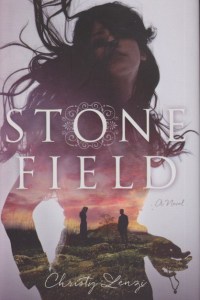
Young adult literature gives me hope.  The quality, speaking for a guy who grew up in a small town with limited choices, has improved astronomically over the past several years.  One of my favorite (adult) novels is Wuthering Heights, and so it’s no surprise that I found Christy Lenzi’s debut novel Stone Field quite engaging.  Set in a different time and place, and with a younger readership in mind, it retells the story of forbidden love based on xenophobia.  The message has never been more relevant.  Although it avoids explicit language, it does include adult situations and features a strong female protagonist in an age of explicit gender inequality.  During the chaos leading up to the Civil War, star-crossed lovers are set against one another because prejudice is a most effective poison.

While not a religious story, the iconic Bible plays a large role in it.  One of the main characters is a preacher, but even without him Catrina Dickinson’s family and friends are ready to quote the Good Book as unquestioningly as a Republican (with my apologies to fiscally conservative friends untainted by this aberration).  This is beyond a realistic portrayal of American life of the 1860s, it reflects the way that many people continue to think of Scripture.  Nevertheless, in one crucial episode of the story set in the church at Roubidoux, Missouri, the iconic role of the Bible becomes clear.  It is deftly woven throughout the story in a way that might serve as a lesson for modern writers seeking verisimilitude.  Many authors fear to address religion, but the Good Book is alive and well in these post-frontier days.

Often the desire to avoid religious motivations leads to stories that lack a key element of the social fabric.  In my own attempts at fiction religion is seldom absent.  It is the way average people live.  Lenzi presents Cat as being aware of but unwilling to be cowed by the Bible.  Indeed, as the story unfolds with several tragic events (remember, Wuthering Heights) she demonstrates that Catrina knows but doesn’t accept the strictures of Scripture.  The issue of theodicy hangs heavily in the atmosphere of the novel.  To me, this makes stories appear more life-like than tales that simply suppose religion doesn’t impact people.  When tragedy strikes, many people question what God, or their stand-in for the divine, is doing.  Anyone who’s asked “why me?” has directed that question into the world of theodicy, whether intentionally or not.  Reading this story while going through a family illness may have drawn this to the surface, but it underscores just how effective it may be for a realism that is otherwise lacking, whether in fact or young adult fiction.


Ghostly Thoughts

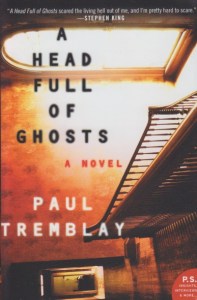
Ghosts tend to be on my mind in the autumn.  Paul Tremblay’s A Head Full of Ghosts, however, has been on my reading list for quite some time.  As a novel about possession, it has some scary moments, but it’s difficult to compete against The Exorcist in that regard.  Tremblay handles the topic with an ambiguity worthy of Shirley Jackson, however, and there are a few clear nods to her work here.  At the risk of giving out spoilers (you have been warned!) although it’s pretty clear by the end that much of the demonic was a cry for attention, the family member behind the tragedy is clearly left obscure.  We find out whodunit, but we’re left unsure as to the real reason behind it.

For fear of giving away too much (although my Goodreads assessment might be guilty of this), I’d like to consider something that I address in Nightmares with the Bible.  Demonic possession is largely coded as a feminine phenomenon.  The reasons for this are likely complex, but they are clearly related to the idea behind witch hunts and fear of women’s power in “a man’s world.”  Possession narratives, while they predated William Peter Blatty, became an essential part of the revived interest in demons brought on by The Exorcist.  Tremblay’s story is clearly aware of this, as he has his characters citing both fiction and non-fictional treatments of the topic.  Since researching the subject on my own, I’ve been wondering if anyone else has been able to handle it as deftly as Blatty did, and although Tremblay has two girls under threat, the question of whether it’s real or not tends to outweigh the pathos of believing Marjorie really has a demon.

In the end, it seems as if her father might be the real source of the family’s haunting.  An unemployed man looking for a way to support his family, he turns to religion.  This scenario is all-too-real to life.  And religion gives us not only a rationale for demons, but also a solution in the form of procedures and proper responses.  There are priests here—the males who alone can deliver the females—but whereas Blatty clearly made them the target of a demon that was pretty obviously real, Tremblay doesn’t play that card.  The priests come and go, and deliverance takes a form not expected for such a narrative.  A Head Full of Ghosts raises lots of questions and, like all good fiction, leaves us pondering at the end.  There’s still time to read it this coming fall.


Trees and Cities

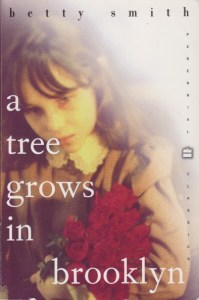
Some years ago I decided I’d read A Tree Grows in Brooklyn.  I had no idea what it was about, but I’d heard cultural references to it over the years.  So I decided to read it.  Then I saw how thick it was.  I confess I shouldn’t do this, but when I sign up for reading challenges, I want to make sure I can finish them.  Books tipping the scales at over 400 pages make me nervous.  Although I work with books, I’m a slow reader, and I panicked when I saw the size of Betty Smith’s ouvre.  All of which is to say that I’ve finally done it.  I’m glad I did, although, as someone who grew up in quite humble circumstances, with an alcoholic father, some of the story hit pretty close to home.

What really stood out, however, was how women and girls were treated in the early part of the last century.  They couldn’t vote.  Full-time work was often difficult for them to find, and when they did it didn’t pay well.  Francie Nolan, however, overcomes this because she’s smart, driven, and literate.  Her reading ultimately rescues her family after her father dies prematurely.  I’m certain there are other messages in this novel.  Other lessons to be learned.  Reading is nevertheless a great takeaway from any book.  As a symbol of its time, Francie learns to read from the Bible and Shakespeare.  These days that combination can get you into trouble.

Perhaps the most disturbing part of the book, for someone who writes instinctively, is that Francie gives up her writing in a deal with God.  When her mother goes into labor and Francie fears she’ll die, she makes a bargain that, strangely, she doesn’t seem to regret too much at the end of the story.  Some of us find writing as natural as breathing or eating.  I can forget to do both when I’m thoroughly into the zone.  I can’t image having that taken from me.  Smith notes that as she reflects on her unholy deal with the Holy One, that she now better understands God.  Indeed, in a kind of Kierkegaardian moment about halfway through she declares she no longer believes in God at all.  Her teacher doesn’t understand her writing.  Ah, but that’s a familiar dilemma to those of us who dare to attempt this craft.  For its size, the book was a fairly smooth read.  It took several weeks, but I learned about myself as a writer, and that makes it worth it.


Mother of Stone

One thing we all have in common is mothers.  Whether it’s the mysteries of biology or something more spiritual than that, the connection lasts forever.  The thought occurred to me yesterday as we visited Columcille, one of those places that reflects a vision for a piece of land that transforms the ordinary into sacred.  Columcille Megalith Park is inspired by the standing stones of Celtic lands.  Open to the public for a suggested donation, the park consists of a stone circle and several menhirs (megaliths) arranged along paths through the woods.  Recognized by the Nature Conservancy as a sacred space and outdoor sanctuary, it draws thousands of visitors of all faiths with both recreational and religious rationales.  Throughout the park we found evidence of spiritual interaction with nature left on or near the stones.  But what has this to do with mothers?

One of the areas in the park is the Sacred Women’s Site.  As we lingered there yesterday, I reflected on the sacred nature of all women, and mothers.  That’s not to suggest that motherhood is for all women, but rather that our society has been slow to catch up with the idea that women show us the way.  Men have “had charge” for millennia now and look at where we are; cooperative ventures and peacekeeping efforts crumble as world leaders encourage the resurgence of exceptionalism.  We’d rather have an inveterate liar lead the nation than a politically able woman.  Britain wants to pick up its marbles and let the European Union disintegrate.  We seem to have forgotten that just a century ago a world war ended.  We need sacred spaces like Columcille.  We need to remember the sacred women.

One takeaway from our brief visit was that although there was also a grove for sacred men, that of the women was more peaceful.  The idea of standing stones making a site sacred goes back at least to the Bible.  Stone circles are found from ancient Israel to the far-flung Orkney Islands of Scotland.  Standing among them, whether modern like Columcille or ancient like the Ring of Brodgar, or yes, the more famous Stonehenge, there is a sense of sacred purpose.  Miles from Stonehenge stands Avebury, a town built around another stone circle.  There the megaliths were divided between female and male stones, with both required to make the ring complete.  Such places require a tremendous amount of work.  When they’re constructed, however, they give us places to think of mothers and the mystery of life.


Writing Life

Writers are a conservative lot, in many respects.  Consider the epigraph.  I’ve written about this before—in modern-day publishing epigraphs require permission to reuse and serve little purpose beyond two negotiable factors: to prove the writer is well-read, and that someone else just summed up your chapter in a single sentence.  Most modern books have stopped using epigraphs, but scholars read old books produced before aggressive copyright laws.  There is a trick you can use, however, that brings an epigraph into the realm of the fair use doctrine.  It involves moving it into the body of your chapter.  Make it a quote.  Comment upon it.  For all their research skills, many academics do not take advantage of easily found advice on academic publishing.  Just ask an editor.

We all, I’m sure, have tunnel-vision.  Life is so incredibly busy and demanding that choices have to be made.  For most academics publishing is part of the rubric for tenure.  Perishing is the only other option.  Been there.  Done that.  Those of us who make a more modest living on the other side of the book sometimes write for different reasons.  We may need to supplement our income (as if academic publishing really ever helps with that!), and thus we must pay attention to the finer details of the business.  Write what people want to read.  Think like a reader.  And, yes, get rid of the epigraphs.  We know you’re smart; you’ve written a book.  Another reason for writing beyond the tenure-dome is the compulsion.  The need to do it.

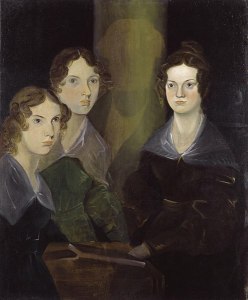
While the struggling artist is a tired trope, it’s also true.  Many of the writers most admired today had lifetimes of struggle and obstacles which often stopped them too soon in life’s tracks.  I often think of the Brontë sisters.  In a family apparently cursed with premature death, living in a time when women writers were rare, three sisters set themselves the task of becoming novelists.  Not one of them lived to forty.  Anne, who wrote The Tenant of Wildfell Hall, made it to twenty-nine.  Emily, author of Wuthering Heights, died at thirty.  Charlotte, who gave the world Jane Eyre, survived to thirty-nine.  They defined, in many ways, the English novel.  And while they lived to see some measure of success in their brief lives, they wrote against the obstacles of life and the specter of early death.  Writing is a passion.  A craft.  And even academic authors provide a favor to the world if they do it well.

Brontë sisters by brother Branwell


No Refuge

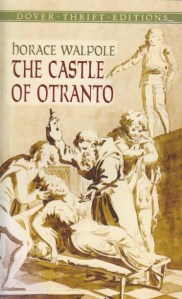
A convention in histories of the horror genre is to trace it to Gothic fiction.  Gothic fiction itself is traced to The Castle of Otranto, by Horace Walpole.  Having grown up reading Gothic stories along with religious texts, perhaps surprisingly I never came upon Walpole’s oeuvre.  Some weeks back I happened on a used bookstore, which, by convention, had its cheapest fare on sidewalk carts.  I was surprised to see a negligibly priced copy of The Castle of Otranto, which I took in to the counter.  The clerk looked puzzled a moment, then asked if it was from the carts.  “Oh,” he sniffed, “that explains it.  We don’t carry Dover editions; they’re too cheap.”  Perhaps that remark haunted me a bit, but I finally got around to reading the slim book and it left a kind of unanticipated horror in my mind.

Okay, so this was written in the eighteenth century, and set further back, in Medieval times.  A spooky castle, knights and knaves, and fainting damsels all populate its pages.  Religion, particularly in debased form, became a standard characteristic of the Gothic.  Here a monk, an erstwhile lord, holds a secret that leads to the downfall of a house of pretenders who have claimed ownership of the castle.  All pretty straightforward.  Even the ghosts and talking skeletons fail to raise fear.  One aspect, however, does hold horror.  The three princesses in the story are completely at the whim of the men.  They acknowledge as much and claim it against piety to declare any different.

It would be unfair to assert that such sexism was intentional—like most human behaviors it evolved over eons—but in this era to read it is to shudder.  We have moved beyond the horror fiction that men own women and that they have any right to determine their fate.  Especially in these days, it’s embarrassing to be reminded that such was ever the case.  Despite the word from on high we cannot hide from history.  The domination of men has been a testament to how poorly civilization has been run.  Some of its benefits can’t be denied, but on a whole we see a succession of aggression and wars, suffering and poverty, generally brought on my societies that have taken their cues from patriarchical ideals.  My reading of The Castle of Otranto brought this back with a force not unlike that of the giant ghost haunting its walls.  Is it too much to hope that some two-and-a-half centuries might show some evidence of progress?


Checkmate

March has been designated as Women’s History Month.  Since history has been written, well, historically by males, women have frequently been excluded.  History as a serious attempt to describe “what actually happened” is a fairly recent phenomenon.  Yes, men (mostly) have been writing their views of what events meant from the days of the Bible and the Classics on.  A few females had made their way into the narratives, but reading history often makes it seem like males were the only people of consequence.  I was thinking about this the other day after I read a reference to the Red Queen in Lewis Carroll.  Chess, I realized, is a game with a message.  Now I don’t often have time for games, but this felt important.

I’m not a good chess player, but I know that if you lose your queen you’ve got to be far better than I am at it to win the game.  In fact, the queen is the most powerful piece on the board.  Now if you plan to come back with something like “using the bishop, knight, and rook you can surpass the power of the queen” it suggests two things.  One, you’re better than me at chess, and two, you’re missing the point.  The queen can move in both perpendicular and diagonal lines.  She can land on either color.  The range of her motion is limited only by the size of the board.  The bishop is limited to one color square only and the rook takes two moves to equal the queen’s diagonal skills.  

Think about the king—he moves one space at a time, and mostly only to avoid capture.  The queen is out there defending the realm.  Even as a kid learning to play chess, it was obvious that the queen did far more than a bishop limited to his ecclesiastical domain, or the rook with his brute force.  The knight makes a move the queen cannot, but his range in limited.  If a player retained only a queen the opponent’s king could still be captured, in my mind.  Chess should be a queen’s game.  

History is a way of looking at things.  Although it involves facts—and this is where the government narrative goes off the rails; the denial of facts is an autocrat’s game—it’s not the same as facts.  History is an interpretation of facts.  The fact is that male history of the world just could not have been possible without women.  It’s time not just to acknowledge it, but to celebrate it.


Terror Text

Dystopia reading and/or watching may be more practical than it seems.  History often reveals authors who may be accused of pessimism more as prophets than mere anxious antagonists.  Two books, according to the media, took off after November 2016.  One was George Orwell’s 1984,  and the other was Margaret Atwood’s The Handmaid’s Tale.  I’d read both long before I started this blog, but I recently asked my wife if she’d be interested in seeing the movie of the latter.  While teaching at Rutgers, I had a 4-hour intensive course and to give students a break from my lecturing I’d have us discuss Bible scenes from secular movies.  The Handmaid’s Tale was one of them.  Watching it again last night, I realized the problematic nature of Holy Writ.

The Handmaid’s Tale is a movie (and novel) that involves what I call “Bible abuse” in Holy Horror.  That is to say, the Bible can be used to oppress rather than to liberate.  To cause human suffering instead of eliminating it.  Sure, to make Atwood’s dystopia work a future catastrophe of fertility has to occur, but the military state, the assumed superiority, and the will to control on the part of men are all too real.  We’ve witnessed this in the United States government over the past two years.  A lot more has been revealed than personal greed—that side of human nature that quotes the Good Book while doing the bad thing.  In the movie it’s literally so, while our “leaders” are only a metaphoric step away from it.  Although it’s not horror, it’s a terrifying movie.  I still have trouble watching The Stepford Wives.  Why is equality so easy in the abstract, but so difficult when it comes to actual life?

Aggression is not a social value.  This is perhaps the most ironic aspect of using Scripture to enforce oppressive regimes.  The whole point of the New Testament is self-denial for the sake of others.  That may be why the only Bible reading in the movie comes from the Hebrew Bible, the story of Jacob and Rachel.  Although this isn’t one of the traditional “texts of terror,” to borrow Phyllis Trible’s phrase, it nevertheless illustrates the point well.  A culture that values women only for their reproductive capacities is dystopian to its very core.  When a book, no matter how holy, is divorced from its context it becomes a deadly weapon of blunt force.  Atwood moves beyond Orwell here—the government that sees itself as biblical can be far more insidious that one that only weighs evil on the secular scale.  Not only the Bible ends up being abused.