Origin of Dragons

The ancient Greeks often take the credit for concepts they borrowed from the Ancient Near East. When casting about for the origin of dragons, a staple, if unstable, element of ancient Semitic myths, the credit often lands in ancient Hellas. Those of us influenced by western culture prefer the Greek versions of myths because they tend to be (mostly) coherent and do not have large gaps like those scrawled on fragmented clay tablets. Also, the word “dragon” traces it etymology to ancient Greece where it apparently derives from the verb drakein, “to see clearly.” Often commentators suggest that the rationale for the name is that dragons guard treasure and need to see clearly to do so.
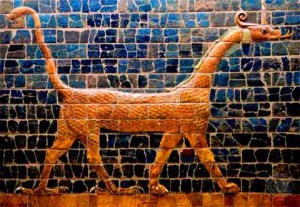
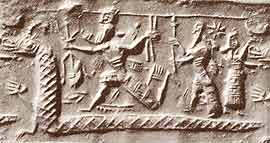
Babylonian dragon

Babylonian dragon

Dragons, however, actually first appeared, like so many western civilizations concepts, in Sumer. In the ancient world, what we would recognize as dragons are always associated with water. Water is an uncreated element, existing as the primordial substance from which everything emerges. It is personified as a dragon that must be subdued for creation to take place. Images of the dragon from somewhat later time periods in Mesopotamia already depict the familiar form we still recognize as draconian.
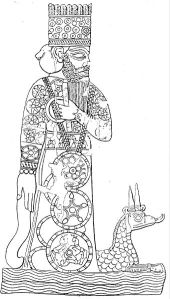
Marduk astride Tiamat

Marduk astride Tiamat

The Bible has its share of dragons as well, although they never actually existed. Tannin, whose name probably relates to serpentine features, is regularly cited as a biblical dragon. Leviathan, as described in Job 41, has scaly skin, lives in the water, and belches fire (perhaps having taken lessons from televangelists). These characteristics probably played into modern conceptualizations of the dragon. Fire breathing, however, is first attested with Humbaba, the Cedar Forest guardian of the Gilgamesh Epic. Humbaba is not a dragon, but he may be the ancestor of our fire-breathing Leviathan. Some ancient iconography may also show fire projecting from the mouths of dragons as well.
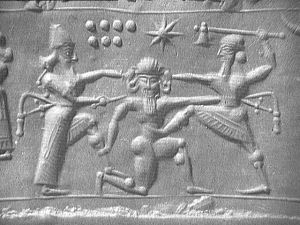
Humbaba (center) on a bad day
Humbaba (center) on a bad day

Traditional Mesopotamian dragon

Traditional Mesopotamian dragon

I would even venture to suggest that the origin of the name dragon could go back to ancient West Asia. The idea of seeing clearly reminds me of the ancient cherubim. According to Ezekiel, they are full of eyes. This complements their role as guardians of the thrones of ancient deities. Cherubim are Mischwesen composed of lions, eagles, humans, bulls, or any other spare parts lying around. In my imagination it doesn’t take much to shape them into dragons, the original watchers.
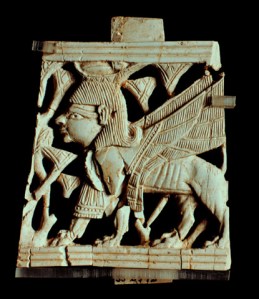
A true cherub

A true cherub

No matter who coined the word, dragons have been with us from the beginning of human civilization and continue to live on in popular culture. Maybe they are, like the unruly waters, truly uncreated.

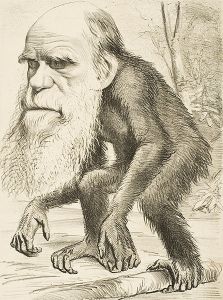
Noah’s Lark

This podcast deals with the myth of the great flood. It begins with a consideration of why modern expeditions do not find anything (nothing to be found), and considers the reasons the story is so appealing to present-day readers. The Sun Pictures productions on the flood story are reviewed, along with the story of the hoax played on Sun in their 1992 made-for-television movie. The history of the flood story is briefly narrated, beginning with George Smith’s 1872 discovery of the Mesopotamian flood story, back to Atrahasis and the Eridu Genesis from Sumer. The flood story is one of the earliest religious stories known.


Science Me This

I’ve just finished going over the creation and flood myths in Genesis 1–11 with my students. By my reckoning, this is about the twentieth time I’ve taken this journey. One comfort of walking a well-known trail is you know what to expect. The fact that always sticks in my mind is how good of a job the Creationists have done. In every setting where I have taught I have many students who unquestioningly accept that Genesis 1–11 was written as science by some kind of Mosaic mosaic of scientist, law-giver, and prophet, a regular Bronze Age Renaissance man. Since biblical scholars do not communicate well with the public (nor do they play nicely with each other), most students come into class wondering why the Creationist viewpoint is even under question.

I want to suggest something radical here: in our culture where science, technology, and finance are highly valued, we neglect to educate our kids in the basics of literary study. Schools push the technological envelope, and this is not a bad thing, but the kids come home and are shuffled off to church where the Bible is revered and a basic disconnect forms in their minds. A compartmentalized Bible, factually true, resides in one region of the cortex while in another scientific theory lurks. And when fact clashes with theory, fact always wins. They know they have to tell biology teachers that they understand evolution, they simply don’t believe it. They come to collegiate religion classes expecting Sunday School part 2.

Just this summer a grown man, Randall Price, director of Liberty Uni-, Univ-, University’s (sorry, I always choke on that one) Center for Judaic Studies once again made the weary trek to Mount Ararat to find Noah’s Ark. If he’d read Atrahasis or even Gilgamesh, he might have known he was looking in the wrong place. Nevertheless, he received coverage from a major news network (FOX, of course!), and those who never studied ancient mythology cheered him on. If we could teach children that the Bible is a literary document, teach them that it can be studied seriously, and that the Big Bang and “let there be light” are not the same thing, we might make some progress. Until then, we will have to contend with silly cartoons trumping hard-earned education.

Jack Chick has more publications than any Bible scholar

Jack Chick has more publications than any Bible scholar


Clergy Letter Project

A few years back I had the privilege of working at the same university as Dr. Michael Zimmerman, currently a biology professor at Butler University in Indianapolis. In my temporary stint as a Lecturer in the Religious Studies department at the University of Wisconsin Oshkosh, I discovered that Dr. Zimmerman, then the Dean of the College of Letters and Science, was the very man responsible for the Clergy Letter Project. I had read about the project before; in an attempt to demonstrate that Creationism is not mainstream Christianity (nor science, for that matter), the Clergy Letter Project was attempting to acquire a few thousand signatures from the ordained of various denominations who were willing to admit that evolution posed no threat to their religion.

As an occupational hazard of someone with my background, I know many, many clergy. I offered to solicit some help in reaching the goal on the list and spent the rest of the semester contacting various sacerdotal practitioners who rightfully saw the Creationist ploy for what it was and continues to be. Creationism is nothing short of an attempt to break through the church and state separation clause and attain federal support for a particular religious viewpoint. That particular viewpoint is not shared by the majority of informed Christians, but the population is easily swayed by Creationist rhetoric. Creationists do not deserve sympathy, for they are much more aggressive than they pretend to be. Subterfuge in the cause of truth is a contradiction in ethics.

Religion may be hardwired into human brains, but it need not seek to pick fights with factual truth as it is learned. At each stage along the progression of human achievement, various religious believers have felt that the new knowledge discovered confronted their faith with unsurpassable barriers. Faith, however, is a belief system, not a factual construct. If faith requires proof, as even the Bible itself says, it is not really faith at all. If you know any clergy who are willing to sign on for common sense and belief in the rational world in which we find ourselves, please send them this link and ask them to weigh in on the question. Nearly 12,000 clergy have signed to date. There are even separate lists for Rabbinical and Unitarian-Universalist clergy. Don’t worry about the Creationists. They will always be back for more.

An early Creationist attempt at intelligent design

An early Creationist attempt at intelligent design


Fundamentalist Foibles

Podcast 11 deals with the phenomenon of Fundamentalism, particularly biblical Fundamentalism, and its history. The podcast begins by setting the historical parameters, in the early part of the twentieth century, and considers some of the reasons that the movement may have begun. German biblical criticism, Darwin’s theory, and the First World War among them. A brief sketch of the movement is then offered, starting with the Niagara Bible Conference and the publication of The Fundamentals. The basic tenets of the belief system are summarized, again with suggestions as to why this may have been the case. A cautionary conclusion ends the presentation.


The Original Mud-bloods

“Let Nintu mix clay with his flesh and blood.
Let that same god and man be thoroughly mixed in the clay.”

This quote is from the myth of Atrahasis (Benjamin Foster’s translation; my Akkadian’s a bit shaky these days), an early version of the flood story. Although I have a burning itch to write about the flood, I would rather focus on the creation of humanity in this post. Maybe it is because in my unemployed mode it is easy to think of myself as only dirt and blood, but maybe it is because in my evening class we’ve just been talking about creation stories.

One of the benefits of polytheism is the lack of a pressing need to ascribe uniformity to your myths. Ancient peoples who believed in a multiplicity of gods had a wide variety of versions about how the world was created, where people came from, who sent the flood, and so forth. They were not writing about what actually, factually happened — these were myths, for the gods’ sake! Nobody was there to see the creation of humanity, so who’s to say what really happened? One element that is repeated in ancient accounts, however, is the creation of people from dirt.

Perhaps it is because people often treat each other like dirt, frequently with religious motivation, but a more likely explanation is that in ancient times the dead were known to return to soil after they were buried. Logic dictates that if the dead turn to dirt, their living version must have been created from dirt. So far, so good. But dirt isn’t exactly alive. The ancients differed on what animated this soil with a soul.

The Bible presents a lofty account of God breathing air into the soil-man. It is clear that the Hebrew Bible equates breathing to being alive. A person is alive when they first breathe; when they stop breathing, they die. At the same time, blood is an essential component too. This is so much the case that the Bible dictates that “the blood is the life” (Deuteronomy 12.23). For this idea the Israelites were indebted to the Mesopotamians. As seen in the Atrahasis Epic, humans are a mix of clay and the blood of the gods, the original mud-bloods. For all their differing opinions, the ancients realized that in this messy world of dirt and dread, human beings, for all their problems, had a bit of the gods within their very veins.


Intelligently Deceived

One of the most difficult things about the life of the academic gypsy is having tons of books. Literally tons. Having been cast from institution to institution in search of that mythical full-time teaching post, we’ve put books in storage and sometimes even forgotten that we’ve had them. So it was that when I was looking for a copy of Great Expectations for my daughter’s English class assignment, I was in the dusky attic, hoping the upstairs neighbors didn’t burst in on me, up to my armpits in boxes of books, that I rediscovered a treasure. Taking a leaf from Dr. Jim’s Thinking Shop, I decided I would review a few of the Creationist books I grew up with. Fortunately I had the presence of mind to keep them although I’d long dismissed their facile, often juvenile, point of view. They have provided great entertainment and even some poignant instruction in the ways of manipulating the minds of the young. Fear of Hell is a great motivating factor to a kid who sees ghosts in every corner and finds bats on his pillow!

So, without further ado, I present the top 5 creationist books of my youth. (Those that I purchased as an adult I bought from used bookstores so as not to add any royalties to the fundamentalists’ already bursting coffers.)

Textbook

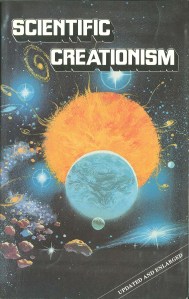
We’ll begin with the textbook. Scientific Creationism makes no pretense, such as the “Intelligent Design” school does, about being non-(necessarily-but-we-all-just-happen-to-be)Christian specific. Here Henry Morris begins with the assertion “the Bible and theistic religion have been effectively banned from [public school] curricula” and offers the present book as a corrective to the situation. A better title for the content, however, might have been Scientific Fiction.

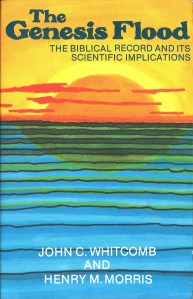
GenFlood

The work that really opened the flood-gates, so to speak, was The Genesis Flood. This craftsterpiece was penned by Henry Morris (again) and his compatriot John Whitcomb. Both proudly proclaiming themselves “doctors” they point out “evidence” designed to confuse the unsavvy into believing that there is a physical way the world could be entirely flooded. They even make room for dinosaurs on the ark, noting that they would have been juveniles of the various species. I’ve been in academics long enough to know that a Ph.D. does not guarantee credibility (or even sanity) on the part of the holder. The fact that Whitcomb’s doctorate is from Grace Theological Seminary ought to speak quite plainly as to its objectivity.

Gish

Written by Duane “the Fish” Gish, Evolution, the Fossils Say No! is an attempt to demonstrate that since not every single phase of the fossil record has been uncovered, the whole theory of evolution is in shambles. Gish, one of the few authentically scientifically credentialed Creationists, should have been able to see that his “back-and-fill” technique was going to fall on hard times as new fossil forms were discovered. As the fossil record grows more complete each year his book becomes more and more outdated.

EvolutionHS

Evolution and the High School Student terrified me in my delicate years. This booklet intimated that when I reached high school the unending assaults of the atheistic non-believers would be unrelenting. I feared for my very soul. Instead, in high school I found nose-picking, pocket-pool playing, and chalk-print-on-the-pants-seat teachers were among the openly committed Christians. Some even kept Bibles on their desks. (This was a public school.) The book lost its teeth.

GooZoo

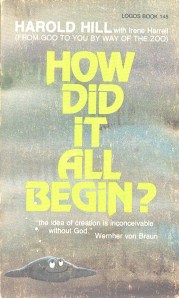
My personal favorite is How Did It All Begin? (or From Goo to You by Way of the Zoo) by Harold Hill (obviously when he was not out swindling River City, Iowa folk of their hard-earned cash to start a bogus boy’s band). This booklet, complete with cute, cartoon drawings, convinces grade-schoolers that evolution answers no questions at all. He had me going as a kid, until I got to the part where he claimed scientists had invented a machine that could indicate if you were “saved” or not. Even as a gullible child I couldn’t buy that.

The efforts of the Creationists are tireless. Even this brief survey of books that I happened to chance upon is nowhere near a comprehensive survey of what is out there. What it does serve to demonstrate is that all reasonable people should be wary. After all, even Jesus knew that a person in the wrong, if persistent enough, could convert even a hard-hearted judge.


Bible Land

Once upon a time I took a trip to visit a friend in West Virginia. I made the drive from New Jersey across parts of Pennsylvania and Maryland. Having grown up in Pennsylvania I never supposed it to be considered part of the “Bible Belt,” but it seems that some of the spillover may be making its way north of the Mason-Dixon line.

Interstate 78 has recently struck me as being highly evangelized. I saw a billboard reading “Blessed is the nation whose God is the Lord” and remarked at how out of context this verse was taken. Last time I checked, the Bible tended to be concerned with Israel, not the United States. Further along I saw a church near Bethel, PA called the Assembly of Yahweh. Not being aware that there was confusion as to who the God of the Israelites was, it amazed me to see that they have their own radio station called “The voice of the Assembly of Yahweh.” This struck me as a missed opportunity; the real message could have come through more clearly with “of the Assembly” left out. Yet further along was an ominous billboard from a local Mennonite Church that sounded eerily like Amos. “You Will Meet God” it announced.

Storm's a-comin'

Storm's a-comin'

As I entered Maryland the sales tactics intensified. In Frostburg there was God’s Ark of Safety Church where an actual replica of Noah’s Ark is being built right along Interstate 70/68. Since the steel frame is all that was currently finished, I was glad that it hadn’t recently been raining. Perhaps a more recent translation of the Bible has updated gopher wood to Bethel steel. Further along I spotted a lighthouse atop a hill over a hundred miles from the nearest substantial body of water. This was the World Lighthouse Worship Center. While visiting an actual lighthouse on Lake Superior a few years back the docent informed me that lighthouses were now considered superfluous with the advent of Global Positioning Systems. (Shhh — please don’t inform them that science has again trumped a quaint piece of folklore! I can imagine that the lighthouse may be useful when the new ark is completed.) Along route 219 in McHenry, MD I saw “A House of Love Gathering Place” that I just couldn’t dissociate from the B-52’s for some reason. Just about on the border to West Virginia was the Fresh Fire Church of God.

The United States is truly an impressive reservoir of biblicism. Perhaps university administrators who believe the study of religion isn’t worth the meager salary of an assistant professor should take a road trip. It would be a learning experience.


Biblical Black Lagoon

During my summer-term courses I feel it is only fair to break the lecture time up a bit. Rutgers summer courses can run four hours at a stretch, and no matter how valiant the student, no one can pay attention to me for that long. I have long had an interest in the Bible in popular media, so for each class session I show a brief clip of a movie that features the Bible, often in a pivotal role. We then discuss how it is presented. As a personal pork barrel I give the students a multiple choice question on their exams as to which movies we have watched (it also gives them incentive to be in class, I hope). One summer, after sending the exam off to the print office, I realized I’d made a mistake. As usual, my interest in 1950s sci-fi flicks led to trouble. One film I hadn’t shown a clip from, and which I thought was Bible free (I hadn’t seen it in a long time) was The Creature from the Black Lagoon, a perennial favorite for both camp and kitsch.

Of course, The Creature from the Black Lagoon does have the Bible in it. The movie begins with a narrator reading Genesis 1.1. Well, I had to give all the students credit for that question, because there was no wrong answer. Nevertheless, the easy association between beginning the film with the Bible and its evolutionary plot-starter seemed worthy of comment. Back in the 1950s evolution was already a hot-button issue (so I’ve read). Forces lined up on the scientific and biblical fronts faced off like angry hockey players as they swung at that hard black puck of the truth. It does seem odd in a country so heavily reliant on science that the foundation of biology and its benefits (if scientists hadn’t recognized and reacted to the swift evolution among microbes I’d likely not be here typing this sentence) that one particular interpretation of a very small section of the Bible should have the power that it does. I’ve seen carnivorous, chrome-plated bumper Jesus fish eating the peacefully walking Darwin fish! Old metaphorical Moses would be scratching his head, I’m sure.

The Creature was, of course, also a metaphor (if I’m not shoveling out too much credit where it isn’t really due). The sequels to the original film grew progressively worse, but those who have the patience to sit through The Creature Walks Among Us discover that the gill-man is a man after all, under all that green rubber. The beast is us. Not too weighty of a revelation to be sure, but it isn’t too weighty a movie. Like any discriminating Bible reader I choose what to accept and what to explain away. When I watch The Creature from the Black Lagoon, it ruins the story for me to think ahead to the denouement of the gill-man being a real man. It is a passage I simply choose not to accept. (This is, of course, a metaphor.)

What might this be a metaphor for?

What might this be a metaphor for?


Man and Womandrakes

With the recent release of Harry Potter and the Half-Blood Prince in theaters, young minds (or at least juvenile ones!) turn once again toward things magical. Anthropologists find difficulty in distinguishing between magic and religion, and many kids have been introduced to religious themes through this series of books and movies. I admit to having read the books and even having seen some of the films, and one of the memorable mythical sub-supporting characters that captured my attention was the mandrake. My first exposure to this herbological wonder was, naturally, the Bible. (Well, after Mandrake the Magician, of course.)

The tale of Reuben’s mandrakes in Genesis 30 shows a hint of that old white magic. Rachel bargains sex for mandrakes and the next time she is mentioned she becomes pregnant. Mandrake roots are often claimed to have anthropomorphic qualities – just how anthropomorphic depends on the imagination and how many the viewer has ingested. In the Middle Ages, the roots were classified as mandrake and womandrake!

Womandrake and Mandrake from a 12th-century manuscript

Womandrake and Mandrake from a 12th-century manuscript

Even in ancient times they were revered as aphrodisiacs. The Bible has plenty of these quasi-magical moments, often explained away as “folk beliefs” by literalists with a nervous laugh. To me they are part of the charm of a Bible unashamed of its roots.

The mandrake (mandragora officinarum) is a Mediterranean plant that had medicinal, and likely “religious” usages in the ancient world. A natural narcotic, the plant is poisonous in sufficient dosages, and it was used as an ancient kind of anesthetic, having been available long before whiskey. When a mandrake was uprooted, its humanesque tuber was thought to emit such a horrendous cry so as to drop the uprooter dead. Dogs were therefore tied to mandrake roots and prodded or urged to run, extracting the plant and dying in the process. Before calling the good folks at PETA, please note that no dogs were harmed in the writing of this post! Although this legend has a distinctly medieval bouquet, it is a method of mandrake hunting actually cited as long ago as Josephus. The mandrake has long arrested the human imagination. From Rachel to Pomona Sprout, the mandrake has not lost its potency for mystical mischief.
"Man"drake, 'nuff said (from Sibthorpe's Flora Graeca, 1808)