Patriarchal Goddesses

My fascination with goddesses began when I decided to research Asherah. Having grown up in a monotheistic milieu, goddesses were strangely, but not surprisingly, irrelevant. I had, of course, read about them in mythology classes, but they seemed less defined than the gods who had strong, striking characteristics. Now that I’m revisiting many classical goddesses in the course of preparing my class on Mythology, I’m discovering a renewed appreciation for the feminine divine and its contribution to the ancient world.
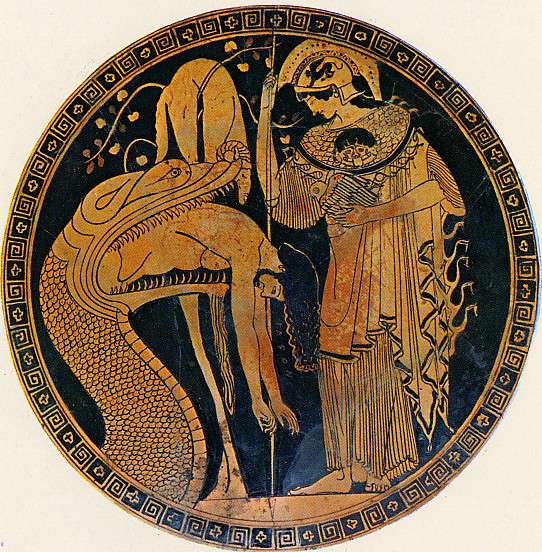
Athena saves a hero

Athena and Artemis have been on my mind for the past several weeks. Among the Olympian deities they are among the strongest female figures (Aphrodite, of course, provides her own feminine form of power, and Hera, although mighty, remains largely in the background). Perhaps what creates such a striking form for Athena and Artemis is that they blend the traditional masculine and feminine roles in a way that the ancient Greeks were prescient to devise – they both possess weaponry and strength that frequently brings mortal men to their demise. They don’t wile with “feminine charms” like Aphrodite; instead they meet men on their own tuft – hunting and warfare, bravery and muscle. They are virgins, not needing male approval. Together they form the basis of many ancient aspects of divine nobility.
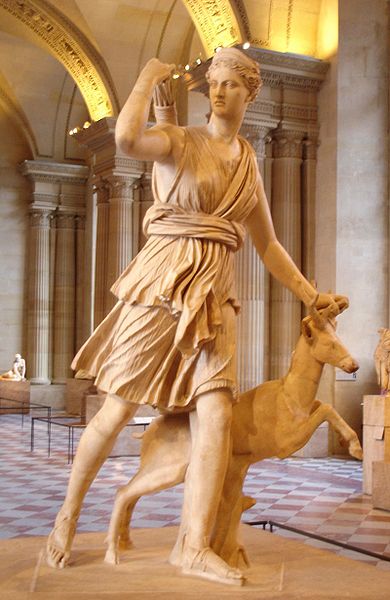
Artemis and her man-dog

Today, however, when we think of Olympians Zeus and Poseidon come to mind almost immediately as the two major figures. No one disputes the unstoppable power of Zeus’ thunderbolt or Poseidon’s earthquake. The goddesses, however, display their power on the human level. They may set the fortunes of armies going to war or individuals out for personal glory or fame. They touch the characters on a more human level. They also have their counterparts, unfortunately often eclipsed, in the world of the ancient Near East. Astarte is still poorly understood, and Anat, although more fully fleshed out at Ugarit, largely remains an enigma. The importance of Athena and Artemis thus stands out in sharper relief for having survived the overly acquisitive masculine ego to remind people everywhere that goddesses also will have their due. Given enough time, perhaps even the gods will understand.
Asherah to Asherah

Every great once-in-a-while I regret no longer being in a position to conduct active research and publication. In the days when a full-time teaching position afforded me that option one of my favorite subjects was the exposure of facile arguments made by otherwise careful scholars. Most of those arguments focused on the presence of Asherah as a fully formed goddess in ancient Israel. Extremely tenuous evidence for the association of the goddess with a variety of ambiguous artifacts has polluted the discussion for decades now. Any vaguely abstract image suggesting a female was declared an “Asherah” representation, sometimes even images as simple as a triangle or a mother cow.

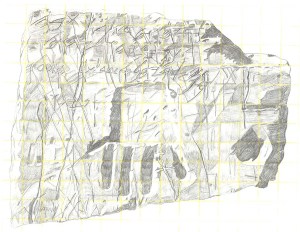
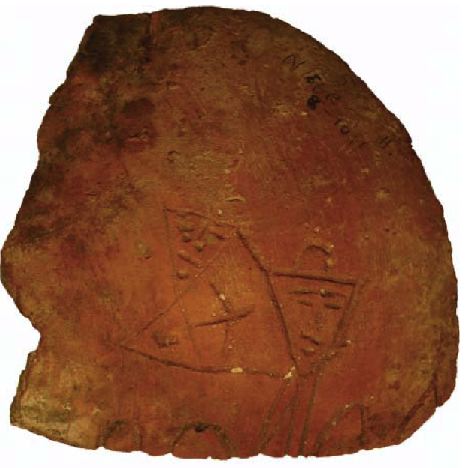
A colleague of mine just pointed out the recent article by Garth Gilmour in Palestine Exploration Quarterly 141 (2009), entitled “An Iron Age II Pictorial Inscription from Jerusalem Illustrating Yahweh and Asherah.” Having more than a passing acquaintance with the goddess, I read his article with considerable interest. A potsherd discovered in the 1920s, but unpublished until now, bears an incised “inscription” of two figures that Gilmour plausibly argues to be highly stylized female (left) and male (right). Basing his analysis of possible identities for this Picassoesque pair on the now canonical interpretation of the Kuntillet Ajrud and Khirbet el-Qom inscriptions, he suggests this is none other than the happy couple of Yahweh and Asherah.

Loving spouses or battling foes?

I encourage creativity in scholarship; otherwise it has a way of becoming deadly dull. The supposed pairing of Yahweh and Asherah, however, has been excessively overblown by scholars who should know better. When it comes to the point that escapees from Flatland who bear the suggestion of gender must be Israel’s most famous bachelor and his main squeeze, I have to wonder what the basis of solid scholarship is. There are no words obliquely hinting that this is a divine couple, nor is there a sacred context to suggest this shard was in any way religious. Given the fact that the image had formerly been on a spouted jar, perhaps holding water, would not a suggestion of Marduk and Tiamat be more appropriate?

Rorschach tests aside, this incised image is an important piece of a puzzle with far too many pieces missing – the puzzle of the artistic life of ancient Israelites. Given the all-too-human interest in relationships between women and men, I would see no necessity of making deities out of a pair of prospective lovers or foes. Why can’t people just be people?


A Sigh for Cybele

As we fall out of the holiday season into that distinctly chilly and sometimes cheerless February, Cybele comes to mind. Over the past several weeks I have added posts focused on the holidays associated with December and January. In the course of my research for a children’s book on American holidays (not published), I was astonished at how frequently Cybele appeared among the origins of current holiday practices. Having researched ancient Near Eastern mythology long enough to complete a doctorate in the field, and to write a book on an ancient goddess (Asherah), the lack of reference to Cybele in my sources was unexpected. I pushed this question mark to the back of my mind, but as I was reading H. P. Lovecraft’s story “The Rats in the Walls,” I found Cybele once again.

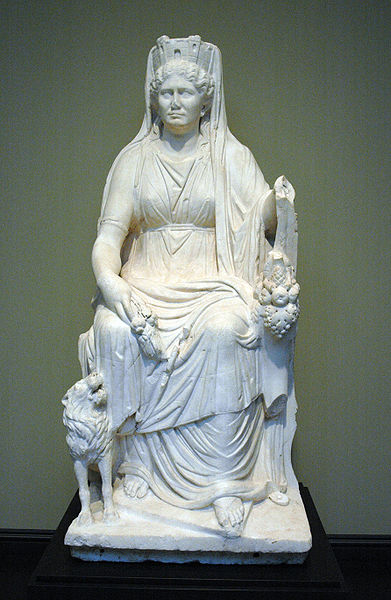
Cybele eventually became a major Roman goddess, although she was never among the Greek Olympians. Her importance shows in her connections with several Roman festivals and practices of antiquity, some of which have survived even to the present. Greco-Roman adherents to Cybele worship considered her to have been of Phrygian origin. Many scholars, however, see in her name and character echoes of a Semitic goddess named after Gebal, or the native name for Byblos in Phoenicia. If so, she is one further piece of the puzzle connecting the classical world with that of the fertile crescent.

Wikipedia Commons Cybele

A standard title for Cybele was Magna Mater, or “great mother.” As such, she was frequently associated with the earth itself, widely considered to have been a primordial female deity in the ancient Near East. In many respects she resembles Asherah, although the two are never explicitly identified. In myths where she is associated with Atys (later Attis), she becomes the spouse of a “dying and rising god.” She is prominent in festivals around mid-March, at the time of the renewal of fertility in the Mediterranean basin. Matronly, stolid, and powerful, Cybele lurks in the background of religious sensibilities. Her association with spring offers something to look forward to as the overly long, yet short, month of February starts to become visible.


Our Mother Who Aren’t in Heaven

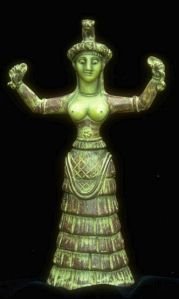
In the course of preparing to teach a course on Classical Mythology, I have been reading up on the Minoan culture of ancient Crete. This fascinating civilization is obviously related to many others in the Ancient Near East, but it has such a distinctive ethos that it always gives me pause. The Minoans had a religion that was apparently dominated by a great mother-goddess. Decades ago astute archaeologists and historians demonstrated that the amorphous “mother goddess” of antiquity was a modern construct rather than an ancient reality, but the evidence still stands that at least the Minoans revered the sacred feminine.

The work of Marija Gimbutas had overstated the case for a matriarchal society in antiquity, but she had touched on a truth sometimes obscured by the patriarchal world of yesteryear — some cultures did venerate the divine mother. Among the cruel ironies of history the name of this goddess has been lost, but images of a secure island with its chthonian female divinities remain. Among the artifacts discovered among the various Philistine sites in the Levant was an inscription, apparently dedicated to Asherah. Asherah is a thoroughly Semitic deity, first appearing in Mesopotamian contexts further to the east. The Philistines, however, likely settled their region after migrating from Crete a few centuries after the collapse of the Minoan culture. Could they have brought with them a remembrance of the divine mother?

I am not convinced by arguments that suggest a polymorphous “mother goddess” reigned in antiquity, as much as I might wish it had been so. What a different world might have emerged if monotheism had been based on a divine mother! Minoan culture appears to have been strong but relatively peaceful. In one of the androcentric twists of history “Cretan” and “Philistine” have come into modern usage as derogatory slurs against good taste and refinement. History demonstrates, however, that apart from foreign biases those hailing from ancient Crete may have developed the superior civilization of antiquity.


Asherah Overcomes

In the constant struggle of humankind against nature, we often find things out of place to our refined sensibilities. With the advent of autumn we frantically rake the fallen leaves into Brobdingnagian piles and anxiously await the colossal vacuum truck to come by and suck them all away. Leaf litter just doesn’t fit the suburban image. Or perhaps there is a dead tree that threatens to fall on our artificial habitat. We call the tree removal experts to have it taken out. All animals reshape their environment. We humans recreate it.

Long ago I argued that divinized trees in the ancient world do not necessarily represent Asherah. I stand by that assessment — asherahs were apparently constructed of wood, but it does not follow that all wooden cultic objects are asherahs — this does not meet the logical requirement of sufficient condition. Nevertheless, the book of Deuteronomy suggests that in times of necessity any tree might serve as an asherah (16.21), although this is soundly condemned. Perhaps the power of the tree represents the feminine vitality of the goddess. Like a tree, Asherah often outlives humans.

Photo credit to Christopher Chung

This picture appeared in today’s paper. A crew trying to remove an out-of-place tree near an expensive home had a little trouble as the tree pulled over the crane, and not vice-versa. Seeing the all too masculine crane truck dangling helplessly in the air while the tree holds its ground, I thought again of Asherah. I do sympathize the homeowners, but my sense of wonder is temporarily restored. Perhaps nature still has the means to prevent humans setting things in their own preferred order. Perhaps Asherah still lurks at the edge of the forest. Let’s hear it for the trees!


Smiling Goddess

One of the enduring myths of the Victorian Age is that of the benevolent “mother goddess.” Amorphous, unnamed, this protective goddess of archaeological imagination was used to explain unlabeled figurines and frescos of the peaceful feminine archetype. As real goddesses were discovered and catalogued, they were frequently discovered to have a violent and fierce aspect, one feared and revered by ancient worshipers. Even today, however, some persist in this blissful pre-conflict image of the mother goddess.

This morning I was sorry I even glanced at the paper. The reality of the violence in the name of religion was everywhere. In Kabul a mob of angry protesters, fueled on by rumors that American troops had desecrated the Quran, burned an effigy of the President Obama. In Jerusalem Israeli police stormed the Al-Aqsa mosque on the Temple Mount to subdue angry mobs in tensions over one of the world’s great holy cities. Even in England, metaphorically, Pope Benedict XVI “has parked his tanks on the Church of England’s lawn” in the words of A. N. Wilson in the New York Times. Three clashes: Muslim on Christian, Jewish on Muslim, and Christian on Christian. Where is Mother Mary speaking her famed words of wisdom?

As even the ancients knew, religion was prone to violent outbreaks. In a polytheistic world the accounting was perhaps simpler: one god or goddess was upset. Here in the monotheistic world, we have either an angry God or a bevy of intolerant interpreters of that single God. There is no mother goddess whispering words of calm to the world’s religions. When opening the papers brings such a jolt to weary, Monday-morning eyes, the appeal of a smiling mother goddess is all too apparent.

The myth of the smiling mother

The myth of the smiling mother


Evolution of Egyptian Cats

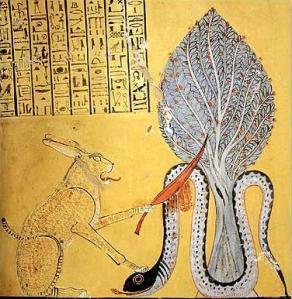
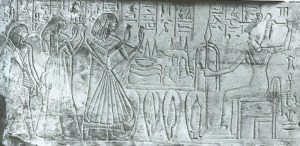
The Egyptians were the first people to “domesticate” cats. Perhaps taking their cue from their pets, they very early venerated cats as divine. Cats were, however, working animals that controlled vermin and poisonous creatures that violated the principle of stability that the Egyptians so valued. From the earliest records of the Old Kingdom we find the goddess Mafdet portrayed as a cat. Her name translates to “swift runner” and she was protector of Pharaoh, and thus of all Egypt. She was also associated with justice, a role reprised by Puss-in-Boots in Shrek 2. The hearts of evildoers were ripped out by Mafdet and brought, like a dead bird or mouse, to the Pharaoh.

Mafdet? (Don't give your kitty knives!)

Mafdet? (Don't give your kitty knives!)

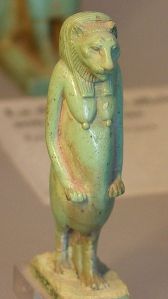
Mafdet’s fame declined with the rise of Bast, or Bastet. Bast (“devourer”) was also an early goddess, associated with the sun, and like Mafdet, she was a fierce protector. Her cult was centered in Bubastis, a city named for her. The guardian of Lower Egypt, she kept the kingdom safe from cobras, scorpions, and presumably hair-balls. Unlike the gentle kitties of today, she was also represented as a lion, a goddess of war.

Bast, all grown up

Bast, all grown up

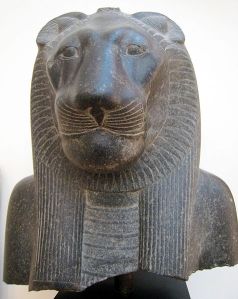
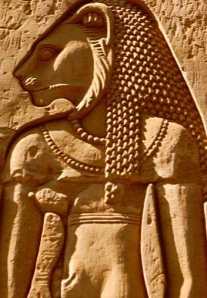
Bast’s fortunes faded with the rise of Sekhmet, the warrior goddess of Upper Egypt. With a name translating to “powerful,” Sekhmet was yet a third feline protector. She was also a lion-shaped goddess whose breath created the desert. (I have worked for human beings who could justifiably make that same claim.) Like Bast, she wore the sun on her head and became Egypt’s version of the violent goddess. Ancient peoples all feared the raging goddess, no matter what name or shape she took. Perhaps they always expected bad behavior from men, so when female deities got in on the act it was all the more powerful.

Sekmet with the breath that sank a thousand ships

Sekmet with the breath that sank a thousand ships

Where does evolution go from there? Is it merely coincidence that the Ashera Cat is part African Serval (as was perhaps the original Mafdet) and that it is being billed as the royal cat? I think not! Cats have a long pedigree with the divine, and from what I’ve been reading, Ceiling Cat has a very wide following. Evolution of the Egyptian cat, it seems, takes us from the Old Kingdom right up to Lolcats.


God’s Wife

Podcast 13 follows up on the previous two posts concerning Asherah. Here a little more background is provided on the discussion/debate concerning the goddess. I trace the origins of Asherah, best attested at Ugarit, and explain why this should be our primary source of information about the character of the goddess. I consider the 40 biblical passages briefly before moving on to the Mesopotamian, Hittite, and Epigraphic South Arabian material. Clearly the most important evidence for the debate on whether Yahweh was wed or not is the set of inscriptions from Kuntillet Ajrud and Khirbet el-Qom. I examine these bits of evidence as well, explaining why I doubt that they intend to portray a divine couple. The podcasts closes with what I believe to be the way forward — a clear understanding of Asherah based on Ugarit and read without a scholarly agenda (yes, they do exist!).


Who’s Your Daddy?

Is there an epigrapher in the house?

Is there an epigrapher in the house?

As long as I’ve broached the issue of Yahweh and his Asherah, it would be fitting to consider the supporting evidence of Khirbet el-Qom. The attention of William Dever was drawn to this burial site as long ago as 1969 by a badly striated inscription purchased from an antiquities dealer that had been traced to the location. Indeed, the exact spot of the excised inscription was discovered where it had been removed from a pillar near a tomb. Dever originally translated the inscription with no reference to Asherah and with an admission of its poor state of preservation. It was only after Kuntillet Ajrud was discovered (see yesterday’s post) that scholars began reading Asherah back into this extremely difficult epigraphic puzzle.

Since that time, Kuntillet Ajrud and Khirbet el-Qom have become the requisite two witnesses to seal the case: Yahweh had a wife named Asherah. Now slow down a bit! What does the second witness say? The Khirbet el-Qom inscription is extremely problematic; those who’ve examined it closely do not all agree that “asherah” occurs in it at all. If asherah appears here it is grammatically unwieldy: “blessed be Uriyahu by Yahweh for from his enemies by his asherah he has saved him,” and that’s only if the word really is “asherah.” Although Dever has gone on to write a book about God’s wife, he has never changed his original translation sans asherah. I followed his publications on the topic to see his revised translation, but surprisingly, he defers to others, some of whom have never seen the original. Am I the only one who sees something odd here? Only after “Asherah” appears in a grammatically awkward way from Kuntillet Ajrud does she get back-read into Khirbet el-Qom, in an even more awkward syntactic construction, and voila! Yahweh is happily wed!

My scholarship suffers from no conservative agenda, and I cannot be accurately classified as conservative by any stretch of the imagination, but I simply cannot
abide sloppy scholarship (and I’m the one without a full-time job!). It seems to me that if Yahweh was married, even if so considered by a tittering band of heterodox Israelites who liked to hang out in tombs and scrawl graffiti on public property, we would find some solid indication. So far all we have is ambiguous references to Yahweh of Samaria (and Tema) and “his asherah” at Kuntillet Ajrud and a badly defaced inscription from Khirbet el-Qom that may or may not even mention “asherah.” I cannot see this as strong evidence for a case of divinely wedded bliss.


Here Comes the Bride – Maybe

Kuntillet

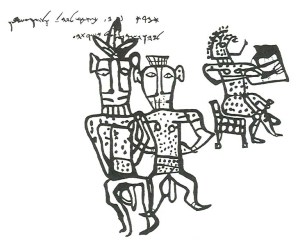
This is one of my favorite doodles from the ancient world. Its rich ambiguity lends to its appeal — some see it as salacious, while others see it as sacred. For those of you unfamiliar with the graphic details of the Asherah debate, this image is an ancient graffito from a desert way-station called Kuntillet Ajrud, a one-period site from the eighth century BCE. Like any number of other ancient drawings, this one would have probably remained in the obscure curios-portfolio of ancient scholars if it hadn’t overlapped an inscription that mentions “Yahweh of Samaria and his asherah.” Discovered in 1975–1976, this inscription, along with a couple others, revolutionized many scholarly assessments of ancient Israel’s religion. Yahweh had a soft side after all, a wife no less, the old god!

I’ve taken some flak in my circumscribed academic career for suggesting that this inscription, and a perhaps somewhat similar one from Khirbet el-Qom, are ambiguous. Sure, I’d like to see Yahweh happily married as much as the next guy, but is that what is going on here? Yahweh and Asherah, sittin’ in a tree? My doubts don’t stem from a squeamish conservatism (come on!) but from a concern of over-interpreting ambiguous evidence. Asherah, as a goddess, was rediscovered with the excavation of Ugarit. Forgotten by time with only cryptic references in the Hebrew Bible to some kind of cultic item called an “asherah,” scholars were excited to learn that she had a body and a personality. Many aspects of that personality fit, circumstantially, with a lovely pairing with Yahweh; wherever Asherah appears she is the consort of the high god, she is royal, matronly, and never showy.

The image above, however, has nothing to do with the inscription it overlaps. The two larger figures in the foreground are clearly Bes, the minor Egyptian protective deity. The characteristics are so clichéd that only the will to see Yahweh and Asherah arm-in-arm suggests anything different. Scholars like a happy ending just as much as anybody else, but I am obligated to state that, taken objectively, Asherah simply isn’t in the picture here.


Of Cats and Goddesses

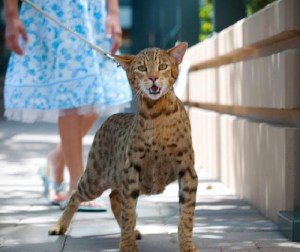
During one of my periodic forays into current Asherah lore on the web, I discovered a new breed of cat. Well, actually, I didn’t discover it, I just became aware of it. Because of a misspelling on a website I learned that the Ashera (trademarked name!) is the most expensive cat in the world, retailing for $22,000. A blend of three species (the mind boggles), the African Serval, Asian Leopard, and domestic cat, this feline comes in at least three varieties, including the especially appropriate Royal Ashera. If you’ve come into an inheritance and want to waste a few grand, take a look at Lifestyle Pets to see the wonder.

According to Kirta she has a temper!

According to Kirta she has a temper!

Curious, I searched to find if anyone would tip a hand as to where the name of the cat was derived. Choosing the name of the queen of the Ugaritic divine world seemed a little too much coincidence for me, but then again, homophones happen. When the Prince of Egypt, Dreamworks’ answer to The Ten Commandments, was released, I had several people ask me why the Israelites were singing about “Asherah” after they crossed the Red Sea. I had to watch the movie very closely, but I figured out that they were singing “I will sing,” which, in Hebrew, sounds suspiciously like “Asherah.” I never did discover Ashera’s origins.

Cats, however often maligned as associated with witches and vampires and other creatures of the night, are certainly among the most divine of domesticated pets. If I were free to purchase an animal companion the Ashera would be in the ranking (after I’d won the lottery, of course). Whether intentional or not, who would not want to own a cat named after the only goddess to be mentioned in connubial relations both to El and perhaps even to Yahweh? (The latter association, like the naming of the cat, is entirely open to question!)


The Lady or the Lion

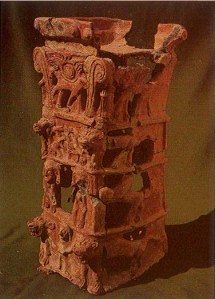
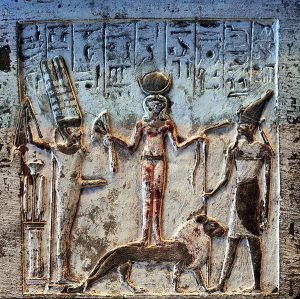
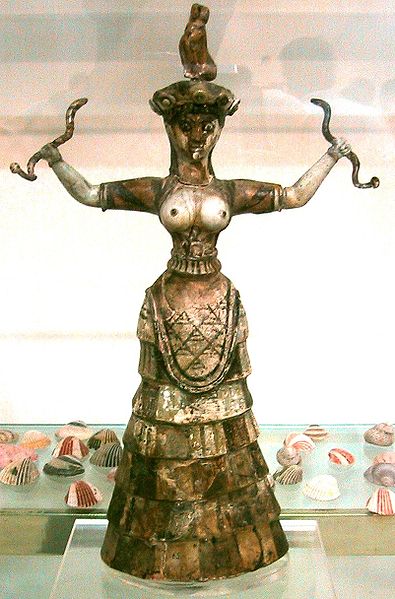
Ancient West Asian society utilizes a striking image that causes no end of confusion — the lady and the lion. Although not always identified, the lady generally appears to have been a goddess. Pairing a female figure with the most ferocious predator known in that society ripples with significance; there can be no question that the cultures involved were patriarchal, a fact of life in that part of the world at that time. If it was a man’s world, why depict the glorious lion with the feminine? Because we fear what we cannot control?

The infamous cult stand from Taanach

The infamous cult stand from Taanach

Ostensibly the rationale for this correlation may be traced back to Ishtar, the goddess sine pari of ancient Mesopotamia. The exact reason for her leonine associations is unknown yet she is among the fiercest females connected to warfare and strife in the ancient world. Her lion companions ranged over the realms of the Levant where other goddesses also assimilated her imagery. Curiously, one goddess who has no specifically leonine attributes is Asherah, the consort of the god most high, El. In Egypt the fierce goddess associated with war was Sekmet, often portrayed with a curiously male lion head.

Min, Qedeshet, and Resheph — a ménage à trios?

Min, Qedeshet, and Resheph — a ménage à trios?

In an earlier post I suggested that the biblical prophet Amos may have known that lionesses generally make the kill. Could it not be that although most women were locked out of public power structures in the ancient world they still may have retained the utmost respect and reverence of the populace? Long before male monarchs claimed titles such as “Lionheart” even gods would tremble before an enraged goddess. Morphed through time and continued patriarchal culture, the connection once again recurs in Frank Stockton’s The Lady or the Tiger where the metaphor has lost its teeth and the lady is no longer the source of destruction, but of male desire. Has the male prerogative once again usurped feminine independence? If only Ishtar or Sekmet could have been behind door number three!

Behind door number 3

Behind door number 3


Shades of Asherah

When my book on Asherah was first published in 1993, some reviewers criticized my humble effort to sort out the identity of this goddess without resorting to iconography. As I had anticipated this, in the text itself I provided what I thought was a reasonable rationale for my decision. It is a sad fact that ancient polytheists seldom captioned their imagery. Some images so clearly resemble the character of deities described in the myths that correlations are almost certain. Asherah, alas, lacks that privilege.

Could be anybody's mommy

Could be anybody's mommy

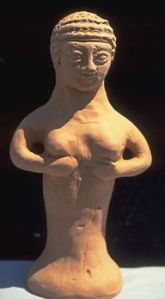
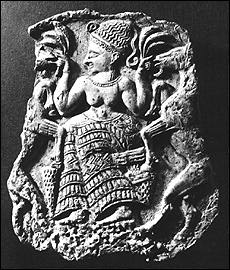
No item from ancient West Asia has yet been recovered that bears an inscription identifying the portrait as Asherah. We simply do not know what the ancients believed she looked like. This hasn’t prevented modern scholars from assigning an Aserah value to certain favored artifacts with a great deal of certainty. So much certainty, in fact, that we don’t know which certainties to trust. If iconic emblems for Asherah existed, that might provide a way of connecting images to the goddess. Unfortunately, snakes, lions, and “twigs” — the usual suspects — could fit just about any goddess with a little twisting. So we are forever left with iconic ambivalence.

May be Asherah, but what's with the goats?

May be Asherah, but what's with the goats?

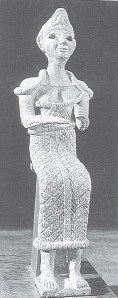
Of all the artifacts recovered from the Levant, where Asherah was actively worshipped, only one, it seems to me, is a potentially clear match. Not as alluring as the Asherahs of popular imagination, she is actually described as a matronly figure, the consort of patrician El. The El images that seem beyond question illustrated him comfortably seated on his throne of state, hand raised in a sign of blessing (or waving good-bye). One image found at Ugarit presents a feminine counterpart in posture and pose. This is likely the image of Asherah. Younger, sexier goddesses need not apply. This one instance reminds us of just how little we know of the immense divine world of Ugarit. If we are careful in our explorations, however, there is much to be learned.

Like hubby like wifie

Like hubby like wifie


Anat, Kali and the Violent Femmes

“Women and men,” runs the chorus of the They Might Be Giants song of that same title, “… everywhere they go love will grow.” Women and men. Thus it has always been. The Sumerians seem to have speculated, on a broken tablet concerning the creation of humanity, that some six varieties of gender had been ordained by the gods. This story reminds me of just how dicey gender definition can be. Despite the howls of protestation from man + woman = marriage crowd, the concept of gender is actually complex and diverse. The lowly slime mold of the genus Physarum has a combination of multiple sex-controling genes mixed with several different types of sex-cells, leading to a bewildering 500 different sexes. You’ve got to wonder what the Physarum bar-scene is like! So the whole women and men combination seems a little tame by comparison.

The ancients did, however, toy with standard gender role concepts. The Ugaritic goddess Anat, sometimes described as a “tomboy,” was perceived as a literal femme fatale, joining her in the company of Ishtar and Kali as warrior women-goddesses. She was a proto-Amazon (before they laid aside their male-bashing and set up a very lucrative web-site). Anat wears the severed heads and hands of slain warriors and stomps in blood-puddles, laughing all the while. Where did the ancients derive such violent feminine images as Anat and Kali? Some sociologists suggest that these myths were intended to solidify gender roles, although they seem to confuse the violent male with the shy and retiring female stereotypes. Perhaps the Ugaritians and other ancient folk knew deep down that gender is only a vague attempt to classify something that is really far more complex than it seems. Just when gender is nailed down you find yourself in a bloody mess as Anat swats at you again and again.

Anat ready to smite Egyptians who just don't understand the Violent Femmes

Anat ready to smite Egyptians who just don\’t understand the Violent Femmes

Nashotah is not far from Milwaukee where the folk-punk, genre-defining band the Violent Femmes started out. In college many of my overtly Christian radical friends told tales of how the Violent Femmes were a closet Christian rock group, based on some of the religious themes in Gordon Gano’s lyrics. When I listen to their CDs, however, I hear the same old angst that has plagued humankind for ages — what does a guy have to do to impress a girl (the same question may be reversed, turned upside-down, or dis-and-re-articulated, depending on whether you are female, male, or slime mold). At Ugarit they would have understood the Violent Femmes — listen to “to the kill” and tell me it’s not so! I would suggest that Gordon and the guys aren’t as much closet Christians as closet Ugaritians, struggling with the Anats and other violent femmes of their world and trying to make sense of it all.


Everlasting Cats

“The mystical divinity of unashamed felinity, round the cathedral rang ‘Vivat!’ Life to the Everlasting Cat!” I’m not sure if this is T. S. Eliot, Andrew Lloyd Webber, or a chimeric mix of the two, but it is an interesting bit of mythology. My daughter is the consummate Cats fan and has been asking me to write a post on Cats and religion. When I read (or hear) the above lines of poetry, I must confess, my mind wanders to Xenophanes who stated that if horses could draw they would draw their gods like horses. Ditto for cats.

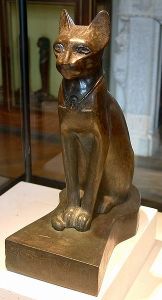
Everlasting cats, however, have their roots deep in religions of the ancient world. Although the word “cat” never occurs in the Bible (“dog” is there plenty of times, with even a “bitch” or two) cats are certainly within the biblical culture. Eternal Egypt knew of an everlasting cat — Bastet, the “cat goddess.”

Bast to see this as an everlasting cat

Bast to see this as an everlasting cat

Hailing from Bubastis, Bastet (I just can’t call her Bast, since it sounds like slathering meat with some kind of ambiguous liquid, something I can’t stomach as a vegetarian) seems likely to have some connection with the sun. Regarding yesterday’s post, the ancient Egyptians had a plethora, a veritable superabundance even, of solar deities. Bastet was called the Eye of Ra. She was also associated with war, appropriate enough to anyone who’s read Erin Hunter’s Warrior series. As a goddess, Bastet qualifies as an everlasting cat.
Little Bastie doesn't seem so playful any more

Little Bastie doesn't seem so playful any more


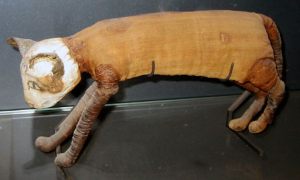
So do the numerous cat mummies from ancient Egypt. Preservation of the body was an aspect of realizing life beyond life for the Egyptians. It would also obviously help to keep the mice out of heaven. T. S. Eliot was C. of E. (Church of England, not Copt of Egypt) and had a savvy sense of wit. Ignoring the biblical snubbing of cats, he named the wisest and most respected of Old Possum’s Practical Cats with a biblical name — Old Deuteronomy. Although I am not a cat owner (is anybody really a cat owner?), I do have great respect for felines, mystical or not. And I am not alone as long as the ancient Egyptians kept a mummy or two around and an Eye of Ra to keep that solar barque on its course.