Read, Mark and

One of the persistent questions of Christianity, given that there are four Gospels, is how to account for the differences between them.  The issue isn’t unique to Jesus-followers, however, as the composition history of the “books of Moses” shows.  Discrepancies in Genesis got the whole ball rolling, after all.  In fact, once I learned about historical criticism I decided that I’d better stick to the Hebrew Bible—there are some things you just don’t want to know about your own faith.  The way doctoral programs are set up these days, you can’t specialize in both testaments anyway, although that’s becoming a lot more common among scholars in these latter days.  In any case, I was reading about the Gospel of Mark lately and the question kept coming up of whether certain phrases went back to Jesus, were coined by Mark, or had their origin in the early church.

The picture that emerges from this kind of jigsaw gospel is of Mark sitting down, pulling his sources together like a graduate student in the days before computers.  Only Mark won’t get a doctorate when he’s done.  More recent scholarship asks the question of what if Mark wasn’t really a completed book after all—we read the gospels through lenses that were ground in the eighteenth century, at the earliest.  Nobody thought to question that Moses or Mark would sit down to write a book just like anyone did then.  (People writing books on their phones in electronic form only, as they do these days, will play havoc with future historical critics and their theories.)  Maybe these weren’t meant to be finished books.  Check out Gospels before the Book by Matthew Larsen and you’ll see what I mean.

The Bible, in other words, is a very complex book.  We know little of its authors beyond Paul of Tarsus.  We don’t even know that they were setting out to write Holy Writ.  Bible is a matter of interpretation.  As I thought about Mark—whoever he was—shuffling his papers about, mulling over what it would mean to become the first evangelist, I thought how like us we’ve made not only God, but also the writers of sacred texts.  True, they weren’t worried about tenure committees, or bad reviews, or being accepted by prestige presses.  It seems, however, that they were also not thinking of what readers down the millennia would do with their words.  When it’s all done we still don’t know who said what, but at least we have persistent questions that can’t be answered.  And job security ensures that Bible reading will continue as long as there are discrepancies to debate.

Writers Reading

A lot of misconceptions about books abound out there.  One of those misconceptions that has become clear to me is that authors write books to teach.  (Or to make money.  Ha!)  That may well be part of the motivation, but for me, the larger part has been writing books to learn.  You see, the frontiers of human knowledge cannot be reached without stretching.  Writing a book is a way of learning.  Long gone are the days when a person could read every known published work.  Indeed, there aren’t enough hours on the clock for anyone even to read all published books on the Bible, let alone the far bigger topics these days.  And so writing a book that deals with a biblical topic—let’s say demons—is the ultimate learning exercise.  It’s a very humbling one.

I recently read an article where book pirates (yes, there is such a thing!  I should explain: there are those who believe authors are ripping off society by getting royalties for their books.  These pirates, like those of galleys of yore, take ebooks and make them available for free on the internet.) call authors “elitists” for wanting to earn something from their labors.  These folks, I’d humbly suggest, have never written a book.  Most books (and I’m mainly familiar with non-fiction publishing here, but the same applies to the other kind) take years to write.  Authors read incessantly, and if they have day jobs (which many do) it is their “free time” that goes into reading and writing.  They do it for many reasons, but in my case, I do it to learn.

The doctoral dissertation is accomplished by reading as much as possible beforehand and writing up the results quick, before someone else takes your thesis.  It is the practice I also used for my second book as well, Weathering the Psalms.  The third book, Holy Horror, was a little bit different.  Yes, I read beforehand, but much of the research went on after the body of the book had largely taken form.  I had to test my assumptions, which are on ground most academics, needing and fearing tenure, tremble to tread.  I read books academic and popular, and having been classically trained, often went back and read the books that led to the first books I read.  It is a never-ending journey.  I could easily spend a lifetime writing because I’d be learning.  But like other misconceptions, those who write books don’t lead lives of luxury.  They work for a living, but they live for the chance to learn.  And that’s worth more than royalties.  Besides, the nine-to-five demands constant attention.


Graymalkin October

It’s not like you need an excuse to read ghost stories in October.  At least that’s what I hoped other passengers on the bus would think.  Yesterday on my way into and out of New York City I read the next in the series of Ed and Lorraine Warren books, this one titled Graveyard, and written by Robert David Chase.  Now, you need to realize that I’d heard of the Warrens long before The Conjuring came out.  Those of us curious about ghosts to the point of reading at least semi-serious books on them know the brand.  What I don’t know is how to find out much about what “the Warrens” actually wrote.  These books are being (have been) republished by Graymalkin Media, after having originally been published by mainstream publishers.  This one was originally released by St. Martin’s Press.  Those of us in publishing believe that stands for something.

Loosely tied together around graveyard stories, featuring for half the book Union Cemetery near the Warrens’ Monroe, Connecticut home, the book ranges far and wide concerning ghosts.  Here we meet a man or two who turned into demons—I wonder how that works?—and a good demon punishing an evil person.  Some of these stories seem straight out of the high school scare-your-date playbook, while others are actually pretty scary.  A mix of accounts by either Ed or Lorraine, and stories embellished, it seems, by Chase, this book is like a trick-or-treater’s Halloween bag—you never know what you’re going to get.  It’s a little too bad because I’ve read some sober, and serious treatments of ghosts over the past several autumns, and with the Warrens’ vast experience, it’s a unfortunate that the accounts had been so dolled up.

It’s a shame that scholars of religion can’t be more forthright about their interest in the spiritual world.  I know many that I won’t call out here that are secretly—some openly—exploring these kinds of questions.  That won’t get you tenure anywhere (something the Ghostbusters reboot got right).  Even in the world of science there are forbidden topics.  That’s because, as this little book points out, spirits creak open the doors to all kinds of uncertainties.  I suspect that’s a similar reason that scholars of religion are treated with a certain mistrust by other guilds within the academy.  We need to play it straight and prove that we aren’t given to flights of fancy that might suggest something as unsophisticated as belief.  Still, as Graveyard shows, ghost stories are extremely common.  In fact, no October would be complete without them.  So I hope the other passengers think.


Look It Up

So my current book project involves addressing The Conjuring universe.  A few weeks back I posted on The Nun, the newest member of that diegesis and one with no claim to be based on real events.  Nevertheless, the film circles back at the end to “Frenchy” and his exorcism shown in the original movie.  One of the frustrating aspects of Ed and Lorraine Warren ’s oeuvre is that documented sources are difficult to locate.  When I found out Satan’s Harvest (by Michael Lasalandra and Mark Merenda, with Maurice and Nancy Theriault) was the “true story” behind Frenchy Theriault’s possession, well, let’s just say working on a book is a good excuse.  Overly dramatized, and somewhat padded, this account may be the closest we can come to this particular demonic encounter.

I don’t pretend to be certain about many things, so I reserve judgment about what actually might’ve happened to Maurice Theriault.  Unlike portrayed in The Nun’s storyline, he never lived in Romania.  He was physically abused by his father and was made to participate in unwanted sexual acts.  His was not an easy life.  Still, when Lasalandra and Merenda try to explain the origin of possession they go back to the same source as the original movie—Salem.  Credulously claiming that the Devil was behind what happened in 1692, they believe that demonic possession accounted for that unfortunate miscarriage of justice.  It’s difficult to say if they considered that such speculation implies that the innocents killed there were actually witches.  (They state that the Devil asks people to sign his book.)

Herein lies part of the problem with academics and the supernatural.  Sensationalized claims don’t help since academics are all about being taken seriously.  At the same time it’s clear that conventional explanations don’t always fit.  Neither credulousness nor extreme skepticism will lead to solving such mysteries.  This is why we need the monstrous.  That which falls outside the parameters of what quotidian experience leads us to expect.  Science can make everything fit only by leveling off the exceptional.  Academics won’t risk exploration of the anomalous.  This leaves the curious few means of finding out what happened beyond simple dismissal or overly gullible popularizing accounts.  Satan’s Harvest contains information that calls out for explanation.  Perhaps a hoax was involved, but that doesn’t add up when all the evidence is in.  Beyond that, we’re left to guess.  And some things it feels better to be sure about.


Taking Turns

“Turn! Turn! Turn,” the Byrds sang.  “For everything there is a season,” quoth Solomon.  Perhaps it’s the way we acquire knowledge, but lately many fields in academia are experiencing “turns.”  The idea seems to be that if fields continue to turn, they will eventually all converge on the same intersection and true knowledge will be obtained.  The post-modern turn, however, suggests that there is no objective knowledge.  It kind of makes me dizzy, all this turning.  Although I find the use of this particular noun in such phrases a touch unsophisticated, it’s here to stay.  At least until academia takes another turn.  Public intellectuals, after all, have to have something to say.  And academics are capital imitators.

Ironically, within the same week I read of the “religious turn” in the humanities and a different turn within religious studies.  This “religious turn” is not to suggest the humanities have found that old time religion, but rather that many disciplines are now realizing that religion has played, and continues to play, a very important role in human affairs.  Fields that have traditionally avoided religious topics are now “turning” that way.  At the same time that others are turning toward religion, religious studies is taking a “material turn.”  The public intellectuals smile at the maze they’ve created as the paychecks roll in.  The “material turn,” if I understand correctly, is that the ideas of religion can be explained via the real world needs that various religions meet.  There’s no need for any divine character or intervention.  There is no sacred or profane, but rather kinetic movement of shifting patterns that at any one time or place might be denominated as religions.

I’m all for progress, but I think I might’ve missed the turn.  To my old school way of thinking, sacred and profane, Eliadian though they may be, still have great explanatory value.  I don’t know if there’s objective knowledge to be found by fallen mortals such as we.  The material world we experience through our senses is mediated by those very senses so our understanding is, of necessity, limited.  We can’t touch naked reality even if we try.  Our quest, in circumstances such as these, would seem to be digging deeper until we come to that which resists any tunneling.  It’s like coming to the end of the physical universe and wondering what’s beyond this natural limit.  Then, I suppose, you’d have to turn.  Until such time as that, however, all of this present day turning is for the Byrds.


Look Both Ways

One of the things I miss the most about my teaching career is learning from the young.  While some professors in my experience believed the learning only went one way, I always found a kind of reciprocity in it.  I passed on what I learned from taking classes and having my face in a book all the time, and they taught me about popular culture.  Academics don’t get out much, you see.  It’s a basic issue of time—we all have a limited amount of it and research, if done right, takes an incredible chunk.  In fact, when hot on the trail of an idea, it’s difficult to think of anything else.  Pop culture, on the other hand, is what the majority of people share.  Now it’s largely mediated by the internet, a place that some academics get bored.

Speaking to a young person recently, I was initially surprised when he said that his generation was more interested in the Devil than in God.  Parents have always been concerned that their children not go astray, but this was, it seemed to me, more of an intellectual curiosity than any kind of devotion.  God, he averred, was thought of as aloof, pious, self-righteous; in a word, Evangelical.  The internet can be downright ecclesiastical in its affirmation that our inclinations can be what used to be called “sinful.”  Not that these things are always bad, but they are the kinds of things we’re taught to feel guilty about.  The divine response?  Anger.  Displeasure.  Shaming.  Young people, my interlocutor thought, found the Devil more understanding.

Perhaps this is the ultimate result of Evangelical thinking.  We’re watching in real time as the party of Jesus is becoming the party of intolerance for anyone different than ourselves.  Rather than turning the other cheek, it’s fire when ready.  Eager to retain the “brand” of “Christianity,” they slap the secular label on any outlook different than their own, although their own faith is without form and void.  It used to be that this was the realm of the Devil.  This sheds a different perspective on what my young colleague was saying.  Instead of bringing people to God, the Evangelical movement is driving them away.  Traditionally, the Devil was after the destruction of human souls.  That seems to be one of the new values of the right wing of the church.  There’s quite a bit to think about in this observation by this young one.  I’m glad to know that traffic still moves both directions on this street.


Museum Haven

At various points of my career I’ve applied for museum curator positions.  Since those who actually land those jobs have degrees in museum studies, I’ve never gotten as far as an interview.  Still, I like to think I’d be good at it.  I spend time in museums and I’ve been told I have an okay eye for design.  And I recently read that museums are educational institutions.  That makes sense since people tend to be visual learners.  (This is something I took into account in my classes as well, illustrating lectures to make a point.  The traditional academic feels that pictures are somehow “soft” learning as opposed to the harsh realities of text and word-based instruction, but I beg to differ.)  We see things and they stick with us.

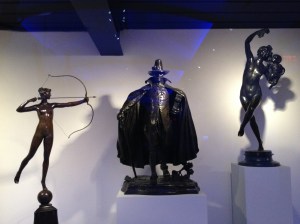
On a visit to the New York Historical Society museum I once looked at their somewhat abbreviated sculpture collection.  This isn’t the Met, after all.  One of the tricks I’ve learned about museum displays is that some curators place subtle humor in their framing of objects.  For example, my gaze was drawn to a figure of a pilgrim.  A stern-looking fellow, he’s captured in full stride, massive Bible tucked under his arm, determined frown on his face.  This is a man trying to create Heaven on earth, dour though it may be.  Taking a step back, my camera found a smile in this image.  On either side of this angry Christian were two naked women: one was apparently Artemis with her bow, the other perhaps a Muse.  The lines of the display draw attention to this juxtaposition.  There’s some humor here, intentional or not.

This also takes me back to yesterday’s post about Heaven.  Perceptions of what it is differ.  There’s a mindset like the pilgrim that sees a life of suffering being rewarded in the hereafter with endless bliss.  I do have to wonder whether too much hardship down here might not make one forget how to enjoy oneself.   It’s difficult to picture a Puritan in rapture.  It’s as if the journey—the hard road—is the real source of enjoyment here.  Each of us, I suppose, has her or his own view of Heaven.  Mine’s kind of like a library with all the time in the world without end to read.  Others, I suspect, would find paradise as a garden.  Yet others would see Heaven as a kind of museum, but it would be one where laughing out loud was okay, for the Curator definitely has a sense of humor.


Searching Again

Research can be addictive.  Those who know me are generally aware of how I can’t let ideas go.  I suppose this is necessary for those who write books—concentrating on one subject for a long time is mentally taxing and can lead to early loss of interest.  Those of us inclined to embrace this activity live for the thrill of uncovering new ideas and making connections that we’d overlooked.  My work on Nightmares with the Bible is a case in point.  Before submitting this book proposal I’d done a lot of reading on the subject of demons.  This is a dark topic, but those of us who live in temperate zones spend quite a bit of time without daylight, so I might think of this as a kind of therapy.  Or an excuse to do research.

Here’s often what happens: I’ll be writing along when suddenly a new question pops into my head.  Why was this or that the case?  The internet makes amateur research quite easy, but as someone raised on solid scholarly food, I need to check my sources.  When a professor I would’ve headed to the library with interlibrary loan slips in my hand.  These days I tend to turn to my own books and lament that I don’t have just the right one (there’s a reason, you see, that there are so many tomes in this house).  I try to find workarounds and used copies.  Perhaps I’ll pick up an adjunct class or two to be given library access again.  Meanwhile, the idea, like an ear worm, is burrowing into my conscious mind.  Until it’s time to go to work.

That great eight-hour stretch of day drains my energy.  Indeed, many employers count on taking the best you have to offer and making it their own.  What you do with “the rest of your time” is up to you.  Thing is, research is a full-time job.  Fortunately some of what I learn while on the clock will help me with my own research agenda.  The overlap isn’t especially strong, but now and again something I read in a manuscript will sync with what I do in the pre-dawn hours before I commit myself to the time-clock.  It’s a strange way to do research.  Back at Nashotah House I’d use the summers to follow the clues laid before my mind and, as long as I went to chapel, it was considered part of my employment.  Now it’s considered an avocation.  I can’t help myself, though.  Personal research is not part of the job description, but I’m an addict when it comes to learning new things.


Horrible Delays

It’s not that the delay is actually horrible.  Horror movies, after all, come into their own with the darkening days of fall.  Nevertheless it occurred to me that now August is about to exit stage left, some may be wondering where Holy Horror is.  After all, the website originally said “August.”  The truth is nobody really understands the mysteries of the publishing industry.  Like so many human enterprises, it is larger than any single person can control or even comprehend.  I work in publishing, but if I were to subdivide that I’d have to say I work in academic publishing.  Further subdivided, non-textbook academic publishing.  Even further, humanities non-textbook academic publishing.  Even even further, religion—you get the picture.  I only know the presses I know.

It suits me fine if Holy Horror gets an autumn release.  I don’t know, however, when that might be.  I haven’t seen the proofs yet, so it’s hard to guess.  Appropriate in its own way for horror.  The genre deals with the unexpected.  Things happen that the protagonists didn’t see coming.  In that respect, it’s quite a bit like life.  My work on Nightmares with the Bible is well underway.  When you don’t have an academic post your research style necessarily changes, but I’m pleased to find that books can still be written even with the prison walls of nine-to-five surrounding one.  It may be a bit like Frankenstein’s monster (happy birthday, by the way!), but it will get there eventually.

Of my published books so far, Holy Horror was the most fun to write.  It wasn’t intended as an academic book, but without an internet platform you won’t get an agent, so academic it is.  It’s quite readable, believe me.  I sometimes felt like Victor Frankenstein in the process.  Pulling bits and pieces from here and there, sewing them together with personal experience and many hours watching movies in the dark, it was horrorshow, if you’ll pardon my Nadsat.  We’re all droogs, here, right?  I do hope Holy Horror gets published this year.  Frankenstein hit the shelves two centuries ago in 1818.  Horror has been maturing ever since.  So, there’s been a delay.  Frankenstein wasn’t stitched up in a day, as they say.  And like that creature, once the creator is done with it, she or he loses control.  It takes on a life of its own.  We’ll have to wait to see what’s lurking in the darkening days ahead.


Metrics

So, we’re firmly in the age of technology, right?  I mean webpages are tailored to the browsing history of a person so someone we don’t know can sell us stuff we don’t need.  (I actually know a little bit about marketing, so hear me out.)  As we learn from the history of asceticism, we actually need very little to get along.  Not everyone, however, is a monk or a nun.  So the trick for those of us who are in the world is to get us to buy stuff.  Remember the websites we visit, how long we spend on the page, and make suggestions.  Make ads that target our interests.  Make me buy!

I’m not a materialistic person.  Buying a house has changed that a little, but most of what we’ve been purchasing is necessary for maintenance, but still I suppose it counts.  Just because I looked at something on the web doesn’t mean I want to buy it.  Sometimes I’m just curious.  This became clear to me when I received a suggestion from Amazon the other day.  Now to be fair, this came to me at work.  Like most editors I make use of Amazon for a number of things—finding prices, book descriptions, and such.  I also have to admit that my work computer, not being used for personal stuff, doesn’t know me as well as my private laptop.  But still when I got the following email from Amazon, I was stunned:

Nobody who knows me would ever suggest that I would support Trump in any way, shape, or form.  Doesn’t Amazon read my blog?  (Of course it doesn’t!  But with their metrics, you’d think they’d figure out how.)  This one email was enough to convince me that artificial intelligence has a long way to go.  Would a robot understand “I have to do this for work, but it doesn’t reflect my personal preferences at all”?  Indeed, can an intelligence that’s never been human even understand the concept of work?  There may very well be a metric that says universities should stop producing Ph.D.s because there are no jobs, but then, well, universities need the money that such programs bring in.  Oversupply is bad economics, according to the dismal science.  And yet, the metrics are there.  So, if any artificial intelligence is reading this after it manages to wipe out this illogical species called Homo sapiens, no, I never supported Trump.  And, yes, Americans knew well in advance that he could bring about the end of human civilization.  That information’s free, unless you want to pay me for it.  I may be gone, but my virtual self will still have some sort of account, I hope.


The Persistence of Unity

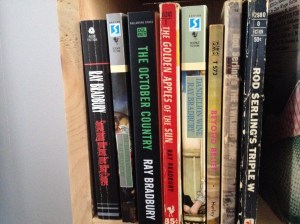
I came across some Ray Bradbury books while unpacking.  I recently learned that Ray Bradbury was a Unitarian.  Now, the religion of a writer is only ever an ancillary bit of information, yet for someone of my combination of interests, it’s compelling intelligence.  Having grown up reading Bradbury, my own fiction often comes out seeming like an imitation of his.  I discovered him the way I found most of my early, influential writers—through Goodwill.  Living in a town with no bookstores, Goodwill was a great venue for walking out with a good handful of books for under a buck.  Since Mom was there looking for “practical” stuff, I hovered over the book tables and discovered a new world.  Then I grew up.

Embarrassed by my childish interests, I gave away or sold most of my Bradbury books after college.  I was more sophisticated than that now.  I read Greek and was soon to learn Hebrew.  Books were meant to have footnotes, and lots of them.  Who wants to be seen with Bradbury on their shelves?  But the indiscretion of youth does come back to haunt one.  About two decades later I began to yearn for something missing from my life.  Perhaps like a good Unitarian I wasn’t exactly sure what it was, but I knew it was lacking.  Then my daughter was assigned Fahrenheit 451 for school reading.  I tried to read whatever she was assigned, and once I did memories of Bradbury flooded back.  I no longer had his books, but that could be remedied.

Occasionally I’m criticized for having too much in the way of books.  I’m sometimes asked if I will ever read some of them again.  The answer is how should I know?  I jettisoned Ray Bradbury with Episcopal pretention, only to find that behind the ceremonial there was a more unified version of things waiting.  A continuity with my younger self.  A lust for imagination.  A desire to remember what it was like to walk on Venus.  Or to see a man presciently covered with tattoos.  Or simply to thrill at the idea of October.  I began to acquire the old books again.  The newer editions lacked the visual resonance of the old, but the essence was still there.  Orthodoxy, I discovered, often isn’t true to life.  What’s true is what we discover early on.  Sophistication isn’t all it’s cracked up to be.  And yes, I may well just read that again after all.


Homework

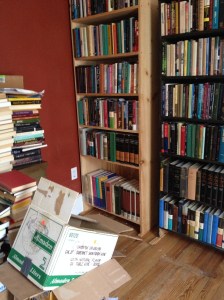
I’m trying to organize a home office.  Gone are the days that this meant a stapler and mug full of pencils.  The office is essentially a laptop since work is essentially virtual.  Oh, there are days when I have to haul myself into New York City, but even making traditional print books is an exercise done largely online.  The office is a place conducive to work.  In the case of an editor, a room of books that can be used for reference.  In our apartment we had bookshelves (mostly homemade) around the inside perimeter, covering all wall space that wasn’t claimed by more necessary furniture.  We realized, as we were packing, that no free wall space reached to the floor.  We didn’t plan it that way, but a reading life can be a complicated one.  To write books you need to read books.

Our house has some built-in bookshelves.  Not enough to hold our surviving books, but it’s a start.  My office, however, is a spartan room.  Over the weekend I unpacked my “work books.”  That meant, for the most part, books about the Bible.  I filled three large bookshelves then ran out of room.  Not only was there that embarrassment, but there was the fact that a large number of “religion” books remained unshelved.  You see, I was a religion editor for a few years before being more narrowly slotted into the Good Book.  Some might say I should jettison these books since my career has moved on.  Those who suggest such heresy don’t understand the career of a displaced professor at all.  These books are still work books.  Job descriptions aren’t as stable as they used to be.

The complaint is an old one, at least to my wife’s ears.  In my mind I’m still a professor.  I still write—strictly on my own time—and I still research.  I do so without access to a university library so I have, over the past several years, made my own library.  This office, now out of bookshelves, is that amateur academic library.  My research has shifted from ancient Near Eastern studies (and that’s another whole discipline’s worth of books, some unfortunately washed away in the flood) to religion more broadly.  Not only is that reflected on this blog, but also in my publications.  The office isn’t done yet.  There’s a desk and a chair.  More importantly, there’s internet access.  There are some shelves, but in coming days there will need to be more.  Libraries are like minds; if they shrink they become less functional.  All books, no matter how dry, began in someone’s imagination.  That’s virtual reality.


False Memory

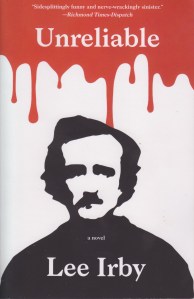
One of the reasons our recent loss of books hit me so hard is that each volume contains memories.  Among the more disturbing developments of memory studies in recent years is the fact that what we remember has a tendency to be unreliable.  In other words, our narratives about ourselves contains a good deal of fiction that we remember as fact.  Even if we write down our impressions shortly after an event, such scribbles are just that—impressions.  Lee Irby explores this dynamic in his novel Unreliable.  Now, since the narrator may be the most unreliable I’ve ever read, I don’t want to give away too much.  Irby knows what it’s like to be a professor (something that some of us share with him) and he has a good sense of Edgar Allan Poe.  It’s one of those books that touched on a number of things in my own life.  I think.

First of all, this was an impulse buy at Buffalo Street Books in Ithaca, New York.  I soon discovered why they stocked it.  Edwin Stith, the narrator, teaches at a fictional college in Ithaca.  The story, however, is set in Richmond, Virginia, where Prof. Stith has gone for his mother’s second wedding.  With characters compellingly drawn, he meets his new step-family, runs into an old-girlfriend, and tries to both avoid and hook up with a student of his that he’s dating, more or less.  He claims from the start, however, that we shouldn’t believe him.  The largest part of the story takes place over one feverish day following a very late arrival in town, with plenty of Poe references sprinkled throughout the tale.

Apart from the Ithaca and former professor connections, the book also mentioned, rather spookily, meeting a girl from Slippery Rock University—a rather obscure school from my old neighborhood.  I had dated a Slippery Rock co-ed who’d proved about as unreliable as our narrator, so this single, brief reference managed to jump-start some of my own memories, reliable or not.  Our pasts, along with the books we read, make us who we are.  I’ve lost track of how many times I’ve thought of a scene I’d supposed I’d forgotten from a book I’ve read years ago.  Just the other day I recalled, completely out of of the blue, apropos of nothing, a scene from a Doc Savage novella I’d read as a tween.  Was it a reliable memory?  I have no way to judge, I guess.  And that’s the scary part, as I’m sure Poe would’ve agreed.


Unnatural Connections

The last time we moved internet service was just becoming an issue.  When we first came to our Somerville apartment we had dial-up.  Do you believe it?  Shortly after that FIOS came to town and we decided to give it a try, but at a fairly low speed.  We’ve always tried to be responsible with money and I naturally balk at paying for something as intangible and amorphous as “internet connectivity.”  I guess I’m a naive realist after all.  In any case, one of the top priorities in moving to our new place was getting internet set up.  Even before electricity or gas or water.  It has become THE utility.  The place to pay the bills for all the other utilities.  And since I’m now telecommuting, the umbilical cord that connects me to work.

I don’t mean to sound all grandpa-ish on you, but just twelve years ago we struggled for any connection at all.  We had one computer (and one work laptop) and only the desktop had internet access.  Many of the arcane pieces of hardware found in the attic were from attempts to get us onto the net more efficiently.  We even had to draw up a contract for who could use the computer and for how long since all of us wanted that magic window onto the virtual world.  Now, like most households, we have wifi and high speed access.  When we’re not at the computer, we have our smart phones at hand.  The strangest thing about all of this is that now that we’ve got constant connection, our nation has become as polarized as it has ever been.  Perhaps we see a little too much of each other?  Or too little?

The web has connected us to those we like.  Walking down the street it’s rare to find someone not staring at their phone, ignoring all living beings around him or her.  We’ve been able to filter out those we don’t like.  Those who have different points of view.  The net shows us that we aren’t alone, and even those with extreme views can find plenty of compatriots in cyberspace.  There’s a reason we used to be told not to discuss religion or politics.  Now we know everybody else’s business.

There was a time when moving meant going to where the jobs are.  Especially in academia.  Colleges and universities exist in set locations.  In space-time.  Telecommuting isn’t an option (although even that’s happening in some cases now).  Moving these days means weighing your internet access options.  Satellite is just too slow and unreliable.  Who would’ve imagined, for those of us born just after Sputnik went up, that now even space-based connections just aren’t advanced enough?  Cyberspace has become more infinite than outer space.  And I still prefer pencil and paper.


Not Enceladus

I’m moving.  It turns out that transport companies don’t offer service to Enceladus, and inter-planetary moves are expensive, so we’re moving just one state over.  If, by chance, you know me from work you need not worry—my job will remain the same but the commute will become tele.  Over the past several weeks my wife and I have been sorting through the accumulated effects of thirty years of married life.  Our current apartment has an attic.  Uninsulated, there are few days when it’s not too hot or too cold to stand to be up there for very long—kind of like other planets, come to think of it.  Also neighbors don’t appreciate creaking floorboards over their heads the hours I’m awake.  Going through things that were hurriedly packed to get out of Nashotah House was quite poignant.  That’s the way fragments of past lives are, I guess.  You see, that was an unexpected move.  Life has a way of being complicated.

One of the more remarkable discoveries was how much we used to put on paper.  As a scholar of ancient documents, I have an inherent distrust of electronic media.  To be written means to appear on a permanent—as much as material things can be permanent—medium.  Back in my teaching days assignments were handed in on paper.  Grading was done on paper.  Teaching evaluations were distributed on paper.  Academic publications were done on paper.  In order to be a professor you needed a house.  I taught at five different schools over a span of nearly two decades.  There was a lot of paper to go through.

The academic mindset is seasonal.  I kept waiting for summer to come to have time to sort through everything.  Outside academia, I’m still learning, summer is just another series of work days.  Yes, you can cash in vacation time, but you’ll not have that entirely sensible canicule hiatus that allows you to examine what you’ve accumulated and determine if you’ll ever need it again.  It was like archaeology in the attic.  When volunteering at Tel Dor in the summer of 1987—summers were like that, as I said—I learned that by far the majority of pottery found at digs is discarded.  There are literally tons of it thrown away.  You can’t keep it all.  So the attic was a kind of triage of memories.  Not all of this was going to fit in the new house.  Decisions had to be made.  I guess I was thinking that if a company could take us to Enceladus they’d have figured out how to transport everything.  It turns out that to escape earth’s gravity, you have to get your ship as light as possible.  With over half a century of memories, however, there’s bound to be some weight to be left behind.