All’s Fair

The county fair is an institution that tastes like a real slice of Americana. My family’s been involved with our 4-H Fair for several years now. Long days sitting under tents in the August heat, showcasing to young people that a good time can be had without the usual kinds of diversions that lead to regrets and tattered dreams. For many kids the fair will be as close as they ever get to a cow, goat, or chicken. For the less rurally inclined, there are pets like cats, dogs, and small animals. For others there are model trains, rockets, and airplanes. Increasingly robots and more current forms of art such as steampunk and film-making are appearing. In short, there’s pretty much something for everybody there. I know that my entire family has benefited from the experience. I didn’t know about 4-H as a child, so this has been a pleasant awakening for me.

IMG_2408 copy

As I wondered the fairgrounds, something that I suppose I’ve noticed before hit me with a new clarity. The Arts and Sciences tents are right next to one another, and these represent the classic forms of liberal arts education. Yes, the Gideons and Right-to-Lifers are here, but they’re over in the commercial tent. They’re selling something. Education—true education—is free. Those who grow up on farms can learn an awful lot about science by watching animals. The more formal schooling, however, asks for deeper engagement. Creative writing helps to explore ideas that simply don’t flow in conversation. Photography forces you to look at something from someone else’s point of view. Science teaches close observation and practical extrapolation. This is like a little university set up in a grassy field with a very affordable tuition.

The old hiker’s mantra goes “take nothing but pictures, leave nothing but footprints.” This year there was a real emphasis on footprints. The kinds of footprints that many clubs chose, however, were carbon. Many adults have grown up in a culture of consumption and disposal. Our young are now trying to demonstrate for us the errors of our ways. Sure, there are resources to last for centuries yet, but they will not last forever. Who are we to suppose it is our right to take what we please and leave the mess for our young to clean up? A day at the fair always renews my sense of hope. These are all volunteers here, giving up the latter part of their summer to try to make the world a better place. Perhaps the ethics should come up from the young, rather than descending from generations that have put their own wants ahead of those who might truly make a difference.
Witnessing Angels

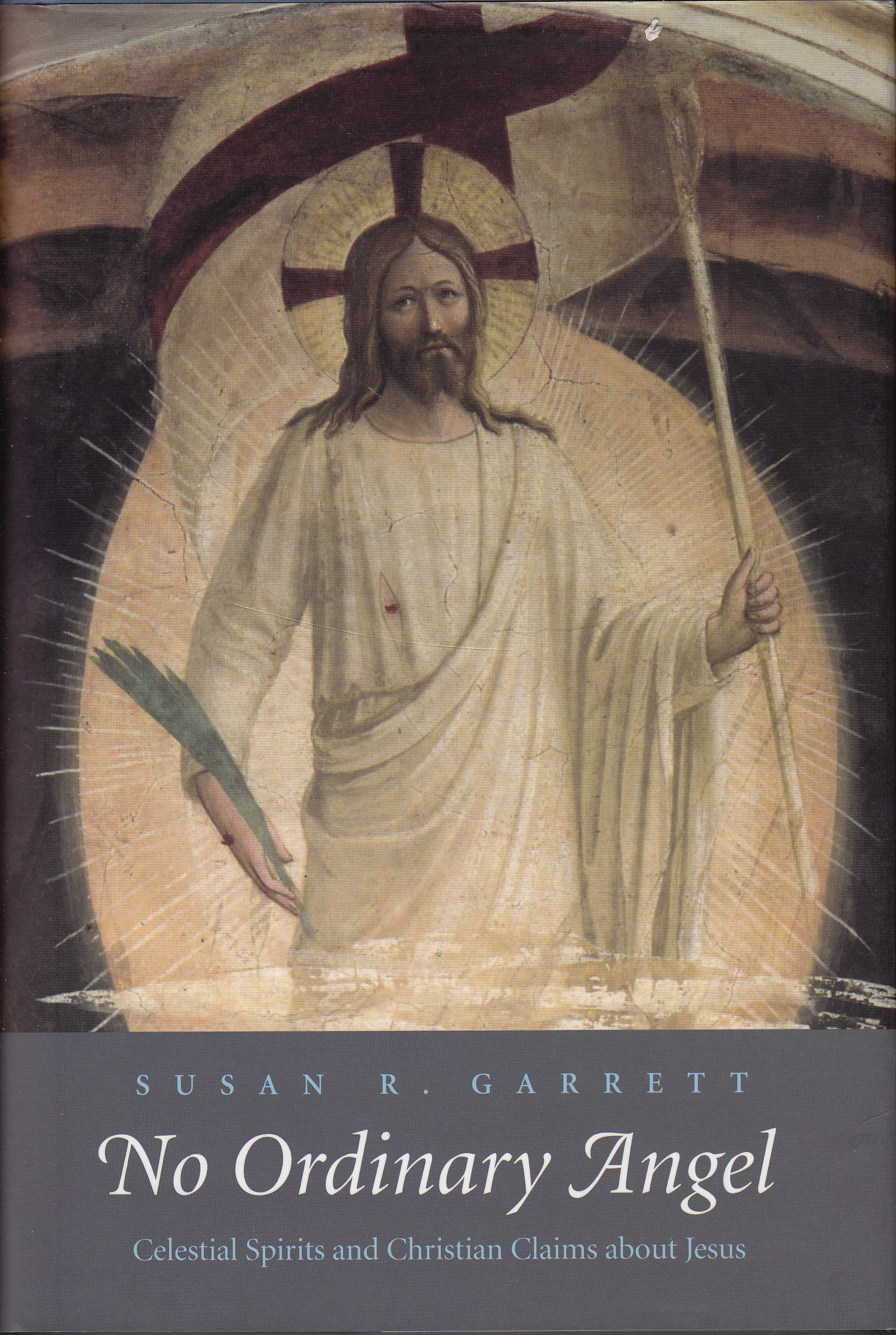
OrdinaryAngelBack in my undergraduate days, I wanted to learn more about angels. Surprisingly, there were no courses offered on the subject, even at evangelical Grove City College. When I finally took an independent study on angels, I found that few serious books had been written on the topic. I was immature as an academic, and I hadn’t learned that the subject of angels was a kind of scholarly embarrassment. Although many biblical scholars still clung to the idea of God, most had jettisoned angels along with other Medieval fabrications such as dragons and virgins. We inhabit a hardened, material world with no room for spiritual beings flitting about. As a student of ancient Near Eastern religions, I discovered angels possessed a hoary pedigree stretching back to Mesopotamia and perhaps beyond. Susan R. Garrett’s No Ordinary Angel opens the question again, and considers the many roles that angels have played and continue to play.

Subtitled Celestial Spirits and Christian Claims about Jesus, the book goes beyond the issue of angels per se, and addresses the distinctly Christian concern of how Jesus differs from them. What becomes clear in the reading of the study is that uniformity isn’t to be had. The earliest Christians already had divergent ideas on many concepts. As Roman Catholicism developed, angels attained a natural role in a world that still allowed mystery and shadows to exist. Protestants, the progenitors of much of science, cleared the closets of supernatural beings, leaving God and a table instead of the hosts of Heaven and an altar. I’m oversimplifying, of course, but there’s a sense in which the more liturgical traditions have more room for angels and demons. You don’t call a Protestant for a proper exorcism. Still, Garrett knows her stuff and shows how angels insinuate themselves into several aspects of sacred experiences of both Protestants and Catholics.

Angels come at births and deaths. They heal the sick, they protect people and they worship God. They rebel and fall, becoming Satan and his minions. Angels are, by their nature, liminal figures. They help to transition people between different states and worlds. As early back as written records, people believed in them. Outside of academia, people still do. God has become wrathful and distant in his old age and, well, you can talk to an angel without having to worry about vaporizing. In antiquity they were messengers. When God didn’t condescend to the earth, angels would come down. Now we get the sense that they’re more like us than we might have originally thought. Or maybe we’re more like them. Angels, even though they may have fallen out of academic fashion, are sure to endure longer than most weighty treatises, no matter how well footnoted they may be.


Preacher’s Best Friend

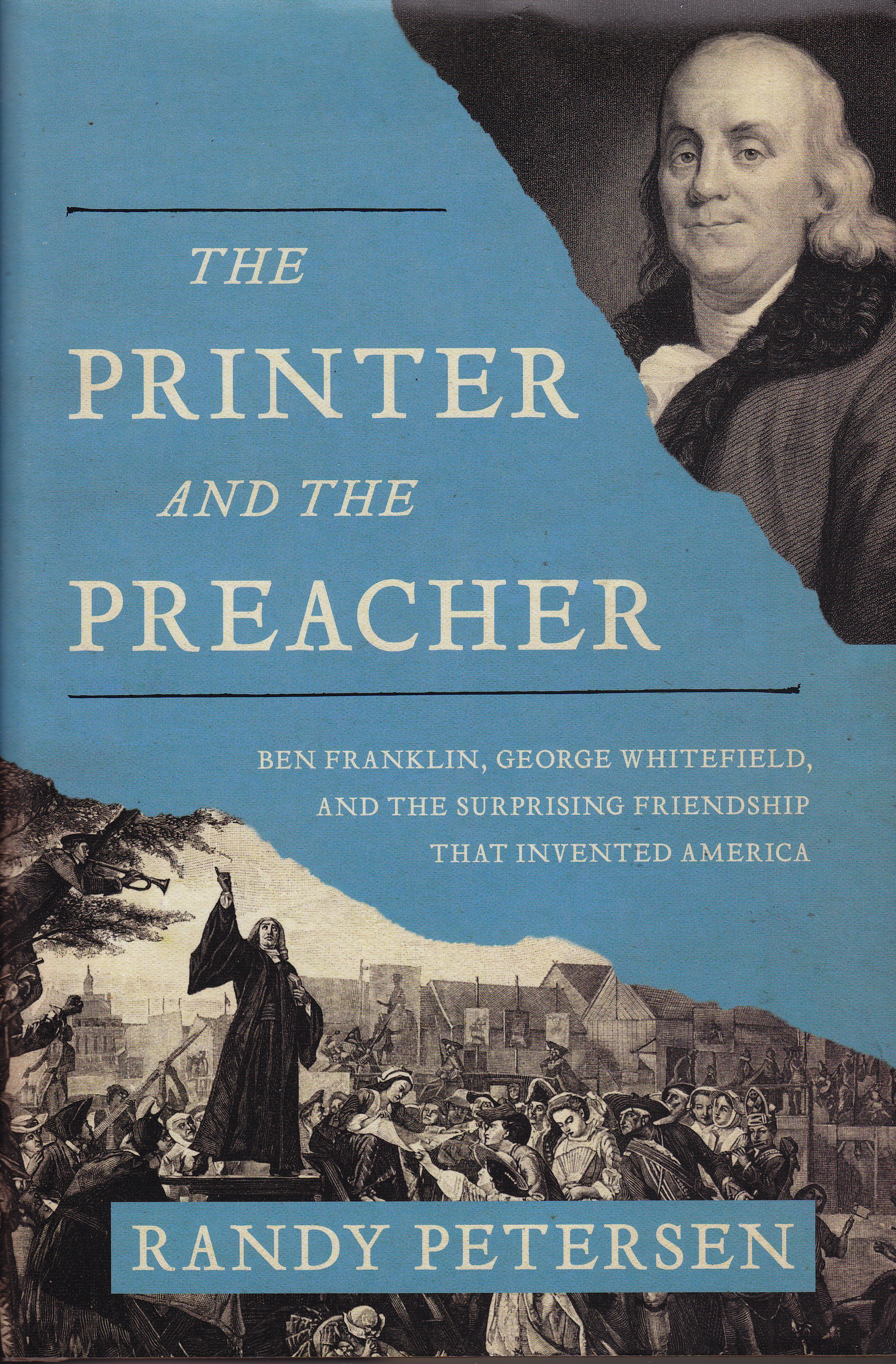
PreacherPrinterPerhaps it’s because I was born in Franklin, Pennsylvania, or perhaps it’s because everything I’ve ever read about him suggests he was delightfully unorthodox, but whatever the reason, Benjamin Franklin has always held my admiration.  Probably we all like to hear echoes of ourselves in the great.  It is difficult to believe that during his early rise to fame, Franklin was eclipsed by an unlikely superstar who was, of all things, an evangelist.  George Whitefield, an early English Methodist, wowed the colonies with his born again message, perhaps being responsible for its appeal even today.  Randy Petersen’s The Printer and the Preacher explores the unlikely friendship that sprang up between Franklin and the younger Whitefield.  While cataloguing early founders’ religious lives is always problematic, Franklin was a self-described Deist, and certainly not an Evangelical.  Whitefield was very into the personal relationship with Jesus idea that Franklin found, at best, simplistic.

Petersen’s book is a kind of wishful history.  He wants to see Franklin and Whitefield together, often suggesting that they might have met here or there, or that they might have discussed this or that.  The fact is, we have little to go on beyond the reality that the two knew and respected one another.  Whitefield stayed in Franklin’s house in Philadelphia.  Franklin printed and sold Whitefield’s best-seller sermons.  Certainly there was a good business opportunity here.  Even today the evangelical Bible market is a strong one.  Savvy businessmen and women know that a good living may be had from the Good Book.  You can’t read a book like The Printer and the Preacher without thinking that Whitefield and Franklin were a kind of odd couple.  Franklin is remembered as a man of wit and science.  Whitefield is barely remembered at all.  One of the first preachers to hire a publicity manager, Whitefield was the Joel Osteen of his day, raking in the accolades for being emotional in front of salt-of-the-earth colonials.  His oratory skills were legendary.  Even though he is honored as one of the founders of the University of Pennsylvania, he was no scholar and has largely been relegated to an historical footnote.

Petersen’s book is a quick read.  His writing is winsome in an evangelical way.  He assumes the truth, or so it appears, of the evangelical position.  Nevertheless, there is material to stop and ponder here.  Many of the questions can never be answered: why, particularly, did Franklin and Whitefield hit it off, for example.  On a more approachable level is the why of Whitefield’s faded flower verses Franklin’s perennial bloom.  The message of Whitefield simply doesn’t stand up to the experience of history.  Human beings—many of them born again—experience constant turmoil in their lives.  Franklin, on the other hand, was the consumate pragmatist.  His aphorisms are regularly mistaken for verses of the Bible.  Although others would have gotten there, we largely have him to thank for our harnessing of electricity, and even the birth of a new nation.  Whitefield’s spiritual descendants now rally to prevent stem cell research and the teaching of evolution.  Franklin’s children, illegitimate or not, reap the benefits of the lightning rod.


Headliners

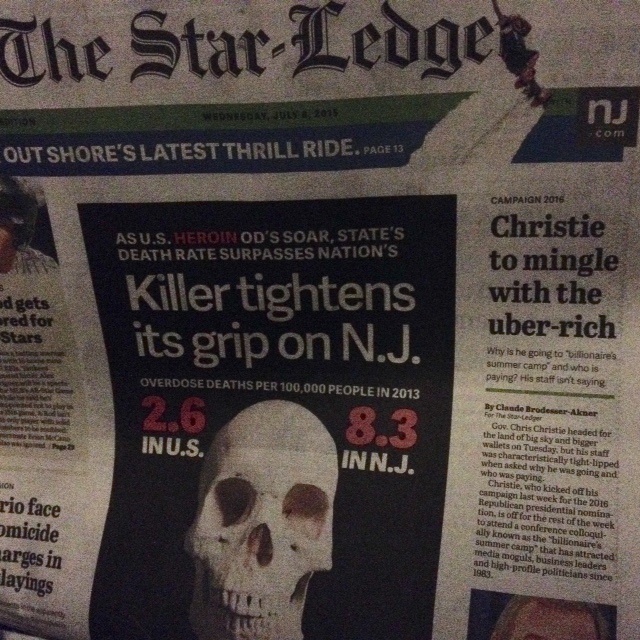
I sometimes wish I was a journalist. Just this past week a couple of people questioned my journalistic skills for an opinion piece I wrote for Religion Dispatches. I’m fully capable of professional research, but who has the time? Still, being a journalist might be fun. Thinking up clever headlines would be challenging day after day, but nevertheless, it might be enjoyable. Editors who lay the articles next to each other on the page must have a sense of irony. This past week in the New Jersey Star Ledger the central headline read “Killer tightens its grip on N.J.” The column to the right began “Christie to mingle with the uber-rich.” Having lived in New Jersey under Christie’s entire reign, I’m no fan. I’ve despised bullies since I was a kid, and rich bullies are worse than the working class variety. New Jersey certainly seems no better off to me. Now he wants to be President.

FullSizeRender

The real headline, however, about the killer in New Jersey is not yet another prison-break story. It deals with heroin overdose deaths. According to the article, per 100,000 people in the U.S. 2.6 deaths are from heroin overdose. In New Jersey the figure is 8.3. New Jersey, as the most densely populated state (1200 people per square mile, I once read) has its share of problems. Most of us like to pretend that drugs are somebody else’s issue, but I’ve known addicts and they are not evil. When life offers you unrelenting recession after recession and all attempts to better yourself run up against the 1 percent, frustration is inevitable. Even earning a doctorate will only lead to jobless misery. What more can you do than get an education? Heroin is dangerously addictive and it makes the user feel great, I’m told. Society doesn’t offer many other options. At least in Rome they had bread and circuses.

He who would be President, however, can’t be concerned about that. The uber-rich must be fed. And fed. And fed. Those whose ambition to high public office is naked power would be foolish to ignore their fellow plutocrats. Down here on the streets, things look a little dicier. Although I think I understand why many turn to chemical relief, I’ve never been tempted by drugs myself. One of the reasons I turned to religion was the prevalence of drug use in the town where I grew up. There seemed to be no future in substance abuse. I may not have chosen the most promising of ways to move ahead either, in retrospect. Now I find myself living with a governor who represents all that’s wrong with government. And if you’re going to die of drug-related despair, it seems like his particular state is the place it’s most likely to happen. Long live the king!


Theological Cemeteries

There is a plague upon this nation.  When in one week, let alone one day, I hear about two colleagues being let go from their academic posts for not meeting conservative theological standards, I believe it is time for higher education to take a good solid look at what it claims to do.  Thomas Jay Oord, one of whose books I supported and saw through publication at Routledge, was dismissed from Northwest Nazarene University after, according to early reports, being considered for a heresy trial.  Almost simultaneously Daniel Kirk, whom I don’t know, was let go from Fuller Seminary, apparently following questions of his belief in traditional marriage.  Having been dismissed myself into an academic morass that has never passed for a satisfying career, I feel a sense of moral outrage here.  No doubt, I am more liberal than either Oord or Kirk, but this is not the way educated adults treat one another.  In fact, it is heinous.
 
While still teaching at Nashotah House, before I crossed some invisible line in the doctrinal sand, I often wondered about this.  Conservative schools want the credibility of professors with bona fide doctorates, and then wonder why they can’t get educated people just to nod their heads at all the right places.  Education should make people think.  It should make us all question our assumptions.  Any faith that can’t examine itself seriously and come back to thrive is no faith at all.  I know all too well how difficult it is to get along with a doctorate in a socially unacceptable field where the higher education economy is far worse than that of our own national economy that keeps limping along.  It is a crime to fire our brightest and best.
 
The unholy roll call could go on and on.  A few years ago it was my colleague Christopher Rollston who fell under the axe.  Although I’ve not met him, I understand the same thing happened to Peter Enns.  These two recovered, at least as far as finding a position goes.  Those of us who were successfully cast into the outer darkness—and I know I’m not the only one—have watched ourselves disappear from relevance as the academic world chugs blithely along.  We are a nation that elects public officials on the basis of their supposed religious outlook while at the same time hamstringing efforts to educate ourselves about religion. I have a question for the administrators who feel they are defending the faith by taking someone’s livelihood: when is the last time you thought about your faith? Really thought? If your God can’t think then it’s not just those of us who are liberal that are destined for Hell.

ScottishSemetery


The Ethics of Deception

In New Jersey you can’t pump your own gas. If you pull into a station with a line, you have to wait your turn. Once, on my way to an adjunct job, I pulled up to the next available pump. It was the only one free, and a car pulled up behind me to wait. Meanwhile the car at the pump in front of me pulled out. The attendant signaled the car behind me to the vacant pump and then walked back to tell me that my pump was out of order, I’d have to wait my turn. I left that gas station and have never gone back.  I think about that a lot. I don’t mind pumping my own gas, and I certainly don’t mind waiting my turn.  If someone is given preferential treatment, however, my primate blood starts bubbling.

Gas pump
 
Although I’m middle-aged, I keep starting my career out again at entry level.  I’m sure I’m not the only highly trained professional in this boat.  In fact, I keep an eye on LinkedIn so I know that it’s not at all rare.  As I sit and watch the available jobs go to those younger than me, I wonder about the ethics of it all.  After all, I’m very nearly the same age as the President, and that makes me shudder.  Here’s the ethical quandary:
 
When I was a student in the late 1980s and early 1990s, those of us in doctoral programs enrolled because we were encouraged to do so by the academy.  No one can see the future, of course, but in academia it seemed if it was status quo ante from here (then) to eternity.  There would be lots of jobs, and those of us with the talent were actively recruited to enter doctoral programs and—here’s the ethics part—help meet the need that was about to come!  Did we want to see university positions vacant?  Of course not!  So we gamely stepped up, read our brains out, defended theses (far more than 95 of them) and found ourselves in a world with no room for us.  I managed to get a job, unlike many of my colleagues.  When I was let go, however, I discovered that the viable jobs were being snapped up by younger candidates.  These were students who’d entered the fray after we already knew it was a dying market.  They had the virtue of being younger, and therefore cheaper, and so the academy blithely moved on to forget those of us who’d gone through when everything short of a promise told us there would be jobs. There’s an ethical issue here.  If you know there are no jobs, should you be giving first shot at the few there are to those who entered the system when there was a future?  We used to call it paying our dues.  Now, it seems, those who’ve paid into the system all their lives will get nothing from it.  I’ll be the guy at the gas station ready to fill your car.  If you pull in behind somebody else, you’ll have to wait your turn, however.  I’ll insist on it.


Don’t Answer Me

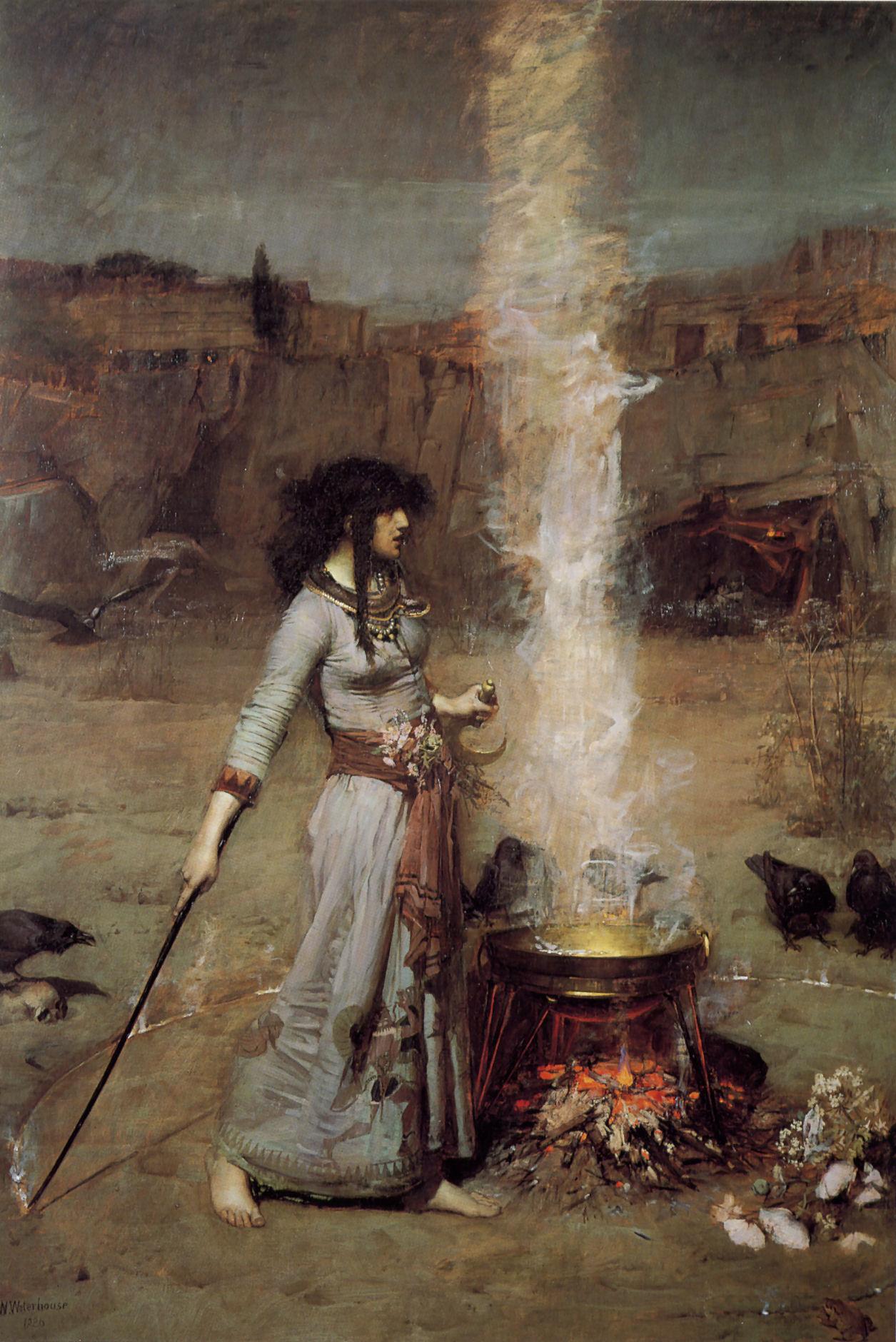
Non-directed reading sometimes follows its own track and a reader might become kind of an accidental expert. I wouldn’t claim that for myself, but I have noticed that scholars, until very recently, tended to give the cold shoulder to anything with a whiff of magic about it. Ancient magic is fair game, of course, but anything like post-Enlightenment magic is anathema, a veritable shibboleth of philistine sensibilities. No scholar worth their diploma would study such a lowbrow topic, let alone give it any credence. Popular culture, and increasingly political culture, tend to ignore academics, however. I have, in my exile from academia, become interested in those who consider themselves witches. I have, I realized recently, read quite a bit about the phenomenon and have been casting about for academic treatments that might fill in some of the gaps. It is a fascinating subject.

John_William_Waterhouse_-_Magic_Circle

Ironically, many religion scholars who swear by a mythological worldview of the first century, devalue magic, or Wicca. Many who study it handle it like a peculiar bug, something that might profitably be placed under the microscope as a living curiosity. The thing is, and I realize that academic institutions often shelter their inmates from the real world, many people still do believe in a kind of magic. It may not involve Harry Potter spells and wands, but everyday life outside the academy sometimes defies explanation. Scientists say it’s impossible, and scholars of religion are quick to lock step. Yet the number of those either openly or clandestinely joining occult groups appears to be increasing. Maybe they know something that the experts don’t?

While working on my academic paper for the Society of Biblical Literature annual meeting, I have run into the amazing void of interest in contemporary magic. The television series Sleepy Hollow has revived some popular fascination with the topic. The curious, however, have few scholarly resources to consult. Here is perhaps the paradigm that shows most clearly why higher education runs into trouble. Could it be that in the academy the Lowells talk only to Cabots, and the Cabots talk only to God? Have they forgotten how the common folk live? Those of us who grew up common are often not welcome in the academy. Our downmarket ways and simian brows mark us as the sort so gullible as to believe in some kind of magic. But the numbers are on our side. And the only option sometimes is to become your own expert.


Becoming an Icon

A kid among the Monster Boomers can’t let the death of Christopher Lee go by without comment. How many hours of my childhood were spent watching movies on Saturday afternoon TV with his many personae arresting my attention? And, of course, his prolific output just kept on coming. The Wicker Man, for instance, would never have been among my childhood fare, but his performance as Lord Summerisle is still captivating and sends shivers down my spine. Of course, he wasn’t always a horror movie star. His voice nevertheless conditioned us to be on our guard, for we knew something untoward was about to happen.

Photo credit: Avda, Wikimedia Commons

Photo credit: Avda, Wikimedia Commons

I often ponder the lure of monster movies. As a young boy, I couldn’t get enough of them. I tried to grow out of this stage, and managed pretty well through my doctoral work, but then when I found myself in a Gothic seminary where my life would be shredded and discarded, I suddenly found myself sitting up late to watch movies my family would not care to see. There was a catharsis happening here. Some would claim that it is puerile and immature—they would be the same people who’ve not been forced from careers and faced with unemployment and been dealt a failing hand by an institution that received full commitment during the formative years of an aborted career. No, those who’ve faced monsters cannot easily leave them alone.

Of course, Christopher Lee was only playing monsters. Now many people around the world can instantly recognize his name, face, or voice. We all face monsters. Our society teaches us to deny that they exist, much to our own peril. Little children, bewildered by this insanely complex world that adults have constructed, may be the ones to see most clearly. We watch the monsters on the screen so that we might figure out how to deal with them on the playground or in the boardroom. Christopher Lee was more than an actor. He was a teacher. And his best students learned something of human nature from him.


Once and Future Bible

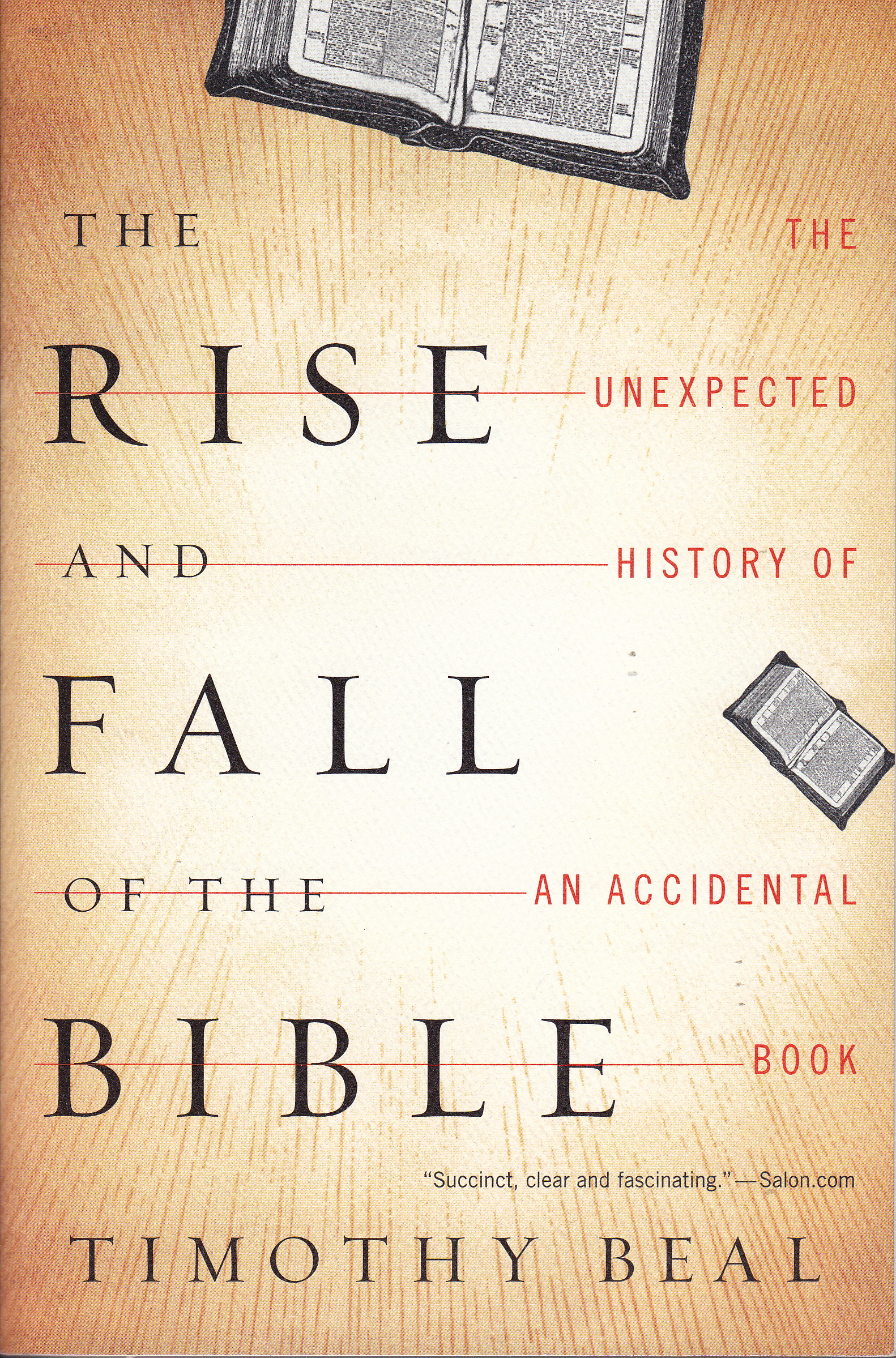
RiseFallBibleWhile I may not share Timothy Beal’s view that print culture is on its way out (I harbor hopes every time I see vinyl records making appearances in stores), he is certainly correct most of the time in The Rise and Fall of the Bible. Written for non-specialists, this book nevertheless gives his fellow biblical scholars pause to stop and think. Beginning with an eerily similar childhood experience (although mine was considerably more dysfunctional and appears to be veering back in that direction by career exigencies), Beal recounts how he came to study the Bible with a critical eye and to observe a number of important things. One of the scholars associated with the Iconic Book movement, he shows how our biblically illiterate society still values the symbolic nature of the book in various ways. We still buy, for example, lots of Bibles. We still want elected officials at least willing to swear on one. We still think it has some special kind of power.

Beal gives a brief history of “the Bible” as an idea. It is essential, as he notes, to realize that as a “thing” the concept of Bible is fairly recent. Certainly nobody in Jesus’ day thought of it as we do. What’s more, and more to the iconic element, Bible sellers have been looking for “added value” to boost the sales. Biblezines (of which I’d not heard) and Manga Bibles are only two examples of the many “extras” Bible vendors add to their texts. In essence they are making new Bibles. Beal wonders how much buyers read the actual biblical text as opposed to the other, more eye-catching material in these books. Bibles are made trendy and hip, decorated, dissected, and dolled up. And we feel virtuous for purchasing them. We play right into Big Dan’s hand, if you get my meaning.

A fascinating collection of interesting bits about the way the Bible has been re-presented to the same public for over two centuries, The Unexpected History of an Accidental Book is an appropriate subtitle here. Those who fueled the Bible craze—those that we now routinely call Fundamentalists—are among those most distressed by the indignities perpetrated upon what was once considered a sacred text. What can be more fundamental than making money off people’s beliefs? Still, for Beal and his colleagues who have managed to land the rare positions teaching Bible, there is an urgency about this whole enterprise. “These jobs,” in Bruce Springsteen’s words and my own experience, “are going boys, and they ain’t comin’ back.” Meanwhile our culture will continue to make love to its holy book, even though they may not recognize who they wake up next to in the morning.


Science v. Evil

Can we eliminate evil? More than a question of metaphysics, this is also the title of an episode of the third season of Through the Wormhole. I’ve noted before that this particular season has been delving more profoundly into areas once reserved for religious thought. Evil is perhaps the most religious of topics, as distinguishing good from evil is at the heart of many religious traditions. Fast forward from the founding of your favorite religion to today. In order to answer the question of whether or not we can eliminate evil, we turn to neuroscience rather than any sacred book. Looking at brain scans, the scientists of Through the Wormhole have isolated areas that indicate who might be a sociopath—a convenient measure of evil—and also who might be less empathetic than whom. Perhaps drugs could be developed to inhibit sociopathic behavior and tendencies. As always, these episodes leave me somewhat distressed.

800px-Planisphæri_cœleste

Losing my long-term position in higher education “without cause” threw me into mental turmoil. Never one to use medications for a long term, I was shattered when my doctor suggested anti-depressants. Would this chemical, designed to “correct” my brain chemistry change who I was? The morning the treatment began, I hesitated to take the first pill, staring long at it and wondering if the person I’d been would be lost forever. I hated being on the prescription. Worse, it was a medication that you couldn’t simply stop. The drop in anti-depressants could bring me dangerously low. Although my employment situation hasn’t radically improved since then, I eventually weaned myself from the prescription. Looking back now, I see that time as an interlude in who I was, depression and all. Mine was, thankfully, a mild case. It has, nevertheless, left me wondering about the nature of evil.

Extremely empathetic, I have never had sociopathic tendencies. I care for insects and amphibians, as well as my fellow humans. I react to the emotions of others. Yet, like all people, I suspect, I know that I’ve got my own personal evils with which to struggle. I wonder if it is a matter of degree. Religions often suggest that the solution to evil is repentance and taking the decision to live a new life. What if one’s brain, however, prevents that? Would the administration of a drug amount to a kind of salvation? And what of those theologies based on concepts of human depravity—can neuroscience prove them wrong? When the moral questions are raised, the physical solutions offer answers. Can we ever reconcile belief and biology? The jury may never come back with a verdict on that one.


Asherah’s Ashes

Academics are often poor communicators. The stunning irrelevance of most research should stand as a rather obvious clue to that. Of course, I’m old school in my approach to research. When afforded the opportunity to do so, I produced at least one scholarly article per year, and these were based on extensive research. One of the misconceptions about research is that it involves only that which supports your theory. My first article and first book, both on Asherah, demonstrated that rather clearly, I hope. A kind of scholarly orthodoxy had grown up around the goddess, originating largely in Frank Moore Cross’s work, but also in that of a few other scholars. Nobody challenged these results although they were clearly built on shaky ground. Before I finished my dissertation it had been decided that Yahweh was married to Asherah, and the two merrily danced together on a pathos graffito from Kuntillet Ajrud. After my work was published, I was surprised to see how completely it was ignored. I, like John Mellencamp, had challenged authority. And we know who always wins.

I recently read an article entitled “Iconism and Aniconism in the Period of the Monarchy: Was There an Image of the Deity in the Jerusalem Temple?” by Garth Gilmour, in a Routledge volume entitled Visualizing Jews Through the Ages. Gilmour uses a crudely incised sherd originally found in 1920 in Jerusalem, to build a turret on the house of cards of conjecture. The incised stick figures which, if you squint just right, may be a male and female, it is suggested, are none other than Yahweh and Asherah. Probably grooving together in the temple. Now don’t get me wrong—I’ve always found the idea of Yahweh having a consort conceptually satisfying. We know that other deities in the ancient world often paired off, and that Asherah was generally the main consort of the high god. The proof, however, was in the pithos. Seeing what you want to see is a constant danger to researchers. That’s why my bibliographies tended to be encyclopedic. Gilmour’s article does not mention any of my several works on Asherah, or even my articles on Baal. Apparently my work harshes the easy conclusions already drawn. Or is insignificant. Caution often is.

Consigned to while away my time in publishing, I’m aware that there’s far too much out there for anybody to be able to read it all. Indeed, when I have rare moments to engage in research during my busy, commuting lifestyle, I find myself increasing aware of obsolesce. New results are published before the proofs get to the author. Still, the number of books out there on Asherah are fairly small. Those supporting the unofficial scholarly consensus are many and top the rankings on Amazon. Nobody likes to be reminded that the dissenting view has logic firmly on its side. We see what we want to see. Research should, in the opinion of this disregarded scholar, involving searching again, even as its name implies. The foundations should be reexamined now and again to make sure the tower’s not about to topple. That’s old school. And old school is now, apparently, understood as merely old fashioned.

DSCN4422


Secular Seminary

The Nones have it. A recent article by Alana Massey from the Washington Post puts it well. We are cultural Christians living in a secular world. My mind often goes back to the fate of those trained by a system that proves itself to be false. We are seduced by religion at a young age, and we readily accept what our culture and our clergy tell us is true. Some, like yours truly, can’t rest without knowing the truth. We press on to seminary, then to graduate school, only to find that the answer is more questions. No church will hire you. No college will either. You’ve invested your youth in finding the truth and you’ve come up empty. There’s a comfort in the old liturgies, but they ring hollow nonetheless. I know many clergy feel this way but can’t admit it. What you sign on the line declares that you “believe” and if you’re honest you could lose a livelihood into which you’ve invested everything.

So I’m thinking, why not found a secular seminary? There are atheist churches beginning to appear. Those who would lead congregations of the unfaithful must have some training, mustn’t they? A secular seminary curriculum wouldn’t need to differ much from that of the standard churches. The secular should understand the Bible. You need not believe, but you’re naive if you don’t understand it. They should also know the history, the non-theology, and the way to lead a service. Pastoral care could be taught, even as it is for those who attend seminary. You need not be a believer to care for other people. In a secular society that requires some spiritual nurture, this is the obvious solution.

IMG_0481

There must be plenty of wealthy people out there willing to buy their way into peace of mind. If there’s no Heaven to own, perhaps purchasing tranquility here on earth would suffice. The numbers of those attending church is falling. The number of those desperately unhappy is rising. We have trouble believing the myths any more and science leaves us feeling cold. Maybe it is time to take seriously the concept of secular seminaries. There are seminaries for all denominations except the most conservative. Perhaps it is time for the most liberal to pony up as well. The Episcopalians have always said they wanted an educated clergy. When clergy are educated the crisis only deepens. It seems to me that this may be the cusp of a worthy idea. If so, perhaps there is hope for a sacred secular society yet.


Book Ideas

Call it sour grapes. When I was a young scholar, I used to wonder how to develop book ideas. You see, at a young age—twenties or thirties—even a doctorate means your understanding of the world is limited. I’d written a substantial dissertation on Asherah, and I was faced with developing several new courses from scratch at Nashotah House. My mind was focused on the immediate concerns. I did continue my research, however, into ancient Near Eastern deities, with an eye toward writing an account of celestial gods and goddesses. A substantial piece on Shapshu ended up being snatched up by a Festschrift, and colleagues began to tell me that to get hired away from Nashotah I had to write something biblical. Thus Weathering the Psalms was born. The research and writing took a few years because I never had a sabbatical, or reduced teaching load. In fact, administrative duties as registrar and academic dean were added to my remit. Still I scribbled away in the early hours and finished a draft. Then I was cast into the outer darkness.

Publishing was never my first choice of career. I’m more a writer than an editor. In publishing, however, you are not encouraged to write your own content. I can’t help myself. As I rounded the corner from my forties, I had finally read enough material—both relevant and extraneous—to have book ideas. In fact, too many. Held back by the lack of publication, I didn’t know how to channel this energy. One of the benefits of working for publishers is you learn how to come up with a viable book idea. I’ve got a backlog now. I’m currently working on a few books, but one is in the forefront of my mind and eclipses all other projects at the moment. Having watched what sells, I think this one has a real chance. Time to write, alas, barely exists. The writer, you must understand, has to build a platform. Get a fan base. Welcome to my platform.

Daily I receive the first books of young scholars. In this publish or perish—strike that—publish and perish atmosphere, even the mediocre is encouraged by dissertation advisors. Young scholars, maybe thirty, think they have something profound to say. Call it sour grapes, but I’m not getting any younger and I don’t have an institution to support me while I write what should be written. The face looking back at me in the morning has more gray hairs than I remember growing, and has wrinkles that my mind doesn’t recognize. It’s too full of books to write to pause long. The bus is coming soon and I have younger scholars’ careers to build with premiere branding. My own ideas ferment unseen in the basement. What some call sour grapes others call fine wine.

Photo credit: Dragonflyir, Wikimedia Commons

Photo credit: Dragonflyir, Wikimedia Commons


Fresh Thinking

Lateral Thinking_0001Creativity receives an immense amount of lip service. Too bad that doesn’t correlate to actual appreciation. I’ve been working since I was 14. In all the jobs I’ve had, the first was the one that used my creativity most fully. I was a teenage assistant-janitor, doing manual labor. Laborers have great incentive to be creative since it can reduce the amount of work you have to do. Of course, at other times it can create more work. While I was teaching (the second-most creative job I’ve held), I picked up Edward de Bono’s classic, Lateral Thinking: Creativity Step by Step. Shortly after purchasing it I lost my teaching job with a change of administration and I’ve been involved in the least creative phase of my career ever since—publishing. I hope that I’m still a lateral thinker, and I read de Bono wishing to verify that I might be.

Lateral thinking, simply put, is the ability to see things differently. Logical thinking, with which we’re all familiar, is linear, or what de Bono calls “vertical.” Each step is based on the previous step and each step has to be right all the time. My mind, however, finds avenues out to wander among the daisies during the whole process. My interior dialogue is often a long stream of “what ifs” and questioning why things are done the way they are. I guess it’s no wonder that the church was leery of me. Lateral thinking, de Bono notes, does not sit well with dogmatism, nor with the arrogance of presuming you’re already right. If you’ve already got the answers, you need not ask any more questions. You go to seminary to learn to shore up the party line. Individual thinking is unwanted, and what’s more, it’s even dangerous.

So I have moved into the realm of business which, it would seem, stands to gain the most from creativity. Instead, standard business practices hamper, if not actively discourage, creativity. Having people sit in cubicles and maintaining rigid, often long, hours, and performing tasks that a lemur could be trained to handle. This is hardly the breeding ground of new ideas. I’ve attended “brainstorming” sessions in the industry where the leader shoots down immediately any idea that doesn’t lock-step with where s/he believes the company should be going. That’s not brainstorming, it’s brainwashing. Creativity may indeed lead to a temporary loss of profits. The truly creative business mogul will know, however, that it will lead to great leaps ahead further down the road. If you want to find the truly creative among the company, I suggest one place to go. Ask the janitors. Their ideas are likely the most creative of all.


Truly Educated

Binghamton University looms large in my consciousness, for rather obvious reasons. Although it sits in a small corner of upstate New York not particularly near anything famous, it has its own culture. Having taught at several schools, and having studied at many along the way, I’ve always been particularly struck by the genuine nature of Binghamton. For example, it is the only school—apart from a hazily recalled “Bible Study” led by the then president of Grove City College—at which the president has made himself available to be met and chatted with by hoi polloi. I’ve met and talked with him twice, and although I taught a phenomenal number of courses at Rutgers, and conveniently solved a crisis in the religion department for a year at the University of Wisconsin Oshkosh, I never found a time or place when the president was available to the likes of mere mortals. Not only that, but at a time when other universities are cutting whatever faculty they can to make more administrative posts, Binghamton is actually hiring faculty and expanding. I feel renewed when I visit the campus. You can tell they care about people.

A story in the Washington Post underscores this. One of the graduation speakers at the Watson School of Engineering is an Orthodox Jew. His commencement ceremony fell on Saturday—the sabbath. According to the dictates of his faith, speaking through a microphone system that passes through a soundboard is considered work, and could not be done on the sabbath. In today’s climate, I would expect most universities to say, “too bad.” Religion is not to be taken seriously, right? So just get over it. Here’s where Binghamton, however, shines. They taped the address beforehand, allowing the speaker to take the stage and have someone else broadcast his speech. This isn’t about picking apart the logicality of anyone’s personal Torah, it’s about recognizing the human.

DSCN4915

Our very religious society has a way of compartmentalizing religion so that we can still get away with what we want to do. We can be religious when our clergy so dictate, but otherwise we’re pretty much free to look out for number one. This story is one that makes me proud to have once been a part of a system that includes a school that can truly lay claim to the designation “higher education.” We learn about the world to become, ideally, better citizens of it. Any university that is able to take what might seem to be a petty problem and recognize its human dimension deserves to have our admiration. It restores my faith in the future. At least in a small corner of upstate New York.