Education for Hire

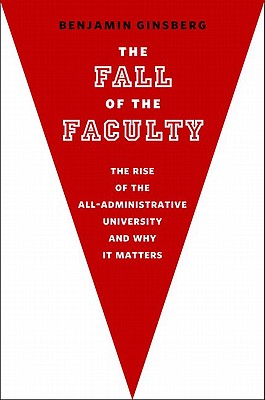
FallOfTheFacultyCapitalism takes no survivors. Ironically, the very concept of capitalism was the result of deep, intellectual reflection. Not that trade hadn’t existed before then, but the arguments that an economy could be based on these principles took an academic setting to become established facts. Universities have been the bastions of new ideas for centuries now. In the United States, however, they are being eroded into corporate playgrounds. Benjamin Ginsberg’s The Fall of the Faculty: The Rise of the All-Administrative University and Why It Matters, will, unfortunately, probably be read only by those who actually care about higher education—faculty and a few curious parents who wonder why they’re paying so much. This is a very important book, and Ginsberg addresses a theme that has been repeatedly expressed on this blog: higher education is in severe crisis because it is treated as a business, not as an educational enterprise. Unlike most situations in life where ambiguity reigns, there’s no question, in this case, whence the blame lies. Ginsberg places the finger firmly where it belongs: professional administrators do not understand, or really even care for, higher education. If you’re curious why you’re paying top dollar for your child’s education, and yet they’re being taught by adjuncts, look no further. Ginsberg has your answers.

Administration, while somewhat necessary, has become an end in itself. A self-perpetuating lackey of capitalistic double-speak. I’ve worked in corporate America enough to know that recognizing a person’s true strengths (what we used to call gifts) is not where managers excel. The bottom line is all they can see. Ginsberg’s is an angry book. And this anger is full of justification. Higher education has become just another garden-variety business, for profit at the heart of it, because faculty have let it slip away. I have been formally associated with eight institutions of higher education, and I’ve seen this pattern operate over and over and over again. Despite the fact that universities thrived in the centuries before professional administrators began treating them as “businesses,” even my alma mater, where Adam Smith himself once taught, could not help hiring a public relations firm to try to bolster the image of an institution which could claim David Hume, Walter Scott, Charles Darwin, and Alexander Graham Bell, among many others.

How the mighty have fallen. Ginsberg does offer some solutions, but is skeptical that many schools can be saved. The fact is, the highest growth rate in the higher education “industry” has been administrators. As faculty jobs are cut and diced ever finer, administrative posts increase at triple-digit rates, and their standards are those of businesses, not educators. Hindsight, of course, comes with greater acuity than foresight, but now that faculty realize they’ve been outmaneuvered, there is little hope of turning the ship in time. Nine-tenths of this iceberg lies hidden beneath the sea, and everyone presumed this ship was unsinkable anyway. Universities were devised by theologians, not entrepreneurs. Like ants crowding around cookie crumbs, business interests have been drawn to the great, untaxable bastions of what used to be called higher education. Factories come in many shapes and sizes. One of the most deceptive is that which bears the once honest nameplate of university.


Fleeting Meaning

Just a year before I had been unceremoniously dismissed from a fourteen-year teaching job at Nashotah House, devastating everything I thought I knew. I’d found a temporary job at the University of Wisconsin, Oshkosh and the head of the department encouraged us to go see the mandala that some Buddhist monks were constructing in Oshkosh one weekend. My family came up and we breathlessly watched as the orange-draped, shaven monks meticulously tapped brightly colored sand into an intricate pattern of incredible beauty. My daughter, quite young at the time, wondered what they would do with it when they were done. We’d been told, in the department, that the sand would be safely flushed into a local waterway, as Buddhism teaches about the transitory nature of life. My daughter was upset at the thought of such a nice piece of art being destroyed. But that’s part of the point of a mandala. As the Buddhists say, too many people concentrate on the hand pointing at the moon rather than on the moon itself.

Photo credit: Kamal Ratna Tuladhar, WikiCommons

Photo credit: Kamal Ratna Tuladhar, WikiCommons

I’m no expert in Buddhism. It is a complex way of thinking, and, like many religious systems, it is not unified into one particular thought-structure. Nevertheless, one of the main teachings of Buddhism is that life is, pardon the crass translation, suffering. We experience desire and we will continue to experience desire until we die. Then we’re reborn to experience desire all over again. Those who are enlightened may break out of this system into Nirvana, or a kind of non-existence where desire can no longer afflict us. There is an appeal to this way of thinking in a universe that science tell us will eventually burn out so that we’re all just a bunch of cinders in infinite, but expanding space. Almost Buddhist in its conceptualization, actually.

So when this morning’s New Jersey Star-Ledger had a front-page, below-the-fold, story of a mandala incident in Jersey City, I had to read. This entire past week, three monks have worked on a mandala at City Hall in Jersey City, for up to ten hours a day. Having watched this work, I know it can be backbreaking, and it is incredibly meticulous. Yesterday, after four days of work, a three-year old, while his mother was distracted, jumped on and ruined the mandala. A mayor’s aide, horrified, had to show the monks what had happened. A mandala is all about the transitory nature of life. Its fleeting moments are, after all, suddenly swept away. Despite the drama, the monks repaired the mandala and one of them quipped that perhaps the child’s action had underscored the lesson the mandala was intended to teach. Indeed. Many religions recognize that children know something about life that most adults simply forget. It’s the moon that’s important, not the hand.


History Department

Rather like an embarrassing personal blemish, many universities tend to hide the fact that they were originally servants of the church.  Ouch!  I know that hurts.  When I was working at Routledge I had to educate some of my fellow employees about the strange interaction between religion and higher education.  Most of the earliest universities were founded primarily as theological colleges.  That stands to reason, since as light slowly began to dawn at the fading of the Dark Ages, the practice of literacy had largely been the domain of clerics, and even today, the clergy are among society’s most dependable readers.  Universities sprang up because churches desired leaders who were informed—educated, even.  Men (at that point) who knew how to reason well.  This impetus eventually led to the kind of thinking that allowed science to emerge, although it soon had fights with its parents over who had the better perspective.  Some things never change.

University or church?

University or church?

Even considering the Ivy League here in the United States, we have schools that were generally founded for clerical purposes.  Harvard was founded mainly to train Puritan ministers.  Yale was intended to provide clergy and leaders to the colony of Connecticut.  Brown was founded by Baptist clergy, while Columbia owes its origins to the missionary wing of the Church of England.  Princeton was founded for the training of Presbyterian clergy.  Dartmouth’s Puritan clergy founded wanted a school for preparing missionaries.  Even non-sectarian Penn had clergy among its early leaders.  Cornell was the lone gunman of the truly secular schools.  The pattern even reaches to state universities that now cower at the thought of expanding or sometimes even maintaining their religion departments.  Rutgers, where I had the privilege to teach as an adjunct for a few years, was originally founded as an enterprise of the Reformed Church in America, scion of the old Dutch Reformed Church, thus giving rise to the small New Brunswick Theological Seminary that still sits in the middle of the College Avenue Campus of the State University of New Jersey.

Every now and again, I ponder this state of affairs.  Religion, love it or loath it, is foundational not only for higher education, but for civilization itself.  If the evidence of Göbekli Tepe is to be believed, religion may have been the very glue that brought societies together in the first place.  Despite the decline in mainline denominations, public survey evidence indicates Americans are just as religious as ever, or at least spiritual.  How quickly we forget that it was biblical mandates to go out and spread the news that led to the idea of a literate, educated society.  The lure of money and technology is great, and has managed to reshape the higher education landscape.  If you look, however, at the lists of institutions of higher education in the United States, even today, the largest subset is either currently affiliated with, or had been founded by, Christian groups wanting to offer education to their children. Today there are still hundreds of universities and colleges affiliated with religious groups.  Somehow I get the sense that the affection showed is not completely mutual.


Clearly Religion

GoingClear“There is no point in questioning Scientology’s standing as a religion; in the United States, the only opinion that really counts is that of the IRS;” so Lawrence Wright partially concludes Going Clear: Scientology, Hollywood, and the Prison of Belief. This is an important book, and one which once again demonstrates how seriously religions should be taken. New religious movements offer a ringside seat to how orthodoxies are born. Facts may be distorted or covered up, but there is information to be had on L. Ron Hubbard, Joseph Smith, and Mary Baker Eddy. We can learn from the way their ideas may move from fiction to fact, and how intelligent people still feeling spiritual yearning can turn to a religion invented recently as well as those invented millennia ago. As Wright points out, all religions make improbable claims. Fact-checking, however, is much more difficult for periods long gone that left only meager records. The distance in time may lend ancient assertions the benefit of the doubt, but the real decision-maker is money.

Given universities’ interests in lucre, one might logically conclude that religions would be of great interest. It is telling that, especially in the case of Scientology, that the factor most important to the status of the church is its money. Religions may claim tax-exempt status, setting them apart from purely commercial enterprises. This gives religions an advantage when they are careful with their finances, and the whole question of whether a religion is a religion is not left to scholars but to the lawyers of the Internal Revenue Service. The truth of religion lies in its bank-books, not its holy books. No doubt in the case of Scientology this is because of the high-profile court cases in which the status of the religion was challenged by government agencies. Nevertheless, when it comes to the laying down of the law, only money really matters in defining a religion.

As Wright discusses, one of the problems we face is that religion is poorly defined. Nobody can really assert much beyond that religions involve belief of some kind. Beliefs, in this case, about L. Ron Hubbard and his ideas. Although facts about his life are disputed, there can be no doubt that Hubbard was an intriguing man. He was a prolific writer with great imagination, and he clearly had keen insight into psychology. A religion used to be measured by the good it produced. Now it is measured by the dollars. As Going Clear illustrates, trying to construct an unbiased account of Scientology is a fraught enterprise. Like many modern religions, Scientology is very secretive. Even the early Christians knew that if everybody could join, then the club loses its appeal. Apart from belief, religions also must have outsiders and well as insiders. In a world measured by consumerism, wealth is the surest sign of blessing. No one should be at all surprised, therefore, that it takes the IRS to decide that which used to be taken by faith alone.


Pair of Docs

I’m not planning any trips anytime soon, but if I were I’d give Pair of Docs Travel a look. The founders of Pair of Docs are friends of mine who’ve also landed in that black hole of academia: hired, established, dismissed, forgotten. In my days at Nashotah House, eager to escape, I talked to Nelia Beth and Joel about an adjunct teaching stint at Carroll College (now Carroll University) in Waukesha, Wisconsin. They arranged for a couple of classes for me, and even wished me luck as they knew they were being forced out. Not for performance or lack of competence, but because of politics. Shortly after their moorings were thwarted, I too was cast off without an anchor. I’ve been adrift ever since. Last week, however, I had a letter from my old colleagues letting me know that they’ve gone into the travel agent business. Give them a chance—I’m sure you’ll be pleased.

An unspoken moral dimension is at work in higher education. Actually, the dimension is immoral. Those who embark on the track of higher education are culled from their teenage years by their teachers and professors. Having taught quite a long time myself, I know that a promising student stands out like a glowing rock in the sand. You know that this person is sharp enough to go far. You encourage, you advise, you try to open doors. The doctorate is awarded and before the silly academic hood touches those untried shoulders, you’ve just created another beggar to line the streets. A tin cup might be a better emblem of higher education than a diploma. At least it’s more useful.

IMG_0595

Universities keep cranking out Ph.D.s because they need the money graduate students bring to the programs. The graduate students, for the last two decades at least, have been the sacrificial victims. I have to wonder about the future of a society that takes those deemed most able by their many teachers and demoralizes them to the point of endless depression and penury. In some cultures teachers are treated like the high-achievers that they actually are. The future rests with them, not entrepreneurs. Not that you would be able to tell the difference from our sluggish economy. Seems to me that maybe we don’t have enough slaves to row this galley. And if you’re wanting to book a place on a ship or plane, maybe it would be considered a form of social justice to give Pair of Docs a try. If I could afford to travel, I know I would.


Disconnect the Dots

In the on-going loss of touch between academia and the world outside, we forever hear of the triumphal march of secularism. Academics are often loath to see the habits of the laity as being of much significance. In the book industry, however, publishers have to pay attention to what the public reads. This is one reason, I’m discovering, that some academics find it difficult to publish. Some research topics just don’t reach the wider readership’s interest. It’s an editor’s job to try to match readers with books. Among the tools we use are magazines such as Publisher’s Weekly and the Library Journal. Although it is impossible to say what people are actually reading, these periodicals trace buying and checking-out habits. And it doesn’t take a genius to see that books somehow tied to religion are frequently at the top of the list. One of the great industry trackers, Bowker, even has three distinct databases for book sales: children’s, academic, and Christian. Religion, in other words, is of tremendous interest.

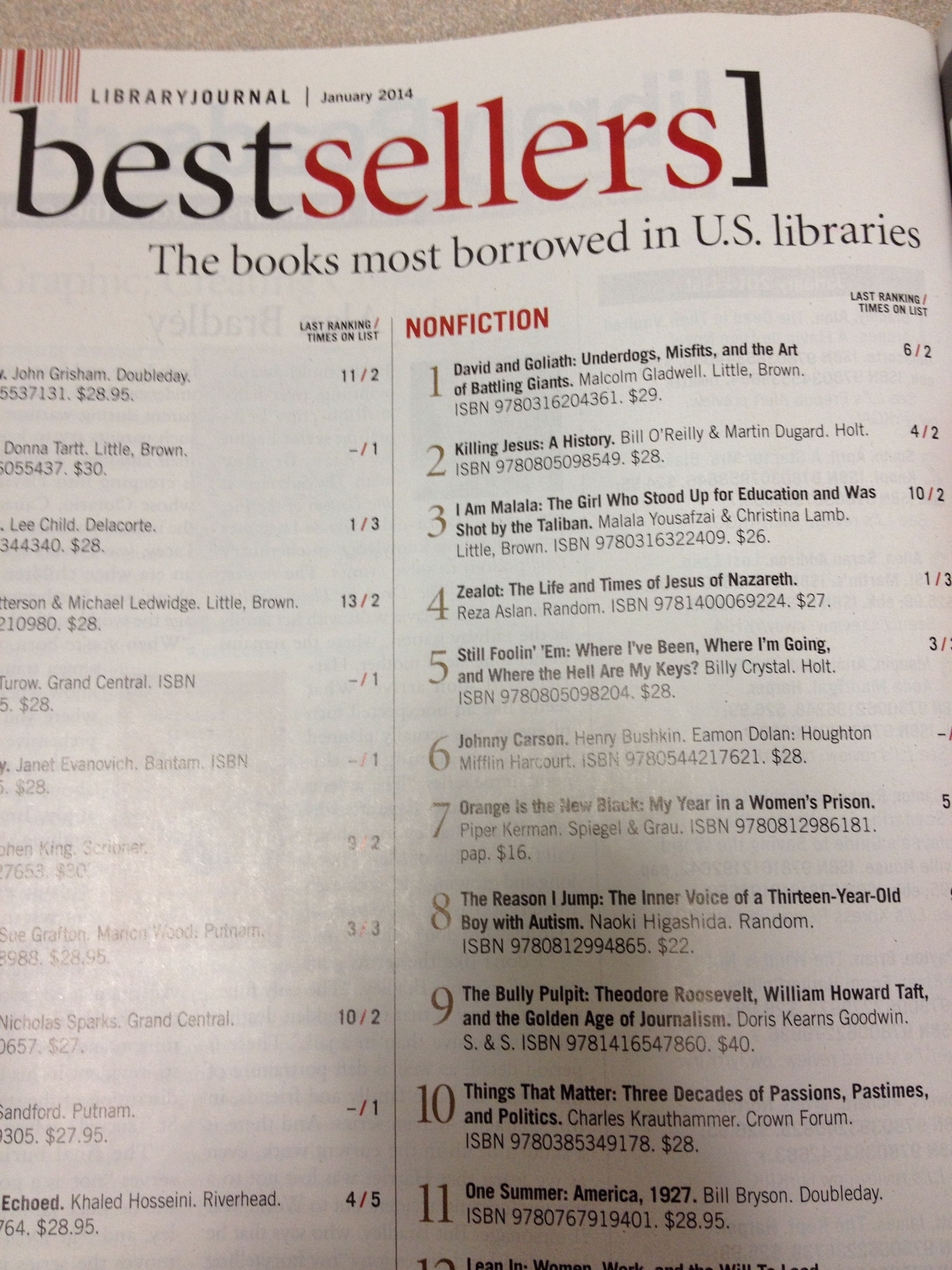
IMG_1279In the January issue of the Library Journal, for instance, there is the list of top books checked out of libraries since the last reporting period. Topping the non-fiction lists? The top four spots are occupied by books tied in some way to religion: David and Goliath, Killing Jesus, I Am Malala, and Zealot. People want to know about religion. Academics just don’t want to hear it. As a perpetual bride’s maid, metaphorically speaking, of the higher education that jilted me almost a decade ago, I hopefully watch hiring trends as the rejection letters pile up in my inbox. It is a diminishing pool. Look at the industry reporting tools: religion is irrelevant at best, puerile or worse when it comes to measuring maturity. People are dying over it, but we’d rather just not know. No wonder they call it the ivory tower—spotless as, well, a bride.

It is often a surprise to many academics how few people buy their books. As someone who had written a couple of academic tomes, I know how I daydream that my work on some obscure topic will take off and suddenly appear in the Library Journal, or Publisher’s Weekly. In actuality, the reading public will decide on the basis of what publishers make available. A writer such as myself, an independent scholar, lacks credibility and is not asked to write books. And universities aren’t hiring scholars of religion much any more. Some seminaries have even moved more toward the secular in their hiring practices, since, universities tell them, that’s the direction things are going. Those who buy books, or check them out from libraries, however, are telling a much different story. But we are much too sophisticated to look for signs among the laity. The more we progress in knowledge, the less we really know.


Floaters and Swimmers

Noah seems to have found a renewed audience these days. Nothing like a major motion picture to make even one of the most famous biblical characters even more notable. And the spin-off stories are now considered news as well. One of the many impossible stories of the Bible, the ark, as scholars have long known, would not have been a physical possibility. Quite apart from the building in days before metal smelting was invented, there was the problem of volume. Since evolution is ruled out de rigueur, each separate species had to have been represented, since no changes are allowed from that time to this. The sheer number of them, especially since new ones are being discovered even now, was deemed impossible to fit on an ark of even biblical dimensions. Add in the food necessary for 150 days, especially considering the carnivores, and the human-power required to care for all those beasts (only eight are permitted by Genesis, and Noah was 600 years old at the time) and you get the picture. Then Mesopotamian flood stories even older were discovered. It was quickly recognized that this was a myth with a larger message to tell.

Now, according to geobeats, and to the relief, I’m sure, of Russell Crowe, physics students at the University of Leicester have calculated that the ark could have floated. The story, in a one-minute sound bite, is a little shy on details. The students used the biblical cubit, and figured there were 35,000 distinct species at the time. I’m not sure where that number originates, but it doesn’t take into account how Noah got the koala’s to swim from Australia. According to present evidence, the earth is home to about eight-million-seven-hundred-thousand different species. And since they can’t evolve, that’s an awful lot of swimmers.

According to the university website, this was not intended as an exercise in biblical literalism. “The aim of the module is for the students to learn about peer review and scientific publishing. The students are encouraged to be imaginative with their topics, and find ways to apply basic physics to the weird, the wonderful and the everyday,” according to Dr. Mervyn Roy, the instructor. The students, working the math angle, didn’t expect the results to work. That they did surprised everyone. Except Noah, one presumes. The story makes clear that the number of animals was used to calculate mass, not dimensions, so squeezing all the beasts in might have been quite another chore altogether. Miraculous, one might say. As for me, I am waiting to see that pair of koalas swim from Darwin to the Persian Gulf, and then back again once the waters finally recede.

Don't forget to see the movie!

Don’t forget to see the movie!


Paying Goliath

A friend pointed me to the story of David and Goliath. Well, actually, it was the Malcolm Gladwell story of David and Goliath. TED talks have become a regular part of public education and I was a little surprised to see one based on a Bible story. If you’d blink you’d miss it. I’d seen Gladwell’s new book on David and Goliath in the bookstore, and I had assumed it was about some hidden principle based on little boys challenging giants to single combat. Who knows. So when I turned on TED and heard Gladwell describing pretty much what I would do in class, and knowing that he was raking in the bucks for doing so, I gave it some thought. Yes, it is clear that he’s done some research into ancient warfare. Most of us who read the Hebrew Bible do, since ancient warfare is a large part of Holy Writ. (Yet the world seems surprised when religions turn violent.) Gladwell’s perspective is refreshing, but I can’t help think that the Bible does indeed view David as the underdog. Yes, slingers were always an important factor in warfare, just as archers were before guns were invented. I seriously doubt David was actually packing the firepower of a .45, however.

The interesting thing is that Gladwell takes the story so literally. Historically David’s existence is questionable, although I personally see the weight of tradition as bearing on the tipping point here. There were just too many stories of the boy who killed the giant in the Bible to say it was all made up. The fact that they don’t agree in details adds a hoary venerability to the tales. But can we take it to the level of seeing Goliath as having double vision because of his gigantism, and saying to David “why do you come at me with sticks” even though the lad is holding only one? Perhaps Goliath can be pardoned for using the plural instead of dual form (he is, after all, a Philistine), but the point here is that it is a taunt. David is what the dog saw, compared to the seriously shielded Goliath. Gladwell makes some good points, but, in my humble opinion, misses the giant.

Saul, the king of Israel, fears to send David into combat because the kid will be slaughtered and Israel will be enslaved. Yes, ancient armies relied on slingers, but, like archers, in great numbers. Perhaps it was David’s accuracy that was in doubt. According to the Bible, however, Israel boasted slingers who could hit a hair at distance, and these from the tribe of Benjamin, Saul’s own people. So the point of the story is that David’s victory is a miracle. Miracles no longer fly, of course. Those who write bestsellers know best. It stands to reason. Okay, so I’ll buy Gladwell’s book now, but I somehow feel that those of us who have spent a life studying the Bible really deserve something more that jobless obscurity. I come at the giant with a tiny blog, but then, I’ve alway been an underdog. An outlier, you might say.

477px-071A.David_Slays_Goliath


Rocket Cats

Franz_Helm_rocket_cat_full_page_1

A few weeks ago the Internet’s attention was captured (if such a thing is possible) by rocket cats. Apparently the brain-child of sixteenth-century artillery expert Franz Helm, the story raised outrage and some giggles and then faded from view. In a recent Chronicle of Higher Education, however, the issue jetted back to life in an academic forum. The article by Steve Kolowich helpfully pointed out that the idea isn’t exactly new. My regular readers know that I advocate for animal rights and I believe most animals are far more intelligent than we deign to admit. In other words, I consider this an inherently bad and distasteful idea. Nevertheless, to look at it academically—Steve Kolowich was referring to the fact that the manuscript, being digitized from Penn University’s library, had been known previously. It went viral when the Associated Press decided to make something of the story. The Internet took an old idea and made it current.

The idea goes like this: a city is under siege and you’re getting impatient. What to do? Strap incendiaries to cats and birds and send them into the city that is guarded against human-sized invaders. Although this does have an evil genius quality to it, I wonder if Franz Helm didn’t get the idea from the good, old Bible. In the commentary on the rocket cats I’ve seen, nobody is giving credit where credit is due. Samson, according to Judges, was fond of the ladies. Not just any ladies, but Philistines in particular. Prior to his wedding he set a riddle for the Philistines to solve and when they pressed the bride-to-be for the answer, Samson ended up owing the Philistines a fair bit of cash. Samson simply killed some Philistines, took their goods, and paid those he owed. Meanwhile, his father-in-law supposed, reasonably enough, that Samson no longer loved his daughter, and gave her to another. In a fit of rage, Samson caught three hundred foxes, tied torches between they tails of each pair, and sent them out to burn up the crops in the field. Substitute city for field and you have Helm’s idea. With steampunkish add-ons.

In an era when the Bible is treated as increasingly irrelevant, the media (and scholars) frequently overlook how important it was to people in the past. You might even say it was inspirational. Despite all that, I’ve met a fair number of clergy who’ve never read the whole thing (it is a big book, after all) and meddlesome laity like yours truly often point out the more uncomfortable aspects of scripture. But even Samson may have to give a nod to the Hittites. Before Israel showed up on the scene, the Hittites, if i recall correctly, had figured out that it you sent a diseased donkey into an enemy’s city, the contagion would do the gruesome work for you, killing of people and well, the donkey was dead anyway. There was no Internet to spread the idea, but it was quite literally viral. Ancient manuscripts can teach us quite a lot, if we can take our eyes from the more questionable bits long enough to read the rest.


The Trouble with Trajectories

The Bible has a way of defining lives.  I realized this at a young age, and although my experience was limited to what life reveals in a small town. Still it was evident that people even there traced trajectories defined by Holy Writ.  I used to ask my students that if something effected you every day, in ways both massive and subtle, and was potentially dangerous, wouldn’t you want to know about it?  Religion in general, and the Bible in particular, fit this description.  As the road began to fork at the usual junctures of my life (high school, college, whatever comes after college), the Bible played a role.  For some reason the Hebrew Bible captured my attention more than the Christian scriptures—perhaps it was because there was more narrative in the “older testament,” and more puzzles to be solved.  While the New Testament seemed to be definitive for matters of doctrinal importance, the Hebrew Bible retained a sense of mystery and intrigue.  Many of its characters, although ending up as “good guys” have decidedly questionable episodes in their pasts.  What’s not to like?

DSCN4387

Ironically, however, I discovered a job market where someone from a Christian background was immediately suspected of a supersessionist outlook on the Hebrew Bible.  Why would a Christian have any interest in that, if not for fabricating prophecies?  Many Jewish scholars were focusing on biblical studies from “both” testaments, and my puerile interests were suddenly naive and not worthy of attention.  This dynamic has always interested me: what right does an outsider have to speak with any kind of authority about another peoples’ culture or belief?  You’d think in higher education we might be beyond such parochialism, but instead, this may be the very definition of its hotbed.  What does it take to gain scholarly credibility?  Being a “white” male in a pluralizing society certainly doesn’t help.

Books are like companions on life’s journey. My reading life started with the Bible and soon gained hundreds of other companions on that long, difficult path to a doctorate in biblical studies that defined an ill-fated career. I cannot reckon the number of books I’ve read along the way, hundreds of thousands of weary pages. And now I find myself back among the biblical crowd, from the outside looking in. They speak authoritatively, I merely whimper. Whether you see it or not, the Bible is here on the streets of Manhattan. Proclaimed or ignored, invisible or plainly manifest. And those of us who’ve spent a lifetime with it have nothing considered worthwhile to say. Once the Bible take a hold, the trajectory for life is set.


Jesus of Hollywood

What hath Hollywood to do with Boston? Not enough, apparently. In this week’s Time magazine, an article entitled “Films Are His Flock” by Josh Sanburn revisits the ark. Actually, it throws the doors open a little wider—it looks at Hollywood’s effort to woo the religious. Ironically, although universities all across the country offer courses in religion in popular culture and the Bible in popular media, they are constantly trying to rid themselves of the detritus known as biblical scholars. High brow is in, while Hollywood makes no secret of its love to the common people. For Americans the common person is religious, or at least doesn’t block out religion like the educated crowd does. And they come with pockets lined. Religious movies, if marketed well, can be phenomenal successes. In my four years teaching at a secular state university, my Bible classes were filled to capacity each semester. Still, Rutgers coyly refused to hire me full-time. “There’s no interest,” they seemed to say. “Nobody reads the Bible.”

Meanwhile, according to the article, Jonathan Bock, founder of Grace Hill Media, a marketing firm that sells the Bible to Hollywood, knows a good thing when he sees it. Noah is about to come splashing into theaters. Son of God has already incarnated. Exodus is yet to come. And those are only the movies that are explicitly religious. I had no trouble pointing out to my long-suffering January term classes that religion plays a role in many movies, most of them explicitly secular. Those in Hollywood know that religious themes—the Bible even—resonate with the general public. Having grown up in, or maybe even below, John Q. Public, I have always known that the Bible makes good movies. Doubt it? Ask E.T. As he appeared risen, ascended, and glorified, the stranger from above wearing a white shroud and backlit with a nimbus, many of us squirmed in our seats for we had seen a clever representation of our Lord.

Perhaps it is resistance to the McCarthyism of the 1950s that so many intellectuals associate with religion, but academics just can’t seem to understand that this is important. The Bible business is a multi-million dollar industry, and yet, universities would prefer to ignore the implications. Meanwhile in Hollywood, they’re trying to make sure they get the blend just right. Theatrics and theology. You’ve got to be careful whom you choose to offend. The Last Temptation of Christ, based on a novel written by a devout Nikos Kazantzakis, just didn’t perform as a Scorsese movie. It is the job of people like Jonathan Bock to figure out why. And it isn’t hard to see that it’s a buyers market on America’s left coast. Indeed, without a hint of cynicism the Bible will bring in a flood. But that’s just academic. Or it should be.

Noah looks down over Times Square

Noah looks down over Times Square


For Love or Money

IMG_1258The Council for Christian Colleges and Universities is seeking a Christian way out of a contract. It seems, according to a recent Chronicle of Higher Education article, that Edward Blews was released from his $300,000 position “without cause” (I know how that feels—not the $300K part, but the “without cause” aspect), and he wants this resolved “in a Christian manner.” To the tune of two million dollars. That’s Christian if anything is. Christian higher education counts for a fair proportion of schools in the United States, while the CCCU, defining itself as “Christ centered” has only 120 members in North America at the moment. It was founded in 1976. Ironically, my old alma mater does not find itself on the list, although Grove City College often proclaimed itself as God’s Country Club during my years on campus. Among the services listed on the CCCU website is advocacy and public policy, that will allow them the “crucial right” to hire “only persons who profess faith in Jesus Christ.” And perhaps, who can’t afford a lawyer.

Academic freedom has been on my mind a lot lately. Conservative Christian views seldom benefit from academic inquiry. These views, most of which are decidedly modern, are passed along as a package with political riders, and strive to see themselves as counter-cultural, although, in fact, they resemble the 1950s more than the 2010s. I have no idea why Blews was let go, but I do know that “without cause” hides a multitude of sins. In my case, it was shorthand, I think, for just being too liberal. I was doing a great job, but endangering the morals of majors, I guess. Teaching critical thinking does have a price tag. I don’t see seminaries on the CCCU member’s A-list at all.

It is becoming increasingly obvious that we need to understand more about human religious motivations. Reason alone cannot satisfy brains where emotion may be just as critical to thinking as logic is. I know that when I’m depressed all thoughts seem to flee, except the most dismal of the lot. Reason can’t penetrate this fog. Yet reason itself cannot be ignored. The facts it teaches are frequently uncomfortable—to scientists as well as religionists. There’s nothing fair about it. When it comes to legal agreements, however, we are at the mercy of lawyers. Ironically, those who head Christian coalitions of various sorts feel the need for financial compensation. A little lucre to wash down the humility of dismissal. “Without cause” can be the most unkindest cut of all, eh Marcus? Even Judas got his 30 pieces of silver, but the cash never satisfies.


Today’s Truth

I spend a lot of time on Amazon. My job is one of those where it is a legitimate form of research—finding authors, seeing what’s already available on any given topic, checking prices. It’s kind of like those old, heavy tomes, Books in Print. Only lighter and faster. Of course, Amazon also lets anyone become an author. Often I’ll spy a name that I don’t recognize even after years of being in biblical studies. Many of these books are written by someone with a keyboard and an ego, but no real training. Then I came across what is surely a death-knell to civilization: books that are collected and printed articles from Wikipedia. Yes, that’s right—the source your professors told you never to cite is now available in book form. University Press (university-press.org) sounds like a reputable publisher, but as the website explains, this is a place to get Wikipedia articles on related subjects bound in book form. Author not included.

I don’t wish to single out University Press; many individuals and small-time publishers exploit the fact that just about anyone can generate enough words to constitute a “book.” Long before Johannes Gutenberg was an ink-blot in his parents’ eyes, books were hand-written. That was a form of natural selection since most of the populace was illiterate. A thousand pages written by hand are authoritative by any measure. The printing press gave rise to publishers—the gatekeepers of wisdom. The publisher decided whether ideas were worthy of print or not. Of course, I’m a bit of a hypocrite for writing such things, since most of what I’ve published has been declined a time or two before being accepted. In any case, the role of the publisher was to ensure the accuracy and orthodoxy of the book. Thus it was from Gutenberg to Wales.

Wikipedia is the first stop on many a quest for new information. With a high search engine optimization, and a built-in collective corrective, in theory Wikipedia should be mostly accurate. Depending on when you access it. A few years back I was researching a historical individual when I came across a sophomoric comment about said individual’s paternity. Since anyone can edit, I deleted the statement and read on. Still, since that time, doubts have haunted me about the combined wisdom of the human race. To hear politicians tell it, universities are merely liberal propaganda tools and the truth resides in politicians’ mouths only. I shudder at the implications. It used to be on Amazon that I knew the books had been vetted by some kind of expert reader (although they even let such as me work as an editor in the industry). Now each item has to be examined closely. For depending on the day and hour, the great wiki of truth is ever changing.

From Wikipedia, of course.

From Wikipedia, of course.


Credo Universitas

DeclineSecularUniversity“I am a Christian gentleman and I teach my course as a Christian gentleman.” The quote was made to me by a colleague at a state university, regarding a former professor of Hebrew Bible, or, in this instance, “Old Testament.” The idea rankled me a bit. You see, religion departments come under pretty constant attack for such things, since in the secular university—especially one that receives state funding—the disestablishment clause looms large. How can one simply bring one’s personal beliefs into the classroom as if normative? I suppose that’s why C. John Sommerville’s The Decline of the Secular University gave me pause. Sommerville, an emeritus professor of History at the University of Florida is no crackpot. He raises some major questions that universities, of all places, should be debating.

While Sommerville is not a scholar of religion per se, he has written about religion before, and he raises some vital questions regarding the secular enterprise. It should be no surprise that secularism can become a kind of religion, especially since the definition of “religion” is anything but fixed. We still don’t relally understand what religion is, except that every human seems to have it. Some call it rationalism or science, but it is essentially belief. None of us has direct access to reality as a Ding an sich, and we all choose to believe senses, reason, and tradition, to varying degrees. Our universities should teach us to be skeptical, but can they excise belief all together? To do so would be to reduce students (and that endangered breed, faculty) to sub-human.

What is it that makes the educated so afraid of belief? I suppose it must feel like weakness to a harsh rationality. Like the implacable Romans of celluloid fame, unmoved by human emotion. Mr. Spock in charge of the nursery. Religion is quite at home in the realm of emotion, and like it or not, humans cannot survive by reason alone. We need our feelings—survival instinct, by itself, is not always rational. As a society, however, we’ve downgraded religion to the point that universities have trouble taking it seriously. I’m sure it would open a few administrators’ eyes very wide to sit in on the religion classes I’ve taught at secular schools. Although most of the students are not majors, all, in some sense of the word, are believers. Sommerville’s book contains much that is challenging, but I think his thesis is absolutely correct: any institution that claims to be human, but removes the possibility of belief, is deluding itself and all its customers.


Weathering Qohelet

Over the weekend I finished the initial formatting of Weathering the Psalms, my long-suffering book on the weather terminology in the Psalter. While I’ll have to give it another going over, a strange cocktail of feelings has come over me in the process. Scholars age quickly. The time between putting that last period on that last sentence and the book showing up in a few dozen hands is generally over a year. You feel outdated. Not only that, but this book was finished, for all practical purposes, a dozen years ago. In this world of endless, indeed, almost insane academic publishing, many books and even more articles have appeared that I should have read, pondered deeply, and incorporated into my work. That, however, is a luxury reserved for those society deems fit to place in colleges, universities, and seminaries. The predominant feeling, apart from relief, was a kind of melancholy, however. The book represents a world that no longer exists. Indeed, a young scholar who no longer exists.

From the day I started teaching at Nashotah House in 1992 (or even before), I knew it would be a limited-time engagement. The then dean, interviewing me, knew that I was too liberal to fit the medieval theology then current (and still current) at the school. As a teacher of the “Old Testament,” however, the damage I might do was deemed minimal. I wrote several articles on my beloved Ugaritic, but no job interviews came. Those who’d sussed the system suggested I try publishing biblical material—after all, that’s where the jobs are. (Ha!) So I began. Weathering the Psalms took several years to research and write in scholarly isolation. I began rising at 4 a.m. to find the time to do the writing. Most of the book was written between four and six in the morning. Yes, it’s rough. And tentative. A young scholar unsure of himself. Now I’m an old man even more unsure of himself. Still, there are insights in that outdated tome that I hope some will find worth their time.

I have a photograph of myself that my daughter took at the time. I was putting on my boots to go shovel some snow. The face in the photograph is young. Optimistic, even. I was facing the weather. I’ve come to realize that all photographs are lies. They capture an instant of time that has already vanished. In my case, a livelihood. A dream that was shredded on the plains of some theologian’s ideological Somme. Winters seem to have become much harsher since then. Colleagues who’ve found jobs prosper while the rest of us fight against nightmares and that sense that all we ever tried to do was, in the end, vanity. One of the questions in the study, The Bible in American Life is, which is your favorite book of the Bible? Mine has always been Ecclesiastes. And even as I make final preparations to ship my manuscript to Wipf and Stock, I know that the preacher is right: there is nothing new under the sun.

snowman