Holiday Season

Now that the holiday season is upon us, I stop to think about what holidays really do. “Keep Christ in Christmas” signs have popped up like winter dandelions as Trump signs consider to litter the landscape. Thanksgiving, however, gave me the opportunity to forget about all of this for a while. The culture of signs. Signs telling us we must bow down and worship. The holidays signal a season when it is okay to hibernate and forget that more powerful forces out there may wish you harm. Part of the trouble is that those who are coming sometimes can’t see beyond their own interests. Perhaps what I do for a living conflicts with the job I’m paid to do. Conscience dictates that one or the other must go. But conscience is such an old fashioned idea.
img_3092

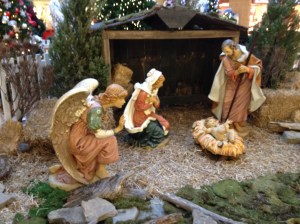
The holidays start with Thanksgiving, but it is now the Monday after. Those in liturgical traditions of Christianity will note that we are in Advent, a season of anticipation. I do wonder what we’re anticipating. Perhaps it’s because Thanksgiving came and went in a blur of travel weariness this year. The few days when commuting wasn’t an issue were the opportunity to stay still for a while and not look at news feeds and reflect on all we’re thankful for. I started hearing Christmas carols in stores shortly after Halloween. We’re entering the season of money in a country in love with lucre. Take a close look and see what lies in that manger.

Most years the stretch of dark months of November through January are accompanied by a sense of peace. Human beings loving each other and getting along. I guess I’ve been away from the news for a few days. I know there was a Black Friday last week. I also know that money has a strange way of funneling upward, a kind of osmosis of Mammon. On my quiet strolls I wonder what we, as a country, truly value. On the highway stuck in traffic with thousands of others returning home, I try to think that in these metal shells are living, breathing, loving human beings. Many of them only trying to get ahead. We’re all in a rush since there’s so much to do before we allow ourselves another holiday. Wouldn’t life be better with more days for reflection? I’d rather not politicize the holiday. Keeping Christ in Christmas seems to be asking for one not to forget the offering plate. I’m wondering about those sleeping in the street not far from Trump Tower. I’m wondering what ever became of conscience.
Abundance

img_2996

A few weeks before Leonard Cohen died I saw a story on how his song “Hallelujah” had been done to death. Covered and recovered, it seemed to be on every cover artist’s playlist. It is a haunting song, however, and the notion of a cold and broken hallelujah feels somehow appropriate this Thanksgiving. Don’t get me wrong—I am thankful for more things than I can name or would care to share with complete strangers on the internet. In fact, when I literally tried to find a job in Canada in anticipation of a horrible November surprise, one of my immediate regrets was that I’d no longer have American Thanksgiving to celebrate. Thanksgiving, to me, has been images of a cozy indoors with special food while the chill takes over outside. Two days in a row off of work. Sleeping until I’m not tired any more rather than waking according to schedule, no matter how troubling the night might have been. In short, feeling safe and secure in a world growing colder.

Since the first week of November the iciness has been growing more intense. I know it’s the circles I go around in—and perhaps they are small enough to call them semi-circles—but I have seen more sad and depressed and scared faces in the past weeks than I have seen in my previous half-century on this planet. It’s Thanksgiving Day, and even vegetarians look forward to something special by way of fancy nourishment. But it feels like a cold and broken hallelujah to me. Entrepreneurs have already been reminding us that tomorrow is Black Friday. We should get our game-faces on and our credit cards out and head to our favorite retail establishments. Pack up our troubles in the old plastic bag and spend, spend, spend.

Thanksgiving, of course, was an originally generic religious holiday. It’s hard to give thanks without someone to, well, thank. You could be Muslim, Jewish, Christian, or even one of those who thanks dharma, karma, or chance. Just be glad that we’re here right now and even though the wind is gusting and there’s perhaps a bit of snow in the air, we have an indoors where nobody hostile is looking for means to exploit us any further than we wish to be exploited. That our planet, for the time being, still supports human life. And that by any measure other than the Electoral College we all really want progress and fair treatment for all. I am thankful and mindful of those who had to sacrifice to allow us the privilege of being here today. It’s Thanksgiving, and I’m thankful.


For the People

The complex of holidays that make up the transition from light to darkness represents a different mix, depending where you are. Life on the equator, for example, experiences no real variation in daylight hours and I would expect that equinoxes and solstices are relatively meaningless. Or at least less so than where darkness encroaches. For those of us in temperate zones the difference in day length can be quite dramatic and our holiday calendar guides us through it. Getting through the darkness. So this weekend, on Bonfire Night—also known as Guy Fawkes Night, or November 5—I watched V for Vendetta again. This isn’t actually an annual practice, but some years the need to remember the fifth of November is quite strong. This is one of those years. I can’t remember having ever been this anxious about a presidential election. Tomorrow we are voting on whether we want democracy to continue or if we want a dictator who can stir hate like no candidate I’ve ever seen. He even makes Ronald Reagan look tolerable.

I’ve posted on V for Vendetta before, so I need not go over the story. The theme, however, that governments are to serve the people is a message that bears repeating. Governments are to serve the people. We’ve come to a crises point in self-government. A vote for Trump instead of Hillary is saying “I give up, I want Big Brother to take over.” Perhaps the movie I should reference is 1984. Orwell may have got the year wrong, but the story right. Make people afraid, stir the pot of negativity and they will act in desperation. Reactionary governments quickly become dictatorships and that message, mean-spirited and full of ugliness, has been placed squarely in our faces.

The point of V for Vendetta, and the point on which the movie ends, is that V is each of us. We have the ability to make smart choices just as we have the ability to act out on irrational hatred. Who would’ve thought that election years would become days of such terror? I’ve always felt strongly about social justice, and I always vote with a conscience. I have never voted for a hate-monger or someone who believes the way to help the poor is to give the rich even more. There is a deep perversity here, a cultural psychosis. And the problem is we’re locked into four years of the result. For the sake of human decency and sanity, we all need to get out and vote. And I sincerely believe that pulling that lever is a choice for self destruction (Trump) or a future of new potential (Hillary). I just hope we’re smart enough to make the right choice.

img_3024


Tis a Season

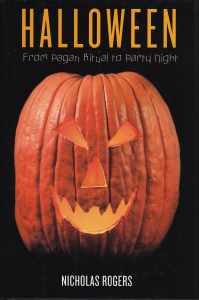
halloweenI always seem to be running late. Still, I wanted to be reading a book about Halloween on Halloween. If I might be pardoned for bleeding over into All Saints’ Day, I’ll share some thoughts this November on Nicholas Rogers’ Halloween: From Pagan Ritual to Party Night. Academic treatments of holidays, I fear, often suffer because of dispassion. Academics tend to emulate Spock in their writing, and I think that those who write about Halloween should really “get” Halloween. Oh, one can discourse about its quaint history in this ever so rational world, but one might just miss what the whole thing is about. To be fair, Rogers was writing his book during the trauma of 9/11. He wonders if Halloween may be fading. Nashotah House was suffering under an evangelical administration at that time, and the usual Halloween spirit was muted. Some fifteen years on it seems that Halloween earns yet more money and people admit that it’s hip to be scared.

Rogers gives a brief treatment of the early, but hidden, history of the holiday. The Celts weren’t much into writing about their festivals and invaders didn’t think much of their quotidian life to begin with. Trying to understand Halloween from modern times, piecing the puzzle together back over time, doesn’t really help much either. Treating the day in its British context, then in its American context, Rogers favors a thematic approach. His section on Halloween movies is interesting. Like most modern treatments of the holiday, his book makes comparison with el Dia de los Muertos, and the usual complaints of cultural imperialism. Maybe Halloween is just too much fun to pass up. It also means this post isn’t that outdated.

Nobody owns Halloween. It is taken as a serious holiday by some Wiccans, but liturgical Christians are far more intense about today, All Saints’ Day. It isn’t a national holiday and no national government decides the correct day for trick-or-treating. Perhaps prophetically Chris Christie cancelled Halloween the year of Hurricane Sandy, but did he really? Sitting in the dark for a few days with evenings lit by candles—some of them in Halloween holders—felt pretty spooky to me. Halloween may be a source of intellectual curiosity, but it is a holiday you either get or you don’t. October is its prelude, November is its aftermath. It is, as the Celts used to believe, when cold weather seriously begins to take over and light is a rapidly vanishing commodity. I may be a day late, but Halloween isn’t quite over yet.


Hallow’s Eve

img_2982

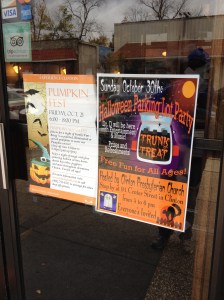
Halloween is finally here, and I’m on my way to work. Over the weekend I noticed youngsters about in costume, heading to a local business that was holding, apparently, some kind of ghostly do. For me it’s just another day—Halloween isn’t an official holiday in any government’s book. Business as usual. Still, I can’t think of Halloween without recalling Nashotah House. I began, and effectively ended, my academic career at Nashotah. Idyllically located in the woods, it was a seminary that knew how to celebrate Halloween well. We were expected—required, actually—to be in church for a good part of the next two days for All Saints’ and All Souls’ days. But Halloween night we were allowed to be afraid.

Gothic writers often used to focus on places like monasteries and churches for moody frights. Nashotah began its life as a monastery, but soon turned into a seminary. The stone buildings were old—for this country—and gothic in design. We had an on-campus cemetery with a bona fide black monk. Students reported seeing ghosts, and with such a small population of religiously devoted people the imagination grew like toadstools. One morning at around 5 a.m. the door handle to my apartment rattled loudly. I’m sure it was just someone trying to get into a forbidden chapel whose only access was through my rooms. Thunderstorms echoing through the kettle moraines that surrounded the Wisconsin campus could be impressive indeed. On Halloween the maintenance man drove a hayride through harvested corn fields and the cemetery where opportunistic ghouls would pop out to frighten the slow-moving, exposed riders.

Since those days Halloween has instead become just a day of work. No more the grandeur of All Saints’ Day being an actual holiday, holy day, followed closely by All Souls’. This is just another day except for the kids who can come around and get some candy if I’m not too tired to hand it out later. I suspect this is why I spend so much of October reading about monsters and ghosts and scary movies. I no longer have a Halloween to focus my energies. So here it is Halloween. It’s dark outside and I’ll be standing in that dark, waiting for a bus. When I climb off at the end of the day, I’ll be sharing the nighttime streets with children who are perhaps the only ones who celebrate holidays as they should be commemorated. Already a month ago I began noticing the Christmas displays in local stores. It was my first real scare this season.


Only October

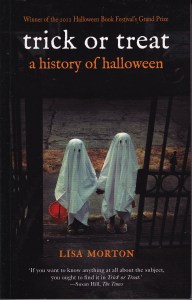
trickortreatComfort may be a strange word to describe Halloween, but it is accurate. I’m no specialist on the holiday, although I’ve read a few books on it—most recently Lisa Morton’s Trick or Treat: A History of Halloween. Growing up in what felt to me like an uncertain environment, holidays—and especially Halloween—have left me with positive impressions. Morton’s book explores this strange combination of fear and fun and suggests that many people of my generation do find comfort in its celebration. I grew up without a father in a conservatively religious home. Yet I loved the escape of putting on a mask and being someone else. Coming home with a bag of candy was a bit like that dream I still have of finding a penny on the ground and then realizing there are thousands of them just beneath the surface. There’s a security in that dream and I always find a tear in my eye when I awake from it.

Halloween is, appropriately, a chimera of holidays. It is solidly pagan. It is equally solidly Christian (specifically Catholic). Perhaps to placate those troublesome Celts, the Roman Church moved its commemoration of All Saints and All Souls to November 1 and 2, allowing for the Eve of what used to be called “All Hallows” as a holdover of Hibernian lore. Morton goes beyond the northern European fascination with the darkening of the year to explore other regions and how they mark the season. The southern hemisphere, obviously, doesn’t have the same pattern of autumn and spring, and the holiday has had less success there. The threat of the light never returning has to be real to make the fear stick. The warmest memories of my childhood seem to come from the days artificially lengthened by electric lights and the holidays they spawned: Halloween, Thanksgiving, Christmas. Comfort.

The air has begun to turn chilly around here. I’ve found myself shivering a morning or two while waiting for the bus. As I pull on my coat and step out into the pre-dawn dark, a stop sign creaks eerily on the deserted street. I’m headed to a long day in a city of stone and glass and warmth will be difficult to find. Halloween decorations get lost in the enormity of New York City and its constant quest for money. So I recall Halloweens of my small-town childhood. I tend not to go out at night, but I haven’t always been this way. When there was an unspoken comfort awaiting at home, no matter how frightening it could be at times, I would brave the dark and ask strangers for candy. Is it any wonder that Halloween still glows in a world somehow grown too cold?


October Weekend

img_2973

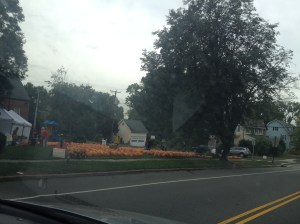
Bright orange pumpkins under a cloudy gray sky. October is surely here. But this is an urban area of the kind in which northeast New Jersey specializes. As I approach I see that it’s a church. A church that has made a truce with Halloween. Judging from the number of people here, it’s a cordial detente. So much of American society lies mired in contradiction that I have to ponder this. Halloween in an age of nones may be simply fun. An opportunity to spend money on pumpkins that won’t be eaten and gourds that can’t be. Decorations for a mildly scary night that somehow makes us feel comfortable and snug at home. October is like that.

Churches have been struggling to maintain active memberships. And although the antagonism has been overblown, Halloween has been an uneasy part of the church calendar. It has, however, become a major commercial opportunity. Depending on the commodity, only Christmas or Easter will draw more lucre from people. The devils and demons and ghosts of Halloween sit awkwardly in the pew next to the victory over death that is the main draw to traditional Christianity. But people will predictably spend their cash for the privilege of carving a pumpkin. Just the memory of the scent, the feel, the contentment of creating a jack-o-lantern makes me want to stop and support whatever denomination this might be.

It is a weekend, however, and I have many errands yet to do. I content myself knowing there are happy people in this temporary pumpkin-patch. The faith of Linus is a powerful thing. To get ready for the week ahead in which I’ll have time only for working, commuting, and sleeping, I keep moving. The orange fades from sight. The cheerful memories of childhood pass. I go on to my next stop. My first errand began at 6 a.m.this morning. Noon is fast approaching. I need a tiny piece of hardware that can only be found in a big box store. I prefer to support the local economy but that shop is all the way across town. Inside the Depot plastic Christmas trees of every description fill the front of the store with winter dreams of even more spending. I forget what I came in here for.


Day Labor

It’s difficult to believe in Labor Day. Don’t get me wrong—I’m glad for the day off. It’s just that I don’t think people really believe in the idea any more. It’s hard to take professed goodwill for workers seriously in a plutocracy. Especially when money’s a fiction. When pay was in coin, although abstracted, you were literally handed something of value for your work. Now technicalities and loopholes and utter abstractions make some—including would be and actual politicians—wealthy. These are all tricks on paper, affirmed by accountants, and we watch like the audience of a magic show as the improbable is made out to be actual fact. And these who hold this imaginary wealth control the lion’s share of the waking hours of the rest of us. We’re given Labor Day off with a pat on the head and we’re told to go enjoy ourselves before summer is up and we really have to get back down to work.

DSCN5084

Many of us—I know because I can see the cars—use the holiday to travel. It’s not really so much a day of rest as it is a day of trying to get back home so we can be to work bright and early tomorrow. Since it’s the last break before Thanksgiving you’d better enjoy it. If there were really money in that pay envelope—not even real envelopes are used any more—it might be easier to buy the illusion. Like Amazon I take a small cut of the transactions between employer and debts I owe just to live near where I work, which isn’t really so near but as close as I can afford. At least today I can not go into the office. I can spend the day getting home instead.

I often wonder why we’ve let ourselves be fooled by a system that will only ever allow the very few to truly find financial independence. Like lemmings we run right after them, thinking that just beyond that cliff true prosperity lies. A chicken in every pot. A car in every garage. Right now all those cars are actually out on the road—I can see them—and they’re not really paid for because they cost too much to buy outright. Most of us need them to get us to and from work. Or to and from vacation. Summer’s winding down. Hurricanes are already spinning away in the Atlantic. I’ve grateful for the day off. I really am. I only wish I could believe that it meant something deeper about human nature.


Becoming the Past

Back home for a flying visit over the final dregs of the summer, I find myself in a hotel in my hometown. It’s an odd place to be. As I’ve often remarked to those who know me, I remember living in three houses in this area and all three have been torn down. Looking over the vacant lot where my elementary school once stood, I have a feeling of being erased. Just up the hill from my hotel is a blank space, like when a molar has been removed, where my junior high school once stood. Even the seedy shops I remember from childhood are gone, an entire block of buildings torn down. Wal-Mart opened up just a couple miles away outside of town, and all small businesses got down on their knees and prayed before dying. Being from somewhere is more than just a matter of going away. It’s also coming back.

IMG_2930

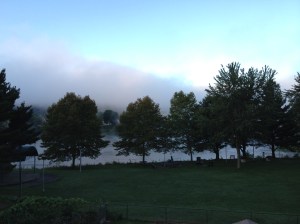
Standing outside in the misty morning sipping my coffee, I watch the river flow. There’s a fog rising over the Allegheny this morning and it makes this place look mysteriously beautiful. I think back to New Jersey, where I was at this time the day before, and how I can’t step outside without seeing other people. I go jogging at 4:30 in the morning sometimes. I’m never alone. On this balcony over the river I see no one. That person down by the river is really just a statue. Maybe I am too. What is left of a person when their hometown disappears? My fascination with ghost towns is catching up with me. Once someone said they thought I disliked small towns from the way I talked. Quite the opposite, the statue whispers. Quite the opposite.

If it weren’t for the people I know, would I ever come back here, I wonder. The warm coffee through the styrofoam cup reminds me of Judas. Even he knew how to kiss. This town, shrinking with age, gave me life. When I stamp the streets of Manhattan on my way to work, I know I’m a different man than I was back in this town. I would’ve found it difficult not to want to help anyone in need, back then. This homeless guy’s been sleeping in the same spot all week while millionaire wannabes look the other way. There’s a mist on the water this morning. The Allegheny flows on to the Ohio, and the Ohio on to the Mississippi. Down into the gulf that’s part of the ocean than encompasses us all.


Nature Worship

IMG_2383

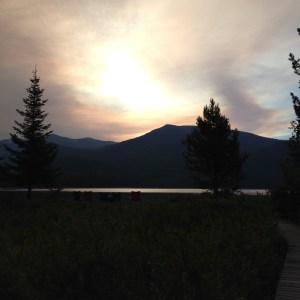
Here I am in a natural setting, with nature close at hand. From these windows I can see mountains, a mercury-smooth lake with fish breaking its silvery sheet, and trees aspiring for the sky. I hear a red squirrel chattering from one of those trees, and the call of a lonely osprey looking for its morning meal. It took a day of arduous travel to get here, and I am staring at a computer screen as nature puts on her show for me. I think, “it’ll still be there when I get done.” Then I think about what I think. Will it be there? This world we’re creating in our own image demands more and more of the planet we inhabit. To which we feel entitled. As I stood at the airport staring at the monitor, I couldn’t believe that my flight had been cancelled. What? I arrived at the airport at 5 a.m., flew countless miles, only to have you tell me my flight has been cancelled? Am I not owed better than this?

This attitude, I reflect, may be what brought us to such a place to begin with. This incredibly beautiful world was never ours to own. We’re guests. Invited perhaps, but guests nevertheless. And we all know that guests are supposed to be gracious and to act as if they wish to be invited back. So why am I rudely sitting here, ignoring my host? We are part of nature, but we tend to think of those closely attuned to nature as “uncivilized.” They don’t dress like city dwellers. Their hair is worn differently. They value things money can’t buy. They don’t play the entrepreneur’s game.

I travel to “get away from it all.” That which I’m getting away from is my life every other day of the year. How did we come to call this “civilized”? There’s no denying the creature comforts of a place to call home and a routine that seldom varies. But sitting here, amid nature, I realize the tremendous cost. Even as soon as it began to warm up in New Jersey we tried to carve out the time to explore local parks. To be outdoors among nature before heading back to the office on Monday. The whole point of worship is to break the flow of everyday time. To stop and think of the good that we have been invited to enjoy. I find myself amid this splendor, and I sit at my computer while nature awakens around me.


Things Remembered

IMG_2839 copy

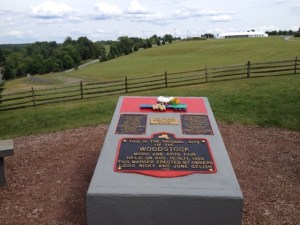
Freedom. Independence Day is our celebration of liberty. Yesterday I happened to find myself at Bethel Woods, the out-of-the-way location in New York where Woodstock was held. Probably no one in 1969 realized just how formative Woodstock and its message of peace, love, and music would become for American culture. Those of us who came of age in the ‘70s learned about it as recent history (I was only seven at the time and, I’m sure, would’ve found the whole thing somewhat unChristian had I been here then). Much has changed in the intervening years. Not many peaceful events get so much airtime any more. Upwards of 400,000, basically unpoliced, youth, gathered in Bethel, New York, for three days of music, chaos, and peace. The Vietnam War was still draining our nation of its youth and murdering its idealism. Fear of the other, racial inequality, and male superiority were part of the context that led to the need for Woodstock. Freedom was free.

Often on this blog I reflect on the sacredness of place. Events that take place in a location leave their impression on the land. Bethel Woods Center for the Arts, the current administrators of the property, have left the field largely intact. As my wife and I stood at the top of the hill and tried to imagine almost half-a-million people here, it was strangely quiet. The nearby museum had plenty of music playing, but standing where it actually happened, there were only ghosts of an event studied in school and which, even today, kids can generally identify. I couldn’t have named every act that played the concert and, although the music was clearly important, it was the gathering that is most remembered. Self-governing youth getting along in an area so remote that still today you have to drive a couple miles to find even basic necessities, sent a powerful message. It was an event that, I fear, can never be replicated. The snake has spoken.

Nearing fifty years later, we’ve become so paranoid that anyone who looks Middle Eastern is under suspicion. Guns, which children of the sixties shunned, have proliferated and may now be carried, wild-west style, in many states. A fear-mongering candidate bellows fascism before the Grand Old Party. Remember, Nixon was president during Woodstock. I may have lived hundreds of miles from here, occupying myself with the matters that seven-year-olds find so pressing. But Woodstock happened. By the time I got to Woodstock, everybody else had gone. I see others milling about the museum, slightly older than me. Perhaps some of them were here for the event itself. We all seem to be searching for something here. The festival had its problems, for sure, but with a sincere belief in freedom, it makes the pre-seventies United States feel like a strangely foreign county. How do we get back to the garden?


Holiday Weekend

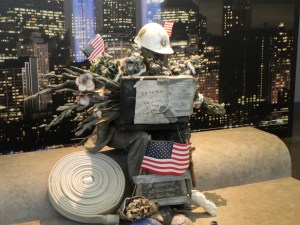
John Seward Johnson II is a sculptor whose work is instantly recognizable by a number of people. Realistic, life-size bronze castings of people doing everyday things, some are painted so as to be difficult to distinguish from quotidian humans. Others are left more abstractly colored or sized so as never to be mistaken. They are, in many ways, explorations of what it means to be human. One of Johnson’s statues, “Double Check” presents a business man sitting on a bench, checking his briefcase. It is most famous for having sat near ground zero and having confused rescuers as a real person traumatized by the events of September 11. Memorial Day seems like a good opportunity to revisit the statue that many thought was human, and which many people still adore.

DSCN6309

While perhaps the most obvious question a sentient being can ponder, what it means to be conscious (and in our case, human) is without an easy answer. We are animals aware of our own mortality in a way that causes many of us angst, or even terror. Humans (and perhaps other conscious animals are) notorious anthropomorphists—we think of other creatures, and even inanimate objects as being like ourselves. We can mistake statues for real people. All too often we treat others as if they were made of cast bronze. Memorial Day is for remembering, but the fallen haven’t only been the victims of the madness we call war. Violence done to others for one’s own gratification is an act of war on a personal scale. Individuals who destroy many others need to stand long before a statue and ponder.

“Double Check” has become an icon of sorts. People left gifts and remembrances for the victims of the attack on the statue. When the real thing isn’t there, sometimes a statue will do. This can teach us something about being human. As we die, at least in this culture, we are buried and a headstone becomes our statue. Our representation for the world to remember that we were here. Our progeny may lay flowers on our grave on this date some day in the future while statues that look just like humans will remain largely unchanged, asking those who remain alive to check again. To think, what does it mean to be human? And when any of us may be tempted to harm anyone else, perhaps we should gaze at a statue and consider the implications.


Literate Madmen

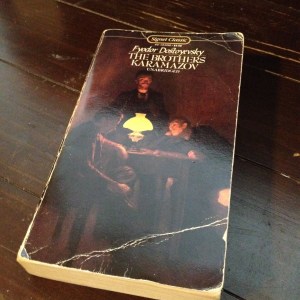
My experience of paternal parents growing up never led me to think Father’s Day was a holiday particularly worth celebrating. (Don’t panic—today’s not Father’s Day!) I do have an ironical sense of humor about the commemoration, though. So the other day when I clicked through one of Amazon’s many daily ads to my email account, I noticed it was for Father’s Day gifts. The first item listed was Fyodor Dostoyevsky’s The Brothers Karamazov. Probably based on my browsing history, I thought. But no, I’ve been looking at non-fiction lately and I bought my well-worn copy of Dostoyevsky before Amazon was a gigabyte in Jeff Bezos’ eye, back when I was in seminary. Then it dawned on me: this is perhaps the most famous patricide novel ever written. Had the Amazon advertisers really thought about what they were recommending? “Here, Dad. It’s a book about sons killing their father.” If marketing is driving America, it may be time to pull over at a rest stop for a coffee break. Or at least read the book first.

IMG_2796

I don’t pay attention to when Father’s Day is. It comes somewhere in that complex of spring holidays that include Passover, Easter, Mother’s Day, and Memorial Day. When my father was alive I sent him a card. It was a card to a stranger, but as Episcopalians know, it’s the done thing. I loved him, but I didn’t know him. Not that I’ve been a parent that deserves a holiday dedicated to my skill either. I confess my fair share of parental failures. They play and replay in my head, in the way the Protestant brain can never quite clear itself of guilt. We, as people, I believe, generally try our best to be good parents. It can be difficult, though. Nothing really prepares you for it.

One of my brothers once told me that, after having a girlfriend with kids from a previous marriage, he better understood how our stepfather viewed us as inherited children. Although I always want to claim the victim role in that scenario (I was only ten, what could I do?, etc.) his insight has stayed with me. It can’t be easy to inherit someone else’s progeny. It’s tricky raising your own child—that new person you want never to experience your own disappointments in life. Even cynics can be sentimental. But then again, I’ve been plowing through The Brothers Karamazov again since January, frequently laying it aside for weeks at a time. It’s not the kind of book I’d give a father on the edge. It’s okay, I think I’m good to drive again. I just won’t pay any attention to the ads I see beside the road.


With Your Measure

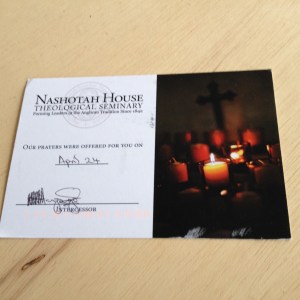
“With what measure ye mete,” someone once said, “it shall be measured to you again.” I certainly hope that’s true, but empirical verification seems to be lacking. I’m looking at, with the full armor of irony, a postcard from Nashotah House. Those of you who’ve long read my posts (I know who both of you are!) will know my history with said sacred institution. No, it’s not with me that they stay in touch, but my wife. You see, she’s one of those women who kept her maiden name, so in the eyes of many at the sacerdotal school we were probably never properly married. They certainly never came out to wave goodbye. Anyway, this past year they’ve begun corresponding with my spouse. I can’t remember—did I ever teach there for a decade and a half? So what are these sweet nothings they’re sending?

The card in front of me informs me that they’ve been praying for my spouse. Don’t get me wrong—she’s married to me and she needs all the help she can get—I never begrudge anyone’s prayers. I also can’t help exegeting a bit. Occupational hazard. One of my students once told me “don’t exit Jesus from your exegesis.” And they tell me I have no practical experience in the real world! So I’m looking at this prayer card wondering whose autograph it is. A man wants to know who’s praying for his wife. More than that, it appears that the name was scribbled out and written again. Did someone pray for those in the outer darkness by mistake? Heaven forfend! Alas, for my meting days seem to be about done. I must have a measuring tape around here somewhere.

That same guy whom I’ve quoted above also said, “pray for them which despitefully use you,” which I suppose might be some good advice. I understand that one-percenters and their ilk couldn’t be where they are despite using you. You just can’t help it—if something is inconvenient, you can simply toss it away. Build a tower to the heavens—what can be more biblical than that? See, words are endlessly flexible. They can be twisted and turned and made to say whatever you want them to mean. And should it ever come to meting cups, there are some recipes that might call for more than a wafer and a sip of wine. This is probably all obscure, but I’m trying to read by candlelight, and this text seems to say “when thou doest thine alms, do not sound a trumpet before thee” and “when thou prayest, enter into thy closet, and when thou hast shut thy door, pray to thy Father which is in secret.” But how will anybody send you money if you don’t let them know?

IMG_2767


The Devil, You Know

I’m the first to admit that I’m behind the times. Too much of my free time is spent reading weird news or going to used book sales to keep abreast of what’s happening in the adult world. If it weren’t for my wife sending me news stories via the internet, I would still be wondering why Gorbachev isn’t helping to hunt down Osama Bin Laden. Since I’m captive to a religious worldview, I was interrupted in my calculations by the news that Ted Cruz is, allegedly, Lucifer. My research had me on the trail of Santa, since the simple transposition of two letters would give us the title of the Zoroastrian prosecuting attorney. And, I figured, it was fairly safe to out St. Nick when Christmas is still eight months away. Hopefully I’ll still find something in my stocking come December. I kind of figured that when we found the real devil he would be a Republican in any case. Even as I write this, Cruz is out of the race. I thought the Devil never gave up.

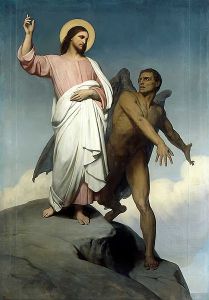
I wonder where else in the civilized world would politics be such a joke. Can you trust the opinion of a man named Boehner? It’s easy to change your name—just ask anyone who came through Ellis Island. They’re laughing at us, folks. Seriously, they are. I don’t get much email, but I’ve had two international missives asking me what’s going on over here. It’s a good thing I don’t know, otherwise I’d have to try to explain. You see, the Bible doesn’t say much about Satan at all. In the Hebrew Bible there is no devil. By scraping together the few references to “the Satan” and morning star, some have said the alleged Ted Cruz of ancient times was clearly in the Bible. Somewhere between the Testaments he showed up. By the time Jesus was old enough to climb temple towers, he was there. In the meantime the Zoroastrians had come down from the North Pole…

Then there’s the fact that when he’s not wearing a conservative suit and announcing a female running mate, the Devil is described as looking like Pan. Goat horns, goat feet, but always the torso of a man. And he’s red, just like the Coca-Cola red of Santa’s suit, and states like Texas. It’s a good thing I don’t read any more conspiracy theories than I already do. You’d probably find me tootling away on my pan-pipes waiting for a bus in the Port Authority. No, there’s a reason I stay away from the real news. It might interrupt my fantasy world. And, I’m afraid, it might actually be more entertaining. And don’t worry about my Christmas—I plan to have an eleventh-hour conversion, just in time to have a chimney installed in my apartment. If I can only be sure I get it done before February.

There's something political going on here...

There’s something political going on here…