Build a God

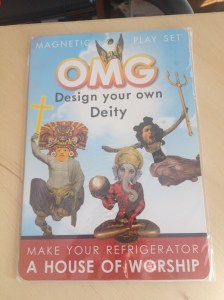
One of the more amusing gifts to find its way under my tree was a Design Your Own Deity magnetic play set. Since I have roughly only this brief holiday break for play in the entire year, I hope to make the most of it. Nevertheless, things like this always suggest something a bit more profound than they were possibly intended to do. The origin of deities is, by its nature, an unresolved question. Partly it’s because regardless of the reality of gods, religions are human constructions. Claims for revelation are frequently made, but the implementation is always our own. We can’t help but think that divinities are motivated by the same kinds of things that people are. I suspect that’s because we make gods in our own image.

img_3116

Historically there are few religions that were admittedly made up. We tend to treat with scorn more recent religions since we’ve become skeptical of a make-your-own deity talking to a person in the post-Enlightenment world. It’s much easier to believe if we say it happened long, long ago. Before we had the reassuring uniformitarianism of science, much could be left to the meddling of deities. Once we had a naturalistic paradigm, the door seemed to have slammed shut on supernatural explanations. Gods, who had been persons, now became symbols and symbols seemed to be less important than the real thing. Hadn’t we been designing our own deities all along? Now don’t we feel silly!

One of the common misconceptions of modernity is that ancient people weren’t very smart. We believe that because they lacked our technology. Looking at the way technology now demands most of my time, I wonder if that’s right. In the light of gadgets, deities have been squeezed out. I’m quite aware that the career choices I’ve made—involved with thinking about gods in some description—are hopelessly outmoded in the technological world. Still, as I look at the political landscape I see that we are still in the process of making our own deities. My play set includes some pretty exotic divinities. One that it seems to be lacking is Mammon. Of course, it’s best not to offend the currently reigning god, even if it is just a symbol.


The Morning After

dickens_gurney_head

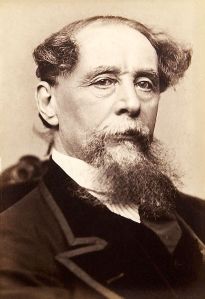
Quite apart from seeing a live performance of A Christmas Carol, Charles Dickens has been on my mind a bit this Christmas season. I suppose that’s not surprising since it has been suggested that Dickens “invented” the modern Christmas, but it is really, I think, because of how the wider world seems to be spinning backwards. The poor have always been a personal concern of mine. I grew up poor and I know how much suffering it entails. My case was a rather mild poverty—we were never out on the street, and we didn’t actually go hungry. We had nothing in the way of luxuries, though, and I could see the possibilities even as I could see the sky where the boards on the roof were pulling apart. It wouldn’t have taken much for us to have been cast out in a cold Pennsylvania winter. Others have it much worse.

On my daily walks to work, I see the homeless. Some sleep in cardboard boxes, some in tents. Others are out under the stars. One morning I walked by a particularly creepy and sad sight of a person sitting, shrouded in a blanket over his or her head, on a subway vent to catch some of the ambient heat. I know that I don’t have the means to buy each one a meal. Their number has been going up, not down. And I think of Bob Cratchit, threatened and bullied by Ebenezer Scrooge. He will lose his job if he’s not in early today, the day after Christmas. Because of his change of heart, Scrooge buys his clerk a pot of “smoking bishop.” And herein lies the only possible cheer.

My wife got me started on Dickens. She also sent me a story from NPR on smoking bishop. It seems, according to the story by Anne Bramley, that British Protestants delighted in making fun of church offices by naming their tipples after titles. Churchmen (and they were men) were largely exempt from being poor and, according to historians, often supported the Poor Laws that made the fate of the poverty-stricken even worse. In a kind of perverse revenge against privilege, drinks were named after various ecclesiastical offices. There’s little that the poor can do, except to try to find the scant humor in a situation where no one has the reach of a Charles Dickens anymore. Ebenezer, unlike Bob, is a biblical name. It means “stone of help.” In these chilly days dare we hope that help may come, even from a stone?


Capital Carol

The idea of exchanging presents on a holiday emerges from the impenetrable veil of time. We don’t know when the practice began—the idea of copying the Zoroastrian wise men in Matthew is a bit of a stretch and the date of Christmas wasn’t settled until much later in time. However and whenever it started, giving gifts at this time of year has become one of the defining features of late capitalism—it’s almost as if Jesus of Nazareth was born for this. An economy that measures self-worth in terms of money is just the place to have God-incarnate celebrated by giving lavish gifts. Those of us who make no money off the holidays can’t deny that it feels good to give someone something. People like, in general, to make each other happy.

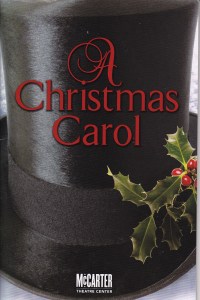
This year my wife asked for a non-material gift. We made our way to the McCarter Theater in Princeton to see their acclaimed performance of Charles Dickens’ A Christmas Carol. A gift of a memorable family time and a truly spectacular play. Seeing this story in 2016 felt especially important. Dickens was a famous advocate for the poor and was well aware of how they suffered at the hands of the wealthy. Indeed, those with too much money lose their humanity almost completely. The story is focused around Christmas, but the message is needed for every day, especially in over-long years such as this. Capitalism is a form of social evil. Anything that lowers humans to mere ciphers on a page is the very definition of sin.

christmas-carol

We all know how the story goes, but to see accomplished actors undergoing conversion is nevertheless a strangely hopeful experience. As the story makes abundantly clear, it requires so very little to make others happy. The point of having money, after all, is to use it for the good of others. Seeing one man facing his own mortality only to realize that he has isolated himself from the care of others is a powerful experience. As we move forward into the long and dark days ahead, there is a reminder here that we need to keep close to our hearts. There may be fewer presents under the tree this year, but we are all the richer for it. This is the kind of gift that we need to share with the entire world.


Charlie Grinch

There were probably about half-a-dozen animated Christmas specials I recall watching as a child. The two that became fixtures, and remain part of my present holiday ritual, are It’s Christmas Charlie Brown and How the Grinch Stole Christmas. I remember watching them from early days—of course you had to wait until their respective channels announced their advent in TV Guide (just writing that makes me feel older than the Grinch). Commuting wasn’t an issue then, so watching television was as common as candy canes and hopeful stockings. As an adult, though, you see things you overlooked, or simply accepted, as a child. I guess that’s what “believing in Christmas” is all about. The willful suspension of disbelief.

I’ve commented on these Christmas specials before. Charlie Brown has so many inconsistencies that an old biblical scholar can’t help but think of J, E, D, and P. What does the signage on Lucy’s Psychiatric Help booth really say? How many branches are on Charlie Brown’s Christmas tree? How does Sally get to the school before her big brother? The animation is clearly a little off—Lucy appears to emerge from the center of her booth’s wooden top as she gives advice to the woeful Charlie Brown with his Trump’s-been-elected-type depression. Still, Linus’ rendition of Luke’s Christmas story brings it home every time. Compare that with the Grinch.

Those who see a war on Christmas (there’s not) seldom cite the Grinch. How the Grinch Stole Christmas is entirely secular. No mention of a special birth. No angels or shepherds. Just a mean old man and his dog. The Grinch shares with Charlie Brown its message of looking beyond the commercialization of Christmas. In the case of the much better animated Grinch (although I still can’t figure out why that one Who’s hat repeatedly flashes from white to blue and back) it would seem that religion matters less than spirit. The Who’s Christmas song with its strange, non-English words, is a celebration of difference. Diversity. Even that angry old man who would steal Christmas itself is welcome in the end. The only war on Christmas is one that has been spawned in the imagination of those who fit the Grinch’s description in Thurl Ravenscroft’s rendering of Dr. Seuss’s lyric. Those my age will understand, and unless you were born yesterday, I suspect that you’ll get my meaning.


Hoping for Light

Although the stores have been playing Christmas music for some weeks now, it is technically Advent. I think we could all use a little Advent as days grow shorter and dark nights increase their influence over our lives. As a nation we’ve been brutalized by a minority candidate and this has become a bleak December that Poe would certainly have understood. The spinning mind occasionally falls upon George W. Bush who somehow has begun to look normal. The president who told us when America was under attack we should shop. After all, that’s what people do in December, right? We buy things to make ourselves feel better. It sure is dark outside most of the time. Advent is all about candles and light and hope.

img_2638

One of the more endearing aspects of human beings is our ability to see the positive amid negativity. Darkness is the natural state of the universe. Stars are tiny points of light in an endless cold and dark universe. Most of what’s out there has no light beyond those willing to burn bright enough for others to see. We, however, see the light of daytime as normative, slumbering away the hours of darkness. We thrive in light and the light has to be augmented by candles as we struggle against the natural darkness that would, if it could, encompass the universe. Darkness, despite its emptiness, is endlessly hungry. Advent reminds us that we must be light if we want anyone to see in the growing nighttime.

We miss this important dynamic if we leap straight from Halloween to Christmas, pausing briefly for Thanksgiving. The church has made its fair share of mistakes, but Advent wasn’t one of them. Experts tell us Jesus wan’t born in December. Christmas isn’t really a physical birthday. It’s an ancient rite concerned with the return of light to darkened skies. A fervent appeal for our colorful lights and candles to encourage the light that we know, we believe, is out there to return to us. Scientists tell us that it’s just that the earth lolls at 23 degrees on its axis and all of this is just a balancing act. That may be so. I’ve never been off the earth to check. Down here on the ground, however, the days come only reluctantly and the nights linger longer and longer. And we can choose to see darkness as our natural state, or we can ignite a candle to encourage the light to return.


Protest Reading

In these days of bold ignorance, reading in public is an act of resistance. A world that follows the uninformed to perdition requires those who stand as witnesses. Those who read. As a cabinet of the wealthiest people in the country is being assembled we need to remind each other that wisdom and wealth aren’t the same thing. Not even close. We read to improve our minds and we find, in such reading, that wealth increases happiness only to a point. Excess wealth leads to misery, but like the addicted, those who have it just can’t stop. Stop, I say, and pick up a book. To help with this my wife sent along the Banned Book Advent calendar. That’s not to say we can read a book a day, but I believe the world would be a better place if we could. Especially if those books were banned.

You see, banned books cause us to think. That’s the payoff. I’ve read many, many banned books. Some of them I didn’t like very much, but that’s not the point. Liking what you read may lubricate the process, but it is the reading itself that stretches the mind. Makes use of mental muscles we didn’t know that we had. Those who ban books want prejudiced minds to prevail. Think about it: prejudice comes from the combination of the prefix for “already” and the root for “judging.” The prejudiced have already decided. Reading challenges. It has from the earliest days of myths on clay down to the era of ordered electrons on a flat screen. Reading makes you question. The thought police prefer mindless acquiescence. Want to show your true colors? Pull out a book and read.

IMG_0899

The season of Advent is one of anticipation. We all know what’s behind door 25, but the journey is the point. That journey is better when it’s literate. When I travel my carryon always has books. More than I can read on the trip, just in case. Books are banned because we fear knowledge. Once exposed to an idea we must deal with it. Far simpler to lock it away in some sealed room and continue to do things like it’s still the 1450s. Before Twitter started revolutions, books did. When we put down our books we are opening an invitation to ignorance. Last month showed what happens when that invitation is given. I won’t make it through a book a day this season, but I flip out my reading material whatever chance I get. And I believe a better future will result.


Holiday Season

Now that the holiday season is upon us, I stop to think about what holidays really do. “Keep Christ in Christmas” signs have popped up like winter dandelions as Trump signs consider to litter the landscape. Thanksgiving, however, gave me the opportunity to forget about all of this for a while. The culture of signs. Signs telling us we must bow down and worship. The holidays signal a season when it is okay to hibernate and forget that more powerful forces out there may wish you harm. Part of the trouble is that those who are coming sometimes can’t see beyond their own interests. Perhaps what I do for a living conflicts with the job I’m paid to do. Conscience dictates that one or the other must go. But conscience is such an old fashioned idea.

img_3092

The holidays start with Thanksgiving, but it is now the Monday after. Those in liturgical traditions of Christianity will note that we are in Advent, a season of anticipation. I do wonder what we’re anticipating. Perhaps it’s because Thanksgiving came and went in a blur of travel weariness this year. The few days when commuting wasn’t an issue were the opportunity to stay still for a while and not look at news feeds and reflect on all we’re thankful for. I started hearing Christmas carols in stores shortly after Halloween. We’re entering the season of money in a country in love with lucre. Take a close look and see what lies in that manger.

Most years the stretch of dark months of November through January are accompanied by a sense of peace. Human beings loving each other and getting along. I guess I’ve been away from the news for a few days. I know there was a Black Friday last week. I also know that money has a strange way of funneling upward, a kind of osmosis of Mammon. On my quiet strolls I wonder what we, as a country, truly value. On the highway stuck in traffic with thousands of others returning home, I try to think that in these metal shells are living, breathing, loving human beings. Many of them only trying to get ahead. We’re all in a rush since there’s so much to do before we allow ourselves another holiday. Wouldn’t life be better with more days for reflection? I’d rather not politicize the holiday. Keeping Christ in Christmas seems to be asking for one not to forget the offering plate. I’m wondering about those sleeping in the street not far from Trump Tower. I’m wondering what ever became of conscience.


Abundance

img_2996

A few weeks before Leonard Cohen died I saw a story on how his song “Hallelujah” had been done to death. Covered and recovered, it seemed to be on every cover artist’s playlist. It is a haunting song, however, and the notion of a cold and broken hallelujah feels somehow appropriate this Thanksgiving. Don’t get me wrong—I am thankful for more things than I can name or would care to share with complete strangers on the internet. In fact, when I literally tried to find a job in Canada in anticipation of a horrible November surprise, one of my immediate regrets was that I’d no longer have American Thanksgiving to celebrate. Thanksgiving, to me, has been images of a cozy indoors with special food while the chill takes over outside. Two days in a row off of work. Sleeping until I’m not tired any more rather than waking according to schedule, no matter how troubling the night might have been. In short, feeling safe and secure in a world growing colder.

Since the first week of November the iciness has been growing more intense. I know it’s the circles I go around in—and perhaps they are small enough to call them semi-circles—but I have seen more sad and depressed and scared faces in the past weeks than I have seen in my previous half-century on this planet. It’s Thanksgiving Day, and even vegetarians look forward to something special by way of fancy nourishment. But it feels like a cold and broken hallelujah to me. Entrepreneurs have already been reminding us that tomorrow is Black Friday. We should get our game-faces on and our credit cards out and head to our favorite retail establishments. Pack up our troubles in the old plastic bag and spend, spend, spend.

Thanksgiving, of course, was an originally generic religious holiday. It’s hard to give thanks without someone to, well, thank. You could be Muslim, Jewish, Christian, or even one of those who thanks dharma, karma, or chance. Just be glad that we’re here right now and even though the wind is gusting and there’s perhaps a bit of snow in the air, we have an indoors where nobody hostile is looking for means to exploit us any further than we wish to be exploited. That our planet, for the time being, still supports human life. And that by any measure other than the Electoral College we all really want progress and fair treatment for all. I am thankful and mindful of those who had to sacrifice to allow us the privilege of being here today. It’s Thanksgiving, and I’m thankful.


For the People

The complex of holidays that make up the transition from light to darkness represents a different mix, depending where you are. Life on the equator, for example, experiences no real variation in daylight hours and I would expect that equinoxes and solstices are relatively meaningless. Or at least less so than where darkness encroaches. For those of us in temperate zones the difference in day length can be quite dramatic and our holiday calendar guides us through it. Getting through the darkness. So this weekend, on Bonfire Night—also known as Guy Fawkes Night, or November 5—I watched V for Vendetta again. This isn’t actually an annual practice, but some years the need to remember the fifth of November is quite strong. This is one of those years. I can’t remember having ever been this anxious about a presidential election. Tomorrow we are voting on whether we want democracy to continue or if we want a dictator who can stir hate like no candidate I’ve ever seen. He even makes Ronald Reagan look tolerable.

I’ve posted on V for Vendetta before, so I need not go over the story. The theme, however, that governments are to serve the people is a message that bears repeating. Governments are to serve the people. We’ve come to a crises point in self-government. A vote for Trump instead of Hillary is saying “I give up, I want Big Brother to take over.” Perhaps the movie I should reference is 1984. Orwell may have got the year wrong, but the story right. Make people afraid, stir the pot of negativity and they will act in desperation. Reactionary governments quickly become dictatorships and that message, mean-spirited and full of ugliness, has been placed squarely in our faces.

The point of V for Vendetta, and the point on which the movie ends, is that V is each of us. We have the ability to make smart choices just as we have the ability to act out on irrational hatred. Who would’ve thought that election years would become days of such terror? I’ve always felt strongly about social justice, and I always vote with a conscience. I have never voted for a hate-monger or someone who believes the way to help the poor is to give the rich even more. There is a deep perversity here, a cultural psychosis. And the problem is we’re locked into four years of the result. For the sake of human decency and sanity, we all need to get out and vote. And I sincerely believe that pulling that lever is a choice for self destruction (Trump) or a future of new potential (Hillary). I just hope we’re smart enough to make the right choice.

img_3024


Tis a Season

halloweenI always seem to be running late. Still, I wanted to be reading a book about Halloween on Halloween. If I might be pardoned for bleeding over into All Saints’ Day, I’ll share some thoughts this November on Nicholas Rogers’ Halloween: From Pagan Ritual to Party Night. Academic treatments of holidays, I fear, often suffer because of dispassion. Academics tend to emulate Spock in their writing, and I think that those who write about Halloween should really “get” Halloween. Oh, one can discourse about its quaint history in this ever so rational world, but one might just miss what the whole thing is about. To be fair, Rogers was writing his book during the trauma of 9/11. He wonders if Halloween may be fading. Nashotah House was suffering under an evangelical administration at that time, and the usual Halloween spirit was muted. Some fifteen years on it seems that Halloween earns yet more money and people admit that it’s hip to be scared.

Rogers gives a brief treatment of the early, but hidden, history of the holiday. The Celts weren’t much into writing about their festivals and invaders didn’t think much of their quotidian life to begin with. Trying to understand Halloween from modern times, piecing the puzzle together back over time, doesn’t really help much either. Treating the day in its British context, then in its American context, Rogers favors a thematic approach. His section on Halloween movies is interesting. Like most modern treatments of the holiday, his book makes comparison with el Dia de los Muertos, and the usual complaints of cultural imperialism. Maybe Halloween is just too much fun to pass up. It also means this post isn’t that outdated.

Nobody owns Halloween. It is taken as a serious holiday by some Wiccans, but liturgical Christians are far more intense about today, All Saints’ Day. It isn’t a national holiday and no national government decides the correct day for trick-or-treating. Perhaps prophetically Chris Christie cancelled Halloween the year of Hurricane Sandy, but did he really? Sitting in the dark for a few days with evenings lit by candles—some of them in Halloween holders—felt pretty spooky to me. Halloween may be a source of intellectual curiosity, but it is a holiday you either get or you don’t. October is its prelude, November is its aftermath. It is, as the Celts used to believe, when cold weather seriously begins to take over and light is a rapidly vanishing commodity. I may be a day late, but Halloween isn’t quite over yet.


Hallow’s Eve

img_2982

Halloween is finally here, and I’m on my way to work. Over the weekend I noticed youngsters about in costume, heading to a local business that was holding, apparently, some kind of ghostly do. For me it’s just another day—Halloween isn’t an official holiday in any government’s book. Business as usual. Still, I can’t think of Halloween without recalling Nashotah House. I began, and effectively ended, my academic career at Nashotah. Idyllically located in the woods, it was a seminary that knew how to celebrate Halloween well. We were expected—required, actually—to be in church for a good part of the next two days for All Saints’ and All Souls’ days. But Halloween night we were allowed to be afraid.

Gothic writers often used to focus on places like monasteries and churches for moody frights. Nashotah began its life as a monastery, but soon turned into a seminary. The stone buildings were old—for this country—and gothic in design. We had an on-campus cemetery with a bona fide black monk. Students reported seeing ghosts, and with such a small population of religiously devoted people the imagination grew like toadstools. One morning at around 5 a.m. the door handle to my apartment rattled loudly. I’m sure it was just someone trying to get into a forbidden chapel whose only access was through my rooms. Thunderstorms echoing through the kettle moraines that surrounded the Wisconsin campus could be impressive indeed. On Halloween the maintenance man drove a hayride through harvested corn fields and the cemetery where opportunistic ghouls would pop out to frighten the slow-moving, exposed riders.

Since those days Halloween has instead become just a day of work. No more the grandeur of All Saints’ Day being an actual holiday, holy day, followed closely by All Souls’. This is just another day except for the kids who can come around and get some candy if I’m not too tired to hand it out later. I suspect this is why I spend so much of October reading about monsters and ghosts and scary movies. I no longer have a Halloween to focus my energies. So here it is Halloween. It’s dark outside and I’ll be standing in that dark, waiting for a bus. When I climb off at the end of the day, I’ll be sharing the nighttime streets with children who are perhaps the only ones who celebrate holidays as they should be commemorated. Already a month ago I began noticing the Christmas displays in local stores. It was my first real scare this season.


Only October

trickortreatComfort may be a strange word to describe Halloween, but it is accurate. I’m no specialist on the holiday, although I’ve read a few books on it—most recently Lisa Morton’s Trick or Treat: A History of Halloween. Growing up in what felt to me like an uncertain environment, holidays—and especially Halloween—have left me with positive impressions. Morton’s book explores this strange combination of fear and fun and suggests that many people of my generation do find comfort in its celebration. I grew up without a father in a conservatively religious home. Yet I loved the escape of putting on a mask and being someone else. Coming home with a bag of candy was a bit like that dream I still have of finding a penny on the ground and then realizing there are thousands of them just beneath the surface. There’s a security in that dream and I always find a tear in my eye when I awake from it.

Halloween is, appropriately, a chimera of holidays. It is solidly pagan. It is equally solidly Christian (specifically Catholic). Perhaps to placate those troublesome Celts, the Roman Church moved its commemoration of All Saints and All Souls to November 1 and 2, allowing for the Eve of what used to be called “All Hallows” as a holdover of Hibernian lore. Morton goes beyond the northern European fascination with the darkening of the year to explore other regions and how they mark the season. The southern hemisphere, obviously, doesn’t have the same pattern of autumn and spring, and the holiday has had less success there. The threat of the light never returning has to be real to make the fear stick. The warmest memories of my childhood seem to come from the days artificially lengthened by electric lights and the holidays they spawned: Halloween, Thanksgiving, Christmas. Comfort.

The air has begun to turn chilly around here. I’ve found myself shivering a morning or two while waiting for the bus. As I pull on my coat and step out into the pre-dawn dark, a stop sign creaks eerily on the deserted street. I’m headed to a long day in a city of stone and glass and warmth will be difficult to find. Halloween decorations get lost in the enormity of New York City and its constant quest for money. So I recall Halloweens of my small-town childhood. I tend not to go out at night, but I haven’t always been this way. When there was an unspoken comfort awaiting at home, no matter how frightening it could be at times, I would brave the dark and ask strangers for candy. Is it any wonder that Halloween still glows in a world somehow grown too cold?


October Weekend

img_2973

Bright orange pumpkins under a cloudy gray sky. October is surely here. But this is an urban area of the kind in which northeast New Jersey specializes. As I approach I see that it’s a church. A church that has made a truce with Halloween. Judging from the number of people here, it’s a cordial detente. So much of American society lies mired in contradiction that I have to ponder this. Halloween in an age of nones may be simply fun. An opportunity to spend money on pumpkins that won’t be eaten and gourds that can’t be. Decorations for a mildly scary night that somehow makes us feel comfortable and snug at home. October is like that.

Churches have been struggling to maintain active memberships. And although the antagonism has been overblown, Halloween has been an uneasy part of the church calendar. It has, however, become a major commercial opportunity. Depending on the commodity, only Christmas or Easter will draw more lucre from people. The devils and demons and ghosts of Halloween sit awkwardly in the pew next to the victory over death that is the main draw to traditional Christianity. But people will predictably spend their cash for the privilege of carving a pumpkin. Just the memory of the scent, the feel, the contentment of creating a jack-o-lantern makes me want to stop and support whatever denomination this might be.

It is a weekend, however, and I have many errands yet to do. I content myself knowing there are happy people in this temporary pumpkin-patch. The faith of Linus is a powerful thing. To get ready for the week ahead in which I’ll have time only for working, commuting, and sleeping, I keep moving. The orange fades from sight. The cheerful memories of childhood pass. I go on to my next stop. My first errand began at 6 a.m.this morning. Noon is fast approaching. I need a tiny piece of hardware that can only be found in a big box store. I prefer to support the local economy but that shop is all the way across town. Inside the Depot plastic Christmas trees of every description fill the front of the store with winter dreams of even more spending. I forget what I came in here for.


Day Labor

It’s difficult to believe in Labor Day. Don’t get me wrong—I’m glad for the day off. It’s just that I don’t think people really believe in the idea any more. It’s hard to take professed goodwill for workers seriously in a plutocracy. Especially when money’s a fiction. When pay was in coin, although abstracted, you were literally handed something of value for your work. Now technicalities and loopholes and utter abstractions make some—including would be and actual politicians—wealthy. These are all tricks on paper, affirmed by accountants, and we watch like the audience of a magic show as the improbable is made out to be actual fact. And these who hold this imaginary wealth control the lion’s share of the waking hours of the rest of us. We’re given Labor Day off with a pat on the head and we’re told to go enjoy ourselves before summer is up and we really have to get back down to work.

DSCN5084

Many of us—I know because I can see the cars—use the holiday to travel. It’s not really so much a day of rest as it is a day of trying to get back home so we can be to work bright and early tomorrow. Since it’s the last break before Thanksgiving you’d better enjoy it. If there were really money in that pay envelope—not even real envelopes are used any more—it might be easier to buy the illusion. Like Amazon I take a small cut of the transactions between employer and debts I owe just to live near where I work, which isn’t really so near but as close as I can afford. At least today I can not go into the office. I can spend the day getting home instead.

I often wonder why we’ve let ourselves be fooled by a system that will only ever allow the very few to truly find financial independence. Like lemmings we run right after them, thinking that just beyond that cliff true prosperity lies. A chicken in every pot. A car in every garage. Right now all those cars are actually out on the road—I can see them—and they’re not really paid for because they cost too much to buy outright. Most of us need them to get us to and from work. Or to and from vacation. Summer’s winding down. Hurricanes are already spinning away in the Atlantic. I’ve grateful for the day off. I really am. I only wish I could believe that it meant something deeper about human nature.


Becoming the Past

Back home for a flying visit over the final dregs of the summer, I find myself in a hotel in my hometown. It’s an odd place to be. As I’ve often remarked to those who know me, I remember living in three houses in this area and all three have been torn down. Looking over the vacant lot where my elementary school once stood, I have a feeling of being erased. Just up the hill from my hotel is a blank space, like when a molar has been removed, where my junior high school once stood. Even the seedy shops I remember from childhood are gone, an entire block of buildings torn down. Wal-Mart opened up just a couple miles away outside of town, and all small businesses got down on their knees and prayed before dying. Being from somewhere is more than just a matter of going away. It’s also coming back.

IMG_2930

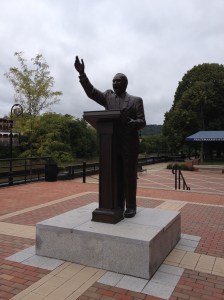
Standing outside in the misty morning sipping my coffee, I watch the river flow. There’s a fog rising over the Allegheny this morning and it makes this place look mysteriously beautiful. I think back to New Jersey, where I was at this time the day before, and how I can’t step outside without seeing other people. I go jogging at 4:30 in the morning sometimes. I’m never alone. On this balcony over the river I see no one. That person down by the river is really just a statue. Maybe I am too. What is left of a person when their hometown disappears? My fascination with ghost towns is catching up with me. Once someone said they thought I disliked small towns from the way I talked. Quite the opposite, the statue whispers. Quite the opposite.

If it weren’t for the people I know, would I ever come back here, I wonder. The warm coffee through the styrofoam cup reminds me of Judas. Even he knew how to kiss. This town, shrinking with age, gave me life. When I stamp the streets of Manhattan on my way to work, I know I’m a different man than I was back in this town. I would’ve found it difficult not to want to help anyone in need, back then. This homeless guy’s been sleeping in the same spot all week while millionaire wannabes look the other way. There’s a mist on the water this morning. The Allegheny flows on to the Ohio, and the Ohio on to the Mississippi. Down into the gulf that’s part of the ocean than encompasses us all.