Despite the obvious consanguinity with the Dawn of the Dead, I am not a mall person. Last week, however, I had a job interview and I discovered that most of my white shirts would be appropriate garb only for the undead, so my wife forced me to look around the local mall for some new apparel. As we walked down the interior boulevard crowded with people younger than us, we couldn’t help overhearing the conversation of some young women behind us. “Yeah, it’s so cool! He’s a vampire; he’s got fangs and everything!” And they weren’t discussing Edward or Lestat, but a (presumably) flesh-and-blood beau one of them knew. Yes, Halloween season is upon us again.
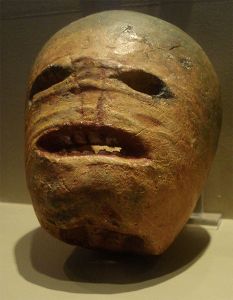
(An early Celtic turnip Jack-o-lantern)
I loved Halloween when I was growing up. Despite the innate conservatism of my family, we always enjoyed dressing up, trick-or-treating, and being just a bit scared. When I reached college, however, I discovered that Halloween was perceived by many to be satanic, and I had to dig deeply into the past to argue that it came from Christian tradition and was, itself, nothing to be afraid of. Still, my friends looked at me askance. When I reached Nashotah House, a perfectly Gothic setting for the twilight of the year, I discovered that despite the theological conservatism there, Halloween was a time-honored tradition. My first year there while driving home after picking my wife up from a conference in Madison, I drove the familiar road into campus only to see a single, ghostly white face float across the road in front of us. I was so astonished I pulled the car to a stop to look back and could just make out several of the students I knew, dressed fully in black cassocks and cappa negras, only their faces showing, painted white. They stood alongside the lonely road and “floated” across it as slowly approaching cars rounded the bend. (I guess that, being potential priests, they were not too concerned with eternal consequences of metal meeting mere flesh in the dark of night.) On the campus, until the takeover by a Fundamentalist administration, All Hallows Eve was a bone fide sacral event.
The reason for Halloween’s popularity, I believe, is that deep down people really are frightened. At some level we know that we aren’t really in control of our lives and we seldom have a say about them ending. Halloween, with its dark Celtic origins, is the acknowledgment that it is acceptable to be afraid. Each year as more and more elements appear beyond our control, our pantheon of Halloween specters grows. One of our neighbors’ houses has a fake cemetery in its front yard. One of the headstones reads “The Stockmarket / 2008.” Even with the economy dipping and reeling like a drunken bat, lawns sport larger, more expensive and expansive Halloween displays. Halloween represents the pulse of fear than animates religions. We should all be afraid!