Roll out the Memories

That takes me back a bit.  It’s also a great idea.  The Epic of Gilgamesh tablet 5 rolling pin, that is.  A friend shared Farrell Monaco’s blog with me and the Gilgamesh cuneiform rolling pin took me back to a seasonal event in Edinburgh.  The Scots love to socialize.  My doctoral training involved lots of seasonal gatherings—something that we’ve missed since returning to the United States.  On one such occasion with my fellow Ugaritic students, we said we’d bring cookies.  Now the correct term for such things is “biscuits,” I know, but we had a recipe that really didn’t fit the biscuit description.  It was for chocolate cookies.  The dough was the consistency of a clay tablet.  I taught my wife enough Ugaritic so that, using toothpicks, we inscribed a good part of the Baal Cycle on the desert.  Alas, the tablets are no long extant.

Photo by Egor Myznik on Unsplash

Of all writing materials, clay and stone are the most durable.  Our cuneiform cookies were in the days before cell phones, however, and film wasn’t cheap.  We didn’t bother to make a photographic record, and, alas, such tablets are edible.  They were a little difficult to read when baked and even more so when eaten.  The use of culinary cuneiform makes me think that its design potential has gone under-utilized.  Also back in Scotland for a while Coke was running a promotion with cuneiform on its labels.  The problem with cuneiform is that even for someone who reads it an isolated character or two, without context, is difficult to decipher.  I never did figure out what Coke was trying to say. 

The Gilgamesh rolling pin apparently exists in the real world and can be purchased by antiquarians with university-salary-level jobs (somewhat over the pay scale of the mere editor).  Tavola Mediterranea is listed as “The Home of Culinary Archaeology on the Web.”  Although publishers and others doubt there is any interest in my erstwhile area of expertise, I feel vindicated by Monaco’s website.  There is a real hunger for things ancient, but universities tend not to support that interest.  I often wonder at how great centers of learning have evolved into upscale job training centers.  Then again, I’m the kind of person who reads the Epic of Gilgamesh for fun.  I even have an illustrated children’s edition of the story.  Now I’m waiting for Ugaritic tablets to show up on cookware.  Given the slow death of the field of Ugaritology, I suspect the day of making Baal Cycle cookies is long gone, and unless a new recipe for encouraging public interest can be found, we’ll all starve for knowledge of it.


Internet Nowhere

So I wake up early.  I’ve been trying for years now to learn to sleep in a bit.  Somehow my body got to thinking the outrageous commute schedule to New York City was normal and I can’t convince it otherwise.  That means my most productive time comes before others awake.  It also seems to be the time favored by internet service providers to take their systems offline for a while.  You see, like any system the internet needs down time.  I slept in until 3:30 this morning and awoke to find internet access unavailable.  I use it during my writing, looking up answers to questions which both my fiction and non raise.  When the internet’s out there’s little I can do, but I’m already awake.  Society prefers conformists, but some of us maybe hear a different beat on our march.

The fact is we expect constant connectivity.  Many of us pay a significant monthly amount to ensure that we have it, but this is no guarantee.  Calling your local service provider at 4 a.m. on a Saturday (I’ve done this) is like dealing with IT at work: they really have no clue what’s wrong but they can talk technical to you, if that makes you feel good.  After all, it’s in the middle of the night.  So I try to decide on something else to do.  Reading works.  Books, however, often lead me to want to look something up.  But the internet’s down, at least around here.  We are utterly beholden to the tech industry that can (and does) wink out from time to time.  When the robot uprising occurs we just need to wait for the service maintenance hour.

I reboot my router.  It’s the first course of action when the internet’s out.  I think I’ll check out a personal hotspot, but to do that I need the internet.  It’s a great, constant feedback loop.  I suspect I’m not the only early riser who faces the internet dearth in the wee hours.  I know I’m overpaying because my data (whatever that is) plan on my phone always shows a monthly surplus.  When it comes to the techies, you just nod your head and pay your bill.  I do wonder what’s happening in the wider world.  Without the net you feel especially isolated in pandemic times.  It’s Saturday morning and the internet’s unavailable.  Back in my teaching days I know just what I’d be doing.  Instead I’m waiting for technology to catch up.


Anticipation

My work computer was recently upgraded.  I, for one, am quickly tiring of uppity software assuming it knows what I need it to do.  This is most evident in Microsoft products, such as Excel, which no longer shows the toolbar unless you click it every single time you want to use it (which is constantly), and Word, which hides tracked changes unless you tell it not to.  Hello?  Why do you track changes if you don’t want to see what’s been changed when you finish?  The one positive thing I’ve noticed is now that when you highlight a fine name in “File Explorer” and press the forward arrow key it actually goes the the end of the title rather than just one letter back from the start.  Another goodie is when you go to select an attachment and Outlook assumes you want to send a file you’ve just been working on—good for you!

The main concern I have, however, is that algorithms are now trying to anticipate what we want.  They already track our browsing interests (I once accidentally clicked on a well-timed pop-up ad for a device for artfully trimming certain private hairs—my aim isn’t so good any more and that would belie the usefulness of said instrument—only to find the internet supposing I preferred the shaved look.  I have an old-growth beard on my face and haven’t shaved in over three decades, and that’s not likely to change, no matter how many ads I get).  Now they’re trying to assume they know what we want.  Granted, “editor” is seldom a job listed on drop-down menus when you have to pick a title for some faceless source of money or services, but it is a job.  And lots of us do it.  Our software, however, is unaware of what editors need.  It’s not shaving.

In the grip of the pandemic, we’re relying on technology by orders of magnitude.  Even before that my current job, which used to be done with pen and paper and typewriter, was fully electronic.  One of the reasons that remote working made sense to me was that I didn’t need to go into the office to do what I do.  Other than looking up the odd physical contract I had no reason to spend three hours a day getting to and from New York.  I think of impatient authors and want to remind them that during my lifetime book publishing used to require physical manuscripts sent through civilian mail systems (as did my first book).  My first book also included some hand-drawn cuneiform because type didn’t exist for the letters at that particular publisher.  They had no way, it turns out, to anticipate what I wanted it to look like.  That, it seems, is a more honest way for work to be done.


At Sea?

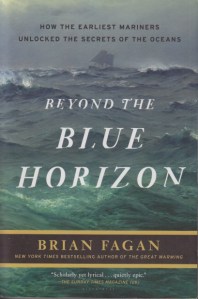
Brian Fagan is a name I’ve long known.  Not exactly the consummate stylist, he is a very prolific archaeologist and anthropologist.  I’ve read a few of his books.  Recently my wife and I read his Beyond the Blue Horizon: How the Earliest Mariners Unlocked the Secrets of the Oceans (you see what I mean about style?).  Divided into different regions of the world, the book explores early boat-craft, sketching how people without our technology navigated oceans, often reaching remote locations.  What interests me is when anthropologists make statements about ancient religions, often before the advent of writing among the peoples studied.  No doubt such peoples realized the dangers of open water—open water is still dangerous with all our tech.  It is reasonable to assume their response was religious.  What exactly it was, we don’t know.

The one that really caught my attention was on the Maya.  Coastal Mayans valued the spondylus, or spiny oyster.  This particular mollusk is seasonally toxic—itself an interesting phenomenon—that becomes a hallucinogen.  Hallucinogens have frequently been associated with religion for indigenous peoples.  If archaeology is to be believed, even temples in ancient Israel burned cannabis, so who’s to judge?  Fagan writes that this practice led to shamanistic trances, and this seems likely.  He goes on to suggest that the spondylus was thus a gateway to the supernatural world.  Of course, in the biblical world shellfish were a forbidden food.

While Fagan likes to reminisce about his own past sailing, and likes to describe boats in detail, and show off his nautical language skills, I think about the religious aspect of the great waters.  We still have only a small understanding of the oceans that cover most of our planet.  We can fly over them these days, and miss the intensity of being where no land is in sight.  It can be a transcendent experience, I’m sure.  I’ve seldom been that far from land.  On a ship bound for the Orkney Islands from John O’Groats we were on the North Sea beyond the sight of shore, if I remember correctly.  Although I can’t recall how long the voyage took, I can imagine the feeling of nerves aching for a sight of coastline.  Even with minke whales off the starboard bow, I knew my feet belonged on terra firma.  It’s more comfortable to read about the gods of the ocean in books like Beyond the Blue Horizon.  And when I’m out to sea, I always pray the mariners know what they’re doing.  


Hot Breakfast

Cooking in a pre-dawn kitchen has a certain appeal as the weather cools.  Knowing that something with warmth will set you right before the nighttime cold forces the furnace on for the next six-to-nine months.  After a recent tooth extraction I was told to keep on a soft diet until the wound healed.  A fan of crispy breakfast cereals, I faced a new dilemma—what to eat before work?  Being vegan means bacon and eggs won’t do (there is passable vegan bacon available, but so far the plant-based eggs haven’t managed not to taste like mung beans).  On a recent frenzy of nostalgia I had purchased a box of (now mostly empty) farina.  Often known by its commercial name “Cream of Wheat,” farina is more like flour and milk (many vegan options available) but with a better texture than paste.  It reminded me of childhood Saturdays.  Then the box was empty and grocery day was the better part of a week away.

Grits seemed a little more challenging.  The particle size is larger and might cause problems in the healing wound.  Still, I gave it a try.  Since my father was from South Carolina I grew up eating things like grits and black-eyed peas.  This makes for a hearty breakfast as long as you keep the grits on the other side of your mouth.  When the black-eyed peas were gone, I turned to oatmeal.  Bigger pieces yet, but still soft.  Oatmeal works best with some kind of sweet accompaniment.  Brown sugar and cinnamon is a standard. Sweets bother my teeth, however, so I need to be careful there.

The problem with all of these options is that one serving of these hot cereals was too little to keep me going.  I wake early and eat breakfast early, so I need about six hours of energy from this meal.  Two servings are too much.  Ratios are beyond me.  So I turn to my religious roots.  Whenever I think of breakfast I’m reminded that our cereal-eating culture (hot or cold) was largely influenced by Seventh-Day Adventist sensibilities.  Adventists are vegetarians, and some prominent among them by the name of Kellogg launched massive, religiously motivated campaigns to have the day begin with grains, back in the day.  It stuck.  I suspect Kellogg was good with numbers.  I wish I could figure out how third-cups and quarter-cups relate to one another.  Like most things in life, it’s falling midway between that is difficult.  It’s chilly in here and I too hungry to do math.  At least the religion part I partially understand.


Fire and Ice

Most people in our modern world consider a cooking device an important part of a household.  Many of us are also over-committed.  These two elements came together last week when our kitchen stove (“range,” I’m finding out, is the correct term) burned out.  We could tell when we bought our house two years ago that the previous owners had likely not replaced any appliances.  The refrigerator died our first year.  Now, in our second, the stove—excuse me, range—went.  Given that it’s turned cooler around here, a good hot meal in the evening has been a welcome relief, but with no stove how do you cook it?  This happened on a Tuesday.  My wife and I compared calendars.  The closest evening we could both get out to look for replacements was Friday.  Of course, once you shell out the money you also have to wait for delivery and installation.  It looked like at least a week without home-cooked food.  Grocery shopping, of course, had been on Monday.

It occurred to me how utterly dependent we are on our big appliances.  The refrigerator died just before a holiday weekend in pre-covid days, so we were on our way out of town when it happened.  A lot of food had to be wasted.  It took about four days before a new one could be delivered, and we had to cut short our trip to be here in time for the installers.  Food.  Unless you’re living on granola bars and trail mix you need to keep it cold or keep it hot.  Our ranges and refrigerators do the heavy lifting for us.  Our ancestors stuck things in the cellar to keep cool and chopped wood to keep what is properly called a “stove” hot in the kitchen.  It was pretty much a full-time job just to survive.  Now nightly Zoom meetings make any interruption of online connectivity difficult.

Weekends, given the circumstances, are gems.  They are the only time we can get things done.  Days are eaten up by ever-expanding work by people desperate to keep their jobs in a tanking economy.  Supply chains, interrupted by the virus, meant that a delivery of a new range would only happen in January.  Going without food until the new year steered us toward a DIY appliance repair solution.  I never thought I’d be sticking my head in an oven, but here I was, with a new part ordered from Amazon and the confidence of the friendly people on YouTube telling me I could do it.  Taking days instead of months, we were cooking again by Sunday, and I just might’ve learned something along the way.


Scared Space

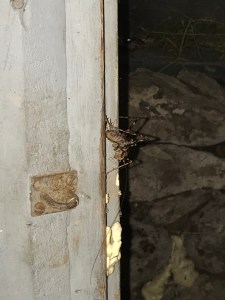
It was dark.  I often work in dim light since the computer screen backlights everything.  I’d strained my back the day before, and getting into a standing position took some time, with the first steps being necessarily ginger.  Out of the corner of my eye, I saw it in the shadows.  A wolf spider was on the arm of my chair, just inches away.  I could move neither fast nor fast enough.  By the time I’d hobbled to an empty peanut butter jar (we keep them for this purpose), it was gone.  But the fright remained.  It was several hours until I could think of sitting in that chair again, although the spider was last seen fleeing the site of the attack.  That got me to thinking about how spaces maintain the events that transpire in them.  It’s the early stage of haunting, I suppose.

Spiders were a childhood terror.  Just a week before the current spider incident, I was in the basement doing some repairs when a spricket jumped on my arm.  Sprickets, also known as camel crickets or cave crickets, live in damp places and they actually jump at their perceived enemies to frighten them away.  It works.  I was absolutely terrified by the thing.  It was large, and although it was on my arm only a second or two, I wanted to run screaming from the cellar and strip off my shirt and throw it in the washer.  I couldn’t go back into the basement the entire day.  It was the site of the fright, you see.  Spricket and spider were long gone, but their threat remained in the place I’d encountered them.

I often write about sacred space.  There is also such a thing as scared space.  I can see how this would’ve evolved from our primate ancestors.  Chimpanzees, for example, are frightened of large spiders.  They can climb trees right after you and they are impossibly fast.  I suspect in our encounter the spider was more frightened of me than I was of it.  I’m a giant in its multiple eyes and, were I not a believer in catch-and-release, could easily have killed it.  (Messy for the chair, but conceivable.)  Our ancient ancestors would likely remember—this is the place the spider bit Oog.  Must avoid.  So the idea remains, scarring the spaces we habitually sit.  Spiders outdoors, as long as I see them before they see me, are not such a source of fear.  But right now I think I’ll pick a new favorite chair, until my favorite becomes sacred again.


Eureka?

It’s weird to feel yourself becoming a curmudgeon.  Especially when it’s about technology.  Someone asked me the other day if I could send an audio file of something I’d recorded.  I stopped doing podcasts because I lost track of the server that had been hosting the files.  My “inbox was full” or some such nonsense—they’re just electrons, folks.  I’m already paying for the space to host this blog and one thing I know about audio files is they take up lots of space.  My laptop reminds me of that every time it wants to update.  Well, I recorded the requested audio file and wanted to send it along.  I couldn’t find it.  Now, I’m one of those people who started using Apple computers because they were intuitive.  You could easily guess, or reason out, where things were.  It’s not that way anymore.

I had to do a web search (use Ecosia!  They plant trees for your searches!) for where Macs store your audio recordings so that I could send it.  Buried deeply in a directory that has a nondescript name that you’d never possibly guess (it’s as if someone were to assign you Concluding Unscientific Postscript during a game of book-title charades), the helpful site said, you’ll find it.  It’s in your “Library.”  Well sir, Mac had decided that you no longer needed to navigate your way to your Library and that directory was hidden.  Another Ecosia search—more trees—and I learned that you could do a special preference tweaking (it only took four or five steps) so that your computer would display your own Library and you could find your renamed file that you’d created.

Back in the day (here’s the curmudgeon part) when you had to swap discs—floppies—and the computer had the memory capacity of a Republican senator, you knew which disc had your files.  To access them, you simply inserted the disc.  Later they were stored on the hard drive itself and the directory told you right where you’d find them.  Now who knows where your created content is stored—out there on a cloud somewhere, I hear.  That doesn’t help when a friend asks you to send a file.  I had no idea where it even was.  It’s job security for the tech sector, to be sure.  At least it helped me to plant some trees along the way.  Back in the day we used to say you can lose sight of the forest for the trees.  It works, it seems, the other way around as well.


A Walk in the Park

About five years ago my wife and I took a drive along the infamous Shades of Death road in Warren County, New Jersey.  Urban legend has all kinds of creepiness associated with it.  It was a pleasant enough autumn drive for us, and we didn’t see any ominous signs.  History has moved on since the road had been named and, as is typical, the origins had been lost to time.  Something I’ve noticed in moving from east to midwest back to east and a little further west again is that names tend to travel with westward expansion.  I haven’t read enough local history to gain a good sense of this, but we noticed that if New Jersey has a “Devil’s Half Acre,” so does eastern Pennsylvania.  

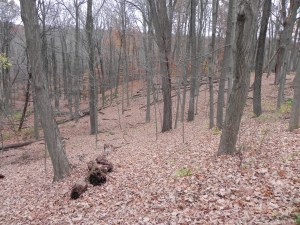
Yearning to get outdoors for a bit—it’s been rainy here and the pandemic limits options for seeing much of anything—we decided to visit Hickory Run State Park in Carbon County.  Not a bad drive from where we live, we decided to pick out a hiking trail before making the trip.  With over forty miles of trails, your choice of parking depends on which one you want.  We found that there was a Shades of Death trail.  The website tries to dispel the fear factor of the name, noting that early settlers referred to heavy woods and rocky terrain when they named the area.  It is some of the more challenging hiking offered in the park, with passages over small boulder fields and some slippery rocks.  It also turned out to have some wonderful scenery.  We’d arrived early enough to avoid the crowds that’ve made walks in the woods less pleasant in pandemic times.

Indeed, as we finished our hike near noon, families with kids excitedly shouting “Shades of Death” were making their way along the at times narrow path.  I couldn’t help but think how our lives have become so much easier, at least with physical challenges, than those of the original settlers who named these once treacherous places.  We find the names quaint and a little amusing.  Indeed, at the visitor center, the outdoor art emphasizes that particular trail, demonstrating its popularity.  Part of the draw of horror is, of course, reading or watching it from a safe location.  On a sunny morning with modern conveniences never far away, the name gives a little thrill even as it reminds us that a walk in the woods once held a peril difficult to imagine when you can drive right up to the trailhead for a walk in the park.


Google Scholarship

The other day I had to check something on Google Scholar for work.  Since our computers now know who we are, mine asked if I would like to update my profile on the site.  I figured it couldn’t hurt.  I waited until after work, however, since my scholarship is strictly separated from my job.  When I went to complete the profile I learned that you can’t do it without a .edu extension on your email.  In other words, and independent scholar is no Google Scholar at all.  It’s not the first time I’ve run into this bias.  I have sat through many meetings where those with no institutional affiliation are spoken of with deep suspicion, as if the extreme shortage of academic jobs has left only the worthiest employed.  Classic blaming the victims.

Having once been a full-time academic, I have watched the job ads for nearly three decades now.  The number of positions has steadily decreased while the number of new Ph.D.s has readily increased.  There aren’t enough jobs to go around and those who don’t land one of the few available are considered inferior scholars.  Even Google says so.  The interesting thing about this is there is little outcry from academia itself.  You’d think that, given the protests that go on in other areas of perceived injustices that the educated would call for redress.  You’d think incorrectly.  As a society we distrust those who don’t have an institution backing them.  Unless they’re rich (for money is a kind of institution).  It’s a strange state of affairs.

In my line of work citations on Google Scholar don’t really matter.  In fact, many publishers are kind of embarrassed when their employees are published, or are even cited in the books they produce.  Scholarship, in other words, is institutionalized.  The thing is, life in our society isn’t so neatly categorized.  My first job, in a poverty-level family, was working as a janitor.  I was always surprised at how philosophical the discussions were among the cleaning staff at our local school district.  Many of these guys were deep thinkers behind a  broom.  In the schools where they worked the students tended to make fun of them.  You certainly won’t find their musings on Google Scholar.  I tend to think that our society might be more equitable if we’d recognize intelligence where it exists rather than sticking it behind the walls of academe.  But then, I’m no Google Scholar so you need not believe a thing I write.


Mummy’s Daddy

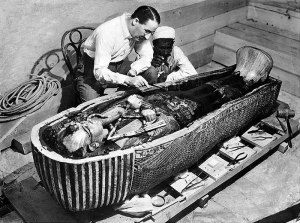
Now that I’ve broached the subject of the Agade listserv, I’m bound to find some interesting stories therein.  The title of this blog “Sects and Violence in the Ancient World” is an artifact that demonstrates eleven years ago I was still keeping up with Ancient Near Eastern studies.  I was calling it “Ancient West Asian studies” then, but I’ve been in publishing long enough to know that shifts in terminology are frowned upon by those in an industry that moves at a glacial pace.  (Just remember that the tortoise wins in the end.)  In any case, one of the recent articles on Agade had to do with the “curse” of Tutankhamen’s tomb.  This is an idea that goes back to the 1920s and was in some respects expressed in the Universal monster film The Mummy.  In pop culture the idea lives on.

Photo credit: The New York Times (public domain)

It seems that some, but not all, of those involved in opening Tut’s tomb died in unusual ways shortly thereafter.  The deaths were not concentrated within a day, let alone a week or a month, and some of them were natural but premature.  The ideas of curses, however, fit the spiritual economy of the human psyche so well that they suggest themselves in such circumstances.  A run of bad luck may last for years, causing the sufferer to think they might be living under a curse.  It is, in many ways, the pinnacle of magical thinking.  No matter how scientific we become the idea never goes completely away.  Just when Mr. Spock seems in control of the Enterprise Harry Potter beams aboard.  Our minds are funny that way.

The particular article I saw was one that had clearly followed on an earlier piece that I had missed.  It mentions “the documentary” but doesn’t say which one.  I suppose there are many such filmed attempts to make sense of memes such as the Pharaoh’s curse.  From my teaching days I have documentaries about a number of weird things that the History or Discovery channel, and maybe A&E, spun out back in the Dark Ages.  I’m not convinced that scientific thinking is really under any threat from such journeys down the paths of speculation.  I’m also not sure that there really is any connection to the various deaths surrounding the Carter expedition in 1922.  In just two years’ time we’ll be at the centenary of the discovery of the tomb and I’m sure there will be plenty of information on offer then.  As long as the curse doesn’t get us all first.


Upgraded at Last

Those who pay close attention to labels may have noticed the tag “Neo-Luddism” appended to some of my blog posts.  Luddites were nineteenth-century protestors against machines because, their thinking went, machines denied people jobs.  I’m not fully in line with this way of thinking, of course, but I do occasionally point out the ironies of how our technological life has become, well, life.  Tech seems to have taken over life itself and some people really like that.  Others of us miss the outdoors and even the “free time” we used to have indoors.  Our computers, phones, iPads, left behind and maybe a physical book cracked open—this seems a dream at times.  I really do enjoy our connected life, for the most part.  It makes this blog possible, for instance.  What I object to is being forced to upgrade.  That should be a decision I make, not one thrust upon me.

Which cloud is it?

This is just one small instance of what I’m talking about: my laptop wants an update.  It has for a couple of months now.  Since it’s in rather constant use I can only devote the time to it on the weekends and the past four weekends have all been used up with other things, including two that had over eight hours of Zoom meetings scheduled.  Now, you see, the update isn’t just a matter of simply updating.  You need to clear space off your computer first.  I like to keep my files and the tech companies want to pressure me into keeping them on “the cloud” so they can charge me for the privilege of accessing the things I created.  Instead I back them up on terabyte drives, sorting as I go.  Photos, formerly iPhotos, take seven or eight clicks to upload and delete for each and every set.  If you snap a lot of pix that translates to hours of time.  It also means when I want to access my files I have to remember where I put the terabyte drive, and then connect it to the computer.  At least I know where my files are.

But do I?  If I were to crack open the drive would I have any means of locating what, on my laptop, looks like memories of family, friends, and places I’ve been?  Are they real at all?  If you’re sympathetic to this existential crisis created by the tech world in which we live, you might understand, in some measure Neo-Luddism.  Of course memory is available for purchase and it will surely last you at least until the next upgrade.


Holy Smoke

I’m not inclined to read news about drug use, and, to be honest, I barely have time to read about the culture of ancient Israel any more.  I very occasionally hear from people who find out that my book on Asherah is free on Academia.edu (it is) that tell me how they plan to use the information.  It’s gratifying, but as with anything put out there for public consumption, you never know which direction it’s going to go.  Thus I found myself on Lucid News’ website.  With the tagline “Psychedelics, Consciousness Technologies, and the Future of Wellness,” ideas begin to form in the mind.  But a citation is a citation, and so I read the opinion piece “Drugs, the Israelites and the Emergence of Patriarchy,” by Danny Nemu.

The story follows on the announcement from some time ago that chemical analysis of an interior altar of an ancient temple at Arad (from ancient Israelite times) revealed that it had been used to burn cannabis.  The biblical story—now questioned by archaeology—is that there was only one official temple and that was the one in Jerusalem.  It was destroyed by the Babylonians in the sixth century BCE and then again by the Romans in the first century CE.  We have no access to the altars that stood in the temple, but we do know that incense, particularly frankincense, was valued for its pleasant smell.  According to the article in Lucid, a second altar in Arad showed residue of frankincense.  Both altars were in a small, enclosed room—the bong of the Lord, as it were—and that together the two forms of smoke would’ve created an intense religious experience for a priest in there for any length of time.  Although the article doesn’t suggest this, it could also explain why animal sacrifices were going on in the courtyard, I guess.

You might be wondering about Asherah.  While the jury’s out on her actual worship and what it entailed, the academic establishment has decided that she was Yahweh’s spouse and was worshipped together with him in the ceremonies that have been forgotten to time.  With all that heavy substance burning I guess it’s not surprising that some things might’ve been forgotten.  I don’t really advocate the use of drugs, but the science behind archaeology shows us that religions have used them for centuries and centuries to reach other levels of consciousness.  I was in chapel services at Nashotah House where the incense was so thick you could barely breathe.  Did such circumstances play a role in the religion that now identifies itself as white-shirted evangelicals?  It boggles the mind.


Zoom Game

Perhaps you’ve notice it too.  The technology blame-game, I mean.  Although it’s grown more acute since the pandemic, it has been around for as long as the tech disparity has existed.  A typical scenario goes like this: someone (often of a more senior generation) encounters a techical problem communicating with someone else (often of a more recent generation) and asks them what the problem is with their (the younger person’s technology).  I sent you the message, the narrative goes, there must be something wrong with your tech if you didn’t receive it.  Believe me, I understand how bewildering this can be.  We’ve sold seniors (one of which I am rapidly becoming) on the idea that this little device in your hand can do anything.  When it doesn’t work, it must be somebody else’s fault.  The young, however, often have the latest tech and fastest speeds and broadest bandwidth, so the problem is probably on the sending end.

I run into this quite a bit since I run a small program for some local folks that involves weekly Zoom meetings.  I’m no Zoom maven.  My wife trained me in it and I can do passably well at running a meeting.  Many of those older than me, however, often have problems.  They wonder what is wrong with my broadcasting rather than their receiving.  I’m not sure how to say ever so gently that we pay (through the nose) for high-speed connectivity.  We have to since I work from home as a matter of course.  Now my wife also works from home and the two of us use our bandwidth all day long with multiple simultaneous meetings without any issues.  The tech here seems good.  We have no way of checking the tech on the end of those who are having connectivity issues.

I’m not setting myself up as any kind of tech prophet.  If you read my blog you know that I am deeply ambivalent about this whole thing.  I’ve been thinking a lot about overpromising recently and I wonder if that’s not a major part of the problem.  Technology will not solve all of our problems.  The fact that you need a regular source of electricity for it to run shows its inherent weakness.  It is a tool like any other, and if the tool is bladed to be useful it must have a dull part onto which one might hold.  Our Zoom society is bound to have issues.  Once we can see each other face-to-face again, all we’ll have to worry about is whether the laptop will communicate with the projector, or if the microphone is on the fritz this morning.  So it always has been.


Time Slip

Perhaps you’ve noticed it too, or perhaps it’s just something those of us in the strange world between Mac and PC see.  A couple of months ago I noticed something strange: the time clock on my work computer (PC) differed from that on the various Mac devices scattered about the house.  The difference was about a minute, possibly a bit less than that.  PC, symbolically, was running behind Mac time.  Now, I have no idea where either platform gets its data regarding what time it is.  I do know that I never have to set clocks anymore, and that the traditional clocks in the house all have trouble keeping up with electronic time.  Still, it is odd that time signatures that had, for many years been the same are now off by a number of seconds.

Time is a mystery.  We know it’s passing and many of us looked up suddenly a few days ago and said “How did it get to be August?”  A summer without vacations, without the usual markers, has silently and sickly slipped by.  We’re all waiting for something undefined, and time has begun to slip.  The phrase always makes me think of “The Time Warp,” and that may be more appropriate than I realize.  We live by the clock.  My jeremiad—surely not mine alone—is that I never have enough time.  The pandemic and its endless Zoom meetings have taken much of what had been a quiet, if time-stressed, life and made it a very busy time-starved life.  Meanwhile HR measures your loyalty by the hour and minute and many of us therefore overcompensate.  “Time,” Morpheus says, “is always against us.”

So you can see why I’m concerned about that missing minute.  There’s a question as to who owns it, but still, it’s another busy moment to slip into a life with barely enough time as it is.  If I perchance glance at my phone during work hours I notice the discrepancy.  Can we not agree about what time it is?  Businesses, of course, like the more conservative PC image.  Many creative types prefer the freedom and ease of use of Macs, particularly those of us who learned the computer world on one.  And since conservatives drive with a foot on the brakes it does make me wonder if they’re slowing down time or Apple is speeding it up.  The end result is the same—we don’t know what time it is anymore.  A deeply divided society can’t even agree on that, it seems.