Unnatural Nature

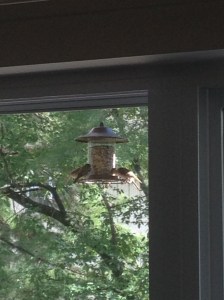
It began as an odd sort of noise.  I had the study windows open during the morning of a heat wave and I heard a small, but metallic noise coming from the roof outside.  My study overlooks part of the first floor roof and slinking to the window I saw a sparrow trying to pick up a roofing nail.  We’ve had the roofers over twice already since we moved in a couple years back (and will have them again), and some of the nails from their work on the second-story roof landed here.  I’ve noticed sparrows pecking at them before.  Instead of skittishly flying away when I came up—I was only about a yard away—she still tried to lift the nail without success.  She then flew even closer to me, snatched up a different nail, and flew off with it.  Sparrows have, of course, adapted well to human dwellings, but what would a bird be wanting with a nail?  Surely not to make a nest?  It wasn’t even shiny—it was a rusty old one from the shingles replaced—since everyone knows birds are attracted to bright objects.

I’ve been a close watcher of nature my entire life.  This isn’t the same as being an outdoorsman, but when I can see outside, or when I do spend valued time outdoors, I look closely.  I always keep an eye out for animals on my daily jogs.  And I watch animal behavior through the window when work isn’t too pressing.  Still, I wonder about what a sparrow could want with a nail.  The next-door neighbors moved out a couple of months ago, and I watch the sparrows on their porch roof.  With no human activity nearby, they frequently gather there.  They seem to be picking up bits of human detritus—even pulling at, it looks from here, nails.  Now this behavior has me a little worried.  I’ve read about sparrows before and despite their innocent looks, they can be very aggressive birds, even attacking and sometimes killing larger perching fowl.  The idea of them weaponizing themselves is disconcerting.

Intelligence in nature is one of the last features many scientists want to admit to the the discussion.  There seems to be too strong a supposed correlation with shape of the physical brain and the ability to “think,” it seems to me.  I don’t know what the sparrows are planning, but clearly it involves gathering rusty old nails.  Even as I was writing this I noticed sparrows chirping aggressively.  Looking out my window across the street, I saw that a squirrel had crawled across an electric cable into a bushy roost where there must’ve been a sparrow nest.  Sparrows began flying into the fracas from all over the place, loudly chirping.  I couldn’t see what what happening because of the leaves, but the squirrel soon rushed out with a whole flutter of sparrows in pursuit.  Perhaps he’d discovered their plan with the nails.
Now, the next order of business…
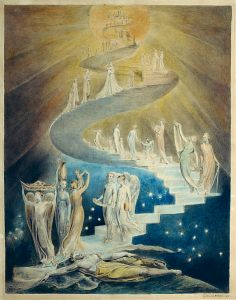

Jacob’s Ladder

Jacob, it is said, was quite a dreamer.  While fleeing from his brother Esau he had a dream of a ladder, or stairway, to heaven.  Well, “Heaven” as we recognize it didn’t exist then, but you get the idea.  Angels were climbing up and down on it, I’m guessing to do roof repairs.  You see, neither my wife nor I are what you might call tall.  In fact, I’m a bit shorter than the average guy and we can’t reach the top shelf in our kitchen, let alone the ceiling.  Or, God forbid, the roof.  So when tropical storm Isaias (not to be confused with the prophet) dropped upwards of five inches of rain on us, some of it got inside.  Our roofer, vexed as I was, promised to get over the next week but there’s more rain in the forecast.  I had to get up there to do some temporary patching.  I needed a ladder.

Ours is an older house.  The roof is way higher than any ladder we have.  I have one that allows me to get as high as the ceiling, but being acrophobic I don’t use it much.  It doesn’t come halfway to the lowest roof.  The hardware stores have ladders, but delivery’s a problem.  A ladder twice as long as our car seems like a road hazard, strapped to the top.  I asked about delivery at the local Lowe’s.  It would cost a third of the price again of the ladder itself, and that’s only be if they could deliver it.  Their truck was, ironically, broken down.  Wasn’t this a DIY store?  Could nobody there fix a truck?  I put a face-mask and rubber gloves on for this?  The world isn’t easy for the vertically challenged.  I really don’t want to climb that high, but with the ceiling below already coming down I’ve got to do something.

I wonder if Jacob’s ladder is still lying about somewhere, unused.  We don’t live far from Bethlehem.  Maybe I can scoot over the Bethel and pick it up.  Then again, maybe angels deliver.  I hear they can be quite accommodating.  Of course, if they’d keep the rain off in the first place that would’ve been helpful.  I’m pretty sure that Plant and/or Page had a leaky roof.  When they went to get up there they’d found somebody had already purchased the ladder (I think they call it a stairway in England).  So I find myself with a leaky roof and no way to get to heaven.


Wolves? Where?

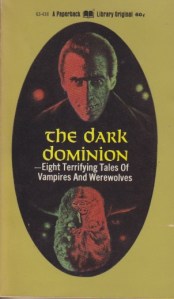
One of the oldest tricks in the capitalistic playbook is to make something look like a more successful product.  Trademarks and copyright laws prevent too close a similarity—for money is sacred—but we all know “brands” that try to look like other brands in hopes of picking up some of the business that attends success.  The same feature was apparently at operation behind The Dark Dominion: Eight Terrifying Tales of Vampires and Werewolves.  This is a book that I picked up in a used bookstore because its cover design—a dull olive green with a picture oval on the front—was clearly based on the Dark Shadows book series.  While the latter are still available, they’re increasingly difficult to find in used bookstores, so when I come across one I don’t have I tend to buy it.  I knew this wasn’t part of the series but the cover suggested to me it might be similar enough, like store-brand breakfast cereal.

Werewolf stories, it turns out, shouldn’t hunt in packs.  There’s no surprise since it’s pretty clear that one of the characters is a shapeshifter and it’s pretty obvious which one.  Six, or maybe seven, of the eight stories concern werewolves while one outlier has a vampire menace.  Some of the stories in the book are clever, but most follow the same trajectory: attacks are made, the villagers suspect something, one of them turns out to be a werewolf.  Time for the next story.  I noticed a long time ago that unlike vampires and Frankenstein’s monster, the werewolf doesn’t have the definitive novelistic origin.  Others wrote vampire tales before Bram Stoker’s Dracula, but that telling set the stage for those that followed.  The olive green cover suggests Barnabas Collins, but in reality is more in Quentin’s territory.

Interestingly, The Dark Dominion, like occasional collections before and after, doesn’t list an editor.  Modern books use the stature of volume editors to reinforce that what’s contained within has quality.  Otherwise who knows whether someone with good taste has picked the stories by authors you’ve never heard of and wrapped them together in a package meant to move?  That’s not to say that some of the stories aren’t good.  A couple are quite clever.  One is a translation of a medieval German tract.  Another comes from medieval Ireland.  The remainder are stories from the nineteenth and early twentieth centuries.  Perhaps it’s the burden of an editor to wonder what the selection criteria might have been.  What’s entirely obvious, however, is that making something look similar to a recognized book series still has the power to sell.


LinkedOut

There are different philosophies behind LinkedIn.  (What a world we live in where such a statement is even possible!)  When I first signed up, it was a professional social network.  Warnings boldly declared that you should accept invitations only from people you actually knew—others might hurt your career.  Friends pointed out (I was unemployed at the time) that if you wanted to use the potential of connecting, you had to take risks and accept invitations from strangers.  Now LinkedIn seems to be a social network just like any other, although many of the individuals on it are perhaps a bit more educated and many of them have good jobs.  That doesn’t stop them from posting snarky comments and using the site as if it were Facebook.

Although I’ve met some good people through it, I’m beginning to grow wary.  Or weary.  Perhaps both.  Now I hover with a bit of angst over that “Accept” button.  Many people, mistaking me for someone with some power in my organization, immediately direct message me after accepting.  I wish they wouldn’t.  Many of them ask me what jobs I might be able to offer.  If they’d search me out a little further on the web, they’d find the dusty path to this blog and learn a bit more about that guy they’d invited to connect.  I don’t work in a hiring capacity.  Bible editing isn’t exactly a growth field.  But connections are connections.  So I click.

Worse yet are the number of people on LinkedIn who immediately direct message you advertising their book, encouraging you to buy.  I work in publishing.  I know that authors have to take the initiative or find their books overlooked (believe me, I know all about that!).  Still, LinkedIn is not the place to advertise your book.  The buzz among publishing types (if they’d only check out to whom they’ve sent that invitation to connect) know that the social media of choice for advertising books is Twitter.  Facebook is okay but if you read the kinds of comments you find on posts there you’ll see many aren’t the book-buying type.  And the advice, to which this particular URL stands in silent testimony, is that starting a blog is an ideal way to build a following.  Social media, it seems, isn’t really peopled too much by those who do a lot of book reading.  If it were it would be a world in which you wouldn’t have to worry about LinkedIn philosophies before clicking that accept button.


No Smoking

I have never smoked anything in my life.  As a kid with chronic bronchitis few things scared me as much as being unable to breathe.  I have not assassinated anyone or consorted with aliens—at least not that I know of.  Otherwise I think I understand the Smoking Man.  As far as my X-Files rewatching saga goes, I recently reached “The Musings of a Cigarette Smoking Man.”  I remember the first time I saw it I found it improbable that the assassinations of the 1960s were the work of a single man.  What hit me this time around, however, was the Smoking Man’s real frustration in life.  He wants to be a writer.  Having completed several novels myself, none published, I have received pin-head letters very much like those he does in this episode, only in greater quantities.  When he finally finds a publisher, he writes his resignation letter to whomever hires assassins and those who change the course of history.  I know just how he feels.

You’d think that by the logic of any reasonable system that those who work in an industry might have some inside tracks.  Some, no doubt, do.  Others of us in publishing are just like the average, uninformed person on the street.  Publishing is a cliquish place.  A friend with some success getting novels published advised me to look at the names of editors and editorial boards on the literary journals that get noticed.  “You’ll see the same ones coming up over and over,” he said.  It is, as the Smoking Man discovered, a kind of cabal, which is, I suspect, the point of making him out as a frustrated novelist.  He can set the course of history, but he can’t get a legitimate novel published.  Cue the X-Files theme. 

I know many academics who write fiction.  My second novel (depending how you count these things—this one was never finished) was a pet project while I worked at Nashotah House.  I knew I wouldn’t be able to publish it when I worked there.  In fact, my first fiction publication only came three years after being shoved out of the nest of academe.  I’ve completed seven novels now and I’ve managed to get some short stories published.  Then again, I don’t have clandestine knowledge from a lifetime of access to the truth about alien-human interaction.  I don’t shoot people for a living.  I’m not even a professor any more.  Still, I think I can begin to understand why someone might turn toward a more interesting career, given the situation when it comes to getting published.


Potboilers

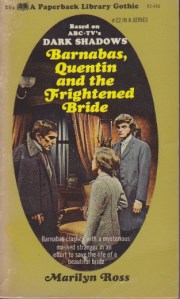
“Potboiler” is used in publishing to describe a book written merely to keep a writer going.  Full-time authors are comparatively rare, and many occasionally resort to churning out books simply to generate income.  I have no doubt that most of them start out as most artists do—creative, and looking for a career that allows them to be so.  If you want to earn money, to keep your pot boiling, you need to follow the formula.  Those are my thoughts on having finished the last book for this year’s Modern Mrs. Darcy’s Reading Challenge.  One of the categories was three books by the same author and I had three unread Dark Shadows books by Marilyn Ross.  Barnabas, Quentin and the Frightened Bride, number 22 in the series, was clearly a potboiler.

As I’ve confessed before, these books are guilty pleasure reads for me.  My literary tastes have changed over the years, however, and such journeyman writing sometimes betrays itself.  Even if a book has vampires and werewolves.  Dark Shadows was a melodramatic soap opera of my youth.  Still, it was moody and gothic—something these books manage to convey, even if the stories don’t live up to their promise.  Some of the plot elements in this particular installment don’t even line up, and having read Jane Eyre I’d guessed the ending shortly after the beginning.  I often wonder how the book series might have turned out with a truly literary attempt to tell the story.  Writing takes time.  Good writing takes a lot of time.  But even writers have to eat.

I’m not a Dark Shadows connoisseur.  I haven’t bought the original television series on DVD and I haven’t watched it since I was about ten.  Early memories, however, are formative.  With a remarriage, a death in the family, and a move, childhood got swept away rather swiftly, and along with it, watching Dark Shadows.  The series ended in 1971 after over 1200 episodes had been filmed.  Ross’ serialization began during the six-year run of the series, and, I suspect, he had to keep up a hectic pace.  Books 13 through 24 were all published in 1970, a rate of over a book a month.  I’ve suggested before that academics ought to take pop culture seriously.  Even before this era of fandom becoming mainstream, Dark Shadows spun off a small media empire and it continues to retain public interest.  The daily show struggled, despite being partially modeled on Jane Eyre, until the supernatural was introduced.  Although the Ross novels may not always show it, the hunger remains for supernatural explanations.


Gratefully

I confess.  I read acknowledgements.  Part of it is the vanity of finding someone’s name I know.  Or the worse vanity of finding my own name.  Acknowledgements, however, reveal quite a lot about the book you’re about to read, or have just read.  Not all books have them, of course.  Most academic books do.  A recurring theme occurs in the acknowledgements I read: privilege.  Many academics are feted and pampered and their institutions pour money on their desks.  Often they show a nonchalance about it all.  ‘Tweren’t nothin’.  What seems to be missing to me is the struggle.  Anything worth having, in the experience of many, is something for which sacrifice was required.  Hard work, long hours, and nobody pouring money on your desk.

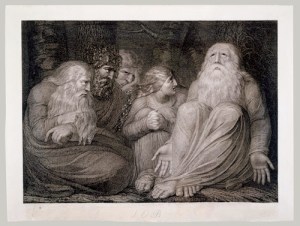
Privilege breeds a strange kind of entitlement.  Many academics complain of how difficult they’ve got it.  (The stories I could tell!)  Now, I haven’t walked in their loafers so I can’t say if the personal circumstances of others are trying or not.  My own experience at Nashotah House—how good I had it!—wasn’t exactly pristine.  Conflicts between dean and faculty.  Required chapel twice a day whether you needed it or not.  Your every move watched for any indication of heresy or disloyalty (that’s not limited to the Oval Office).  And yet, those days were much better than I realized at the time.  Once in a while you have to crawl up next to Job on his ash heap to get an idea of what you simply couldn’t see before.

Acknowledgements are often like mini biographies.  You try to make sure you don’t leave out anyone that helped you along the way.  Books, particularly academic books, are the product of many people, not just the author.  Sure, the author’s the star of the show, but if the support staff wasn’t there, you wouldn’t be reading this right now.  Book making is incredibly complex, which is why self-publishing, while sometimes necessary, often shows in the end results.  Editors come in many flavors: acquisitions editors, copyeditors, line editors, production editors, and more.  Sometimes there’s overlap between positions, but even books that barely get read have plenty of sets of eyes upon them before they come to the public.  Acknowledgments don’t always name everyone.  In fact, they simply can’t.  It takes a village to publish a book.  Instead of feeling entitled,   I find acknowledgements always instill a sense of humility.  It’s an honor to be part of bringing a book to birth, even if your contribution is hidden away in unread pages.


In the Clouds

So I’m looking for a photo.  An electronic one, of course.  And since my camera, or phone, or whatever it is, automatically names them for the benefits of machines, I don’t know what it’s called.  When I want to search for it I have to scroll and scan through hundreds of images.  It’s the price we pay for letting technology run things.  Okay, so it’s made life easier; I’m down with that.  Still, I would like to know where my info is.  I learned to find files by navigating to them, something computers taught me how to do.  But computers move things around while we sleep.   

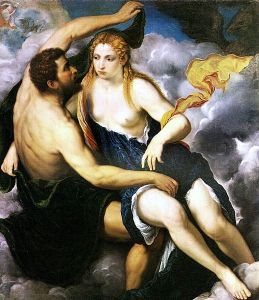
Now that Covid-19 has moved in to stay, we all use meeting software to stay in touch.  Most of us use Zoom so businesses naturally prefer Microsoft Teams.  I don’t know the details of Teams so I watch a video tutorial.  The Microsoft official (well-paid enough to dress casual) is explaining that you can attach things in Teams, something that we’ve all had to learn how to do in email school.  He says that those sharing in your chat don’t know where the actual document is.  “Who needs to know?” (I’m paraphrasing here), he says.  “Nobody needs to know where it is.”  This is my fear—my personal files need to be where I can find them, not on some sleepy server halfway around the world.  Just the other day the internet went out here.  Just for a little while, but those were panicked minutes nonetheless.  I don’t want my files bumping around in a cloud when I need to know how to navigate to them.  What if the server goes down right when I need them?   I don’t trust clouds.  Zeus raped Io in the form of a cloud, remember.

Bordone, Zeus and Io; a picture I did find!

I’d feel better about all this if those of us pen-and-paper types were involved in the discussion.  Nothing says “ephemera” like documents made of electrons.  Maybe I need to spend more time with religions of east Asia where the idea of lack of permanence is key.  Knowing where to find important things, however, has been a hallmark of Euro-American thought.  And if your very own personal documents are being kept where you don’t even need to know where, how can you sleep at night?  Some of us are kept awake still wondering where that thing we can find since we’ve moved might be.  I get the spooky feeling that technology is training us.  For what nobody can guess.  As for me, I’ll get in line once I find that photo that I didn’t even name.


Up the Downgrade

My computer’s been telling me that it wants to upgrade.  In fact, when I first bought this laptop several years ago, and started it up the first time right out of the box, a message popped up that a system update was available.  The tech business, you see, never really sells you a computer.  They’re working on it constantly, often at the same time I’m trying to use it.  In any case, the reason I haven’t upgraded has been that I need to clear off space on my hard drive.  Each upgrade requires more and more of the limited space I have, so my work has to be shoved off onto external drives that I stack like bricks in my attic.  And that takes time.

This wasn’t a problem with my pre-internet computers.  You bought them to do PowerPoint for work and word processing for publications.  Said publications were printed out and sent via mail to publishers.  Just typing that makes me feel old.  The fact was, however, you could get by on those computers without any upgrades at all.  The system that came with it was sufficient for the life of the machine.  Once you get connected to the internet, though, you have to keep up.  I often run into websites on my work laptop, which doesn’t have the latest system, that simply don’t work.  If they’re going to upgrade, I have to upgrade, and to upgrade I have to discard stuff I want to keep.  Every day I get the red warning signal—computer is hungry but can’t be fed until I start throwing my hard work away.  Or at least putting it where it will take extra effort to get it back.

Also, how are you supposed to find the time for upgrades when you use your computer constantly?  A typical download and install takes over an hour.  If we’re so wired, when are we possibly going to find the time for that?  And I still haven’t cleared enough space on my hard drive.  My external drive’s getting too full.  I guess it’s impossible to keep everyone happy.  In the midst of all this I squeeze in some time to use my laptop for that which I actually bought it—to do my research and writing and, during the pandemic, to buy the necessities of life.  And if I don’t upgrade Zoom’s going to stop working because it’s upgrading too.  I need to buy a computer that does nothing but upgrade itself.  That might be the solution.  That, or going back to good old-fashioned pen and paper.


Tentacly Fun

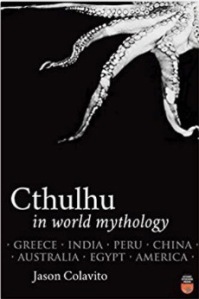
Anyone who has spent time amid scholarly religion tomes knows how cases used to be made for connections.  Similarities were seen as parallels, and it wasn’t unusual for the learned to assert that ideas were organically related.  This same style (now much out of date) was borrowed by writers proposing that what we now call “ancient astronauts” visited the earth and helped with things like the pyramids of Egypt and Stonehenge.  Jason Colavito knows how to parody such writing as he demonstrates in his Cthulhu in World Mythology.  Known as a skeptic and critic of what he calls “pseudoscience,” Colavito is also a Lovecraft aficionado.  This tongue-in-cheek treatment approaches the subject with an earnestness that almost convinces the reader that Colavito actually believes what he is writing.  Meanwhile he’s poking fun at those who like to draw untenable parallels and invent unwarranted scenarios.

All of this is accomplished by using H. P. Lovecraft’s brainchild Cthulhu.  Good old-fashioned common sense tells readers that a fictional god-monster created by a fiction writer is not to be believed.  What Colavito does, with a straight face (or straight pen) is pretend all this is real.  Finding tenuous connections between ancient myths and words that can, from certain angles, resemble the name Cthulhu, Colavito takes the unwary reader down the garden path that suggests Cthulhu was the origin of nearly all world mythologies.  Or rather that all world mythologies are reflections and recollections of when Cthulhu was widely known.  Treating both fiction and factual sources with footnotes, this is a fanciful romp through “research” published by fictional characters made up by Lovecraft right next to actual sources where scholars are addressing something else, most of them in older tomes.

As an example of good fun, one thing worries me about the book.  Granted, it was published before the great Cthulhu was elected in 2016, but many people today have difficulty discerning actual facts from alternative facts.  “Fake news” can cover a host of sins.  Reconstructing the ancient past is notoriously laborious.  Not having written records means guesses are necessary.  When writing does appear it is so far removed from contemporary uses of the art that its original usages are sometimes completely opaque.  Receipts we understand.  Myths not so much.  Rituals even less.  Many scholars spend their lives in attempting some logical reconstruction of ancient cultures.  We have very little scientific means to test them.  It might make sense, in such situations, to offer Cthulhu as a suggestion for filling the gaps.


WWW

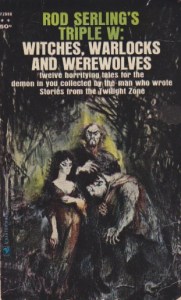
With a few exceptions I think we’ve lived beyond the time when a single name could spawn an industry.  I used to watch re-runs (itself an arcane concept) of The Twilight Zone when I was a kid.  These weird stories drew me in, and, it seems clear, not only me.  Rod Serling’s brainchild led to an industry and “twilight zone” became a household concept.  Lots of little books were written bearing Serling’s name in some way.  One of those paperbacks was Rod Serling’s Triple W: Witches, Warlocks and Werewolves.  I can’t remember where I picked it up, but it was a used book and it had Rod Serling’s name right there on the cover.  Going over my books to find unread gems, I picked up Triple W and sat down to find out what it was like.

None of the stories are by Serling himself.  He’s listed as the editor and he wrote a very nice little introduction.  The tales here reflect, as the subtitle indicates, witches, warlocks, and werewolves.  Some are old stories and some are fairly recent for a book published early in the 1960s.  Descriptive writing does tend to evoke a scene, but I’m often amazed at just how dated it can make a story seem.  What struck writers from the 1940s and ’50s as huge sums of money are likely less than we pay for our monthly internet bill.  Men all try to act tough and the ladies prepare dinner.  Stereotypes.  That’s somehow appropriate for this collection since most of the stories have to do with witches.  Serling was well aware of the tragedies of history, and these tales are told mostly for fun.  The scariest characters are the witch hunters (generally men).

Serling’s famed conscience shows in the choice of the final piece.  Not a story, not even fiction, Charles Mackay’s “Witch Trials and the Law” is an essay about the horrors of witch hunting.  It’s a rather sober piece with which to end a book of speculative fiction, but then Serling was always known for his impatience with injustice.  Also included is Nathaniel Hawthorne’s “Young Goodman Brown,” which I’ve been wanting to read for some time.  Given his shame at the Salem trials and his own ancestor’s part in them, it was mildly surprising that Hawthorne’s story seems to presuppose the reality of witches.  Of course, it condemns the respectable folk who, in reality, all participate in the ills of the society in which they find themselves.  In all, this collection made me think.  Not bad for an impulse purchase on what was probably a rainy afternoon. 


Letterbox

It’s kind of scary.  I mean, I know that Google Maps has everything recorded.  Some family members recounted, a few years back, how they were shown raking the leaves in their yard on street level photographs.  I guess everything’s part of your permanent record now.  What was scary to me was receiving a letter with a picture of my house on the envelope.  Yes, it was from an insurance agency, and insurance thrives on the feeling of vague threat that rattles around our primate brains most of the time.  Is something  or someone out to get me?  Oh no!  They know where I live!  Maybe it was supposed to be friendly, like a good neighbor.  It just didn’t come across that way.  Smile, you’re on Candid Camera.

Not that being recorded doesn’t have its advantages.  We live in an older house, and like most older houses it has had some additions over the decades.  That means the roof is complex.  That complex roof turned out to be leaky also.  When the roofer was trying to explain why he couldn’t do just the one part where the water was getting in (we have been re-roofing on an installment plan), I had trouble imagining it.  You see, when you’ve got neighbors all around it’s pretty tough to get the right angle to examine your own roof.  I googled our address and shifted to satellite mode.  I zoomed in and found the layout of the roof.  Screenshot and save.  Otherwise I don’t think I’d ever have understood how complicated rain deterrence can really be.

But getting a letter in the mail with your own house on it—this seems to cross some kind of line.  Yes, I like our place.  I feel comfortable here.  It’s got space for lots of books.  It isn’t fancy, though.  It still needs quite a lot of work both inside and out.  And I like to spend my scant free time reading.  It’s cheaper than buying all the lumber and tools I need to do things the way they should be done.  Maybe if my job were driving around filming other peoples’ houses I’d make enough to have some contractor come in and fix things up.  But the insurance agent knows where I live now.  Covid-19 probably stops him from knocking at my door, but I do value my privacy.  Like most things, being recorded is a mixed bag.  Who couldn’t use a little extra anxiety once in a while?


Indexing Life

I’m thinking about indexing my life.  It might help to keep things organized, don’t you think?  One of those odd disconnects that a biblical studies editor faces is the discipline’s love of indexes.  I have volumes on the shelf behind me right now that have five or more indexes.  You can look up subject, author, biblical citation, non-biblical citation, and even for some, places mentioned.  The thing is such books were produced before the internet.  If you’ve read a few of my posts you know that I’m no fan of ebooks.  I like a book in my hands, and a book, in my definition, is made of paper.  Still, I do occasionally look things up in an index.  If at all possible, however, I try to find an electronic copy so I can type what I’m looking for in the search box and come up with the exact reference.  In this I’m not alone.

A great deal of my editorial time is spent trying to explain this to other biblical scholars.  In the post-Covid world academic libraries are going to be closed for quite a while.  They’ll likely increase their electronic holdings while cutting back on paper books.  When someone wants to look something up, they’re not going to scroll to the index and scroll back through countless pages to find it.  They’ll use the search function.  That’s what it’s for.  So it goes.  When I index my life, the early part will be all about looking things up manually.  The latter years will be searchable.  To be fair, I would’ve never come to know this if it hadn’t been for working in publishing.

Indexing points to milestones.  Earning a Ph.D. from Edinburgh was one, I suppose.  For a guy who grew up with ambitions to be a janitor, that’s something a little different.  Some things I’m not sure how to index.  The abrupt transition from professor to not-professor, for instance.  What are the keywords you’d put down to search for that?  Or the part about being treated like a lackey by former colleagues?  I guess that’s not really a milestone anyway.  Besides, it’s in the internet half of life, the searchable bit.  The earlier years, many biography readers note, are the most interesting.  They set us on a trajectory that we type up in our curricula vitae.  When I write my fiction the characters are often janitors.  Unless I put my pen-name in the index nobody will ever know.  Of course, I haven’t got to the last chapter yet.


Temple Mysteries

Maybe you’ve noticed it too.  If you read the Bible, rather than just pose with it, you’ll wonder what went on in the temple when you’re done.  Yes, it’s obvious there would be the bleeting of sheep followed by an eerie silence, and that “that Burger King smell” would be pervasive, but what of the interior of the temple itself?  The Good Book says next to nothing about what happened inside.  We do know that going to temple wasn’t the same as going to synagogue or church.  The laity, for one thing, weren’t allowed inside.  Although the temple in Jerusalem can’t be excavated, many ancient temples have been found and archaeologists have the ability to analyze residues found on altars and that tells us something at least.  A story on Artnet News publicizes an archaeological report that rests behind a paywall, so I’ll use Artnet’s headline: “Did Ancient Hebrews Get High During Temple? A New Archaeological Discovery Suggests They Did.”

The story explains that chemical analysis of the famous Arad temple from ancient Judah shows that one of the altars was used to burn cannabis.  I guess that could help explain all the animal sacrifices.  Like most religions, that of ancient Israel kept much in the dark (literally).  Read the biblical account again.  The temple had no windows.  The holy place was illuminated by the menorah, so there was light.  The holy of holies was completely dark.  Other than the rituals of the Day of Atonement, we’re not given much information on what the priests and levites did for the rest of the year.  They may or may not have burnt cannabis.  It might be that what happened in Arad stayed in Arad.  What hath Arad to do with Jerusalem?  We simply don’t know.

Another altar in Arad, according to the story by Sarah Cascone, burned frankincense.  That sounds much more biblical.  I’ve never been a smoker and I’ve never smoked anything in my life.  I did, however, attend many services at Nashotah House where the small space of St. Mary’s Chapel was filled with so much incense that I wondered about its health affects.  I’m not sure if others felt they were getting lightheaded from all the fumes or not.  Incense, to be used effectively should be handled sparingly.  Its purpose was, theologically, to cloud the air in case God decided to show up.  You weren’t allowed to see him.  If he did show up, though, maybe it was party time.  And there’s bread and wine just out in the vestibule.  Some mysteries will never be fully explained.


Sinning

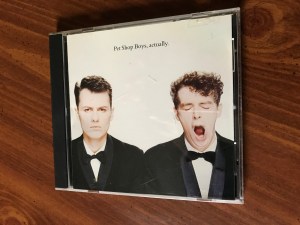
The other day I was searching through the CDs we have and came across the Pet Shop Boys’ album, Actually.  Curious, I googled them and was surprised to learn that they are considered the most successful British pop duo ever, by some metrics.  Who knew?  I lost track of them after 1987.  As I played the album—and synth-pop really isn’t my style—I began to wonder why I’d bought it.  Then “It’s a Sin” played.  The Pet Shop Boys’ second number one hit from ’87, that song was part of my personal history that has led, indirectly, to my last two books.  Let me set the scene:

In 1987 I graduated from seminary.  I was just a small town boy, having grown up in rural northwest Pennsylvania.  My exposure to big cities was limited, and that was one reason I’d chosen Boston for said seminary.  It was there that I began to realize just how much popular culture referenced religion.  “It’s a Sin” is emblematic in that regard.  Everything the boys want to say or do is a sin.  Sounds like Calvinism to me. Still, the song was heard by millions.  I bought the album because of it.

As I recall, there were several pop artists singing about religion at the time.  Joan Osborne’s “One of Us” was still eight years away, but it was becoming obvious to me that people took religious cues from pop media.  I once described the ability to find references to the Good Book as “Bible radar.”  If you’re raised in that culture you learn to spot religion in the most unlikely places.  The concept of sin is a purely religious one.  We all have consciences (I hope) but to make an act Hell-worthy requires religion.  And according to some forms of Christianity just about everything is a sin.

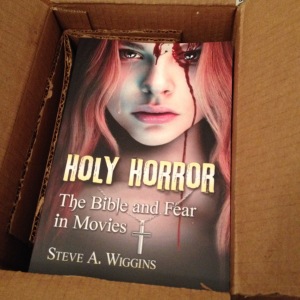
That idea lay dormant for decades.  I read novels and found religion embedded in them, often in biblical form.  I saw it on television.  And in movies.  Even horror movies.  While I sometimes elected to expose myself to intentionally religious media, these references often came from secular sources.  As I began to research this, I came to realize that religion is intricately woven into the fabric of society.  Try to tease it out to isolate it and the cloth starts to come undone.  We like to think of ourselves as more sophisticated than that, but the truth is at some level we still believe it’s a  sin.