Weaponized Scripture

One of the many questions that haunt evangelical Christians is whether it is okay to watch horror films or not.  The same applies to whether it’s okay to listen to rock-n-roll (even as it’s reaching its senior years).  Cultural accommodation is often seen as evil and evangelicalism, as a movement, is frequently offered as a culture all its own.  I recently rewatched Brian Dannelly’s Saved!, a coming-of-age comedy about a group of teenagers at American Eagle Christian High School.  Gently satirical, it portrays well how evangelicals try to redefine “cool” in a Christian mode.  Taking tropes from pop culture and “baptizing” them, Pastor Skip—the principal—assures the young people that they’re every bit as cool as secular culture icons, only the Christians are going to heaven.
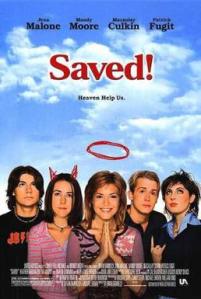
The film came out when I was teaching at Nashotah House.  That seminary also had problems with secular culture, but in a completely different way.  Its method was basically to ignore that culture.  Isolated, Anglo-Catholic, one might even say “Medieval” but for the sanitation, it was likely not a safe place for a professor to be watching such films.  Evangelicalism and right-wing Catholicism were beginning to find each other.  Once the cats and dogs of the theological world, they were becoming more like goldfish in their bowl, watching a strange and unnerving world just outside the glass.  A world in which they couldn’t survive.  Now, Saved! is only a cinematic version of this, but it has a few profound moments.  Mary, the protagonist, comes to see the hypocrisy of both the school and her former friends when she supports a boyfriend who is gay.

At one point her friends attempt an intervention.  They try to exorcize Mary, and when that fails one of them throws a Bible at her.  Picking it up, Mary says “This is not a weapon.”  Since this movie isn’t by any stretch of the imagination horror, I didn’t address it in Holy Horror.  As I rewatched it in the light of that book, however, I recognized a motif I did discuss in it.  The use of the Bible in movies is extremely common.  That applies to films that don’t have an overt Christian setting such as this one does.  The iconic Bible is a protean book.  Despite what Mary says it can indeed be a weapon.  It often is.  Many of us have been harmed by it.  Christian separatist culture has its own dark side, even if it’s carefully hidden, its adherents think, from the secular world outside the fishbowl.


The Late Vortex

So there was this polar vortex recently, here in the States, that led to a meteorological frenzy.  It was worse than the apocalypse itself since it was so bone-chillingly cold outside.  I had contacts from around the world asking if we were okay.  It used to be called “winter.”  Now, I’m not big on human suffering.  I hate to see anyone cold, hungry, or lonely.  These are things for which theodicy itself will some day have to stand trial.  But it does seem that we’ve caved in to media hype about the weather.  Yes, the cold is not to be trifled with.  It can kill.  Winter, however, comes around every year in the temperate zones, and using our evolved brains can help us survive things like winter’s chill.  Heck, our species has survived ice ages before.  They just had no internet to tell them that.

One morning at Nashotah House we were scheduled to attend a lenten mediation in Milwaukee.  A real winter storm was upon us—whether it was a polar vortex or not I do not know—and the temperature plummeted.  The Dean at the time was undeterred.  He’d hired a van to take us to Milwaukee.  I awoke to the news that the air temperature, not the wind chill, was 42 below zero.  For those of you who read centigrade, it crosses paths with Fahrenheit at 40 below.  The weather forecasters warned that mere minutes outside could be fatal.  Our Dean was no respecter of weather.  We piled into a rented van whose windows frosted over as soon as they were cleared and we made our way to experience lent.

My point is, winter can get cold.  A polar vortex by any other name would be so chilly.  What makes the difference between a cold day and an apocalypse?  The media.  Now that we’re constantly online we know when the chill settles in.  The hype makes it more marketable.  Advertisers pay, but they want hits.  By the end of the winter we’ve survived many apocalypses.  I always did find it ironic when some celibate priest would snort, hitch his pants, and say he was a real man (it actually happens!), but living through winter is something we ought to be used to by now.  On the way home from Milwaukee, we said evening prayer in the van so that we wouldn’t have to go outside to trudge to chapel in the midst of what may have been a polar vortex.  Even real men feel the cold, I guess.


Something Blue

I’ve worked for two British publishers.  This probably has nothing to do with the fact that I lived in the United Kingdom for over three years, but the two situations have this in common: they’re bloody complicated.  I say that for a reason.  I’ve always wondered why “bloody” is considered swearing in Her Majesty’s realm, but not over here.  Profanities tend to be culturally specific, of course, while some forms (scatological and blasphemous, in particular) are generally universals.  I had always assumed “bloody” had something to do with religion, kind of like the more tame “zounds” is an abbreviated form of “God’s wounds.”  In fact, the folk etymology of bloody suggests just that.  Folk etymologies, I learned as a budding philologist many years ago, aren’t the same as scientific etymologies.  In other words, like folklore, they aren’t entirely accurate.

One of the lessons I learned in Britain was that if you wish to cite a lexicon, it should be the Oxford English Dictionary.  It’s The authority.  So I thought I’d bloody well check it out on this.  There, it turns out, the emphatic use of bloody has to do with breeding, not bleeding.  Back in the seventeenth and eighteenth centuries there were rowdy aristocrats, or “bloods,” that gave the phrase it’s referent.  These privileged wealthy classes, as befitting the stereotype, could afford idle drink.  They did not work, so life was a matter of passing the time with aristocratic pursuits, such as imbibing.  This led to a phrase “blood drunk,” which, disappointingly, didn’t refer to Dracula, but meant drunk like a blood.  It was only a short, tipsy walk to “bloody drunk.”

Antoine-Jean Duclos, from Wikimedia Commons

Disengaging the adjective—like the saucer part of the Enterprise pulling away from its iconic Star Trek hull—you get stand-alone “bloody.”  This swear has nothing to do with sacred blood, but rather blue blood.  Which brings us to the realm of sacre-bleu, in which the word “blue” (bleu) features.  But this has nothing to do with the color blue (such as Marian blue, known from mythology of the virgin) but from the fact that bleu rhymes with dieu, and using the name of a deity (although “god” is actually a title, not a name) is swearing.  In fact, it is technically what is meant by blasphemy.  Working for British-based publishers has been its own kind of education.  It’s easy to get lost in etymological labyrinths.  But is that the bloody time?  I’ve got to get to work.


Ground, Candle, and February

The world’s hairiest prophet?

Relying on the prophetic ability of a rodent may seem like a fool’s errand, but to understand Groundhog Day you have to go back to Candlemas.  Apart from when I lived at Nashotah House, I’ve never been anywhere that people knew what Candlemas was.  It’s also known as the Feast of the Presentation, and it in itself is built on an archaic ritual based on a creative understanding of biology.  In ancient Israel, a woman was considered impure for seven days.  The eighth day, if the child was a boy, he was circumcised.  Thirty-three days later the woman, finally considered pure enough to approach the temple precincts, was to take a sacrifice for her purification.  And oh, if she bore a girl the impurity lasted sixty-six days.  It’s all there in Leviticus.

What does any of this have to do with Groundhog Day?  Well, according to the much later tradition that Jesus was born of a virgin on December 25, if you do the math you’ll find Mary’s purification falls on February 2.  And if Jesus had been a girl Candlemas would be a moveable feat since February sometimes has 29 days.  Since it’s still dark out for most of the time in February a couple of traditions developed: one was a way of finding out when winter would be over and the other was the blessing of candles since you’d still be needing them for awhile.  That gave the feast its common name.  The tradition grew that clear weather on Candlemas meant that winter was to last for a good long time yet.  Since Germanic peoples love their Christmas traditions, a badger was used for the long-range forecast part of the celebration.

In Pennsylvania Dutch territory, badgers are rare.  Woodchucks, or groundhogs, are just about everywhere and they live in burrows like badgers do.  In a carryover from Candlemas’s clear weather foretelling the future,  the belief was that a badger or groundhog seeing its shadow—because it’s clear, get it?—meant six more weeks of winter.  Of course nobody knew about global warming in those days.  Candlemas, it turns out, was one of the earliest Christian celebrations and it was part of the Christmas complex of holidays.  It’s still winter out there.  It’s also Saturday which means I already have a list of chores as long as a badger’s shadow.  Now I’ve got to remember to get my candles blessed as well.   Winter, it seems, never ends.


Mastication Meditation

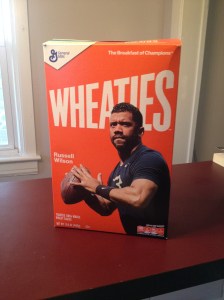
Musing while munching a bowl of Wheaties, a thought came to me.  Not only do we owe the practice of eating breakfast cereal to an evangelical strain of Christianity, but we also encounter the early morning ideas that stay with us through the day.  Cereal boxes start our day.  Advertisers and marketers know that images are important.  If successfully done they stay with us and may influence future purchasing choices.  In the case of Wheaties (which I’ve always liked) the box shows some athlete or other, implying that we’ll be champions too if we partake.  We are what we wheat.  Now, I don’t follow sports.  I can tell a football from a basketball, but watching grown men (usually) chasing one about really has no appeal to me.  I don’t eat Wheaties to become big and strong.  (At my age you don’t want to get bigger.)

As I ponder my fodder, I wonder what it would be like if we put pictures of people reading on our cereal boxes.  Would we experience a massive renaissance of literacy if cool people were shown with a book instead of a ball?  Don’t get me wrong—I’m all for exercise.  I’m a fidgety sort of guy who doesn’t sit still well.  I like to get out and jog or walk.  I don’t mind doing household repairs.  I like to move about.  But reading is one of the great rewards I allow myself.  When work becomes dull, I look forward to an evening of reading (I tend to do my writing in the morning, before the mental exhaustion of the day kicks in.  Wheaties are, after all, a morning food).  It’s kind of like living in pre-television times, I suspect.

Among the publishing industry the fate of book reading is a constant topic of discussion.  Or, not to put too fine a point on it, book buying.  Reading itself is doing fine.  If, for example, you are reading this you are probably doing so on a screen but you’re still reading.  You don’t have to pay for reading, and it passes the time.  No, the crises is getting people to buy books.  People like yours truly buy books even when many are available free online.  I spend at least eight hours a workday in front of a computer screen, and by the end of it, nervous and twitchy, I need a break.  I need a physical book.  And maybe a physical constitutional walk.  If only my breakfast cereal encouraged others to explore the joys of the literary life—but then, I’ve got to get going; my Wheaties are getting soggy.


Not Quite Thursday

I discovered Jasper Fforde, as these things so often happen, at the recommendation of a friend.  A writer of rare talent, he’s conjured a few meta-worlds where fiction is the subject of fiction.  Probably best known for his Thursday Next novels, the premise is that fiction can be distorted by malevolent sorts within the Book World, which is like the Outside (our world) only much more interesting.  The sole problem with series is that in order to follow the storylines, you need to be able to recall where things were left the last time.  That’s complicated when you don’t read the books in order.  I haven’t followed Thursday Next in sequence—I find Fforde’s books sporadically and pick them up when I do (I prefer not to buy fiction on Amazon, for some reason).

The latest installment I found is One of Our Thursdays Is Missing.  It’s a bit more convoluted than the last plot I recall, but the writing is still good.  In this story, which mostly takes place in Book World, the written Thursday Next has to find the real Thursday Next (who is, of course, also written, thus the “meta” I mentioned earlier).  This is probably not the best place to start the series for neophytes.  There was an interesting aspect, however, that I feel compelled to share.  The majority of this novel takes place on an island dedicated to fiction, divided into different “countries” by genre.   Just north of Horror and east of Racy Novel is Dogma.  It’s just southeast of the Dismal Woods.  This plays into the plot, of course, but the placement is interesting.  As Thursday tells it, the full name of the region is Outdated Religious Dogma.  Then I realized something.

Simply placing Dogma on this island plays into the idea that religious thought is fiction.  There are other islands in Fforde’s world, including non-fiction.  Dogma, of course, is not the same as religion.  The definition of dogma is something that is incontrovertibly true, by the authority that states it.  Problem is, nothing is inconvertibly true any more (if it ever was).  When Christianity ruled Europe, such ideas became highly politicized.  Indeed, parts of the world could well have fit into the Book World map.  Fforde’s novel is really just for fun, and Dogma doesn’t play a major role in the story.  That doesn’t prevent it, however, from being a legitimate point over which to pause and wonder.  Fiction can be factual, but not in a dogmatic way.


Fun with Skeptics

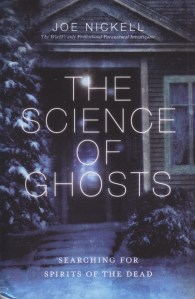
You have to love skeptics.  Really.  Like most people who’ve spent many years attaining a doctorate, I’m naturally skeptical about many things.  One thing that I only temporarily lost (between about 1991 and ’99, if I recall) was an open mind.  That is to say, I discounted many things out of hand because people with doctorates don’t countenance such things.  I eventually realized the folly of academic arrogance and went back to considering things by actual evidence.  The results were interesting.  In order to help with my Ed and Lorraine Warren dilemma, I decided to read The Science of Ghosts by Joe Nickell.  It’s hard not to like Nickell.  He was a stage magician and eventually earned a doctorate in folklore.  He then made a career out of being a paranormal investigator.

He begins his book by claiming to have an open mind about ghosts.  Very quickly, however, a skeptical reader with an open mind notices his magician’s tricks.  He’s very good at misdirection.  While putatively not debunking (but actually debunking) ghostly encounters, he time and again comes to the states of consciousness when individual super-impose images from the  unconscious mind onto what they’re seeing: when falling asleep, in the middle of the night, when waking up, when doing routine chores, when concentrating, when working.  That about covers over 90 percent of human time.  During these periods we’re likely to mistake what’s not really there for what is.  It could explain much of the driving I’ve witnessed in New Jersey, if not ghosts.  And he also picks straw men (and women) to knock over (pardon the violent metaphor).  Accounts by the credulous are his favorites to explain away.

What we really need is a middle ground between credulousness and a skepticism that can’t be convinced even by evidence.  Yes, ghost hunters use ridiculous methods for claiming “proof.”  Yes, some credible people legitimately see incredible things.  Nickell never deviates from his definition of ghosts as a form of energy left by the departed.  Nobody knows for sure what ghosts are, of course.  If they did there’d be little mystery about them.  Although Nickell claims openmindedness, he states at several points that at death brain activity ceases therefore nothing can think, walk, or talk afterward.  As any experimentalist knows, the results reflect the way an experiment is set up.  If the assumption is that there can’t be ghosts, there won’t be ghosts.  To get to the truth of the matter something between credulousness and biased skepticism must be brought to the table to see if it really tips.  Skeptics are fun, but an actual conversation might be more fruitful.


Now Hiring?

In keeping with my recent theme of jobs you never knew you could have, I recently read a story a friend sent me from The Vintage News.  The story concerns a spiritual counselor who is planning to marry a ghost.  I didn’t know that spiritual counselor was an available job.  You see, I had taken enough psychology courses in college that I could’ve had it as a minor, but I didn’t declare it.  At the time I was destined, or so I thought, for a career in ministry and psychology seemed a good subject to assist with that.  Also, I naturally tend to try to figure out what motivates people.  Like most career options, not having a science background prevented me from pursuing psychology as a fall-back career.  But spiritual counselor?

The woman in the story lives in the United Kingdom.  Here in the United States, where unhappy people seek any opportunity they can find to sue someone, having a job as a spiritual counselor probably involves ordination.  Even if you’re ordained, as I learned from long years both attending and teaching in seminaries, you always refer those who come to you to a licensed psychologist.  Clergy can easily be sued for providing bad advice.  That’s why the counselor part of this job seems so odd to me.  That, and the woman the story features is only 27.  I suppose that’s time enough to finish a doctorate, for the truly ambitious, but apparently she doesn’t have a terminal degree.  Just a post-terminal lover.

Also, I learned that spectrophilia is a condition with a name.  The idea of intimacy with spirits is nothing new, of course.  The ancient idea of incubi and succubi reflect this concept, and a number of the stories in the Ed and Lorraine Warren oeuvre include sexual attacks by demons or ghosts.  What’s different here is that the young woman wants to marry a spirit she can’t see.  Unlike most such reputed cases of spectrophilia, she claims spirits are superior to physical lovers.  Despite the oddities that make such a story newsworthy (in a sense) a potentially important point could emerge from all of this.  Love is not a physical phenomenon.  We all know it when we feel it.  I suspect that other such feelings, like finding the perfect job that matches your skills and interests, are likewise intangible.  The problem is finding out that such jobs even exist.


The Truth of Fiction

The thing about reading is that it’s a lifestyle.  I record books both here and on Goodreads, but I read a lot more than books.  Although I don’t have much time for magazines or even newspapers, I read a lot on the web.  And billboards.  And sidewalks.  I’m quite content doing it.  One thing I’ve noticed in all this reading is that fiction writers tend to be more often cited as experts and intellectuals than do non-fiction writers.  Oh the non-fic practitioners get their footnotes, and other specialists mention them, but fiction writers get analyzed, probed, and explored.  Literary types wonder what they meant by some obscure doggerel they wrote.  When’s the last time a non-fiction writer drew that kind of attention?  It makes me wonder about all the time I’ve been spending on non-fiction lately.

I suffer from graphomania.  There’s no cure.  The other day I went looking for an old, pre-electric typewriter to get my fix in case the power goes out.  I have notebooks, zibaldones, commonplace books.  I carry one in my pocket.  I have one on my bedside stand.  And the thing I’ve noticed is that the ideas that come to me unbidden are often fictional.  You see, I have a hidden life as a fiction writer.  That persona is very poor since he’s never made any money from his writing.  He was nominated for a Pushcart Prize some years ago, but he never won.  That fiction writer has been suffering cabin fever because I’ve been finding publishers for my non-fiction work.  I wonder, however, if maybe I shouldn’t be spending my time on fiction.  It’ll never get me to the point I can make a living on it, but it might get quoted after I’m gone.

Writing, after all, is a stab at immortality.  Those of us who do it are legacy builders.  Even as the web has moved us more and more toward visual, iconic forms of entertainment, it has still left a few dusty corners for the written word.  When I pass the sometimes impressive graffiti on the way into New York I think I know what the vandals are feeling.  We’re kindred spirits.  We don’t want to be forgotten.  Whether with spray can, fingers on a keyboard, or fountain pen (or maybe even an old-fashioned typewriter) we are trying to say, “I was here.”  I used to print out all my blog posts in case the web failed.  It grew to thousands of pages.  I had to stop.  I was beginning to act like a fictional character.


Poppins Fresh

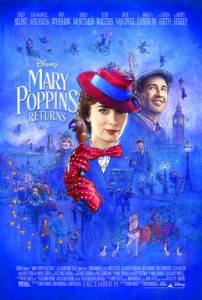
The holiday season often means doing things out of the ordinary.  Despite writing books that deal with movies, I can’t afford to see them in theaters often, but we went as a family to see Mary Poppins Returns.  A few things about that: I grew up never having seen Mary Poppins (I first encountered it in college).  The new movie is neither a remake nor a sequel proper.  It follows the same basic pattern as the original but with new songs and animations, and all of it based on a somewhat darker premise—the death of the mother (which allows Jane and Michael, as adults to both be back in their childhood home) has led to financial straights that threaten to leave the Banks family homeless.  The bank has turned cruelly capitalistic and wants as many foreclosures as possible.  Sinister stuff.

The reason I mention the movie here, however, is a premise that it shares with Hook: children can see things that adults can’t.  Or more precisely, that adults learn not to see.  Some investigators of unusual phenomena suggest that as we grow we’re taught not to believe what we see if it’s impossible.  I’m in no position to assess the validity of such an assertion, being an adult, but it does give me pause for wonder.  We regularly shut out the vast majority of stimuli we experience; our brains are not capable of taking in every little detail all the time.  Instead, we’ve evolved to pay attention to that which is threatening or rewarding to our survival, and we tend to ignore many of the mundane feelings, sights, sounds, and smells that are constantly around us.  Perhaps we do shut out what we’re taught is impossible.  Mary Poppins Returns says it outright. 

In many ways this is behind the materialism we’re spoon-fed daily.  The only reality, we’re told, is that which can be measured and quantified with scientific instruments.  Any apparent reality beyond that is simply illusion.  We all know, however, that our experience of life doesn’t feel that way at all.  There seems to be no counter-argument, however, since we have no empirical evidence to offer.  Experience, we’re told, is unreliable.  Perhaps we’re not too old to learn a few things from the movies.  Mary Poppins Returns won’t likely become the cultural sensation that its forebear was, nevertheless it contains a message that may be worth preserving.  Childhood may hold the keys to understanding reality.


The Cult of Relaxation

Relaxation comes with a price.  As with most people who work hard, I find taking more than a day or two off work tricky.  It’s not that I want to go to work, but that I feel the need to keep improving my mind.  I read quite a bit on holidays, and, being of the opinion that movies are the modern mythology, I like to watch what I can.  Last night I saw a film I’m too embarrassed to name, but which was so utterly awful that I can’t get it out of my head.  Call it an experiment in relaxation.  Or call it madness.  Either way, I came to realize just how much impact a movie might have without really containing anything to give back.  This particular film is often listed as a cult classic.

I’ll confess right now that I loved Attack of the Killer Tomatoes the first time I saw it.  (This is not last night’s feature.)  It is a bad movie—so bad that it’s good.  My professional reputation may suffer for it, but I have to admit to having watched it multiple times over the years.  I’d heard that last night’s film was like that.  So bad that it’s good.  And that made me ponder the blurring of these categories.  Without a universal deity to declare the terms, good and bad are matters of consensus.  No quantitative means exists for making, a movie for example, good or bad, beyond the human judgment of viewers.  We tend to listen to critics, who experience more cinema than the rest of us can afford, but I’m sure we all have our secret likes that don’t match the decrees of the experts.

Films that flaunt convention so radically, and which gather disciples, are, as I mentioned, called “cult classics.”  This is the language of religion.  Although religionists have moved away from the use of the word, cult implies irrational intensity of devotion toward that which is clearly, in the eyes of the majority, bad.  Again we come to the question of who defines value.  For most of human history it has simply been majority opinion.  Cults, however, give meaning to those who “get it.”  Cult classics have faithful followers.  In the line of duty some months back I watched Exorcist II: The Heretic.  I later found out that it also frequently makes the list of all-time worst movies, despite starring Linda Blair, James Earl Jones, Paul Henreid, and Richard Burton.  It’s a cult classic.  The unnamed film from last night has no known stars.  Hideous acting.  Ludicrous writing.  I watched it to relax.  Now I wonder if I’ve joined a cult, or if I just need a vacation.


Book Birds

I just read an interesting article about how social media, and the internet in general, hijacks our time.  If you’re reading this, no doubt you’ll agree.  Those of us who write books on our “free time” know that the way books are both found and sold is on the web.  Publishers  encourage authors to build a social media platform, usually involving Twitter.  Academics are often hopeless at social media—they’re lousy at following back on Twitter, as I know from experience.  There is a kind of self-importance that comes with higher education which makes many of the professorate assume the work of others is less important than their own.  It’s more blessed to be tweeted than to tweet others.  After all, such-and-such university has hired you, and that proves the value of what you have to say.

Head-banging tweeter

Book publishers, however, will be looking at how many followers you have.  Not that all of them will buy your book, but at least a number of them will know about it.  Curiosity, indeed, drives some sales.  Just like many academics, I’m jealous of my time.  I’m also conscious of that of others.  These blog posts seldom reach over 500 words.  I tweet only a couple times a day, although I understand that’s not the way to get more followers.  You need to tweet like a bird, often with images or memes, but try explaining that to your boss when each tweet is time-stamped.  The academic is uniquely privileged to be given control of their time outside of class and committee meeting.  Tweet away.  That doesn’t mean they’ll follow you back.

The reason for tweeting is, of course, self-promotion.  45 may understand little, but he understands that.  You can commit treason and people will overlook it if you tweet persistently enough.  My own Twitter activity is like the eponymous birds after which the site is named; it is active before most people are awake.  And it, like this blog, is not designed to take up your time.  Since my tweeting during the work day is limited, my tweets are seldom picked up.  I try following other academics, but often they don’t follow back.  After all, what does a mere editor have to say that could possibly be of interest to the high minded?  Alas, I fear my advanced studies of the Bible have become bird-feed.  And my forthcoming book won’t get noticed.  I only wish more colleagues would consider the adage, tweet others as you would like to be tweeted.


I’ll Be Googled

It’s a strange sensation to do an innocent web search only to find yourself cited.  (And no, I was not googling myself.  At least not this time.)  I was searching an obscure publisher and my own pre-publication book, Holy Horror, came up on Google books.  Now, the computer engineers I know tell me that Google remembers your searches, and this has a way of being unintentionally flattering; when I search for my book it pops up on the first page because I have searched for it before.  Still, it was a bit of a surprise to find myself where I had no idea I’d been cited.  All of this drew my mind back to my “post-graduate” days at Edinburgh University.  To how much the world has changed.

One of the first things you learn as a grad student is you can’t believe everything you read.  Granted, most of us learned that as children, but nevertheless, with academic publishing a new bar is raised.  That which is published by a university press is authoritative.  So we’re led to believe.  But even university presses can be fooled.  This prompts the fundamental question of who you can really believe.  Our current political climate has elevated that uncertainty to crisis levels, of course, and the vast majority of people aren’t equipped to deconstruct arguments shouted loudly.  Where you read something matters.   Even publishers, however, are fallible.  So what am I to make of being cited by the web?  And is my book already available before I have seen a copy?

Even credibility can be bought and sold.  Colleagues make a much better living than me with the same level of training, but with more influential connections.  It was just this reason that I decided to try to shift my writing to these who don’t need credentials to impress each other.  Some of the smartest people I ever knew were the janitors with whom I started my working life.  As a fellow post-grad in Edinburgh once said, professors are always ready to fail you for your lack of knowledge but most can’t tell you what an immersion heater is.  (That’s one of those Britishisms that no amount of graduate courses at Harvard will teach you.)  I suppose when it’s all said and done nobody else will ever search for the obscure publisher that brought my book to Google’s attention.  No matter, at least Google will always flatter me.


Captive to Capitalism

Some people are born capitalists, while others are not.  I recall the old TIAA-CREF ads showing some famous thinker and stating that some of us don’t have time to think about money.  Since I’m an obscure private intellectual I feel hard pressed to put myself in such exalted company as university professors, but here I am anyway.  I just don’t think much about money, other than to panic over my lack thereof.  It doesn’t motivate me and as long as I can get along without too many worries, I seldom think about it.  Or so it used to be.  Then I bought a house.  Suddenly everything is about money.  This needs to be fixed, and that requires repair.  Instead of spending weekends writing (as I’m fond of doing), I now try my hand at skills like carpentry and masonry.  At least now the grass has started to turn brown.

I was never offered TIAA-CREF as a fiduciary option.  (I can’t believe I even know what fiduciary means!)   Having grown up poor I didn’t think much about things like retirement or dental care.  These were things middle class people did.  Now that I’m technically part of the club, I think back to being a poor kid working my summers away.  I had lots of time to write in those days.  It’s not that ideas for writing have stopped—they’re rather backed up—but the concerns and cares of this world have forced me to think about that thing I’d rather not face.  You see, capitalism takes no prisoners.  Once it starts the entire world has to play its game, otherwise the rich can’t keep getting richer.  Those of us who’d like to make a living by creativity take jobs that, in turn, take our time.  And more than just 8 hours a day of it.  Some people don’t realize that money doesn’t motivate everyone.

Accuse me of being a utopian; I promise I won’t take offense.  I can imagine a world where money would be an opt-in.  I’m careful to be discreet about it, but there are frankly some of us that would work for books, should our other basic needs be covered.  Secular monks, perhaps, unleashed from dogma and allowed to roam where the human mind can go.  Once you start thinking about money it’s difficult to stop.  You want to have a cushion that will soften unexpected eventualities—which seem to be coming somewhat more frequently these days—and every time you rub your back after a fall you think that pad should be a little thicker.  Getting paid for writing?  In your dreams!  I’d say more about it but I think Lowe’s is open now.


Free Cookie

So, it started out as a freebee.  The way I looked at it, I paid enough for my computer to justify some free software.  We had Quicken on our desktop for years before we started to use it.  Then came the notice that it would no longer work on our system (which upgrades apparently every nano-second).  If we didn’t want to lose our financial data we would, the note cheerily said, have to upgrade.  You have to buy what once was in the land of the free.  We consulted about it—I still have an objection to paying for something made strictly of electrons; when I pull the blanket off the bed this time of year I get a healthy jolt of electrons without having to pay for them.  We caved.  Then the notice came again.  Upgrade time!  Only you can’t buy Quicken, you can rent it.  The one-time fee for buying software is now an annual fee.  Isn’t everyone happier now?

I don’t mean to pick on Quicken, although that is the most insidious offender since you can’t very easily transfer all that data back to paper.  Services withdrawn.  Welcome to the internet of thieves.  Bakeries worldwide know that a free cookie leads to sales often enough that it’s worth the small loss in profits.  But electrons are free all the time.  Shuffle your feet across the carpet in you stocking feet and test it.  Amazon for a while sent the Washington Post headlines daily, for free.  Now, Amazon ought to know me by name since I’m a book addict.  Then, just at the midterm elections, they announced this freebee was over.  I don’t know what in the world has been happening since.  I do hope someone will tell me when our currency converts to rubles.

Who wants a cookie?

Humans are susceptible to the myth of permanence.  Although change is constant and time never ceases to flow, we tend to think things will stay where we put them.  Technological change, however, has become so swift that we now pay for the privilege.  Unlike that cookie which lasts a moment and the choice of buying more is up to you, the internet has swept up our lives and you can no longer opt out.  We pay our bills online because letter carriers drop things.  We communicate online because who has the time to pick up and dial an actual landline phone?  The fact that the signal cuts out now and again isn’t a problem, even when we lose valuable information.  It’s only electrons, after all.