Inter-species Prognostication

Groundhog Day is a holiday easily forgotten by all but Bill Murray fans and residents of Punxsutawney, Pennsylvania. The day, however, has a role deep in European folk religion that was reflected in the “cross-quarter days.” From ancient times, the four days of the year that fall precisely between the solstices and equinoxes were known as cross-quarter days, based on the day of the month that rent was due in England (“quarter days”). The Celts recognized this cross-quarter day in early February as Imbolc (later Christianized as Candlemas). Part of the folk religion held that animals had special powers on cross-quarter days, and that fair weather on Imbolc meant that more wintry weather was on the way.

In America, where Groundhog Day has its original burrow, the tradition began among German immigrants. The first historical reference to Groundhog Day was made in 1841 in Morgantown, Pennsylvania. By 1886 Punxsutawney had its groundhog Phil and the tradition has continued ever since.

Although it is a lighthearted holiday, I always tell my Hebrew Prophets class (which begins near Groundhog Day) that this is a form of socially accepted prognostication. Few believe that a marmot can predict the weather, but we like to believe that winter is on its way out when the cold starts to feel old and stubborn and we are ready for a few sunny days. The old tradition states that if Phil doesn’t see his shadow he won’t dash fearfully into his den and spring is on its way. Fact is, spring falls six weeks from Groundhog Day, so no matter what the rodent says, spring is on its way. Ancient religions always stress the hope that nature will continue as it has in the past and that spring will follow winter as it should. It is nevertheless a fun day to watch the largest member of the squirrel family amble out of his heated burrow, no doubt confused by all the furless bipeds standing around with cameras, and play the prophet for his fifteen minutes of national fame.

The world's hairiest prophet?


Paul Does the Classics

I first became aware of Greek mythology in fifth grade. My teacher in an industrial, rough and yet rural school, believed in the benefits of teaching aspiring drug addicts and laborers the stories of gods and heroes. I immediately adored the stories we heard and read. Raised in a religious household, however, I feared enjoying the tales of what were admittedly pagan gods after all, too much. In the educational topography of my youth, we were on the brink of this brave new electronic world we’ve entered, and mythology was not considered a terribly useful part of the curriculum after that. I left the gods behind. In a class on the Christian Scriptures in college, however, my instructor suggested we all go see Clash of the Titans (the 1981 version) for its appreciative (if a little hokey) presentation of the Greek world. I enjoyed the movie and even took a class in the literature department on mythology.

Over the years I have touched and gone on Greco-Roman mythology while specializing in the mythology of Ugarit. Now that I’m teaching a course on mythology, I’m going back to my classical roots and rereading the stories of times not quite so ancient as the fertile crescent civilizations’, but older than what is considered practical nowadays. While rereading Euripides’ play The Bacchae, the concentration of images, concepts, and actions that recur in the Bible stood out in chiaroscuro. Especially noticeable were references to Paul in the book of Acts.

Like Paul, Dionysus comes to be imprisoned. Not recognized as a divine figure, King Pentheus of Thebes locked him in chains until he could demonstrate that Dionysus is just the wild imaginary figure of repressed women. An earthquake, however, soon rattles the city and Dionysus emerges, chains shed, to the astonishment of Pentheus. The scene reads like Paul and Silas’ escape from jail in Philippi (Acts 16). Admittedly this could be coincidence. A few lines later, however, Dionysus, free from prison, tells Pentheus, “Don’t kick against the goad – a man against a god,” (Act 3, Paul Roche’s translation). Even so, Paul on his way to Damascus sees a vision of a god and is asked, “Why are you persecuting me? It is hard for you to kick against the goads” (Acts 26.14). Perhaps Luke had read his Euripides?

Now I’m no scholar of the Christian Scriptures (although I have taught courses on them a time or two), but when obvious parallels exist it is incumbent upon modern readers to pay attention. The parallels of Dionysus and Jesus were evident to early Christians, so what I noticed was nothing new. When the followers of Dionysus, however, strike a rock with their sticks and water flows out, I wondered if Euripides had read his Torah!

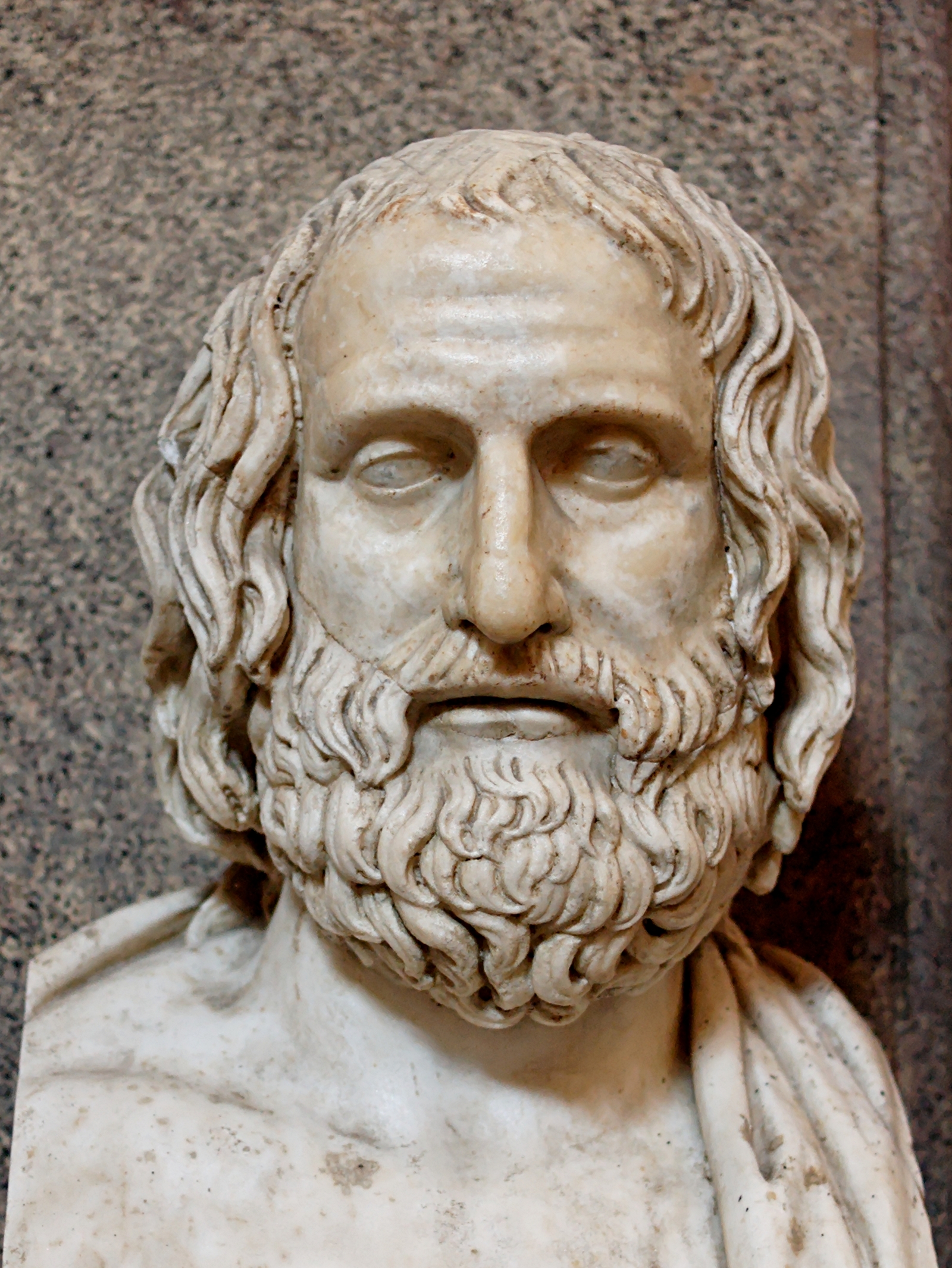
Paul's bedtime reading


The Truth is in Here?

Constantly trawling for the shattered detritus of truth that rests scattered around our lonely little planet, I have often supposed they were here. I have never seen them, but in the Drake Equation there is a high probability that they exist. And now the newspaper says they may have been here all along. And closer than we thought.

Aliens. These latter-day angels and explorers of the cosmos are often pictured like E-T or the little gray aliens from Close Encounters of the Third Kind. The latest findings suggest they could even be quite a bit smaller than that. Paul Davies, a physicist from Arizona State, believes that life may have developed multiple times on earth, and perhaps some of the googol of microbes on our planet may have their origins in space. These potentially extraterrestrial microbes, he stated could be “right under our noses – or even in our noses.” Yikes! Time to put up the intergalactic “No Trespassing” sign!

Stop the alien menace!

In all seriousness, however, this concept of multiple origins of life, I fear, will be latched onto and misread by our Creationist fellow-life forms. I can see the fingers stiff from grasping at straws claiming that now there is scientific proof that different species do have different origins, thank you Mr. Darwin. The price to pay, if they apply logic, however, is not one evolutionary track, but many.

The movie Creation, focusing on Darwin, opened this past weekend in the United States. Delayed because of concerns that Americans can’t handle the truth, this film about Darwin’s sad voyage to the inevitable truth of natural selection will surely raise evangelical ire. Nevertheless, we did not design this world we evolved into, we simply inherited it. And the closer we peer at it, the more complex it becomes. These multiple evolutionary tracks may also explain the origin of Creationists – could they come from different stock than scientifically minded folk? In any case, the news today provides yet another reason to keep our noses clean and our eyes on the skies.


Father Freeze

Photo credit: Dmitry Lovetsky, Associated Press

This picture appeared in the newspaper this morning. At a monastery in Valdai, some 250 miles to the northeast of Moscow, Russian Orthodox believers were celebrating Epiphany by leaping into a cross-shaped hole in the ice on a nearby lake. The temperature, as noted in the caption, was 18 degrees below zero (Fahrenheit). What the caption did not explain is that Epiphany, at least in this context, translates as Russian for “severely clenched scrotum.” Hypothermia, the Lord is frozen! Blessed is he who comes to freeze. The ice-man cometh in the name of the Lord.

Many years ago, well into the decades mark, I was talking to a friend about the liturgical churches, as opposed to the strictly Protestant ones. She had grown up staunchly Protestant and was put off by the ceremony of the sacramentally-identified churches. In our discussion she paused and mentioned a televangelist (I can’t recall which one; they all look alike after a while) who had agreed to ride down a water-slide at an amusement park, in a full three-piece suit, if his audience would raise a certain payload of cash. Although the details escape me, it seems entirely plausible ⎯ there is little a televangelist won’t do for money! Then she said, “I can’t see the Pope doing that. I guess there is some dignity to that.” I was pleased; I had made the point that some Christian groups do not need to be in the spotlight of artificial flamboyance in order to proclaim the seriousness of their message. Shortly after that I began to work at Nashotah House.

To speculate from the photo above, there was not a large gathering of the faithful on the Siberian ice. Just a few believers in an extreme masculine Christianity dressed in liturgical underwear. Nevertheless, such displays of faith have been part of religions from the very beginning. Ancient believers used to carry their statues of gods around Babylon for a day out to remind the secular that the eyes in the sky are still watching you. When a sartorially perfect prefect steps out in all his finery, what other option is there but to drop one’s hands and stare? A favored photograph at Nashotah House when I was there featured the “Fond du Lac circus,” a gathering of such high rollers in the Anglo-Catholic corner of the Episcopal Church that even a future Russian saint deigned to show up. The event was the consecration of Bishop Weller, coadjutor of the Diocese of Fond du Lac, in 1900. As I look at the Orthodox man poised over his cross-shaped hole, I wonder if my friend had it right after all. The Fond du Lac circus haunts me to this day. What is religion without the show?

The Fond du Lac Circus


Illusions of Permanence

Blogging about the ancient world presents idiosyncratic problems. Quite apart from the fact that few readers show much interest in the shadowy ages of antiquity when new tunes and flicks are available to download just mouse-clicks away, the worldview of ancient people is difficult to comprehend. Most people before the common era probably focused their energies on their crops and beasts, hoping to survive for as long as possible in a subsistence world. I’m sure they would have appreciated an i-pod as they were out plowing or were at home weaving and cooking, but theirs was a solid, practical world where reality could be brutally felt.

Fast-forward to our day. I can’t teach a class of undergraduates without noticing their constant attention to their electronic arsenals forever at hand. Cell-phones, i-pods, laptops, and god-knows what-else making as much buzzing and chirping noise as a meadow in springtime. This constant interruption is what Linda Stone has coined “continuous partial attention.” Kids are raised to juggle many sources of input or stimulation at one time, an activity that befuddles those of us raised when television was black-and-white and telephones were heavy devices solidly settled in one place. The disconnect is palpable.

I read in Wired magazine some years back a whimsical analysis of data storage. A chart indicated the most reliable means of keeping data over long periods. Electronic media suffers from rapidly increasing technology (does anyone have a 5-and-a-quarter inch floppy drive I can borrow?) as well as the transience of the media itself (electrons marching in order). On the top of Wired’s chart for durability was the humble clay tablet with a period of about 5000 years. I chuckled at the chart, but deep in my psyche I know that a major power-outage, or a catastrophically failing server could plunge my electronic compositions and data into oblivion. We have so much information out there, but what happens if it flies away in the tale of an errant comet? My suggestion to the younger generation is to learn cuneiform. It may take a few years, but as a storage solution it is rock-solid.

The original hard copy


Incredible Shrinking Saturdays

As a kid Saturday afternoon was devoted to the science fiction repertoire offered to B-movie connoisseurs on commercial television. There were only about a dozen channels in those days and one of the local Pittsburgh stations had the demographic of teenage boys’ viewing habits down to a science. Now that people tell me I’m grown up, although they won’t give me a full-time job, the temptation is there to let the television do the thinking for me. Actually, I only allow myself to watch TV on the weekends; it never gets turned on until Friday night. The rest of the time is spent getting ready for classes or looking for jobs.

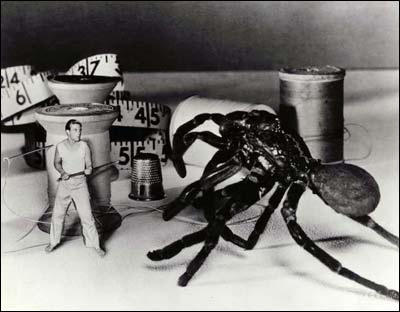
Anyway, yesterday I decided to watch I movie I first saw as a tween (“kid” as they were called in those days), The Incredible Shrinking Man. The Christmas tree was set up and decorated and the snowstorm scheduled to bury the East Coast was doing its job quite well. So I settled in to remember old times. I’ve mentioned before the mild social criticism of 1950s sci-fi, and seeing this film as an adult yielded the same results. When Scott Carey realizes he’s shrinking, the doctors figure out that he had been exposed to radiation — a perennial plot device in Cold War movies — and the various creatures of the natural world become deadly threats. His cat, and, of course, the basement spider, both try to kill him.

Then, as the realization dawns that he will eventually shrink down to nothingness, Carey reflects how the infinite and infinitesimal are the “ends of a circle.” And in a movie where the divine is not previously invoked, he ends his relentless deflation by narrating, “To God there is no zero. I still exist.” When technology (medical science) and human help (his wife stays with him until he is the size of a cockroach, and only leaves when she believes the cat ate him) fail, the 1950s audience falls back on God. Theologians call this thinking “God of the gaps,” where God, the ultimate deus ex machina, is used to explain what human reason can’t yet figure out. It is still prevalent in Fundamentalism and most forms of contemporary Christianity. If belief in God relies on having unexplained phenomena, the question of who is shrinking becomes challenging indeed.


O Tannenbaum

Today we put up our Christmas tree. As we drove home with it strapped to the roof our car yesterday we felt like pariahs since everyone else in New Jersey seems to have collected their tree a week or two before Thanksgiving. I have spent too long among Episcopalians to appreciate such eager chomping at the bit. At Nashotah House Christmas trees were discouraged until about Christmas Eve, since a hearty Advent celebration was considered a sign of true piety. Well, with a small child in those days, we didn’t care to deprive our daughter of the childhood anticipation of Christmas, so we received the ugly stares due to those so uncouth as to set up a tree a week in advance. Now people think we procrastinate to wait until the weekend before Christmas to set up our interior conifer.

A few years back I wrote a book on holidays for teenagers. I haven’t found a publisher yet, but I did quite a bit of research that I’d rather not waste. Sometime soon I will post the Christmas section under Full Essays. It is chock-full of traditions and facts and impressions about Christmas and what it has come to mean to us today in the United States, but since today is tree day for us, I thought I’d start out with a little of the story of the humble Christmas tree:

The modern use of Christmas trees can be traced directly back to Germany in the 1500s. The earliest written reference comes from 1570 when a fir tree was set up in guild houses and decorated with apples, nuts, pretzels, and small things for kids. On Christmas Day the kids of the guild members could come and take the hanging gifts. The apples may go back to plays in the Middle Ages with Adam and Eve; sometimes plays of the Garden of Eden had apples hung on a fir tree. A tradition says that Martin Luther, the monk who started the Protestant movement (the Reformation) was walking home one winter night when he saw the stars twinkling through the branches of the pines. He set a tree up in his house, the story goes, lit with candles, to try to recreate the effect.

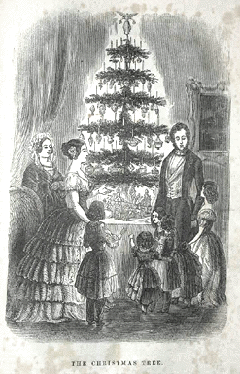
We do know that the Christmas tree (originally Tannenbaum) was a German invention. Until the 1800s it was almost completely limited to Germany. Candles were used to light the trees – talk about your obvious fire hazard! Royalty from other European countries were presented with Christmas trees as a novelty in the 1800s. Soon other well-to-do families started to set them up. An engraving of Queen Victoria in England with a tree from her German husband Prince Albert captured the public imagination and Christmas trees became the rage in England. Charles Dickens took over and the rest is history.

A Christmas Tree primer


Im in ur blogz

Translation. The Bible as we know it would not exist without translation. Ours is a culture of convenience — Americans want divine revelation dished out in easy-to-swallow portions in their own tongue. Going through the rigors of learning new alphabets and grammatical systems, not to mention the eerie specter of textual apparatus, are enough to frighten off all but the most stalwart of truth-seekers. This is a good thing. We would never advance as a culture if we all had to spend our time learning actually to read our religious texts as they were written, only to find out that we have no original texts at all. So we trust our translators.

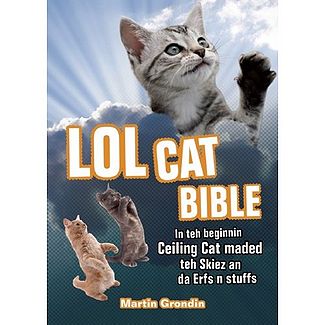
A few weeks back I posted an entry on Andrew Schlafly’s misguided (imho) Conservative Bible, devoid of liberal bias. Since then Stephen Colbert’s interview with Schlafly has been making its rounds on the internet and thousands of people are now aware of the project and its biases. I stand by my original objection that biased translations are unfair representations of the actual ancient texts. But it looks now like I’ll have to be eating crow. A new translation is scheduled to arrive in stores next month, and it looks like it may have a bias. Still, it is a translation that no internet-savvy reader can afford to ignore. Yes, the Lolcat Bible is nearly ready to pounce from the press.

The culmination of the Lolcat Bible Translation Project, over two years in the making, a Bible in Lolspeak will soon be available. Comparing what I’ve seen of the two projects, I think there is more truth in the Lolcat Bible than in the Conservative Bible. I’ve studied more ancient languages than any sane person rightfully should, but I do rely on my able research assistant (aka daughter) to help read Lolspeak. She suggested the title for this post, but the full text reads, “Im in ur blogz, postin mah wurdz of wizdum.” That’s straight from the mouth of Ceiling Cat!


A Walk Around the Watchtower

The Jehovah’s Witnesses stopped by yesterday. I never pretend not to be home, and when I’m less stressed out I like to engage them in terms of biblical exegesis — religion is all about conflict. Yesterday I was still recovering from the disappointment of not getting a job I really wanted, so I simply answered their questions and accepted their Watchtower magazine. Thumbing through it, I ran into some hermeneutical obstacles — an occupational hazard for those of us who’ve spent a little too much time with the Bible, I suppose. A story about Joshua informed me that “Jehovah wants you to succeed.” It tasted a little too much like prosperity gospel and not much like life in the present. So I flipped a few more pages.

An article on Lunar New Year (Chinese New Year, as it is traditionally called), warned against Christians celebrating it, in part because of ancestor veneration. The Watchtower declares, “the Bible show that the ‘ghosts’ and deceased ‘spirits’ are really wicked spirit creatures pretending to be the deceased. For what purpose? To mislead people and bring them under their evil control!” Now, I admit to being drawn into the Ghost Hunter fan-base, but I do recall the story of Saul summoning Samuel from the dead. The Bible doesn’t indicate that he’s evil; in fact, it is Samuel himself! If ghosts want to deceive then they need to show up a little more clearly and give more direct messages.

I then learned about King David’s remarkable musical prowess in the story about music in the Bible. It is truly amazing what can be extrapolated from a literal reading of the Psalms. The magazine informs us that King Sennacherib, emperor of Assyria, demanded male and female musicians from Hezekiah. “It seems that they were first-class performers.” This seemed a little too much like the stereotype of Jewish entertainers, and since it was extra-biblical I couldn’t accept it. The story concludes by indicating that music is not a human invention. “The Bible describes music and singing in the heavens themselves, where spirit creatures play figurative harps and sing praises around Jehovah’s throne.” As I pondered what a figurative harp would sound like, I could swear I heard the sound of one hand clapping.

Being that time of year, the issue has an Epiphany story. Well, most Christians associate the wise men with Christmas, so I’ll call it a Christmas story. Eager to be honest, the author notes that the wise men were really foreign astrologers. And although they were into witchcraft, the angel announced Jesus’ birth to them to lead them away from this abhorrent practice. Then a divine revelation came to them in a dream in order that they could avoid Herod and his wicked plan. So the astrology that led them to Jesus was bad, but the end result was good.

When the Jehovah’s Witnesses ask me if I know about the Bible, I look at my feet and kick at an invisible speck of mud on the floor as I admit that I have taught Bible for nearly twenty years. But when they ask what I believe about the Bible I tell them the same thing I tell my students — what I believe is personal and I choose not to share it. I don’t begrudge any person of their religion. I even share the Jehovah Witnesses’ hope that the future may be brighter than the present. If you want to convert a religion professor, even an adjunct one, however, it will take more than a Watchtower to do it.


Christian Movementarians

After a distressing day of job-hunting yesterday, I turned to the Simpsons for solace. Often the most intelligent program on American television, as well as being the longest running series, the Simpsons frequently hits religion with a few good-natured and well deserved whacks. Last night I watched The Joy of Sect from season nine. It has been a few years since I’ve seen the episode, and I was pleasantly surprised how it correlates with the overall theme of this blog.

Although the episode ends with a normalcy returning to Springfield after the appearance of a cult called the Movementarians, the parallels between the cult and Rev. Lovejoy’s church are numerous and poignant. This perhaps hits too close to reality for many religious believers — what separates a “cult” from a “church” is more a matter of perspective than a matter of practice or accident.

Even early Christianity had considerable connection to and similarity with Gnosticism. When religions collide, they must emphasize their distinctiveness to survive. Like biological organisms, those that meet the needs of their societies (“the fittest”) survive, while others go extinct. It seems to me that the main cause of religious violence is the need to claim exclusive access to the truth. People are not comfortable believing a religion that might be proven wrong. Like the Simpsons they wish everything will return to normal at the end of the day.

The very definition of normal


Moses and the Calf

It seems that Moses just can’t get away from that calf. Last week in a manger in rural Connecticut a calf was born. The calf is brown rather than golden, but it bears a distinctly cross-shaped white marking on its forehead. The owner suspects it might be a divine message, but he’s not sure what the message is. The children of the area named the calf Moses.

Does this all fall into the category of coincidence? Or is it indeed a long-awaited sign from on high? It does fall a bit on the C.E. side of the long-expected red heifer, but it looks like it just gamboled out of a bovine White Ash Wednesday service. And it was born in December! In a manger! (Or at least the present-day equivalent of one.) He bears the name of the arch-nemesis of venerated calves — Moses, the solemn monotheist. Even the chair of the Dairy Sciences Department at the University of Wisconsin-Madison declares the Catholic birthmark to be unique.

All in all, I think the farmer got it right. If divine messages come in the form of calves, we’ve got a serious mixed-signal problem down here. The greatest crime, according the book of Kings, that the Northern Kingdom of Israel perpetrated was the erecting of a set of golden calves. And the sign we get is a denominationally confused calf? Perhaps the appropriate question at this juncture would be, “how now, brown cow?”

Photo credit: Aaron Flaum, Associated Press


Sunday Morning Football

There is a Baptist Church in East Orange, New Jersey that celebrates Football Sunday to draw the menfolk in. Complete with a tailgate party after the service, this event may boost numbers, but the winner of this divine gridiron has not yet been determined. Not being a fan of football (or any other sport — oh, the heresy!) this particular tactic would not appeal to me, but knowing that when guys get together the topic of sports always seems to come up, well, it just makes sense.

According to the canonical Gospels, Jesus never played football. (The Gospel of Judas, however, does mention a quarterback-sneak, I believe.) The few times I’ve watched games on television (generally under duress) I see a bunch of men trying their physical best to beat some other guys up. Rampaging after a pig-skin (definitely not kosher), they attempt to score and prevent the other team from doing so. This is my amateur analysis of what I am told is a very complex game.

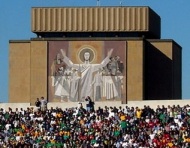
Rewind. Stop. Replay. The Baptist Church. Founded to protest against the vicissitudes of the Church of England, the Puritan-inclined Baptists wished to establish a church free from the constraints of the formalism inherent in the staid worship of either Roman or Anglo-Catholic England. Breaking from tradition was an honored principle here. Like our football heroes, they joined a team against the competition for that Super Bowl in the sky. Will the men stick around for the post-season slump? Maybe not, but as Notre Dame has always known, the divine man is a big fan of the Catholic team.

Notre Dame's famous Touchdown Jesus


Robots vs. Ancient Deities

NasaRob

Yesterday I found myself at my first ever robotics competition. As a scholar more familiar with the offering recipes for long extinct mythological deities than with the practical application of computer technology, I felt a little out of my league. I had gone to support the local high school robotics team, and, well, robots and Halloween seemed a natural combination.

The first thing that stood out was the large NASA van parked in front of the school. Fidgeting over finding a job at the moment, I realized that the money is far more forthcoming for practical enterprises than reading ancient history. It is, literally, for rocket science. So I was crammed into high school gym bleachers with other aging parents, surrounded by kids smarter than I’ll ever hope to be, watching robots compete in exercises too complex for the average Republican. There was rock music blaring and yes, nerdy people dressed like science fiction movie/television characters. I was really feeling lost when I spied the character below.

DrJim

I had no idea that Dr. Jim of the Thinking Shop had relatives in the robotics field! As I saw the bearded Norseman approaching me, I was strangely reassured that there might be a place for me here after all. Religion and NASA do share an interest in celestial realms, and if my generation has been capable of producing kids this smart, there may be hope for the future yet.


Halloween All Year

Despite the obvious consanguinity with the Dawn of the Dead, I am not a mall person. Last week, however, I had a job interview and I discovered that most of my white shirts would be appropriate garb only for the undead, so my wife forced me to look around the local mall for some new apparel. As we walked down the interior boulevard crowded with people younger than us, we couldn’t help overhearing the conversation of some young women behind us. “Yeah, it’s so cool! He’s a vampire; he’s got fangs and everything!” And they weren’t discussing Edward or Lestat, but a (presumably) flesh-and-blood beau one of them knew. Yes, Halloween season is upon us again.

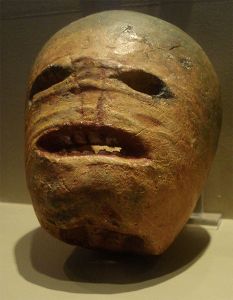
An early Celtic turnip Jack-o-lantern
(An early Celtic turnip Jack-o-lantern)

I loved Halloween when I was growing up. Despite the innate conservatism of my family, we always enjoyed dressing up, trick-or-treating, and being just a bit scared. When I reached college, however, I discovered that Halloween was perceived by many to be satanic, and I had to dig deeply into the past to argue that it came from Christian tradition and was, itself, nothing to be afraid of. Still, my friends looked at me askance. When I reached Nashotah House, a perfectly Gothic setting for the twilight of the year, I discovered that despite the theological conservatism there, Halloween was a time-honored tradition. My first year there while driving home after picking my wife up from a conference in Madison, I drove the familiar road into campus only to see a single, ghostly white face float across the road in front of us. I was so astonished I pulled the car to a stop to look back and could just make out several of the students I knew, dressed fully in black cassocks and cappa negras, only their faces showing, painted white. They stood alongside the lonely road and “floated” across it as slowly approaching cars rounded the bend. (I guess that, being potential priests, they were not too concerned with eternal consequences of metal meeting mere flesh in the dark of night.) On the campus, until the takeover by a Fundamentalist administration, All Hallows Eve was a bone fide sacral event.

The reason for Halloween’s popularity, I believe, is that deep down people really are frightened. At some level we know that we aren’t really in control of our lives and we seldom have a say about them ending. Halloween, with its dark Celtic origins, is the acknowledgment that it is acceptable to be afraid. Each year as more and more elements appear beyond our control, our pantheon of Halloween specters grows. One of our neighbors’ houses has a fake cemetery in its front yard. One of the headstones reads “The Stockmarket / 2008.” Even with the economy dipping and reeling like a drunken bat, lawns sport larger, more expensive and expansive Halloween displays. Halloween represents the pulse of fear than animates religions. We should all be afraid!


Feline Angels and Demons

Happy National Cat Day! Well, to you readers in the States in any case. October 29 has been declared National Cat Day, and as a blogger who has frequently posted on ancient cats, I feel a sense of duty to include our feline friends in today’s entry.

Elsewhere on this blog I have extolled the divine nature of cats. The Egyptians revered them to the point that killing a cat was a capital crime, but the evolution of domestication was probably very practical. Domestic cats appear in the archaeological record along with the advent of grain silos, also an Egyptian invention. When the grain attracted rats, the rats attracted cats, and the cats stole Egyptian hearts. Even before the Egyptians, however, archaeology points to associations of cats and humans in Neolithic Jericho, perhaps the oldest city in the world. As early as 9000 years ago, cats were stalking the allies of the city of the moon god. They have been among our most loyal companions.

The domestic cat’s spread into Europe only began in earnest, it seems, when Christianity reached the continent and the cat was no longer considered divine. Perhaps cats had to be profaned before being admitted to the church’s roster of approved animals. Nevertheless, under the influence of a predominantly Christian milieu, in the Middle Ages Europe had come to see cats as the demonic companions of witches and vampires. Did some memory linger of the divine cat of Egypt? Did those dark days of suspected sorcery glance back to the magicians of Egypt and their suspect pets? We will never know the answer as to why cats, long encouraged to join human households, became evil in superstitious Europe. Even my stepfather in the twentieth century America counted to ten after spotting a black cat, and followed the count with a solemn cuss each and every time.

I, for one, cast my vote on the side of the felines. I don’t have cats (allergies and irate landlords, and such), but I enjoy them when I visit those who do. Sure, they rip up furniture and bring unwanted gifts of dead things to you as a kind of feline worship, but with their loving nature I simply can’t see a devil in our everlasting cats.

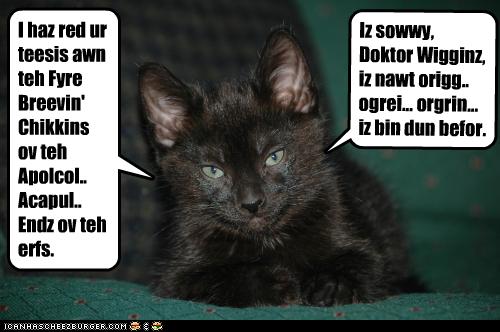
Swiped from Dr. Jim's Thinking Shop

(Swiped from Dr. Jim’s Thinking Shop)