Finishing the Set

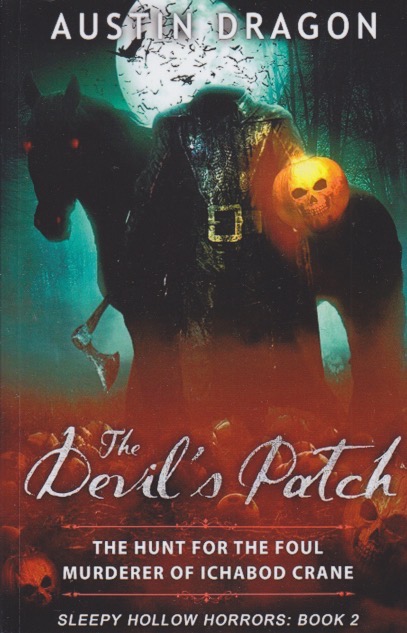
I hope I didn’t leave you hanging too long.  Autumn is always such a good time for mood reading that I had a couple of books I wanted to be sure to cram in before finishing Austin Dragon’s two-volume Sleepy Hollow Horrors set.  I wrote about volume one, Hollow Blood, some weeks back.  I wanted to read The Devil’s Patch to finish out the series before I forgot too much about the first one.  The subtitle is the same as it is for the first volume: The Hunt for the Foul Murderer of Ichabod Crane.  This imaginative retelling shifts the action away from Sleepy Hollow, although part of it takes place there, to the eponymous Devil’s Patch in upstate New York, near the Canadian border.

Instead of focusing solely on Ichabod’s avenging nephew Julian Crane, volume 2 adds an ensemble cast.  The first half of the novel provides the backstory for ten characters who will eventually accompany Crane to the Devil’s Patch to confront the Headless Horseman on his home turf.  The conceit here is that the Horseman, for some reason, has tried to kill each of the posse who eventually form to dispatch him.  Perhaps there’s some prophecy or something that he’s heard.  In any case, once Julian Crane recovers from his own encounter with the Horseman in book one, he begins to gather a group in Sleepy Hollow to go with him further upstate to take care of business.  The group of ten constitute his posse and Brom Bones goes along too.  They encounter the evil and defeat it.

There’s always a sense of accomplishment in finishing a set of books.  What has dawned on me in the process of all this reading is that the story was already told by Washington Irving in one of America’s first literary collections.  If fans want to engage with the story they need to take it in different directions, or tell it from a different perspective.  This is sometimes done cinematically and, increasingly, in literary form.  For me this is an autumn story.  That makes sense since Irving set the climatic scene during a fall party at the Van Tassel estate.  That tradition is frequently carried on in retold versions, but not always.  Whether or not they are set in autumn, they seem to be appropriate reading for this time of year.  That’s in keeping with the spirit of the season, whether in Sleepy Hollow or not.


Hallowed Tradition

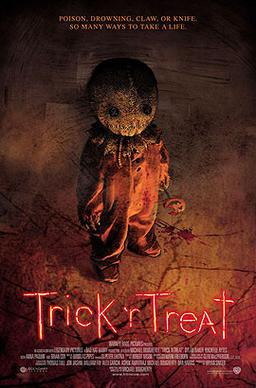
The more I learn about the movie industry the more complex I realize it is.  Take Trick ‘r Treat, for example.  It was released to some film festivals—and backed by a major studio—in 2007.  I wondered why I’d never really heard of it, and the reason seems to be that it never had a theatrical release.  Until this month.  It is now playing in theaters.  The thing is, it’s already available on streaming services because it gained a cult following when it was initially released fifteen years ago.  I came to know about it by wandering into one of those Halloween pop-up stores recently.  There were plenty of Sam costumes so I did a little research and discovered a Halloween movie I’d never seen.

I have to say, the first time watching it was confusing.  I didn’t realize it was four or five separate, but interlaced stories.  I kept waiting for a central plot to emerge, but it didn’t.  At the same time, I wasn’t aware that it was a comedy horror either.  I have no problem with comedy horror, of course.  I just like to know that before I get into it.  Once I’d figured these things out, I could see the draw.  It is fun and seasonal.  Clearly it’s holiday horror.  In fact several websites list it as being essential October viewing.  It’s certainly different from many Halloween movies in refusing to be taken seriously.  It’s like adults having fun instead of kids enjoying the holiday.

Perhaps the most self-aware Halloween film, it constantly reinforces that you need to obey Samhain etiquette.  Those who are killed (and there are many) die for having violated the rules of the holiday.  I appreciate the fact that it insists that we do these things for a reason.  Wearing costumes, handing out candy, carving and lighting jack-o-lanterns, these all serve a purpose.  The movie suggests we need to do these things to stay safe from Sam.  Sam, of course, can’t be killed which means that a sequel may be in the works.  Trick ‘r Treat gets full marks for staying focused on the holiday.  Holiday horror has been a fascination of mine for some time and this movie has it in spades.  Even if it’s a little confusing at times, it’s a fun way to celebrate the season.  And this year you have your choice of seeing it in the theater or streaming it on your most convenient device.


Love for the Sky

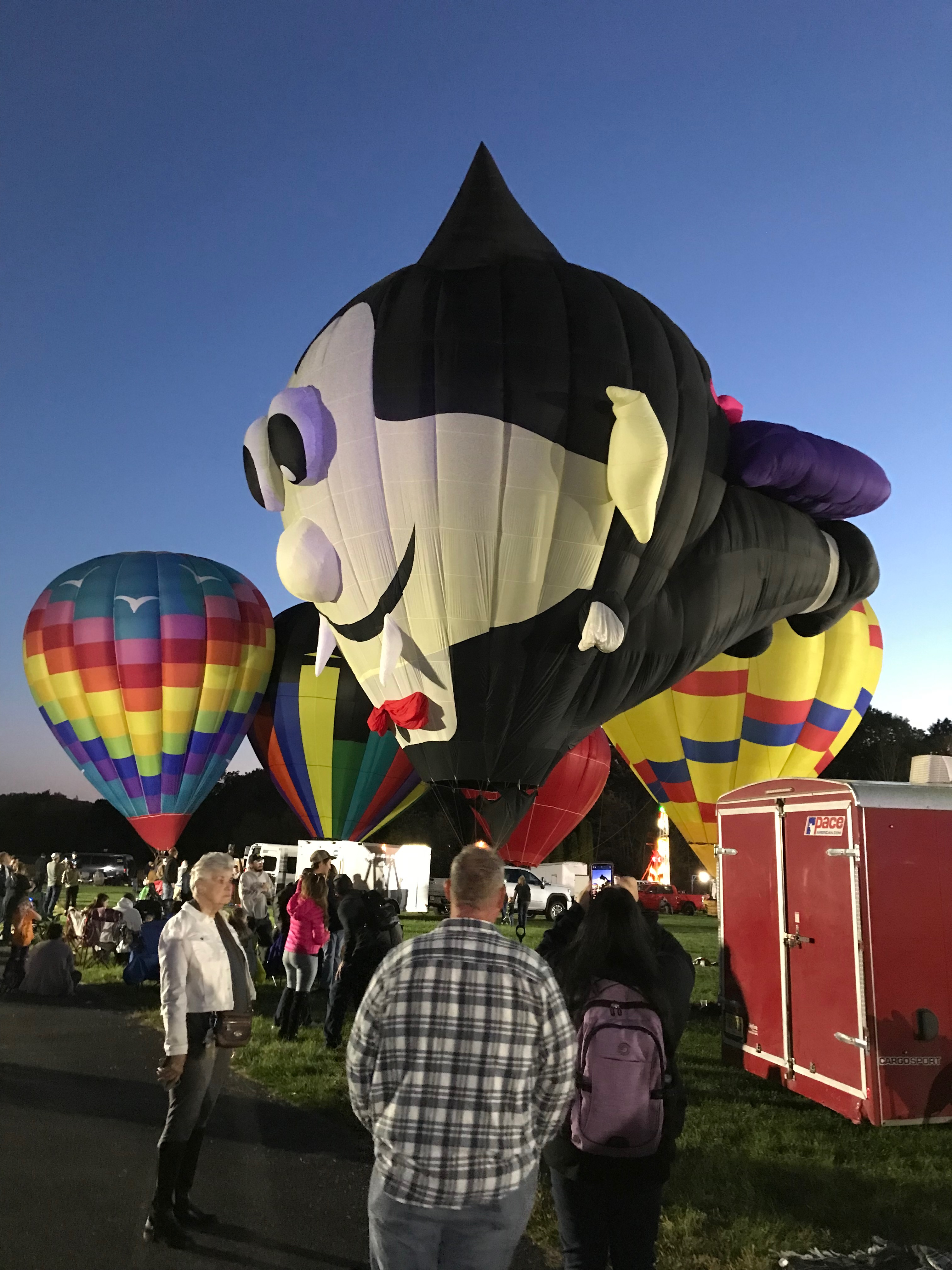
People long for the sky.  We look at birds with envy and we have historically treated the weather, or the sky itself as divine.  To get oneself into the air is an expensive venture, no matter how it’s done.  One of the earliest forms of overcoming gravity was the hot air balloon.  The principle’s pretty simple: hot air rises.  Trap that hot air in a container large enough and it will lift a person, or people, to the sky.  Today ballooning remains popular, although not generally used for long-distance transit.  Still, to be in the sky is a consolation all its own.  Various hot air balloon festivals tour the country, but the Lehigh Valley Spooktacular Hot Air Balloon Festival was the first time I’d ever been close to an actual hot air balloon.  While not asking, I’m sure it is quite pricey to own and operate one.  Given the number of people there, it’s a safe bet that others are fascinated by the sky too.

Apart from one vampire balloon, two things made this “Spooktacular.”  One was the fact that it’s midway through October, the month for scares.  The other was the vendors selling Halloween merchandise.  Options for disguises have come a long way since my childhood.  Blinking LED lights dangling from tentacles and battery-operated masks of black that show patterns in glowing colors on the faces of the wearers were both popular among attendees.  And not just with children.  Although the festival runs all day for Saturday and Sunday there are those of us who came for the evening finale—a mass inflation of balloons followed by a laser show and fireworks.

Such shows as this obviously require a ton of tech and a lot of set-up, but I couldn’t help but think as I watched that the sky, so eerily lit up at times, that in ancient times this would certainly have been considered as a theophany, an appearance of the gods.  Projected onto the sky itself, or penetrating that very sky, the lights could be made at times to dip, creating the impression of something large descending from above.  It was a show worth seeing.  As we drove home—it was past my bedtime and I had the passive role of passenger—I spotted a large bird winging through the night, dark against a low cloud.  Too dark to identify (although probably an owl), I thought how birds have a view that’s still rare among land-dwellers.  Theirs is the realm of the gods.


Flavor of Childhood

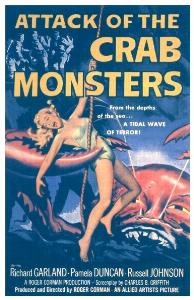
Giant, telepathic crabs whose molecular structure make them impervious to bullets, explosives, and fire, and that know how to use dynamite and who plan to take over the human world?  A group of scientists trapped on an irradiated Pacific island that is slowly sinking into the ocean?  This must be Attack of the Crab Monsters!  I was born during what is generally considered the dearth  period of the American horror industry.  Roger Corman, however, was working hard outside of the studio system to cater to that new demographic—teens with spending money.  Drive-in theaters were big and for about $100,000 you could shoot a double-feature and bring in ten times that much.  If you shoot quickly enough you can produce several of these in a year and not have to worry about the big studios.

It’s been fashionable to laugh Corman off, but he knows how to live the teenage dream.  Monster movies were part of the childhood of many of us during this “dearth.”  Yes, sophisticated frights were yet to come, but these creature features were full of creativity and escapism.  And so many unanswered questions.  How did those giant crabs chop all the radio wires to bits with those indelicate giant claws?  If they could smash through the outside wall of a house, why couldn’t they break through a light-weight door once inside?  And why, knowing that bullets and grenades can’t possibly hurt them, do scientists keep firing away?  What was that oil subplot all about anyway?  And how do you end a film with the lines “He gave his life,” followed up by “I know”?  This is stuff, like Strawberry Quik, I couldn’t get enough of as a kid.

No, this wasn’t intelligent horror—it was often laughable—but it made an impression.  As an adult I can’t recall which of these movies I’ve seen before and I suspect it would take a lifetime to watch all the films Corman directed or produced.  Along with his contemporary indie director/producer William Castle, Corman may be inordinately responsible for my tastes as an adult.  I’ve grown more sophisticated (I hope) in some ways, but I’m at a pay grade where free on Amazon Prime often decides a weekend’s entertainment.  Besides, these movies struggle to top out an hour’s running time.  You can still get a lot done in a day and still have time for a monster crab, giant leech, or wasp woman.  With enough radiation, and imagination, anything can happen.


Eclecticism

Eclectic.  An eclectic approach is experiential.  I don’t mean to be obscure here, but I was once an academic.  Let me try to spell this out a little more clearly.  You’re reading along in your academic study—perhaps it was assigned to you for a class, or perhaps you have unusual interests, or maybe you want a deeper treatment than you find in Barnes and Noble or on the internet.  In any case, what you’ll often find is academics like to glom onto a theoretician that they follow.  Applying Derrida to this, Lacan to that, and Bakhtin to the other.  In doing so they establish their mastery over complex theory, and earn their ticket into the academy.  You, the poor, curious reader, are left wading through explanations of the theory when what you really want is the content—the actual subject of the book.

My own work has been rightly accused of lacking theory.  Or, more precisely, not following a consistent theory.  It’s eclectic.  That’s because I believe in an experiential approach to research.  I trust my own experience.  Your experience is different, I know.  Trust it.  We learn things through experience.  Perhaps others were raised by parents who read and thought deeply and introduced their children to Deleuze (and perhaps Guattari as well), but most of us weren’t.  And some of us came to trust both raw logic and intense feeling.  We call it instinct in animals, but in people we expect more.  What’s wrong with being eclectic?  It seems to make sense.  If Foucault had it right, shouldn’t it be obvious to all of us?

What’s always amused me about this is that such theoreticians—and I don’t know how you become one without basing your work on your own experience—come and go like fashions.  Ricoeur was the big name a few years back and now I haven’t seen anybody writing about him for a couple of decades, at least in the fields I’m reading.  I tend to read primary material and think as deeply as I can on it.  Yes, I read others who write on the topic and sometimes I’m even quite taken by someone else’s approach.  Still, my experience tends, alas, toward the Baconian—an embarrassment for a vegan, I suppose—that of gathering information and seeing what makes sense of it.  I read the theoreticians from time-to-time and then I read those not classically considered experts.  We’re all in this knowledge game together.  Even Lévi-Strauss and his school.


Subconscious Humor

It’s good to know your subconscious has a sense of humor.  What with all that’s going on in the world these days, God knows we could use a laugh or two.  At least a smirk now and then.  One of the less-anticipated aspects of becoming old and wise is disrupted sleep.  Our bodies did not evolve for the 925 schedule, and the “eight hours a night” trope is more naturally along a pattern of sleep for maybe four hours, get up for a while and get things done, then sleep for a few more hours, until dawn.  That doesn’t fit well at the office, so we try to cram all of our sleep into one unbroken stint.  When you’re young that’s often not a problem, at least in my experience.

Then you reach a certain age when, with no discernible change in habits, you have to visit the restroom in the middle of the night.  Modern people, of course, have a lot on their minds, so after that mid-night pee it’s difficult to get back to sleep.  For those of us who can’t break the long-term commuting habit, any waking after midnight is likely to be the end of a night’s sleep.  Once you get tired enough, however, you tend to overpower the full bladder and snooze on to the usual rising time.  (For some of us that’s earlier than it is for others, but that’s immaterial.)  This is where the subconscious starts to play its role as the comedian.

Mildly thalassophobic, I tend not to go out on very deep water, especially in small craft.  To be fair, I don’t live too close to the ocean and I don’t own a boat of any kind, so this often isn’t an issue.  One of my biggest traumas in college was meeting the “swim a length of the pool” requirement for graduation—I understand that’s now been abolished.  I nearly didn’t make it, but the last semester as a senior I had a private show—which must’ve been funny—for the swim coach.  So when I need to pee and I sleep through the middle of the night, I have deep water dreams.  I’m on a small boat in an ocean.  Sometimes I see paranormal geysers bursting from the surface and wonder what they are.  Then I wake up and dash for the bathroom.  Hey, it could be worse—my subconscious could find a humorless way of waking me.  Meanwhile, it probably wouldn’t hurt to take some adult swimming lessons.

All that water…

Immature

I’m not immature, but I have to admit to having done a double-take every time I saw the name of the school.  While living in Edinburgh my wife worked for a short while at the Medical School and I couldn’t help but notice the official name of the associated veterinary school: The Royal (Dick) School of Veterinary Studies.  I was sure Dick was a surname and yet little boys never grow up, it seems.  Fast forward to just last week when I had occasion to look up Arcadia University, here in Pennsylvania.  For those of you who’ve never had the privilege of being an editor at an academic press, I’ll say that one of the things we constantly do is check out colleges and universities.  In the case of some church-related schools it’s easier to get the straight dope from Wikipedia before going to their actual websites.  I never rely on Wikipedia alone, of course.

A defunct college (Marvin College). Image credit: Nyttend, via Wikimedia Commons

Still, the Wikipedia page for Arcadia explains that the school had to change its name because internet searches were being blocked for sexual language.  The former name of the school?  Beaver College.  Human beings have a very wide variety of slang words to refer to our genitalia.  I suspect part of the reason is the fun of establishing, and violating taboos.  There are many schools that could fall into this category (Ball State comes immediately to mind), but when it gets to the point that search engines block you because they assume your mind is in the gutter, what choice have you got?  Changing names is a big expense and even bigger hassle, but everyone searches for everything on the web.  It’s our common reference book.

I don’t know whether to believe Wikipedia on this point or not, but I know from personal experience that employers or commercial servers can block “offensive” information.  I’m a religion editor.  When I took our car in for service some years back—they have free wifi for customers so they can work while they wait—I soon found I could not get onto any websites mentioning religion.  Given my job, that’s a bit of a problem.  The garage had blocked it as a taboo topic, perhaps for good reason—I have no way of knowing.  What it means is that my wife now has to take the car in for service.  Regarding Arcadia, it probably doesn’t help that it was an all-female school.  Its first name was Beaver Female Seminary.  Things have changed since 1853, but I’m afraid that those of us who are immature still find this a little funny.


Double Feature

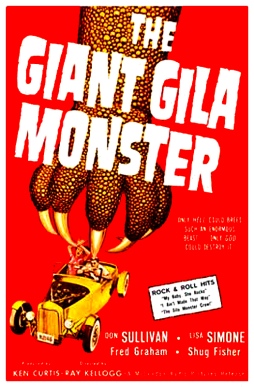
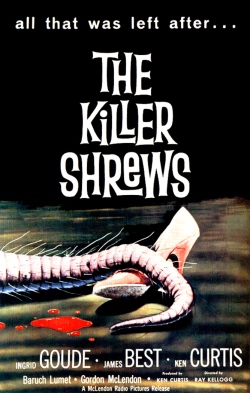
Creature features were a regular part of my youth, and, I suspect, where my appreciation of horror films began.  Nobody was really afraid of Godzilla or other monsters that were clearly people in rubber suits.  The use of forced perspective to make regular-sized animals into giants was obvious even to a child, but that didn’t make such movies any less fun to watch.  The Giant Gila Monster and The Killer Shrews both involve gigantic versions of rather small animals and both of them were produced outside of the studio system by Gordon McLendon, the owner of a chain of drive-in theaters.  Looking for B-movies for double features, he decided to make a couple of his own.  These two didn’t cost that much, but the special effects artist, Ray Kellogg, agreed to do them if he could be the director.  Together they make quite a double-feature of their own.

The Giant Gila Monster is never explained beyond the effectively shot beginning stating the who knows how big some things grow in the unexplored west.  Not even using a real gila monster, the lizard (unlike Komodo dragons, which one expects, were too expensive and untamable) isn’t aggressive and seems, from my perspective, to be just barely putting up with the fake trees and models it has to crawl over and around.  And everyone, apart from Mr. Wheeler, is nice.  The local Texas teens want to drag race but Chase Winstead, the gold-hearted mechanic, keeps them in line.  It’s a perfect world, in a Republican kind of vision, except for that darned giant lizard.  Winstead even figures out a way of getting rid of it so the authorities don’t have to.

The Killer Shrews, in reality puppets and dogs dressed up as shrews, is more adult-themed.  Four scientists on an island—contradicting the voiceover at the opening—have bred giant shrews.  The supply-boat captain and his Black mate are trapped on the island by a hurricane, where the mate predictably gets eaten by the escaped shrews.  McLendon himself appears as an over-the-top nerdy scientist while the producer, Ken Curtis, appears as another, more action-oriented man of science.  In a move a little unexpected for the fifties, Dr. Craigis’ bombshell blonde daughter is also a scientist.  But she’d be willing to be a sea-captain’s housewife if only she could get away from these awful shrews!  There’s a bit more tension in this one as one of the scientists is already engaged to Miss Craigis, but he’s a drunk and she wants out.  So might some audience members, but both films found international distribution and made money.  Now widely available for free, they are a slice of childhood served up in giant proportions.


Naming Conventions

Okay, I confess.  Every now and then I do it, but then, a lot of people do.  Perhaps because I’m trying to figure out who I really am, or perhaps because I’m looking for any reviews of my books, I search for myself online.  Various search engines (I prefer Ecosia) bring up different websites near the top, generally those with large numbers of hits.  I was surprised to find a website that gives away lots of personal information, even in the description so you don’t have to click on it.  One bit that caught my attention about myself was where it said “Steve also answers to Steve A. Miller.”  That’s incorrect.  My mother’s second husband was a Miller.  He never adopted us.  One thing that kids fear, however, is being teased and the name “Wiggins” came in for quite a bit of teasing in rural Pennsylvania.  We started using “Miller” since both our mother and stepfather used that name.

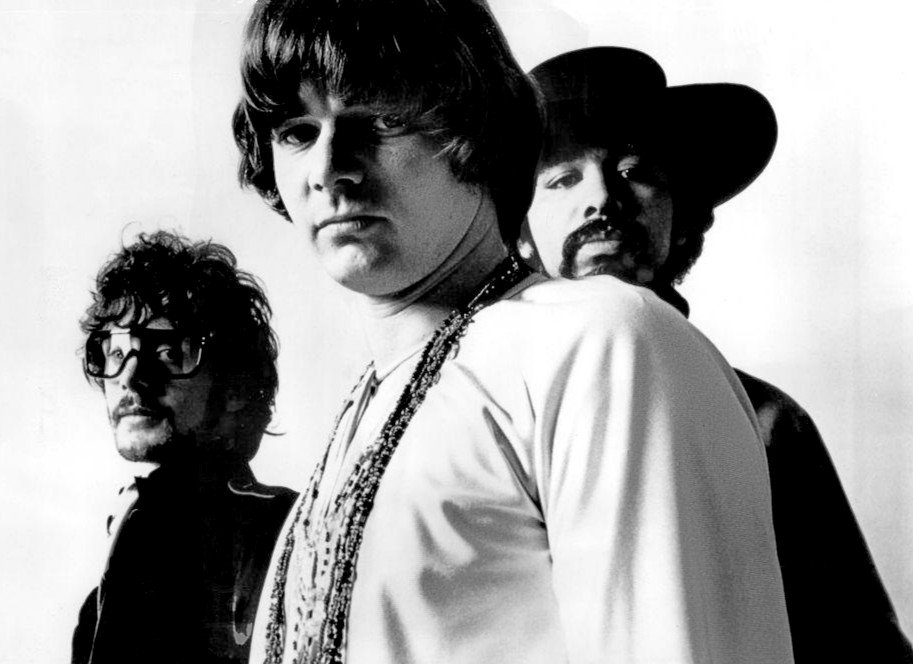
What is it with the singers? Photo credit: Capitol Records, public domain via Wikimedia Commons

Of course, I only later found out that “Steve Miller” was an up-and-coming pop artist at the time.  That singled me out for more teasing.  It didn’t help that I didn’t like Steve Miller’s musical style.  I still don’t.  I kept the name Miller up through seminary.  When I was preparing for ordination I was also rediscovering who I was.  A wise minister I knew told me that since there were two names out there for me, I’d need to nail down one to keep.  Although we’d only recently officially changed names to Miller, my brothers and I had to officially change them back to our birth names.  In a way perhaps inconceivable today, as I recall it, we simply introduced ourselves at our new schools (we had to move after the wedding) as “Miller.”  We registered for Social Security under that name, and nobody batted a lash.  Maybe we talked with an inexpensive lawyer at some point?

Only as an adult did I feel that my birth name was my heritage.  I suppose some of those who friend me on social media, who knew me in high school or college, wonder who “Steve Wiggins” is.  They only knew me as “Miller.”  Changing names is a pain.  I can understand, and support women who want to keep their “maiden” names.  It confuses our dowdy society even now, but one thing about marriage is that it generally involves two individuals.  But then I glanced down at the next entry.  This person, apart from living in a state where I’ve never resided, had even the same middle name as me.  Who’s the joker now?  I don’t answer to that name any more. And no, I didn’t find any reviews.


Pitfalls

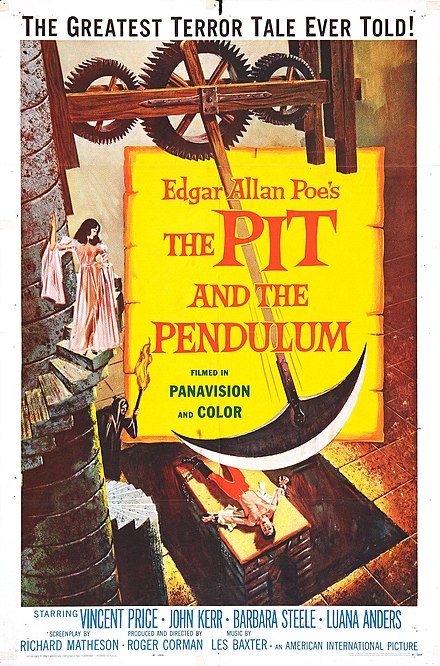
While watching Roger Corman’s The Pit and the Pendulum, it occurred to me that these movies have improved with age.  The series of American International Pictures’ Corman Poe productions do manage to capture a mood.  One of the reasons, I suppose, is that Vincent Price was an able, often underrated, stage performer.  No, these aren’t like modern movies.  They’re clearly fictional and the backdrops are pretty obviously fake and it always seems to be thunder-storming outside. They are going for a mood, and for those who watch films for the feelings they generate, this can work.  Although based—very loosely—on Edgar Allan Poe, The Pit and the Pendulum was screen-written by Richard Matheson, an able novelist in his own regard.

The Poe story hinges on the terror of the slowly descending pendulum and it has been used and reused in various guises over the years in everything from horror films to James Bond movies.  Corman’s Poe movies often set trends.  For example, in the backstory to Pit and the Pendulum, Nicholas’ (Price) father was a member of the Inquisition.  He kept a personal torture chamber in his basement—well, he lived in a castle, after all.  One of the victims of his father was Nicholas’ mother, an event the young Nicholas witnessed.  A very similar scenario, with even some similar shots, occurs in Tim Burton’s Sleepy Hollow.  I’m sure it must occur elsewhere as well, but in making a narrative of the story, this is my own unprofessional observation.

Yes, Corman is often over the top.  His films know they’re for entertainment purposes.  He’s not above camp and gimmicks.  The strange juxtaposition, in my own case, is that movies are meaningful.  Ninety-minutes to a couple of hours relieved from the constantly pressing demands of work and trying to maintain some sort of social life.  (And yard work.)  In ancient times, I suspect, myths served a similar purpose.  They still do.  Our myths have become more Technicolor over the years and have evolved from celluloid to pixels.  Their function has also evolved from escapism to a location of meaning.  On a recent weekend on my own I ended up watching five movies, feeling guilty between times for not painting the porch or doing that plastering that’s requiring attention in the attic.  The movies, however, give meaning to these other more mundane tasks such as work or housekeeping.  They’re not literally true, I know, but we need not disparage Roger Corman for stating the obvious.  Myths entertain as well as inform.


Some High School

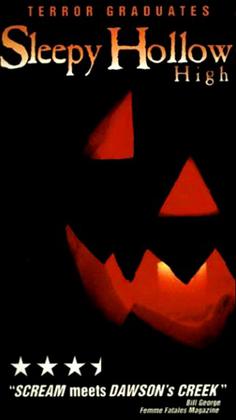
I have a soft spot for bad horror.  And Sleepy Hollow High isn’t exactly good horror.  It’s not horrible horror either.  It follows the story of five teenage delinquents at Sleepy Hollow High School.  Threatened with expulsion, their only choice is to do community service.  In this case that means picking up trash in the eerily secluded town park.  I won’t give away the one big spoiler, but it’s fair to say not is all that it seems.  It’s very low budget (paid for by credit cards and estimated to be $16,500) shows in several places, but it does keep you watching.  And wondering, to an extent.  It claims that the legend of Sleepy Hollow is true, but not exactly in the way you might think.  (Sorry for being cryptic—I don’t want to give too much away.)

One of the reasons I appreciate efforts like this is that I know what it’s like to be possessed by a story you want to tell but being unable to find a publisher—or in this case, a distributor/studio—who’s willing to take a chance on you.  The movie is largely the effort of Kevin Summerfield and Chris Arth.  They are listed as co-directors and co-producers, and each has credited roles beyond that.  Neither one is famous, and yet they made the film anyway.  It’s the same impetus behind self-publishing, I suspect.  The problem with the latter is that anyone can do it, and it often shows.  Most of us don’t have access to proper movie equipment, props, and actors willing to work for free.  Heck, I don’t even know most of my neighbors.

Movies like this stand a chance of becoming cult favorites.  I have no idea how that happens or who makes the call on it.  Low budget (often), cult films catch the imagination of a certain kind of fan and eventually generates some buzz of its own.  Wikipedia articles will appear about some of the people involved because those who watch grow curious.  Our highly developed publicity systems make decisions on who or what gets exposure.  That doesn’t mean the rest of us can’t get a small dose of attention now and again, but those who’ve made it have had some help.  Sleepy Hollow High was perhaps able to cash in a bit on the previous year’s Tim Burton effort, Sleepy Hollow.  But there are horror movies—and stories—out there that nobody knows about.  And which might, if discovered, have their fifteen minutes.


Yelp Me

Do you remember the Yellow Pages?  Or even phonebooks, for that matter?  (Or wall phones?)  They certainly weren’t perfect, but they tended to be updated yearly (at a great cost in trees).  That meant that they tended to be almost up-to-date.  You’d find the business you sought, and call them to ask for their hours, or directions.  Now we rely on the internet, of course, and the number of businesses that you can find has exploded.  And they open and close with bewildering rapidity.  It took me a couple years of googling to figure out that Yelp was a rebranding of the Yellow Pages.  I also feel sorry for any company that has to try to keep up with the current status of things.  It does seem, though, that Yelp could use some help.

Although it might seem impossible, many businesses still exist without websites.  And if you’re looking for a type of business in a specific city or town, you need to know, first of all, what’s there and what’s not.  The big boxes are never a problem, of course.  When I travel to a new location, however, I want to know what bookstores I’m likely to find.  I’ve done this a number of times recently.  Type in a city name and “bookstore.”  (In the case of Reading, the city name didn’t help at all.)  Yelp helpfully shows up at the top but it lists many establishments that have closed.  Even some of those that are open are virtual and don’t have a store you can wander around.  More than once I’ve come to a place only to discover there’s no longer anybody home.

Independent bookstores have been doing pretty well through the pandemic.  Many people have rediscovered reading.  Since they are seldom crowded, they feel like safe spaces during Covid.  And chances are that people who hang out in bookstores have been vaccinated and will likely be wearing a mask.  The problem is finding such places.  I have to say that Pennsylvania seems to have a healthy population of bookstores.  There are several in the Lehigh Valley and I’ve been pleased with the treasures I’ve discovered elsewhere as well.  Finding them hasn’t always been easy.  One of my favorite used bookstores here in the Valley folded during the pandemic.  Fortunately there are others.  Google maps sometimes work better than Yelp, but nothing beats getting out and exploring on your feet, except sitting at home later and reading what you’ve found.


Odd Getaway

It’s small.  Almost cramped, you might say.  But then again, a Pennsylvania Railroad caboose wasn’t really designed to be a two-bedroom apartment with en suite bath.  Why the Gideon Bible was laid open to Ezra 2.62–4.19 I couldn’t fathom.  I suppose the story begins in Wisconsin, and ends up with me deep in Trump territory for an overnight getaway.  Let’s start at the Badger State.  I’ve always been a sucker for the unusual.  In that regard, I suppose getting a job at Nashotah House was inevitable.  When I spied Weird Wisconsin in Books & Company in Oconomowoc, it became an obvious birthday ask.  When we moved to New Jersey I learned that Weird NJ was a magazine as well as a book, and I bought, and read, every issue.  I also bought both volumes of the book and those of nearby New York and Pennsylvania.  It was in the latter that I first read about it.

The Red Caboose Motel began as a kind of a lark in the late sixties.  A Lancaster county man bought a bunch of cabooses at an auction and then had to figure out what to do with these tons of steel.  He settled on refurbishing them as individual hotel rooms.  I read about them in Weird Pennsylvania and hoped that someday I might stay in one.  My family, feeling restless after more than two years of pandemic isolation, wanted a short staycation.  Hotels involve corridors and breakfast rooms, often tiny, and too many Americans just won’t get vaccinated.  This seemed an ideal opportunity to spend a night in a discrete, self-contained caboose.  And, I admit, to tick something off my bucket list.

Driving behind Amish buggies to get there after a hot day on the streets of Lancaster—a surprisingly busy and loud city—the Red Caboose felt like a good getaway.  Given the number of cars parked outside cabooses, we weren’t the only ones with this idea.  Lancaster is more than just Witness territory.  Known for its boutique shops and pretzels, as well as its thriving Central Market, it’s a busy place in July.  Bumper stickers and loud, aggressively roaring pickup trucks indicate that outside the city the Trump myth reigns supreme.  In town we visited two independent bookstores, one of them quite large.  With at least seven to choose from, Lancaster feels like a readerly place.  Indeed, I could, had I the money and time, envision renting a caboose for a month or two to do nothing but write.  Why they wanted me to read about rebuilding the Jerusalem temple I just don’t know.  I’ll chalk it up to being weird in Pennsylvania.


Stay Safe

I’m not an impulse buyer.  Having grown up poor, I tend to walk into stores with a list firmly in hand and I don’t deviate from it.  Advertising has virtually no impact.  I don’t pay attention to ads unless they’re for things I know I need, and even then I shut them out most of the time.  I do let my guard down in independent bookstores, however.  So it was that I found in Aaron’s Books in Lititz, Your Guide To Not Getting Murdered in a Quaint English Village.  It was totally an impulse buy, easily read in a sunny afternoon in a caboose motel.  Or a rainy afternoon in an English manor house.  Maureen Johnson and Jay Cooper have produced a wonderfully witty illustrated guide here.  It helps to have lived in the United Kingdom for a few years.

Shelved face out in the thriller section, it’s a great opportunity for murder-mystery, gothic literature, horror movie fan types to laugh at themselves.  Some parts are snort out loud funny.  Okay, so I was on staycation and being a bit free with cash for a change, but I’m sure I will keep this one near my desk and turn back to it from time to time.  Maureen Johnson is known for her young adult novels and Jay Cooper is a children’s book illustrator.  Their talents, however, work together incredibly well for this slightly naughty guilty pleasure read.  The Wicker Man even gets a nod or two.  Something that those who disdain horror don’t often realize is that it quite frequently has its own sense of humor.  It’s an intelligent genre that doesn’t take itself too seriously.  At times it does, of course, but those of us who are fans can tell fantasy from real life.  Maybe.

Independent bookstores are starting to make a comeback.  A significant part of our population isn’t on board with retailers trying to convert everyday life to the metaverse.  We want to hear our music with the occasional pop and microphone hiss.  We want to drive our own cars.  We want to browse in actual bookstores.  Given my buying record online, I have to laugh every time I look at the recommendations.  The electronic world brain doesn’t know me very well at all.  It assumes it knows why I bought that ladder or that round blank four-inch stamped electrical cover.  Some of us play in nontraditional ways with such things.  And we get ideas from wandering into independent bookstores.  As long as they’re not in quaint English villages.


The Birds and the Bees

Our house came with a wood-plank fence surrounding the yard.  This is a dog neighborhood and just about everyone has a fenced in yard to keep their dogs in check.  It’s more the birds and bees that have me worried, though.  The fence, which is in need of some attention, is bare pine stained redwood.  As the stain fades carpenter bees find it irresistible.  These insects are great pollinators and we don’t like to gas any creatures just doing their evolutionary job.  Painting that fence will be a summer-long project and one that requires far more sunny weather than we tend to get around these parts.  So we have a fence with several carpenter bee homes.  (These are ubiquitous insects in this area, with lots of people complaining about them.  We have, however, the only wooden fence in the neighborhood.)

The other day I heard a knocking while I was working.  I looked out the window to see a downy woodpecker, well, pecking at the site of one of the carpenter bee homes.  This industrious little fellow had three holes in the post by the time I got downstairs to startle him or her away.  Now, you have to understand that this is a large fence.  We didn’t put it up but we have to keep it up.  Then I thought, “I was worried about the carpenter bees.  Why should I be worried about the woodpeckers?”  Holes can be patched, and fences can be painted.  I hope the neighbors don’t mind a white fence.  In any case, I left the woodpecker alone after that.  Besides, I can’t be outside all day long—I have a day job.

Over the next several days the pecker became a regular visitor.  I’d be working and then I’d hear a now familiar knocking.  I decided to watch once.  I keep a pair of binoculars in my office because I see lots of birds that I want to identify—there’s a park across the street.  At the risk of the neighbors thinking I was spying, I trained them on Downy.  It was amazing how effective its bill is on a four-by-four.  It quickly cleared a hole, stuck its beak in, and pulled out a fat carpenter bee grub.  Down it went.  A centimeter to the right it repeated the procedure.  Carpenter bees, which are so territorial when building their nests, seem to have forgotten their young.  Perhaps it’s for the best.  This bird was one well-fed flier.  And I’d finally learned what they mean about the birds and the bees.