Earliest Sunset

Welcome to the day of the earliest sunset of the year.  “But how can that be?”you may ask, “since the winter solstice is many days away?” I’m no wizard when it comes to numbers or math, but I do know tomorrow’s sunset will be a minute later than today’s.  It’s the other end of the day, however, that continues to increase darkness.  Sunrise will continue to creep later and later until on January 16 it will be at its latest.  Mornings will then become longer, very, very slowly.  Combined, the shortest day will be on the 21st, almost two weeks from now.  Then sunlight will begin its slow crawl back to majority.  And so the seasons eternally negotiate on a planet that sometimes seems to spin too fast.

Those awake early, sensitive to sunrise, need to wait a bit longer than those wanting longer evenings.  There’s no taking without reciprocity here.  For those in the northern half of the northern hemisphere, winter has begun its settling in process.  Morning frost on the rooftops augurs the coming of snow.  The almost preternatural stillness of a cloudy late afternoon anticipates what’s to come.  Those of all religions, or of none at all, alike await a glimmer of lengthening days in this season of long nights.  It pays to become comfortable with the darkness in the meantime.  Dark need not equate to evil.  It invites rest and renewal.  Perhaps our culture that valorizes action and movements blurred with speed might learn from the hours of diminished light.

Walking into an early morning room with a light switch on a far wall is an act of faith.  If done before any artificial lights are engaged, it’s always surprising how much light crowds in on the dark.  The luminescent clock.  The power strip on button.  The ever-watchful router.  Darkness is seldom absolute, as much as the tenebrous circumstances might suggest such extremes.  Light and darkness need each other to find any kind of definition at all.  Starting tomorrow, there will be incrementally longer moments of day stretching out into night.  Mornings will grow more reluctant to release their light for another month or so.  In the midst of this we snuggle down into the darkness and learn from it.  Learn to slow down.  Learn to listen instead of always looking.  Learn to breathe slowly and accept that the darkness can comfort.  The solstice is coming, in good time.  Until it arrives, be in the twilight of the moment and trust it.


Split Personality

This may be the way to develop a split personality.  For the majority of my waking hours of the week I’m a biblical studies editor.  I do the usual, boring editorial work associated with that job.  Academics contact me supposing I’m just some Joe who majored in English and who has to pay the consequences.  Once in a very great while the person contacting me knows that I once was a professor as well, but that’s rare.  So I have one part of my life.  When I’m not at work I continue to research (in my own way) and write books, as well as this blog.  Being in “the biz,” I have a fair idea about how to get published in the academic realm.  Ever since Weathering the Psalms came out I realized I could use that knowledge to steer my books toward appropriate publishers, but all of this is very separate from my day job.

A third compartment of this personality is as the closet fiction writer.  I’ve had thirty short stories published (under a pseudonym, for work purposes) and anyone curious about that pseudonym’s life can’t really tap into this one because I have to keep them separate.  I’m also involved in a faith community.  Most of the people there are surprised that I watch horror and write about it, and even write it.  Only two have expressed any interest in reading what I write.  So it is that each of these discrete elements—and they’re not all!—prevent me from being an integrated personality.  I know other religion scholars who watch and write about horror.  Because they’re academics they can integrate it into their profiles in a way a mere editor can’t.  To be fair, they’re misunderstood too.

The possibility of living an integrated life is limited in the workaday world of capitalism.  Companies want you to spend as much time as humanly possible making money for them.  You shouldn’t try to shine any light on yourself, and if you do, well, keep the company name out of it!  Who wants to be associated with some horror pariah?  And yet, statistics reveal about half the population of the United States enjoys horror movies.  A significant number of those people attend religious services or belong to religious bodies.  So what’s a graphomaniac to do?  I write because that’s what I do, and have always done.  I started in fiction and moved to academic and now I blog.  Somewhere in there there’s a person and someday I may discover who he is.


Pods

Some cultural assets (ahem) are so well known that you come to know them by association.  I knew the story behind Invasion of the Body Snatchers (1956 and 1978) long before I saw the original, within the last couple of years.  I may have been body-snatched myself since I can’t remember when it was or why I didn’t write a blog post about it.  In any case, I’d long been curious about the remake and discovered it free (for the time being) on Amazon Prime.  The fact I’m still looking for free stuff proves I’ve not been body-snatched, I guess.  If you’ve been raised with our cultural assets you know that the eponymous body snatchers are pod people who look exactly like the victims they destroy.  Their goal is a well-ordered society with no emotions.

The thing that’s so interesting about the 1978 version is that its assessment has changed over time.  When it first came out, many thought, and opined, that the 1956 black-and-white version was better and this one really added nothing.  However, over time this judgment has been questioned.  Critics taking a second look have now scored it as one of the best remakes ever made, and not only that, but it is considered one of the best science-fiction horror movies of all time.  I suspect nothing in that category will ever displace Alien, but still, my first viewing of the ’78 Body Snatchers agreed with the latter assessment.  It is quite good and it has even aged well.  You can kind of guess how it’s going to end, largely because the final scene has been played over and over, but still it’s definitely worth watching.

The social commentary in the film runs deep and strong.  Non-conformity is suppressed.  Life without emotions is better than really feeling something.  Simply go along because everyone else does.  The parable has changed actors over time—fascination with social media/virtual reality have perhaps become the modern pods—but the story is as old as our species.  Probably even older.  It’s non-conformists, generally after their demise, that are realized as visionaries.  Shooting a car into orbit requires tons of money but not much vision.  I’m not conforming, however, when I agree that the 1978 remake is good.  My taste in movies has always stood apart from others, at least from my own experience.  I also think that horror is often among the more intelligent genres of film.  But then, I tend to side with the emotional.


Religion in Its Place

The other day at work I virtually “met” someone else from western Pennsylvania.  It came about in an odd way.  We were both in an online author talk and my colleague put something in the chat about a particular social issue being purely religious for some parts of the country, like his native western Pennsylvania.  I immediately knew what he meant.  For those who think religion is irrelevant, look at the make-up of our government.  Those preachers in rural places wield incredible power.  Their word is law and because of the shortsightedness of our founders, the rural few have amazing sway over the vast majority of the urbanites.  We need each other, of course, but not all have educated themselves on the issues.  When they want to vote they turn to their preachers for the answers.

Interestingly enough, churches lose their tax-exempt status (and thus many can’t afford to survive) if they openly back a political party.  They are required by the law they game to remain party neutral.  Of course, depending on who appointed a federal judge, they are often willing to overlook that particular law.  You get the sense that God favors some commandments over the others anyway.  But back to the homeland—western Pennsylvania is a preacher-dominated part of the country.  That may well have been what set me off on this strange track I follow instead of a career.  We were a church-going family in a church-dominated part of the state.  If you took what you heard on Sunday seriously, we should all be studying religion, down on our knees.

My colleague brought something into focus for me.  The religiously convinced will accept no other evidence.  They’ll refuse vaccines that could save their lives.  They’ll say women and blacks are lesser humans.  They’ll even—since I pay taxes this is okay—vote Republican.  Clergy have been sidelined by much of what’s going on in society.  They are hardly irrelevant, however.  I recently had a minister tell me that if I were to make a formal “questing” status with a denomination I could pick up some preaching cash on weekends.  Without that status, this clergy asked me, “why should anyone listen to you?”  Ah, there’s the rub, you see.  Although I’ve studied religion more than many clergy, and taught those who are now clergy,  I’m not qualified to make it official.  Perhaps it would be different if I were from somewhere else.  


Not Sleepy Yet

Working on a doctorate changes the way you think.  Or at least it’s supposed to.  Easy answers have to be examined closely, and sources critically scrutinized.  One of the side-effects of this is that many Ph.D.s tend to think that only others of that status are able to do good research.  An essential piece of research, however, is passion.  This part isn’t always logical and can’t always be explained.  A recovering academic, I first resisted Gary DenisSleepy Hollow: Birth of the Legend because it was self-published.  I’ve had bad experiences with self-published books before but what I discovered here is that Denis is quite a capable researcher, driven with a passion for Washington Irving’s tale.  The execution may be a little rough, but the data-gathering is very good.  He tries to point out where accounts have problems and attempts, where possible, to resolve them.

Denis is driven by the question of what in Irving’s story is factual, if anything?  This is probably not a question an academic would ask, presuming that fiction is fiction.  Still, there is data.  The first four chapters are very good.  Here he lays out the background to the region, Irving, and stories of headless horsemen.  I learned quite a lot from it.  The final three chapters turn to the main characters of the story—Ichabod Crane, Katrina Van Tassel, and Brom Bones—asking who they might’ve been based on.  The best drawn of these is the first and there’s good reason to suppose Irving based Crane’s situation on that of his friend, Jesse Merwin.  The other two, however, are sketched rather hastily and lots of people have suggestions for who might’ve been behind them.

Clearly aware that authors borrow and make things up, Denis knows that Katrina and Brom may well be pretty much imaginary.  He also knows that Irving did indeed borrow much from previously known stories and legends.  Irving’s real genius was in the way he expressed these stories in colloquial English, making American literature a blend.  Although Irving wrote many books, his fame was largely due to two of his stories published early in his career.  One of those stories, “The Legend of Sleepy Hollow,” has left quite a paper trail and Denis leaves no rock unturned in his efforts to collect data on it.  I’ve read a fair number of self-published books over the years—they’ve been easy to produce since the internet began—and I’m wary of them.  This book, however, is one that I’m glad I found and it serves as a useful reminder that good research isn’t limited to the privileged few in the academy.


Prosthetic Horse?

Old habits die hard.  As a young researcher, I was dogged about reading everything possible on a subject before writing on it.  Both the profusion of information and the endlessly ticking clock of mortality now suggest that if you want to say something, say it.  You need to do a reasonable amount of research, but you’ll never read everything.  This is the kind of thinking I should’ve heeded before spending a couple of bucks on Headless Horseman.  I should specify, the 2022 film by that name.  The name has been used before and it has an unspecified coding.  Often it has to do with Washington Irving, but not always.  A 1972 Russian film by Vladimir Vajnshtok is titled The Headless Horseman, but it has to do with a completely separate story.  In any case, Jose Prendes’ 2022 film isn’t what you expect.

Sophia, a girl with a former boyfriend who’s a drug dealer, gets engaged to Brandon.  He’s not too bright, but he’s clean.  When her ex, named Angel, tries to kidnap her back, Brandon dies defending her.  The Devil shows up and a deal is made.  Brandon has 24 hours to kill the gangsters.  He’s given a bladed glove (where have we seen that before?) and a burning jack-o-lantern head (ditto?).  Did I mention this all happens on Halloween?  Well, Brandon just isn’t up to killing people and he fails in his mission, defeated by bad guys with holy water.  So Sophia sells her soul to get Brandon back.  She manages to kill the thugs, but gets shot in the process.  Brandon make a third counter-offer with the prince of darkness, to harvest souls.

The pacing for the film is all off.  The writing is about the worst I’ve ever heard.  Someone being sucked to Hell stops to discuss semantics with his girlfriend?  Really?  And not only that, the special effects are sparingly used.  You’ve got a flaming pumpkin head—use it!  I guess part of me felt cheated by the premise that never materialized.  The “headless horseman” isn’t trademarked, nor can it be copyrighted.  It does, however, convey an expected story that viewers know.  The point of this effort seems to be, if you sell drugs you’ll ultimately get yours.  Those who are innocent will also get theirs, although perhaps will remain on Satan’s good side.  For all its faults it does demonstrate how religion and horror play well together.  Even when they haven’t much good material to work with.

John Quidor‘s The Headless Horseman Pursuing Ichabod Crane

Goodbye, Linda

It’s out of the ordinary for me to post twice in one day, but I’m compelled to do so by the passing of a friend I’d never met.  I’ll already published today’s post when I learned the news.  Linda S. Godfrey was a Wisconsin journalist.  She’s known for her many books on paranormal and weird subjects.  She was the reporter who first took “the beast of Bray Road” seriously.  I only discovered her after we’d moved from Wisconsin, although we didn’t live far from her in those days.  Fascinated by her work on the beast, I contacted her with some information I’d read and we opened a very occasional exchange of stories.  She was my very first Twitter follower, and she published one of my true stories (anonymously, by request) in one of her books.

I know that academically-inclined folks are dismissive of her work, suggesting she was credulous.  I always looked at it differently—Linda was willing to listen to people.  Yes, she probably talked to some people with mental issues, but here’s a true secret—all people have mental issues.  Although I never met her in person I had the sense from her writing that she didn’t simply accept what others told her, but she was willing to consider it.  I remember visiting Rutger’s University library while I was an adjunct there, to find a difficult-to-locate reference for her.  I mailed her a photocopy of what I’d found.  As I say, we never met, and we only corresponded once in a great while.

Seeing that her blog hadn’t been updated for some time (so this is related, you see, to my earlier post), I began to wonder if she was well.  Like most of us born to write, I knew it was unusual for her not to post.  Not knowing her personally, I didn’t think it polite to ask.  I’ve read several of her books, some of them highlighted on this blog.  Often dismissed as “only a cryptozoologist,” my sense is that Linda was hounded by the need to know the truth.  Yes, the world is a mysterious place—it’s not nearly as well understood as we’re often confidently told that it is.  Some of us simply can’t rest without finding out for ourselves.  Linda earned a reputation as an expert on werewolves—many suggest the beast of Bray Road was some such creature.  She recognized the tie-in to folklore but she also knew that monsters always, always cross borders.  Linda is missed already, and it’s about time I caught up on some of her latest books, for I’m compelled to believe she now knows.


Forgot Again?

I’ve noticed a pattern.  I’ve been posting daily on this blog for over thirteen years now.  During the past two of those, several days (including the day before yesterday) have gone without a post.  It’s not that they haven’t been written—no, I have a surplus of ideas—it’s because of the pattern I mention.  I know that early morning is a bad time to be active on social media.  Few others are awake and by the time they are many, many more posts come on top of my meager efforts.  So in my reptilian brain, I think, “Maybe I should wait until about 6:30 to post—you know, when people are awake.”  My reptilian brain tends to rise between three and four (sometimes earlier) and so I really do believe people are shaking off sleep at around 6:30.  I think this although my family repeatedly assures me it’s just not true.

In any case, I load up my daily post on WordPress before starting work, which I also do early.  The pattern for the days I forget to post is this: something sets off my early morning schedule and I forget to click “publish” before getting engrossed with work.  I guess I need a blog posting alarm clock.  For example, two days ago I had an early author call from someone in Europe.  I don’t mind early calls,  as long as they’re pre-arranged, but that meant I had to jog early so that I could get dressed in time—I don’t like meeting someone for business for the first time wearing sweats.  By the time I’d jogged, changed, and wolfed down breakfast, I’d forgotten to click “publish” for the post already loaded up and ready to go.  Any interruption to my schedule can do this.  Just last month I forgot because election results were coming in.  I need that alarm clock.

Posting daily is a happy part of my routine.  I’ve done in when I have a flight out of the country later in the day.  Or when I’m overseas, I make sure to post ultra early Eastern Time (presuming I’m flying east) to make sure I get one post in each day.  If I fly west I post ultra early local time so that I can keep it about the same time as usual, or else I post later than usual—time zones flummox me.  (So far those western flights haven’t been out of the country, I would note.)  When I forget to post, however, I’m home and something disrupts my morning schedule.  Those who live by the clock, I’m told, die by the clock.  And when that happens, I’ll probably have a post loaded but I hope I’ll be forgiven if I forget to click “publish,” even if my alarm clock does go off.


ABC 2 QWERTY

I thought this was over after school.  Sitting in a class with a long list of names, always coming in last—or very nearly so—because my name began with W.  Even now, however, it still happens at work.  If there are a limited number of places at an event, just try to register with a W (or X, Y, or Z) name.  Even if you get your name in first, you automatically drop to the bottom of the stack for many electronic lists (AI knows the alphabet, right Hal?).  This got me to thinking about the alphabet.  Alphabetical order is, of course, neither fair nor random.  It follows strict rules and it must in order to work properly.  The assignment of alphabetical order, however, is arbitrary.  More than that, it is a teaching tool cum organizing principle.

Consider your basic keyboard.  It’s used far more often than the alphabet and if we went in QWERTY order, Ws would always be near the front of the list.  Problem is, although our fingers know the keyboard well, who can recite it?  Maybe we need a mnemonic device like “Quite well, early riser, thank you…”   Someone at some stage laid out alphabetic order.  The earliest known abecedaries seem to come from Ugarit.  That doesn’t mean they were invented there, but it also doesn’t mean they couldn’t have been.  We don’t know what the criteria were, but interestingly enough, what we transliterate as w came about sixth place.  The order is largely recognizable to modern schoolchildren, although they had fewer letters and some of them we don’t have.  W was in the middle but closer to the head of the class.

An Ugaritic abecedary

There have likely been psychological studies done on the mental state inflicted by always being last, or near the end.  Granted, a good part of it is because of the gospels, but I wonder if my tendency to think others should go in front of me is a life-long socialization of being a W.  Growing up in a town with few “exotic” names, I don’t recall ever not being last.  There were teachers who would divide by height, but that’s even worse because I’m not tall.  Could it be that something as random as scratch marks made on clay by some priest or scribe in illo tempore, thousands of years ago, led to such a blog post as this in the early twenty-first century?  All I know is that my projects at work still get bumped because kindergarten politics still hold.


This Way

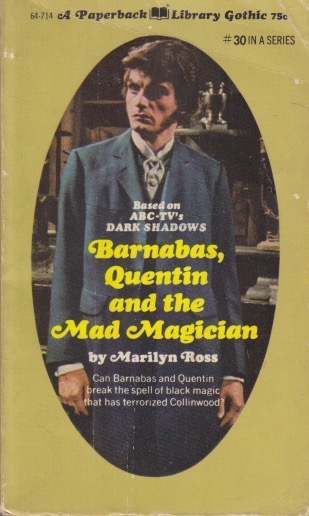
The more I get to know myself—pleased to meet you, sir—the more I realize that my childhood was cobbled together from small but repeated exposures to my favorite things.  I knew Dark Shadows from watching a limited number of episodes and reading a limited number of cheap novels.  I knew Alice Cooper from just two of his albums.  And I knew Ray Bradbury from a couple collections of his short stories.  No doubt this is in part because we weren’t exactly affluent and I found my books, by chance, at Goodwill.  I had no way of collecting Bradbury’s oeuvre, and besides, I was trying to get to know Edgar Allan Poe as well.  I knew Bradbury as a short story writer, and that’s still how I primarily think of him.

I felt compelled to read Something Wicked This Way Comes recently.  Since I’m used to Bradbury the short story author, it felt overdrawn to me.  I know this is heresy.  Great horror writers point to this novel as highly influential and inspirational.  Maybe if it were read closer to when I was born, when it was published.  Too many long paragraphs, especially early on, contain almost abstract descriptions without clear actions, leaving me confused.  Once the story got underway it was quite good.  As someone who writes, I know the dilemma of trying to freeze poetry into prose, and to make a coherent story from thousands of separate impulses.  Believe me, I know.  These days such things are edited out and stories become as thin as Bradbury’s Skeleton Man.  I guess I’m just out of practice.

The plot is great, but it feels so 1950s.  So boy/male oriented.  So American.  I suppose I attended my fair share of carnivals as a kid.  We didn’t go often, and I never knew one to settle on the edge of our small town.  And although we were free to ride our bikes or run as far as we cared to, home was never that far away and, I knew, there were scary things in the ubiquitous woods.  Ray Bradbury’s short stories were likely the main source behind my own early attempts at fiction.  Even today I’ll be scribbling along and think, “this is kind of like Bradbury.”  But I always have his short work in mind.  There are some great parts in Something Wicked, and it does build the tension toward the end.  Still, when it’s said and done I’ll be thinking of Bradbury’s short stories and how they formed my own nostalgia, even if only in little fragments.


Doppelgängers

Maybe this has happened to you.  Two names get stuck and mixed up in your mind until you consistently can’t tell them apart.  Jeff Bridges and Jeff Daniels are two very different actors.  About five years apart in age, they’re both white men, but they play very different roles from each other.  What’s worse, I’m a real fan of a Jeff Daniels movie or two (ahem), and one I watch every year.  When it’s over I inevitably think it was a Jeff Bridges movie.  I’d let this pass as aging gray matter but for one thing—I recently read a book on movies where the author made the same error.  So I tried to exegete it.  Why such a mistake?  They’re not exactly doppelgängers, after all.

Okay, so they’re about the same age.  They don’t look alike and their movie personae are very different.  I tend to think it’s the euphony of the names.  Jeff, followed by a two-syllable last name that ends in s.  As I was talking this through, I said “Both last names begin with a bilabial.”  My daughter corrected me, “D isn’t a bilabial,” she rightly pointed out.  Okay, well, they occur near each other in the alphabet—they’re both in the first four.  What I’m struggling with here is how at least three of us (I had this conversation with someone else years ago who also admitted to confusing the two), have this issue.  And it’s not just the Jeffs.

Back in seminary, the song “Bruce” got a lot of airplay.  By Rick Springfield, it was a lament that he was mistaken for Bruce Springsteen.  The two both play rock (duh) and they were both born in 1949.  Their last names begin with “Spring,” but “steen” and “field” are quite different.  Not to mention Rick and Bruce.  I sometimes think fame is just a mosh of pop culture that gets stuck in our heads and thoughts go around and around like a washing machine until those we don’t really pay attention to end up blending.  And also, famous white guys about the same age with somewhat similar names, have to put up with imperfect doppelgängers.  (Or is it doppelgängeren?)  Academia.edu seems to confuse me with the Steven Wiggins who is an Economics professor at Texas A & M. Or is it the Steve Wiggins, Agricultural Economist at the UK Overseas Development Institute? Since I can only guess from their photo, we seem about the same age.  None of us is famous, but that doesn’t prevent doppelgängers from finding you.


Holding Still

For some people today is the start of the “holiday season.”  Thanksgiving begins what often becomes a rush up until Christmas.  Moods tend to be more festive, if not carefree.  As for me, I always save up vacation days so that I can make my own mini “semester break” late in December.  From the onset of the holiday season I can see far enough to be able to make it through the rest of the year.  For me the season seems to begin at Halloween.  It’s not a federal holiday and I don’t know anyone who gets Halloween off of work, but I take holidays seriously, and Halloween, Thanksgiving, and Christmas are all anticipated days.  And in the spirit of the day, I’m thinking of the many things for which I’m thankful.

Family, friends, and health go without saying.  I really don’t need a holiday to remind me to be grateful for these things.  This year I’m thankful to have made it back from Denver unscathed.  Since it was over twelve hours of travel (less than three of those hours spent in flight) to get home, it was a long, weary, mask-wearing day of travel.  Denver Airport is nearly an hour from downtown.  The American Airlines agent was able to get me an earlier flight to Chicago.  My reading was disrupted by sleepiness and the fact that the woman next to me was watching Jordan Peele’s Nope on her laptop.  I’ve been meaning to watch it again, so I hope I wasn’t obvious when I didn’t strictly observe the custody of my eyes.  The most grueling part, however, was the four-hour layover in Chicago’s O’Hare.  

No matter what the owners do, there’s a limit to how comfortable airport waiting can be.  You have to keep a constant eye on your bags.  Very, very few people are wearing masks.  And two days before Thanksgiving is a busy travel day with people trying to avoid the busiest travel day of the year (yesterday).  I’m thankful to have gotten home and not to have been too much the worse for the wear.  And I’m thankful to spend a day not having to wear a mask.  It’s funny how having to wear one for five straight days all day long can become a point of dread.  I like being able to take a drink of water without having to pull down a mask.  Returning to life as usual will take some adjustment—it always does.  So much travel after spending years not doing it is a bit of a shock to the system.  I’m reminded of one of the most colourful place names we encountered in the highlands of Scotland, and it is my theme this Thanksgiving: Rest and Be Thankful.

Rest and Be Thankful, unknown photographer

Religion in the Air

There’s a physicality to it.  Being in Denver, I mean.  My hotel was a mere four blocks from the convention center and the short walk inevitably found me huffing and puffing.  My first night there it had me wondering if something was wrong—should I call a doctor?  I jog on a regular basis and try to stay healthy and so I’m not used to being winded by an inconsequential walk.  My second scheduled meeting saw me with a seasoned scholar.  He pointed out as we slowly made our way to the seating area that the altitude was probably to blame.  The mile-high city does lack the oxygen more abundant down where we lowlanders dwell.  I often wonder if my first trip here was beset by altitude sickness.  I met a colleague at the conference, on his first trip here, who had the same non-Covid symptoms I had all those years ago.

We’re used to our own air.  The familiar atmosphere we breathe each day.  Taken out of that context we’re not exactly fish out of water, but we’re not exactly not either.  The combination of back-to-back meetings, the effort it takes to walk around city center, and the constant chill in the air during my time there dissuaded me from exploring.  Or even finding places to eat.  I started to worry that they’d recognize me at the Chipotle where I ordered carryout the first three nights in the city.  I know there must be other places to get some good, vegan options, but it was always dark by the time I was done with work and I was still waking up on Eastern Time.  On the positive side, I didn’t get sick this time.  And I would really like to explore the place further.

Many years ago, on a family driving trip from Wisconsin to Idaho, we drove through Colorado on the way home.  High above Denver, in the Rockies—driving through Rocky Mountain National Park—I told my wife I felt strangely elated.  “It’s like a religious experience,” I said.  Perhaps it was the physicality of that altitude, mountains spread out before us, that led to that brief moment of rapture.  It’s so closely related to that acrophobia that whispers the warning not to fall off the edge of this globe when you’re so high in the air.  Even now as I’m heading home from Denver when I’ll be even higher in the sky for a few hours, I reflect on what it means to be a physical being enveloped by the air.  And I’ll appreciate with wonder the planet of mountains, endless plains, and eroding hills on which I live, and I’ll be thankful for every breath.


Kids’ Stuff?

Do you want to be popular with the kids this Christmas?  Do you want to hear the squeals of pure delight that every mom, dad, aunt, or uncle wants when that special present is unwrapped?  Might I suggest a book of theology?  Yes, one of the publishers here at AAR/SBL has a table of Theology for Kids.  Staring at that sign during the long hours on the conference floor, my mind kept wandering back to Richard Dawkins’ comparison of teaching children religion to child abuse.  Indeed, my wife had sent me an article in Rolling Stone a few weeks back that declared an Evangelical childhood was a, to put it politely, a total mind-fornication.  It is something from which those of us raised religious spend all our lives recovering.  Some never escape, while others try to make sense of the world without it.

Publishers of religious bodies make up a substantial part of those present at the annual meeting.  The ones with the biggest, flashiest displays are often buoyed up by evangelical dollars.  Teaching kids to think this way is a core part of keeping the meme alive and those of us who dared question it with our God-given brains are the modern heretics and heathens.  Some years here, various publishers are piously closed on Sunday morning (this is only a three-and-a-half day conference) with signs telling the rest of us that they’re observing the Lord’s day.  America is a strange mix of evangelical and secular, the kind of place where you can purchase theology for kids.  I know I grew up with such things, even though we really couldn’t afford the other children’s classics that I only learned about from having a child of my own.

The canon is important to this self image.  For me, I’ve come to expand mine a bit over the years.  That expanded canon includes unconventional sources of spiritual inspiration, or so my conversations with others leads me to believe.  Theology can, and often does, lead to death sentences for adults.  And sadly, occasionally for children.  It’s difficult to blame adults for trying to ensure their children’s eternal salvation, especially when religion is so terribly difficult to escape even as an adult.  I suppose that’s why I still advocate for learning about religion although it has damaged me personally as well as determined what would pass for my career.  So I stand here awaiting my next appointment and find myself again taken into my past which was full of theology for children.


Reflections of a Hermit

Although I acknowledge that Covid has made even more a hermit of me—I won’t deny it—and I often complain when I have to travel for work, I generally end up glad that I have.  (As long as I avoid Covid.)  Being at the AAR/SBL annual meeting is like being in a living library.  You meet and talk with so many smart, smart people and their ideas and yours begin to blend in an amazing kind of way.  I suspect that it shows that my books have been written by a guy in isolation.  That is, they could be improved by other eyes on them.  That’s what peer review is about, of course, but there’s something exciting about talking to my monster friends and engaging them about their ideas.  Frequently they will ask about mine.  I’ve even had colleagues mention that they’ve read some of my work.

The only real problem with how this unfolds is that I have so many meetings in a day that I sometimes lose track of the many ideas that crowd into my head.  Hastily-scrawled memos in my notebook—I’m too busy paying attention—mean that only fragments remain the next morning.  Each of them a gem.  (Fitting for Denver.)  When conversation comes around to what I’ve been working on, no matter how obscure it is, my monster friends know the root story and even have ideas that help shape my work.  No one scholar can read everything, and those of us who tend towards being hermits have the limited sources of one human imagination.  When imaginations get together, however, these ideas blossom.  I learn so much from these brief days that I think I might’ve been dangerous if I’d remained in the academy.  The man with an exploding head.

I sincerely hope that I give as well as receive at these meetings.  It’s really unfortunate that we don’t support humanities scholars in this nation.  These are some of the bright stars in our national constellation, yet they struggle with underfunding, and pressures such as “metrics,” as if you can quantify the influence on young brains and the potential future of our collective imaginative life.  Although I grouse, as is perhaps to be expected of an aging hermit, I can’t help but be enriched by the fertile minds I encounter, even if behind a Covid mask.  I’m never quite sure how to thank all these idea-conjurers properly.  I wouldn’t have met most of them had my career not taken the strange turns it has.  Now I realize that even hermits may have many friends.