Werewolves Not Forgotten

Copyright is a strange thing.  Without it there would be no making a living as a writer or artist or even music composer (or so I’m told).  The idea is straightforward enough—someone comes up with a “marketable” idea (how marketable varies widely), and therefore owns the exclusive rights to the expressed form of that idea.  If, for instance, the idea becomes a published book the publisher (generally) owns the rights and pays the writer royalties for the use/ownership of those rights.  Copyright, however, like fresh food, expires.  Written work or music or art becomes part of the public domain and can be reproduced by any with the gumption to do so.  There are publishers, such as Gorgias Press, that got their earlier starts by doing just that—finding public domain material, scanning it, and republishing it for a price.  All above board.

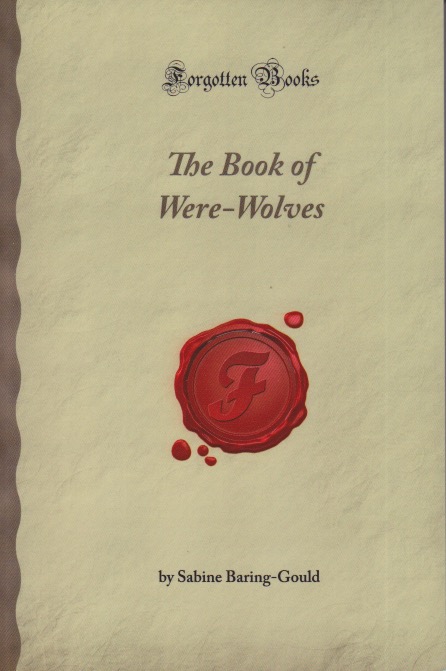
Back before I worked long in publishing I was going through a werewolf phase.  No, I am not a lycanthrope, but I was reading about werewolves.  I knew one of the main sources of folklore was Sabine Baring-Gould’s The Book of Were-Wolves.  Being strapped for cash (some things never change), I bought a copy published by Forgotten Books.  They’re rather prevalent on Amazon.  Although the content is free online, some of us prefer to have a book in our hands and leave the devices aside.  I soon discovered why my Forgotten Books version was so inexpensive.  It is simply a printout of the scanned book, apparently with optical letter recognition software utilized.  No serious formatting or proofreading required, a book is produced, covered, and sold.  It is a disorienting experience reading such a book.

Readers look for landmarks just as surely as a hiker or traveler of any sort.  Old books have layout and typesetting to help the reader navigate.  My copy has “Error! Bookmark Not Defined” instead of notes.  First editions of Baring-Gould, it turns out, sell for upwards of $6000.  So I continued reading.  A lack of italics and the occasional optically misread word make me wonder just how much of Baring-Gould I’m really ingesting.  Any book that begins with a disclaimer regarding possible errors should’ve been assigned a copyeditor.  SBG likes to use lots of foreign words.  They may be spelled correctly or not.  I have no notes to check.  Caveat emptor, n’est-ce pas?  The technology that allows scanned, unread by human eyes products to be sold as books makes me wonder.  No, I haven’t forgotten books.

Horror and Theology

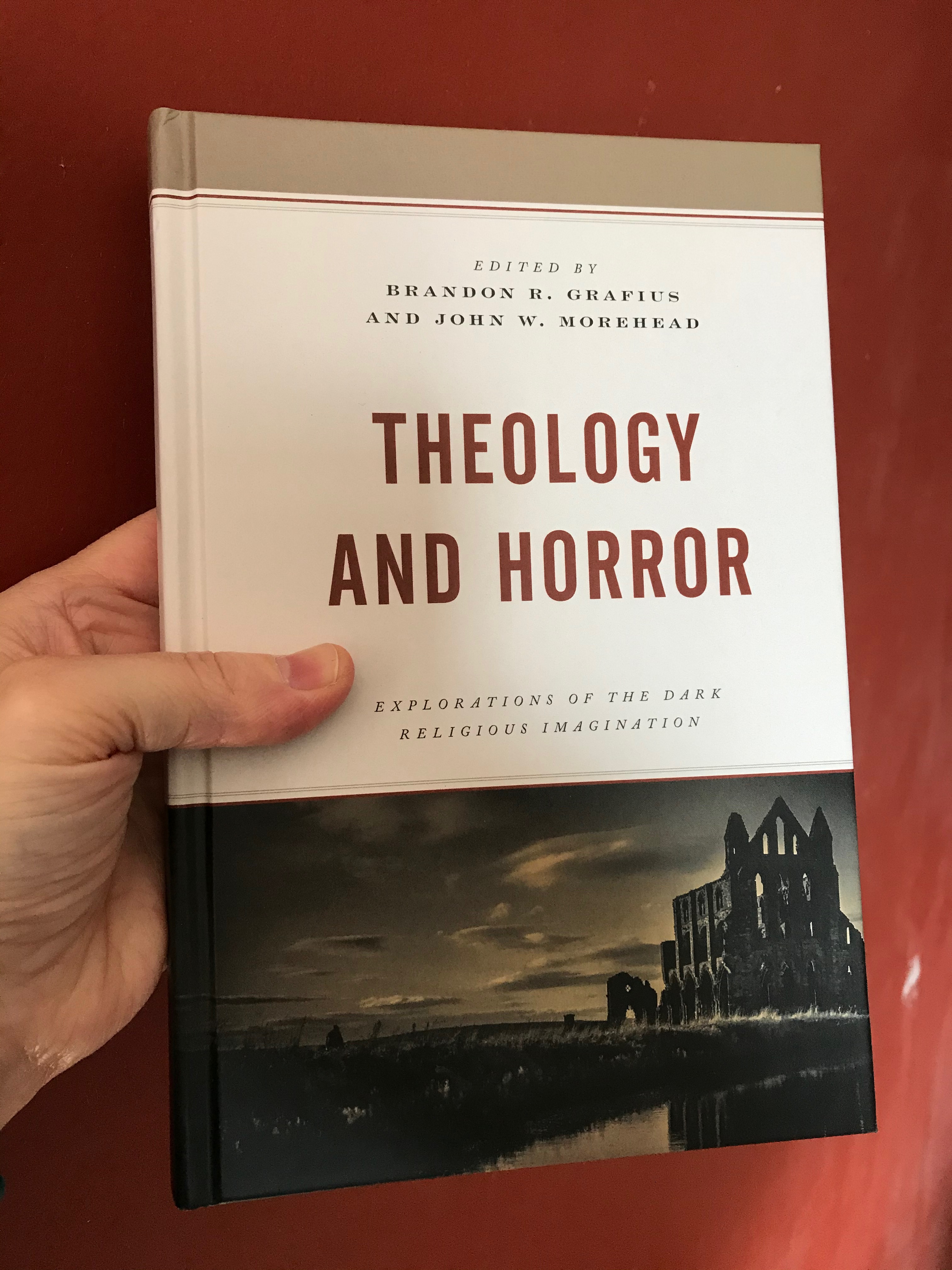
The idea may be catching on. The idea I mean is that horror and religion have something to do with one another. I have to confess that I’ve been one of the (non-academic) explorers of this approach and I was flattered to have been asked to contribute an essay to the just released volume Theology and Horror: Exploration of the Dark Religious Imagination, edited by Brandon R. Grafius and John W. Morehead. My article looks at the origins of horror in biblical (and perhaps pre-biblical) storytelling. In fact it is one of the oldest forms of exploring what it means to be human. Perhaps it began its life as an evolutionary fight or flight response, but it eventually came to represent a way of dealing with the human condition. Horror is generally traced to the gothic novel tradition, but I suggest it goes back much further.

This volume contains twelve essays on a variety of topics, along with an introduction by the volume editors. Since my copy only just arrived in Friday’s mail I haven’t had the opportunity to explore it yet, but I’m looking forward to it. Ironically, it’s an area that I began probing only after the academy no longer required my services. As I reflect on that ubiquitous “why” question I often come back to that fact. Nothing like having your career yanked out from under you makes you consider horror as a kind of therapy. Things could be worse. Besides, horror frequently demonstrates coping skills. And change is constant. Learning to adjust when the monsters of capitalism loom can make you think of religion—trust me.

Individual scholars have examined the connection between religion and monsters before—there’s a pretty obvious connection in that case—but sustained discussion of how horror informs religion is new. The developments are sometimes edgy, but I get the sense that they’re honest. It goes back to that flight or fight response. What happens if you hang around to look? Might not something become clear that was only viewed through a blurred lens before? And the goal isn’t to cause fright. Indeed, it’s just the opposite. Frights will come, and if you’ve anticipated them you might have coping skills at hand. Besides, the frisson can be enticing in its own way. Receiving a new publication can be its own source of thrills. I guess I knew this volume was coming but I’d been busy enough to have shoved the thought aside. I’m delighted it decided to interrupt the mundane, just like monsters often do.


Old Wolves

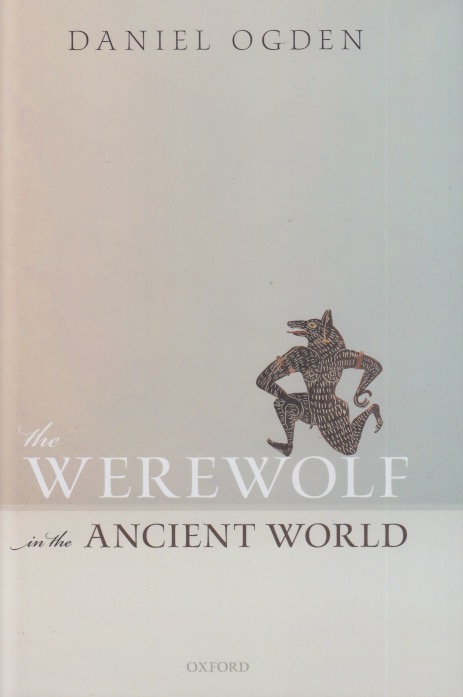
Among the classic monsters, the werewolf seems to suffer from lack of a foundational novel.  Yes, vampires are older than Bram Stoker’s Dracula, and antecedents can be suggested for Mary Shelley’s Frankenstein, but there isn’t a werewolf novel of similar stature.  Daniel Ogden, however, does us a service by providing an extended discussion of, as his title states, The Werewolf in the Ancient World.  His survey is intriguing and informative, and also insightful.  The werewolf is not always what it might seem.  Ogden is an able guide through sources from antiquity through some medieval tales, focusing mainly on the ancient ones.  He extensively explores their associations—witches, sorcerers, ghosts, and the like.  And related tales of human transformation.  He even suggests what some of those transformations may have been seeking.

The werewolf is perhaps the most obvious monster that expresses repressed desire for transformation—a kind of salvation.  Civilization comes with a cost and the werewolf is symbolic of the individual driven by animal desire, unrestrained by human convention.  It’s also an idea of great antiquity.  Although Ogden doesn’t go into it, stories of humans turned into wolves goes back at least to the Epic of Gilgamesh, one of the earliest pieces of literature we have in fairly complete form.  The idea is attested in writers such as Plato and Augustine, if only to refute it.  In other words, it is clearly something people have thought possible from very early times.  Our long association with the wolf, and its domesticated version—the dog—certainly plays a psychological role in such tales.

As Ogden points out, Guy Endore’s novel The Werewolf of Paris, published in 1933, is perhaps as close as we come to a foundational novel.  In the Universal monsters series that developed a canon for monster boomers, The Wolf Man was a somewhat late entry, appearing in 1941—a decade later than Dracula and Frankenstein.  Despite these tardy cultural appearances, the werewolf has been part of our collective psyche far longer.  Ogden shows that clearly.  When you stop to rethink stories like Little Red Riding Hood, the talking, humanized wolf appears so naturally that we don’t often stop to consider the implications.  I certainly hadn’t made the connection explicitly until reading it here.  Ogden’s work is readable but academic, so be prepared for citations and some technical talk.  Nevertheless, this is the clearest guide to lycanthropy and the magical ideas behind it from ancient times to have appeared in recent years.  


J-Horror

J-Horror better move over.  There’s a new kid on the block.

For many years those of us strange fans of horror have used “J-Horror” as shorthand for Japanese Horror.  With two highly successful films (eventually series) of the mid-nineties (Ju-On and Ringu) the Japanese contribution stormed back into American consciousness.  Those of us who grew up on Godzilla knew that J-Horror had been around for decades already, but these new movies were distinctly creepy.  So much so that English-language versions were remade for both original films (The Grudge and The Ring, respectively—rather like Let the Right One In and Let Me In).  So far, so good.  So why does J-Horror need to move over?

At least three separate friends have pointed me to another emerging J-Horror trend: Jewish horror movies.  These used to be rare.  With cases of early antisemitic themes in horror, and the real life horror of the Holocaust, this is certainly understandable.  “Christian” producers or directors delving into Jewish themes would seem to be in bad taste.  Still, some notable Jewish-themed horror has begun to emerge.  (I addressed one such film in my recent Horror Homeroom piece.)  The Possession (discussed in both of my most recent books) centers around the need for a Jewish exorcist in the case of a dybbuk problem.  For more information, you know where to look!  It seemed to me that the dybbuk box contents were reminiscent of the Holocaust, but that may not have been intentional.

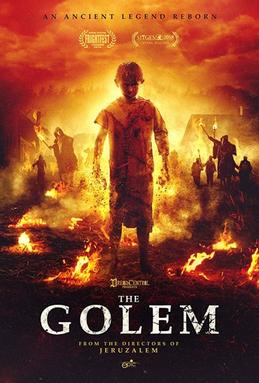
I recently wrote a post about The Golem.  This is a recent Israeli movie that builds on the traditional Jewish monster.  Although set before the Holocaust, the fact that there’s a pogrom in the film shows that the concept is not far off.  The movie that people have recently been pointing me toward is The Vigil.  I’ve not had an opportunity to see it yet, but the press it’s received suggests it too will be another classic based on lived experience in Judaism.  I’m not sure if Jewish horror will eventually rival the numbers of Japanese horror films, but the offerings thus far have been noteworthy.  Horror often addresses the problem of human suffering.  With all the oppressions in “white” society, it’s no wonder that, along with Black horror, Jewish horror is beginning to garner attention.  Although it’s clearly not to everyone’s taste, horror is often a genre with a conscience.  It becomes a screen on which we can see our worst behaviors projected.  And if we’re wise, we’ll take steps to make such suffering become merely an unfortunate memory.


Religions and Horrors

My latest piece on The Golem has just appeared on Horror Homeroom.  It’s free—check it out.  In it I briefly discuss Jewish horror.  I mainly write about Christian horror because that’s my immediate context.  That’s not to say other religions don’t participate in the genre too.  While I worked for Routledge I acquired the book Buddhism Goes to the Movies, by Ronald Green.  Like the title suggests, it’s about movies focused on, or made by, Buddhists.  What sold me on the project was the chapter on horror films.  Much of what’s being called “J-Horror,” or Japanese Horror these days, occurs in a Buddhist or Shinto contexts.  I’m not expert enough in these traditions, however, to spot them with the detail that I do in my own native religion. 

All religious traditions have certain commonalities.  As I’ve frequently discussed on this blog, sex and death are two of them.  Given the powerful ideas that religion trades in, it seems natural that it would appear frequently in the horror genre.  It’s just that modern viewers tend to be somewhat divorced from religion and can’t see it.  Religion is that way—it fills the cracks.  How often do we pay attention to the caulking or grout?  We tend to focus on the tile or woodwork instead.  Religion holds thought systems together, including those of the horror genre.  I just discussed no-go subjects yesterday, but even science shows religion in some of the cracks.  Learning to see it involves learning to shift your focus.

I blogged about The Golem just after I watched it, back in December.  The golem is an original Jewish monster, and Judaism is both a culture and a religion.  It’s difficult to tease them apart sometimes.  The same can be said of many traditions outside Christianity.  In fact, many cultures had no word for religion—the idea of a separate realm of life where you try to please the gods because what you do otherwise is inherently sinful.  (There’s probably a reason that capitalism grew in a Christian context.)  That means that horror particularly welcomes Christianity.  Many of the bases of fear are premised on a religion that, as culturally bound as it is, has always claimed that joining it is a choice.  If you can choose you can choose wrongly.  This is fertile ground for horror, especially when the consequences are eternal.   My Horror Homeroom piece takes a different approach than this, but religion and horror nevertheless find themselves together, often in the same room.


Gothic Dreams

There’s something that compels a large number of people to consume material in the horror genre.  Whether it takes the form of movies, books, or music, it is a genre widely spread.  The gateway to adult likes seems to be in childhood.  As a young person I read about how many adults wanted to “re-live their childhood” and at the time I wondered why.  Now, as an adult of long standing, I think I can begin to see the answer.  In any case, my gateway into appreciating horror was the Gothic.  But what is gothic?  Like many abstract concepts I know it when I see it, but what exactly is it?  I’m not sure Nick Groom has fully answered that in The Gothic: A Very Short Introduction, but then the reason may well be in the “very short” part.  Nevertheless, this is a remarkably broad treatment of the subject in not so many pages.  It also helped me to understand my own fascination a bit better.

Groom begins with the historical Goths.  Like the Celts, they are a people without a prodigious written record, so the imagination takes over.  They valued freedom above all else, and that, it seems to me, is the beating heart of the Gothic.  Recognized through its architecture, especially in notable cathedrals, the incipient Romanticism in the style made its way into works of fiction.  In that realm it is remarkably widespread.  Shakespeare participates in it.  It becomes more fixed in later generations, but it still returns in popular format even today.  At several points in this brief treatment I found myself wondering at the connections.  Gothic is so huge and sprawling that it informs quite a lot of literature that isn’t even categorized with that title.

The story Groom sketches takes the Goths from their Germanic roots to their Anglo-Saxon influence in England.  For English readers, the genre really takes shape in Britain before spreading out into the many forms in which it exists today, including several species of American Gothic.  While the modern mind tends to turn toward the dark and melancholy aspects—and they are clearly there—the underlying theme of freedom comes through.  Thus the separation of ways between “Classical” culture with its rules and strictures and symmetry and the Gothic with its mystery, wonder, and romance.  By the end we’ve passed through Poe and on to modern horror.  And through it all I catch glimpses of what drew me to all this in a childhood of longing for freedom.


Feelings of Horror

One thing that’s become clear to horror fans (or those of us who try to analyze it, anyway) is that more and more pundits are asking serious questions about its appeal and its utility.  A particularly interesting piece on Bloody Disgusting (and that title isn’t representative of the site) explores how horror is often about probing grief, loss, and mourning.  People who immediately associate horror with slashers and blood and gore probably became aware of the genre in the 1980s.  In the post-slasher era (and even during it) many thoughtful films have dealt with the primary areas associated with pastoral care: mourning, grief, and loss are the bread and vegan butter of ministerial work.  These are elements all people have to face, and some horror is remarkably adept at helping viewers do so.

We all die.  Horror has never been shy about that fact.  When the dead do come back it’s seldom good.  Given the permanence of the situation, it seems reasonable to think about it in advance.  Shallower topics are good too—life without fun is hardly worth the effort.  Horror, however, reminds us that the bill remains due at the end.  One of the main points of Holy Horror is that people tend to find their meaning through pop culture.  (It can also be through more classical means as well, but the point remains the same.)  We watch movies for more than entertainment.  Movies other than horror deal with loss, mourning, and grief, of course.  But as Stephen King once noted, this genre forces the reluctant to look.  What seems to be under-appreciated is how sympathetic it is to the human condition.

Apart from a few colleagues who work in this same nexus of religion and horror, I know few fans of the genre.  Most people I know shy away from it.  For me, it seems to be a brutally honest genre.  There are speculative elements in much of horror—those are the elements that make the films fun to watch, in my opinion.  Speculative is often synonymous with supernatural, or spiritual.  Spirituality is often coded as a positive.  Life throws a lot of loss and grieving our way.  A genre that brings these things together can’t be all bad.  Some of the more recent transcendent horror can be downright profound in its probing.  The editorial by Marcus Shorter doesn’t take the step of addressing the pastoral aspects of the genre, but they are plainly there.  And they can offer solace that all people can use.


Comedic Horror

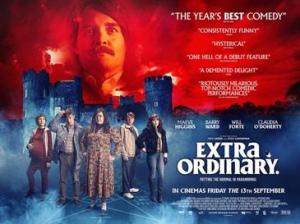
Spoofs can be a great way of preventing us from taking ourselves too seriously.  Extra Ordinary is a film I’d completely missed until my wife made a gift of it.  We weren’t quite sure if it was a horror film or a comedy, and genres aren’t always helpful here.  I would call it a spoof on possession movies, something of particular interest after writing Nightmares with the Bible.  Apart from being a bit of much-needed silliness after a terribly serious year, it’s also a demonstration of how genre can be helpful in knowing how to interpret what we see.  Not knowing anything about the film, it begins with the statement that it’s based on a true story.  There’s an interesting history behind that phrase, but when it comes with a spoof it only adds to the fun.

Extra Ordinary follows the adventures of Rose Dooley, a driving instructor who was raised by a ghost-hunting father.  Blaming herself for her father’s death, she’s taken on an anodyne career that she feels is safer.  A particularly desperate widower whose daughter is targeted by a hapless Satanist, brings her back to her true calling.  Although there are some horror-comedy scenes (that’s an entire sub-genre often eschewed by horror fans who don’t like to laugh at themselves) the witty dialogue and crude jokes make it fun rather than anything to be worried about.  Possession occurs in a specific way to move the plot along—Rose has to have a partner (the widower Martin Martin) accept possession by the ghost in order to send it to the beyond.  Although there are clever takeoffs from The Exorcist, the idea of possession is much different.

What is evil?  The film asks the question directly (if comedically).  Although washed-up rock star Christian Winter has become a Satanist, the demon in the film is Astaroth, a later development from the pre-biblical goddess Astarte.  As discussed in Nightmares with the Bible (for which this film could’ve been profitably discussed), there’s a confusion among demons.  (Beelzebub is also mentioned by name.)  The element that ties them together with the human condition is clearly sex.  The frantic search for a virgin, and the communal shaming of unwed mothers makes that obvious.  Although deliberately campy, Extra Ordinary answers the question of evil by noting that it is a person using their powers (magical, in this case) for their own benefit rather than for the good of others.  There is a moral to it, after all.  And if we can’t laugh about the human condition once in a while, we deserve to be spoofed.


Ghost Stories

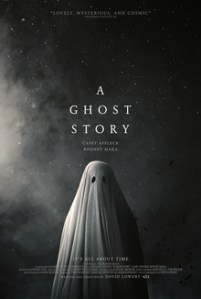
Those of us who confess to watching horror are fond of noting that the Christmas season has long been associated with ghost stories.  Charles Dickens wasn’t the first to make use of the trope and certainly won’t be the last.  After reading about elevated horror movies, I decided to watch A Ghost Story (David Lowery, 2017).  Many wouldn’t classify the film as horror at all.  It is quiet, slow paced, and has no gore.  It is nevertheless a haunting film.  I suspect its poignancy comes from a situation we can all imagine and which many people face in life—being left alone after the death of a loved one.  The idea that the dead never really leave us can be both comforting and unnerving at the same time.  The film plays to those strengths.

The premise of the film is simple: the ghost of one of a couple finds his way home and tries to reconnect with his widow.  He ends up staying there until, many owners later, the house is demolished and a high-rise is built in its place.  It’s essentially a story from the point-of-view of the ghost.  There isn’t too much dialogue included, but one significant monologue comes when a party is being held.  One of the party goers, or perhaps the current owner of the house, explains that because of what we know of physics everything on our planet will eventually be destroyed.  His beer-fueled lament is that whatever we do is therefore in vain.  He brings God into the discussion.  The ghost listens intently, but seems to disagree with his conclusions.  For someone like me the introduction of religion into the story is a Venus fly-trap, since religion and horror can’t seem to keep away from each other.

Death is a dilemma, a point that I made in a recent Horror Homeroom article on Pet Sematary.  Horror, like religion demands that we confront it.  Science can only offer cold comfort regarding the cessation of life.  Religion (and horror) open the dialog into the unknown, the realm into which mere human instruments cannot reach.  Sad and reflective, A Ghost Story hits on an essential question in the nexus of religion and science.  If a spiritual world exists, there may be some survival even of the earth’s eventual heat death.  As time passes, the titular ghost continues to learn.  Life is a learning experience, and although many modern forms of religion join in the cultural denial of death, horror is always ready to remind us that confronting it may be the wisest course of action.  Ask the ghost.  He knows.


Monster Guides

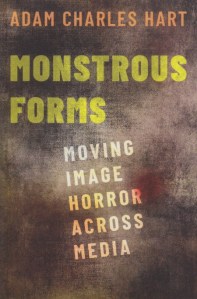
Reluctantly, almost begrudgingly, society seems to be accepting horror as a genre of more than cheap thrills, blood, and gore.  From childhood I was drawn to the gateway figure of vampires, but I’ve never been a fan of blood and gore, and not even cheap thrills.  You see, I saw something profound in horror.  A longing.  Experts might call it abjection, but to me there was a spiritual component to it, and I watch these kinds of movies to capture those moments of transcendence.  Adam Charles Hart seems to be aware of the draw horror has.  Monstrous Forms: Moving Image Horror across Media still shows its origins as a dissertation, but it has an appreciation for horror that doesn’t feel the need to make excuses for it.  Exploring the body-focus of horror, it delves into television, gaming, and other applications of the genre.

I have to admit that I don’t understand the cultural fascination with what we used to call video games.  I know they’re tremendously popular and the rights for gaming bring in even more royalties than sold movie rights do.  I just don’t get it.  Still, Hart explores how horror has become a very popular element in the gaming community.  Not only that but on the internet many young people like watching videos of other people playing games.  I’m sorry, but I’m just not that meta.  If I want to get lost in other worlds I read a book.  Or watch a movie.  And this is where Hart’s book shines.  His read on horror films is fresh and compelling.

Recently I had a conversation (virtual, of course) with some colleagues about the horror genre.  The topic of horror games came up.  I had to sit that part out.  I commended Hart’s book though.  For me time is too valuable to immerse myself into worlds where options are limited by some programmer’s imagination.  Movies will take a couple hours of your time.  If well done they’ll remain in your head for hours or days, interacting with other thoughts and experiences, and perhaps even inspiring the viewer.  If horror isn’t your thing, I get that.  I do have to say that the genre as grown up, and as Hart points out toward the end of his study, academy recognition of a couple of horror films in 2017 bodes well for the future of a genre that seems more and more applicable every day.  And when horror comes to town we’re going to need some able guides.


Time for Golem

I don’t claim to understand how the film industry works.  My two books on horror and religion deal with interpreting the movies, not their native cinematic environment.  I say this because I limited my treatments in them to films with a theatrical release.  Mainly this was so that readers would have had easy access to them.  Some films, of course, never go to theaters and it seems that happened, in the United States, to the Israeli movie The Golem.  I saw a trailer for it last year and patiently waited for it to arrive.  I recently found it on an online streaming service and finally had a chance to watch it.  Golems, as original Jewish monsters, have shown up in a variety of popular media including The X-Files and Sleepy Hollow.  Film treatments have been rare, and this one makes for a fascinating monster movie.

What makes the golem so compelling is that it is an explicitly religious monster.  To create a golem (according to the film) the maker must use Kabbalah, Jewish mystical texts, to learn how to bring it to life.  Hanna (Hani Furstenberg), the female protagonist, is the only one in her seventeenth-century village willing to try.  The real hook, for me, is that the golem she creates is a little boy.  The role must’ve been fun to play.  Golems cannot speak, so there are no lines to learn.  Kirill Cernyakov nails the part with an ability to portray emotionless menace.  The problem with a golem, you see, is that it goes on rampages, killing even those it’s conjured to protect.  Since the movie is intended to be a retelling of the classic story (involving the golem of Prague), it doesn’t have too many surprises.  It is, however, a thoughtful movie.

Write-ups on it call it “the Jewish Frankenstein,” but scholars who research Frankenstein often go the other way, seeing Frankenstein’s monster as a form of golem.  The basic idea is taking something inert and bringing it to life.  Afterward the creator is unable to control it.  It’s too bad that The Golem didn’t get a wide theatrical release.  I’ve seen far worse horror films that did.  Perhaps the focus on religion was too blatant?  One of the points I make in Holy Horror and Nightmares with the Bible is that religion and horror belong together.  Some Jewish viewers will undoubtedly spot inaccuracies (even this goy did) but the movie isn’t a religious text.  It is an appropriate rebuff to Trumpian “politics” and even features a plague.  It is a movie for our time.


Timely Terror

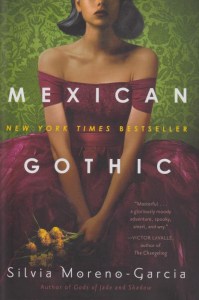
Fear comes in many colors.  Silvia Moreno-Garcia’s Mexican Gothic was getting such positive press that I didn’t wait for the paperback.  At first the title threw me a bit, but creepy old houses can be found in many places around the world, and the gothic often lurks in such structures.  The story builds slowly until the supernatural begins to seep in steadily and the reader realizes they’ve been hooked along the way.  In some ways it reminded me of Jeff VanderMeer’s Annihilation, but the setting in Mexico gives Moreno-Garcia’s tale its own kind of zest.  Having a strong hispanic, female protagonist is a nice corrective to the political rhetoric we’ve been fed for the past four years.  As I said, fear comes in many colors.

Perhaps I’m not as afraid as I used to be when I read fiction.  Gothic, however, is all about setting the right mood.  It’s a creepy sensation that boundaries are being crossed and such things often take place in isolated locations.  The house owned by the Doyles—not exactly colonialists, but symbols are seldom exact matches—is marked by greed and power.  A kind of rot is everywhere evident, but the family must keep power within its own circle.  The parallels to a Trumpian outlook were perhaps not intentional, but national trauma can make you see things in a different way.  As Noemí attempts to rescue her cousin from the house, High Place itself participates in thwarting their escape.

Reflection after reading draws out some further insights.  Not only is the white Doyle family the  oppressive element here, they do so by religion.  Secret rituals and practices have made the patriarch a god—and here let the reader ponder—who builds his power on the oppression of others.  I have no idea if Moreno-Garcia was influenced by the nepotistic White House we’ve just experienced—eager to use political office for overt personal gain, and yes, worship—but she’s laid bare the ugly truths of white power.  I dislike racializing people, but race was invented by Europeans as a mean of oppression and keeping wealth within the grasp of a few individuals who would be surrounded by an empowered “white” race.  It worked in Nazi Germany and it came close to working officially in the United States that fought to vanquish it just seventy years ago.  Mexican Gothic is a moody book indeed.  It’s also a book, whether intentionally or not, that is an object lesson for our times.


Trade Wars?

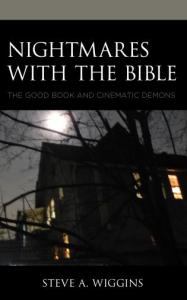
A few friends are suffering sticker shock at the cost of Nightmares with the Bible.  I offer my sincere apologies.  To those in the normal world (outside academia) such pricing appears predatory.  It is, but you’re not the intended prey.  One of the pillars upon which capitalism rests is “what the market will bear.”  You price up any product until people stop buying it, then you retreat.  I’m no fan of the dismal science, but I am certainly not in the cheering section for capitalism.  Institutionalized greed.  Still, I can explain a little of why Nightmares comes with such a high price tag.  Publishers have long indulged in “library pricing.”  Although many libraries now buy ebooks instead, the model persists.  The idea is that libraries can afford higher prices than mere mortals.  For those of you not in academia, $100 is actually on the low end.  Believe it or not.

In researching Nightmares I saw monographs I coveted.  Some of them priced at $175.  Considering that some of these were under 200 pages, my primitive math sets the rate at about 87 cents per page (single-sided).  Here’s where the disconnect comes in.  Nightmares was written for general readers.  I long ago gave up the idea that to be intelligent a book must be impenetrable.  And academics wonder why people question their utility?  Only after I signed the contract did I learn that the Horror and Scripture series, of which Nightmares is the second volume, would suffer “library pricing.”  There is a discount code for those who may not be libraries.  But please, have your library buy a copy.  That’ll give me fuel for a paperback argument.

In a “catch-22” scenario, it goes like this: a publisher tells an author, “if your book sells well enough at this price we’ll issue a paperback.”  The truth is your hardcover only sells well if you’re well known or if your choice of topic is truly compelling.  If the unit cost were actually the same as the library pricing I’d be a rich man.  Where does all that money go?  It’s a legitimate question.  It’s not royalties!  Academic publishing is an expensive business to run.  Apart from overheads—there are always overheads—you need to pay tech companies to ready your files so they can be printed.  Unless the print run (generally under 200 now) is intended to sell out you’ll have it done domestically so that you don’t have to pay warehousing costs on unsold stock.  I knew a single-man academic publisher who stored his stock in his basement.  Excuses aside, my apologies that Nightmares costs so much.  I’ll send the discount code to anyone who’d like it.


Arrival

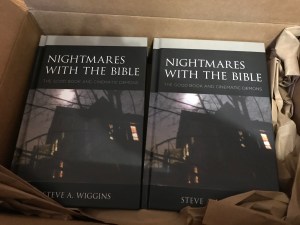
Excitement that comes during the work week gets sublimated.  Work, you see, is like a huge ship chugging ahead at about 30 knots.  It takes some time to stop, or even change direction.  So on Thursday, while I was still at my desk, Nightmares with the Bible arrived.  Since all work—even salaried—is measured by the clock by HR,  I couldn’t take off time to enjoy the birth.  I opened the box, cursorily flipped through a copy, and got back to the task for which I’m paid.  After work it’s time for supper and I can’t stay awake much beyond seven or eight, which meant I neglected my baby.  Friday was another work day, and although I wanted to do all the things marketers tell you to do, I had other duties.

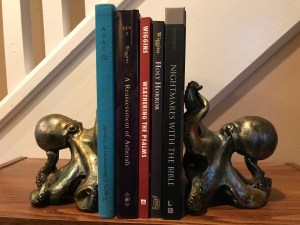
So now it’s Saturday and I can officially say Nightmares have been released.  I have a discount code flyer, about which nobody has yet emailed me, but the offer still stands.  You can get a discounted (but still expensive) copy by following the instructions below.  Feel free to share with your rich friends.  Better yet, have your library order a copy.  I’m hoping for a paperback on this one, but that’ll be a couple years and I know paperbacks seldom outsell hardcovers, even expensive ones.  Raising a child can be a costly venture, no?  Adding another book meant that my display copies had to move out of their cubby-hole onto a bookshelf.  Hopefully, if things go well, there will be more siblings.  Perhaps better priced.

A Reassessment of Asherah was published by a European academic press and put at the incredibly high price of $78 back in 1993.  Gorgias Press reissued it, with additional material, but made it even more expensive.  I can’t even afford to buy a copy.  Weathering the Psalms was only $22, but wasn’t a gripping topic for many.  Cascade Books, at least, know how to price things.  Holy Horror, at the shockingly high $45 for a paperback (McFarland), languished.  It missed its Halloween release and no reviews have appeared.  “Nightmares” might well capture my sense of the price for my second missed Halloween release.  There are other books in the works.  If any of them get completed I’ll be seeking an agent to try to bring the prices down.  Until then, Nightmares will be the final word.  It’s out there now, for those brave enough to engage with it.


Nightmares Awake!

According to Amazon, Nightmares with the Bible has now been published.  Authors are seldom the first to see copies of their own books, strangely enough.  I probably won’t have any physical copies for a couple of weeks yet.  Until then I’ll wait like an expectant mother.  I don’t actually read my own books after they’re published.  Like some other writers I know, I’m terrified of finding mistakes.  And the older I get the less certain I am about anything.  I’m not even sure if it’s officially published yet or not.  I choose to trust Amazon’s opinion on that.

Right now I’m caught up between four or five other book projects, each a good bit along.  Since writing is often a mood-based thing, what I do in the sleepy hours of pre-dawn is what I feel like writing on any given day.  Unless you have a book contract in hand, that’s not, I suppose, that unusual.  I’m trying to guess what might most get the attention of an agent.  Both Holy Horror and Nightmares with the Bible were written for general readers.  I don’t have the name-recognition to command any kind of attention (or affordable prices), so I need to find a topic that’ll do the work for me.  I personally find religion and horror a fascinating subject.  Many other academics do as well, but general readers not so much.  It’ll feel more like reality when I have a copy I can have and hold.  I still haven’t reconciled myself with ebooks.

What usually makes me stick with a project for the dash toward the finish line is a book getting close enough to see the ribbon ahead.  I write incessantly, so I have a backlog from which to draw.  I know my tastes are odd, which means it’s a challenge to get others onboard with my likes.  I know horror fans love to read about movies.  I suspect most of them don’t care much about the religious aspect of what they’re seeing.  That’s why I write about it.  People get information about religion from popular media.  Even if they deny their interest, writers and directors will slip it in regardless.  I’m just calling them like I see them.  The nice thing about movies is you can have instant replay.  And with a fair number of us now publishing books in this niche, hopefully conversation will follow.  Until then, I’ll just be waiting here until my first copy arrives.