Preorder Alert

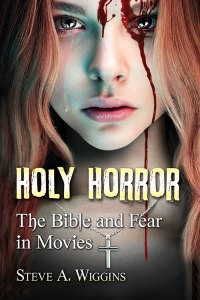
Although you can buy most anything from Amazon, the book industry is particularly under its hegemony.  I have to admit that I enjoy browsing there, and often dream of the books on my wishlist.  I suppose that’s why I was pleased to see that Nightmares with the Bible is now available for preorder on Amazon.  I like to give updates for those interested, and the proofs have just arrived.  There’s kind of an inevitability to seeing your book on Amazon, a prophecy almost.  It now exists out there somewhere on the internet.  I do hope that it might stir some interest in Holy Horror, but like that book it will miss its sweet spot of a release before Halloween.  That means it also misses the fall catalogue.  The next one comes in spring, and who’s thinking of horror then?  Something all publishers of horror-themed books know is that minds turn toward these topics in September and October.  Just look at the seasonal sections of stores.

Horror films come out all year long, of course.  Halloween, however, serves as an economic lynch pin.  People spend money on being afraid in the early fall.  By mid-November thoughts have moved on to the holiday season and the bright cheer of Christmas.  Holy Horror arrived days after Christmas two years ago, and although I was delighted to see it, I knew we’d missed the boat for promotion and by the time it was nearing the backlist at the next Halloween it was old news.  That doesn’t dampen my enthusiasm for the books, of course.  It just means they won’t get the attention they might have had.

Nightmares with the Bible is about demons.  Primarily demons in movies, but also a bit of a history of how they develop.  There’s a lot of academic interest in the topic at this point in time, so hopefully it will get checked out of academic libraries that will make up its primary home.  According to Amazon you get five dollars off the exorbitant price if you order it there.  Although it’s standard practice in the industry, I’ve always disagreed with “library pricing.”  It comes from presses publishing too many books, I suspect.  Since few of them are pay dirt they have to recoup their costs by overcharging for the rest.  Nightmares with the Bible is reader friendly.  It’s non-technical and, I hope, fun to read.  Amazon seems excited about it (it’s an illusion, I know, but one for which those of us who do this kind of thing live), and is happy to take preorders.  Have your library order one, and if you do, be sure to check it out.


Nightmares’ Progress

Ironically for someone who works in academic publishing, I have my own issues of how books are priced.  I understand why, however, because I can see sales trends.  When it comes to authoring my own books I’ve learned how to write for general readers.  Not all publishers know how to price for that.  Already I’ve had one friend blanch at the price of Nightmares with the Bible and the hope is that it does well enough in the library market to earn a paperback.  I also know paperback sales seldom reach the level of hardcover sales from academic presses.  Much of it is driven by demand.  If people know about the book and ask their libraries to buy it, and this is key—check it out—that has a way of sometimes snowballing enough to convince a publisher that there’s an individual market.

Since I’m plotting the progress on Nightmares here on this blog, I’ll point out that the book has its own page on my website (located here).  Actually, all my books have their own page, but since my website is in the low-rent district of the internet not many readers venture here.  Yesterday I added the back-cover blurbs to the page.  I did so with fear and trembling.  Life has taught me not to take well to compliments.  They make me uncomfortable, like strangers entering my house without masks on.  Since I have no institution backing me, however, I need the praise of colleagues to convince others to buy this book.  In my long-term thinking on the topic, I’m hoping Nightmares gets reviewed and people will get interested in Holy Horror, which didn’t get reviews but which is half the price.

In the biz we call this “platform building.”  Those with healthier egos than mine hire their own publicists who boost their number of Twitter followers and get their names out there on the internet.  My own platform building has been of the budget kind.  I’m active on Goodreads to get followers.  I’ll engage with any comments I get on social media.  But I’m also a working stiff hoping desperately not to lose my job during this pandemic.  The blurbs on Nightmares are very nice, and they note that I write for non-specialists.  This blog is open to all comers, after all.  Likes, shares, and comments all help.  My thanks to my endorsers—you know who you are!—you made my day with your kind words.


The Birth of Nightmares

It’s often said that it takes a village to raise a child.  A similar idea lies behind the writing of a book.  Sure, the lion’s share of the research and writing are done by the author—the person who gets credit for the work—but publishing is an industry.  That means other people’s livelihoods are based on the end result as well.  The author often doesn’t know what’s going on when the book is in production.  It was a pleasant surprise, then, to find the publisher’s website for my book is up.  You can see it here.  My own site for the book has been up for months (here; go ahead and take a look, there’s not much traffic).  Those who only read these posts on Facebook, Goodreads, or Twitter may not realize there’s a whole website out here that addresses things like books and articles.  (I think the CV part requires updating, though.)

In a writer’s experience, seeing a book’s website—receiving an ISBN—is like the quickening of a baby.  You’ve known for some time that it’s there, but the proof is in knowing that other people can find out.  I only learned of this because a friend wanted a link to the book page.  If you google the title without quotation marks you’ll find lots of websites about Christians and nightmares.  (Who knew?)  People of my generation still often don’t realize that, much of the time, searches with quotations marks are increasing necessary on a very, very full internet.  I’m still not sure of a publication date for Nightmares with the Bible, but you can preorder it.  (Sorry about the price.)

Once a friend asked me why we do it.  Writers, I mean.  Unless you’re one of the few who are very successful you don’t make much money off the project that has taken years of your life to complete.  I’ve never earned enough in royalties even to pay for the books I had to purchase to research the topics on which I write.  It’s not an earning thing, although that would be nice.  For some it’s an expectation of their job.  For some of us where it’s not, writing books is perhaps best thought of as monument building, a long and intensive “Kilroy was here.”  You notice something you think other people might find interesting, and so you write it down.  Chances are the number of other interested people will be small.  Family (maybe) and a few dedicated friends will lay down the cash for an academic book.  But still, there’s a village behind it, and I need to thank them here.


Summer of Horror

Summer vacation—or at least what used to be known as summer vacation—is winding down.  Unlike most years when the season is marked by a carefree sense of time off and travel, many of us spent it locked down while the Republicans have used revisionist history on the pandemic, claiming against all facts that America handled it best.  Is it any wonder some of us turned to horror to cope?  My latest piece in Horror Homeroom has just appeared (you can read it here).  It’s on the movie Burnt Offerings.  The movie is set in summer with its denouement coming just as vacation time ends.  I’ve written about it here before, so what I’d like to mull over just now is transitions.  The end of summer is traditionally when minds turn to hauntings.

Doing the various household repairs that summer affords the time and weather for, I was recently masked up and in Lowe’s.  Although it was only mid-August at the time, Halloween decorations were prominent.  Since this pandemic—which the GOP claims isn’t really happening—has tanked the economy, many are hoping that Halloween spending (which has been growing for years) will help.  My own guess is that plague doctor costumes will be popular this year.  Unlike the Christmas decorations that we’ll see beginning to appear in October (for we go from spending holiday to spending holiday) I don’t mind seeing Halloween baubles early.  There is a melancholy feel about the coming harvest and the months of chill and darkness that come with it.  Burnt Offerings isn’t the greatest horror film, but it captures transitions well.  (That’s not the focus of the Horror Homeroom piece.)

Many of us are wondering how it will all unfold.  Some schools have already opened only to close a week or two later.  Those in Republican districts are sacrificing their children (this is the point of the Burnt Offerings piece) in order to pretend that 45’s fantasy land is the reality.  The wheels of the capitalist economy have always been greased with the blood of workers.  (Is it any wonder I watch horror?)  As I step outside for my morning jog I catch a whiff of September in the air, for each season has its own distinct scent.  I also know that until the situation improves it will likely be the last I’ll be outdoors for the day.  It has been a summer of being cooped up and, thankfully, we’ve had movies like Midsommar and Burnt Offerings to help us get through.


The Birth of Horror

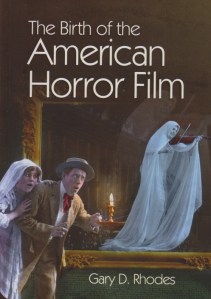
In both Holy Horror and Nightmares with the Bible I concern myself with horror films that have appeared since 1960.  I’m not enough of a cinema studies type to argue eloquently about the various stages of the horror genre on celluloid, but the many histories I’ve read settle on 1931, the year Universal’s Dracula and Frankenstein both appeared.  Dealing with more contemporary fare, I often use that as a mental benchmark.  Gary D. Rhodes has changed  that perspective, however.  The Birth of the American Horror Film is a somewhat sprawling treatment of a subject that’s more involved than I had supposed.  Early films didn’t suddenly appear, of course, and Rhodes spends some time surveying what came before the film that eventually produced what we recognize as cinema.  One of the things he notices is that which we call “horror” was pretty much there from the beginning.

Call it morbid curiosity.  While not everyone admits it, it is a pretty widespread human condition.  After surveying literature, theater, and visual culture, Rhodes moves on to consider many different genres of pre-1915 horror.  Some of them don’t strike every reader as horror today, but that’s a point I tried to make in Holy Horror.  The definition depends on the viewer.  Rhodes suggests throughout that American viewers tended to prefer non-supernatural horror.  While statistically this may be true, he devotes several chapters to genres that fall into the supernatural category.  These were, in the opinion of this reader, the best in the book.  One of the reasons is that horror and the supernatural naturally go together.  Many of us working in this field have noticed, some with embarrassment, that the two are closely related.

What might strike other readers as starkly as it did me, is just how terribly prevalent “horror” films were before there was a proper genre.  Rhodes makes the point that even if we like to think otherwise of ourselves, if there hadn’t been a substantial market for such movies they wouldn’t have thrived.  Some of them, like murder mysteries and other dramas, we might cast more as “thrillers” today.  I included a few of them in Holy Horror.  The real terror, however, often arises from subjects that were somewhat taboo in the late eighteenth and early nineteenth centuries.  Religion was handled with all seriousness.  I wonder if this might be one of the reasons that the supernatural didn’t appear, in the early days, as much as it would later.  This is one of those books that raises many questions such as this, and that makes me glad that the author is working on a sequel.


Creation of Horror

I recently read the article “The Christian Worldview of Annabelle: Creation” by Neil Gravino on Horror Homeroom.  I’m pleased to see that the complex world of religion and horror is being addressed by other scholars.  (I know that many actually work in this area, but if you don’t have access to an academic library finding their articles can be impossible.  Also, did I ever think I would miss Religion Index One and Two so much?)  Since I have a piece that is scheduled to appear on Horror Homeroom concerning the 1976 movie Burnt Offerings, I’m glad for the company.  As in my article, Gravino makes the case that the relationship between horror and religion (the Christianity of Annabelle: Creation and its need to be a horror film) is fraught.  This is something I describe in some detail in Nightmares with the Bible.

Back when I was writing Holy Horror I realized that putting individual horror films into a series creates continuity issues.  Annabelle: Creation is part of the wildly successful Conjuring franchise, the latest installment of which has been delayed by the pandemic.  Depending on how you count it, there are already seven films in that particular universe and the shifting of the story is the focus of an entire chapter in Nightmares.  The reason it requires such sustained attention is that, apart from being the most successful horror franchise after Godzilla, these movies are squarely based on Christianity.  Lacking the unrelenting gravitas of The Exorcist, they feature (in the main branch of the diegesis) the Catholics Ed and Lorraine Warren.  In an almost Dantesque view of Heaven and Hell, the characters struggle with monsters that hover between ghosts and demons.  They’re closer to the latter.

Many horror films—but by no means all—are based on fears associated with religion.  That religion isn’t always Christianity, as both The Wicker Man and Midsommar show, but the warnings against extremism apply equally to belief systems across the board.  Another thing I miss, being outside the academy, is the funding to do some in-depth research on this.  It’s good to know that others are seeing what I’m seeing as well, as is appropriate when you encounter something unexpected.  Our religion haunts us.  The reasons we believe are often tied to the self-same fear that the religions themselves generate.  And like religions, horror movies hold the possibility of earning quite a lot of money.  The parallels should not, I believe, be overlooked.


Mummy’s Daddy

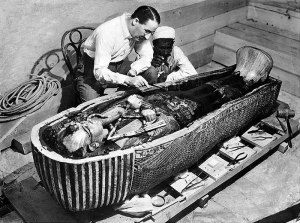
Now that I’ve broached the subject of the Agade listserv, I’m bound to find some interesting stories therein.  The title of this blog “Sects and Violence in the Ancient World” is an artifact that demonstrates eleven years ago I was still keeping up with Ancient Near Eastern studies.  I was calling it “Ancient West Asian studies” then, but I’ve been in publishing long enough to know that shifts in terminology are frowned upon by those in an industry that moves at a glacial pace.  (Just remember that the tortoise wins in the end.)  In any case, one of the recent articles on Agade had to do with the “curse” of Tutankhamen’s tomb.  This is an idea that goes back to the 1920s and was in some respects expressed in the Universal monster film The Mummy.  In pop culture the idea lives on.

Photo credit: The New York Times (public domain)

It seems that some, but not all, of those involved in opening Tut’s tomb died in unusual ways shortly thereafter.  The deaths were not concentrated within a day, let alone a week or a month, and some of them were natural but premature.  The ideas of curses, however, fit the spiritual economy of the human psyche so well that they suggest themselves in such circumstances.  A run of bad luck may last for years, causing the sufferer to think they might be living under a curse.  It is, in many ways, the pinnacle of magical thinking.  No matter how scientific we become the idea never goes completely away.  Just when Mr. Spock seems in control of the Enterprise Harry Potter beams aboard.  Our minds are funny that way.

The particular article I saw was one that had clearly followed on an earlier piece that I had missed.  It mentions “the documentary” but doesn’t say which one.  I suppose there are many such filmed attempts to make sense of memes such as the Pharaoh’s curse.  From my teaching days I have documentaries about a number of weird things that the History or Discovery channel, and maybe A&E, spun out back in the Dark Ages.  I’m not convinced that scientific thinking is really under any threat from such journeys down the paths of speculation.  I’m also not sure that there really is any connection to the various deaths surrounding the Carter expedition in 1922.  In just two years’ time we’ll be at the centenary of the discovery of the tomb and I’m sure there will be plenty of information on offer then.  As long as the curse doesn’t get us all first.


Wolves? Where?

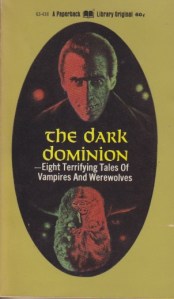
One of the oldest tricks in the capitalistic playbook is to make something look like a more successful product.  Trademarks and copyright laws prevent too close a similarity—for money is sacred—but we all know “brands” that try to look like other brands in hopes of picking up some of the business that attends success.  The same feature was apparently at operation behind The Dark Dominion: Eight Terrifying Tales of Vampires and Werewolves.  This is a book that I picked up in a used bookstore because its cover design—a dull olive green with a picture oval on the front—was clearly based on the Dark Shadows book series.  While the latter are still available, they’re increasingly difficult to find in used bookstores, so when I come across one I don’t have I tend to buy it.  I knew this wasn’t part of the series but the cover suggested to me it might be similar enough, like store-brand breakfast cereal.

Werewolf stories, it turns out, shouldn’t hunt in packs.  There’s no surprise since it’s pretty clear that one of the characters is a shapeshifter and it’s pretty obvious which one.  Six, or maybe seven, of the eight stories concern werewolves while one outlier has a vampire menace.  Some of the stories in the book are clever, but most follow the same trajectory: attacks are made, the villagers suspect something, one of them turns out to be a werewolf.  Time for the next story.  I noticed a long time ago that unlike vampires and Frankenstein’s monster, the werewolf doesn’t have the definitive novelistic origin.  Others wrote vampire tales before Bram Stoker’s Dracula, but that telling set the stage for those that followed.  The olive green cover suggests Barnabas Collins, but in reality is more in Quentin’s territory.

Interestingly, The Dark Dominion, like occasional collections before and after, doesn’t list an editor.  Modern books use the stature of volume editors to reinforce that what’s contained within has quality.  Otherwise who knows whether someone with good taste has picked the stories by authors you’ve never heard of and wrapped them together in a package meant to move?  That’s not to say that some of the stories aren’t good.  A couple are quite clever.  One is a translation of a medieval German tract.  Another comes from medieval Ireland.  The remainder are stories from the nineteenth and early twentieth centuries.  Perhaps it’s the burden of an editor to wonder what the selection criteria might have been.  What’s entirely obvious, however, is that making something look similar to a recognized book series still has the power to sell.


Fear Writing

Unless your publisher is good at marketing, that book you spend years on will remain unknown.  That “share” button in the right hands can make all the difference.  The other day while searching for reviews on Holy Horror I came across Scriptophobic.  The website had started a column titled “Holy Horror,” and so I contacted them asking if they’d like to review my book that shared the title.  They graciously accepted.  I want to drive traffic (in as far as I can drive anything) to their website, so I’ll simply say the review may be found by following this link.  It’s too early to tell if it will raise much awareness, but I’m glad to see a review at last.  I suppose I should let the publisher know.

Reviews are one way to get notice about a book out there.  It may not help that the idea behind the volume is a strange one: what can we learn about the Bible by watching horror?  (Or, as the reviewer points out, some not-quite horror.)  I’ve always had a bit of an issue, I suppose with strict genres.  Movies I consider horror may not be so for someone else.  I’ve read enough theory to know that even the experts have a difficult time pinning it down.  The real unifying factor behind the book is actually the Bible.  If I’d waited a little longer to write it I would’ve had more material to use, but I’m not getting much younger, and I needed to get the ball rolling or continue to wish I had.  Holy Horror really falls into the category of reception history, and more specifically as the study of iconic books.  Many biblical scholars, I’m discovering, have no interest in horror, or pop culture.

Books that bring unusual ideas together have always appealed to me.  Were I in a university department I would’ve asked colleagues to comment and critique, but this was a book done solo.  Appropriate to horror, perhaps, I was pretty much isolated when I wrote it.  Still, all things considered, I’m pleased at how it turned out.  No reviews have appeared on biblical sites, and I’ve always found the horror community to be so much more welcoming anyway.  That should be saying something right there.  Think about it.  In any case, if you’re interested in what intelligent horror fans think of a book like my humble effort to start a discussion, I encourage you to take a look.  Don’t wait for the biblical studies reviews unless you care to wait a very long time.


Too Close?

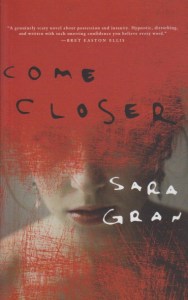
Some time back I did a Google search on something like “best novels about possession,” like one does.  I was in the midst of writing Nightmares with the Bible at the time.  One of the titles that came up was Sara Gran’s Come Closer.  I hadn’t heard of it before, but I started to look out for it.  I finally found and read a copy.  It is a page-turner.  A first-person narrative, it is a story about how a woman became possessed and how her life changed because of it.  Creepy and moody, it isn’t your typical Exorcist-type story.  What it highlighted for me (I don’t want to give too many spoilers) is the dilemma of those who a) live in an era when such things are routinely dismissed, and b) who have no religious background on which to fall.

While there are some quasi-religious characters in the story, there are no priests.  There’s no Catholic Church with its reassuring, if disturbing ritual.  Nobody seems to know how to handle a powerful demon.  One of the features that fuels exorcism movies (and presumably many novels on the subject) is the uncertainty of success.  Will there be deliverance or not?  I’m not going to tell you the answer here for Gran’s novel, in keeping with the spirit of the genre, but the dilemma of where to turn is believably laid out.  Amanda, a well-employed professional, lives without religion.  She acknowledges that strange things happen, but when she gets an inkling that a demon is after her, she doesn’t know where to turn.  As the story builds the loss of personal control is convincingly portrayed.  What do you do without the church?

I often ponder the particular power of The Exorcist narrative.  The threat to a young woman (as I discuss in Nightmares) is part of the key.  Another is the knowledge that the Catholic Church has packed away a powerful ritual that is only brought out in what are clearly extreme circumstances.  Like Amanda, the MacNeils aren’t church-going individuals.  The difference is that they live near Georgetown University where help may be found.  Unveiling this ancient rite was perhaps the greatest brilliance behind the story.  We live in a different age, however.  Simultaneously both more religious and more secular.  With the old certainties now under question, people wonder what they are to do when the impossible happens.  That is the driving pathos behind Come Closer.  It is a scary story on many levels.


Potboilers

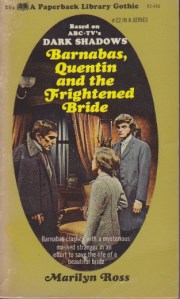
“Potboiler” is used in publishing to describe a book written merely to keep a writer going.  Full-time authors are comparatively rare, and many occasionally resort to churning out books simply to generate income.  I have no doubt that most of them start out as most artists do—creative, and looking for a career that allows them to be so.  If you want to earn money, to keep your pot boiling, you need to follow the formula.  Those are my thoughts on having finished the last book for this year’s Modern Mrs. Darcy’s Reading Challenge.  One of the categories was three books by the same author and I had three unread Dark Shadows books by Marilyn Ross.  Barnabas, Quentin and the Frightened Bride, number 22 in the series, was clearly a potboiler.

As I’ve confessed before, these books are guilty pleasure reads for me.  My literary tastes have changed over the years, however, and such journeyman writing sometimes betrays itself.  Even if a book has vampires and werewolves.  Dark Shadows was a melodramatic soap opera of my youth.  Still, it was moody and gothic—something these books manage to convey, even if the stories don’t live up to their promise.  Some of the plot elements in this particular installment don’t even line up, and having read Jane Eyre I’d guessed the ending shortly after the beginning.  I often wonder how the book series might have turned out with a truly literary attempt to tell the story.  Writing takes time.  Good writing takes a lot of time.  But even writers have to eat.

I’m not a Dark Shadows connoisseur.  I haven’t bought the original television series on DVD and I haven’t watched it since I was about ten.  Early memories, however, are formative.  With a remarriage, a death in the family, and a move, childhood got swept away rather swiftly, and along with it, watching Dark Shadows.  The series ended in 1971 after over 1200 episodes had been filmed.  Ross’ serialization began during the six-year run of the series, and, I suspect, he had to keep up a hectic pace.  Books 13 through 24 were all published in 1970, a rate of over a book a month.  I’ve suggested before that academics ought to take pop culture seriously.  Even before this era of fandom becoming mainstream, Dark Shadows spun off a small media empire and it continues to retain public interest.  The daily show struggled, despite being partially modeled on Jane Eyre, until the supernatural was introduced.  Although the Ross novels may not always show it, the hunger remains for supernatural explanations.


In the Zone

Since it lies somewhere between waking and sleeping, between youth and old age, the Twilight Zone is often where I find myself.  I’m hard pressed to say why the show made such an impression on a young and otherwise religious mind.  Maybe it was because religion itself deals with the Twilight Zone of human experience.  In any case, reading Rod Serling’s Stories from the Twilight Zone, as I continue to make my way through the books of my childhood, was a trip down memory lane.  While living in coronapocalypse, these short stories, novelized from Serling’s teleplays, take you back to a different time.  The late fifties and early sixties seem so very different from where we are now.  And reading about them, I’m not sure why some people want to go back there.

At the same time, reading the physical book takes me back.  My edition was printed in 1964.  It smells like an old book.  It has that unmistakable feel of pulp fiction.  Reading a book is so much more than scanning the words with your eyes.  It’s the lying on your back on a lumpy couch on a hot, humid summer day after being at work for endless hours.  It’s the foxing of the pages and the almost laughable cover design.  But more than that, it’s a signpost back to childhood.  This is a book I first held before leaving home.  It was a refuge from a tense life never knowing what might happen in a day.  Believing that escape was possible could save a soul from a ton of grief.  At the same time, those characters who do escape often learn why that isn’t the best option after all.

Some of these stories I remembered from the shows I watched, while others seemed unfamiliar.  There really are no surprises here.  You see, the Twilight Zone was long ago and the stories have entered our national consciousness.  Some have been borrowed, adapted, and parodied by others.  Others, such as “The Monsters Are Due on Maple Street,” were even part of anthologies we read and discussed in school.  Why are human beings so distrustful of others?  I remember us talking about that in class.  Serling’s version has a more grim ending, it seems, that the one I recollect as a youth.  Sitting here in coronapocalypse, however, I see it playing out around me every day.  We don’t know who might be infected.  And suddenly reading about the Twilight Zone seems like a most sensible thing to do in the circumstances.


Something Burning?

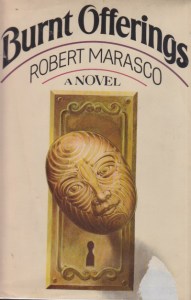
It’s all Amazon’s fault, really.  Several years ago—I can’t recall how many—they were running a horror movie DVD sale (that’s how long ago!).  I hadn’t yet watched enough movies to write a book on the subject, and most of the movies on offer I hadn’t heard of.  One of them was called Burnt Offerings.  Well, burnt offerings, by definition, come from religious settings.  The DVD was very inexpensive, and so, well.  The movie wasn’t that scary, but it was moody, which is often what I’m really after.  I did wonder, however, at the title.  In one sense it fit the plot, but in other ways it was almost as if something were missing.  A vital clue.  For one thing, the movie was completely secular, nothing I could include in Holy Horror.  

I’ve watched the movie a few times over the years.  There’s something compelling about the story, even though missing something.  A little research revealed that the movie was based on a novel by the same title by Robert Marasco.  Now, when I learn a novel was written in the 1970s, my thoughts turn to used bookstores.  Although the days of getting books there for less than a dollar seems long gone, the fun of browsing makes up for it. I don’t know how many years I looked for it in shops throughout the tri-state area.  Now with the virus, I finally broke down and ordered it from Bookfinder.

My main reason for wanting to read the novel was to find what I’d been missing.  The movie, it turns out, follows the original story very closely, for the most part.  The ending is different, however, and that makes all the difference.  (If you haven’t seen the movie or read the book, there will be spoilers here.)  The Rolfe family decides to move to an estate for the summer to get away from the noise of New York City.  There’s something odd in the house they’re renting, which they sensed even before moving in.  Marian Rolfe, the mother of the family, clearly becomes possessed by the house.  In a diabolical sense.  As her family dies off the house renews itself.  In a scene not in the movie, the regular caretaker stops in for a visit and tells Marian that she has to give her all to keep the house.  Finally, resigned to the death of her loved ones, she asks to have any remaining doubt burned out of her.  Her family will be the burnt offering.  So at last, it makes sense.  And yes, there’s a more religious theme in the book than there is in the movie.


Layers of Brick

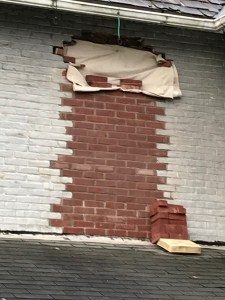
If, like me, you can’t see a neighbor’s brickwork without thinking of “A Cask of Amontillado,” then I need not explain why I watch horror films.  I know that as of late some literary scholars have challenged the idea that Edgar Allan Poe wrote horror.  There is now, and always has been, a bias against the genre.  In fact, many would point out that Rod Serling’s Twilight Zone wasn’t really horror, no matter how creepy some of the episodes were.  Some would cast Ray Bradbury into that lot as well, and others would not.  I spend a lot of time pondering this because those of us who enjoy some of what’s called horror are often cast as misfits.  And misfits have a lot in common with monsters.

The connection with religion is a palpable, yet intangible one.  It does seem that religion has its origins in fear and as it branched out it came to have different emphases.  Jesus, for example, apparently stressed love, at least according to the gospel of John.  That religion of love came, eventually, back around to fear.  Calvinism, especially, is suffused with it.  There’s a reason that it is the religion expressed in particularly effective horror.  Apparently they meet similar needs, but psychology is not an exact science, and our tastes in it differ.  Even our interpretations do so.  As the bricklayer puts down row after row of masonry, the thoughts get walled up in days where work prevents serious consideration of the deeper questions.

It’s been years since I’ve read “A Cask of Amontillado.”  The story has stayed with me, however, whether it’s horror or not.  Stories about imprisonment are like that.  The other day a police car stopped outside our house.  We live in a working-class, but descent neighborhood.  From the bits and pieces glimpses out the window revealed, there was a problem with a car that had been parked on the street for quite a while, and that didn’t belong to any of the local residents.  The natural response to seeing that car just outside was fear.  We fear criminals and we fear the police.  We fear what Covid-19 is doing to us, even to those of us who’ve managed not to contract it.  Traditional religion would tell us punishment comes from the Almighty.  These things are all related.  And across the way the bricklayer keeps up his work, row after row.


X-Files Redux

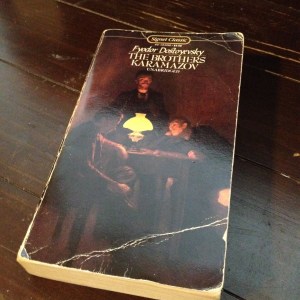
So, after writing a post about The X-Files, I finished season three, forgetting up until then that the last episode was “Talitha Cumi.”  Apart from being part of the alien mythology arc, the biblically literate recognize the title as the words Jesus said to Jairus’ daughter as he raised her from the dead.  Appropriately enough, the episode features an alien-human hybrid that is able to raise the dead and to shape-shift.  This particular episode also has an intriguing dialogue between the Smoking Man and Jeremiah Smith (the hybrid) where they discuss whether the alien agenda for people, or that of the shadowy cabal, is better.  With a theology drawn from the Grand Inquisitor chapter of The Brothers Karamazov (according to Wikipedia, and which I have no reason to doubt), they argue from different perspectives.  The Smoking Man explains that they have given people science instead of God and miracles will only confuse the issue.

While not exactly Fyodor Dostoyevsky, this scene raises some very real questions.  Are people happier not believing?  Not only that, but the cynicism of the Smoking Man matches rather precisely the modus operandi of our government some two decades later.  There’s a reason we keep coming back to the classics.  The X-Files mythology is, like the Cthulhu Mythos, woven throughout a larger tapestry whose warp and weft both seem to be religion.  It ran far longer than Sleepy Hollow ever did, and it would take considerable effort to tease all of the Bible, let alone religion, out of it.  They make the story far more believable.

This particular episode also displays the staying power of the classics.  Long, ponderous books like The Brothers Karamazov require concerted effort to read in these soundbite days of internet hegemony.  That Grand Inquisitor chapter, however, has been enormously influential.  (I recall during my most recent rereading of the novel that I hit that wonderful chapter and then realized I still had hundreds of pages to go.)  We often have trouble telling God from the Devil.  Just look at today’s political scene and try to disagree.  In the X-Files diegesis there is a shadowy, high-powered group that got to the extraterrestrials first.  They keep the secrets to themselves while the masses play out their insignificant lives that enrich those in charge.  Democracy, it seems, used to be about elected representatives seeing to the will of the people.  It perhaps assumes a greater educational base than we’ve been able to retain.  But still, with chapters like “Talitha Cumi” we see that there may be some glimmer of hope after all.