Fun and Fear

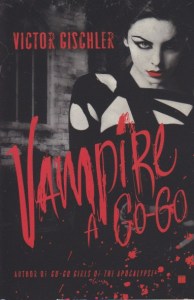
It’s curious the way people find books.  I sometimes see them advertised (the way publishers suppose people see them), but far more often I find them more serendipitously.  I’m active on Goodreads, and many times a book someone else has reviewed will catch my eye.  I like to read things that I notice in independent bookstores.  I’m always on the hunt for a bargain.  At work we have a used book rack where any volume is half-a-buck.  During lunch one day I spied Victor Gischler’s Vampire a Go-Go.  Now the title told me this wasn’t exactly a serious novel, but it had vampire in the title and when I write horror it often ends up on the funny side.  All in all it seemed like it would be worth the tiny investment, even if I don’t have a clear idea of what go-go really means.

While not laugh-out-loud funny, this is an enjoyable romp through monster land.  Kind of like Harry Potter with some adult themes thrown in.  The characters—which include ghosts, witches, wizards, a werewolf (sorry lycanthrope), a golem, and a vampire—are likable and strangely believable.  An unexpected twist came with the Battle Jesuits, a nice touch that shows yet again how close religion and horror can be.  I won’t try to summarize the action here, but I’ll simply note that there are twists and turns aplenty and smiles and splatter along the way.  It’s clear that Gischler researched the novel well, bringing interesting texture to the tale.

Like the last novel I read, also acquired in an inexpensive browsing situation, much of the story is set in Prague.  My wife and I visited Prague back when it was still in Czechoslovakia, and before it had become a tourist haven.  From reading these recent novels, apparently quite a lot has changed there.  Of course, in those days I hadn’t tapped into my love of monsters for many years.  Working on a doctorate has a way of doing that to you.  Now that I’m back, I’m enjoying the variety available in the genre these days.  I still have a soft spot for Stephen King novels, and Poe will always remain among my sacred texts, but I’m inclined to read these newer treatments as well.  There’s nothing really to scare you in Vampire a Go-Go, but there are remarkably moving moments.  And some of the monsters are quite a lot of fun.  It would restore my faith in the power of the accidental find, if it ever required resurrection.


Hidden Monsters

I don’t think much about having been born male.  I’m starting to realize that that’s because I don’t have to.  The same is true of being caucasian, although I’ve always objected to the labels of “white” and “black” as being polarizing and wildly inaccurate.  Although I grew up in poverty, my “social markers” put me in a place of privilege, even if others sharing my demographic have locked me out of the club.  These thoughts were raised by Mallory O’Meara’s excellent The Lady from the Black Lagoon: Hollywood Monsters and the Lost Legacy of Milicent Patrick.  As soon as I saw the book announced, I knew I had to read it.  As O’Meara would doubtlessly not find surprising, I had never heard of Milicent Patrick before.  I’m not surprised that a woman designed the Creature from the Black Lagoon, however, because woman create memorable monsters (can I get a “Frankenstein”?!).

The reason I don’t think about being male is because the crumbling society built by males assumes that it’s the default.  Men have always been shortsighted, I guess.  Having been raised by a “single mother” (she was technically not divorced because a male-made religion said it was sinful), I always believed women to be protectors, capable heads of families, and far more empathetic than the men I met.  I didn’t realize at the time that we lived so close to the brink because men devalue women.  Milicent Patrick grew up in a family where this was much more obvious.  A talented artist, she incurred her family’s lasting wrath by going to Hollywood and doing what was then movie makeup work.  That she designed the beloved Gill Man makes sense to me.

O’Meara’s book is sure to make thoughtful readers angry.  Not at the author, but at the behavior of men.  Perhaps due to my unbalanced upbringing, it has taken many years to see what others probably notice much more readily: women have to struggle for that which someone like myself can simply claim.  Bud Westmore, Patrick’s boss at Universal, claimed her creation as his own work.  There are monsters in this book, and I’ll give you one guess as to their gender.  Still, I’m glad to have read it for I know I’ve found another monster fan.  O’Meara’s clearly aware of how those of us who admit this odd passion are marginalized in a world that prefers super heroes and those good with finance over those who see monsters everywhere.  This is an important book; read it and you’ll see them too.


Summertime Boos

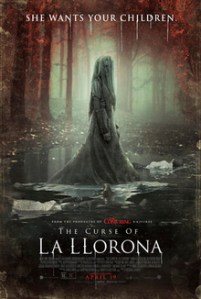
There are so many of them that it’s difficult to keep up.  Movies, I mean.  And they can be an expensive habit.  As some readers may know, I’ve followed The Conjuring franchise pretty much from the beginning.  That particular film was long anticipated (at least in certain circles), but still I waited until it was available for home viewing to see it.  I always feel kind of selfish going to the movies on my own since they are a kind of event—a form of social outing.  For me, however, horror movies are research, but that hasn’t taken away the thrill of seeing one on the big screen once in a while.  The Conjuring branched off into the Annabelle movies, and I caught the latest offering in the latter series in a theater.  I hadn’t realized that The Curse of La Llorona had been released a couple months earlier, and that it was being considered part of the diegesis.  It was back to the small screen to catch up.

La Llorona is based on a Mexican folktale and is tied to the other films in its universe by a character who recurs from Annabelle, Fr. Perez.  He’s not the protagonist, but he does introduce one way in which horror responds to the present insanity we call the US government—the character who defeats the fiend is hispanic.  In fact, most of the characters in the film are from hispanic families in Los Angeles.  They take down the ghost without the assistance of border guards or any kind of wall.  They don’t need the simpering help of the GOP.  Like most of the movies in this franchise, however, they do make use of religion.

When Fr. Perez can’t offer immediate help to the family beset by La Llorona (“the weeping woman”), he points them to a local shaman.  In this otherwise Catholic world, the truly amazing outcome is that the faith healer does possess the knowledge and ability to stop the evil.  While the backstory of the ghost is well known, the nature of the entity is a bit unclear.  Most Conjuring films feature a demonic presence, so it’s kind of a relief to have a garden variety ghost for a change.  You see, when Ed and Lorraine Warren challenge entities in these movies they do so with religious accoutrements which tend not to fail.  Ghosts, however, traditionally don’t require a religious banishment.  We’re entering new territory here, of course.  And I hadn’t even known about this film until after I’d seen its predecessor.  How can you hope to keep up with spirits?  It’s a full-time job. 


Good Monster

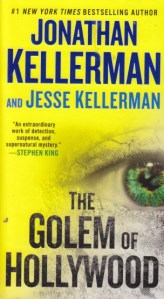
The little free library is a great idea.  Just after our move last year we contributed to our local many times as we discovered duplicates in the process of packing.  On one such venture, I discovered a book I wanted to read.  Not that I’d heard of it before, but any book with “golem” in the title catches my eye.  For the first (and so far only) time, I took a book.  Jonathan and Jesse Kellerman’s The Golem of Hollywood proved a fairly quick read for being over 600 pages.  I believe the industry term is “potboiler,” but it’s also a page-turner.  Nevertheless, it made me think.  The story follows a hard-bitten Jewish detective in Los Angeles.  Struggling with personal issues, he gets assigned to a bizarre homicide case that eventually takes him to Prague and Oxford, and then back to LA to clinch it.  And the killer is a golem.  (That’s not a spoiler, since it’s right there in the title.)

Parallel to the modern-day crime drama is the retelling of the biblical tale of the first days of humanity outside the Garden of Eden.  One of Adam and Eve’s daughters is headstrong and beautiful and when the tragedy between her brothers plays out she eventually takes her revenge on Cain.  Although not explicit about it, for violating the mark of Cain she witnesses the horrors that people will visit upon one another and her redemption is to become the soul that animates the golem of Prague.  Not your garden variety golem, she can transform into different shapes, and she stays loyal to the family of Rabbi Judah Loew ben Bezalel, the legendary first creator of the golem of Prague.

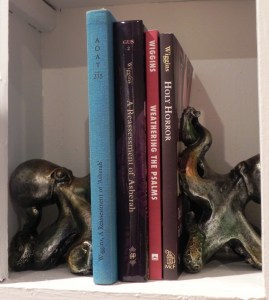
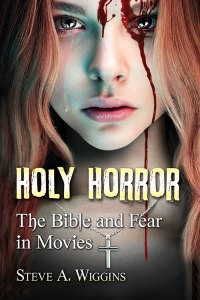
One of the frequent topics raised on this blog is how the Bible appears in everyday life, often unnoticed.  This novel is an example of that.  A further point, which is what stands behind my book Holy Horror, is that the Good Book is understood as mediated by popular culture.  Even those few biblical scholars who make it into the limelight can’t compete with the myriad representations of Scripture in the entertainment media.  Like The Golem of Hollywood, Holy Horror sees the Bible in the context of monsters.  Horror is an outsider genre.  Despite the many intelligent, thought-provoking exemplars extant, the default among the more refined is to see horror as something base and low.  It can also be a lot of fun.  Perhaps not great literature, The Golem of Hollywood is entertaining even as it underscores the continuing influence of the Good Book. 


Conjuring Success

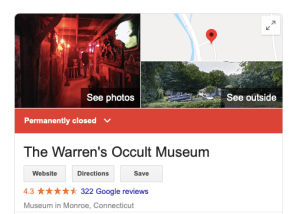
I wonder if it’s one of the consequences of success.  While writing up some thoughts on The Conjuring diegesis, I got to wondering how accurate the movies’ portrayal of the occult museum of Ed and Lorraine Warren is.  The museum set appears in multiple films, and in Annabelle Comes Home it serves up a smorgasbord of horror.  Some of these artifacts, such as Annabelle, really do hold places of infamy in the establishment and some are clearly used in the cinematic version to set up spinoffs to keep the franchise alive forever.  Curiosity drove me to the open web—website owners of spaces of reputation now distrust this “open web,” what with its money grubbing and lack of peer review—to peruse some actual photos.  That’s how I learned the museum is permanently closed.  The reason given: zoning issues.  (I presume they don’t refer to the Twilight Zone issues.)

That The Conjuring franchise has proven remarkably successful hardly requires footnoting.  With The Conjuring 3 due out next year, a total of eight films will have been produced over seven years, currently and it currently stands as the second most profitable horror franchise in history.  For anyone wondering why I wrote Holy Horror, such numbers may help explain.  Now what of these zoning issues?  I wonder if it’s not the number of visitors drawn by the films that have created a problem.  (Those with questions aren’t purchasing Holy Horror, that’s for sure!)  Since the Warrens have now both passed away, the New England Society of Psychic Research runs the museum and is seeking a new place for it.  (We have space in my garage, just sayin’.)  And hey, Gettysburg isn’t too long a drive from here!

Success, I suspect, does come with its price tag.  People are drawn to those who’ve captured the interest of the big screen, and what with everyone dying death is a growth industry.  I suspect part of horror’s appeal is just that.  We all have to face it some day and while many run from it screaming some use this opportunity to prepare.  But I’ve also got to wonder if it can maintain its level of fear.  I recently watched the current iteration of It and found little that was even frightening about it.  But then again, clowns have never bothered me that much.  The bullies are the scariest thing in the film and Washington DC’s full of them.  Talk about success and its consequences.


Victorian Nightmares

J. Sheridan Le Fanu isn’t exactly a household name, but as a writer from the same era (and perhaps same cloth) as Poe, he was known for his gothic imagination.  Since he was Irish his work never really took off in America as some other writers’ did, and he’s certainly not likely to be found on bookstore shelves because there’s not great demand.  I have a fondness for gothic literature and Le Fanu’s name had been on my list for some time.  At a used bookstore I found one of his books, and as I was checking out the clerk said “I was just checking in another of his books,” so I bought that one too.  (When you’re paying just two dollars a pop for books, it feels like virtue.)  The latter turned out to be In a Glass Darkly, which apart from its biblical title, contains five stories loosely linked by a narrative framework.  Poe wrote that short stories should be read in one sitting, but these tale venture into novelette territory, with some requiring considerable time to finish.

That having been said, the experience was enjoyable enough.  Each story is quite different and they range from the vampire classic “Camilla” to a foiled murder mystery and a canonical ghost story or two.  While better known across the Atlantic, several of Le Fanu’s stories have been translated to film, and he was regarded as one of the best ghost story writers of his era.  Perhaps because modern readers have been subjected to much more subtle foreshadowing, some of the tales are predictable to those on the lookout for twist endings.  The Room in the Dragon Volant, for example, suggests that the mysterious lady at the masquerade is indeed the narrator’s adulteress love interest, although the final twist is nicely wrought.

Probably the most well-known of the stories in the collection is “Camilla,” the account of what’s regarded today as a lesbian vampire.  The tale is well-crafted, but the credulity of the narrator is almost unbelievable as the pieces fall together and the puzzle picture still isn’t seen.  Nevertheless, it’s a creepy account that has captured the imagination of filmmakers through the years.  It took me long enough to finish the book that the earlier stories had faded by the time I’d reached the end, but the fault lies with me, not the author.  As a gothic fix each of the narratives serves quite well.  My other Le Fanu purchase was a much larger book, so it will take some time to achieve that goal.  In the meantime, I’ll look forward to discovering more Victorian nightmares as autumn wends its way forward.


The Zone

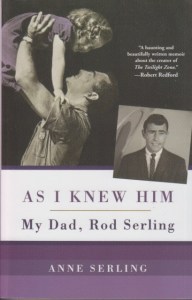
My youth—who am I kidding?—my life has been a search for father figures.  Since I grew up with television, many of them came from the tube.  The professor from Gilligan’s Island, Mr. Rogers, Barnabas Collins, and Rod Serling.  Serling was like the father I couldn’t remember in that he was always smoking.  But unlike my father, Serling had an imagination in sync with mine.  The Twilight Zone was in reruns by the time I caught up, but it gave me an odd kind of happiness.  The sort that you had as a kid after the bath was over and you were wrapped up snuggly and warm in a bathrobe, and you got to watch one of your favorite shows before going to bed.  I discovered Serling as a writer when I was in Junior High School.  He was right up there next to Ray Bradbury, in my book.

I have to admit to feeling anxious as I read Anne Serling’s As I Knew Him: My Dad, Rod Serling.  You see, she actually was his child and I’m afraid of learning too much about those I put on my personal pedestals.  Her book, however, didn’t disappoint.  Serling lived a writer’s life, something I’ve coveted since I was a kid.  If I couldn’t have a father, at least I could write about life as I saw it.  I still write fiction inspired by, among others, Rod Serling.  Spending much of my time in Binghamton and Ithaca for my own family reasons, I was only obliquely aware of how much I was traversing the region Serling considered home.  As I read his daughter’s autobiography—or is it a biography?  Who can tell the difference?—I was inexorably drawn in.  Fathers and daughters can be the best of friends.

Sometimes I wonder if those who know writers the best are their true fans.  I don’t mean groupies or the like, but rather those whose lives have been transformed by their words.  I’m reminded of Evermore, written by a relative of Edgar Allan Poe.  Family, it is true, see a side of a person that the reader does not.  But who are we, really?  Those of us who write may be saying more in our fiction than we care to admit even to those who know us well.  Rod Serling recognized dimensions well, I suspect.  A writer’s life requires sacrifice and keeping things hidden.  Anne Serling’s book is a gift to those who write, even if it is about someone else’s father.


Ghouls and Dolls

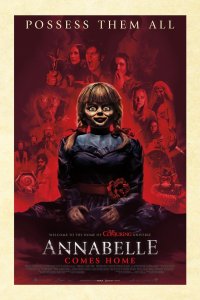
It was my plan—as if plans ever really work out—to see Annabelle Comes Home on opening weekend.  July got away from me but I finally found my way to the theater yesterday.  My current book, Nightmares with the Bible, deals with demons in cinema.  One of the chapters covers The Conjuring universe, and since this is the sixth film in that diegesis (with one tangentially attached spin-off) watching the movie was as much research as it was fun.  While the demon utilizing the doll Annabelle is clearly the main villain, the film, as in most of the franchise, interjects any number of entities.  Ed and Lorraine Warren, in real life, kept a museum of occult objects in their house.  This room contained items that had figured in their cases—they maintained demons didn’t possess objects, but people—including the doll Annabelle.

The new film maneuvers three girls (Judy, the Warrens’ daughter, her babysitter, and a friend) into the house alone.  One of the girls releases Annabelle from her blessed case, and a nighttime of terror ensues.  The demon behind Annabelle animates several of the haunted objects, so the girls have to deal with many ghoulish threats.  The film knows it is following tropes such as a car breaking down by a cemetery at night, and the idea of a babysitter being attacked by monsters, and at times it gives a slow wink to fans of the genre.  Still, there are plenty of genuinely creepy moments and a few jump startles.  It also shows the clearly demon in its “true form” at the climax of the film.  When it does so, it matches traditional renditions.

Set to become the highest grossing horror series of all time, The Conjuring universe mixes films that claim to be “based on a true story” and others, such as Annabelle Comes Home, that use real settings but without claiming to follow actual events.  What I found engaging about this particular movie was the fact that the youngest girl, Judy Warren, was the one who figured out how to re-capture the demon.  There are holes in the plot, of course, but featuring a young woman not requiring a man’s help to trap a demon is somewhat unusual in a Catholic diegesis.  True, she doesn’t perform an exorcism, but Judy does contain the evil without a priest, or even her father’s direct help.  As this diegesis wends its way into American folklore, moments like this are increasingly important.  Even though there are demons here, the women don’t require men to do the heavy lifting. 


Sighs

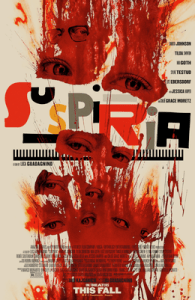
Suspiria is a movie intentionally difficult to follow.  The original 1977 version was an Italian film about witches posing as dance instructors.  After watching it, I felt I didn’t have enough backstory to understand the action.  Then a remake was released last year and I felt I needed, like a dancer, to try again.  I have to confess I’m not a dancer.  Luca Guadagnino’s remake left me scratching my head again, although it underscored a point I make in Holy Horror: in horror films with remakes the role of the Bible changes.  Now, it’s been years since I’ve seen the first Suspiria, but I don’t recall the Bible appearing.  It does, however, in the 2018 remake.  The protagonist, Susie Bannion, is an American enrolled at a German dance school.  She is, in the remake, a Mennonite from Ohio.

Not only does this situation allow religion to take once again an important role in a horror film, it is also the opportunity to show the Bible visually.  Susie’s mother, who objects to her daughter engaging in such a showy profession as dancing (and given the performance of Volk in the film, the nature of this objection can be easily guessed), is dying as the film begins.  Her Mennonite community watches and prays over her, sitting with Bibles clutched in their hands.  To take a page from Holy Horror, this suggests that the Good Book is powerless to save.  While the movie itself is a little confusing on this point, it seems that Susie’s mother dies as her daughter becomes the head witch of the dance academy.  Since Holy Writ famously contains verses condemning witches, the impotence of Scripture is underscored.

Italian folklore about witches appears to be remarkably robust.  From Strega Nona to Suspiria, the wizened women of society have power against which men are powerless.  Some of the bleakest moments in the film (from the point of view of the male gaze) are when the witches taunt powerless, naked men who cannot in any way defend themselves.  Turnabout, of course, is fair play—at least if folk sayings have any validity.  Here it’s worth considering that if male religions hold females down—the Mennonite women are shown in bonnets and uncomfortable clothes—then being a witch is remarkably freeing.  Indeed, there is the energy of a life-force evident in the dancing of the young women and the academy is closed to men, apart from public performances.  I’m still scratching my head over Suspiria, but it seems that the direct engagement with religion and the power of women makes this a movie worthy of rewatching and attempting to understand.


Monsters and Gods

Nothing makes you feel quite as old as seeing a documentary where the names of the experts are unfamiliar to you because they’re too young.  So it was when I watched PBS’s Ancient Skies episode “Gods and Monsters.”  They had me at “Monsters” although I know that when paired with gods the term generally refers to Greek mythology.  This documentary had a pretty cool rendition of Marduk battling Tiamat that would’ve left many a Babylonian quaking in his or her sandals.  Ranging across the world, it showed the earliest efforts to understand astronomy, and then went on to contrast it with how the ancients nevertheless still believed in gods.  It was a striking kind of condescension, I thought.  Many scientists today still believe in a deity, although it’s no longer the fashion.

That sharp dichotomy, that either/or, bothers me a bit.  It’s not that I have a problem with science—I’ve always supported the scientific method.  No, it’s the idea that everything is explained that bothers me.  We understand so little about the universe.  Yes, we’ve made great strides over the past millennia, but we’ve not even been out of the cosmic neighborhood yet.  And I wish we could acknowledge that even on earth life is still a mystery that can only be solved with poetry as well as reason.  “Gods and Monsters” made the point that the ancients realized the explanatory value of stories.  Myths weren’t just idle constructs to pass the time.  They were ways of understanding how this universe works.  Some people take their mythology too seriously, of course, but that doesn’t mean that no stories are required to make sense of it all.

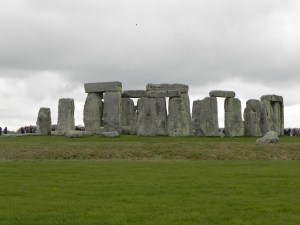
It was the inherent conflict implied between science and religion, I think, that bothered me the most.  Not everything in life comes down to an equation.  That doesn’t mean that equations are wrong, just that they’re not everything.  One of the points Ancient Skies makes is that people of bygone eras had a very sophisticated understanding of the sky.  It featured the builders of the great pyramid of Khufu, those who constructed Stonehenge, the Maya, and the Babylonians.  They all knew much of the math that would only be formulated in Europe much later.  And they all assuredly believed in gods.  It didn’t prevent them from complex thought in either architecture or astronomy.  Our modern dilemma is the razor burn left by standing before the mirror too long with Occam.  You don’t have to shave to support science.


Universals

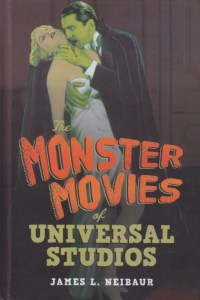
It was on television that I met them.  The Universal monsters.  The entire run of films from Dracula to The Creature Walks among Us had been shot, printed, and screened before I was born.  In other words, I’m a late monster boomer.  By the time I was old enough to handle monster movies, they were on television and my early memories of them are tinged with the nostalgia that accompanies what seemed like better times, although each era is about equally difficult.  When I saw James L. Neibaur’s The Monster Movies of Universal Studios I knew I had to read it.  Neibaur goes through all the films in the series, chronologically, encapsulating the Draculas, Frankenstein’s monsters, mummies, invisible men and women, wolf-men, and the gill-man.  As I child I never watched them systematically, being subject to television schedules, among other things.

Not understanding studios or business, and certainly not copyright, I never understood why other favorites such as Jekyll and Hyde, the phantom of the opera, and various assorted ghosts and ghouls weren’t part of the collection.  Nevertheless, this study in discrete, brief chapters, treats the official canon reasonably well.  The line between religion and monsters is sometimes crossed in these movies, which gets at an underlying theme of my own interest—how horror and religion interact—but that’s not Neibaur’s purpose.  That dynamic is, however, the driving force behind my two most recent books.  A tie-in to the paranormal may also be found there.

As I dropped off some promotional material for Holy Horror at an area bookstore recently, the events manager revealed her interest in the paranormal.  In my mental schematic, it’s wedged in there between monsters—which are fictional—and religion, the antithesis of fiction for most people.  What do we do with ghosts and others that don’t fit into the neat lines of a theology that draw a stark line between the supernatural and human?  Universal’s monsters sometimes ran into problems with the Production Code for stepping over that line.  Of course, the Universal monsters are pretty tame in comparison with today’s fare.  Still, they were the monsters who showed, in many ways, what it was to be human.  Neibaur isn’t going for an in-depth analysis here, and his treatment is readily readable by anyone interested in revisiting the monsters of yesteryear.  Some of the descriptions reminded me of movies from my childhood that I’d forgotten.  It is pleasant to relive them for a few moments while the real monsters in the real world lurk not far from my door.


Fearing Errata

Well before I became an editor, I noted mistakes in books.  I go through phases of marking up books as I read them—in pencil only, please!—and not doing so, but I used to mark mistakes when I found them.  At that point I hadn’t realized the complexity of the process of book production and I had no idea of the many ways in which errors might creep in.  I’m a bit more forgiving now.  In any case, errors are a regular part of book publishing.  Older books used to carry pages with incantational-sounding titles like “errata” and “addenda et corrigenda.”  Errors, in other words, were considered inevitable because every time you have another set of eyes look over the manuscript it adds to both the costs and time for the production schedule.  Then I started writing books.

Now, before I get too far I should explain that many book editors don’t line edit submissions.  The standard “editor” is an acquisitions editor, which means you sign up books for your press, but you don’t necessarily (if ever) actually edit them.  I still have the sensibilities of a copyeditor, however.  That’s the main reason I fear to read my own books after they’re published.  I’m afraid I’ll find mistakes.  I do take the proofreading stage seriously, but often a writer has little control over when proofs arrive with a tight turnaround time.  You have to drop everything to get them returned by the deadline.  I’m always worried that errors might’ve crept in.  For example, with Holy Horror, I corrected with website copy for the book.  The errors, however, remain online.  They’re minor, but as the author you’re always considered culpable for such oversights.

Now that I’m working on a presentation to give for Holy Horror, I find myself facing my fears.  I need to go back to a book already published and look inside.  Since writing it I’ve completed another book, Nightmares with the Bible, and my mind can’t help mixing up a little in which book I said what.  To make sure I don’t tell potential readers the wrong information, I need to go back and reread parts of my own work.  What if I find errors?  Will I have to mark up my own copies like I used to do to those of others?  Will I need to compile an errata sheet?  I tend to be a careful reader, especially with proofs.  But facing possible errors is nevertheless a terrifying prospect, even if it’s a regular hazard for those who attempt to write books.


Witch Way from Here?

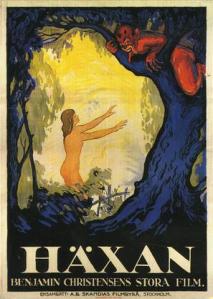
Häxan is often considered a horror film.  Produced by Benjamin Christensen, it was released in 1922, the same year as Nosferatu, eine Symphonie des Grauens.  Both are silent films and the term “horror movie” didn’t exist that early.  Framed as a documentary of sorts, Häxan deals with witches, or more precisely, with ideas about witches.  Taking a remarkably modern view, it presents how the church led to the persecution of women during the witch hunts.  It had been on my “to see” list for many years before I realized it is now in the public domain and is rather easily found on YouTube for free.  It presents reenactments that are still difficult to watch, although silent films have a difficult time scaring viewers used to CGI verging on virtual reality.

Banned in the United States upon its initial release, the movie dares address that sacred ruminant, the foibles of the church.  Christensen was largely correct in placing the blame for harm inflicted on thousands of innocent people—mostly women—on the zeal of a masculine church.  The prolonged dramatization of the destruction of an entire family based on forced confession and trickery, often by well-fed monks, makes the point clearly.  While modern explanations have recourse to the psychological motivations, often unknown to those whose worldview was ecclesiastical, we still haven’t relinquished the misogyny of the Middle Ages.  Considering that Häxan is nearly a century old itself, there’s cause for embarrassment in a world largely run by technology.  We still tend to ban that which causes us ridicule.  

When tragedies occur, it’s only too natural to blame someone or something for it.  Why the burden of that blame was laid on women by a male hierarchy is sadly only too easy to guess.  Häxan is one of those examples of the way horror can cross over between fact and fiction.  Today it can’t be taken as a documentary with any kind of seriousness, but it maintains an atmosphere of dread that finds it classified as horror before the genre itself began.  Movies about witches continue in the genre up to the present, and most are quite aware of the male culpability behind this particular variety of “monster.”  To test if witch trials continue all we need to do is watch how men in power continue to behave toward women.  It’s almost enough to make us believe hexes are real.


Making Monsters

It’s not so much I’ve been away from monsters lately, but that life has intervened between them and me.  Life can be scarier than monsters sometimes.  In any case, the summer is when my mind turns back to haunting even as on the breaks during heat waves a whiff of autumn can be caught on the air of a July morning.  Yes, we’ve past the solstice and days are getting shorter.  Slowly, of course, but that’s what builds suspense.  And there are local signs that I need to get my haunting in gear.  It is finally time to get Holy Horror out of wraps and give the book a proper launch.  Being published around Christmas last year was poor timing for a subject so readily coded for fall.

I received the welcome news this week that the Moravian Book Shop—the oldest continually operating bookstore in the country—will be hosting a book signing for Holy Horror in October.  This is a fortuitous turn of events because when I first approached them with the idea the price of the book made the idea look unrealistic.  But we’re now thinking of autumn, and with autumn comes Halloween.  There have been a spate of horror films this summer, all of which I’ve unfortunately missed.  Time, as Morpheus notes, is always against us.  There does, however, seem to be a lively interest in the genre and the curious wonder what it has to say about what we believe.  Horror loves religion, and indeed, thrives on it.  So it’s been from the beginning.

October will also see the Easton Book Festival in this area.  I will be on the program for that as well.  While none of this is earth-shattering, these events represent the first successes in trying to build awareness of Holy Horror.  This was a book written for a general readership, but not priced for one.  Working in the academic publishing world, this is a phenomenon with which I’m all too familiar.  Many colleagues offer to read and spread news about your book.  It seldom happens, though.  Academic presses can’t afford book tours (especially if they have to price books at $45), but these self-driven presentations are opportunities to spread the interest in ideas.  That’s what those of us who write really want—to be part of the conversation.  We’re in the midst of a heat wave here.  It’s the height of summer.  Even so, those who know about monsters can feel them coming, even from here.


Alien Ideas

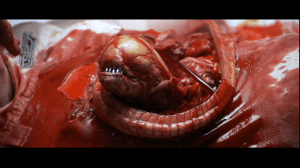
One of the iconic moments in all of cinema, known well beyond the confines of sci-fi and horror fans, is the alien bursting out of Executive Officer Kane’s chest.  The movie, of course, is Alien.  The screenwriter, Dan O’Bannon, was also known for contributing to Star Wars, Total Recall, and Return of the Living Dead.  Alien is one of those horror films I was too afraid to watch when it came out in 1979.  I was sixteen at the time, and had been primed by commercials that still haunt me.  I would eventually, in seminary, see Aliens and prompted by curiosity, eventually went back to watch the original.  It has since become one of my favorites, and analysts of genre fiction and religion quite often point to the iconic role of Ridley as worthy of theological mention.  Her self-sacrifice in the third installment has been heralded as one of the many cinematic messianic moments.

Science fiction and horror are closely related genres.  They can be teased apart in Alien only with extreme finesse.  Consider the most famous scene again.  Kane, while on the derelict alien vessel on LV-426, has the unfortunate experience of an alien larva sealing itself to his face.  The crew of the Nostromo can’t get the creature off—whenever they provoke it, it wraps its tail more tightly around Kane’s throat or leaks acid.  Then it falls off and dies.  Everyone, not least Kane, is relieved.  He joins the rest of the crew for a meal, but then shows signs of distress.  Something is eating him from inside.  The alien rips out and the line from sci-fi to horror is irrevocably crossed.  That unforgettable scene immediately became a classic of the genre.

Dan O’Bannon, the screenwriter, suffered from Crohn’s Disease.  He attributed the alien-bursting scene to his own experience with the condition, which eventually took his life.  Someone in my family was recently diagnosed with Ulcerative Colitis, a disease similar to Crohn’s.  In response I did something I’d never done before; I started a fundraiser on Facebook.  The Crohn’s and Colitis Foundation is a non-profit organization funding research into these debilitating illnesses.  It offers support to those who suffer with the diseases, the incidence of which is on the rise.  I once told my family member about O’Bannon’s use of his own suffering as the inspiration for that cinematic moment.  It brought a rare smile in the midst of a flare, a smile with a little too much understanding for a young person.  If only Ripley were here to take control of a menace far too human.