Seeking Sava Savanovic

According to the Associated Press, Sava Savanovic seems to have risen from the grave again. In the world of professional vampirologists, I am a mere hack, but when local Serbian officials start instructing villagers to stuff their pockets with garlic, I know enough to sit up and listen. The Balkans and eastern Europe claim the lion’s share of vampires, but the idea is an ancient one that some scholars trace back even to the Sumerians. While the AP report seems very tongue-in-cheek (as opposed to teeth-in-neck), there is no doubt that ancient fears are as hard to kill as actual vampires. It is no surprise that vampires found their resurrection in the western world as the Enlightenment was catching on. The emphasis on reason and science alone leaves many people very cold. We all may be lemmings headed for the cliff, but we don’t want to be told so. And when the scientists pack up all their equipment and head home, there are still unexplained noises in the night.

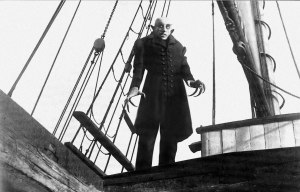
Sava Savanovic may have been a historical person, but not one approaching the stature of Vlad Tepes off to the north and a few centuries earlier. A little closer to home, Peter Plogojowitz, an actual Serbian peasant, was staked for being a vampire in the eighteenth century. Fortunately, he was already dead at the time. The story is recounted in Gregory Reece’s Creatures of the Night and the account remains one of the earliest documented Balkan vampire records. The Enlightenment was under full steam and yet, and yet…
Nosferatu

Interestingly, the report on Newsy shows a Fox News reporter declaring with certainty that no vampires exist. Given the track record of Fox News of catering to causes near and dear to Neo-Con hearts, it is hard to accept that people believing in fairy tales only inhabit the darker regions of the Balkans. No, vampires do not just crave blood. The ancients often believed that they were after reproductive fluids in order to generate more of their kind. A more recent version is the fiend who drains others of their money so that they may live in their remote castles far from the reach of the unwashed populace that has to work for a living. Perhaps we should be envious of those fearing Sava Savanovic—he can be frightened away by garlic and crucifixes, after all. The modern American vampire fears nothing but death and taxes, and the latter they’ve already defeated.
Creature Feature

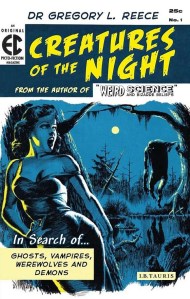
Gregory L. Reece’s Creatures of the Night is a strangely profound book. I picked it up to read on the plane home from Chicago and I wasn’t disappointed. Promising to explore ghosts, vampires, werewolves, demons and devils, Reece suggests that maybe the key to such fascination rests with the late Rudolf Otto. I had over a decade of students read Otto’s famous little book, The Idea of the Holy. Otto, whose palindromatic surname suggests something uncanny, characterized the holy as the fascinating mysterium tremendum, the wholly other. (I will refrain from calling it the wholly holy.) The mystery that makes us tremble. The monsters that haunt our nights and imaginations are aspects of this utterly other.

Along the way Reece proves an able tour guide. He recognizes, as I have repeatedly stated in this blog, that religion and fear are conjoined twins. He also knows how to get your skin crawling. For Reece there is no question that such things are real. Real doesn’t mean that they are physically lurking outside your window at night—for who is to say that only the physical is real?—but they are as real as religion. No doubt strange things have transpired in history and continue to occur. And the reason we go into church may ultimately be the same reason that we watch a horror film.

As Reece comes upon the topic of demons the air in the room (or plane, or bus) thickens. Here we have documented accounts of impossible events. No amount of rational training can remove the shudder from these stories. Explanations of epilepsy only go so far before terror takes over. By herding them together with vampires, werewolves, and ghosts, Reece stakes his claim that they all are real. Rational reductionists may shrink our world down so tightly that no room appears in the inn for our creatures of the night. But those who are honest, even among the reductionists, will admit to a mysterious tremor, even if unintentional, on a dark and stormy night.


Phantom Prayers

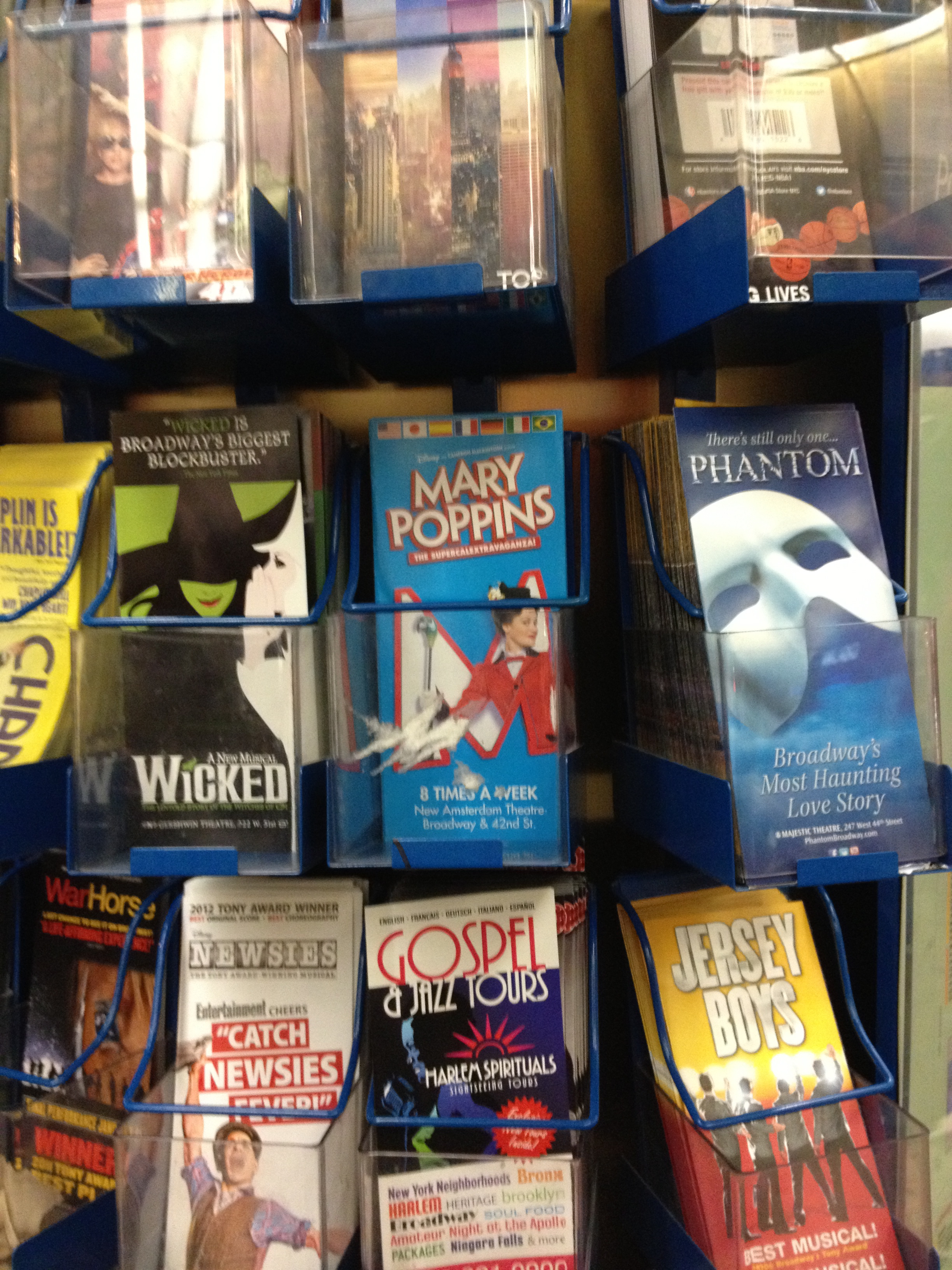
Religion and theater have much in common. I suspect that this is one reason several religious traditions initially protested against the secular theater. Morality plays were one thing, but dramas about purely human matters are quite another. Being given the very generous gift of tickets to the Phantom of the Opera, I recently had the opportunity to experience Broadway’s longest continually running show. It occurred to me that theater can often, if done right, draw in huge crowds—the line to get in was certainly impressive—while other than megachurches and very conservative religious movements based on reaffirmation of one’s superiority, many religious houses struggle to draw people in basically for free. It could be argued that secular entertainment requires less of an attendee than a religious service, but I wonder if that’s true. To receive your money’s worth for a show, you must be willing to put yourself into it.

While Andrew Lloyd Webber has never been afraid of religious themes—think of Jesus Christ Superstar and Joseph and the Amazing Technicolor Dreamcoat, or even Whistle Down the WindPhantom of the Opera is loosely based on the early twentieth century novel by Gaston Leroux, the story of a hideously deformed musician who falls in love with a beautiful opera star. Although characterized as “a monster,” the Phantom is, after all merely human. Lloyd Webber’s adaptation leaves much of the story undeveloped, allowing the imagination to chart its own course. This is precisely where theater diverges from religious performance—imagination. Religions frequently claim to possess all the answers and questioning or imagining new approaches to age-old dilemmas is often discouraged. Unless, of course, the dilemma is how to draw more people in. Those who run megachurches learned the lesson of theatrics long ago.

For all that, Phantom of the Opera is hardly devoid of religious sensibilities. In one moody scene where Christine visits her father’s grave for solace, and perhaps advice, the first set piece visible is the cross atop the tomb. It is from this cross that the Phantom in the guise of the “angel of music” comes to her. Having the representation of death emerge from a cross is a powerful enough symbol. During this scene Christine’s plaintive cries to her father sound like a prayer. The prayer is heard, however, only by a phantom. The end of the story is ambiguous, something religious performance simply cannot tolerate. And yet, as I was being pushed and propelled down a crowded Broadway after the show, amid a flood of humanity that had emerged from many theater doors, I wondered if this “secular” experience might not be religious after all.

Religious tracts?


Hallowed be thy Kane

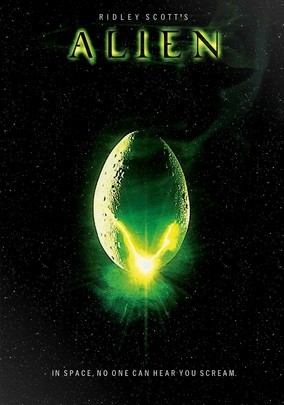
Watching the alien burst from Kane’s distended abdomen as he appeared to have eaten too much seemed somehow appropriate on Thanksgiving. I’m well aware that my taste in movies does not always match expectations and few bother to comment on my idiosyncratic observations. Nevertheless, it had been years since I’d watched Alien and on this particular holiday it felt like synchronicity. I’ve seen the film a few times before, but this is the first time since starting this blog. Not surprisingly, some biblical allusions popped out at me as I watched the crew of the Nostromo struggle with alien life. And I’d just read of NASA’s “exciting discovery” on Mars, a discovery whose official announcement for which, like Christmas, we’ll have to wait until December. Learning that the gut-busting alien was modeled on Three Studies for Figures at the Base of a Crucifixion by Francis Bacon (a contemporary one) only sweetened the analogy.

Character names hide aspects of personality and intention. Sometimes the writers may not even be aware of all the shades of gray. The alien’s first victim is Kane. On paper he seems an ordinary citizen, but on the screen the euphony with the first human child, Cain, is obvious. As Parker is lamenting how large the alien has grown in just a short time, science officer Ash whispers, “Kane’s son.” Or is it Cain’s son? Cain, the infamous ancestor of the sinful Grendel and any number of other villains of literature and cinema. Cain is, significantly, the first child born in Genesis, himself the genesis of sin in the world since his murder of his brother is the first act that the Bible declares a “sin.” The alien, born worlds away, conforms to biblical expectations.

Since Ash is actually an android and has no real feelings, he admits the alien to the ship and protects it until he is destroyed by his shipmates. He represents unfeeling science amid the horror of human bodies being invaded and rent apart. When accused of admiring the alien, the resurrected (!) science officer states, “I admire its purity. A survivor… unclouded by conscience, remorse, or delusions of morality.” Is he not really describing science itself? Religion is running rampant on the Nostromo. As Ripley sets the detonation charges and finds her escape blocked, she races back to the console and cancels the self-destruct order which the HAL-like Mother ignores. In a secular prayer Ripley calls out to Mother who, like any deity, does not answer all human pleas. And even as she escapes the detonating ship, Ripley will find that Cain’s son is still lurking in the corner of the emergency shuttle, for the science can never truly escape from Genesis.


Say Can You See

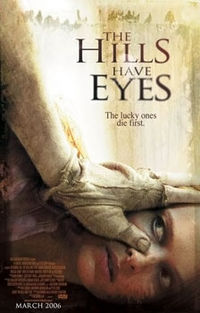
Remakes of classics. It is my sense that a classic has earned its place in its own constellation for a reason. Remakes seldom attain the je ne sais quoi of the original, but sometimes I have trouble telling them apart. I like scary movies—the classics anyway. In recent years various directors think they can improve on the masters and some of us get confused about what’s what. So it was that I came to watch the remake of The Hills Have Eyes without having seen the original Wes Craven version. As is typical for remakes, the writing tends to lack the flare that often characterizes the original vision. The story may be similar (in this case I’m only guessing) but more than the names may have been changed to protect—who? I’m afraid I didn’t care for the film. Graphic violence is seldom as effective as suggested terrors, but it can make you a bit queasy nevertheless.

I decided to stay with the movie to see if my thesis of religious elements and terror would become part of the story. In the remake, in any case, the action is set in a nuclear test zone where people disfigured by the radioactive fallout of American nuclear tests prey upon the victims they can lure into their lair. So an extended family is drawn in and very few of them make it out. The pater familias is a man who trusts his gun and has no fear of walking into the dark desert alone. But before he goes—yes! Religion. The mother of the brood, it turns out, is a devoted Christian and insists on praying before the men-folk set out to try to find help for their stranded vehicle. The eponymous eyes in the hills watch them pray and then begin to prey. The confident father says, “I trust my bullets more than your prayers.” (Or something along those lines.)

Ironically (and I can’t believe it was anything beyond coincidence) both dad and mom end up dead—the father in a crucifixion pose, the mother by being shot. Neither bullets nor begging save them from the mutants who seem to live just to cause others misery. The man who trusts his gun dies in a somewhat religious way, and the woman who trusts prayers is the victim of a gun. Now, in a classic there would be some lingering on the reversal here, but the remake syndrome is eager to add gore and grotesqueness to the screen without pausing for thought. The eerie backdrop of a nuclear testing town with mannequins still intact is effective, but otherwise you know to expect Road Warriors-type action in this small, post-apocalyptic world. The fact that even this wasteland supports a moment of prayer, however, demonstrates that fear and religion are never too far from each other.


November’s Vampires

It may have been the year without a Halloween here in the northeast coastal region of the United States, but it looks like some of the spirit has persisted into November. My daughter was disappointed when, due to storm damage, our local borough cancelled Trick-or-Treating for this year. So I was intrigued when I spotted a news story yesterday discussing Prince Charles’ relationship to Vlad the Impaler, the historical Dracula of yore. (And a good Christian by his own reckoning.) I wondered about the timing of the story until I noticed the gothic script on Google’s search page and realized that yesterday was Bram Stoker’s 165th birthday. Well, it would have been, supposing that he has remained dead since 1912. Completely unrelated to this anniversary, I read Dracula again in September through October and realized just how religiously charged a story it is. The Church of Ireland, to which Stoker’s family belonged, was Anglican in name and identified with both Catholic and Protestant traditions. In Dracula the more Catholic side seems to predominate.

Prince Charles’ connection to Vlad Tepes suggests perhaps a deeper meaning. The short news clip I saw (I can’t recall which network it was on) noted that the connection is being promoted by Romanian tourist agencies. Nevertheless, Prince Charles appears in the material acknowledging his hereditary connection to Vlad III, and noting that Transylvania has much to teach us. (He goes on to explain that the people of Romania have a lot to teach other Europeans about sustainable practices.) I could not help but note the irony of a member of the royal family, however, inviting comparison with a character who came to be known as the drainer of other people’s blood. Taking that which by no rights belongs to them.

Perhaps it never occurs to those with great wealth that what they amass is absconded from others. In a world that holds to a social contract that values money—which is merely a symbol—for some to have excess means that others will have less than adequate amounts. I’ve always had trouble understanding such selfishness. Perhaps it was being raised in a Christian environment with siblings with whom I was expected to share. Maybe it was just a part of the sober assessment of the social injustice I began to notice when I was a teenager. Somehow I’ve never felt entitled to much, but I do wonder how others can justify taking more than they need while knowing that many others suffer from real want. It is a matter of degrees, I realize, and we all do it to some extent. I have never complained about taxes because I know that my eyes too may be blinded by the beguiling glitter of gold. When the very wealthy don’t pay taxes (not pointing any particular fingers here), they too, like Prince Charles, may claim to be true descendants of Dracula.

Just add vampire of choice


New Prometheus

Nothing portends the wrath of the Almighty like an unseasonal storm. The late season Hurricane Sandy, now dubbed the Frankenstorm because of its potential hookup with two wintery systems making their way east and south, is poised to make an apocalyptic scenario on the east coast, we’re told. Well, it is 2012, the year of apocalypses, after all. In an interesting shift, however, this storm is named after not a divine character, but Frankenstein’s monster, the human-made nightmare. I first read Mary Wollstonecraft’s Frankenstein back in high school, and I was immediately subdued. The story, undoubtedly frightening when first heard, is unremittingly sad. The “monster,” like all of us, finds himself in a cold and lonely world where he is rejected because he is different. It is cruel and Republican kind of world. All the monster seeks is companionship, acceptance. I found the story so sad that I’ve had trouble reading it ever since.

The naming of a storm after a terror created by humanity may be prescient, in a regrettable way. Only the most gullible (read “greedy”) believe that industrialization had nothing to do with it. We toasted our own planet for a buck or two. In biblical terms we have sowed the wind, for which there is only one kind of produce. Hurricanes are quite natural, and although the irregular weather of 2012 may prove simply a meteorological anomaly, it may be the result of our tinkering with the baubles of divinity. They certainly seem to be getting bigger than they used to be.

I have to admit to having a persistent fear of those doing the cobbling. Too often their motivation appears to be flat and green and indigestible. And nothing like stockpiling it makes a person somehow less human. Mary Wollstonecraft wrote Frankenstein not for money, but for love of words. The modern chimeras we construct are mere carnival side-shows by comparison. And like Victor Frankenstein we have engineered beyond our capability to understand. Our best option may be to stand silently and wonder at the forces that hold us enthralled. For in the novel, at least, the real monster is not the cadaver stitched together underneath the sheet.


Barely Departed

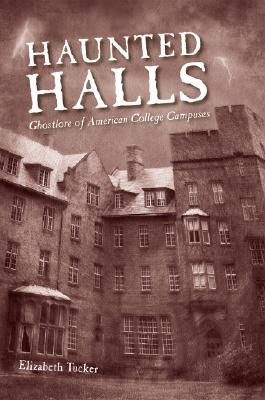
Back before any of us, or anyone we knew, had attended Grove City College, one tragic night a student on the basketball team crashed through the glass doors of the gym on west campus and bled to death. If you walked across that part of campus at night, it was said, you would see his ghost. Everyone knew his name was Jim, but I never saw him. Folklorist Elizabeth Tucker presents a rare treat of the anomalous and academic in her book Haunted Halls: Ghostlore of American College Campuses. Professors have traditionally shied away from the paranormal. It can be a risky way to spend your time since the supernatural has been banished from the academy for ages. That doesn’t mean that students and professors have stopped seeing ghosts, though. Tucker, like a good prof, doesn’t just tell us ghost stories and dismiss class. She tries to unpack a bit of what they might mean.

Ghost stories, even when entertaining, are able teachers. Kids going to college find themselves in liminal situations. Not really independent, not really supervised, they test the limits of what they’ve been told. Ghosts, not supposed to exist, are the ultimate rebels. They don’t even obey the laws of physics or biology. But what are ghosts if not the embodiment of the human spirit? We call them spirits, and they represent that part of us that stubbornly refuses to go gentle into that dark night.

Tucker’s book will not convince a skeptic that ghosts exist. It probably won’t cause you any sleepless nights (unless you are about to send your child off to college). Her book is more about what ghost stories say about the living, as would be expected of a folklorist. Although not a comprehensive survey, Haunted Halls may well bring back the ghostly tales of your own college years, for very few places are without their specters, especially on a rainy October night. And even though I never saw Jim as I cut across west campus in the dark, who am I to say that he’s not really there?


Buyer Beware

Pain, it is said, has a wonderful way of focusing the mind. So when I woke up in what can best be described as a body position used for extras in the movie, Twister, I took a few aspirin and got on with my life. I had purchased non-refundable tickets for a campus visit, and capitalism is nothing if not unsympathetic. The lower back pain was fine when sitting, or standing. Try anything in between, however, and you’ll learn the real meaning of reading the riot act. Once off the train—slowly, slowly—I was fine again, until I had to sit down. The next morning, facing a day of meetings (why is everyone’s office on the fourth floor? Why do Brownstones still lack elevators?), I decided I’d better pop into CVS for some meds. It was with considerable irony and not a few groans that I noted all the products for back pain were on the bottom shelves. The condoms, in the same aisle, were right at eye-level. Sitting on the floor, pondering the relative merits of chemicals of which I’d never heard, I thought about what we take for granted.

Parents and guardians are our first teachers. Among those early lessons are often the religious ones. Recently speaking with both seminary professors and pastors, I have heard the common refrain that church membership is declining and the number of younger people listing themselves as religiously unaffiliated is growing. I noticed this in my teaching outside the seminary setting; quite apart from students of other religious traditions, many undergrads took my class knowing nothing at all of the cultural matrix of Christianity in which they’d been raised. It is also true in a consumer mentality that one shops for religious experiences just like one shops for backache medicine. You go with the one that works for you. Few bother to ask if they agree with the theology, after all, Methodist = Baptist = Presbyterian = Lutheran in many people’s minds. Doan’s or Bayer? Take your pick.

Now that Dark Shadows has been released for home viewing, another component may be added to the equation. We pass on what we value to those we love. While the writing for Dark Shadows leaves quite a lot to be desired, there are a few memorable lines. Angelique, you may recall, cursed Barnabas Collins for unrequited love, turning him into a vampire. When he laments to Elizabeth Stoddard that Angelique hates him, she replies, “No, if she had hated you she would have merely killed you. A curse takes devotion.” Passing on our beliefs, perhaps, somehow ties into all this. As believing creatures, perhaps we each need to find our own solutions. My only fear is that when I find the right remedy, it may very well be on the bottom shelf.

Read the caption


Shaman on Us

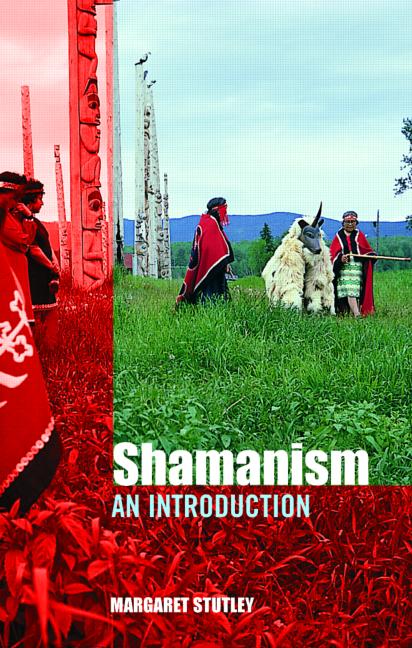
My reading habits are unorthodox. I don’t follow a fixed plan, but hope for something that will keep me engaged for the fifteen or so hours I spend commuting each week. I began October with a book about werewolves and followed it up with a book on the Hmong. Apropos of neither and both, I turned next to Shamanism: An Introduction, by Margaret Stutley. While not the best organized book, it does provide a smorgasbord of shamanistic traditions, principally from Siberia, where Shamanism was first recognized. Before I’d finished, I’d read about both epilepsy and werewolves.

Shamanism is not a “religion” per se. There is little agreement among scholars about what a religion is at all. Shamanism is very much a local set of beliefs and practices that have only very basic elements in common (shamans being one of them). It is a good example, however, of how moral heathens can be. Shamans often accompany egalitarian societies who do not require governments and religious leaders telling them to be nice to each other. No, this is not the noble savage myth, but it is a clear indication that major religions are not required for morality. It evolves on its own. Often shamanism is not constrained by overly left-brain influence, and sees connections science can only deny. The plight of Lia Lee was explained here in a way physicians could access—epilepsy and other diseases are problems of the soul as much as the body—if only they read books about religion. Healing involves calling the soul back. Treatment of the body misses the point. And sometimes the dead become werewolves.

We live in a world where real suffering is caused by lack of understanding about religion. Assuming a cultural hegemony of Christianity, or Islam, and sometimes even other religions, we discount those who believe differently than we do. The New Atheists frequently overlook just how seriously people take the world of the emotions and belief. That realm is a large part of what makes us human and it plays by no logical rules. Nor does it care to. In a country, such as the United States, where money is believed to be the very warp and woof of the good life, shamans sometimes secretly cut the thread. Still, don’t ask universities to expand the study of something as insignificant as religion because all intelligent people know that nobody really believes that stuff any more.


Holy Wolves

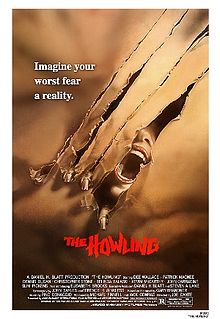
Nothing creates the mood for a werewolf movie like reading a book about real werewolves. The Howling was released the year I was finishing high school. At that time my humble circumstances allowed for very few visits to the movie theater, and certainly never to see horror films. I grew up watching B-films in black-and-white on television, but paying extra to see what was slightly unseemly in a theater stretched the limits for a good Christian just a bit. College was on my mind, and it was while in college that my horror film interest blossomed. All of which is to say, I’ve never seen The Howling before. I remember the movie posters, but the film had to wait until werewolves clawed their way back into my mind. Most of the classic movie monsters have their basis in religion, but The Howling doesn’t really delve into the origin of werewolves as much as it wonders what to do about when their numbers start to become a problem. Those who know about such things note that the special effects were cutting edge for the time, but CGI has spoiled us all.

Although the film doesn’t inquire into werewolf origins, it still gives a nod to the religious. The film’s werewolf population lives in a colony that has a “ritual center,” and since the cover for the colony is a retreat center for a psychologist’s patients, we find seekers amid the crowd. One of the inmates, Donna, explains that before joining the colony she had tried all the new religious movements, without success. And the one character who knows how to dispatch werewolves runs an occult bookstore in Los Angeles that is visited, in a shock-comic moment, but a pair of nuns. The message, so typical of the early 1980’s, is that all religions are just about the same. People are seekers, and any religion will do in a pinch.

In a way, this downplaying of the religious element in werewolves is not unexpected. As society was becoming more obviously secularized in the sixties and seventies, religion was becoming just one of many options available on the path toward self-fulfillment. In The Howling, becoming a werewolf was another. Ironically one of the old-timer werewolves laments the loss of “the old ways.” The werewolf colony lives on cattle that are farmed as politically correct sheep for the wolves, and it just doesn’t satisfy. The same might be said for religions. Accommodations, so necessary to survival in an evolving society, inevitably change the old ways of religion. Religions themselves transform over time. The Howling may not be scary, or believable, but it does serve as a kind of paradigm for worldviews that are undergoing transformation. Shifting shape, after all, is a sure symbol that one is still alive.


Where? Wolves?

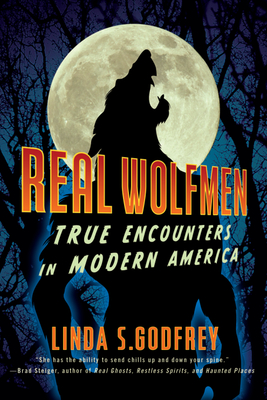
The problem with occasional phenomena is that they are seldom empirically verified. Try as we might, no one has managed to be in the exact place at the exact time on Loch Ness to capture definitive evidence that Nessie exists. Of course, it is very difficult to prove that something doesn’t exist. I have a creeping suspicion that not all of reality can be quantified. I’m very glad for the parts that can be, but a little mystery never hurt anyone. I’ve just finished reading Linda Godfrey’s Real Wolfmen: True Encounters in Modern America. There—I’ve already lost some of you! We all grow up to learn that there are no such things as werewolves and I’ve experienced many a peaceful night in that knowledge. Nevertheless, many people do report seeing upright wolf-like creatures, and many of the people interviewed by Godfrey appear to be entirely sincere. What makes this intriguing to me is that many of these episodes are reported in a circumscribed area (near which I used to live). While reports come from across the country, it is easier to dismiss one person who saw something odd once than it is to discount many people who see a similar thing over many years in the same general vicinity. That’s why I keep coming back to Godfrey’s books.

Being an open-minded writer, Godfrey also considers possible spiritual explanations for what people see. Shamanistic traditions, in this case particularly Native American ones, do not dismiss transformations from human to animal. It is difficult for most of us to accept that a person could bend the laws of physics and biology—for which we suffered through so many tests in our education—to mutate or mix human DNA into or with lupine stock. Indeed, it takes the faith of the world of religion to believe that. And yet, people see beasts.

We have been in the process of sealing the borders to our universe since the Enlightenment. The vaster our universe becomes the smaller the realm of possibilities grows. But we haven’t even explored all of our own little planet yet. The deep-sea trenches remain largely out of our reach, and the sheer volume of the oceans boggles the imagination. Even on land, we can’t watch every place all the time. The possibility of getting to somewhere truly remote is frequently an optimistic illusion. At times with my wife’s family I’ve ventured to places so far from civilization that freedom truly feels palpable. And as we hike down some neglected trail, talking to alert the grizzlies to our presence, nearly always we end up encountering others out here to escape from the likes of us. Yet a whole lot of the woods remain off-trail. It’s not a small world after all. And it’s October. Who’s to say there’s not the occasional werewolf out tonight?


Shopping for Fear

So I decided to visit a Halloween store. These have been showing up with metronomic regularity in September for several years now and are usually good for a cheap thrill. My personal preference for Halloween is more somber than garish, but the affirmation that other people enjoy a safe scare has a way of drawing me in. Those who read this blog on a regular basis know that I frequently point out commonalities between fear and religion. They both seem to hover around the same orbit in the brain, and, in some accidentals are very similar. Horror films therefore often indulge in religious imagery, and monsters do not infrequently partake of the divine. So it is no surprise to see my thesis borne out in shops intending to capitalize on fear.

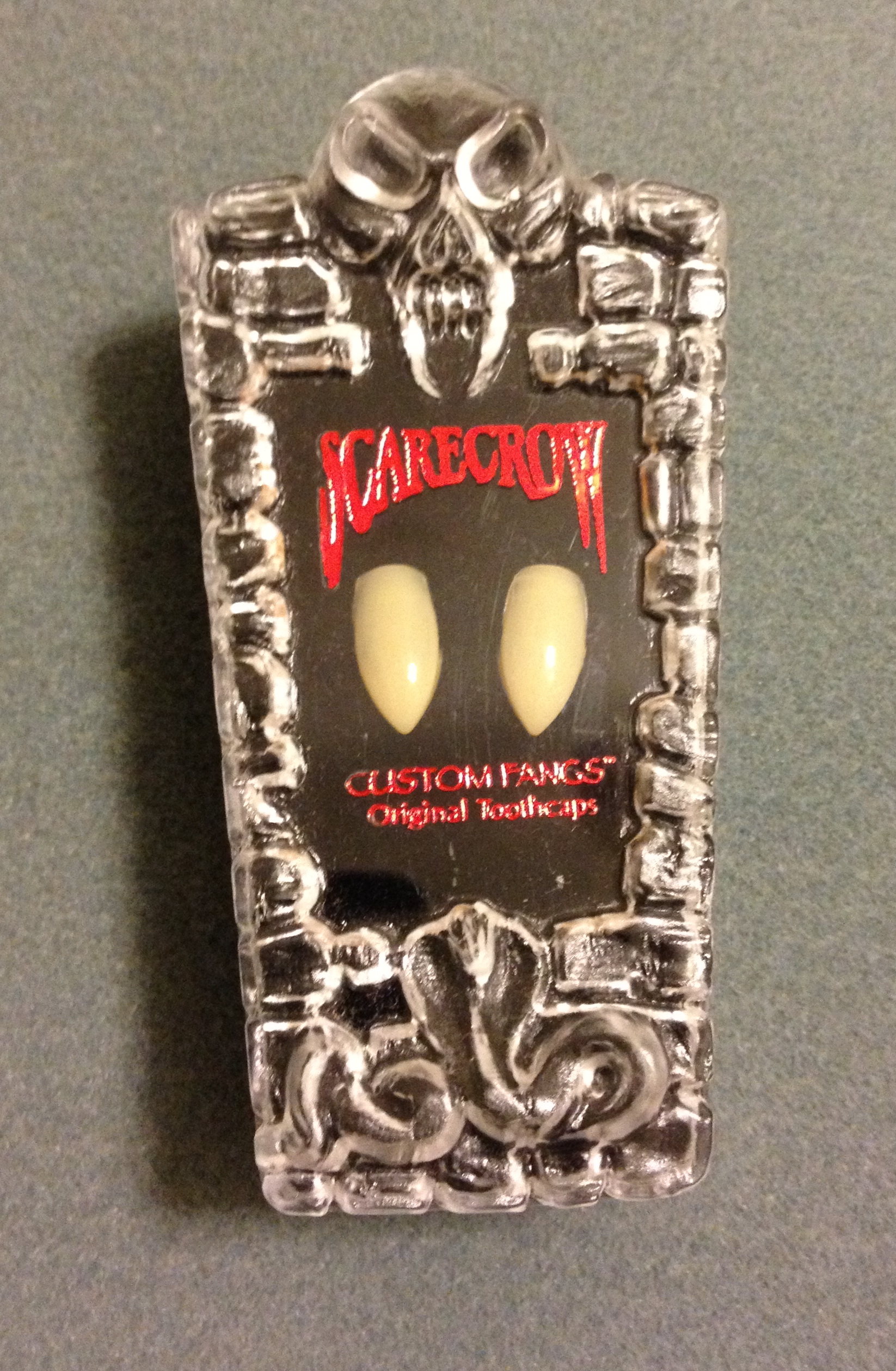
I will freely admit that there may be cultural references that I’m missing here. A movie that I’ve neglected, or some television show or graphic novel may be informing some of the images in ways I can’t comprehend. Nevertheless, we all know of the power of the crucifix when it comes to vampires. I wasn’t aware that the cross had horrific effects on other species of monsters as well. Take this guy here. I’m not sure what he’s supposed to be—perhaps a zombie? It seems a little too corporeal to be a demon. The teeth just don’t look right for a vampire. In any case, he seems to have an extreme reaction to religion, with the cross melting right into his skull. Is there a conversion message hidden here somewhere? Of course it could be just a chinzy attempt to scare a real religiophobe. The cross has become the backup weapon against all supernatural evil.

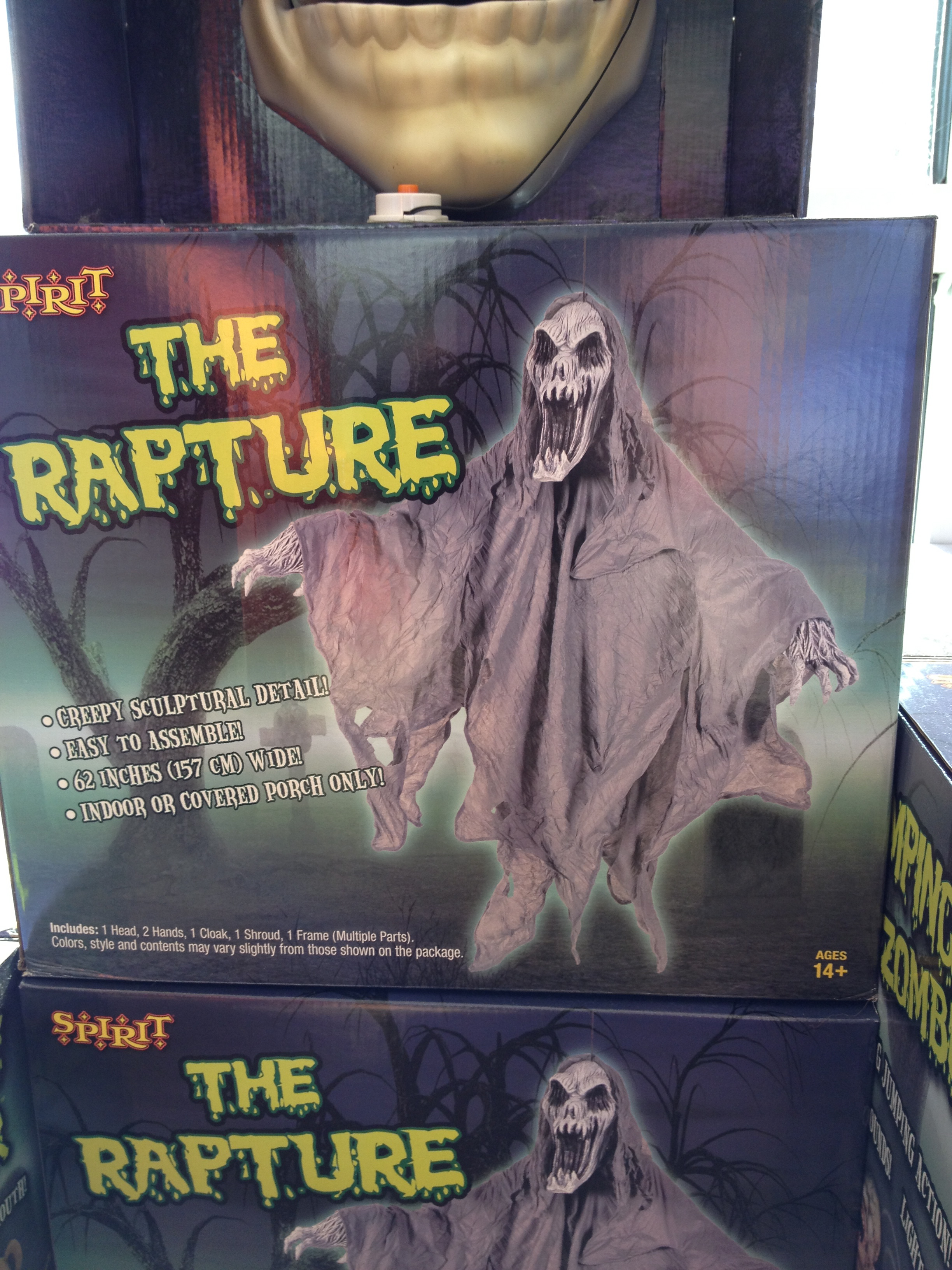
The use of a grim-reaperish ghoul rising from the grave to illustrate The Rapture was a new one on me. Last I heard only the squeaky clean and friends of the Tea Party got to go on the Rapture. (Well, the latter category might explain it.) The idea of the Rapture, as it was fabricated late in the nineteenth century, involved the chance for all the good Christians to escape before things really got rough down here for us normal folk. I would’ve thought that scary guys like this joining the heavenly crusade might take a little bit of the joy out of the occasion. Or maybe they’re being left here to haunt the rest of us. In either case it is clear that consumers respond to religious sounding language and symbolism when looking for a scare. Obviously there is plenty in the store with no religious significance at all, but finding hints of religion scattered in with the plastic scares does show a kind of Frankenstein’s monster of human sentiments and emotions. It’s only appropriate when the nights are now longer than the days.


Longer Nights

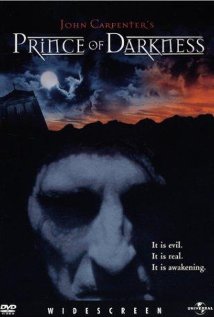
Nothing accompanies the slow decent into winter like scary movies. Now that autumn is officially here, it is time to look for the religious motifs in frightening movies again. Perhaps it is time to join Netflicks, because when it comes to my own movies I have mainly choices among bargain basement films I’ve picked up over the years. Over the weekend I watched one of them. John Carpenter’s Prince of Darkness is the second of his apocalyptic-themed movies, following on the remarkably creepy The Thing. (This is one of the few remakes that manages to outdo the original in just about every way.) Prince of Darkness, however falters almost from the beginning. I do appreciate a movie that is straightforward about using religion as the source of fear, and one that even has a character who is a graduate student in theology! Apart from the priest and street people, all the ill-fated characters are academics—professors and grad students of theoretical physics, the sciences, and our one, lone theologian. The plot revolves, literally, around a swirling green liquid in a decrepit church, which is the Anti-Christ.

Although the trappings are all here for a truly frightening experience, Christianity doesn’t really lend itself to a frightening mythology. To get to something truly tremendous, Prince of Darkness posits a kind of gnostic anti-God who is the father of Satan. The persona is evil writ so large that it is simply not believable that a corroded screw-top jar is able to contain him. For anyone who’s studied history or anthropology, placing the date of the Ball Mason jar back seven million years ago sounds like random guesswork. Homo sapiens sapiens weren’t even around then, making one wonder why God thought of a jar to trap the viscous Anti-Christ millions of years before the “fall” necessitated a regular Christ. The Bible appears, in transmogrified form, as an ancient book of spells that when translated sound suspiciously like the good old King James.

The movie does have its creepy moments—abandoned churches are scary; even fully functional ones can be remarkably spooky at night. It is difficult to accept that a priest would go to a physics professor before consulting his bishop, but then we have to prevent this movie from becoming just a watered-down Exorcist flick. Having Alice Cooper appear as the leader of the homeless minions was a nice touch, in any case. Since we are all still here, the movie ends predictably enough, with Satan’s Dad being stopped before entering the world. It does, in a de rigueur metanarrative, involve a self-sacrifice, albeit not a virginal one. And for the surviving handful of academics, life goes on as normal the morning after. Perhaps evil was blown too large to be believable here. Enough human-sized diabolism exists to frighten any reasonable person. And autumn is only just starting.


Magic Bibles

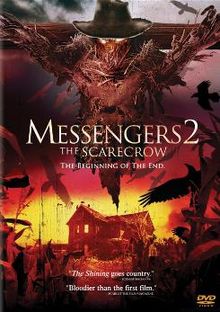
With autumn not far down the road, my mind turns to scary things. Actually, it is that way quite a bit of the time. Nevertheless, movies about farms are often the setting for the creepy—the sense of isolation, the sharp implements farmers use, the rustling of the drying crops in the wind. A couple years back I watched The Messengers. As a horror film it had a number of good scares, but the menace always seemed somewhat restrained. Nothing profound happens, and it is a film fairly easily forgotten. It was a rainy Saturday afternoon and The Messengers 2: the Scarecrow suggested itself to me. I began watching in an ambivalent mood, but when the first scene began with the protagonist (whose name I’ve forgotten) dropping his Bible on the porch chair as he loosens his tie to work on a derelict water pump, I was curious. When his wife arrives home and asks why he left church before it was over, my interest grew. This direct-to-video prequel turned out to be a cut-budget horror flick based squarely on a religious parable.

In a faustian moment of abandon, and at the advice of a jocular neighbor named Jude (Iscariot, anyone?), our hero erects a scarecrow to try to improve his lot (literally). To give credit where it is due, the scarecrow is distinctly disturbing. The scene of John (okay, I looked it up) nailing the scarecrow to the cross is clearly a crucifixion scene, and the blood that will later appear at the foot of the cross bears this out. Before he realizes that the scarecrow is evil, John hears ghostly children singing in his cornfield. The song is “Jesus Loves Me.” There is a strong fertility goddess theme running through the film and when Jude reveals that his wife has a magic book that explains all the benefits of the scarecrow, John decides to cut it down. The scarecrow, predictably, resurrects.

Meanwhile, John’s Christian family thinks he has gone insane. Or worse, backslidden. As he tries to explain to his wife what has happened, John shows her the magic book and she insists “It’s just your old Bible,” and it is. Heathenish occult instruction transubstantiates into Christian scripture. It is tough to tell one sacred writing from another. For cut-rate horror fodder, this is wonderful commentary on religious sensibilities. Although straight-to-video movies are not high art, and will never receive academy award nominations, they do reflect popular religious beliefs. Scholars are now in search of such beliefs in ancient societies since “official religion” almost never reflects what actual hoi polloi think. Lived religion seldom conforms to the intricacies envisioned by religious founders, and yet it is out there on the Internet for all to see. Maybe the messengers in this film are not the crows after all. The point of the parable? Stay true to your Christian upbringing or else the scarecrow will get you.