Moral Monsters

trees

Everyone likes to feel vindicated. From my childhood I have felt marginalized because of my interests in monsters, and now a book has just been released from Oxford University Press that vindicates my interest! Stephen Asma, a philosophy professor at Columbia College, Chicago, has written a monograph entitled On Monsters: An Unnatural History of Our Worst Fears. Further vindicating my idiosyncratic interest is the fact that the Chronicle of Higher Education even has an electronic front-page article on the book this week. I am overcome with credulity! I haven’t been able to lay my hands on the book yet, but I hungrily read the article and look forward to the whole product.

Readers of this blog know my assertion that monsters originate in a mental space shared by religion. Both are responses to the unknown. Asma writes in his Chronicle article, “The monster concept is still extremely useful, and it’s a permanent player in the moral imagination because human vulnerability is permanent.” Indeed, his article is entitled “Monsters and the Moral Imagination.” The thesis he promotes is that our morality (again tied to religion for many people) benefits from its struggle with monsters. We imagine our moral responses to being faced with the truly horrific, and the monsters themselves are less frightening than our imaginary responses. The top box-office winner this past weekend was Paranormal Activity, a movie noted for not showing the menace, but implying it. There is an evolutionary advantage here; we learn about coping with real danger by imagining danger.

So as I look out the window on yet another cold, gray, rainy October morning, and see the trees swaying in the wind, my imagination takes flight. Those Saturday afternoons and late nights filled with cinematographic visions of even worse things that could happen are cast in a new light. Instead of scaring myself, I was building moral character! As my friend K. Marvin Bruce likes to say, “monsters are only mirrors.” Sometimes the mirror reflects a truly untamed world, and Dr. Asma informs us “inhuman threats are great reminders of our own humanity.” I would simply add, “and of our religions.”
Jersey Vampires

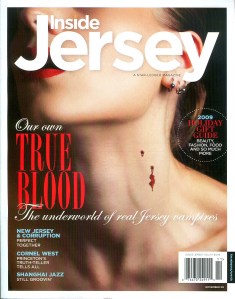
Subscribers to the New Jersey Star-Ledger receive a periodic local-interest magazine called Inside Jersey. Since I’m already inside Jersey and have too much to read as it is, I generally ignore the freebie unless a story catches my eye. Anyone who has followed this blog for long knows of my contention that what truly frightens us is related to religion, or lack thereof, including fictional movie monsters such as vampires and werewolves. Despite the claims that such interests are juvenile and immature, this month’s Inside Jersey features a story reflecting just how serious such issues can be. When my wife showed me the cover, I knew it was blog-worthy.

VampireJ

There are vampires among us. Not Bela Lugosi or Christopher Lee-type Draculas, but actual blood-imbibing vampires. Only those who have shunned bookstores like a crucifix will not be aware that the Twilight series of teen romances have dominated middle and high school female reading lists for the last few years. The vampires in this magazine story, however, are not conflicted teens, but conventional young adults. The story covers what religionists call a New Religious Movement, or NRM. It is a religion, growing in the larger New York City area (as well as in other parts of the country), where consenting adults don artificial fangs and sip blood from willing donors. According to the story these groups, which include professional people who join under pseudonyms, engage seriously in religious rituals not unlike traditional Christianity’s sacramental rites. Now before snatching up your holy water and fresh hawthorn stakes, consider for a moment that adherents to this sub-culture are actually exercising their religious freedom.

Older, established religions are often quick to judge newer religious rivals. The fact is, however, that every religion on the planet was once a new religion. Believers often attribute the origin of their species of religion to the divine: special revelation, enlightenment, or a growing-up of humanity. All other religions, therefore, must be false. The difficulty here is that there are no final arbiters who can stand outside human religious institutions to tell us which is the right one. Lessing’s three rings have reached mass production and still there is no Ragnarok so that one religion might brag “told you so” to all the others. While I’m no vampire — I’ve been a vegetarian for over a decade — I have to accept the claims of those who are that this is their religion. The article ends with a revealing quote from a member of a local Court, so I give the final say to an actual interview with a vampire: “So many people think being into a certain lifestyle, you cut yourself off from the divine. It’s quite the contrary. To me, when you become more attuned to yourself, who you are uniquely, it brings you closer to God.”


The Life Is in the Blood

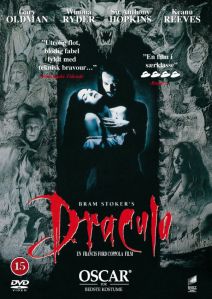
Finally, after a couple of decades, I got around to watching Francis Ford Coppola’s Bram Stoker’s Dracula. As viewers know to expect of a Coppola film, the cinematography is stylish and artistically exaggerated. It has been even more years since I’ve read Stoker’s novel, the book that gave birth to the modern vampire, but I am pretty sure that the many oblique references to the Bible count among the film’s innovations. Coursing like an artery through the movie is the phrase “the blood is life,” taken from Leviticus 17. I’ve posted earlier concerning the biblical outlook that life is equated with breath, and so it is. The Bible does not always remain consistent on this point — natural enough for a book with multiple authors living centuries apart. Blood and breath obviously share crucial functions in maintaining life.

Stoker

Ancient peoples believed in a world peopled with unusual, quasi-supernatural beings, including blood-drinkers and nocturnal baby-snatchers. Theirs was a world of harsh realities where death was more closely observed than it tends to be in many parts of the world today. The fascination, often coupled with religious underpinnings, continues to engage our imagination today, as can be seen in any given Halloween season or on el Día de los Muertos.

Whether el chupacabra or Bela Lugosi, the fascination with mythical creatures of the night that thrive on the life-source of others is a concept never far from religionists. No matter how many stakes we pound through undead hearts, the unholy bloodsuckers continue to show up in our theaters and on YouTube. A childhood penchant for Dark Shadows books has recently been reactivated in the restless gray-matter in my head. As the days grow shorter and shadows become an increasing element of daily experience, I marvel at how the human imagination parodies our daily experiences, dressing them up in fanciful garb to parade about with the other ghosts of October. What is perhaps even more unusual is that money is still to be made in this business of selling the parasite. How else can we explain Buffy and all her cohort? The life is indeed in the blood.


Origin of Dragons

The ancient Greeks often take the credit for concepts they borrowed from the Ancient Near East. When casting about for the origin of dragons, a staple, if unstable, element of ancient Semitic myths, the credit often lands in ancient Hellas. Those of us influenced by western culture prefer the Greek versions of myths because they tend to be (mostly) coherent and do not have large gaps like those scrawled on fragmented clay tablets. Also, the word “dragon” traces it etymology to ancient Greece where it apparently derives from the verb drakein, “to see clearly.” Often commentators suggest that the rationale for the name is that dragons guard treasure and need to see clearly to do so.

Babylonian dragon

Babylonian dragon

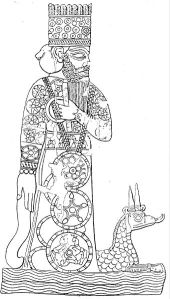
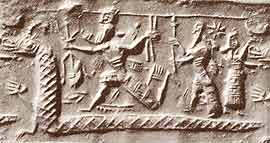
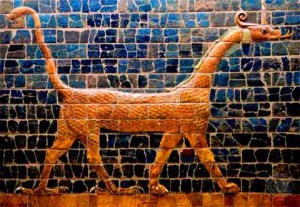
Dragons, however, actually first appeared, like so many western civilizations concepts, in Sumer. In the ancient world, what we would recognize as dragons are always associated with water. Water is an uncreated element, existing as the primordial substance from which everything emerges. It is personified as a dragon that must be subdued for creation to take place. Images of the dragon from somewhat later time periods in Mesopotamia already depict the familiar form we still recognize as draconian.

Marduk astride Tiamat

Marduk astride Tiamat

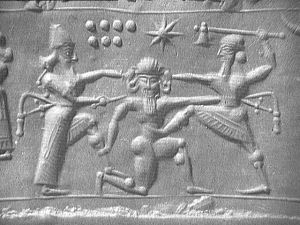
The Bible has its share of dragons as well, although they never actually existed. Tannin, whose name probably relates to serpentine features, is regularly cited as a biblical dragon. Leviathan, as described in Job 41, has scaly skin, lives in the water, and belches fire (perhaps having taken lessons from televangelists). These characteristics probably played into modern conceptualizations of the dragon. Fire breathing, however, is first attested with Humbaba, the Cedar Forest guardian of the Gilgamesh Epic. Humbaba is not a dragon, but he may be the ancestor of our fire-breathing Leviathan. Some ancient iconography may also show fire projecting from the mouths of dragons as well.

Humbaba (center) on a bad day

Humbaba (center) on a bad day

Traditional Mesopotamian dragon

Traditional Mesopotamian dragon

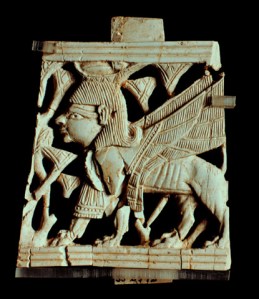
I would even venture to suggest that the origin of the name dragon could go back to ancient West Asia. The idea of seeing clearly reminds me of the ancient cherubim. According to Ezekiel, they are full of eyes. This complements their role as guardians of the thrones of ancient deities. Cherubim are Mischwesen composed of lions, eagles, humans, bulls, or any other spare parts lying around. In my imagination it doesn’t take much to shape them into dragons, the original watchers.

A true cherub

A true cherub

No matter who coined the word, dragons have been with us from the beginning of human civilization and continue to live on in popular culture. Maybe they are, like the unruly waters, truly uncreated.


Hallowed Be Thy Wolfbane

Anti-pesto to the rescue!

Anti-pesto to the rescue!

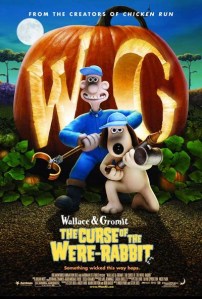
With autumn in the air and the harvest season looming near, my family recently watched Wallace and Gromit: The Curse of the Were-Rabbit. Quite apart from the inspired improbability of Aardman Studios productions, the central role of the village vicar in this film aroused my interest. Confirming an oft-cited proposition of this blog that mythical creatures burst from the same mental regions as religion, at Lord Quartermaine’s inquiry as to what might kill a were-rabbit, the vicar promptly pulls down a monster book from his shelves to reveal the secret. It is the church that knows about monsters.

In my continuing research into religious reactions to death and the afterlife, I constantly run into the name of Montague Summers. Summers was the author of the definitive books, in his period, on vampires, werewolves, and witches. He is best known for his translation of the Malleus Maleficarum, “the hammer of witches,” the main witch-hunting tome of the Middle Ages. A deacon of the Church of England before converting to Catholicism, Summers was a believer in the phenomena that he researched. Styling himself a witch-hunter (he lived from 1880 to 1948), he tried to live the fantasy world he helped to create.

The more that neurologists study the brain, the more we discover how deeply embedded religion can be. Any number of researchers have suggested various “God-shaped nodules” in the gray matter that provide for continuing religious belief in the face of advancing scientific knowledge. I would suggest, as a “religionist,” that perhaps nestled next to our mental menorahs, crucifixes, and statues of the virgin, there are also ghosts, witches, werewolves, and vampires lurking in the dark corners of the God node.


Religion or Death

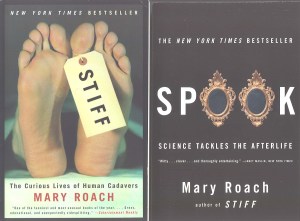
Researching traditions about death can lead to some occluded avenues shunned by many Ancient Near East scholars (generally anything after about the rise of the Roman Empire is irrelevant). It has long been my contention that death and religion are intricately intertwined, well nigh incapable of being teased apart. I’m also very interested in the research of writers on popular culture. Findings, no matter how erudite, if they don’t reach the public will only fail to impress. Mary Roach, ever masterful, wrote a morbidly fascinating account of the afterlife, so to speak, of corpses. This work (Stiff) was followed shortly by Spook — her foray into the science of ghosts. Anyone who can have you mortified one minute and laughing out loud the next deserves to be read.

Can't have one without the other

Can't have one without the other

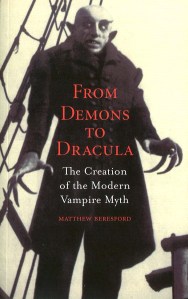
I recently finished Matthew Beresford’s From Demons to Dracula: The Creation of the Modern Vampire Myth (Reaktion, 2008). I was pleasantly surprised that Beresford ambled back to the Neolithic Period in his quest for vampire origins. A number of unexpected facts jumped out at me from his pages — vampires historically have very few traits that last through the folklore about them over the ages. Primarily all they share is being improperly dead. This horrific concept is among the most deeply rooted of human terrors. We prefer the properly dead who stay dead, thank you. Whether revenant or still alive, the vampire somehow threatens the lives of the living and must be dispatched by making him (or her) properly dead.

More rat than bat

More rat than bat

Having been a youngster and woefully unaware of international news at the time, I had never heard of England’s Highgate Vampire of the 1970s. A disjointed and confusing account involving an actual vampire-hunting Catholic priest, a rival vampire-hunting occultist, and ending with the actual staking of a corpse (in 1970! CE!), the tale in Beresford’s book is almost incredible. A little web research demonstrated that the story still has a much wider following than this blog will ever have. Overall, however, it convinced me that my inklings of the danse macabre between religion and death were as accurate as a vampire hunter’s stake.


Biblical Black Lagoon

During my summer-term courses I feel it is only fair to break the lecture time up a bit. Rutgers summer courses can run four hours at a stretch, and no matter how valiant the student, no one can pay attention to me for that long. I have long had an interest in the Bible in popular media, so for each class session I show a brief clip of a movie that features the Bible, often in a pivotal role. We then discuss how it is presented. As a personal pork barrel I give the students a multiple choice question on their exams as to which movies we have watched (it also gives them incentive to be in class, I hope). One summer, after sending the exam off to the print office, I realized I’d made a mistake. As usual, my interest in 1950s sci-fi flicks led to trouble. One film I hadn’t shown a clip from, and which I thought was Bible free (I hadn’t seen it in a long time) was The Creature from the Black Lagoon, a perennial favorite for both camp and kitsch.

Of course, The Creature from the Black Lagoon does have the Bible in it. The movie begins with a narrator reading Genesis 1.1. Well, I had to give all the students credit for that question, because there was no wrong answer. Nevertheless, the easy association between beginning the film with the Bible and its evolutionary plot-starter seemed worthy of comment. Back in the 1950s evolution was already a hot-button issue (so I’ve read). Forces lined up on the scientific and biblical fronts faced off like angry hockey players as they swung at that hard black puck of the truth. It does seem odd in a country so heavily reliant on science that the foundation of biology and its benefits (if scientists hadn’t recognized and reacted to the swift evolution among microbes I’d likely not be here typing this sentence) that one particular interpretation of a very small section of the Bible should have the power that it does. I’ve seen carnivorous, chrome-plated bumper Jesus fish eating the peacefully walking Darwin fish! Old metaphorical Moses would be scratching his head, I’m sure.

The Creature was, of course, also a metaphor (if I’m not shoveling out too much credit where it isn’t really due). The sequels to the original film grew progressively worse, but those who have the patience to sit through The Creature Walks Among Us discover that the gill-man is a man after all, under all that green rubber. The beast is us. Not too weighty of a revelation to be sure, but it isn’t too weighty a movie. Like any discriminating Bible reader I choose what to accept and what to explain away. When I watch The Creature from the Black Lagoon, it ruins the story for me to think ahead to the denouement of the gill-man being a real man. It is a passage I simply choose not to accept. (This is, of course, a metaphor.)

What might this be a metaphor for?

What might this be a metaphor for?


Memento Mori

This is the end, my friend, my only friend, the end

This is the end, my friend, my only friend, the end

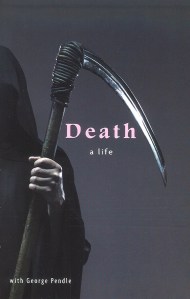
Those of you who’ve listened to my podcasts have no doubt noticed my reference to George Pendle’s, Death: A Life (Three Rivers Press, 2008). This fictitious account of Death’s memoir, all things considered, is a fun read and a wild romp through various ancient religions. Postulating a loveable, if somewhat obtuse, God (no more obtuse, however, than the supreme being in Harold Bloom’s Book of J) Pendle populates his mythological world with a vast array of embodiments, personifications and supernatural beings, all slightly neurotic, and more or less on an equal playing field. Although the book is intended as fun, it does offer some serious consideration to the phenomenon of death.

One of the earliest intimations that Homo sapiens had begun to consider religious sensibilities is burial, the concomitant state to death. Burial serves an important biological function of preventing the diseases borne of putrefaction from infecting others, but it also serves as a condensed statement of a fledgling belief in an afterlife in some form. Even Neanderthal burials have been discovered with rudimentary grave goods. Concern for the wellbeing of the departed is surely a religious sentiment. Death and religion are never far from each other. Even the early Mesopotamians trembled at the etemmu, their version of a ghost, and marked it with the divine determinative on their clay tablets. Religion has been a fine-turned handle that humans have used to get a grip on death.

That is not to say, of course, that death is religion’s only concern, but there is some wisdom in that old saying that people seek out their religious leaders when they are “hatched, matched, and dispatched.” Mesopotamian (and Hebrew Bible, for that matter) afterlife was a gloomy prospect, yet it was certainly brighter than the alternative of the simple cessation of biological functions. Death as a concept inserts meaning into the all-too-natural act of dying. Not a religion exists that does not address itself to this great leveler of all human aspirations. If at times it seems that my posts tend toward the macabre, peopled with vampires, werewolves, zombies and Republicans, bear in mind that such creatures of the night are expressions of the essentially human and indisputably religious preoccupation with death. Its unbeating heart transfuses life to religion.


Cenobites and Angels

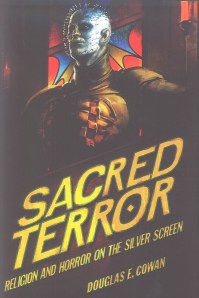
I recently became aware of Hellraiser. Actually, I’d seen images of Pinhead around for years, but never realized that he was a Cenobite until reading Douglas Cowan’s Sacred Terror (see my post on Vampires, Mummies and the Holy Ghost). In fact, Pinhead is featured on the dust jacket of the book and comprises a large part of Cowan’s evidence. Curious enough to watch the movie, I steeled myself for the macabre and terror, but although there were gory scenes it was no more disturbing than the Republican National Convention.

Pinhead for president?

Pinhead for president?

This movie draws its lifeblood from religious, particularly Christian, imagery. Cenobite, of course, is an old word for “monk” and in the movie Cenobites are interdimensional beings known as “demons to some, angels to others.” In a strange convergence of themes, I had recently viewed Dogma again after a gap of a few years. Here Loki and Bartleby are fallen angels, who, rather like myself, move from Wisconsin to New Jersey. Both of these films are pervaded with a healthy ambivalence towards those beings who have the potential for so much good but who opt for what most of us would consider evil.

Angels have a long pedigree in ancient religions, probably originally being gods who only ever achieved supporting roles. Not all gods were created equal. At Ugarit we find a whole class of deities below the power and dignity of reigning gods. Besides, in a non-scientific worldview, angels, especially fallen ones, had great explanatory value. When things unexpectedly go wrong and you’ve made all the proper sacrifices to appease the resident deity, bad angels might just be the cause. Theirs was a world of naive realism; what the eye observes is pure reality and what the eye doesn’t see is divine. Today we know this to be overly simplistic — reality is so complex that even our brightest can’t completely comprehend it. Yet when we have trouble explaining things, even in a scientific world, many are ready to point to the angels in the wings.


Ghosts of Nashotah House

A recent search for “Nashotah House” + ghost (not unsurprisingly) brought up my blog. Perhaps I was being bated, but I’ll bite anyway. Who can resist a good ghost story?

A wee history lesson will help to set the scene. Nashotah House is/was a seminary of the Episcopal Church nestled in the woods of what had been the frontier in Wisconsin. Established in 1842, it was originally conceived of as a monastery — an ethos it has tried to maintain ever since. It is a residential campus with both students and faculty required to live on the school grounds. I taught there from 1992 to 2005, long enough to see some strange things.

I admit up-front that I don’t know what to believe about ghosts. Very nearly ubiquitous as a cultural phenomenon (and firmly related to religion), ghosts permeate the human imagination. It is not at all unusual that ghost stories should thrive in a gothic setting like Nashotah; a simple web search will bring out the traditional hauntings of the place, especially those of the black monk. When I made my first visit to campus there were some distinctly creepy vibes that I wrote up as being non-priestly jitters amid the secretive life of the black-robed clergy. For my first two years I would be there for just part of the week, so instead of the usual faculty house to reside in, I was assigned to live in an apartment in Webb Hall. Known simply as “the Fort” for the solidity of its limestone block construction, Webb Hall had been built for a former dean, Rev. Dr. Azel Cole, as a grand three-story residence for the priest and his wife, Betsy. (Episcopal priests can marry, creating a steady siphoning of Roman Catholic priests who love both the liturgy and the ladies.) My apartment was on the third floor of the Fort, the highest point on campus. As the living dean showed me around, I had that oppressive, “something’s not right” feeling, despite the fact that the living room had been newly furnished and had a spectacular view across campus.

The dean pointed out the amenities of the spacious apartment, but when we reached the kitchen/dining area, we found something unusual. In the very center of the floor was a single dining plate, shattered. The dean muttered something about how the cleaning lady must have missed it on her rounds when she had prepared the apartment for my arrival. Otherwise the apartment was spotless. There was a door leading to a private chapel that Dean Cole had constructed. I was told it was no longer used since the only access was through the apartment, but the dean supposed I would be interested in seeing it. We stepped inside and it was coated with cobwebs and a thick layer of dead black-flies covered the floor, especially near the windows. The dean informed me that it was kept locked to prevent clandestine, unapproved Masses from being performed there by renegade priests on the faculty.

The creepiest room, however, was my bedroom. A spare room (for sleeping only, no doubt), furnished with only a new bed and side-table, it nevertheless felt crowded. When something finally did happen in that room it was after I had moved to a regular faculty residence.

[For the rest of the story please see the Full Essays page]


Origins of the Undead

With all the talk of organ harvesting in New Jersey (see any Jersey paper over the past couple of days — you can’t miss it), my mind naturally turns to zombies. I have to confess to having enjoyed Pride and Prejudice and Zombies (Jane Austen and Seth Grahame-Smith, Quirk Books, 2009) very much, particularly when the Bennett girls form the “Pentagram of Death” at a ball. Like most creatures representing humanity’s deepest fears, however, the undead have religious origins.

The evils of the slave trade and missionary work concocted a dangerous brew in the West Indies. Shamanistic “voodoo priests” claimed to have the ability to arrest a person’s soul, making that person an unthinking mercenary of their bidding. (The mind again turns to missionaries!) A similar idea enlivened the golem in medieval Jewish lore, only dirt was used to construct a golem rather than an already occupied fleshy apartment. The concept of the inculpable perpetrator of revenge in West Indian religion was first introduced into popular consciousness by the writing of William Seabrook, a noted traveler and author. Seabrook spent some time in Haiti and his account of zombies in The Magic Island captured the public imagination.

The undead aspect of zombies is largely due to the unexpected success of George Romero’s 1968 cult hit film, Night of the Living Dead. In an interview Romero noted that the zombie idea had been applied to the film rather than having been its driving plot device. The undead are called “creatures” at several points but never “zombies.” The zombie connection nevertheless took off from the movie and landed the undead directly into the supernatural monster pantheon. As people continue to struggle with death and all its implications — one of the largest psychological roles of religion — it may seem difficult to believe that zombies have only been with us since the 1960s. William Seabrook committed suicide after having committed himself to an asylum in his later years. In one of his travelogues, Jungle Ways, he describes in detail the experience of eating human rump roast while in West Africa. Perhaps he was well on his way to becoming a zombie (or at least a New Jersey public servant!)?


In the Light of the Moon (Sin)

While teaching at the University of Wisconsin Oshkosh I was assigned a course whimsically entitled “Myth and Mystery.” With little more than an old syllabus and some Agatha Christie reading experience to go on, I set about building an academic study of the unknown. (Ironically, in the years since then it has mostly been students from this course who have contacted me later to follow up on classroom material.) One of the mysteries I addressed was the werewolf legend (also see the previous post).

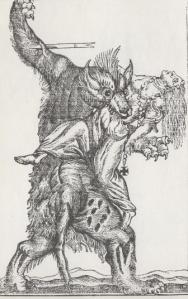
The earliest known record of a man becoming a wolf derives from ancient Greece. An Olympic athlete named Lycaon reputedly turned into a wolf (not during the games, I suspect, or he would had to have been put in the dog races). I would contend, however, that werewolves are at least biblical and likely older yet. The tale of Nebuchadrezzar transforming into an animal in Daniel 2 is widely known. Less recognized is that this story likely originated earlier than the book of Daniel, and it was associated with Babylonian king Nabonidus. Nabonidus was a devoted worshiper of Sin, the god in charge of the moon, and was rumored to have struggled with an “evil ulcer” (the mind reels) instead of having transformed into a beast. Rumors that he’d gone insane abounded, which, for lunatics, must count for something! How far back the moon’s transformational powers go is not known, but the marauding beasts of the night were known and feared long ago, along with the occasional insane king.

Not Nabonidus, but maybe one of his kids?

Not Nabonidus, but maybe one of his kids?

Unfortunately only after my Oshkosh course ended, I struck up correspondence with Linda Godfrey, a journalist who lived almost close enough to be a neighbor. Linda is an avid researcher of the Beast of Bray Road, Wisconsin’s own home-grown version of the werewolf. The closest I ever came to experiencing the beast was being awoken one midnight by a pack of coyotes howling through the yard, but I read Linda’s books with wonder. Are ancient fears really present realities? I suppose only time will tell, but our ancient ancestors sometimes had more keen eyesight than their modern day beneficiaries do. Their advice was to love the moon with caution since it could cause insanity in select cases!