Fire Walking

Telinema is a strange place.  (This is my word for television and cinema, since apparently no such term exists.)  My wife and I have been making our way through Twin Peaks.  We missed this when it first aired, being somewhat preoccupied living in Scotland.  As with most telinema involving David Lynch, there’s quite a lot to ponder.  (I’m less familiar with Mark Frost’s oeuvre.)  The show only ran for two seasons, but as often happens with substantial short-run shows like this, it became classic in retrospect.  Lynch had made movies before, and the initial series was like watching a several-hour film.  Then the movie came.  Twin Peaks: Fire Walk with Me tells the backstory of what had happened before the series began.  Like the X-Files, you kind of need to interlace the movie in with the series.  So we have.

Knowing me, I’ll probably write up a reaction after watching the third season, but I want to reflect a little on telinema.  Visual media have been around at least since cave drawings were first made and their power recognized.  People are captivated by images.  When movies started, they were short and sprinkled in with other entertainments until the idea of a feature-length film developed.  If you were going to spend an hour or more with a movie, there had to be a story.  (Some of those stories, early on, seemed to involve quite a lot of pedestrian activities, of course.)  Then television happened.  Movies could be shown on TV and movies could be made specifically for TV.  Then impressive series, like Twin Peaks, required a theatrical movie to get part of the story across.  They became hybrids.

Lately I’ve been realizing just how much “how a story goes” matters.  We are story-telling creatures.  Our lives are the stories we tell ourselves about ourselves.  And some of us are obsessed with the true story.  What really happened?  Telinema sometimes makes this difficult.  Dan Curtis, for example, made House of Dark Shadows—a theatrical movie—as a version of what he’d already produced in television land as the daily Dark Shadows.  Since there’s no word doing the work telinema does for me, I’m not quite sure how to search to see what the earlier examples might be.  The point is a compelling story will draw fans.  And being visual creatures we’ll watch if the story interests us.  Sometimes we have to watch across “platforms.”  Get out of the house into a theater to see how the story goes.  Yes, we need a word for this and we need to study just how far we’ll go for a story.


Small Things Grow

I’ve always been fascinated with origins.  I guess I’m a kid who never grew up.  Now that I’ve turned my attention to movies, I sometimes wonder about the origin of the story.  For example, The Little Shop of Horrors.  I first saw the musical movie version of 1986.  It was cute, and employed horror themes like the Rocky Horror Picture Show from the previous decade.  Then, when Roger Corman died, I read that he’d filmed the story back in 1960.  Curiosity compelled me to watch the original.  Like its remakes, it’s comedy horror, or horror comedy.  But beyond that it’s a literal farce.  Roger Corman was a showman, and that means he tried different things to entertain.  One of them was Little Shop.  The idea of the plot you probably know, but I couldn’t remember the ending as I sat down to view it.  After all, it’s not meant to be taken seriously.

I have to say that the music makes it better in the remake.  The endless malapropisms and burlesque humor are funny, but really in the original they are presented as low comedy.  The Jewish humor led me to fear that it might be anti-semitic, although not intended that way.  I empathize with Corman.  It took him nine months to find a company to release the film.  Ironically, it attained cult status after being double-billed as the B movie with Black Sunday, which was a quite serious attempt at horror.  Camp has a way of living on in cult status.  Of course, the early bit part for Jack Nicholson didn’t hurt.  It isn’t bad for a bad movie.

The idea of people-eating plants is a reasonable approach for a horror story.  (I’ve used it myself.)  Plants move very slowly, however, which is one reason that the idea’s hard to accept.  Even The Land Unknown had used the idea three years earlier.  But the seed was planted.  The idea of the film lead to an Off-Broadway show, which led to the more famous movie.  Then it reopened off-Broadway and a reboot was planned (but currently seems to be on ice).  Not bad for a movie based on a desire to reuse a set that was scheduled to be torn down, and then shot in two days.  Classic Corman.  The result was a bad film that is still fun to watch all these years later.  I did miss the musical numbers, however.  When you plant seeds, you never know what might grow.


Carnival Days

Carnival of Souls has been receiving renewed attention of late, so I decided to watch it again to see if I’d missed something the first time.  Indeed, I had. Carnival of Souls is one of those low-budget movies that was really never considered worth much until reevaluation started to take place several years after it was released (1962).  As a snapshot of an era, it offers a view of how horror and religion interact.  The story, in case you’re unfamiliar, follows Mary Henry, a young woman who’s a professional organist.  Even here a few things stand out.  She went to college, she relies on no man to support her.  And she views church work, as an organist, to be “just a job.”  This is pretty incredible on its own, but I’m getting ahead of myself.  Her car is nudged off a narrow bridge by a couple of guys out hot-rodding.

From the beginning the viewer is clued in that she drowned, although this isn’t made explicit until the end.  She makes her way to Salt Lake City where she’s been offered a job as an organist in an Episcopal church.  She “sees dead people” and becomes fascinated by an abandoned carnival on the shore of the Great Salt Lake.  The priest at first notes that she plays music to elevate the soul.  Later, however, after the dead man she keeps seeing unnerves her, she plays eerie music on the church organ (during practice) and the priest realizes that she’s not a believer.  He fires her on the spot.  Apart from getting the ethos of the Episcopal Church about right, this in itself is interesting.  The playing of creepy music is enough to lead to the loss of a church job.

John, the guy who won’t stop trying to score with her, wonders at one point if viewing church work as “just a job” doesn’t give her nightmares.  These attitudes, from only about six decades ago, seem terribly remote by today’s standards.  Many clergy have doubts about their faith.  Many don’t really believe what their church actually proclaims.  The movie shows a society that has an almost magical view of the church.  You can probably even take the “almost” out of that last sentence.  While the Bible’s not mentioned or quoted, the idea of a lost soul finding no home in the church is a telling bit of commentary.  Intentional or not.  Carnival of Souls will never be my favorite horror movie, but it has pre-echoes of Night of the Living Dead and a sincerity that invites consideration.  I can see why it’s gained renewed interest.


A Kind of Shine

Sometimes you just can’t not comment.  A few weeks after Donald Sutherland—known by some of us for his horror roles—passed away, Shelley Duvall has died.  It feels like the passing of an era for horror fans.  I never saw Sutherland in MASH, although I’m sure he made a good Hawkeye.  I did see him in Don’t Look Now, however, and An American Haunting.  Shelley Duvall grasped her claim to fame in The Shining, of course.  I can remember the apprehension that gripped me, after years of everyone telling me how scary it was, when I first saw it.  The Shining has its detractors, of course, but it remains one of my favorites.  That’s in no small measure due to Duvall’s portrayal of Wendy.

Duvall did other things, of course.  Since I tend to fixate on the things I like, I never followed her further career, but I did see her now and again.  She was in Tim Burton’s Frankenweenie.  For those looking forward to The Myth of Sleepy Hollow (I know I am), she’ll appear as the creator of Tall Tales & Legends.  She also created Nightmare Classics, which I have to admit to never having seen.  Although she was involved in other genres, she seemed to have a real interest in horror.  She retired from acting early in the millennium, but came out for one final film, last year.  It was the horror movie The Forest Hills.  Horror gets its hooks into you, I know.  But it keeps coming back to The Shining.  

In part it’s the claustrophobia of three people, only three, in an isolated hotel.  Of course it’s haunted as well, but the isolation premise alone is frightening.  Especially when one of the three (or maybe two) is becoming unhinged.  We live in an era of remakes and it’s possible someone will be foolhardy enough to try to remake Kubrick’s classic.  Even if it were a more faithful adaptation (Stephen King’s book is scary in its own right) it’s difficult to imagine that it could be better.  Part of it probably has to do with how Kubrick’s treatment of Duvall pushed her to the edge.  Fame has its cost.  And I suppose (since I wouldn’t know) that fame in a horror role comes with its own burdens.  Duvall went on to create things of her own.  More’s the pity that they’re not easily found either for streaming or on disc.  And things seem just a little bit quieter now, don’t they?


Hungry for Choice

I was recently asked to speak to a senior seminar about Holy Horror (many thanks for the invite!).  One of the questions asked was how/why I chose the movies I did.  The same question applies to Nightmares with the Bible.  The thing is, my avocation is an expensive one, particularly on an editor’s salary.  The number of horror movies is vast and our time on this planet is limited, so one thing any researcher has to do is draw limits.  Otherwise you get a never-ending project (some dissertations go that way).  I had figured, for both books, that I’d seen enough movies to make the point I was trying to make.  Neither book was intended to be “the last word,” or comprehensive, but were attempts to open the conversation.  Since none of my books have earned back nearly what resources I’ve put into them, a line has to be drawn.  Movies are expensive when they get to the bottom of the “outgoes” column.

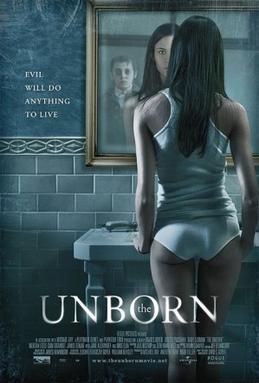
All of this is to explain why I didn’t include The Unborn in either book.  (It fits into both.)  I was aware of the movie, but I had to decide what I could afford in order to get the books written.  I confess that I wish I’d watched this one sooner.  (Remember, it’s a conversation!)   This movie has so much in it that I may break my self-imposed rule of no double-dipping for blog topics.  Or perhaps I’ll pitch something to Horror Homeroom.  The Unborn is about a dybbuk.  Like The Possession, it features a Jewish exorcism.  Like An American Haunting, a holy book is destroyed.  (The credits include a statement that no actual Torahs were harmed in the making of the film.) Interestingly, the exorcism is a joint effort between a rabbi and an Episcopal priest.  Held in an asylum.  It’s also a story about twins.

The skinny: college-aged Casey is being pursued by a three-generation dybbuk.  Her mother, who died by suicide in an asylum, had been adopted.  Casey is unaware that she was a twin, her brother having died in utero.  She discovers her birth grandmother, a Holocaust survivor, who clues her in to why all the strange things are happening to her.  Her own twin brother was possessed by a dybbuk at Auschwitz.  It is now after Casey, having caused her mother’s suicide.  The plot is pretty sprawling, and the exorcism scene over-the-top, but I’m only scratching the surface here.  There’s so much to unpack that I wish I had a bigger movie-and-book budget.  But then we all have our demons with which to struggle.


Monster of Aging

Movies with no likable characters, or none with any redeeming personality traits, are difficult to remain awake through.  At least on sleepy weekend afternoons.  The Leech Woman is one such movie.  It was difficult to get past the premise that an aging woman is cause for alarm among the overly entitled male characters.  Dr. Paul Talbot is disgusted by his older wife until he finds credible evidence of a concoction that will cause a person to grow young again.  Wanting her to be his experiment, he takes her to Africa where he witnesses the rejuvenating formula in person.  It requires, however, a murder to be effective.  For her victim, June chooses her husband.  The effects, however, are only temporary so June will need to keep on killing to remain young.  Each time the formula wears off she’s prematurely aged.

When she’s young again, the men around her feel it is their right to claim her, which, in a sense, provides her with a ready pool of victims.  On the other hand, it reflects attitudes beginning to die out as the sixties began.  Many of these movies from the fifties throw in a woman to provide little more than love interest.  Sometimes these women have a profession—reporter is one that shows up occasionally, or perhaps in a military role or as nurse—but mostly they are there to find a husband and become, ideally, a housewife.  Many unrealistic men today still think that should be the case, but few jobs earn enough for the possibility of being a one-income family.  Besides, did anyone ever think to ask the women what they wanted?

Aging isn’t the easiest thing to do.  This movie plays up the stereotype that men become “distinguished” with age while women don’t.  Such unreflective outlooks on aging completely overlook things like aching backs and forgetting things that are typical for just about anyone who makes it past a certain landmark.  In fact, aging is something we all face in common, and our attitudes toward it can make all the difference.  Fortunately since this movie came out, we’ve had many role models showing us that women do retain their worth and dignity as they age, even as men do.  We are an aging population.  One benefit, hopefully, to the passing years is the accumulation of wisdom.  And that applies, no matter gender or sex.  We reach a certain age and we look back and wish we’d known then what we know now.  That takes place with generations, too.  That way we can say Leech Woman is a period piece, but that still doesn’t make it a good horror movie.


Shifting Gears

The question’s very basic: do you pay with cash, or by watching commercials.  When it’s the same three commercials the whole way through—for products you’d never buy—just paying the cash may seem the better option.  But it’s too late for that.  It’s the Graveyard Shift.  There’s no doubt  that Stephen King is responsible for the ideas for more horror movies than probably any other single individual.  I’d read his story, “Graveyard Shift,” many years ago.  I was warned, though, that this was one of the least favorite of his adaptations, and that’s a pretty low bar.  Still, it was just a matter of sitting through the same commercials over and over.  And one of them was more entertaining than the movie.  Of course, I don’t really watch for entertainment.  This is a learning opportunity.

Let’s start with the basics: You need at least one sympathetic character.  Okay, you kinda like Jane, because she shows basic humanitarian traits.  And Carmichael.  Then you want a plot that makes some sense—what is Warwick’s motivation?  The writing is particularly bad.  If there’d been a bit more intentional camp, this might’ve made a reasonable horror comedy.  I mean, you’ve already got the empty aluminum cans being fired by slingshot.  As it is, it’s played straight with an evil foreman, rats everywhere, and a giant bat in the basement.  By the end you’re kind of rooting for the bat.  And whose idea was it to use voiceovers of the sub-par dialogue over the closing credits?  Is this so bad that it’s good?  I’m having trouble deciding.

Although set around the fourth of July I wouldn’t call this holiday horror.  Nevertheless, there are some moments of religious imagery that pop out.  The graveyard sinking in the river has a listing statue of Jesus near the start of the film.  And the exterminator—the only real camp in the flick—narrates how in Vietnam they pinned victims down, like Jesus, to feed them to the rats.  The final couple of minutes—well earned, I assure you—have Hall fighting the wicked foreman with the jawbone of an animal (one has to assume an ass), inexplicably among human bones (some still in their coffins).  And his slingshot ultimately killing the giant (bat).  The references are to Samson and David, respectively.  Perhaps this movie’s an indictment of capitalism, since the basement cleanup is on Independence Day.  Or maybe it’s just tired horror tropes on a break.  (Having one of the characters reading Ben in the diner was a nice touch.)  It may become a holiday tradition after all.


Storming Fourth

Our founders picked a day of uncertain weather to declare independence.  One gets the sense that people were more stoic about the weather in those days.  Of course, we’ve increased global warming and made things more extreme.  Nevertheless, I can remember very few fourths of July when the possibility of storms was zero.  The weather around here has been odd this year with a suddenly hot June, with a dry spell that killed quite a few plants, followed by a cool start to July and some very intense storms.  And now, on the fourth, the possibility of rain in the forecast.  The grass hadn’t been growing in the dry spell, but I’m hoping the rain will hold off today long enough for me to get that job done.  In fact, on this secular holiday I’d been hoping to get quite a few outdoors chores checked off the list.

When I was younger and fireworks were the main draw to the day, I noticed that just about every year rain fell, or threatened to, on July fourth.  I’m sure it’s not that way everywhere, but here in Pennsylvania, where the declaration was signed, it’s a reality of life.  Of course, the modern Independence Day celebrations evolved over time to include the cookout and fireworks—outdoor activities both.  For me, apart from the outdoor chores on a day off work, a movie seems like an indoor celebratory alternative.  Perhaps Return of the Living Dead, set on the fourth.  Or I Know What You Did Last Summer.  Or Graveyard Shift.  Maybe something else.

Watching the political theater unfold—and my, what a dramatic election year it’s been—perhaps a comedy horror is just about right for today.  This is going to take some thought.  Something to occupy my mind while doing those outdoor chores.  Of course, I’ve got a book to get submitted as well.  If the weeds can hold off for another day or two—is it wise to paint the porch when rain’s in the forecast?—maybe I can finish up Sleepy Hollow.  It’s a good American ghost story.  That might be appropriate as well.  You see, holidays are so rare that too many things crowd in on them.  They’re breaks from the constant earning of more money, which is the American way.  Of course, our founders were largely restless gentry.  For me a day off work is always a busy day.  Especially when the rains have returned and the grass has grown.  It must be the fourth of July.


A Land Forgotten

In case anyone’s noticed (which I doubt) that I’ve been discussing a spate of 1950s sci-fi/horror movies, I have a confession to make.  Several years ago I needed to see Tarantula.  (Anyone with similar headspace will know this need.)  The only place it was available at the time was in The Classic Sci-Fi Ultimate Collection.  Volumes 1 and 2 were sold together.  I did what I had to do.  Then I forgot I had the set before finishing volume 1.  Who knows what might’ve been going on in my life then?  Rediscovering it has been a budget-saving way to address my fix.  I had never heard of The Land Unknown before, and although it has one of the goofiest T-rexes ever, it is actually a good story.  Of course there are holes in the plot, but it is about the necessity of being humane, even when emotion dictates otherwise.

A helicopter crew on a South Pole expedition makes an emergency landing in a volcano that harbors prehistoric life in a hot spot in Antarctica.  The crew has a female reporter with them—these movies certainly have fifties attitudes about women!  Not having the parts to repair their copter, they try to survive among dinosaurs and an aggressive, giant monitor lizard.  There is another person there, the sole survivor of an earlier expedition, who’s become mostly feral.  The commander of the modern crew demands that they give him the dignity and fair treatment that all people deserve.  There’s a bit of drama around who will get the girl (again, the fifties), with the commander ultimately winning out.  How do our heroes escape this peril?  They’re able to repair the helicopter with parts from the earlier expedition’s crashed vehicle.

With its budget the special effects had to be cheap, but the story has redeeming value.  The message that we mustn’t let isolation drive us to bestiality is still as important as ever.  There are those who watch such movies solely to laugh at the special effects.  Hey, I laughed a bit too, but I’m only human!  There is, however, more to this movie than the dinosaurs, which drew audiences then just as the Jurassic Park franchisedoes now.  There’s even some serious talk about evolution, which was often present in these Universal creature features.  There are some slip-ups on the evolution part, but apparently the monitor lizards were meant to represent stegosauruses—did I mention the budget was tight?  I actually found the movie to be worth seeing for its intrinsic value.  Not bad for a forgotten set purchased mainly for one movie in a time unknown.


Praying for Mantis

Now this is a Cold War movie.  And I mean “cold.”  The Deadly Mantis is one of those movies that hovers between “so bad it’s good” and just plain “so bad.”  I was kind of rooting for the mantis.  In any case, this was an ambitious movie for the time but it reflects the post-war paranoia in the United States.  It also makes very abundant use of stock footage, much of it military.  You almost expect a recruiting ad at the end.  (It does thank the Ground Observer Corps in the closing credits.)  Okay, so here’s the story.  A volcano in the south Atlantic causes the calving of an enormous Arctic iceberg near the North Pole.   That iceberg contains the frozen body of a 200-foot praying mantis from dinosaur times.  Even earlier.   Said frozen mantis, quite hungry after millions of years, begins attacking Arctic radar bases and flying south.  The Air Force calls in a paleontologist to help identify what they’re looking for.

The mantis is so big that it prefers people for food, although, one might note, a polar bear would’ve been easier prey.  In any case, given the technology limitations of the time, the military has trouble keeping track of the insect as it flies over the most populous part of the country.  They do get the cloudiness of the East Coast about right.  Eventually they shoot it down—actually a fighter jet crashing into it does the job—over Newark and the mortally wounded mantis crawls into the Lincoln Tunnel (called “The Manhattan Tunnel” in the film).  By this point the viewer is saying “just let the poor thing die in peace,” but they pump smoke into the tunnel, presumably to hide wires and other props, and commit a protracted insecticide.  

Now, I’m one of those people who hates to hurt any animal.  The death twitches of an insect are quite troubling, so I try to catch what I can indoors and release them.  I have trouble with the instructions to kill spotted lantern flies—it’s not their fault that they’re here.  The movie shows a bravado regarding the military and a machismo regarding the main female character that hearkens back to why it was so necessary to evolve out of the fifties.  Of course, we learned nothing from The Deadly Mantis and have catapulted back into a new Cold War and an even more robust military.  William Alland, the producer, had a real love of this genre of movie, and for that we have much to be grateful.  But even the big bug genre can produce a real groaner now and then.


Not Poor

It’s an amazing era for cinema.  A number of genre-defying films have emerged and some of them are quite striking.  Some months ago I saw Everything Everywhere All at Once.  Some called it horror, but that label didn’t really stick.  It reminded me of Parasite, another movie difficult to classify.  Casting about for something we might both like, my wife and I settled on Poor Things, recommended to me by a fellow horror fan.  Other than being amazed by it, I have no idea how to classify it either.  Again, there are horror elements here but it’s certainly not a horror movie.  A comedy, yes, but a dark one.  It’s a movie that has a feminist message, but one that’s been disputed.    Perhaps a quasi-summary might help.

Bella Baxter is not what she seems.  Cared for by a Frankenstein-like doctor named Godwin, she literally has the brain of an infant in an adult body and is rapidly coming to know the world.  Rescuing her just after she died by suicide, Godwin transplanted her unborn baby’s brain into her revived body to see what would happen.  Himself experimented on mercilessly by his own father, Godwin is a rationalist, eschewing emotional entanglements.  He decides to marry Bella to one of his students but before that can happen an unscrupulous lawyer steals her away only to find he can’t control her.  After gaining experience of the world, and learning life lessons in a brothel, Bella returns home to marry her fiancé and be with Godwin as he dies.  Her cruel former husband reclaims her only to have Bella realize why she’d chosen suicide in the first place.  She returns to Godwin’s home and sets up life on her own terms.

A number of things stand out.  One is Bella’s innocence and utter lack of shame regarding her body.  Emma Stone’s acting here is incredible.  Another is the nods to steampunk sensibilities in a story set in Victorian times.  Perhaps the aspect that most caught my attention was Bella’s use of “God” as her name for Godwin, frequently calling him “my God.”  Her grammatical naivety leads to much of the comedy in the film, but this particular choice is freighted with interpretative possibilities.  Obviously, one’s parents are the models one incorporates into concepts of God.  That has been long recognized.  Another, however, is that Godwin did, in fact, create her to see what she would become.  As Godwin faces his own mortality, Bella notes “God is dying.”  What happens after this is that she becomes her own woman for the first time, not under the control of men.  I’m not sure how to classify Poor Things apart from a movie that may require another watching just to attempt a classification.


Invisible Again

Sequels are a fact of life.  Movies, although some of us look to them for profundity, are made for selling.  (I guess my writing for so long with no profit from it has skewed my view a bit.)  Still, The Invisible Man Returns isn’t too bad.  In my mind, there were a set of six canonical Universal monster movies: Dracula, Frankenstein, The Mummy, The Invisible Man, The Wolf Man, and The Creature from the Black Lagoon.  In reality, each of these successful films was followed by a clutch of sequels, filling the thirties and forties—into the fifties—with monster movies.  I never really bothered with the sequels, but some of them are pretty good.  And I still haven’t seen the more recent Invisible Man, which I hear is quite good.

When I was a kid, Vincent Price represented horror like no other single person.  He had developed a persona that was lucrative and that influenced other monster boomers as well.  He was a relative unknown when he was hired for The Invisible Man Returns.  His face only appears in the last minute of the film and his voice had not yet settled into its characteristic menace tone that would make him a genre icon.  Still, the story has a typical plot for the period.  Sir Geoffrey Radcliffe is set to hang for killing his brother—they own a coal mine.  Dr. Frank Griffin, a friend of the family and brother of the original Invisible Man, believes him innocent and makes Radcliffe invisible so that he can escape the gallows.  As we all know, the problem with the invisibility drug—here duocaine rather than monocaine—is that it causes insanity.  Radcliffe discovers the real murderer before going insane, all the while being chased by police.

These “invisible” films demonstrated what special effects could become.  Shot in black-and-white, “black screen” technology was used to make Radcliffe appear headless and handless.  In fact, this movie received an Oscar nomination for the effects.  It’s not a scary film, but it’s a reasonably told story.  And the special effects really were cutting edge for 1940.  Probably somewhat scandalous for the time, Radcliffe has to undress in front of his fiancée at one point, leading the men who discovered her fainted to suppose that seeing a naked, if invisible, man could do it.  There is a subtle humor here.  Other films followed but they veered into the comedy realm.  Until the recent remake.  I guess I’ll need to add that one to my ever-growing list of must-see movies.


Two-Eyed Cyclops

You can probably tell, if you read me regularly, that I’ve been going through an older movie kick.  A lot of these are easier to find for free on streaming services, so that’s been the path of least resistance.  So it was that I came to watch Doctor Cyclops.  I’d completely forgotten that I’d watched it about fourteen years ago.  In any case, a kind of precursor to The Incredible Shrinking Man, it’s the story of the deliberate shrinking of five people by a mad scientist with an endless supply of radium at hand.  The movie made a splash because of the use of Technicolor in a horror film (with no blood, however).  The story is a touch dull and the shrunken people (three scientists among them) spend most of their down time running around and saying very little.  They do face an alligator, which is kind of fun, and the big hand that holds the pompous Dr. Bulfinch is distinctly unnerving.  The movie received an Oscar nomination for visual effects.

There’s something distinctly enjoyable about these early sci-fi horror films that don’t explain much but nevertheless manage to employ some impressive cinematography.  The use of oversized props and forced perspective make much of this possible, perhaps making up for the simplicity of the tale.  Even by 1940 the “scientist goes mad and must be stopped” narrative was getting old.  The Second World War was underway but nuclear power wasn’t yet harnessed either for bombs or energy.  Interestingly, the source of the mad doctor’s radium is pitchblende, which one of the characters notes, is a source of uranium.  Of course, many movies were to follow where radiation mutated life forms in various ways, including shrinking them.

Coincidentally—it was a rainy Sunday afternoon—I watched the Twilight Zone episode “The Little People” later in the day.  Here was another story about the large oppressing the small.  This one, however, has a stranded astronaut who discovers the little people thinking that he is their god because he has the power to harm them.  The message here is much more profound, even if told with more brevity.  No clear motive is given for Dr. Cyclops’ work beyond his interest in pure science.  By the way, his real name isn’t “Cyclops.”  That refers to his being a giant with one eye—the latter because one of his glasses lenses gets broken.  Don’t worry, the shrunken people learn that the effect is temporary—their brush with radioactivity leaves no lasting harm.  There is, however, a decided danger to desiring to return to a “simpler time,” as Mr. Serling steps in to remind us.


History Lesson

This blog, which has come to define me in many ways, wasn’t my idea.  A niece started it for me when Neal Stephenson suggested I should have a place for podcasting.  I still have ideas for podcasts, but finding the time to put them together (and a place to host them) has proven quite challenging.  In any case, the title, “Sects and Violence in the Ancient World,” reflected where I was at the time.  I started posting when I was 46, and now I’m over 60.  Things are bound to change a little.  From the start, I wrote about books.  Indeed, for things I’ve read since summer of 2009, I check the blog to find out when.  I also noted significant movies.  In the early days I tried to limit the posts to religion-themed topics since, well, I have three degrees in the field.

As I gradually grew comfortable discussing pop culture (generally horror), I gradually addressed movies and books without a religious bent.  It could be that I didn’t record everything I read or watched here, and that makes things before 2009 kind of a muddle.  While the muddle really began before 2005—my last year at Nashotah House.  That period was a kind of maelstrom of desperation to find a job, teaching classes, pretending to be an editor, making my way in a world unfamiliar to me and certainly unchosen.  Eventually this blog came to focus on horror movies more than religion.  Now, like my life, it’s a jumble of conflicting impulses trying to make sense of the world as an existentialist with a bit of faith.  I’m still aspiring to that mustard seed.

I’m not sure when it was that I began commenting on most movies I watched.  I’ve used movies as therapy since 2005—for some reason horror made me feel better.  Even now, when I want to remember when I saw a movie I check this blog.  Or if I want to know when I read a book.  My wife pointed Goodreads out to me in 2013, and that became another place to post on books, even if they didn’t qualify for “Sects and Violence.”  But that slushy period between 2005 and 2013 was full of books, I know.  In addition to movies, I read incessantly.  If I want to remember when I read what, however, I’ve only got the last decade really covered.  Goodreads says I’ve read about a thousand books since 2013.  For movies, I have no way of knowing how many I’ve seen.  Or where, for the most part.  Maybe I need to start keeping a proper diary.  Maybe one with a lock and a key.


Under Bite

Religion and horror have long been bedfellows.  And quite companionable ones at that.  I’ve written a longer piece that I’ve not yet managed to wedge into a book about how the earliest Universal monster movies all involve religion in some way.  Maybe some day it will come out into the light.  In the meantime, I submit, for your consideration, The Cult of the Cobra.  This 1955 horror film was one of a series of movies about shapeshifting.  We’ve recently seen The Leopard Man on this blog, and before that Cat PeopleCult of the Cobra, set in amorphous “Asia” to start, involves the invented religion of the Lamians.  A group of US Airmen pay a Lamian to watch a woman transform into a cobra in an “Asian” ritual.  They’re revealed by trying to take a photograph—they’d been warned that if they were discovered the cobra would hunt them down and kill them.

Convinced this is all superstition, despite one of them dying the next night from a cobra bite, they return to New York City and civilian life.  The cobra woman follows them to carry out her mission.  She’s killed, however, before getting the last two.  What’s so interesting here is the discussion of belief that takes place throughout the movie.  Americans can’t believe in some “cult”—it’s clear from the start that anything not western is cult—but none of them show any inclination to church, or crosses, or even references to God or the Bible.  The only religion shown is that of the Lamians.  The cobra woman falls in love with one of the Airmen and tries to explain that she’s coming to doubt something she’s believed all her life.  She’s caught between religious duty and the experience of falling in love.

The movie failed to impress critics and was largely dismissed as a knock-off of Cat People.  There’s too quick a judgment here, however.  One of Universal’s earlier monsters had encountered a non-western religion but became much more famous for it.  The Mummy was based on “ancient Egyptian” religion.  Indeed, the whole story is premised on it.  The Cult of the Cobra, however, engages with the religion.  As jingoistic as it is, it nevertheless tries to represent “the cult” as a religion taken seriously by an exotic group of believers.  “Lamians” seems to have been borrowed from Greek mythology, however, where lamia were demon-like devourers of children.  I write about them in Nightmares with the Bible.  This isn’t a great movie by any stretch, but it shouldn’t be dismissed either.  It’s an important piece of the puzzle of how religion and horror interact in film.