Tall and Slender

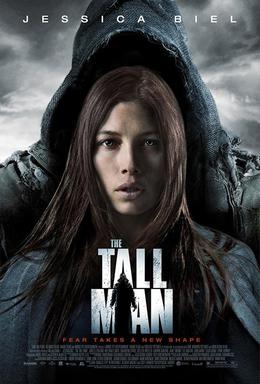
At first I thought she was mistaken.  A friend mentioned, in a litany of horror films, The Tall Man.  I thought she meant The Slender Man.  Then I saw an online post that referenced The Tall Man and I grew curious.  That curiosity almost cost me my lunch.  Not for the reasons you might assume, but because The Tall Man’s one of those movies that seems to think the camera has to be in constant motion.  I have an inner ear condition that makes me extremely susceptible to motion sickness.  It happens even if I watch train cars passing (which is, indeed, one of the images with which the movie starts).  I kept telling myself, give it a few more minutes, maybe they’ll buy a tripod.  I’m glad I stayed with it because it was inspired by the Slender Man urban legend.  Later, The Slender Man was made into a movie, perhaps inspired by The Tall Man.

Although horror, this probably isn’t what you think.  The reason I was glad that I stuck with it is that, although confusing, it has a good message and everything becomes clear at the very end.  Director misdirection is very common, of course, but this one worked on me.  There’ll be spoilers here—so you’re warned.  The common thread behind both Tall and Slender is missing children.  Some mythical or folkloristic creature snatches them away.  There’s no supernatural in this movie.  It revolves around a widowed nurse in a dying town, Cold Rock, Washington.  The children are suffering and the nurse wants them to live a better life.  Here’s a spoiler—read no further unless you want the ending ruined.  I’m serious.  The next paragraph will spill the beans!

Her husband isn’t really dead.  Working together they kidnap working class children and get them to loving, caring, affluent families.  There’s a ton of social commentary in this film.  As the nurse explains, the system is broken.  Too many children are left to suffer and the only way to break the cycle is to break the rules.  The appearance of William B. Davis made me think X-Files, but his role here is a straight-up sheriff.  There is no “Tall Man,” just like there is no Slender Man, but legends do take on lives of their own.  This isn’t one of my favorite movies, but it is better than I was led to believe.  And having a social conscience, while not rare, is always a good thing to see in a horror movie.  If only they could keep the camera still.


Cinematic Demons

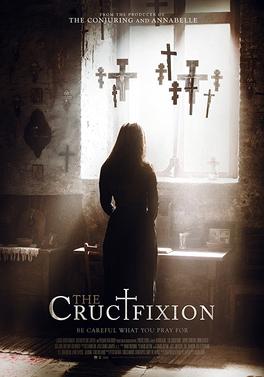
It was because I read The Exorcist Effect.  I realize that there are lots of movies that I could’ve watched for Nightmares with the Bible, but with limited time, limited budget, and limited social contact, I made choices without all the data.  I guess no one ever has all the data, really.  In any case, I could’ve discussed The Crucifixion.  I’ve been taking a bit of a break from exorcism movies, but since this one was based on a true story I’d not heard before Exorcist Effect, I decided to give it a go.  Although highly fictionalized, the movie crew did pick up on significant details from the case of Maricica Irina Cornici, who died after an exorcism in Romania.  The framing story is that of Nicole Rawlins, a journalist who wants to learn the truth.

In fact, the story is really about how Rawlins comes to faith after confronting the demon Agares.  Rawlins has guilt over being an atheist, unable to convince her dying mother to try new treatment and then by letting her die with the knowledge that her daughter has no faith.  In Romania Rawlins drives around a lot and, in one of the most difficult to accept aspects, everyone freely gives information.  Sister Adelina Marinescu, the victim, we’re led to believe, picked up a sexually transmitted demon in Germany.  Her brother, and friends, even the bishop, all freely share their opinions.  Rawlins develops a crush on the local priest, Fr. Anton.  He wants her to regain faith since, as an atheist, she’s an easy target with a demon on the loose.

It turns out that the demon was actually transmitted from a possessed priest, who got it from a possessed farmer.  It then passed to Sister Adelina and from her to Rawlins.  Her possession becomes apparent on the farm of the original possessed man and Fr. Anton performs an unplanned exorcism to save Rawlins from the same fate as Sister Adelina.  Rawlins comes to believe; she saw her mother during a brief moment when, it’s implied, Nicole died.  The film has a rather convoluted plot and many scenes where logic seems to break down, but it is certainly a passable horror film.  Rawlins earns sympathy as the lead, and the Romanian setting is a nice (if historical) touch.  The local festival “like Halloween” adds intrigue.  The movie didn’t rock the critics, but it seems like it works for what it is.  And if I even write a follow-up to Nightmares, it will definitely be included.


Movies, Paused

Technology breaks the world into bits.  It’s not just pixels, or 1s and 0s, it’s culture.  And we let it happen.  I was thinking this when I should’ve been watching a movie.  I don’t have much time for films, nor do I have money to see everything in a theater.  Or even to pay on a streaming service so that I can watch without commercials.  So like any zombie, I just let it happen.  Recently I was watching a movie—it’s here on this blog someplace—that was uncommonly unified by mood.  Edgar Allan Poe was of the opinion, and I think he was right, that short stories should be brief enough to finish in a single sitting.  Poe opined that such a reading allowed for the continuation of a mood set by the writer.  He was a master at doing this himself.  Breaking up movies with commercials reminds us of his wisdom.

Photo by Ramon Kagie on Unsplash

So I was watching a film where the dread builds up slowly.  The shadows, the music, the unspooling plot—try this new toothpaste!  Here’s a silly television show that you can watch on our network!  What was the mood I was in?  It was shattered by people pushing stuff I’ll never buy.  (I’ve got sensitive teeth, Mr. Commercial, and my dentist has recommended a brand that keeps me from gnawing my tongue off.  And that television show, Ms. Commercial, has no appeal to me.  I won’t watch it.)  Back to the mood you were trying to enjoy.  This isn’t anything new, of course.  I grew up watching Saturday afternoon monster movies and they were constantly interrupted by commercials.  You have to endure the sermon if you want the fun of coffee hour.  But still, but still…

Yes, I know the rules.  Subscribe to a service (I use two) and you can watch what we’ve got.  Only some of it will be interrupted by commercials.  Companies as large as ours didn’t get this way by accident, you know.  We had to show the average person what market research indicates they want—whiter teeth, more entertainment.  Forget what you’re watching at the moment.  Isn’t that mood just a little intense?  Don’t you need a little break just about now?  I don’t know how you see these posts, but I pay extra not to have advertising on my website.  I do hope that’s the case, if you see it from a device other than mine.  Besides


Revisiting the Zone

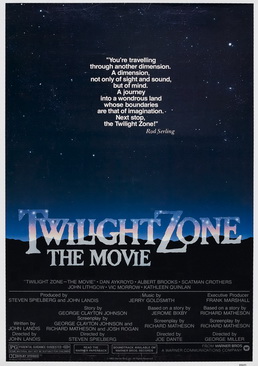
Like many people in the early eighties, I heard about the terrifying accident that killed Vic Morrow, Myca Dinh Le, and Renee Shin-Yi Chen during the filming of Twilight Zone: The Movie.  Because of that I steered away from ever seeing it.  I grew up loving The Twilight Zone, and I was probably enough of a self-assured critic at twenty to suppose the movie would never have been as good as the original series had been.  Still, it didn’t leave my consciousness.  Not entirely.  There have been a couple of television reboots of the series—most recently by Jordan Peele—and it seems that those of the present day still see the cultural value in the original.  Peele’s relaunch, although short-lived, brought the movie back to mind and I finally decided to watch it when I learned that one of the segments was based on “Nightmare at 20,000 Feet,” given my recent gremlin kick.

I knew the film was an anthology and those are always dicey.  I also knew I’d be watching an actor in his final role—the scene in which he and the children actually died was not used in the movie, of course.  I didn’t realize how many stars were in the cast, and I didn’t even know what the other three episodes were.  Critics (paid and un) have opined that the episodes increase in appeal as the movie progresses, and the opening segment has been hailed as one of the scariest introductions among films.  So some forty years after it released I watched it.  I actually found it to be largely in the spirit of Rod Serling.  I don’t know what he would’ve thought of the movie, but it seems to have continued his message.  The first segment, the one in which Morrow starred, wasn’t based on a single original Twilight Zone episode as the other three were.  A few “Easter eggs” exist for fans, such as Burgess Meredith narrating and Helen Foley saying she’s headed to Willoughby on the remake of “It’s a Good Life.”  No doubt, “It’s a Good Life” and “Nightmare at 20,000 Feet” are among the most famous of the episodes in the series.

Part of me is surprised that the film was released at all.  Deaths have occurred, of course, in the making of other movies.  Some in which millions of dollars had already been invested.  Still, watching a final performance like this has a haunted quality to it.  At times it seems that acting can be a dangerous profession.  And certain movies may always be difficult to watch because of it. But should we expect anything different from this Twilight Zone in which we live?


Loving Vampires

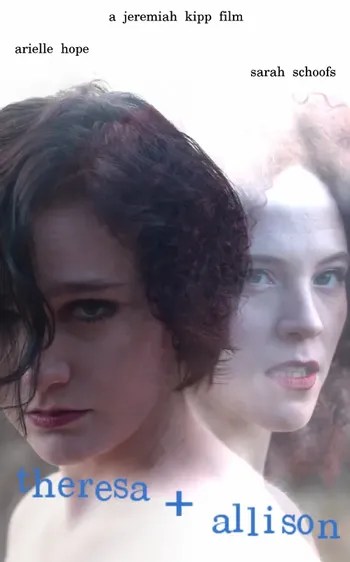
Vampires caught my attention early in life.  I believe, apart from ghosts, that they were the first monsters I learned about.  Apart from the fangs and perhaps an ironically anemic look, they appear to be just like us.  I’ve seen a great number of vampire movies over the years—I can’t seem to resist them.  I don’t care for the blood and gore, but the idea of the conflicted undead is a powerful draw.  It’s this conflicted aspect that brought Theresa & Allison to my vampire radar.  This movie is not for the squeamish, and I have to say up front that it is a lesbian vampire movie, with all that that implies.  You have been warned.  Theresa & Allison is also an indie movie—I’ve been watching quite a few of these lately because they’re often free.  This one is also smart and fairly original and it explores humanitarian concerns as well as vampiric ones.

Said Teresa is “made” when a drunken vampire (they get drunk when their victims are inebriated) decides to turn her (make her into a vampire).  She soon learns that vampires are organized and sanctioned by the government, and there are rules to be followed.  Also, some of the standards for vampire lore, we’re told, are male bovine droppings.   Teresa was lesbian before she was turned, and she’s befriended by fellow vampire Allison.  We learn that two major vampire “families” range about New York City—one graceful and kind, the other brutal and unfeeling.  Teresa has real trouble killing people for blood and she’s confused about what she’s become.  She doesn’t know what to make of it when the kinder vampires offer to let her join.  Instead, she follows Allison and finds herself in a blood-drenched nightmare.

Vampire movies are often full of social commentary.  Especially the spate of movies made available by independent auteurs.  Theresa & Allison asks the question of what makes something right or wrong.  It also explores what it means to accept who or what you are while also having the ability to change some aspects of it.  It reflects, it seems to me, the moral landscape of the young.  In that respect, it makes sense that those of us from older generations (let’s not kid ourselves) may have been raised with very different standards.  Culture, however, has continued to evolve.  The internet sped all of that up immensely.  Still, the acceptance aspect of the young is written all over movies like this.  And the internet means there will undoubtedly be more to come.  Vampires are sure getting interesting.


Christmas Monsters

Gremlins holds up pretty well with the years.  My renewed interest was sparked by holiday horror—I had last seen the movie in a theater in 1984, when it came out.  Having grown used to CGI, I was surprised to re-learn that the gremlins were puppets but that it was so obvious was also a surprise.  Although comedy horror, or horror comedy, had been around for years at that point, as critics pointed out, the contrast here was stark.  This could be a kid’s movie (and was one of the reasons behind the shortly new PG-13 rating) but the nasty gremlins could be unexpectedly brutal.  I’d forgotten that Billy’s mother was so effective—killing a gremlin in a blender and another in a microwave.  The story has been retold and/or parodied often enough that a summary isn’t necessary, but given my recent interest in both gremlins and holiday horror, it’s worth a few moments’ reflection.

Holiday horror is more than a scary movie that happens to occur on a holiday.  In my definition, the horror has to derive from the holiday itself.  In Gremlins the gift of Gizmo is based on the fact that it’s Christmas, otherwise Rand wouldn’t have been looking for a gift for his son, starting the whole chain of events.  More than that, the reason I didn’t go back to the movie again in my college and grad school years was the story Kate tells about her father on Christmas.  Like some parents, I felt like what was a fun little story was a bit too distressing given the holiday setting.  Would the story have worked set at a different time of year—remember, it was released in summer—with the commentary that it makes about consumer culture?  No, this had to be a Christmas movie and the fear comes from that fact.

The gremlins are given minimal backstory here, although Murray Futterman tells Billy and Kate  that gremlins come from foreign merchandise and they tinker with machines.  Gremlins had been used in horror before, and given that the canon of classic movie monsters was being set from the thirties through the fifties (gremlins appeared as monsters as early as the forties) they fit right in.  They’re inspired monsters.  People naturally feel vulnerable on planes and monsters in the atmosphere can be particularly frightening.  And the fact that technology frequently malfunctions, well, wouldn’t it be nice to have a monster to blame?  Reading up on the movie made me curious to see the sequel, which, it seems wasn’t too badly received.  I’m glad to have used a small portion of the holiday season to have refreshed my memory.


Dryad?

There are so many movies out there.  The prudent horror fan knows not to be nickeled and dimed to death by renting/buying everything available, so you stick with a streaming service and take what they offer.  That’s how I find many of the movies I discuss on this blog.  It’s how I found Ayla.  You won’t find much information on this indie, art-house horror beyond IMDb, and it doesn’t say much.  Although the ratings are low the premise is good and it is beautifully filmed.  It is a little weird, though.  Elton, a mentally disturbed man, has never gotten over the death of his sister when she was four.  He supports himself by working in a bookstore and has a regular girlfriend, Alex, but he hasn’t let his sister go.  Going to a remote, dilapidated house that Alex showed him, he digs under a tree until he finds an adult Ayla.

Ayla’s alive but she doesn’t talk and can’t tolerate solid food.  She seems to be part of the tree where Elton found her.  His brother and mother tell him this woman isn’t his sister.  Alex, who lost a brother when she was a child, doesn’t say whether Ayla’s Elton’s sister or not.  Accepting that this woman now lives with him, she’s just not sure if the dead do come back.  Elton quits his job and tries to move home with his mother, but it doesn’t work out.  While driving at night, Ayla, ahem, distracts him, and his car hits a tree.  Elton understands that Ayla has returned to the tree and begins digging for her, but doesn’t find her.  Alex finds evidence that Elton has begun to turn into whatever it was “Ayla” is.

Apart from being a study of grief—very much like A Ghost Story in that way—Ayla also explores mental illness and incest.  This is done with a high degree of artistry, however.  Those who rate the movie poorly probably haven’t considered metaphors much.  To me, there’s a lot going on in this film.  It’s the kind of movie where you want to talk to somebody about it after it’s over.  Was Ayla really a dryad?  She’s found in a nymph (insect variety) state and quickly transforms to, apparently, Elton’s missing sister.  Meanwhile, his family doesn’t give him the affirmation he requires.  Metaphorically, it seems, like Outpost, to be a movie about dealing with trauma.  Such films are well worth watching and pondering.  And they make me thankful for streaming services that occasionally bring good, if obscure, movies to light.


Movie Ancestors

I’ve read quite a few Very Short Introductions, but this one struck me as particularly good.  Donna Kornhaber knows how to write for non-specialists, and she knows how to single out what’s interesting in the vast collective known as Silent Film.  As is the series trademark, this book is very brief, but it covers the essentials.  Kornhaber divides the silent film era, roughly 1895 to 1927, into three periods: early cinema, the transitional period, and the classic era.  During each of these, new developments demonstrated the sophistication of the industry and groundwork was laid for cinema as we know it today.  I learned quite a lot from this short treatment—so much that it’s difficult to know how to summarize it here.  Of course, it’s short so you can read it for yourself if you’d like to learn more. 

Perhaps what stood out to me the most was the correction of a misperception that, I hope, is not unique to me alone.  I’ve always thought of silent films as being grainy, poorly exposed, and choppy when showing people’s movements.  Kornhaber explains that most movies were of sound quality in their day, when projected properly.  Early film stock deteriorates, however, and not all stock was properly preserved.  This accounts for the graininess and the sometimes “overexposed” look of such films.  Even modern projectionists don’t use the proper speed and that leads to choppy motion.  In their own day, and with film handled by people who knew their business, early movie goers would have experienced realistic, well-rendered images.   These issues are our issues, not those of the original footage.

Another feature of the book is its focus on diversity in filmmaking.  Early silent film was dominated by France and the United States, but several other nations contributed to what we now think of as standard elements of cinema.  And the fact is that until sound was introduced many women played important roles in the development of what we expect from films.  Women directed.  Became business-savvy.  Ran their own studios.  Once the industry established itself as particularly lucrative, men began to edge women out.  The majority of early films—Kornhaber suggests around 80%—were lost as studios saw no reason to preserve them once “talkies” were the way to make money.  Consequently we’ve lost a good part of that early history.  We pretty much take movies for granted.  We can stream them any time, and we know what to expect (roughly, anyway).  What we don’t often consider is how much we owe to those who established what the movie-going experience should be, and did so before sound was added to the mix.


Which Love

Perhaps some content creators use genre as a guide when writing, or when filming a movie.  Some categories are pretty well defined—the western, the romance, or in writing specifically, the literary.  Others are less easily settled.  Horror is particularly slippery.  Although The Love Witch was an interesting story with a feminist message, the horror trappings weren’t entirely obvious.  In fact, it reminded me quite a bit of The Wicker Man.  (Not in any literal way, of course.)  Afterward I read that it is also a comedy and that helped make sense of it.  It gets generally high marks although, to me, the acting seemed pretty wooden.  The Love Witch follows Elaine, a young, present-day witch, who’s moving to a small town in California that tolerates witches.  Her husband has recently died and flashbacks imply that Elaine may not have been entirely innocent in the matter.

Once she settles in Arcata, she starts looking for her “prince charming” as she continues to practice the craft.  She finds an emotionally unstable professor who take her home readily enough, but he quickly proves to be too needy.  Part of this is because he took a love potion she gave him.  He dies that very weekend.  Elaine seems less than distraught as she buries him and begins seeking the next possibility.  The husband of a friend comes over when the friend is out of town and he too proves emotionally immature.  After their affair he dies by suicide.  A policeman investigating the missing professor comes to suspect Elaine, but he too feels drawn to her.  The locals, meanwhile, aren’t as witch-friendly as they seem.  They riot in a burlesque club, chanting, “Burn the witch, burn the witch!”  I won’t spoil the ending.

I was watching all of this with the genre “horror” in my mind.  I’d not seen it labeled as “comedy,” and, as an art film there’s nothing so crude as a laughter track or cheesy and obvious comic music.  Instead, the film is an example of “the female gaze.”  Film analysts, and even religion scholars, have long written about “the male gaze,” which looks at women a certain way.  This movie’s writer, director, and producer, Anna Biller, experiments with the female gaze instead.  The results for some men, I suspect, are disturbing.  They certainly aren’t in control in this film.  Retro in execution, it’s unlike most other horror I’ve watched.  Unusual for the genre, the critics responded well to it.  It was a fun flick, but I’m still not sure how wide “horror” stretches, but I do sense that it’s quite inclusive.  And I applaud the female empowerment on display, even if I’m confused.


Sights of Silence

To an historian who cut his teeth on deep antiquity (if circumstances were different I would’ve ended up a Sumerologist), my current fascination with film feels manageable.  The form of communication we call “movies” really only began around 1895.  For those of us who find 1000 BCE a bit too modern, the nineteenth century seems strangely contemporary.  Simon Popple and Joe Kember offer a service, therefore, by giving us a Short Cuts on Early Cinema.  I’ve never formally studied cinematography, of course.  I have watched movies my entire life—grew up with them—and have learned to write about them (with some degree of intelligence, I hope!).  The history of the industry itself is fascinating.  Short Cuts are written for students, and this one covers the first twenty years of cinema, 1895–1914.  The cutoff coincides with the start of World War One, although not the introduction of sound, but it works nevertheless.

Although I learned a lot from this little book, the writing was sometimes verging on the technical.  Also, and this is a personal pet peeve, many of the paragraphs were too long.  This is an academic epidemic, not applying to this book only.  Look, I know the whole topic sentence and development thing, but paragraphs may be divided in different places, hopefully compelling the reader on.  When I see books intended for “general readers” with a wall of unbroken left margin, I shudder.  Give the eye a break.  This little digression shouldn’t be taken to imply that this book does it a lot, but there are some long paragraphs and they can make you lose your way.  In any case, there’s lots of good info here to balance out the occasional academic framing.

I especially found useful the year-by-year breakdown of major development in the early film industry.  Movies required quite a few breakthroughs, not the least of which was photography itself and also film stock that could be measured in hundreds of feet.  The machines to both film movement and project film.  Although not by 1914, syncing sound.  Color photography.  Movies are technical marvels.  And my approach to anything that is so gripping is to research its history.  In the case of cinema, it’s not a terribly long history.  Although 1895 is getting further away each passing second, it wasn’t even a century before I was born.  For those of us who look backwards, length does make a difference.  A lot was going on behind the scenes as movies went from one-minute side-show attractions to feature length productions where people went to specially designed theaters to view them.  This little book gives a walk through that world and what helped make cinema what it’s become.


Could Have Understood Differently

A lesson many authors need to learn (and I include myself here) is that titles matter.  Cutesy, clever titles may work for well-known writers, but something that describes your book, or movie, is essential.  And avoid acronyms.  I avoided watching C.H.U.D. for years, put off by the title.  I’d read a few books where it was discussed, but finally decided it was something I should see.  If you’re as put off by acronyms as I am, C.H.U.D. has a double meaning.  Initially Cannibalistic Humanoid Underground Dwellers, but more importantly, Contamination Hazard Urban Disposal.  I suppose that’s a bit of a spoiler, but since the movie’s been out since 1984 I’ll let it stand.  Although largely panned, I think C.H.U.D.’s a perfectly serviceable monster movie and despite what the critics say, it has a larger message.

Set in a gritty New York City, the film focuses on the homeless who live underground.  Although it’s not preachy about it, the underlying message is that these are people too.  Until, of course, the contamination hazard mutates some of them into C.H.U.D.  Then they start looking for human victims.  In a city the size of New York, they don’t have much trouble finding them either.  A government cover-up is behind all the mayhem.  Nuclear and other hazardous waste is a very real problem, and none of us really knows what happens to it.  With much of government boiling down to political theater, I’ll take my chances watching movies and wondering.  The good guys in this movie are those who actually care about the homeless.  They are a rather unsympathetic photographer and his wife, a police captain with a missing wife, and a guy who runs a soup kitchen.  They learn something isn’t right beneath the streets but can’t get the authorities to admit it.

This isn’t a great movie—there are gaps in the plot all over the place—but it’s not a horrible movie either.  Sympathetic portrayals of the poor are, in my experience, rare.  These are people who’ve organized themselves into a society that’s come under threat because of those who dwell in the light.  Some classify C.H.U.D. as science fiction,  but that’s a very loose use of the term.  It’s actually a low-budget horror film with a bit of heart.  Unfortunately the title obscures that this is a little gem of a monster movie.  I really had little idea of what it was about when I started streaming, but ninety minutes later I was glad I’d done so.  And I went down to the basement afterwards, you know, just to check.


What Poe Saw

It must be quite a draw, making a film based on Edgar Allan Poe.  The psychology of his tales of terror is compelling and modern filmmaking offers endless possibilities.  I wasn’t looking for anything too heavy, so I watched Requiem for the Damned.  Vignette movies are like a box of chocolates (I’m sure you know how the rest of it goes).  This particular feature doesn’t seem to have had a theatrical release, perhaps because it is an independent film made by students and faculty at the Douglas Education Center.  The opening credits cite the Allegheny Image Factory, and when I think of Pittsburgh and horror my mind eventually wanders to George Romero.  The Douglas Education Center began as a business school south of Pittsburgh and it offers training in filmmaking.  And that seems to explain this particular film.

Five vignettes are taken from Poe’s “Fall of the House of Usher,” “The Tell-Tale Heart,” “The Black Cat,” “Murders in the Rue Morgue,” and “The Pit and the Pendulum.”  Only “The Black Cat” is set in Poe’s period and it is heavily CGI.  The rest are modernized versions of ideas inspired by Poe rather than following his plots.  “Usher” uses Poe’s characters and an introduced illegitimate son, to present the Usher curse—the unfeeling business practices that brought the Ushers wealth have made theirs a haunted estate. “Tell-Tale” has a modern urban legend feel as a guy starts seeing his ex-girlfriend’s broken heart everywhere he goes.  “Rue Morgue” is a lesbian revenge story involving an improvised gorilla suit.  “Pit” is a post-apocalyptic vision with almost no dialogue and a somewhat confusing resolution.

Horror anthologies seldom work.  Like edited volumes in the book world, they lack coherence.  Poe insisted that short stories should be single-sitting forms so that mood could be maintained.  Putting five together, each with different directors, writers, and styles, makes for a disjointed viewing experience.  A couple of the segments, “Black Cat,” and “Pit,” seemed to drag a bit.  The former because you already know the story and the CGI was so abstract that it interfered with the telling and the latter because you really don’t know what’s going on.  The visuals are impressive, but story seems to have been sacrificed.  I was looking for something not too heavy and I did find that.  I also learned about a place where filmmaking is taught and you don’t have to have connections to get in.  Who knows?  Perhaps in another life I might’ve gone that direction.  I tend to follow Poe.


Black Bird

Although we prefer typecasting—it’s so much easier!—Edgar Allan Poe had both depth and width as a writer.  He penned funny as well as scary, love poems and detective stories, even something like a scientific treatise.  One thing I’m sure he didn’t anticipate was his name being suborned for cheap horror movies.  Roger Corman is a Hollywood legend—a good example of a guy making it in the film industry on his own terms.  He paired Vincent Price with a number of Poe titles that had little to do with the actual works of the writer.  One that oddly stayed with me since childhood is The Raven.  This was well before I’d read the poem.  It’s funny how very specific things will stick in your mind.  I remembered the strange hat Price wore.  And I remembered—misremembered, actually—Price using a spinning magical device with sparklers.  Misremembered because that was Peter Lorre’s character, not Price.

That was it.  I didn’t remember that Boris Karloff was also in the film.  I was too young (as was he) to recognize Jack Nicholson as well.  Although I watched The Twilight Zone, I didn’t realize the script was by Richard Matheson.  This film was loaded with talent, but it really was goofy.  I recollected Price was a magician, but I didn’t know this was a rather silly battle to become chief magician.  Lorre’s ad libbed lines were surprisingly funny, even after all these years (I was about one when the film came out).  Surprisingly, the movie did well at the box office, despite its taking a sophomoric approach to perhaps Poe’s most serious poem.  

I’d avoided watching it again for all these years because of that sparkler scene.  I’m not sure why that particular moment wedged itself so firmly in my young brain.  It seemed so not Poe that I couldn’t get back to the movie, apparently.  With Price and Lorre camping it up—Karloff was, by all accounts, most professional as an actor—and Nicholson uncharacteristically timid, the cheap special effects, it’s obvious that viewers enjoyed a good laugh at this one.  It’s not true to Poe, of course.  It’s true to Roger Corman, however, a filmmaker who knew how to deliver cheaply and quickly and still earn some money at it.  I’d last seen The Raven about half a century ago.  I may be tempted to watch it again, after having seen it as an adult, but if I wait too long I’ll need to leave that duty to someone who’s read this and who isn’t afraid of sparklers. 


After Effects

Every once in a while you find a book you wish had been published sooner.  The Exorcist Effect, by Joseph P. Laycock and Eric Harrelson is one of those books.  Although it covers many of the same films I talk about in Nightmares with the Bible, it does so with a different target in mind, and a lower price point.  Drawing on the observation that human recall is often accompanied by “source amnesia,” they explore the idea that famous horror films (and some less famous) get remembered as “facts.”  This seems to be a greater danger to those who don’t actually watch horror or who watch it uncritically.  Movies such as The Exorcist become the basis for what individuals believe about demons.  But it’s far more dangerous than that, because in a culture where everything’s politicized, horror movies become “the truth” for groups like QAnon.

Considering Rosemary’s Baby, The Exorcist, and The Omen as prime examples, they then move on to consider the fascinating, if weird, lives of Ed and Lorraine Warren, and Malachi Martin.  Popularizers such as these three influenced both horror films and general public opinion about demonic possession and exorcism.  The study moves on to the Satanic Panic of the eighties and nineties and how heavy metal music both utilizes and ties into the Exorcist Effect.  This important book ends by discussing the very real dangers of a society that elects presidents and others based on this Effect, which confuses reality and movies.  The book shows how many of the ideas behind conspiracy theories either misremember, or intentionally misuse, horror films.

Back in the days when I started Nightmares with the Bible there was comparatively little published in readable terms that discussed demons or, specifically, the portrayal of exorcism in movies.  Laycock and Harrelson’s book would’ve been a welcome contributor to that dearth of resources.  As someone who works on the fringes of the fringe, I don’t always hear the discussions other scholars have and I’m often left to my own devices when it comes to finding and reading information on horror films.  Without library privileges, it often means having to purchase the books to access them.  I was thrilled when I first learned about this book and I’m glad to have finally had the opportunity to read it.  I’m sure I’ll be coming back to it on occasion.  After writing Nightmares, I took a bit of a break from demons because being in the dark for too long can do odd things to a person.  But not knowing about them, as this book shows, might cause even greater problems.


Edge of Civilization

This is not a movie to be watched by someone with PTSD.  I watched Outpost for the scenery (I’ve been to the area it was filmed many times) and because the New York Times highlighted it.  It ended up being the scariest movie I’ve seen since The Shining.  I mean the kind of scary where your heart is still battering around your chest even after the credits roll.  As an indie horror film it may not be well known.  For clarity’s sake I need to say it’s the Outpost released in 2023.  The one about a woman who goes to spend a summer in a fire tower to recover from domestic abuse.  If you haven’t suffered PTSD, and you’re not as emotionally involved as I let myself become, you might guess by about halfway through what’s really going on.  But there are a bunch of people in the northern Idaho woods that you just don’t trust.

I’ll try not to spoil the ending, but here’s how it goes: Kate was beaten by her husband.  And sexually abused by an uncle when she was growing up.  Against the advice of her best friend, whose brother works for the forestry department, she takes a summer job on a fire lookout tower.  The locals at the store, all men, are threatening in her eyes.  Her new boss doesn’t think she’s a good fit for the post, but to help smooth things over with his sister, he lets Kate have the job.  Along with lighthouses, fire lookout towers are some of the loneliest places in the civilized world.  When a couple of young guys hike by, noting she’s all alone in the tower, your skin begins to crawl.  She keeps having flashbacks to the violence in her past.  Then she meets an older woman hiker who stays awhile and teaches her how to shoot.  A local retiree teaches her how to chop wood.

Kate still doesn’t trust the local retiree.  One of her colleagues from the forestry service has surreptitiously taken photos of her and ogles them.  And day after day after day she has to follow a routine and sees no one.  You get the picture.  I don’t want to give too much away, but for some of us this may be among the scariest movies we’ve ever seen, despite most of it being in the clear summer sunshine of northern Idaho.  The movie ends with a contact number for the National Domestic Violence Hotline.  Joe Lo Truglio, the director, is an actor known for comedy.  Outpost makes me think there’s something else behind the laughter.