November Nightmares

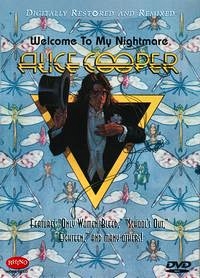
Music videos weren’t really a thing then.  And “Welcome to my Nightmare” was theater as well as rock.  I knew a movie of it existed, but I only made an effort to see it as October was slipping through my grip.  I have a strange, one-sided history with Alice Cooper.  We listened to the radio back when we were kids and we all knew Cooper from “School’s Out,” an unofficial anthem of the seventies.  We didn’t have much money when I was growing up (some things never change), but I had a copy of the album Welcome to my Nightmare.  I couldn’t recollect how I’d got it until my brother clued me in.  We were at Jamesway just outside Franklin one Friday night.  My mother, frugal to the day of her death, saw that Alice Cooper’s new album had a song called “Steven” on it and she bought it for me.

Now Mom knew full well that my official name is “Steve” (she named me).  There’s no “n” in there anywhere.  Yet still, even as I knew this, I found that song spoke to me.  Like the Steven on the album, I was prone to nightmares.  And the sequence of “Years Ago” and “Steven” on that concept album never left me.  Mom would not have approved of the movie version—I found the misogynist parts difficult to watch myself—but it did answer a question I always had: how did he perform these songs in concert?  They seemed too big for that.  They weren’t the snippets I always assumed rock stars did.  (I never attended concerts, so what did I know?)  Alice Cooper is still the only rockstar I’ve ever seen in concert, but the theatrics were brought way down and his back probably ached like mine did after that event.

I’d been looking for a horror movie to finish out the month, you see.  I keep a list of movies that, apparently, are never free on Amazon Prime or Hulu.  It ended up taking nearly all the little time I allot myself for such indulgences to try to find something.  Then I remembered Alice.  It was raining outside and I had caught up on my emails for the moment.  This step into a yesteryear I never knew made me realize just how creative people can be.  We have to get someone to pay us for doing something, and if you can sing and strut, well, you might consider sharing your nightmares.  Something many of us have in abundance, even in November.


October’s Child

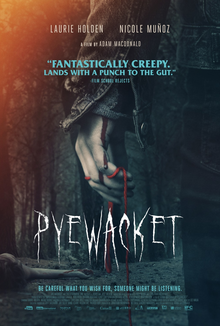
The thing about films is that there are so many of them, and they come into existence in so many ways.  Back when I was a kid, you learned about movies through the newspaper, or television or maybe radio ads.  Sometimes word of mouth, or, if you were lucky enough to see a film in a theater, through previews.  These days the internet has billions of pages and many streaming services and movies are produced faster than we can watch them.  All of which is to say Pyewacket, in my opinion, should be better known.  It’s an effective, thoughtful, and seasonal movie that caught me off guard.  It’s a Canadian independent film, not the product of a major studio, so it didn’t get the notice that massive advertising budgets provide.  I found it by scrolling on Amazon Prime.

Pyewacket is a teen angst movie (I wasn’t an angsty teenager—it came a little later for me).  Leah Reyes and her friends are into the occult.  Leah’s father has died and her mother’s having a difficult time coping.  She has decided to sell the house and move away.  Leah, who has a small circle of close friends, doesn’t want to move.  After mother and daughter are in the new house they fight, with her mother insulting Leah’s friends.  Leah goes into the woods and summons Pyewacket to kill her mother.  After this, mother and daughter make up and the tension builds.  Leah doesn’t want her to die but she’s set something in motion that she can’t control.  There are some really scary scenes in this movie, often without showing anything explicit.  In fact, views of Pyewacket are brief and indistinct, which really works.

This is an October movie.  Moody and evocative, it raises some very real questions.  Not all of them are resolved.  The occultist Leah consults informs her that Pyewacket is very deceptive and she can’t believe what she sees.  This leads to a tense resolution and somewhat abrupt ending.  It is very well done.  The point about deceptive spirits raises one of the truly potentially demonic facets of human society.  Deception throws truth off balance.  (Some of the more cynical politicians know and use this for their own ends, as we sadly know.)  Deception is dangerous and that seems to be almost the moral of this movie.  There are no villains here, but extreme actions can’t be taken back.  If you’re in the right mood, and the dark is just right, this is the kind of movie that delivers.  And I only found it by chance.


With Spiders

It gets October right, but Cobweb leaves quite a few unanswered questions.  One of the queries I always bring to movies is “where did it happen?”.  This isn’t, of course, the same thing as where it’s filmed.  Cobweb was filmed in Bulgaria—that certainly gives it an atmospheric feel.  It’s set, however, somewhere in the United States.  License plates aren’t shown long enough to really help, but a refrigerator magnet in the shape of Pennsylvania may be a hint.  In any case, the story’s a bit of a stretch, and it has some continuity issues, but I may come back to it in a future October.  The acting is pretty good, but the direction could be tighter.  So what’s it all about?  (There will be spoilers.)

A young boy, Peter, is bullied at school.  His parents are odd and they never believe Peter when he hears noises at night.  Or so they say.  As with much horror, things are not what they seem.  Peter’s parents had a somewhat Poesque solution to what turns out to be Peter’s older sister.  Born deformed, they made a pit in the basement to house her.  She gets out into the walls of the house, and talks to Peter at night.  We all know you should never listen to creepy voices in the dark, but she tells her brother he should defend himself from bullies.  And when he gets expelled from school for doing so, she suggests he give his parents the “We Have Always Lived in the Castle” treatment.  In support of this, she points out where he can find the body his parents buried in the back yard.  Now, there are many pumpkin-sized holes in the plot, but for a movie embodying October, I’m willing to let it pass.  Spooky rather than outright scary, the film does have some fairly tense moments.

Rescue comes at the hands of a teacher—and this is always a heartening development.  The name, “Miss Devine,” awoke hopes that maybe some traditional religious elements might appear, but no.  It seems to have been from the lineage of Miss Honey from Matilda.  She does read Poe’s “The Raven” to her class, though.  Overall she’s a teacher who has her students’ best interests at heart, particularly those who are sad.  The message is a little more difficult to discern.  Other than Peter and Miss Devine, pretty much everybody else is unlikeable.  Parents are murderers, sister a manipulative monster (even if made so by said parents), and all the other kids pick on Peter.  A good October effort, Cobweb is a story that needs some direction.


Halloween Tale

Halloween movies are hit or miss. Anthology movies are the same. My interest in holiday horror keeps me coming back for more nevertheless. Tales of Halloween has been fairly well reviewed over the years. As intimated, it’s an anthology film. There are ten separate stories squeezed in, leading to an average of nine minutes per episode. To make matters more interesting, each story has a different director. The end result is kind of like a pillowcase after trick-or-treating, you get some good stuff and some you’d rather not have received. The movie’s also a comedy horror so you’re meant to laugh throughout. Kind of like Halloween itself, I suppose. At least for some people. The movie didn’t do anything for me. There were no takeaways, and nothing really memorable.

Halloween is an unusual holiday.  For one thing, the way it’s celebrated is fairly recent.  Childhood memories of costumes and trick-or-treating and ghosts and goblins are all pretty new.  Well, maybe not the ghosts.  For some of us it’s a spiritual time.  A reflective season.  I’m not sure how anybody can not try to figure out what life’s all about.  Some of us have steered our lives (in as far as we actually steer them) in the direction of trying to figure these things out.  For me, Halloween is a time of spiritual growth.  Not exactly fun, but enjoyable nevertheless.  I know it’s different for different people.  Some people live for the fun and the partying.  It’s like that pillowcase all over again.  There is, at least in my experience, no perfect Halloween movie.  I won’t stop trying to find it, however.

John Carpenter’s Halloween is the movie that really kickstarted films based on this particular holiday.  Although I’m no fan of slashers, I do enjoy this one from time to time.  It’s a well-made movie, moody like autumn.  In Tales of Halloween, the background movie in two segments is Night of the Living Dead, a classic by any standards.  Carnival of Souls is shown in another episode.  Horror is a notoriously self-referential genre.  Last year I watched Trick ‘r Treat, another such anthology film.  It likewise made little impact.  On me, anyway.  Perhaps Halloween isn’t about horror after all.  It’s a time for reflection.  And pretending.  Since we all pretend most of the time it is perhaps the most natural of holidays.  Pretense on other holidays, although it happens, is considered in bad taste.  At least on Halloween we can be honest about it.  Some day someone may actually capture that in a movie.


Ginger Wolves

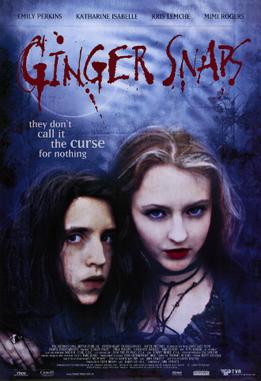
I’ve known about Ginger Snaps for years but the reason I finally watched it was a rainy fall weekend.  The kind of day that suggests imminent winter and you wish that you had a fireplace instead of waiting on the furnace guy to check everything out for another year.  Surprisingly, in my experience, there aren’t many movies that capture that mood very well.  The Little Girl Who Lives Down the Lane is one of the best.  But movies new to me give me topics for blogging, and so I watched Ginger Snaps.  It’s not a typical werewolf movie.  It’s become a cult favorite over the years since it didn’t get much of a box office boost.  It’s smart, and sad, and moody.  And, as is becoming more important to me, well acted.

Brigitte and Ginger are teenage sisters, 15 and 16 respectively.  They share a room and morbid interests.  Their affluent, suburban parents just don’t understand them.  They’re ostracized at school.  Then Ginger gets bitten by a werewolf.  The plot is a coming-of-age story for women, and it has attracted feminist interest over the years.  The sisters are devoted to each other because both are pariahs and, well, sisters.  This begins to change when one of them becomes a monster.  But only to a degree.  Brigitte is determined to stick with her lycanthrope sibling, and tries to cure her.  There’s quite  bit of dark humor along the way but this is pretty effective body horror.  Making it about growing up adds an emotional poignancy to the story.

Werewolves have always been my favorite classical monster.  Ginger Snaps made me realize that it’s almost always a guy problem, however.  Men are the ones struggling to keep the beast inside.  Having this apply to a young woman throws into relief all the uneven standards society harbors.  Some exist for pretty obvious historical reasons, but others are matters of convention, often religious in nature.  Religion is pretty much absent from this movie, however.  Lycanthropy is transmitted like a virus and you don’t need silver bullets to stop a werewolf.  This is a world, in fact, where teens have to try to figure out their own way because parents are too distracted with their own problems.  It is a kind of modern parable, but without a religious angle.  The girls are conflicted about what’s happening to Ginger.  She enjoys the power but fears the consequences.  It is a good Halloween movie, but mostly it’s about growing up, whatever that may be like.


Not Grant

Grant Wood’s painting, “American Gothic,” is undoubtedly his most famous work.  The image is so evocative and suggestive that countless interpretations have been offered for it.  The idea of debilitating isolation suggests itself.  An unhappy self-reliance that has taken its toll on an aging couple (some say the woman is his daughter) often comes to mind.  For some it suggests a movie.  Normally I like horror films from the seventies and eighties.  There’s almost an innocence to them that gets lost in the new millennium.  On a rainy weekend afternoon when I couldn’t be mowing the lawn I found American Gothic on Amazon Prime and it had received four stars and even IMDb showed it as better than average.  The longer I watched the more I was inching toward “bad movie” territory, but I had to see how it ended.

Six young people, four of whom are distinctly unlikeable, have plane trouble and get stranded on a lonely island in the Pacific northwest.  They discover a house furnished from the twenties and it turns out there’s an older couple there who don’t really cotton onto strangers.  As the plot unfolds it turns out they have three adult children who think they’re still adolescents.  And—this is the good part—they are a very religious family (in part.  Again, as often happens in such films, the writers really don’t understand religion).  In any case, the predictable killing off of the kids starts to happen when they continue to be rude and insult the family.  Since we’re in slasher territory here, there’s a final girl—one of the two sympathetic women—who ultimately takes over the house.

Part of the problem with the film is the utter paranoia with which it treats mental illness.  The family clearly has problems and, in a way typical for the genre, they turn toward killing.  Ironically, Pa, when he finds his family has been killed by the one mentally ill visitor (everyone with psychological problems in this movie turns to murder), renounces God and sells himself to Satan.  Interestingly, he doesn’t survive long enough to do anything about it.  Reading about this movie after watching it I came across a new word: hixploitation.  Exploitation movies are familiar to anyone who watches much in this genre, but I’d never considered that Deliverance and company exploit “hicks.”  It’s all about how others look at you.  And, as a movie made in Canada and the UK, it shows us what others see when they look at us.  There’s some ground to explore here in a sequel to Holy Horror


What Message?

The search for autumnal horror movies is a never-ending one.  Can it really be that auteurs just don’t—drenched in the California sun—get that October feeling?  There’s something in the turning of the leaves and the appearance of pumpkins that changes everything.  And it works every year.  So it was that I thought of The Messengers.  I’d watched this years ago but found it somewhat unremarkable.  I seemed to recollect that, being based on a farm, it was autumnal in character, so I decided to try it again.  I remembered once more why I hadn’t watched it for years.  It’s a serviceable movie, but it is really set in summer (short sleeves the whole way through) and although August farm visits put me in the fall mood, this one is incoherent enough to prevent that feeling from catching on.

Jess is a girl with a past.  Driving under the influence, in Chicago, she was in a crash that rendered her baby brother mute.  In response her parents decide to move to a sunflower farm in North Dakota.  There the crows (actually ravens) attack them.  A stranger arrives and offers to help out.  Of course the house is haunted because of some past murders, but when the crows attack the hired help, it spurs him into a relapse—he’d lived here before and had killed his family, and so he decides to kill this new one too.  Being PG-13, they survive and the house swallows up the murderer from the past.  It’s never quite clear what the crows (the presumed messengers) really want to convey.  Are they trying to warn the family?  Are they trying to awake a killer’s memory?  What do they want?

This is an early Kristen Stewart movie—she’ll go on to more sophisticated horror films.  William B. Davis, with only cameo appearances, offers echoes of The X-Files.  Casting the generally congenial John Corbett as a killer is a bit of a stretch, however.  More intriguing, in this more global world, are the directors—the Pang brothers.  Known for their east Asian movies, including award-winning horror, they took on this American-themed, shot in Canada, project.  It had the backing of a few production companies and a reasonable budget.  Still, it struggles to be memorable.  I seem to recall that the prequel might’ve been a bit better.  But was it autumn-based?  I can’t recall and it’s that time of year when seeing falling leaves and a pumpkin or two make for essential viewing.


Something Wicked

There comes a morning each year, pre-dawn, that it happens.  I crawl out of bed and things feel slightly chilly.  The furnace hasn’t been turned on yet, and ever sensitive to cold, I put on long sleeves and slippers to do my morning writing before the sun.  I start getting a powerful hankering to watch my autumn movies.  This year when that happened, in September, I finally watched Something Wicked this Way Comes.  Now, Disney isn’t a studio known for its horror films.  Over the years, however, they’ve produced some family-friendly efforts toward the scary end of the spectrum.  I tried to make the case in Holy Horror (and a list on IMDb agrees with me) that Pirates of the Caribbean falls into that gentle horror category.  I’ve read established writers on horror claim that The Watcher in the Woods was the movie that frightened them most.  I don’t think Something Wicked falls into that category, but I can say I liked it better than the novel.

And that’s saying something, because it was written by Ray Bradbury.  Bradbury’s stories were an integral part of my childhood.  In fact, much of my fiction writing is modeled on his work.  I didn’t really care for the novel Something Wicked this Way Comes, which I read last year.  The film is an improvement.  And it had a tortured way to the silver screen.  It began as a short story.  Bradbury himself adapted it into a screenplay anticipating a role for Gene Kelley.  This was in 1958.  When that didn’t pan out, he wrote it as a novel.  Filmmakers began to show an interest in the early seventies, but the movie didn’t come out until 1983, after Disney bought the rights and took over production.  The screenplay is mostly Bradbury and the soundtrack rips off Star Wars more than once.

Bradbury could get a little too nostalgic about boyhood.  His yesteryears seem far too innocent to me.  Although, having a few scenes where Jim shows curiosity about sex was a bit racy for Disney, I should think.  Jonathan Pryce does a fine job as Dark, and the mood isn’t bad for family-friendly fare.  I was never much of one for carnivals.  I can’t do rides and it’s easy to see through the games you can’t win and even if you do your prize is cheap.  Other entertainments always appealed to me more.  Still, the film sets a mood, and that’s generally what I’m after when the mornings begin to feel chilly and I’m looking off into another winter.


Frightening Legacy

Like The Wicker Man, The Exorcist also turns fifty this December.  I was caught up in this half-century mania and so I got ahold of Nat Segaloff’s The Exorcist Legacy: 50 Years of Fear right away.  The reading was disrupted by life events, but I’d been enjoying it, as time permitted.  Written by a movie insider (as opposed to an ex-academic wannabe), this is a fairly full treatment of the film.  It’s actually not unlike what I tried to do with Nightmares with the Bible, but it is yet another testimony of the importance of The Exorcist to our understanding of demons.  Although one book can’t really be one-stop shopping for any worthwhile movie (there are plenty of books out there on the subject), this one is well worth reading.  For those who enjoy learning about cultural phenomena with a bit of horror tossed in, this is a very good introduction.

One of the things I’ve learned as I’ve tried to break into film reading is that a lot more goes on in making a film than most of us imagine.  And when we see a movie we miss an awful lot.  I’m no shill for Hollywood, but watching a movie multiple times brings out things that writers, directors, and producers didn’t even notice.  Think of the Bible, for comparison.  Readers two thousand years later are still finding new things to say about it.  The Exorcist has influenced religious outlooks in extremely important ways.  Our modern ideas of demons and possession largely go back to this film.  Details may change over time, but even the church has had to respond to it, and actual exorcists reference it.  The Bible says little about demons (again, Nightmares), so we have to pick such knowledge up from elsewhere.

The one part I found somewhat thin was, not surprisingly, parts of the final chapter, “The Mystery of Faith.”  It tends to show when a writer really knows religion.  William Peter Blatty, who wrote the novel and screenplay (the latter at least partially), knew Catholicism cold.  One of the things I’ve been yammering on about for years is that understanding religion enhances our understanding of horror movies.  I’m certain that the connection goes even deeper than that, but books written on horror mention religion often in amateur ways.  If we want to get at what’s really going on here, it’s going to be important to listen to those who understand religion as well.  None of that detracts from this fascinating book that will throw new light into shadowed corners.


An October Movie

October means different things to different people.  I know what it feels like to me and I suspect, and hope, that there are others who experience it like I do.  When I search for October movies I’m looking for a kind of happy melancholy unique to the season, but others seem to think movies about witches capture the feel.  So it was that I came to watch Practical Magic, which was recommended on more than one October movie list.  It’s not a horror film, in fact it’s a rom-com and it doesn’t try to frighten anyone, although there is one tense scene.  Like many movies about modern-day witches, it has a good message of female empowerment.  I’m glad I watched it for that reason, and the story isn’t bad.  Set on an island community, presumably in Massachusetts, but shot in California, it’s not exactly falling leaves and pumpkins, though.

Witches seem to be the preferred monsters for feminine endorsement.  Most people, I suspect, wish they had magical powers.  We all want things to go our way and would like to manipulate them in that direction.  But there’s something more to it.  It’s tapping into an ultimate power—something that can’t be challenged.  Practical Magic, although not always in a serious mood, does portray the struggles witches have against occult powers.  The story is of the Owens family, which have been witches since the pilgrims landed.  They suffer under a curse dooming the men with whom they fall in love.  Not all the women are cut out for such a life.  So it is that Gillian and Sally set out to break the curse, each in their own way.

Other occult powers are at work, however.  One is clearly the curse itself and another seems to be an undead boyfriend who eventually possesses Gillian.  The women of the community have to come together to exorcise this entity, and that finally leads to communal acceptance of witches.  A major studio production with a reasonable budget and star power, it really didn’t do well at the box office.  Barbie seems to have struck a feminist chord that Practical Magic was reaching for, but the late nineties were a time when women’s power seemed to be starting to secure itself.  I noticed that, when looking for the movie on streaming services, it’s now having a limited theatrical run—it’s October, after all.  This may not be my October movie, but it has a good message that still needs to be learned.


Final Thoughts

You feel kind of special running stop signs and red lights.  I’ve never driven in a funeral cortege before but this one is somehow taking place on an obligingly rainy October afternoon.  Although I was in that kind of emotional shock that you feel at the death of a close family member (it isn’t my first), I couldn’t help but consider all those behind the scenes who work in the death industry.  From the mortician at the Gardinier-Warren Funeral Home—where my grandmother’s funeral was also held—to the undertaker getting soaked in the chilly rain, everyone was friendly and kind.  I also reflected that watching horror movies is homework in a world where death is inevitable.  As a child I already knew about death, and although I’m not afraid to die, I’m not eager to have that particular experience just yet.

Horror movies are all about learning to cope.  Not so different from the book of Job, they’re reflections on why “the good life” doesn’t continue as it sometimes does for various stretches of a human life.  And as we age, death more and more naturally comes to mind.  I’ve written before about the therapeutic aspect of my odd avocation.  One of the realities of growing up religious is that my mother—may she rest in peace—taught me early on that this would be my bodily fate.  I found it disturbing seeing my grandmother in her casket.  I remember distinctly Mom telling me, “this is just her shell,” that her soul had moved on.  That didn’t prevent nightmares of that shell rising and walking again.  Is it any wonder I grew up watching horror films?

Reflecting afterwards with my brothers on our physical ailments—we aren’t young any more—my thoughts wandered back from time to time to horror movies that had made this just a little easier for me.  Life is full of opportunities to do our homework.  As I grew up reading the Bible and watching horror, I didn’t think of it as studying, but it was.  Many kids with whom I went to high school have died over the years.  I tend to look at the alumni magazine necrologies even as medical science improves our chances of surviving some of nature’s more dreaded diseases.  Life comes with no guarantees and horror films reinforce that it’s not a bad idea to think of some of these things ahead of time.  Afterwards, at one of my mother’s favorite local overlooks, I reflected on how I have a lot yet to process.  Homework never ends.


Horror Therapy

It’s Friday the 13th.  Like Barbra and Johnny I’m driving to rural western Pennsylvania to visit a cemetery.  It must be October.  I’m not a magazine reader (this has probably hampered my development as a writer [I prefer books]), but the October issue of The Christian Century is devoted to religion and horror.  This morning I watched an interview with Jessica Mesman on her article on horror as therapy.  In it she discusses her mother’s death.  Since we have this in common, I was intrigued.  Mesman states that studies substantiate that watching horror functions as therapy for people with PTSD.  It has been suggested to me more than once that my career malfunction at Nashotah House led to PTSD.  It may be no coincidence, then, that I started watching horror after that happened.  When The Incarcerated Christian podcast was still going, I was interviewed three times and the topic was, broadly, how horror acts as therapy.

Until today I’ve had to work daily and then make arrangements for an unplanned trip to celebrate my mother’s life as I could.  I’ve never met Jessica Mesman, but I sense that she would understand what I’m going through.  As I grapple with grief, loss, and relief (my mother was ready to die, but I had been unable to see her for a few years because of the pandemic and other circumstances) what I feel I really need is to watch a horror movie or two.  I have found—and 2023 has been a traumatic year for me—that when I’m feeling overwrought, taking ninety minutes to watch a horror film can get me back on track.  It helps me cope.

None of this is intended as any disrespect for my mother, whom I love deeply.  Although she didn’t read my books, she knew I watched monster movies as a kid.  She occasionally grew annoyed with me when such things made me too clingy—she had two other sons and her own dying mother in our home and she was trying to keep it together with my father gone.  Looking at photos of my young self, I wonder if that early loss of a parent translated to a kind of childhood PTSD.  Once I’d successfully (?) made it to adulthood, Mom told me—“you were the one I worried about; you seemed to have difficulty adjusting.”  I sought therapy in religion.  I’ve dedicated my life to it.  Until it too became a source of grief, horror, and pain.  As I prepare to drive to her funeral, I’m pretty sure that Mom understands.


Creeping Again

The morality of Creepshow 2 is pretty straightforward.  Of course, this is early Stephen King.  Sometimes it’s good to keep things simple.  Horror anthologies sometimes work and sometimes they don’t.  This one falls somewhere in the middle.  Of course, George Romario didn’t direct, although he wrote the screenplay.  And King didn’t write the screenplay, as in the first installment, but he shows up for a bit part.  Campy and funny, as the first film established, there are a few scary moments, but you get the sense that the bad guys deserve what they get.  There are only three regular segments, apart from the cartoon framing, each with a “do something bad, get punished” theme.  “Old Chief Wood’nhead” seems to start out insensitively to First Nations people, but it features an avenging statue “cigar store Indian” whole doles out justice.  It’s the most disturbing of the three segments since the robbers show no human compassion at all.  Of course, the chief gets them.

“The Raft” features less obviously bad protagonists.  Four teens drive out to an isolated lake with a swimming platform (the eponymous raft) in the center.  They all get high on their way there, and it’s clear the guys want to get their girls to the raft to have sex with them.  A mysterious floating blob surrounds the raft and eats them one by one.  You start to think Randy might survive for being good but when left alone with Laverne (his best friend’s girl) he begins to seduce her while she’s asleep.  None of them survive.  The last segment, “The Hitch-hiker,” follows a woman who’s having an affair.  Late getting home, she hits a, well, hitch-hiker and ends up as his victim.

The Creepshow franchise is, of course, comedy horror.  This film does end with a moralizing message that comic books don’t lead to juvenile delinquency, but rather other factors do.  This feels like an important message in days of increasing efforts to ban books.  Easy solutions by unthinking adults never solve the “problems” they hope to address.  Often what it comes down to is an aesthetic difference rather than true morality.  Morals don’t fit across the board, especially if you don’t think through your own motivations.  Of course, it’s nice to have a movie where such deep thinking isn’t really required.  Kids being eaten alive for being kids may be a bit harsh, but the others in this pleasant little diversion really just get what’s coming to them, and right soon.


Of Wolves and Humans

Time has a funny way of distorting perceptions.  I remember when The Wolfman (2010; please, I’m not old enough to have seen the classic initial release in 1941) came out.  I’d already started this blog by then, and I was occasionally watching and writing about horror movies.  Initial reports said this reboot was too violent and bloody.  I had the impression that it’d done well at the box office, but I didn’t see it.  I found a used copy on DVD several years later and still I waited to watch it, a bit afraid from the initial assessments I’d read.  (I tend not to read reviews or watch trailers before seeing a movie—I prefer to come in fresh.)  All of this is to say I finally got around to seeing The Wolfman and I was disappointed.  I really wanted to like it too.  The wolf man was my favorite classic monster as a kid.

I do need to praise the gothic setting and landscape cinematography.  This is beautiful and well done.  Part of the problem is the way the story is changed.  Another is that, apart from The Silence of the Lambs, Anthony Hopkins doesn’t seem to fit the horror genre very well.  Claude Rains made a believable Sir John Talbot, despite being so much smaller than Lon Chaney.  Hopkins has trouble pulling it off.  It could be poor directing, I suppose, but it was difficult to take him seriously.  And two werewolves?  That suggests just a little too much CGI.  Still, there are some good moments.  I did appreciate Sir John encouraging his son to let the wolf run free.  I suppose if you’ve got a werewolf issue, having a dad to talk you through it would be a good thing.

Werewolves, like most classic monsters, are thinly disguised psychological tendencies.  Civilization isn’t always easy, even for social animals like our own species.  There’s a werewolf inside.  Transformation, however, always suggested redemption to me.  The ability to become something better.  I saw The Wolf Man as a parable.  That may have been unusual for a kid, but when religion and monsters come together strange things can happen.  The wolf may be angry, but it need not be dangerous.  It turns out that I really didn’t have to wait thirteen years to see this movie.  I’ll probably watch it again for the points it scores on the gothic scale.  The action features aren’t necessary for a good monster flick, though.  The 1941 version worked just fine.


Swamp Things

If I have time, before I go on a trip I like to consider what different flora and fauna I might see.  People from southern states traveling north to Pennsylvania would likely not see too much that they can’t see at home, I expect.  South Carolina, however, is far enough south to hold what seem (to me) to be exotic species.  These are things that are probably pretty quotidian here, but to a traveler they really stand out.  My family had hoped to see an alligator, in a safe way, as long as we were here.  That’s why we ended up at the Audubon Swamp Garden on the Magnolia Plantation just outside Charleston.  Although it’s October, it’s still warm here and although it took some time we eventually spotted a fair sized gator sunning itself many yards away.  After seeing the first one you kind of know what to look for and we ended up spotting four more.

This swamp has a walkway intended to keep visitors safe, so we followed it through the facility.  You have to pass a kind of Jurassic Park entry gate to get in, and it may be best to reflect later that alligators have been around since the dinosaurs.  There were plenty of other animals too.  Our first encounter was a snowy egret.  This was followed shortly by an anole, but my lizard species identification isn’t very developed, I’m afraid.  There were dozens of turtles sunning themselves—several quite large—and a blue tailed skink.  And spiders of apocalyptic size.  My phone camera didn’t zoom in much on the gators, so I’ll put the anole here for you to enjoy.

This iconic swamp was used in the filming of Swamp Thing (I couldn’t resist), and is rumored to have been the inspiration for Shrek’s swamp in that movie.  The most poignant aspect to me, however, was just how much beautiful diversity the world allows if people aren’t constantly trying to improve it.  When a field in my native Pennsylvania is left to its own devices, it will likely become a forest and all the usual suspects will come back.  We do still have elk in some northern counties.  Yes, I suspect if we left swamps run wild mosquitos and other less fun species would also proliferate, but still, there are places that are transcendent for not having been improved upon.  The Audubon Swamp Garden is one such place, although the sunning platforms allow us to see some of the creatures, and with an alligator just a few yards away, I am grateful for this raised walkway.