Unfinished Business

Photo by Reid Naaykens on Unsplash

As a person who likes to finish what he starts, it’s pretty unusual for me to walk out of a movie.  When I say “walk out” I really mean “click away,” since streaming is how we watch movies these days.  Since I’ve been writing and publishing on horror movies and religion, I try to watch what I can without breaking the bank (which is pretty fragile these days with inflation and whatnot).  There have been, however, three movies, or television series converted to movies, that I have walked out in the last couple of months, all of them free.  I want credit for watching them, but sometimes I just can’t claim it.  The first one was for health reasons.  Amish Witches: The True Story of Holmes County is not a true story, but a television movie cashing in on current interest in isolationist religious movements.  I had to stop watching because the hand-held camera movement was making me extremely nauseous and time off work is too precious to waste being sick.  It wasn’t that good anyway.

Then some weeks later I started to watch Legends of Sleepy Hollow.  If you’re a regular reader you know that I’ve been on a Sleepy Hollow kick lately.  This series, about which the internet is mostly silent, is an Amazon Prime original.  It may be set in the upstate New York region around Tarrytown, but the vignettes I made it through had nothing to do with Sleepy Hollow and were thoroughly depressing rather than scary.  I decided this series, formatted somewhat like a movie, was something I just couldn’t finish.  I don’t have time for watching things that aren’t what they seem to be.

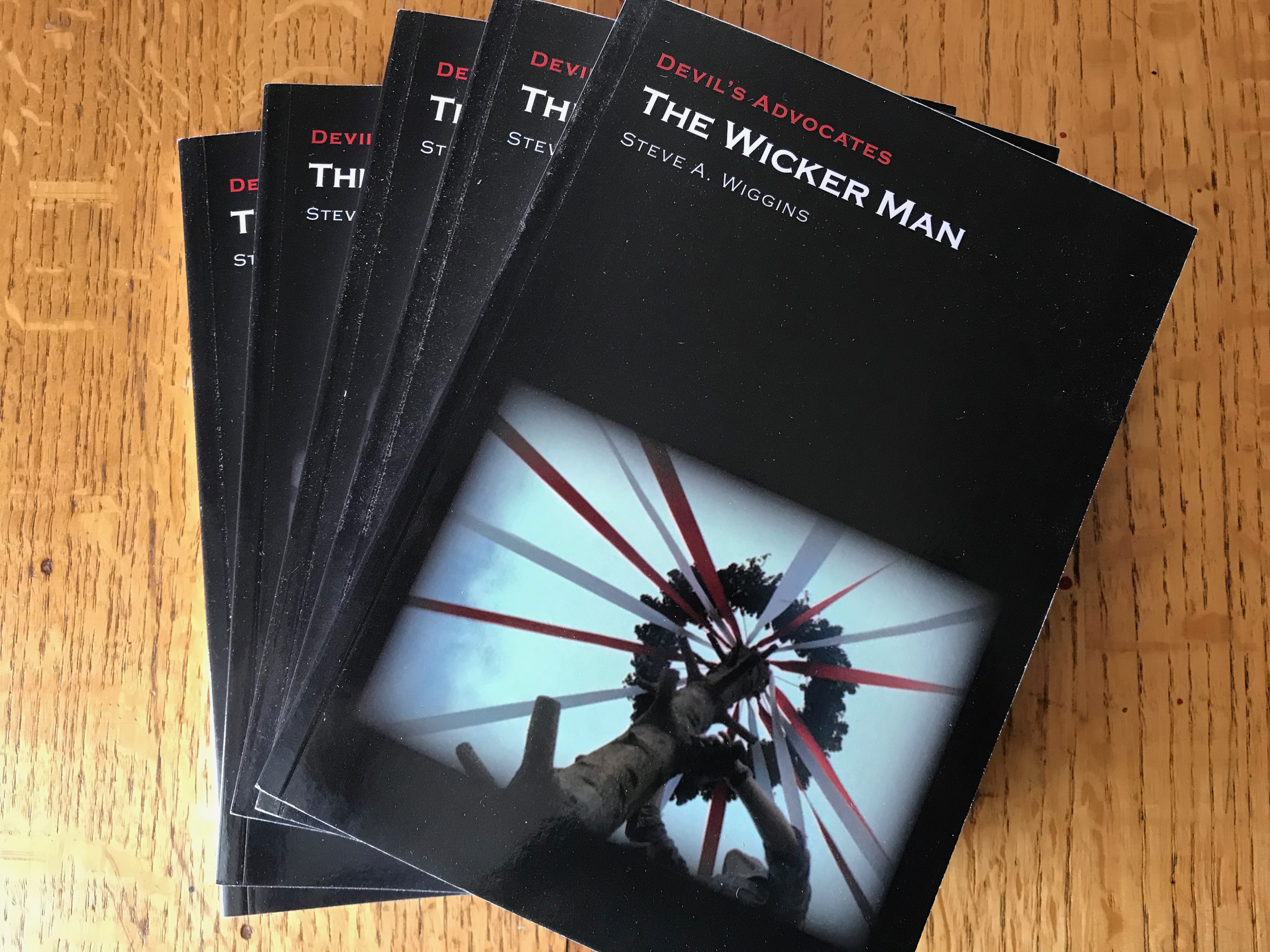
In addition to Sleepy Hollow, I’ve also been interested in holiday horror.  This is the theme of my forthcoming Wicker Man book, and I’d toyed with the idea of writing a book on the topic in general.  I knew there was a movie called Happy Horror Days, which I felt compelled to watch for any scrap of academic respectability.  (If a title tells you it’s directly on your topic, well, you investigate.)  I managed to make it to the Fourth of July before this truly execrable film just clearly became a waste of time.  The stories feel incomplete and the racist undertones (which may have been an attempt at social commentary) or that final episode left such a bad taste in my mouth that I had to walk away.  I’m not such a horror fan that I’ll watch just anything, but I don’t like to read spoilers before I watch movies.  It’s a dilemma, but to make good use of limited time I may start walking out more often.  Especially if it’s free.


Keys

Do you know the difference between “Voodoo” and “hoodoo”?  Well, The Skeleton Key does.  This is a movie I watched at the recommendation of a friend.  I get a sense—perhaps based on stats, or maybe lack of engagement—that you folks that kindly read this blog generally don’t watch the same movies that I do.  Nevertheless, I hesitate to give away spoilers for films I think more people should see.  So we’ll explore hoodoo instead.  But first, I can give you the basic idea of the film, in case you’re one of the few who takes recommendations from this blog.  Caroline is a young hospice nurse who feels guilty about not being present when her father died.  She gets a job with a couple in a decrepit southern Louisiana mansion where he’s dying and she’s doing fine.  

Caroline isn’t from the south, however, and she senses that something’s not right.  A modern girl, she doesn’t believe in the supernatural, but she slowly becomes convinced that something strange is happening in the house.  That something turns out to be hoodoo.  Critics weren’t particularly kind to the film when it came out in 2005, but I found it moody and engaging.  There were some exciting scenes and I enjoy haunted house movies generally.  And this one uses a lot of religious imagery, even though hoodoo is better thought of a form of spirituality than a formal religion, like Vodou is.  The movie defines the difference as one between religion (Vodou) and magic (hoodoo).  There’s some truth in that, but scholars are inclined to class magic and religion together.

Hoodoo consists mainly of folk spirituality that involves some magical beliefs.  Like Vodou it’s of African origin, mixed with the cultures experienced by slaves in the new world.  Unlike Vodou, it doesn’t have any kind of formal structure.  The reason it’s treated with suspicion, in general, is because it’s of African origin and doesn’t fit well with northern European ideas of the way the world works.  Skeleton Key makes pretty heavy use of hoodoo as a plot point and it isn’t alone in using African traditions to inculcate horror.  The Believers, many years back, did a similar thing with brujería.  Although these folk traditions are generally kept separate from “religion,” they tread similar ground with similar aims.  And since they’re “foreign”—at least to button-down white Christianity—they’re treated with utmost suspicion.  I think Skeleton Key handles this well, and if you’re one of the few who takes recommendations on movies, I’d suggest it’s worth seeing.


Othering Offering

I get to feeling a bit anxious when nobody else publishes me for a while.  It’s a strange kind of validation, I suppose.  No matter my motivation, I knew as soon as I saw The Offering that I would have to write something about it for Horror Homeroom.  The article is now available here.  Horror, as one of the more intelligent genres, often has much to say about things such as religion and esoteric beliefs.  In the article I compare it to other recent Jewish horror such as The Possession, The Golem, and The Vigil.  All of them are worth watching.  Religion often addresses those things that scare us, whether secular or sacred.  Movies like these often make me ponder the sense of belonging that religious communities offer.  At least in the best of times.

These three movies each have their own posts on this blog, but the point of the Horror Homeroom article is to try to look at them together.  Judaism can be a particularly delicate topic.  Not only the Holocaust, but also subsequent political developments have led to dangerous situations for Jews in the real world.  Theirs is an old and rich culture, persecuted largely by Christians who ironically blame Jews for their own salvation.  And hate them for it.  Nevertheless Jewish culture and belief persist.  It’s telling that even when they invent a protector, such as the golem, they come to realize that it too will turn on them in the end.  Most horror movies, if they participate in religious worldviews, do so from a Christian point of view.

Some colleagues recently asked me to name some Protestant horror movies.  That’s a tricky question to answer because the American context is still largely Protestant as a whole.  And when you want to take on monsters and demons you generally call a priest.  Even movies like The Last Exorcism have Protestant clergy using Catholic crucifixes.  As I’ve stated elsewhere, Asian horror movies have also come into their own, often reflecting Buddhist or Hindu outlooks.  So we find religion and horror intermingling worldwide.  Movies are more than just entertainment.  They can be, and are, teaching tools.  We should pay attention to what goes on in their classrooms.  Not only can we learn about ourselves, we can also learn about those that we, or society, tend to “other.”  Like high school, there are a variety of classes you might take.  The day always starts, however, with homeroom.


No Plan

I suppose it’s debatable whether it can be considered a holiday treat to watch what is often called the worst movie ever made.  Still, I did so over the Christmas break.  Ed Wood’s Plan 9 from Outer Space is a frequent nominee for worst film, and Wood himself an enigma.  Disagreement over whether he really had such poor taste or whether he was hampered with budgets too small to achieve his goals seem to float around.  Was he misunderstood or simply clueless?  As many of us learn, breaking into big entertainment—whether it be film making, novel writing, or music performance—is a game of chance in which your chances are nearly nil.  So we might have some appreciation for those like Wood who, perhaps lacking talent, press on anyway.  Wood, who became an alcoholic, died in poverty, his work scorned.

Plan 9 from Outer Space is truly bad.  Everything from the stilted writing to the wooden acting is risible.  The idea that aliens are raising the dead to get world leaders to admit they’re there might give you a chuckle, but edit in previously shot footage of Bela Lugosi as a vampire, and confusion reigns.  Lugosi, who also died in poverty, was no longer even alive when the movie was released.  He and Wood had become friends.  Despite all its obstacles, the film has a good message.  The arrogance of humanity in assuming no higher beings could exist is still as much of a problem now as it was in the fifties.  And interestingly enough, Wood throws God into the dialogue as well.  There is even a Bible scene, if I ever get around to writing a sequel to Holy Horror.

At the end, the earthlings give a sigh of relief watching the flying saucer explode, even as they admit that the aliens are more intelligent and advanced than we are.  There’s almost a parable here that still holds true in the United States, at least.  We don’t like to listen to those who know more than we do, and after we defeat them we reflect on how they really were better equipped to handle things.  It may not have been any consolation to Wood as he died at the age of 54, but his films would go on to gain substantial cult followings.  I had been meaning to watch Plan 9 for many years, and now that I have my response is one of sympathy for a creative guy who simply didn’t have the means to do what he wanted to do.  And yet he did it anyway.  There’s almost a holiday feel to it.


Black Sabbath

I used to be afraid of them.  The band Black Sabbath, I mean.  I heard the songs from Paranoid wafting from my older brother’s room (separated from mine by only a curtain) and was secretly intrigued.  But the name of the band—wasn’t that satanic?  To a young Fundamentalist there was much to fear in the world.  More than once I bought Alice Cooper’s Welcome to My Nightmare only to replace the copy I’d thrown away in evangelical terror.  I recently learned, however, the the band name Black Sabbath was taken from a 1963 horror movie.  And I also learned that the film was, in part, based on a Russian vampire story by Leo Tolstoy’s second cousin Alexei, titled The Family of the Vourdalak.  And that this story was published decades after Tolstoy’s flop, The Vampire.  That novel was inspired, in turn, by John Polidori’s The Vampyre.

Polidori’s work was inspired by a fragment by Lord Byron, which he contributed to the ghost stories putatively told among friends a stormy night in Geneva that also led to Mary Shelley’s Frankenstein.  Connections such as this are immensely satisfying to me.  Although I taught mainly biblical studies, my training was in the history of religions—it just happened to focus on ancient semitic examples.  Finding the history of an idea is one of the great pleasures of life.  But we’ve left Black Sabbath hanging, haven’t we?  The band realized something that Cooper would run with, namely, horror themed songs and metal go naturally together.  Such dark things led evangelicals to condemn the whole enterprise, claiming the band name was satanically inspired.  (Michael Jackson, raised as a Jehovah’s Witness, was famously fond of horror, although Thriller is perhaps the least scary horror-inspired album ever.)

I’d never seen Black Sabbath before, so now I had to watch it.  Of course, there’s nothing satanic about it.  An Italian, French, American collaboration, it’s a set of three stories bound together by Boris Karloff’s narration, and it’s all in Italian.  One story is about a woman double-crossed but saved by an estranged friend.  The second, the one featuring Karloff, is the one based on Alexei Tolstoy’s Russian vampire tale.  The third is about a poor woman who steals from a dead patron and is haunted until the inevitable happens.  Not particularly scary, the film title was the inspiration for the band, not the content.  They were therefore labelled satanic because of a movie that has nothing to do with satanism.  The song “Black Sabbath” was actually inspired by Dennis Wheatley novels, which do, of course, deal with satanism.  The song itself isn’t satanic.  They decided to make songs like horror films in music.  And it all goes back to Lord Byron and the night near Geneva that inspired both Frankenstein and Dracula.


Truth and Belief

I met Claire Donner the way I meet most people these days.  Online.  I’m not sure how she found me in this dusty little corner of the internet, but she has one of the coolest jobs of all time: the New York City Director of Miskatonic.  If you don’t know Miskatonic, and if the title doesn’t at least give you a hint, you need to go back to your Lovecraft.  Its full title is Miskatonic Institute for Horror Studies.  They also have offices in London and Los Angeles.  Miskatonic offers a variety of one-session courses on horror and Claire had emailed me about the vexed idea of the nature of belief as it relates to horror movies.  Her course on the Amityville Horror—“‘Based on a True Story’: The Importance of Audience Faith in The Amityville Horror”—was excellent.  It left me in a thoughtful mood.

The way that I write books is that I have several projects going simultaneously.  Eventually one reaches critical mass and starts a chain reaction until it gets finished.  One of those projects that hasn’t yet attained critical mass is on Ed and Lorraine Warren.  It’s such an avocation that on a visit to Jim Thorpe on a family trip, I stopped into a shop where the owner proudly displayed articles about the Warrens in his window.  I asked him about the Warrens—whom he knew—but I wasn’t prepared for an interview (and I’m sure, neither was he).  Meanwhile, relatives waited patiently outside.  One thing I’m pretty certain about is that the Warrens sincerely believed in most of what they were doing.  There are nagging loose threads, however, that suggest they kept the financial angle firmly in mind.

To bring this back to Amityville, the course raises the question of the Warrens’ involvement.  They were among the earliest of “investigators” to take what was largely a hoax seriously.  They, however, didn’t get a cut in the profits.  I suspect this is what launched them into their promotional activities.  That book and movie combo brought in, and still brings in, the cash.  Who wouldn’t feel cheated?  But still, there’s belief.  For many of us belief requires some evidence, some tangible trace of truth.  These are the kinds of things explored in this fascinating course.  Horror and religion have been bedfellows for a very long time.  They often converge on this concept of belief.  There’s so much more to the Amityville Horror than meets the eye, even if we all know it was largely a hoax.


On Offer

Feeling a bit overwhelmed by various January blues, I took me to my homegrown therapy of watching horror.  The newly released The Offering raises many questions regarding religion and horror, focusing again on Hasidic Judaism.  I say “again” because several movies from the past decade have begun to reflect Jewish monsters, often in Orthodox settings.  This is fascinating because Judaism tends not to emphasize spiritual entities, and perhaps that’s why they’re so surprising in such a framework.  I’m not a specialist in Judaism, and I worry about cultural appropriation, but horror is open to all people.  Religion often plays a central role.  A former author of mine, with Routledge, wrote a fascinating chapter in his book that dealt with Buddhist horror films.  So, The Offering. (I have an article on the movie coming out soon on Horror Homeroom, so be sure to check there for more.)

Like most Jewish-themed horror, The Offering is intelligent.  A Hasidic Jewish scholar, wishing to see his recently deceased wife again, accidentally raises a demon.  While demons aren’t especially plentiful in Judaism, this one happens to be Abyzou, a character familiar to anyone who’s seen The Possession, or, perchance, read Nightmares with the Bible or Holy Horror.  Abyzou targets children and so when Art, a non-practicing Jew, takes his pregnant wife to visit his religious father in Brooklyn, the tension is lined up.  Also, did I mention that Art’s father runs a funeral home out of his house?  The scholar’s encounter with Abyzou lands him in the morgue in the basement where, as demons are wont to do, it escapes.  And it wants that unborn baby.  There are also other family tensions which add to the complexity of the story.

I’m not in a position, without committing a lot of research time that I don’t currently have, to gauge the authenticity of Jewish lore associated with the demonic attack in this particular movie.  It is a film, however, that uses many familiar tropes in the service of horror that’s fueled by religion.  Demons are, after all, religious monsters.  Unlike The Exorcist, the goal here isn’t to exorcise but rather to trap the demon.  Exorcism always raises the troubling question of where a demon might go once it’s expelled.  The famous gospel story of Legion entering a herd of swine makes that abundantly clear.  The Offering also makes the threat to a pregnant woman a key element in the tale, and since we know that Abyzou wants the young, we’ve got built-in suspense.  There may not be a ton new here, but the movie addresses some important issues.  The dialogue about religion deserves some in-depth consideration—perhaps after I finish the book I’m currently writing.


Annihilated

For a long time I resisted seeing it.  Partially I wasn’t sure if it was any good and partially—mainly—it was because of spoilers.  Annihilation came out in 2018, just as I was reading Jeff VanderMeer’s novel upon which the movie was based.  I will always remember this because I worked in a cubicle where I couldn’t see my fellow workers and the woman in the next cube was a bit of a chatterbox.  She and one of her coworkers had seen the movie and began discussing, somewhat loudly, what’d happened.  I was in the middle of the book at the time and didn’t want any spoilers.  I’d never actually met the woman in the next cube and I couldn’t go over and tell her to stop talking about the film because one of the reasons we watch movies is to talk to one another about them.  (Mostly I do this online.)

Enough time has passed, and a different woman at work, remotely, suggested I see it.  I don’t know why the movie did so poorly at the box office.  The director, Alex Garland, has said he didn’t reread the book as he was making the film because he wanted it to be impressions of the novel rather than strictly based on it.  Even as I watched, I recalled some of what I read back in 2018.  I’ll try to limit spoilers here, but if I’m talking too loudly you can just click away (and, hopefully, come back after you’ve seen it.)  It begins when a mysterious “shimmer” appears after a meteorite strike in Florida.  Those who enter the shimmer never come out.  A team of women scientists are sent in, wondering if gender might make a difference.  One of them, Lena, volunteers because her husband did make it out and almost immediately went into a coma.

A sci-fi horror movie, I wonder if it underperformed at the box office because it stars women.  The tension builds between them as they try to figure out what’s going on within the shimmer.  Species have mutated rapidly and the predatory animals are pretty frightening.  The threat, as in VanderMeer’s novel, is ecological.  The ending, I’ll say, is quite different from the book because it was intentionally written as a trilogy and the director wanted to resolve the tension in a single film before reading the other two (which I still haven’t done).  The end result is thoughtful and tense.  The acting is good and the effects are stunning.  I’d class it with Arrival as an intellectual exploration of what it means to be part of a universe we barely begin to understand.  And kudos for having women lead the way.


Not in My House

I had a friend in seminary—nameless here because I mention no non-public figures without their permission—who invited me over for movies.  Although he was more of a comedy guy, he liked horror too and I couldn’t help but think of him when watching House (the movie, not the doctor show) recently.  The film looked familiar to me but I couldn’t recall having watched it before.  By the end I was pretty sure I’d seen it with my seminary friend one weekend afternoon.  There was too much I remembered someone else commenting upon.  A comedy-horror, House is one of those not-so-great movies that becomes a cult classic.  The monsters aren’t particularly scary, and the plot’s a bit disjointed, but still it bears repeating once every few decades.  There really isn’t any religious imagery, but it does reflect on American involvement in Vietnam.

Roger Cobb, a divorced horror writer, moves into the house where his favorite aunt died by suicide.  It’s also the house where his young son went missing years ago.  The titular house, which is, of course, haunted, is where Roger plays out his memories of Vietnam while trying to write his next book.  Monsters pop out of closets and show up at his front door as he tries to make sense of what happened to a friend in the war.  I couldn’t help but be reminded of Mark Z. Danielewski’s House of Leaves as mirrors and doors open onto voids that confuse the narrative but make the film like a funhouse ride.  My friend, with whom I must’ve seen it, commented on several of these scenes, which is what convinced me, by the end, that this wasn’t a new film for me.

I watched monster films as a kid—I was a late monster boomer.  Kids talked about prominent horror in school—Rosemary’s Baby, The Exorcist, The Omen—movies I didn’t see until I was an adult.  I watched a few horror movies in college and quite a few in seminary.  I moved away from them until I lost my career and then I came running back.  I’m not really sure what I’m looking for here in this haunted house.  Like most people, I don’t like being afraid, but there seems to be something hidden here.  Horror can convey meaning, even solace.  Very few people understand my use of horror for spiritual development, but it’s something with very deep roots.  And as realities in the quotidian world become more and more untenable, I’ll have at least have had some experience grappling with monsters.  Sometimes even with friends.


Like a Splinter

I saw that it was based on a novel by Ira Levin, and it was free on Amazon Prime, so I watched it.  I’m not sure Sliver did much for me, however.  Ironically I watched it a weekend after watching another Sharon Stone movie that had been panned, Diabolique.  (Stone grew up not far from me I learned, but then, it’s a small world.) Something I’ve noticed about myself is that my limited experience sometimes sets false expectations.  My experience with Ira Levin has been The Stepford Wives and Rosemary’s Baby.  I read both novels and saw both movies.  I’d classify them as horror, so I guess I thought that’s how Ira Levin translated to me.  What Sliver (the movie) suggests to me is that Levin must’ve been really conflicted about living in New York City.  In both this movie and Rosemary, getting a great apartment always comes with a hidden problem of a major kind.

Sliver is a bit difficult to figure out because the original ending was changed so I’m not sure what to believe.  One thing I know for sure is that movies that make a character work in publishing are never shot by someone who actually does work in the industry.  Either that or I’ve been shortchanged.  In the movie Carly Norris (Stone), who moves into the Sliver, has a huge office.  I’ve only ever had cubicles, if even that.  No oak paneling and book-lined walls for me.  In any case, the movie focuses on Carly’s home life because two men fall for her as soon as she moves in.  One of them is a killer (this was what was changed with the rewritten ending), and both of them are creeps.  One spies on everyone in the building through hidden cameras and microphones, and the other has affairs with the young, single women.  And maybe kills them.

I guess I was expecting something more like the original Stepford (the remake—why?) or Rosemary.  Both had a message with plenty of social commentary, it seemed to me.  Of course, both of them were pretty close to the book.  (I’ve not read this novel.  Perhaps I should.)  Sliver, at least the film, was more a matter of moving into a building with a mystery and not knowing whom to trust.  It really didn’t suggest much about surveillance, or women’s agency or lack thereof.  It did make a case for not moving to New York City.  I don’t know how an editor could possibly afford such a nice apartment, in any case. 


Diabolical

Diabolique, the 1996 remake, is sometimes tagged as horror.  It’s also considered drama and a thriller, so how you classify it has some flexibility.  One thing it’s generally not classified as is “good.”  Most remakes suffer in comparison to the originals, and their originating novels explain a lot more.  Still, it’s set near Pittsburgh and it has a lot of religious imagery in it.  In case you’re not familiar—it’s the story of a love triangle involving a particularly odious man and two women who inexplicably adore him.  One of the women is a young, wealthy heiress who inherited a private school outside the city.  She’s a teacher at the school and her cheating husband is the principal.  Her best friend, beknownst to her, is sleeping with her lecherous husband.  But the best friend also protects the wife from her husband’s bullying.

The wife, a former nun, has a heart condition.  Her husband and best friend plot to scare her to death and inherit the school and all her money.  They do this via an elaborate—almost Rube Goldberg-esque—ruse where the women drown the man and he then “comes back to life” frightening the former nun into a heart attack.  Her best friend, apparently, repents along the way and along with the wife, end up drowning her husband for real when he attacks both of them.  You kind of get the sense that there are few characters with whom to empathize and although this could’ve been a feminist manifesto, it was directed by a man and missed that opportunity.  So why am I discussing it here?

The use of religion in this film is intriguing.  Throughout the school there’s discarded religious imagery.  Crosses cast aside, empty holy water fonts, grace not said before meals.  The husband, not a believer, has put all of that aside.  His wife, convinced she’s murdered her husband, confesses.  Then engages a private investigator, for appearances’ sake.  The thing is, the religious imagery doesn’t really come into contact with the story.  The only real exception is when the wife uses the cross she’s wearing to gouge her husband’s face.  A strange form of salvation indeed.  The movie isn’t that good (it’s free on Amazon Prime, though) but it underscores once again that religion does find a natural partner in crime with horror.  Or in this case, a thriller.  However you want to classify it.  The plot twists aren’t effectively executed but I suppose it’s better than a crucifix in your eye.


Hidden Talent

It’s difficult to imagine any corporation with a more powerful influence on children than Disney.  It catches us early and forms our first impressions on plenty of things.  And, of course, Disney was started by Walt Disney, right?  Well, partially.  I recently became interested in Ub Iwerks (born Ubbe Iwwerks), the man who originally came up with Mickey Mouse.  Ub Iwerks and Walt Disney got their start in animation together.  They both worked for the same Kansas City ad firm as illustrators and then went into business together.  This was in the early days of film—silent and black-and-white—when few took cartoons seriously (they hadn’t made much money yet, and that’s the true mark of seriousness).  The major studios were starting to come together in Hollywood, so eventually Disney moved to California where, with his brother Roy, they began Disney Studios.  Ub came to work with them.

The Hand behind the Mouse, by Leslie Iwerks and John Kenworthy, is a brief account of the life of Ub Iwerks, who was famously quiet but who went on to develop special effects that were far ahead of their time.  Iwerks never really took his deserved credit for Mickey Mouse, noting that what you do with a creation is just as important as coming up with it.  Walt Disney, he opined, was the one who did something with Mickey.  At the same time, Disney claimed that Iwerks was the world’s greatest animator (as the subtitle proclaims).  The two eventually split, with Iwerks forming his own studio and hiring some of the most famous cartoonists of his day.  Hard times came, however, with the Depression and Second World War.  Iwerks closed up shop and went back to work for the by now very powerful Disney.

His move back saw him increasingly in “special processes”—essentially engineering special effects—and he was innovating literally until the day he died.  His imprint on not only Disney, but the film industry (he worked with Alfred Hitchcock on The Birds), was substantial.  He never, however, sought the limelight.  All of this makes him a remarkable individual.  He recognized Disney as the one with a vision and a brand, and also a business-savvy brother (Roy) who could help it all come together.  Walt Disney died at 65, a couple years after I was born.  Ub Iwerks died five years later.  Together they had invented American childhood.  Everyone knows Disney.  It’s the top name in children’s entertainment, a corporate giant.  I’m drawn to those, however, who fall between the cracks of history.  This brief book tells the story of one such individual who should, in all fairness, be better known.


Skin Deep

The thing about art-house movies is they’re meant to be discussed.  I spend a lot of time alone and I watch most of my movies alone.  There’s a kind of danger in that, I suppose.  Under the Skin was recommended by one of the books I read, analyzing horror.  I knew nothing about it and it became clear from the opening that director Jonathan Glazer had been heavily influenced by Stanley Kubrick.  In particular, 2001: A Space Odyssey.  There’s also the question of genre—is it science fiction or horror?  Art-house goes without saying.  The story is minimal and the movie is about images.  Even so, Glazer spent years working on the script.  The results won critical acclaim but box office failure.  We know the feeling.

So what is Under the Skin about?  Quite a bit is implied rather than stated outright.  The woman—the characters are generally unnamed—is an alien trying to learn about, while living off of, humans.  Early on she learns that sex appeal will nearly always entrap men so that they can be used for food.  Much of the film involves her driving around Scotland, seeking victims.  She has a co-conspirator who goes around making sure she leaves no traceable clues.  Conversation is minimal and shots linger to a point that viewers might feel the need for some explanation.  When she finds a victim with a deformity, the woman begins to learn empathy.  This victim is apparently set free, but is rounded up by her companion.

The woman tries to befriend a kindly man who tries to help her.  She can’t eat human food and doesn’t know to wear a coat in a Scottish winter.  The intimacy scares her and she comes across a logger in the forest with rape on his mind.  When he discovers she’s not human, he burns her to death.  Her companion, apparently seeking her, has no idea where she’s gone.  Roll credits.  As I say, the story is conveyed by the images and they stick with you.  The beautiful Scottish scenery can’t help but appeal to someone who’s lived there for a time.  The movie leaves you reflective and in the mood for conversation, the way art-house films do.  It’s also another example of Euro-horror.   This has captured my attention of late since it’s generally intelligent and light on the violence.  It makes you think.  Critics loved it, but the paying public didn’t want to hand over cash to see it.  That means, in my private calculus, that it’s well worth watching.


Disappearing

It might be easy to suppose that horror uses religion gratuitously.  Or it may be that the connection runs much deeper.  Yes, many people are still religious as growing numbers are becoming less so, but both kinds watch horror.  As is usual for a guy who doesn’t get out much, I learn about movies often by reading about them in various analyses.  That’s how I came across the box-office flop, Vanishing on 7th Street.  While various critics point out its flaws, to me it watches like an extended Twilight Zone episode, exploring interpersonal dynamics when a bad situation overcomes a community.  For reasons unexplained, people without a light source disappear.  This is somewhere not too far from Chicago, but we don’t know exactly where.  Five people have managed to survive and four of them end up in a bar that has power because of a back-up generator.

Jim, an African-American boy, is waiting for his mother to return to the tavern.  She was the bar tender but had run to the local church to find other people because the lights were on.  She didn’t return and three other people make their way to the bar.  Disagreeing on a course of action, or what has happened, they try to work together to stay in the light.  Jim eventually makes a break for the church.  He alone manages to survive there until daylight reveals a young girl named Briana, spotted throughout the movie, with a solar-powered flashlight.  The others have all vanished, so Jim and Briana decide to try to make it to Chicago together as night falls.

Wikipedia calls the film “post-apocalyptic,” but I would say it’s more metaphorical.  The only two characters to survive do so by finding refuge in a church.  No prayers are said, but candles keep the darkness and its dangers at bay.  There’s plenty to reflect on here, even though we don’t know what has led to this situation or why the shadows snatch people, leaving rapture piles of clothes all over the place.  Not a fast-paced movie, it’s a film with only one jump-startle and plenty of time to think.  That was my take on it.  Not all horror has to be slasher-oriented.  I was really puzzled why this one ended up with an R rating.  Sometimes horror just makes you think.  Often that thinking involves reflections on the meaning of life.  Some would call that philosophy, but those who consider the light and its relationship to darkness tend to call it religion.


Holiday Horrors

Holiday horror is a genre—really a sub-genre—that is still being explored.  It’s the subject of my my latest YouTube video.  Typical definitions suggest that it builds on a haunted or inauspicious history of the day.  I tend to think that really to fit the category that the holiday can’t be simply incidental.  It has to contribute to that fear that the movie brings.  The most popular holiday for horror films has long been Christmas.  Halloween may be starting to catch up, but Christmas has a long head start.  I ask myself if Black Christmas fits.  The title suggests as much, but how does it derive fear from the holiday?  It is, like When a Stranger Calls, one of the early cinematic renditions of the urban legend “the babysitter and the man upstairs.”  Yes, the calls are coming from inside the house, but there’s more going on here.  The sorority house is invaded during a Christmas party.

The fear, however, comes from both the juxtaposition of the cheerful holiday and the ambiguity of a slowly emptying residence.  Coeds are leaving for the holiday.  Or are they?  The bleakness of the weather adds to the dreariness of the plot.  The function of holiday horror is to make viewers address what’s really important about the occasion.  Tragedy can strike any day of the year—it’s no respecter of birthdays or other holy occasions.  John Carpenter got his idea for Halloween from this film, so in many ways Black Christmas does fit the sub-genre.  Its titling, however, complicates this.  Originally called Stop Me, the movie was to be set on Christmas break but the focus was not to be on the holiday.  Even as it was released the title continued to change, in America it was first called Silent Night, Evil Night.

Like the remake of Invasion of the Body Snatchers, critics initially didn’t like this movie but time has shifted that.  It is an effective horror film and probably part of the objection (I’m psychologizing here, without a license) had to do with implicating a holiday—a happy holiday—with horror.  Christmas is, for many, a stressful time of year.  Instead of quietness and relaxation, it’s a season of intense socializing and measuring one’s generosity against that of others.  We try so hard to make others happy with material things.  Holiday horror need not add to that stress.  In fact, it can make you stop and think about what’s really important.  There’s a reason that Christmas was long the holiday associated with scary stories before Halloween really took off.