Rats

Small town living had its benefits but one of them wasn’t seeing movies.  In the seventies, before the local mall came in, there were scattered movie theaters about.  You could sometimes see reruns on television, if you were free and awake when they were aired.  VCRs weren’t widespread and DVDs and streaming were decades away.  One horror film I very much wanted to see was Willard.  Released in 1971, it did quite well at the box office.  I was only 9 at the time so I never saw it and by the time I became aware of it theaters had long lost interest.  Kids were still talking about it years later, probably from television showings.  When my second resurgence of interest in horror came around, it was still difficult to find.  The DVD wasn’t available and it took some time for it to appear on a streaming service to which I subscribe.

I have to wonder how we got through the seventies, but I finally had a chance to stream it.  The story, since there was a new millennium remake, is probably familiar.  A young man (the eponymous Willard) who doesn’t fit in eventually befriends some rats in the run-down property of his once opulent home.  He teaches them to understand him and eventually has a virtual army of rodents.  He’s a good lad, however, and only uses the rats to redress social inequities.  His boss, a real old school bad guy, stole the steel mill from his father and is trying to drive Willard out.  You can see the boss’s fate coming from afar.  It’s not much of a horror film by present-day standards, but it does have its moments.  It would likely have more impact had I seen it fifty years ago.

The theme song from the sequel, “Ben” (also the title of the next movie), performed by Michael Jackson, rose to number 1 on the charts.  Those of us in the seventies knew it was a song about a rat.  Well, at least some of us knew.  Horror, despite its detractors, often influences mainstream culture.  Indeed, Willard seems to have had some lasting knock-on effects, including the remake just into the new millennium.  Movies from the seventies, although some are excellent, often bear the brunt of the malaise of that period.  Did we ever think big, boxy cars were attractive?  Were men really such chauvinistic pigs?  Still, the story is a good one.  I wasn’t really interested in the 2007 reboot, but having seen the original I’m now curious.  It is, at least, fairly easy to find.


Not Really Nervous

Embarrassment is a not uncommon reaction.  People who knew me as a religion professor or who now know me as a volunteer leader in my local congregation wonder why I watch and read horror.  It helps to know that you’re not alone.  Mathias Clasen is an author I’ve mentioned before.  I read his first book on horror and I was excited to see his A Very Nervous Person’s Guide to Horror Movies, recently out.  I’m not really a very nervous person in this particular regard.  As those who know me will attest, I’m nervous in many aspects of life, just not this one.  Still, after having heard the author describe what his university sponsored fear lab does I was curious how he’d approach horror for the nervous.

Clasen is an academic who clearly enjoys writing.  He’s fun to read.  He admits to being somewhat nervous around horror himself, not watching horror alone.  In fact, the book has several tips—such as not watching horror alone—on how to survive the experience for the curious but cautious.  What I inevitably take away from studies such as this is a couple of things: watching horror isn’t something only I do, and it’s actually good for you.  Studies (and here’s where Clasen is able to point to actual sources) have repeatedly demonstrated that horror has adaptive benefits.  Kids like scary stories, and there’s a reason for that.  The interest in horror generally peaks at the onset of adulthood and tends to decline from there.  Some of us, however, are perhaps arrested at that stage.  Or rediscover it.

There’s a great utility in being able to discuss horror intelligently.  Another point Clasen addresses is that horror is often intelligent but since those who don’t watch it often set the social standards it’s addressed as if it’s juvenile and unsophisticated.  Yes, there’s trash out there.  There is in every genre.  For many people, however, the popularity of slashers in the eighties forever defined horror as naughty teens getting murdered by a bloodthirsty maniac with some kind of blade.  That’s only part of the picture.  Horror has a history as old as cinema itself and the earliest exemplars were based on literature.  It has been an innovative genre from the beginning and when a particularly noteworthy horror film comes out critics and pundits are quick to relable it as a thriller or drama or anything but horror.  We need to give horror its due.  It’s always a pleasure to read a book by someone who has an appreciation of what horror has to offer, even if he’s nervous about it.


After This

It didn’t rock the critics, but it is distinctly creepy.  After.Life came out in 2009 and quickly fell from sight.  It’s an interesting movie nevertheless.  Any film that features an undertaker, for one thing, gets edgy.  The story of a young teacher who never really felt loved and who is killed in a car crash sounds tragic enough.  Then she finds herself conscious in the preparation room where the funeral director, Eliot Deacon, talks to her, assuring her that he can speak with the dead.  As the movie progresses we begin to wonder if Anna, the teacher, really is dead or if she’s being killed by Deacon for having given up on life.  His name is suspiciously religious, fittingly for a film that deals with such a topic as the afterlife.  Overall, however, it’s pretty bleak.  One of Anna’s students also sees her after she dies and Deacon befriends him, offering to teach him his trade.

Although the critics didn’t like it, it is spooky on many levels.  Not the least of which is the question never satisfactorily answered of how to know when you’re really dead.  The movie presents the soul as a fact, and even dead bodies can move around when the situation merits it.  Death is one of those areas that religion generally enters.  Some secularists maintain their lack of religious thought even in this situation, but many people find religion helpful at this ultimate transition and the soul seems entirely natural then.  It’s unclear in the movie whether Deacon is good or bad.  He’s certainly obsequious, accommodating the wishes of families even when unreasonable.  With the dead, however, he takes a firmer stance, having to convince them that they’re no longer living.  The movie’s a bit confusing in the case of Anna—we’re never really sure if she’s dead or not.

Even with commercial interruptions (it’s free to watch that way) I found myself getting caught up in the story.  Deacon kept asking what it is the living really want.  He’s shown throughout doing the work singlehandedly, from picking up the bodies, to embalming, to even digging the grave.  His loneliness is ameliorated by his ability to speak to the dead, each of whom he photographs and puts on his bedroom wall.  Religion may be behind the soul, but no obvious religious talk pervades the film.  I have to wonder if this might not be the reason it fails to frighten its many critics.  Horror that uses religion effectively often becomes successful.  Those that avoid religion like, well, death, often fail to convince even secular critics.


Brooding

Horror was undergoing a serious development beginning in 1968.  Into the seventies many boundaries were being crossed and new areas of fear were opened.  David Cronenberg is known for his body horror.  Being the squeamish sort, I don’t always seek out his films, but I’d been curious about The Brood for several years.  A holiday weekend afforded the opportunity to see it and, in a strange way I’m glad I did.  The story concerns a psychiatrist who helps his patients embody their neuroses physically in order to deal with them.  The patients manifest in their bodies their deep-seated rage, generally from childhood parental issues.  Those of us who grew up in broken families may seem to wear them on our sleeves, but I suspect most people have issues that were unresolved from that complex parent-child relationship.

The interesting thing here is that there is really no antagonist in the film.  Dr. Hal Raglan isn’t evil, but he does have secrets.  He tries to help his patients, but one of them, Nola Carveth, has major, well, issues.  Abused by her mother, she enters Dr. Raglan’s institute while her husband cares for their five-year old daughter.  Nola’s rage, however, bears a brood of small, gargoyle-like children who, when she focuses her anger on one person, attack and kill them.  Her parents, their daughter’s school teacher, and even Dr. Raglan receive her rage, all murdered by these children born purely from herself.  This strange kind of parthenogenesis makes for a distinct form of body horror.

It’s pretty clear that there is a critique of therapy going on here, but also a kind of therapy is being offered.  I’ve had people ask me if I watch horror as therapy and I freely admit that I do.  The movies I watch are often self-care, or even a spiritual practice.  Many people suggest that horror portrays a negative view of life.  Others of us tend to think of it as more metaphorical.  And besides, the message is often an upholding of conservative social values.  This particular film is difficult to interpret in that regard.  It was written after Cronenberg had gone through a divorce and that makes sense of the central conflict of the movie.  Parenting is as difficult as it is life-changing.  While The Brood may not give solid parenting advice, it may offer a way of understanding ourselves.  If a film does that, it can’t, in my opinion, be all bad.


Devils and Witches

If you’re a regular reader (thank you!) you know that I’m currently under contract to write the Devil’s Advocates series volume on The Wicker Man.  As an editor myself I’m aware that academic series, often unlike fictional series books, tend to vary quite a bit from one another.  I want to try to get my submission close to the goal, however, so I’ve been reading volumes by other authors.  You may also know that The Wicker Man is part of an “unholy trinity” of early British folk-horror, with the other films being Witchfinder General and The Blood on Satan’s Claw.  Of the three my least favorite is Witchfinder General, so I’ve put off reading the particular volume on that film by Ian Cooper.  That has nothing to say about the author, but rather a lot to say about the base film.

The book is quite good.  Cooper is clearly aware of the controversy surrounding the movie and he points out some of the difficulties with it as well as what it does well.  His treatment is quite insightful.  The movie is violent and it’s an representation of the historical violence we thought we outgrew.  Matthew Hopkins was an historical “witch hunter” who was, in reality a serial killer,  mostly of women.  Fearing witches, while getting paid to find them, he was responsible for over 200 deaths.  As Cooper makes clear, the film lingers a bit too long on the abject nature of many of the tortures, not allowing us to look away.  For this reason many critics found the film distasteful.  I personally found it hard to watch.  Education isn’t always easy.

There’s quite a bit of film history in the book.  Cooper does a great job placing the movie in its cinematic context.  Like The Wicker Man, Witchfinder General is sometimes said not to be a horror film.  Indeed, there’s nothing supernatural about it.  Still, it fits the bill for many of those in-between movies that cross over into horror.  In this case it’s due to the violence.  For me, monsters are preferable to human monstrosity.  They’re easier to walk away from.  Although the witch hunts ended centuries ago, violence against women has remained.  Whether it’s legislative or physical or economic, women deserve better treatment than they’re offered by the male establishment.  Movies, and books about movies, like this one may be difficult to watch/read, but they carry important reminders that power continues to corrupt and it must be challenged and changed when it reverts to the mentality of Matthew Hopkins.  His spiritual kin, unfortunately, continue to thrive. 


Abominable and Biblical

In many ways Holy Horror was an initial volume.  The Bible  is fairly prevalent in horror, and had the book done any better I might’ve considered a sequel.  Take The Abominable Dr. Phibes.  I’d literally never heard of it until I saw on a website listing states’ favorite horror films that it was number one in Pennsylvania.  At that point I decided I would have to see it one day.  That day came and I later found out that quite a few critics hold it in high regard.  It is very campy, almost worthy of the live action Batman series with which I grew up.  Phibes is out for revenge and kills his victims (more on this shortly) with vampire bats and acid.  It may have been the first movie I’ve seen with death by brussels sprouts and locusts.  None of this makes it fit Holy Horror’s premise, however.

Phibes is a serial killer using the Bible as his road map.  About halfway through the film we learn Dr. Phibes’ doctorate is in theology.  He is using the ten biblical plagues to kill his victims.  The police consult a rabbi to learn about the plagues but even here the Bible’s misquoted.  Interestingly for this period, the inspector refers to the plagues as a myth.  The first plague shown is of bats.  There is also a plague of rats.  Neither of which occur in the Good Book.  The Bible’s a fairly easy tome to find, but it takes quite a bit of ingenuity, I guess, to murder by gnats or the death of cattle (which doesn’t prevent The Reaping from trying).  Plot holes are large enough to drive a chariot through, but the Bible clearly has a starring role in the narrative.  And Vincent Price is able to pull it off because he’s, well, Vincent Price.

Drawing some inspiration from The Phantom of the Opera, and featuring a scene set in Highgate Cemetery, this movie has its fingers all over the place.  I do have to wonder why so many people in Pennsylvania picked this as their favorite horror film.  I grew up in the state watching horror, much of it camp, and much of it worse, but never heard a thing about this.  It’s not really scary.  Perhaps it appeals to those who think they know the Bible but really don’t.  Of course, having amulets inscribed with Hebrew letters to symbolize the plagues is classy.  I doubt The Abominable Dr. Phibes will give anyone nightmares, but it could stand a bit of analysis in its use of the Good Book.


Erase This

Over the years I’ve read a fair bit about Eraserhead without having ever seen it.  Approaching it I had little idea what to expect—normally classified as body horror, there’s a fair amount of debate as to whether it should be considered horror or not.  Now that I’ve finally seen it, I’d probably call it existential horror.  There are no jump startles, and the quirkiness makes it almost funny at times.  To me it suggests the horror of finding oneself in a world where the most desirous things are also those that scare us the most.  If you’ve not seen the movie this may not make sense to you.  David Lynch, the writer and director (and producer), went on to find fame in more mainstream media, but Eraserhead made the National Film Registry’s preservation list, which says something about it.

Comparison is sometimes fittingly made to Kafka.  Life itself can be traumatic.  Body horror tends to focus on the abject aspects of being incarnated.  We associate intimately with our bodies, but they do things we don’t understand and which sometimes alarm us.  The absurdity of this situation wasn’t lost on the great existentialist writers of the last century.  Faced with these circumstances we carry on because it’s not clear what else to do.  So Henry Spenser doesn’t emote very much.  Life does weird things to you and sometimes just watching the strangeness unfold is the best option.  This level of vanity brings old Qohelet to mind, for even the Bible realizes that some things just can’t be explained.

In an interview on the film Lynch cites the “little torments” of those in the workaday life.  It’s difficult not to feel like a mere cog when your wage is premised upon the amount of time you spend on the clock.  Even for professionals.  The stark divide is like the industrial wasteland the film so ably portrays.  This isn’t where anybody wants to be—no, it’s where one finds oneself.  Comforts are few and the background noise is constant.  Although Eraserhead isn’t widely known among the general public, its influence on other filmmakers is clear.  I could help thinking “oh, this is where that idea comes from.”  Probably most strongly that related to Brazil, a film I saw twice in one week in the theater (something I’ve not done with any other movie).  Having worked within the system, following all the rules only to find they don’t really mean you’ll end up where you hope, the theater of the absurd has always felt natural to me.  I should’ve watched this sooner.


Mag Dash

I don’t do much magazine reading.  Back when I had more time (mainly before buying a house), there were a few with which I attempted to keep up.  Mainly, however, I’d buy a particular issue that I wanted to keep.  I suspect that’s because I’m a book reader and my time for pure reading is limited.  Strange thing for a professor/editor hybrid to write, but there you have it.  Each year I “pledge” a number of books to Goodreads to keep me honest, and achieving that goal adds a kind of friendly pressure on my reading time.  Magazines don’t count, and mostly I never read the whole thing.  My current book project is an analysis of the movie The Wicker Man.  This led to some magazine reading.

Horror movies, especially, have been traditionally treated as ephemera with little lasting cultural value.  Fan magazines, therefore, often provide most of the periodical treatment for some of these “B movies.”  The Wicker Man suffered legendary distribution problems and that may have been what prompted Cinefantastique to devote all its feature space to this particular movie back in 1977 (the movie came out four years earlier and was still struggling).  The article is a lengthy one, not quite to the extent of The Atlantic, but still several pages.  It was the origin of the much repeated epithet “the Citizen Kane of horror films.”  To read this I had to locate a copy of the magazine.  There was, fortunately, a seller in Beloit, Wisconsin who wasn’t extortionate (thank you!).  My experience in buying print materials from the seventies has often proven the opposite.

Occasionally someone glimpsing my books will cattily ask, “Have you read them all?”  No.  But then not all print matter is for reading all the way through.  Reference materials, for example, are consulted.  The way my mind works, I need to keep things around so I can find them again.  Studies have shown that retention for electronic media isn’t as reliable as it is for print.  That may change some day as we evolve more and more into extensions of our machines, but for now I use it to justify keeping books.  Since I can’t predict the future, I never know when some forgotten tome might come up again in a new project.  That has happened a few times already while working on my small book on The Wicker Man.  And that includes magazines with good articles.  This one is a keeper.


Global Swarming

It’s a veritable horror trope.  The swarm, that is.  We fear being overwhelmed by vast numbers of apparently innocuous insects or arachnids, although they are much smaller than us.  It’s their logistical superiority, and perhaps their utter disregard of personal space.  Summer at Nashotah House was the time of the earwigs.  They came out in such numbers that no room in the house was safe from them.  There was a horror element to pulling your toothbrush out of the holder only to find one hanging onto the place you were about to put your fingers.  Or opening the refrigerator to find that one had crawled into the butter.  Any time you picked something up you might find an earwig under it.  They would crawl up the walls and across the ceiling.  Other places on campus would be overrun with ladybugs or black flies.  It was in the woods, after all.

Most places we’ve lived since then have had their native bug that gets in, often in numbers.  Our current nemesis is the box elder bug.  Although harmless, it is a true bug in every sense of the word.  I’m Buddhist in my desire not to kill and there are too many to catch and take them back outside.  Fortunately they’re pretty localized—they like my study, probably because its southern exposure means it gets sunshine even into December.  We’ve had some cold days but November has been experiencing global warming and the box elder bugs, clueless, wander all over the place.  Most of them are near the end of their life and die after poking around for a few days.  Others are quite frisky.  Some remind me of horror movies from the fifties.

I have one of those desk set Stonehenge models.  I don’t have the space to set it up fully, and the die for the model was obviously done with poorly sculpted clay, so it takes some imagination to think the trilithons resemble those of the actual site.  When I noticed a box elder bug crawling over one, however, it took me back to Tarantula and other such films where the menace wasn’t just a little old bug, but a huge one.  Our monsters these days have shrunk, however, and fear comes in small packages.  Box elder bugs are harmless but annoying.  Of course, they’re still out this year because we’ve warmed the place up for them and even in November they, well, swarm.


Numbers Game

I once asked a movie expert—this must’ve been when I was regularly on a campus somewhere, but not Nashotah House—how many movies had been made.  He sighed and said “There’s no way to know that.”  What I was thinking at the time was the Motion Picture Association of America (now the Motion Picture Association) number that comes near the end of the credits.  I wondered how many of those there were.  Of course, the number keeps changing.  It doesn’t account for television movies or straight to video, although, I see it does now include Netflix.  In any case, I was really interested in the statistics.  I still am.  I may not be a math person, but big numbers are intriguing.

The more I read about movies, and I seem to be moving in that direction, the more I realize how nobody can be an expert on all of them.  Even those of us with decades of experience watching horror can’t keep up with that genre.  Many of the books I’ve read are by authors whose families don’t like horror, so they have to carve out time alone to see the films.  This is on top of their jobs, which for some, admittedly, is film analysis—perhaps they’re the lucky ones.  I selected many films to discuss in Holy Horror.  There’s no index of the Bible in films, as useful as such an index would be.  As I continue to watch, and sometimes rewatch, I keep finding more and more material.  At some point, however, you just have to say “what I have written, I have written.”  But how many movies actually engage the Good Book?  There may be a way to know that, but it will take a lifetime of research.

Speaking of large numbers, the stats for how many Bibles are sold each year is a phenomenon unto itself.  It seems inevitable that it would find several of the cracks in American culture and leak in like rain water.  At times it’s the antidote to horror, while at others it’s the dote itself.  Holy Horror was never intended to be comprehensive.  It limited itself in intentional ways.  As I was writing it my naive question kept coming back to me.  When I research a topic I like to read as much written on the topic that I possibly can.  Of course, I spend over eight hours a day for most of the year doing something else.  The number of days like that, I suspect, is frightfully large.


Next Books

The other day an older friend asked about my writing.  My answer was brief because it’s complicated.  Not because I do it from three to four a.m.  Not because many of my older friends don’t know what a blog is.  No, it was complicated because my next book is about a movie few Americans know, especially many of my friends.  I really don’t know many horror fans.  Academics, yes, but normal folk, no.  This is a little odd because statistically most adults like horror.  I feel I always need to explain why I bother writing such books.  (There is a reason and there’s even a book I’m working on to try to explain it.)  It’s easiest, in such circumstances, just to say “I’m keeping busy with it.”

The fact is the draft of my book on The Wicker Man is done.  It has been for a few weeks.  None of my published books are the same as their drafts initially were.  (This is the difference, say, between a dissertation and a first monograph.  Let those seeking advice take note.)  The draft follows the approved proposal pretty closely, but I now kind of do research backwards.  Or at least while the book is in process.  Unlike a professor with a library and sabbatical and summers off, I find my sources as I write.  My books, despite what might seem a narrow focus, range pretty widely.  My reading goes in directions not even I anticipated when I began.  Ideas lead to other ideas.  Soon there’s enough of them for an entirely new book.  So I’m reading my draft and reading other books and creating the Frankenstein monster that will be a codex.

Every time I reach that point where I say, “this will be the last book I need to read for this project,” only a matter of days later I find another.  And another.  Book writing involves both creativity and distillation.  It takes a lot of books read to make one book written.  All writers know that.  Some have trouble knowing when to cut off the research because, and this is a truth for all of life, there’s always one more.  The very month of my doctoral defense a new book on Asherah was published.  The external examiner brought it to my viva.  Obviously he knew that I couldn’t have read it by then (it had to be in German, of course).  It ended up on my bibliography.  So I plod along with my book already written, but not yet begun.  I said it was complicated.


Haunted Landscapes

The Devil’s Advocates series consists of short books focused on a single horror film.  For horror fans they’re a great resource, as they will hopefully also be in teaching settings.  David Evans-Powell’s recent volume on The Blood on Satan’s Claw is a fine example of just how intelligent horror can be, and how it can be interpreted so.  This particular movie from the early seventies was never a major revenue earner, but that in itself is a lesson.  Influence, measured in smaller scales, can still create an impact on people’s lives.  Evans-Powell’s treatment takes several angles, each of which casts light on this unusual movie.  Reading this little book brought quite a few ideas to mind, both about social structures and religion.  The film is set in the early 18th century, with a city judge who is problematic actually saving the day.

Since The Blood on Satan’s Claw is folk horror, quite a bit of the discussion focuses on landscape.  Paying close attention to landscape reveals hidden information.  It becomes almost a character.  At the risk of too many spoilers, the film is about uncovering Satan—or a demon, it’s not terribly clear on the point—from a farm field.  As this evil character gains power the local children are drawn to him and the village authorities are unaware of what’s going on in the nearby woods.  Landscapes reveal and conceal as the creature gains power and the children engage in acts of violence.  The response of the judge is a violence of its own.  The movie doesn’t really deliver all that it promises in that regard, but Evans-Powell explains how the film was made and that, in turn, explains some of the rough edges.

Religion and horror go naturally together.  I suppose any film with “Satan” in the title will address religion somehow.  Not all horror is religious, of course, but many of our fears derive from religious subjects.  It’s almost as if as we ceased to fear the landscape—nature having been tamed to some degree—we began to find fear in religious thinking.  Put another way, religion has kept fear alive.  The Blood on Satan’s Claw was never a major, big-budget release.  Except for fans of British horror it has largely escaped notice.  Folk horror, because of its recent revival, brought interest back to some of these older efforts to explore such themes, many of them implying a religion hidden in the landscape.  This book provide a useful map in exploring that territory.


Everything’s a Nail

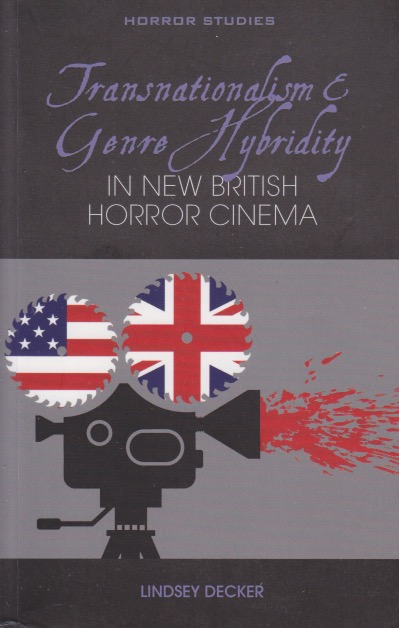
Taking my first, tentative steps into horror analysis, I had read a great many monographs on the subject.  I had watched many horror films over the years, but since my family has no love of the genre, and since habitually under-employed I can’t afford to pay for many, my quota is fairly modest.  I’ve missed out on many.  When I could afford it, I started out with either movies I’d heard of when younger but had never watched, or packs of ultra-cheap B (C or D maybe) movies that nobody has ever heard of.  As I lamented recently, British films were rare—Hammer, which held the English reputation for horror, was the undiscovered country.  Then I saw that Peter Hutchings’ Hammer and Beyond: The British Horror Film had come out in a second edition.  (The new edition contains three of Hutchings’ other articles as well as the original text.)  I had to read it.

Although I’ve not seen many of the movies discussed in the book (again, access issues) it was fascinating nonetheless.  Hutchings considers the elements of gender and Britishness in his readings of the films and there’s quite a lot there.  Horror is generally seen as a conservative genre (it tends to uphold typical social values) and for many Hammer and other films this meant that male prerogative was important.  Equally important, however, is that horror often disrupts this hierarchy.  There are strong, and even fatal, women here.  Horror embodies the acting out of the complex world of fear between women and men.  The study, as befitting a revised dissertation, is laid out chronologically for the most part.

Some readers of this blog have kindly pointed out ways to access Hammer films in the US.  Now all I need is the time.  I’ve been able to keep up with my reading, at least.  And this was a worthwhile book to read, even without having seen much Hammer.  It surprised me, however, that their list of classic horror wasn’t longer.  Having read about Hammer for many years,  I suspected their output was massive.  Instead it was mostly just impactful.  The essays following the main body of the book make the point that British horror was/is distinctive.  These days a lot of international cooperation takes place in the movie industry, and national cinema is becoming more global.  We could use a little less nationalism just about now.  So I’ll continue my quest for Hammer and try to make my way through the movies I really should add to my repertoire.  It’s a good book that can make you want to do that.


What’s Poppin’?

“How are things in the world of finance?” Admiral Boom calls to a passing George Banks.  The bland answer of fine as everything is good with the pound sterling assures the seaman that everyone is doing their job properly.  This may be a throwaway scene from Mary Poppins, but it captures an anxiety I’ve been experiencing for some time now.  Admiral Boom doesn’t have to be an expert in finance—he knows that Banks and his ilk are taking care of that so that he can oversee his household, keeping it ship-shape.  With the shenanigans of the Republican Party, however, all of us—bankers, seafarers, editors, it doesn’t matter—have to become experts in politics.  Why?  Politicians can no longer be trusted to do their jobs.  Corruption is so rife that they saw no problem with Donald Trump (“How are things in the world of finance?”) being elected.

The internet has given people the idea that they know more than they do.  If you read enough you soon realize just how little you actually know, and that humility (note, Mr. Trump) is the only proper response.  Now we have people all jazzed on the idea that you can express your personal hatreds and be rude to others because, well, that’s what 45 did.  Now we all have to learn about what schemes (and they are schemes) the Republican Party is up to at all times to try actually to steal power.  Come on folks, gerrymandering is a blatant attempt to game the voting system, as is the retention of the electoral college.  And the filibuster.  

Sure, voters should be informed.  We are responsible for gathering facts, and not alternative facts, before we head to the polls.  Beyond that we used to be able to trust politicians to do their jobs.  Yes, there was always corruption—power inevitably leads to corruption—but there were checks and balances.  Those checks and balances are gone.  Now instead of keeping his house Bristol fashion, Admiral Boom must spend hours a day trying to sort out lies handed out like candy on Halloween, trying to figure out what is the truth and what is republicanism.  Don’t be listening for that boom on the dot anymore.  Mr. Binnacle is too busy trying to memorize the names of everyone running for the school board who are anti-masker, anti-vaxxers who stand for Trump and his original stolen election.  How are things in the world of finance?  How can we ever possibly know since we now all have to spend our time back in civics class?


Horror Show

The horror film history narrative runs something like this: although there had been some scary movies in the silent era, the term “horror” was first used to describe Universal’s 1931 release of Dracula and Frankenstein.  Some other studios got in on the action and creature features were a staple of US cinema until the fifties when they began to peter out.  By that point a UK horror industry took off, largely due to Hammer Studios.  While these Hammer offerings often remade the standard creature features, they also branched out into less commonly explored areas such as films set in contemporary times focused on the occult.  This phase faded in the sixties just as “modern horror” was taking off with classics like The Night of the Living Dead and Rosemary’s Baby.  Modern horror quickly grew.  Further divisions can of course be made, and the modern period has gone through several transformations as well.  It’s a rich coffer.

There’s a real problem with this, however, for those who might’ve missed a decade or two somewhere in there.  Many of the UK films are still not available in the US for anything like a fair price.  Part of the reason for this is copyright law, but another is apparently the ignoring of demand.  I saw maybe one Hammer film (on TV) growing up.  Saturday afternoon fair was more often American B movies like Zontar the Thing from Venus.  I’ve got a hankering to watch some of those Hammer films, but even in the 2020s they’re difficult to find.  Even with the internet.  Often the DVDs are (because of differing copyright laws) coded so they can’t be viewed in North America.  You can buy a player to see them, but when you think of the inevitability of streaming it hardly seems worth the cost.

Streaming might be the solution, but much of the Hammer oeuvre doesn’t stream in the US, at least not that I’ve found.  If I’m wrong please let me know in the comments!  You see, I spend time reading about horror and when you do this recommendations often arise.  Some Hammer classics are as expensive as the academic books that discuss them.  Is it possible to be a horror connoisseur?   And can you truly be a connoisseur without sampling what’s on offer overseas?  We tend to forget that the world is culturally divided by copyright laws.  If nobody’s watching the movie anymore what’s the harm in making it free?  If people do want to see it, why not sell it to them at industry standard price?  Even trying to watch horror, it seems, has become a horror show.

Photo by Michael Mouritz on Unsplash