Look It Up

So my current book project involves addressing The Conjuring universe.  A few weeks back I posted on The Nun, the newest member of that diegesis and one with no claim to be based on real events.  Nevertheless, the film circles back at the end to “Frenchy” and his exorcism shown in the original movie.  One of the frustrating aspects of Ed and Lorraine Warren ’s oeuvre is that documented sources are difficult to locate.  When I found out Satan’s Harvest (by Michael Lasalandra and Mark Merenda, with Maurice and Nancy Theriault) was the “true story” behind Frenchy Theriault’s possession, well, let’s just say working on a book is a good excuse.  Overly dramatized, and somewhat padded, this account may be the closest we can come to this particular demonic encounter.

I don’t pretend to be certain about many things, so I reserve judgment about what actually might’ve happened to Maurice Theriault.  Unlike portrayed in The Nun’s storyline, he never lived in Romania.  He was physically abused by his father and was made to participate in unwanted sexual acts.  His was not an easy life.  Still, when Lasalandra and Merenda try to explain the origin of possession they go back to the same source as the original movie—Salem.  Credulously claiming that the Devil was behind what happened in 1692, they believe that demonic possession accounted for that unfortunate miscarriage of justice.  It’s difficult to say if they considered that such speculation implies that the innocents killed there were actually witches.  (They state that the Devil asks people to sign his book.)

Herein lies part of the problem with academics and the supernatural.  Sensationalized claims don’t help since academics are all about being taken seriously.  At the same time it’s clear that conventional explanations don’t always fit.  Neither credulousness nor extreme skepticism will lead to solving such mysteries.  This is why we need the monstrous.  That which falls outside the parameters of what quotidian experience leads us to expect.  Science can make everything fit only by leveling off the exceptional.  Academics won’t risk exploration of the anomalous.  This leaves the curious few means of finding out what happened beyond simple dismissal or overly gullible popularizing accounts.  Satan’s Harvest contains information that calls out for explanation.  Perhaps a hoax was involved, but that doesn’t add up when all the evidence is in.  Beyond that, we’re left to guess.  And some things it feels better to be sure about.


All Things Being Equinox

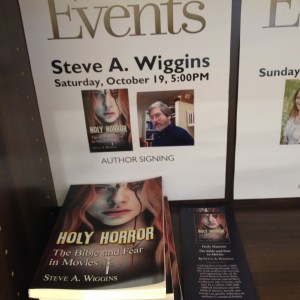
The weather around here has been appropriately gloomy for the autumnal equinox.  Although Hurricane Florence gave us a day of rain, the heavy clouds have been part of a pattern that has held largely since May.  Given the gray skies, we opted to watch Alfred Hitchcock’s The Birds last night.  My wife isn’t a horror fan, but she does like Hitch.  We’ve watched The Birds together many times, but this is the first time since I wrote Holy Horror.  I was somewhat surprised to recall how much Scripture plays into the script.  This is mostly due to a drunken doomsday sayer in the diner.  After the attack on the school kids of Bodega Bay, he declares that it’s the end of the world and begins citing the Bible.  He’s there for comic relief, but the way the movie ends he could be right.

When I was writing Holy Horror I had a few moments of panic myself.  Had I found all the horror films with the Bible in them?  Could anyone do so (without an academic job and perhaps a grant to take time off to watch movies)?  I eventually realized that I was merely providing a sample in that analysis.  Several weeks after I submitted the manuscript I watched The Blair Witch Project.  There was the Bible.  The same thing happened last night under a glowering late September sky.  The Birds has the Bible.  Two weeks ago I saw The Nun; well, that one’s almost cheating.  But you get the picture—the Good Book appears rather frequently in horror.  That’s what inspired me to write the book in the first place.

Now that nights are longer, and cooler, the grass has somewhat poignantly relinquished its aggressive summer growth.  Most of the ailanthus trees have been cut down (I must be part lumberjack).  My outside hours are limited not only by work but by the fading light.  In the words of the sage, “winter’s tuning up.”  We moved to a house we saw in the spring as days were lengthening.  Now we’ve come to the dividing line that will slowly leech the light from our evening skies.  I suspect that as I go back and watch some of my old favorites again I’ll discover something I already knew.  The Bible and horror belong together because both are means of coping with the darkness.  Call it puerile if you will, but there is something profound about this connection.  It just has to be dark for you to see it.


Southern Turn

In America’s ever roving commercial eye, Día de Muertos has become an extension of Halloween.  Retailers have realized that people will spend a lot on their fear, and the autumnal holidays delve into that primal territory.  Since the Day of the Dead, being a mix of indigenous Mexican religions and the Catholic celebration of All Souls’ Day, comes two days after Halloween why not blur them together with greenbacks?  So capitalist thinking goes.  While certainly not free of monied interests, the Disney/Pixar movie Coco has the virtue of addressing Día de Muertos as the separate holiday that it is.  A form of ancestor worship—a religion extremely common around the world—the thought-world of the film shares in common with Tim Burton’s Corpse Bride this idea that the afterlife is colorful, if not joyous.

I realize I’m jumping the gun here, but I just saw Coco for the first time over the weekend.  Not just a culturally sensitive treatment of an indigenous holiday, it is also a celebration of music.  In a very real sense, music is life in the film, and even the dead continue to thrive in its presence.  Again, the connection with Corpse Bride suggests itself.  The key difference, from a religionist’s point of view, is that Coco is based on, to an extent, actual religious traditions.  An irony of this is that, together with the worship of Santa Muerte, the focus on death sometimes makes the Catholic Church nervous.  Focus should be on resurrection, not death.  But what if death isn’t seen as evil?  Where is thy sting?  This can be a real challenge when your organization is offering escape from death.

The fear of death is natural enough.  It’s the ultimate unknown.  It fuels both religion and horror.  In that sense films like Coco that show a joyful aspect of the hereafter do an end-run around traditions that base their wares on ways to avoid the consequences of death.  Hell becomes a threat to be avoided—the forgotten dead in Coco face annihilation, a fate that Héctor notes comes to everyone eventually.  Eternal torment isn’t in the picture.  I have to wonder if this view doesn’t present a form of salvation that is unwelcome among rival religions.  Although Catholics don’t have the hostility toward Halloween that many Evangelicals display, there is a challenge of rival faiths here.  Stores have already begun offering this year’s Halloween wares, and increasingly among them are Day of the Dead decorations.  The holidays are quite distinct, although related, and movies like Coco suggest what we fear may be more a matter of perspective than of the decree of an angry deity.


Scriptural Slashers

Let me relish this a moment.

Thanks.  You still there?  It’s not too often, you see, that I get to feel like I’m near the front of the crowd.  I began writing Holy Horror when there were a small handful of books on the market concerning horror and the Bible.  I wasn’t aware of Brandon R. Grafius’ work at the time, but it sure is gratifying to see that others have noticed the connection.  Reading Phinehas, Watching Slashers: Horror Theory and Numbers 25 is pretty much what its title says.  I’ll be having more to say on it in a different venue—don’t worry, I’ll let you know—so I’ll keep to the basics here.  My spellcheck, and I’m sure not a few others, might have trouble identifying Phinehas.

In one of those weird, short, violent episodes for which the Good Book is justly famous, the story of Phinehas is clearly part of a larger, untold narrative.  Like the sons of the gods marrying the daughters of men in Genesis 6.  The grandson of Aaron, Phinehas was one of the hereditary priests of early Israel.  The Israelites wandering for their 40 years in the wilderness were nearly as xenophobic as the Trump Administration.  When one of the chosen people chose a foreign wife, Phinehas, full of zeal, grabbed a spear and skewered the couple.  Tradition says in flagrante delicto.  This act of violence stops a raging plague sent by the Almighty, so Phinehas looks like a hero in context.  If you want to read the story the subtitle tells you where to find it.  Or you could read Grafius’ excellent book.

Horror, which should be already obvious, enters the picture in the form of theory.  Yes, there is such a thing as horror theory.  Grafius uses it to analyze this story, along with other methods.  This is what I’m relishing.  I certainly wasn’t the first to notice the connection.  Many years ago Phyllis Trible wrote Texts of Terror, noting how the Bible seems less holy (my expression, not hers) when read from the perspective of a woman.  Indeed, many accounts that seem like standard issue narratives of God laying down the rules and humans disobeying tend to fall pretty heavily on females.  And the punishments used are fit for horror films.  Grafius focuses specifically on slashers, but one gets the sense that this book is just the start of something larger.  This reader, at least, hopes that is the case.


Appily Ever After

While in the theater to see The Nun (which ended up being the biggest take) this weekend, I couldn’t help but notice that the pre-movie adds were all about apps.  I couldn’t help it because, much to my own chagrin, I’d left the house too quickly and I hadn’t brought a book to read while waiting.  This may not be news to some people, but different cinema chains have different “channels” of what passes for entertainment and ads to try to draw viewers in early.  The movie house we used to frequent in New Jersey had a variety of goods on show, most of the time.  The one we visited here in Pennsylvania presumed that everyone had their phones in hand, waiting for the show to begin.  On screen was the idolization of the app.

My phone is old enough that most modern apps don’t work on it.  Most of the time that doesn’t matter to me since I’m not addicted to the device.  Of course, when you’re trying to park your car in a town that offers only online options for such a convenience, I sometimes wish I could download the relevant necessary software.  Otherwise, I often wonder what we’ve lost in our lust for connectivity.  Coming out of New York on the longer distance bus recently, the driver called out, as leaving the Port Authority, “Lights on or off?”  The unanimous chorus, for I didn’t speak, answered “Off!”  I glanced around.  I was surrounded by devices.  I carry a book-light with me on the bus, for this has happened before.

“Drink the Kool-Aid” has become post-Jonestown slang for simply following the suggestion of someone without considering the consequences.  I sometimes wonder if our smartphones come in more than one flavor.  I’m not talking about features or physical colors.  As apps chip away at our money, a little bit at a time, they also take larger pieces of our time.  I’ve experienced it too, but mostly on my laptop (I don’t text—my thumbs aren’t that limber, and besides, the apocopated messages often lead to misunderstanding, emojis or not), the wonder of one link leading to another then realizing an hour has disappeared and I still feel hungry.  Perhaps that’s the draw to the modern commuter.  Or movie goer.  I’m sitting in the theater, taking a break from unpacking.  In my version of multitasking, I’m also doing research by watching a horror movie.  Around me eyes glow eerily in the dark.  I’m lost in the forest of unsleeping apps.


Nun Among Them

Life is sweet when watching a horror movie counts as research.  It’d be sweeter, of course, if a university paid for it, nevertheless, I went to see The Nun on its opening weekend.  My wife gamely went with me (no sponsor was paying for this) on a rainy Saturday afternoon.  Now, if you haven’t been following The Conjuring universe, you might not know about The Nun.  The full story will be revealed in Nightmares with the Bible, which is coming along nicely.  Suffice it to say it’s a movie about a haunted convent in Romania.  Those who know the Dracula tradition will perk up at the mention of the location.  The scenery is quite lovely in a horror genre kind of way.  And it also has ties to The Conjuring diegesis that bring the story full circle.

Ghostly nuns, it turns out, can be scary.  Religion, after all, involves coercion and threat as well as love and salvation.  Sister Irene, the protagonist, is a novice nun sent on a mission to investigate said convent.  The film reveals both an awareness of religious motivation and a seeming lack of research regarding monastic life.  Sister Irene, for example, tells the students at her school that the Bible isn’t to be taken literally.  It’s “God love letter to humanity.”  Well, parts of it are.  Still, the struggle with biblical literalism is a present-day issue that the movie addresses head on.  It was difficult to believe, on the other hand, that even a novice would walk into a chapel where someone is praying and call out “Hello?”.  Many years at Nashotah House taught me something.

Cloistered environments, although not part of most people’s experience, are great locations for horror.  For example, the first night she spends in the monastery Irene is told that the great silence is observed until dawn.  Did I mention that in chapel no one can hear you scream?  There’s an element about that in actual cloistered life.  The discipline of secrecy is heavy and full of threat.  We spent a great many silent days at Nashotah House and the sense of violation as sin was heavy indeed.  The part that truly stood out, however, was where the nuns used their only recourse against evil; they had to pray.  In the world of action movies, striking out with whatever is at hand is the expected response.  Spiritual entities, although the film does relent, can’t be touched except with spiritual threats.  The praying nuns looked so helpless in the presence of a demon.

There were less than a dozen people in the theater.  The Nun may not be a runaway hit.  The devoted will see it, however, and some of us will include it in our working life as a kind of spiritual exercise.


Horrible Delays

It’s not that the delay is actually horrible.  Horror movies, after all, come into their own with the darkening days of fall.  Nevertheless it occurred to me that now August is about to exit stage left, some may be wondering where Holy Horror is.  After all, the website originally said “August.”  The truth is nobody really understands the mysteries of the publishing industry.  Like so many human enterprises, it is larger than any single person can control or even comprehend.  I work in publishing, but if I were to subdivide that I’d have to say I work in academic publishing.  Further subdivided, non-textbook academic publishing.  Even further, humanities non-textbook academic publishing.  Even even further, religion—you get the picture.  I only know the presses I know.

It suits me fine if Holy Horror gets an autumn release.  I don’t know, however, when that might be.  I haven’t seen the proofs yet, so it’s hard to guess.  Appropriate in its own way for horror.  The genre deals with the unexpected.  Things happen that the protagonists didn’t see coming.  In that respect, it’s quite a bit like life.  My work on Nightmares with the Bible is well underway.  When you don’t have an academic post your research style necessarily changes, but I’m pleased to find that books can still be written even with the prison walls of nine-to-five surrounding one.  It may be a bit like Frankenstein’s monster (happy birthday, by the way!), but it will get there eventually.

Of my published books so far, Holy Horror was the most fun to write.  It wasn’t intended as an academic book, but without an internet platform you won’t get an agent, so academic it is.  It’s quite readable, believe me.  I sometimes felt like Victor Frankenstein in the process.  Pulling bits and pieces from here and there, sewing them together with personal experience and many hours watching movies in the dark, it was horrorshow, if you’ll pardon my Nadsat.  We’re all droogs, here, right?  I do hope Holy Horror gets published this year.  Frankenstein hit the shelves two centuries ago in 1818.  Horror has been maturing ever since.  So, there’s been a delay.  Frankenstein wasn’t stitched up in a day, as they say.  And like that creature, once the creator is done with it, she or he loses control.  It takes on a life of its own.  We’ll have to wait to see what’s lurking in the darkening days ahead.


A Kind of Happening

The roofers were here.  One of the things you learn only after laying down a ton of money is that those selling a house like to withhold information.  Moving during one of the rainiest summers in history, we naturally discovered leaks.  And so the roofers are here, like noisy angels banging above my head.  Given the orientation of our house, their access is outside the window of my work office.  I figured it was an opportunity to learn.  As the old shingles came raining down, however, I couldn’t help thinking of M. Night Shyamalan’s The Happening.  One of his more disappointing efforts, this horror film involved a memorable scene of mass suicide where people jumped off of a high building one after another.  Maybe other people would think of other comparisons, but the falling debris brought the film to mind in my case.

It’s a matter of framing, I suppose.  I’ve watched enough horror that it has become a framing device.  This is true although it has literally been months since I’ve seen a horror film.  (Moving proved to be its own kind of nightmare and one day I suspect we’ll be unpacked enough to watch movies again.)  Instead of losing the frame of reference, however, I find it intact.  If you spend long enough with Poe, he gets under your skin.  And changing states to M. Night Shyamalan’s eastern Pennsylvania might have something to do with it.  This is Bucks County territory, after all.  Another frame of reference, mediated by media.

As I watch the old shingles drop, I realize the window through which I’m witnessing this is another frame.  Like a camera lens, it limits my view.  At times it can be like Hitchcock’s Rear Window, seeing neighbors at their daily business.   Indulge me. For nearly the past five years I worked in a cubicle with no view of any windows whatsoever.  I was completely cut off from the outside.  (Which, for those of you who’ll admit to having seen The Happening, might not have been an entirely bad thing.)  Now that I have a window—my own framing device—I realize some of what I’d been missing.  At Routledge I had a window, but at such a level that the Manhattan outside seemed artificial.  You couldn’t see individuals down on the street.  The entire wall was a window—too much of a frame.  Gorgias Press involved working in a windowless room as well.  I’m professional enough not to let the falling material or the pounding distract me much.  There’s work to do because there are bills to pay.  And horror films prepared me for that as well.  It’s the ultimate framing device.


Enoch Enough

For a person referenced so little in the Bible, Enoch captured popular imagination in a way difficult to comprehend.  Even in ancient times speculation about him was rampant.  The seventh generation from Adam, and great-grandfather of Noah, Enoch lived a remarkably short 365 years before “he was not, for God took him.”  Now, there are lots of obscure people in the Bible.  Many of them have very little afterlife in later tradition.  Enoch, however, became the putative author of a collection of booklets that goes by the name of 1 Enoch.  This book fed speculation in antiquity and became a vehicle for many esoteric traditions that continue even into the present day.  It might seem that there’s little information to go on for an entire book, but James C. VanderKam’s Enoch: A Man for All Generations finds plenty of material with which to work.

A careful scholar like VanderKam doesn’t delve much into speculation, and he rather cautiously examines many of the ancient texts that discuss Enoch and draws some basic conclusions.  There’s a lot of information in this book.  With my own fascination concerning the Bible and popular culture, what stood out to me was how Enoch went from the “mere” man who didn’t die to become, in some traditions, the Metatron, or “the lesser Yahweh.”  Having been a fan of Dogma since teaching at the perhaps too sanctimonious Nashotah House, I’d never researched the late, great Alan Rickman’s character.  I supposed the Metatron was a character like the Muse—some extra-biblical quasi-divine functionary thrown in for fun.  I didn’t doubt such a figure was known in early Jewish or Christian writings, but I had no idea that Enoch had been promoted to that level.

Since I’ve been researching demons lately, the book of 1 Enoch has been a major source of interest.  One of its sections, The Book of the Watchers, expands on that odd story from Genesis 6 where the sons of God lust after the “daughters of men.”  Ever coy, the biblical passage doesn’t directly say that their offspring were giants, but this idea was developed by sources like 1 Enoch.  And these fallen angels—the nephilim—in some traditions, become demons.  Studying Enoch is a fine introduction to a mythological world every bit as rich as Dogma.  These characters—Enoch, nephilim, watchers, and demons—populated the imagination of early readers of the Good Book as much as they do modern speculators’ worlds.  Not bad for a character barely mentioned at all in the Bible.


You’ve Never Seen

In spite of accusations of puerile voyeurism, horror is a genre containing many deep films. I have no training as a film critic, but it’s evident that among the more weighty of horror heavyweights is The Exorcist. Mark Kermode is, on the other hand, a film critic, and his book named after the movie demonstrates just how much a viewer can see. I’ve watched The Exorcist quite a few times and there were things I’ve consistently missed. I also realize that I’ve only ever seen The Version You’ve Never Seen (the 2000 theatrical re-release). Having been too young and far too skittish to have seen its debut, I’ve been happy—if that’s the right word to use with such a production—with the version I’ve seen. That’s the human condition, I guess. Kermode made me wonder what it would’ve been like to have experienced it before the spoilers became universally known.

Yes, there are striking special effects—especially for the early 1970s—but the message is what really holds the depth. The story is the classic struggle of good and evil. Demons are, after all, a form of evil personified. The fact that a young girl is the victim may be a little too true to life, but it also gives the drama considerable emotional resonance. In the end, according to the view of the writer and director, good wins. The struggle, as they portray it, is real and costly. It’s always informative to find out what those who made a film thought it was about. Even with the motive of making money, many involved in the industry still have the hearts of artists. Maybe even priests.

Having learned at the feet of post-modernists, we know that no interpretation—even that of the creators—is privileged. Just as there’s no such thing as “only reading,” no one “only watches” cinema. The acts of reading and watching inherently involve interpretation. Kermode draws that out nicely in this little book. His interpretation, as insightful as it is, is but one way of looking at it. Was The Exorcist the version originally released in 1973? Bill Blatty and Bill Friedkin disagreed to the end about what the definitive version was. The many sequels and spin-offs have reinterpreted the story in their own ways. So it is with the struggle against evil. There’s no one single way to go about it. Some make horror movies to demonstrate that point precisely. At least in my view they do.


Wolves Again

Although I don’t read movie reviews until after I’ve seen a film, I have a confession to make. With rumors swirling of The Conjuring 3, and since a chapter of Nightmares with the Bible will involve The Conjuring, I was a little curious what it might be about. Word on the street—and by “street” I mean “internet”—is that it will feature the case of Ed and Lorraine Warren that’s presented in Werewolf. Co-written by William Ramsey (the victim) and Robert David Chase, the book describes the strange malady of Ramsey, who never actually changed into a wolf, but for inexplicable reasons (at the time) thought himself a wolf and took on a wolfish look as he attacked people. The reports suggest he had preternatural strength at such times.

Since most of the Warrens’ books are concerned with demons, it should come as no surprise that in this case that was the diagnosis as well. With no real reason given, once upon a childhood evening Ramsey was possessed and occasionally broke out into violent fits. He landed in a psychiatric hospital a couple of times, but was eventually released. Noticed by the Warrens on one of their trips to England, Ramsey was invited to come stateside for an exorcism. According to the book, the rite was successful at least up until the time of publication. That’s the thing about demons—you can’t always tell for sure when they’re gone.

It’s pretty obvious why such a story line would appeal for a horror flick. You’ve got a werewolf, an unnamed demon, and an exorcism—there’s a lot to work with here. Weird things happen in the world, and there’s not too much to strain the credulity in this case. It would seem possible that a mental illness could cause much of what’s described as plaguing Ramsey, though. Its episodic nature is strange, I suppose, and the Warrens had a reputation for spotting demons. I did miss the conventional elements of the exorcism, however. No demon forced to give its name, no levitating and no head-spinning. Not even a bona fide bodily transformation. They’ll be able to fix that in Hollywood, I’m sure. Credulous or not, there will always be people like me who feel compelled to read such books. And since there’s no final arbiter but opinion in cases of the supernatural, that can leave you wondering.


Mythologies

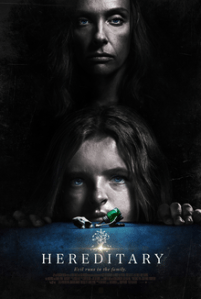
Now that Holy Horror will be appearing soon, I’ve been neglecting my horror movies. It’s not on purpose, I assure you. I don’t feel comfortable speaking as a writer—publishers tend to agree with that, and besides, my job is more of being a reader—but my experience of it suggests you never have enough time. (Or money; movies never come with no costs.) With another book under contract and a lot more going on behind the scenes than I reveal on this blog, as Morpheus says, “Time is always against us.” So when my wife showed me a story about Hereditary, I knew my list of must sees would only continue to grow. I haven’t even seen Get Out yet!

Beyond being simple guilty pleasures, horror films area also a means of coping. I know this because although they’re generally very successful at the box office, I’ve rarely met anyone who admits to watching them. Horror thrives on secrets. We act one way in public, and a different way when we shut the door and pull the drapes. Since we’ve outlived our belief in gods and heroes, cinema has taken the role of mythology in modern life. Crammed with archetypes—and yes, stereotypes—movies act out age-old themes in impressive displays of color and sound. You might even learn something without trying. Mythology may have originated in stories told around the campfire, but science never displaced the need for hearing them again and again in different media.

I’ve taken to writing books about films because it’s clear that meaning lies there for many people. The invention of cinema and television forever changed culture. Yes, there’s cheap, thoughtless material available in both formats. Still, movies have an ability to convey truths in a way that sermons often fail to do. The values they depict are often very human ones. Horror, for example, isn’t about blood and gore. It’s about survival. That’s not to say the protagonists always reach a happy ending, but we learn from their mistakes. There’s a reason you shouldn’t open closet doors in a house not your own. Those who do, however, often find uncomfortable truths inside. Holy Horror looks in the closet at the way the Bible functions iconically in horror. Since writing it I continue to notice the Bible in horror and I feel affirmed in the conclusions I drew. And if only I had a bit more time, I’d be watching more mythology. And the list only keeps getting longer.


Credulity

So I went to see The Incredibles 2. Like the first movie, it deals with the complexities of family life amid the feelings of inadequacy when people are kept from their full potential. The idea of humans being enslaved by their screens seemed real enough. If you’ve ever tried to walk through Manhattan in a hurry you know that one of the clearest dangers is the pedestrian staring at his or her phone. People used to come to New York to see the scenery. Now you can get the full experience all online. There’s little doubt that we do need to be saved from our screens. Meet virtual reality. After only one encounter you can drop the “virtual.” Ironically, we were all sitting in a theater looking at a great big screen.

What was even more interesting was the fact that the film began with an apology for taking so long to make a sequel. An actual apology. As if no movie ever could, or should stand on its own. It’s common knowledge that sequels seldom live up to the originals. Interestingly, the villain in the movie states that people will always choose convenience over quality. That much is certain, and in an ironic way it applies to the film in which it’s uttered. I don’t believe in the crisis for creativity. It’s still out there. Original ideas are endemic to human nature. Ideas that bring in lots of money are more rare, and so we rely on the sequel. Sure things.

Publishers play this same game. Books that are completely new ideas frequently find their way from editors’ slush piles to their rejection piles. Publishers want something similar to what they’ve done before. Even better, something similar to something that sold well last time. The odds, in a capitalistic society, are stacked against creativity. It’s money that’s important, not originality. Yes, there have been books written extolling the wonders—virtues even—of originality. Such books are more easily published if they’re written by somebody already famous. So here was the dilemma in the theater: enjoy the movie or accept the message of the movie? The rare days I’m away from the screen, I’m old enough to admit, I don’t really crave it. When I come back in the door, however, the first thing I do is login to see if I’ve missed anything. Screens can lead to a strange uniformity. As long as we’re willing to pay for it, nobody will complain.


Behind the Scenes

Although I confess to being a horror aficionado, it took many years before I could convince myself to watch The Exorcist. I finally saw it in the mid-20-aughts, and have watched it many times since. It’s a movie that I discuss in Holy Horror, and it will star in Nightmares with the Bible as well. Although younger people often don’t experience the movie as scary—certainly the increasing trust in science and growth of secularity contribute to this—there is a sincerity about it that earns it its deserved place in the pantheon of horror. Bob McCabe surely counts as a fan for his The Exorcist: Out of the Shadows. Sub-subtitled The Full Story of the Film, this book is a gallimaufry of anecdotes, interviews, and facts about the movie and even its sequels. It’s like of like a sustained reaction shot.

The book doesn’t lack insight and McCabe is surely right that this was one of the most influential movies of the early 1970s. It has become a frame of reference on its own and it has defined, in large measure, what people believe about demonic possession. One of the quotes from McCabe’s treatment however, uses the phrase “metaphysical unknown” to explain why the film retains its power to scare, and there’s a great deal of wisdom in that assessment. Fear of the unknown, of course, is prime real estate for horror, and one of the most interesting things about demons is how little the Bible, or other ancient texts, really says (or say) about them. They are an embodiment of the unknown that can take over a person and make her somebody else. But it’s that metaphysical that’s really scary.

As we continue into a time of less and less that remains unclaimed by scientific theory, those metaphysical unknowns continue to lurk and to frighten. Maybe it’s the concept of the metaphysical itself that scares—can there really be something larger, more intelligent than us? The human psyche bruises easily, and we don’t like to be reminded that we lack the control we suppose we have each day. The metaphysical challenges all that. Since it refuses to submit to empirical verification, it remains unknown. A great many people interpret this as the same as not believing in it. Every once in a while, however, a powerful statement such as The Exorcist comes along. Few people thought about demons before William Peter Blatty’s novel and subsequent film. Then the world was full of them again. Requests for exorcisms are on the rise, and the metaphysical unknown haunts us now as much as it ever has.


Cult of Paris

The cult of celebrity is dangerous. The results of both biological and psychological sciences inform us that mammals, especially primates, hold “alpha” individuals in awe. We don’t know what quality makes them irresistible to some, but in the case of humans before you know it everyone is talking about this Kardashian or that Trump. Valorizing the power of media as we do, those who appear ubiquitously on screen gain in magnitude merely by the attention paid to them. Others have vetted the details, and those who are deemed important enough for constant, widespread television exposure are worthy of our worship. Most of the time it seems banal, harmless. But when those without scruples are willing to exploit it, it is dangerous.

Paris rejecting the cult of celebrity

For example, the other day my wife and I rewatched An American in Paris. I know my wife likes the movie, but when it was over I couldn’t help noting that Jerry Mulligan chauvinistically claims his right to a woman he’s just met, and who is, moreover, engaged to a friend of his who had just lent him money. The fact that he doesn’t know about the engagement is no excuse. Lise tells him “No,” and when she gives him a false telephone number he doesn’t take the hint that she doesn’t want him to call her. He stalks her in a selfish and predatory way. Only because she laughs at his antics with some perfume bottles does she agree to meet with him later. He takes advantage of another woman who clearly has feelings for him and who sponsors him, using her money but not reciprocating her feelings. He’s aggressive and eavesdrops to get Lise’s name. He lies to her and about her (saying he knows her so her friends don’t object) and refuses to take no for an answer. Laying out my grievances, my wife politely listened and then said, “But it’s Gene Kelly.”

Like many people, I was jilted a time or two when I was younger. Losing out to a rival lover leaves a lasting scar. How can we hope that on New Year’s Eve Lise will leave Henri for the interloper Jerry? But it’s Gene Kelly. The cult of celebrity allows those on various pedestals to get away with many things. Trump was likely correct in saying he could stand in the middle of a crowded street and shoot someone and his base would not object. The cult of celebrity ’sn’twonderful, ‘sdangerous.