This Halloween

This year I’ve been making a conscious effort to appreciate autumn.  It’s admittedly difficult when you’re forced to sit in an office, even a home office, for most of the daylight hours five days a week.  (At least I have a window here, which I never had on Madison Avenue.)  Seeing the blue skies and colorful leaves, each individual one of which is a singular work of art, or watching the moody, cloudy skies, I wish for freedom.  Every night before falling asleep, if I can remember to do so, the last word I whisper to myself has been “September,” then “October,” to remind myself of the wonder of this time of year in which I’ve been privileged to live.  Since America is driven by money alone, often in the guise of religion, Halloween is practically over before it begins.  Stores have sold their candy and spooky decorations, now it’s on to the more lucrative Christmas season.

Do we really believe that holidays have any power anymore?  Is Halloween really, perhaps, a time when the veil between worlds is actually thin?  Or have we ceased believing in the other world, the one behind all the money and sham?   Holidays are liminal times.  In an ironic way, it’s my heartfelt appreciation of Halloween that led me to write about The Wicker Man, although it’s set half a year away.  Nashotah House was hardly an ideal place to work, but prior to an administration change, it was the best place I’ve ever lived to celebrate Halloween.  A campus with an in-house cemetery, and surrounded (at the time) by cornfields and woods, was adjunct to really believing.  It was a haunted place.

Out on late nights or early mornings, I often felt it.  Trying to photograph a comet down by the lake by myself, woods on either side, in the total dark.  Or dragging a lawn chair through the trees to the edge of a cornfield at 4 a.m. to try to catch a meteor shower.   Hiding in the graveyard on Halloween night, dressed as a grim reaper to follow the hay wagon of kids that the maintenance director would drive through on that night.  Those memories remain as highlights of my foreshortened teaching career.  Since Harry Potter was in the ascendant, students had taken to calling the seminary “Hogwarts,” and, I was told, I was the master of Ravenclaw.  The leaves, miniature Van Gogh’s each one, are fast falling from the trees.  There’s a decided chill in the air.  Something might, just might, really happen this Halloween.


When Autumn Starts

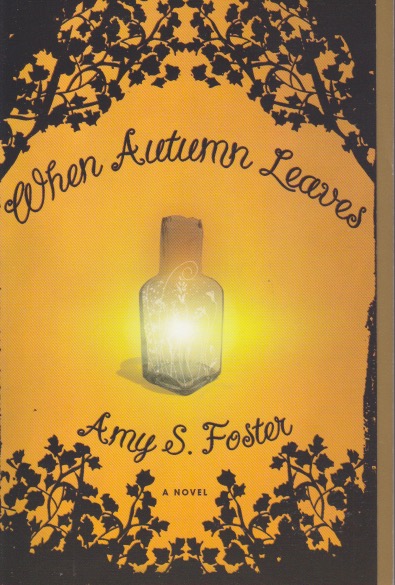
Some books catch my attention and I’m not sure why.  Knowing myself, the title When Autumn Leaves, invoking my favorite time of year with its intriguing syntax, probably did it.  I’m always on the lookout for books that capture the spirit of autumn.  Although she’s quite well known as a lyricist, Amy S. Foster’s name wasn’t familiar to me.  The cover looked autumnal and I knew it was about witches.  It came out quite a few years ago, so my recollection of why I’d marked it then had faded by the time I finally got to it.  The title is a play on both autumn and leaves.  The main character of the ensemble cast is Autumn and knowing that changes leaves from those on a tree to a verb of action.  I’ll try not to put any spoilers here since there’s plenty to say without giving away the ending.

Autumn is a good witch.  Well, the book doesn’t out and say so directly.  Being magical realism there’s some room for interpretation.  She’s the matriarch of Avening, an island city off the west coast.  Those drawn to Avening tend to have some kind of magical powers, whether or not they know of them.  The story unveils the various women coming to be aware of their special talents, but generally they’re unsure what to do with or about them.  Autumn is the one to help them.  She’s been in Avening as long as anyone can remember, but, as the novel opens, she learns it’s her time to leave (thus the title).

Before she can go, however, Autumn has to select a replacement.  This is what introduces us to the various characters in the story.  We hear of the magical powers of some of the thirteen in quite a bit of detail, and others more incidentally.  Many of them don’t know they have these powers.  They know there’s something special about Avening and that they were drawn there, but they don’t know why.  So it’s a tale of female discovery.  Some of the vignettes are difficult to read, dealing with serious subjects, but they reflect realities in women’s lives.  It’s not really an autumnal story, spinning as it does through the wheel of the year, beginning with the winter solstice and ending up at Samhain.  It doesn’t dwell on Halloween, however.  It’s much more a character-driven story.  It creates a wondering image of Avening and what might happen if women were in charge.  And in that respect it’s very compelling indeed.


Free to Listen

It was a delightful conversation, as always.  Robin and Debra from The Incarcerated Christian podcast always amaze me with both their program and their enthusiasm.  I’m still bit nonplussed that they find my work interesting.  They invited me back for an October discussion around Nightmares with the Bible, located here.  Although the book has not yet sold enough copies to have earned any royalties (i.e., it hasn’t covered the cost of its own publication yet), it has nevertheless led to four interviews and even had a Choice review.  Granted, a good part of the lack of enthusiasm is its Elon Musk price point, at least that’s what I tell myself.  I’m still hopeful that a paperback will be out next year.

I suspect people are interested in demons.  Considering that movies keep on being made about them and doing well, I hope it’s only a matter of time.  While I’m waiting, however, I’ve got some good listening over at The Incarcerated Christian.  The podcast addresses a couple of issues: one is spirituality and the other is the effects of being raised in a religion that boxes or cages a person in.  The proprietors are among the few who realize that there’s a spirituality to horror.  I’m reading a book just now that considers thzt question.  And I know of others, active ministers among them, who find spirituality in horror.  I don’t know their backgrounds well enough to know their carceral status, but to me the connection makes sense.

Photo by Marco Chilese on Unsplash

I’ve written before that I’ve come to rely on experience as a source of knowing.  Not entirely, of course, but it’s clear that those who don’t trust their experience end up incarcerated.  My experience of organized religion suggests that it has many issues that require professional help.  That’s one aspect of having been a seminary teacher, and administrator, that has fed into my experience.  Having seen how that happens, and knowing the kinds of people who rise to the top—just look at politicians, particularly on the right-hand side—my experience suggests that ecclesiastical corruption is far more common than most people suspect.  In order to accomplish big things humans have to organize.  And in any organizational structure there will be climbers.  In general you don’t get to be clergy (apart from those non-denominations that’ll hire anyone making certain claims) without seminary.  And seminary isn’t what it seems.  To me, watching horror makes far more sense than befriending the jailer.  Take a moment to listen; it’s free.


Woman in the Wilderness

The “Burnt Over District” is religious historian shorthand for upstate New York.  That particular region, during the “Second Great Awakening,” spawned so many religions and hosted so many revivals that it was difficult to believe anything more could sprout there (thus, “burnt over”).  One of my great fascinations is the origins of religions.  Not only that, but where those religions began.  On a continent-size level, Asia is clearly the champion, with all of the “big five” beginning there.  But religions evolve, sometimes rapidly.  Christianity in Britain gave rise to such groups as Quakers and Anglicans, and, in a post-Christian phase Britain gave the world Wicca.  The Germans were also great religious innovators with Luther and the Pietist and Anabaptist traditions.  Perhaps it’s in the Anglo-Saxon blood to make religions new.

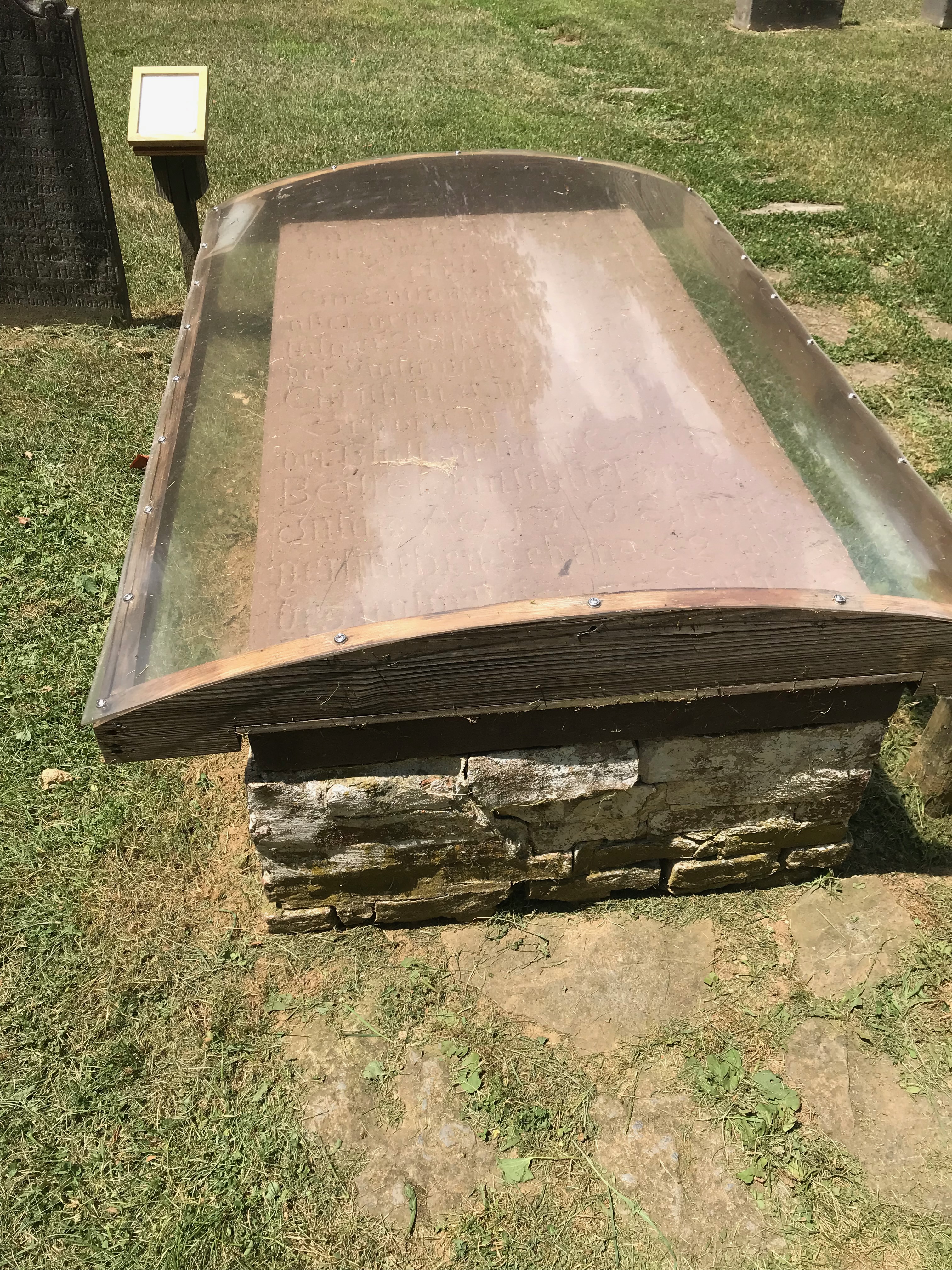
After visiting Ephrata Cloister recently, my mind naturally turned to the “Hermits of the Wissahickon.”  If you’ve not heard of them, you’re not alone.  They, despite being men to a man, preferred the title “Society of the Woman in the Wilderness.”  They were followers of Johannes Kelpius.  Kelpius, like Conrad Beissel after him, was a German mystic, Pietist, and musician, and he also believed the end of the world was imminent.  This was in 1694, just a few years before Beissel laid the foundations for Ephrata Cloister.  Like Beissel, Kelpius decided Pennsylvania was the best place to set up camp.  Although founded by Quakers, Pennsylvania offered something some other colonies didn’t—real religious freedom.  Given that you could be killed for being a Quaker in some of the other colonies, this didn’t seem like a bad idea.  Convinced Jesus would return in 1694, Kelpius and his followers settled into a cave just outside Philadelphia, by the Wissahickon Creek.  They set up a quasi-monastic community to wait out the clock near the city of brotherly love.

It’s difficult to know if Conrad Beissel was consciously imitating the work of Kelpius.  Religious leaders tend to have pretty strong views of their own outlooks.  The draw to Pennsylvania, in those days, was strong.  Interestingly, both Kelpius and Beissel are remembered for their music.  The death of Johannes Kelpius isn’t as well documented as that of Beissel—you can see the latter’s burial place in Ephrata.  Like millions of others, Kelpius lived through the “great disappointment” of not having the Second Coming occur when he supposed it would.  Some suggest Kelpius believed he would be translated after death.  He died in 1708, as his younger colleague was exploring the wilderness several miles to the west.  Keplius’ final resting place is listed, perhaps fittingly, as “unknown in Pennsylvania.”

Beissel’s Grave, Ephrata Cloister


Welcome to the Labyrinth

Do anything long enough and you’ll produce a labyrinth.  I started this blog back in 2009 with the idea of perhaps continuing in the biblical studies/ancient Near East (actually west Asia) studies, where I began.  I always knew this would be a place to talk about books and movies and sometimes current events.  Often it would address American religion because, well, it’s so bizarre.  Over the years the blog has ranged pretty widely.  My interests are fairly diverse and I tend to get obsessed with a subject for some time and then move on.  I suspect that’s one reason followers are few.  People want the same thing—should I dedicate the site to horror films, religion, or social justice?  The weather?  Instead, it’s what catches my interest at the moment.  Thus the labyrinth.

On the rare occasion when someone actually comments on an older post this blog (there was a healthy chain about the Highgate Vampire some years back), I often have to ask myself, “Did I write about that?” “What did I say about it?”   The human mind is a labyrinth.  And life is too short to ever stop learning.  Even if it means that few will be interested in what you’re doing.  The few who’ve known me a long time and read this blog (I know who you are), might be surprised at the horror themes that have become pronounced.  These were, however, part of my childhood.  When I tried to get away from them, they pursued me.  Monsters are like that, of course.  They like to hide in labyrinths.

But labyrinths are contemplative spaces.  Contemporary spirituality has rediscovered labyrinths.  You walk them in intentional thought.  In the moment.  We might be able to forget for some time that the original labyrinth was built to house the minotaur.  And without Ariadne Theseus would’ve never survived.  When he left her on Naxos his actions spoke louder, much louder than his fight with the monster.  Labyrinths make you forget where you are.  One saved Danny Torrance.  And perhaps one might save your soul.  Those who make enough chairs, or write enough books, or design enough skyscrapers leave labyrinths behind.  Manhattan may be a grid, but it’s a labyrinth nevertheless.  It seems to be a part of every story.  The thing about labyrinths is that they have no one goal.  There is no single answer to this mystery.  When you begin making one you may not even realize it.  Until you stop to contemplate it.

Photo by Ashley Batz on Unsplash

Healing Borders

Sometimes you read a book that just gets your head buzzing.  Brett Hendrickson’s Border Medicine: A Transcultural History of Mexican American Curanderismo is one such book.  It brings together so many areas of fascination: healing based on different belief structures than scientific medicine, the role of community in avoiding cultural appropriation, and the cultural blending that takes place at all borders.  The myth of the “pure” has long created problems, particularly in the realm of religion.  Things blend.  They always have.  And this includes belief structures, faiths, religions.  This is most obvious at borders, which makes them very interesting places.  Officially we police them, wanting to keep what is “ours” and keep “them” out.  In reality we are blending with each other and that’s not a bad thing.

In much of educated society, it’s assumed that scientific medicine is the only valid kind.  There are those even among the schooled, however, who pray for the ill.  Curanderismo is a form of folk healing that involves cures that would be rejected out of hand by science.  In a materialist, chemical world, only this can heal that.  Curanderismo looks at things quite differently.  Its practitioners don’t charge an arm and a leg for their work.  They are extremely popular.  And they heal people.  This is part of what makes Hendrickson so wonderful to read—he doesn’t assume up front that this doesn’t work.  Some analysts treat this kind of thing from a perspective of cultural superiority, as if scientific medicine is the only real way to treat illness.  Cultures, however, can heal.

Culture is something we value because it makes us feel secure and comfortable.  We know what to expect.  We speak the language, know the conventions.  (It would help Democrats, I think, to realize that although we’re trying to dismantle xenophobia, it is still very much intact in most of the world.  People follow autocrats because they’re afraid.)  We all live near borders.  Our personal border may be the wall of our apartment or the front door to our house.  It may be the Protestant/Catholic next door (or Buddhist/Atheist/Muslim/Hindu/Agnostic).  It may be the middle class/working class person who lives across the street.  In one town in which I lived it was literally those on the other side of the railroad tracks.  We draw borders for protection, but what Hendrickson shows so clearly is that they can also be places of healing.  


Phobia Therapy

I don’t like being scared.  That’s why I watch horror.  You see, many people deal with fear by running away from it.  Embracing artificial fears, however, prepares you for the horrors life will inevitably throw at you.  We humans have created an artificial environment for ourselves with many natural dangers removed.  For example (and there are always exceptions) we’ve been able to seal ourselves up in our homes and wear masks in public to avoid a killing virus.  For the most part we’ve destroyed our large predators.  As a society we tend to avoid the things that make us afraid which, in turn, makes us fragile when we have to face truly frightening situations.  I wouldn’t suggest becoming a fear junkie, but experiencing scary scenarios can diminish the overall  fear factor.

People often make assumptions about those of us who watch horror, even though it is the majority of Americans.  We’re seen as creepy people who lurk in dark places, unable to get along with our fellow human beings.  Perhaps it’s true, or perhaps it’s a reasonable coping technique.  I tend to think of it as a spiritual practice.  Spirituality is often about feeling, but it’s not completely divorced from rationality.  Often it has to do with that gut feeling that this is really real.  This is something that my years on this weary old globe have taught me is true.  Many times it’s this way in the face of evidence.  Others have trouble believing it, although some bearded guy alone on a mountain top says it’s true.  So life goes.

Spirituality is important.  I have many humanist friends and they are often uncomfortable thinking about spirituality.  It seems dangerous, a superstition that somehow survived enlightenment.  Enlightenment, however, is itself a spiritual idea.  There’s something inside of us that makes us who we are.  Whether it’s something physical or something else, it requires nourishing in order that we might thrive.  We expend a lot of energy arguing about the right (only right) way to do it.  The way to be a more spiritual person.  To me it seems that it’s about discovering what replenishes us.  What makes us into better people.  You find that and you feed it.  Spirituality comes in many forms and shapes.  Some of us have it fed by what others dismiss as mere horror.  There’s more to it than meets the eye, however.  I watch it to learn not to be afraid.


Spirit of Halloween

So it’s Halloween.  It’s also Sunday.  I’ve been thinking quite a lot about the spirituality of this particular day.  Now it’s often treated as a trick, a consumerist holiday with too much candy and befitting spooky decorations.  Like all holidays Halloween has evolved from its origins to how we celebrate it today.  Other than Wiccans and Neo-pagans, however, not too many take it seriously.  At Nashotah House, and therefore likely at some parishes scattered around the world, All Saints Day—which is tomorrow—was a day of obligation.  What we call Halloween was the day before this major festival of praising the faithful.  There is some evidence that All Saints was moved to November 1 to counter the lively celebration of Samhain, or the Celtic fire festival marking the onset of winter.

The Celts included an intellectual class known as Druids.  Druids seem to have been the “theologians” (oh, that word!) of the Celts and they mandated that their teachings not be written down.  A great deal of information was passed on by intensive memorization and only became known to us outsiders because after Christianization it began to be written down.  Their idea of the afterlife seems to have been that it was being born into the other world.  In the otherworld life was different and apparently in some respects better.  When our time there drew to a close, our death led to our birth into this world.  The cycle continued on and on.  Samhain was the time when crossing between worlds could occur.  Death wasn’t a cause for sorrow since the otherworld awaited.  Birth into this world was more problematic.

Fear of death seems natural enough to us.  Even though it’s inevitable and this world’s graveyards are full, somehow we seem to think we can avoid it ourselves.  Our evolved survival instinct runs out of control since we’ve eliminated many of the causes of death that have plagued our species (and many other species) for millennia.  Eons.  As we’ve done so we’ve distanced ourselves from death—dying in hospitals, our corpses prepared in funeral homes, buried and eventually forgotten.  To me, the Celtic idea, from a world where death was likely much more close to hand, seems a more healthy outlook.  Instead of fear, why not consider it a day of wonder and celebration?  To many, I know, that is a spooky thought indeed.  It’s more than a day of masks and candy, however.  And we might learn from it if we stop and ponder.


Angel of Harvest

It’s been a few weeks ago now, but one October Saturday we attended the Lehigh Valley Vegstock.  Autumn is the season for harvest festivals and a surprising number of them are now catering to vegetarians, or even vegans.  When I say that, it probably calls to mind a certain kind of individual—perhaps an aging hippie who’s probably into New Age and alternative spiritualities?  If so, you’re not the only one whose thinking goes along those lines.  Among the recycled, reused, and other earth-friendly tents was one that offered contemporary spirituality.  A lot was going on behind my mask so I forgot to take the name of the actual vendor, but I did find the use of angels interesting.

No, I haven’t been living under a rock.  Well, maybe I have.  Even so, I know that angels are popular and have been for several years.  Some people who find themselves uncertain about God are still down with angels.  Back in college—who knows anything at that age?—I did an independent study on angels.  The professor (who’s still at Grove City) didn’t provide much direction, and I soon found there wasn’t too much in our library about the subject.  Like demons and other monsters, scholars tend to shy away from the topic.  That, and I hadn’t yet learned how to use Religion Index One.  Now, of course, there’s the internet.  In any case, the idea of angels stayed with me through my teaching career.  After all, studying ancient gods does bring you into close proximity with other spiritual beings.  Even so, I was interested to see Archangel Metatron on the Vegstock vendor table.

Metatron isn’t biblical.  He makes his first appearance in Jewish literature, including the Talmud and Kabbalah.  Although my research interest was always toward the earlier era of the spectrum, it seems that much of our angelology was percolating during the period after the Hebrew Bible was written.  Jewish scholars were working out the complex spiritual world and later Christian writers would attempt to systematize it.  It is possible, and it appears in some traditions, that Metatron was actually Enoch, translated.  Enoch, who is biblical, receives just a few words in Holy Writ, but he eventually grew in importance.  Genesis indicates that he walked with God and was no more.  What happened to him?  Metatron was one possible answer.  There are other Metatron origin stories, I’m sure.  And one of them was right there in Tatamy in the midst of a harvest festival.


Shifting the Narrative

Wide ranging.  That’s a phrase that comes to mind to describe Vine Deloria Jr.’s book God Is Red: A Native View of Religion.  Another phrase is very important.  I know this book has been available for several years and it’s been on my reading list for many of those.  What is it about?  Some books are just difficult to summarize, but the basic answer is that it’s an American Indian view of how Christianity has distorted the world.  An accomplished academic, student of law, and activist, Deloria knew of what he wrote.  His book explains articulately the view of Christianity from the outside and what a religion that reverences the earth really looks like.  What makes the book so fascinating is that Deloria had theological training and could engage with the Christian worldview over a considerable range of topics.

Controlling the narrative is of primary importance and the fact is white men have controlled the narrative and normalized one view of history, science, and our place in the universe.  First nations peoples had, and some still have, a radically different outlook.  Deloria makes the crucial point that even our science developed out of our religion.  That science, in turn, supports the worldview that created it.  It is possible to look at things differently.  In fact, for much of human history those alternate views were predominant.  The triumphalist view of Christianity claims it’s successful because it’s right.  A native view takes a longer view, saying “we’ll see.”

Very concerned about the state of the planet brought on by the Christian/capitalist partnership, Deloria advocated for not only Indian rights, but environmental protection s well.  Not only is the environment central to Indian spirituality, the concept of sacred spaces is very real.  Many of us not raised with indigenous points of view have experienced this as well.  Some places are special to us.  We hesitate, because of that very science created by the Christian worldview and its view of God, to call such spaces objectively sacred.  Even the “objectively” part is determined by a Christian perspective.  Deloria ends up by asking whether this form of religion has improved the state of the world.  There’s no doubt that some of Christianity’s achievements have lessened human suffering.  It is also true that science has achieved great things.  If I understand correctly, Deloria isn’t disputing this.  His point of view is much more essential.  Is this the only way to live on this planet?  From the indigenous point of view, which is far more important that we want to admit, the question is—is this the only way to see it?


Time To Think

Although I’m not Roman Catholic, I often thought about joining a monastery as a teen and twenty-something.  The idea of spending all my time devoted to contemplating the ultimate reality still has a strong appeal.  I know quite a few rationalists who have no time for spirituality, but it seems to me that we all need it for facing death.  Most people, I know, avoid the topic if at all possible.  Contemplatives, on the other hand, spend quite a bit of time preparing for it.  Since it’s inevitable that makes sense.  I often wonder why people consider the most common thing in human experience with such trepidation.  If it’s a source of anxiety, shouldn’t it be confronted?  That’s not to say we need to look forward to it, but it does mean we shouldn’t run from it either.

Carlos Schwabe, Death of the Undertaker; Wikimedia Commons

The combination of Christianity and rationalism, it seems to me, lead to this terror.  Christianity because it views death as an enemy, and rationalism because it has no comfort to offer.  I’ve been reading about how pre-Christian cultures thought of death.  They didn’t display the fear that Paul seems to have introduced into the equation.  Since American culture is so heavily influenced by the Bible (as was European culture before it), we have adopted the scriptural view that death is a problem.  The Hebrew Bible, in which there was no real afterlife, was less concerned with making sure you avoided Hell—they had no Hell to avoid.  The anxiety seems to have been introduced by, ironically, the concept of resurrection.

I’ve noted on pieces I’ve written for other websites that resurrection is among the favorite themes for horror films.  One of the reasons is precisely this discomfort in taking death at face value.  Our religions keep us aware of the spiritual side of our nature.  They have developed around the world in different forms and all of them address death in some way.  Most without a profound sense of anxiety.  There is some irony in cultures that adopt resurrection as a theological tenet are among those that try to avoid death most assiduously.  It plays into those cultures’ views on abortion and capital punishment.  As well as their performance of social justice.  While Paul asked death where its sting was, and seems legitimately not to have feared it, in the centuries following his position seems to have eroded.  There seems to be plenty to contemplate here, if only secular society had monasteries.


The Spiritual Life

Genuine spiritual experiences don’t sit well with a nine-to-five job.  When something truly profound happens to a person s/he requires time to think about it.  Ponder the experience.  If such a thing occurs on a Sunday (imagine that!), the next morning, still reeling, you need to go to work.  Perform duties that no longer seem significant.  And continue to do so for four more days, until the fire has gone out.  This paradox has plagued me for some time.  Perhaps it’s the fate die cast for an editor who can’t just read submissions for their financial payoff.  Who asks, “What if she’s right?”  Doesn’t that affect everything?  Especially in the case of a religion editor.

Blown away.

I first noticed this in college.  Even there the schedule was quite flexible, according to classes you had to take.  The professors were sincere in their presentation of ideas you should take seriously, but then in the work world your boss indicates that you’re not being paid to do that.  You’re being paid to produce.  Contribute to the machine.  Cogs and sprockets don’t think.  They do.  Then a significant weekend would come (or a holiday, say) where the message would really speak to me.  Change my outlook.  Until Monday morning.  The outlook would still be changed, of course, but the demands on routine would not also be changed.  It’s quite a dilemma.  As the great contemplatives throughout history have known, these ideas must be wrestled with.  Conversed with.  Tried on for size.  Walked with.  Such things can’t be done in the context of what you’re paid to do.  “Do it on your own time.”

What is your own time?  The weekend, essentially.  Work expands to fill the quiet times of weekdays.  Your time is owed to somebody who pays you less than the national average to do something any nonspiritual person could do.  Such is the danger of being open to new ways of looking at things.  Vacations need to be planned.  They are rejuvenating, but spiritual experiences can’t be planned.  They just happen.  HR has no algorithm for them.  Not exactly sick days or floating holidays.  And what if you need more than one day?  That meeting that was scheduled for Tuesday, what about that?  As if such things were really important.  Perhaps you too had the professor late for class because s/he was struggling with an idea, an experience that fit her or his specialization.  There were always office hours to recover.  That’s all fine and good, but it’s time for work.


Animal Spirituality

I had little scientific basis for my claims.  It wasn’t that I didn’t have evidence, but it was more one of those “if you see something say something” kinds of scenarios.  I have been claiming for many years that animals experience some kind of spirituality.  My evidence was drawn from disparate scientific materials I’d read, along with ancient religions.  Egyptians believed baboons worshiped the sun.  Chimpanzees make threatening gestures toward the sky during thunderstorms.  Penguins grieve.  Human spirituality, it seems to me, is part of our kinship with other living creatures.  Then I found an article by none other than Marc Bekoff titled “We’re Not the Only Animals Who Feel Grief and Spirituality,” in no less a prestigious place than Psychology Today.  Bekoff, some of whose books I’ve reported on here, has studied animal emotions professionally.

Our ideas of human exceptionality, it seems to me, often get us into trouble.  Arrogance is perhaps the most dangerous of psychological states.  When we see ourselves as part of a continuum, and realize that it can go on beyond us—yes, there are likely greater intelligences—humility should be an expected response.  Those who are arrogant frequently experience their comeuppance, even if they have to get elected to high office for it to happen.  We share emotions with our fellow creatures, and, now according to at least one expert, we share spirituality.  What is spirituality?  It seems to be an awareness that the body isn’t everything.  In my lexicon it’s listed there right with consciousness, mind, and soul.  We know it because we feel it.

The interconnectedness of the world, and beyond, is something many want to take exception from.  Looking around, such folks say, “Hey, we’re different than all of this.”  Yes and no.  We’re different, but that makes us no less a part of it.  Nature is our matrix.  We build fancy houses, but so do bower birds, and they do it without benefit of opposable thumbs, or even hands.  Of late we seem reluctant to admit that even human beings have spirituality.  That doesn’t stop us from feeling it, however.  I’m glad that others see it in the animal realm also.  Anyone who’s “owned” a dog knows what it’s like to receive worship.  We’ve selectively bred these wolves to adore us.  Is it so much of a stretch, then, to suppose that other animals also feel a sense of admiration for what’s beyond themselves?  Only the most arrogant wouldn’t pause to consider it.


Time for Golem

I don’t claim to understand how the film industry works.  My two books on horror and religion deal with interpreting the movies, not their native cinematic environment.  I say this because I limited my treatments in them to films with a theatrical release.  Mainly this was so that readers would have had easy access to them.  Some films, of course, never go to theaters and it seems that happened, in the United States, to the Israeli movie The Golem.  I saw a trailer for it last year and patiently waited for it to arrive.  I recently found it on an online streaming service and finally had a chance to watch it.  Golems, as original Jewish monsters, have shown up in a variety of popular media including The X-Files and Sleepy Hollow.  Film treatments have been rare, and this one makes for a fascinating monster movie.

What makes the golem so compelling is that it is an explicitly religious monster.  To create a golem (according to the film) the maker must use Kabbalah, Jewish mystical texts, to learn how to bring it to life.  Hanna (Hani Furstenberg), the female protagonist, is the only one in her seventeenth-century village willing to try.  The real hook, for me, is that the golem she creates is a little boy.  The role must’ve been fun to play.  Golems cannot speak, so there are no lines to learn.  Kirill Cernyakov nails the part with an ability to portray emotionless menace.  The problem with a golem, you see, is that it goes on rampages, killing even those it’s conjured to protect.  Since the movie is intended to be a retelling of the classic story (involving the golem of Prague), it doesn’t have too many surprises.  It is, however, a thoughtful movie.

Write-ups on it call it “the Jewish Frankenstein,” but scholars who research Frankenstein often go the other way, seeing Frankenstein’s monster as a form of golem.  The basic idea is taking something inert and bringing it to life.  Afterward the creator is unable to control it.  It’s too bad that The Golem didn’t get a wide theatrical release.  I’ve seen far worse horror films that did.  Perhaps the focus on religion was too blatant?  One of the points I make in Holy Horror and Nightmares with the Bible is that religion and horror belong together.  Some Jewish viewers will undoubtedly spot inaccuracies (even this goy did) but the movie isn’t a religious text.  It is an appropriate rebuff to Trumpian “politics” and even features a plague.  It is a movie for our time.


Wild God

Living with a Wild God, by Barbara Ehrenreich, is one of those books I wanted to put down gently after reading it, for fear that it might explode.  Or maybe it was my head I feared might combust.  Describing it is difficult because it is so wide-ranging.  On the one hand it is an atheist’s view of religion.  On the other hand it is a spiritual biography.  On a third hand it is coming to terms with having had a profound mystical experience.  It is one of those books where, knowing my life has been so very different, yet I feel that Ehrenreich and I have had so much in common that we’d be friends if we ever met.  It is also the work of a woman who is scary smart and whose teenage thoughts were so intense that my own seem puerile by comparison.

But that mystical experience!  I’ve had many of them in my life, but I don’t know you well enough to share them here.  They’ve been recorded in an unfinished book that I may or may not try to publish some day.  (Ehrenreich was smart and took a job as a journalist, which means others assume you know how to write.  Even those of us in publishing have trouble convincing agents and others who hold the keys to non-academic pricing that we understand the craft.)  Mysticism quickly becomes a staid discipline, not at all like the life-directing experiences such encounters themselves actually are.  It’s difficult to explain without sitting down and talking to you.  It’s something academics tend to avoid like Covid-19.

The books that mean most to me are like conversations with an absent author.  Drawn in by an openness, or perhaps by the fact that we’ve lived in a few of the same places over the years, perhaps passed one another unknowingly on the street, you feel that they’ve invited you into their very head.  What you find there has a strange similarity to what is in your own head, while being completely different at the same time.  We should all strive for such honesty in our writing.  In the end Ehrenreich, with a doctorate in science, suggests we need to be open.  That kind of validation is important for those of us who’ve poured our lives into the study of religion.  She was drawn in from atheism, and I have been trying to escape from literalism all my adult life.  We have ended up in places not dissimilar from each other and I’m glad to have met her through this profound book.