Burning Crosses and Aftershocks

In a small blurb I would have missed had my wife not pointed it out, today’s paper carried a brief follow-up on the religious implications of the Haiti earthquake. The story (caption) ran: “A Christian mob circles a burning stack of items to be used for a Haitian voodoo ceremony for earthquake victims while singing church hymns in the Ti Ayiti neighborhood in Cité Soleil. The voodooists were run out of the central pavilion under a hail of rocks, and all the ceremonial items they left behind were destroyed and burned.”

My mind, at seeing burning religious symbols in the picture, turned to the infamous burning crosses used by equally intolerant “believers” in the last century in this country. Perhaps the motivation for burning the symbols is different, but the message is the same – a very narrow band of the wide continuum that is Christianity has decided that another variety of human being must be brought under control or destroyed. I don’t seem to recall reading in the Gospels, or even Paul for that matter, that throwing stones at believers in other faiths was a recommended activity. The voodou service, according to the blurb, was intended to help earthquake victims. Instead, the Christian faction forcibly drove them out and violated their religious symbols. Could they not have been spending helping victims instead?

I am not the sort to throw the first stone, knowing my own faults all too well, but the rampant supersessionism of an entitlement generation Christianity is showing its ugly side in such an instance as this. If religions are not here to improve the lives of others, then what is their purpose? To placate mythical gods to ensure one’s own blessed future, no matter who has to be hurt along the way? It seems to me that less time burning religious symbols and more time helping the needy is a platform worthy of any honest religion.
View from the Snowpocalypse

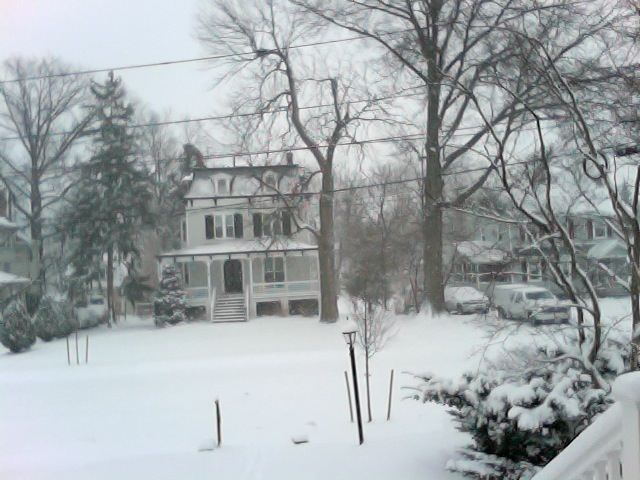
With all of the hype and anxiety of the current Nor’easter dumping snow on the East Coast, a guy from northwestern Pennsylvania can’t help but shrug his shoulders. What’s all the fuss about? Growing up in the snow belt of Lake Erie, I was accustomed to forgetting the color of the ground between December and April. School seldom closed with under a foot of snow. And I had to walk a literal mile to catch the bus, but it was uphill only one way.

The truly fascinating aspect of this storm is the creation of biblically charged words to describe it, as if the American vocabulary has run out of appropriate adjectives. “Snowpocalypse” and “snowmageddon” both appeared in this morning’s paper. The late biblical concepts of apocalypse and Armageddon indicate a devastating turn of the era when a new world is ushered in. All I saw out my front door was a bunch of snow. Peaceful, white, and pretty.

Snowmaggedon? Hardly.

I lament the farming of the otherwise underused Bible for images that cheapen the visceral fear and dread that accompanied ancient outlooks. Once while at Nashotah House in Wisconsin, when the temperature plunged to 38 degrees below zero (air temperature, not wind-chill) and the tired snow was being blown about by unforgiving winds, we were required to make the trek to Milwaukee for a day long spiritual retreat. Just about all human institution had shut down, with the sole remaining exception of a church eager to revitalize its aging congregation. As the ice on the window of the bus refroze immediately after being scraped off, I came close to thinking apocalyptic thoughts I admit. The weather, I guess, has always had a divine connection in our primitive minds after all.


Rushing in Where Angels Fear to Tread

As my daughter’s public school undertakes its humble efforts to raise funds for the devastated nation of Haiti, contributing the little that unemployed children can raise, Rush Limbaugh unapologetically proclaims that Americans shouldn’t contribute to the earthquake relief. The New Jersey Star-Ledger notes that on Wednesday Limbaugh declared that Americans already support Haiti through their tax dollars and shouldn’t feel the need to contribute anything beyond that to the poorest nation in our hemisphere. This is true Christianity, according to the Neo-Con gospel.

Rush Limbaugh basks in the limelight as the outspoken representative of the “Gott und Ich” school of religious politics. With an estimated annual salary around the $400 million mark, Limbaugh comfortably sits back and watches the world burn around him. Together with James Dobson, Pat Robertson, and others who support the new, compassionless version of Christianity (Christianity 2.0), they inveigh directly into the ears of high-ranking politicians with coarse voices declaring that God wills for them to be the sole arbiters of what is right. I only hope that Americans are really listening. Really listening.

Religion has always been a form of social control. From earliest times, those who claim to know the will of the gods tell others what they need to do to placate the angry deities that hover all around. Earthquakes are the work of such angry gods. What do they demand? Listen to your local priest. America has been beset with a plague of Religious Right voices that are well-funded and so parsimonious that seldom can the gentle voice of reason be heard. While Limbaugh enjoys his enormous wealth kids who have never known anything like basic comfort are dying in the thousands in a nation right next door. And the people say, “Amen.”


Theodicy Versus Idiocy

Among the leading reasons generally given for atheism in developed countries is the problem of theodicy. Theodicy is the act of justifying God, as implied by the roots of the word itself. In a world where many innocent suffer, as well as many guilty, the question of how a loving God and divine fairness fit into such a warped and corrupted system presents questions often left unanswerable. My class tonight will be reviewing Job, a book steeped in the issue of misfortune. The best that the narrator can offer is that Yahweh made a bet with the Satan and Job came out on the losing end. Not much hope for justice there.

This week’s horrific earthquake in Haiti has elicited high levels of sympathy and support as this poorest of western hemisphere nations struggles to find some kind of balance in a reeling world. The question of where God is amid all this tragedy, perhaps 100,000 dead, pensively teeters in minds sensitive to the human condition. Other minds, however, blare idiotic platitudes that only drive mourning theists closer to the other side. Pat Robertson, a major political player who has been a card-holding member of the Religious Right from its unholy inception, has declared that Haitians are paying the price for an ancient deal they made with the devil. In a theology that makes a mockery of even the Charlie Daniels band, Robertson stated, according to MCT News, that Haiti had made “a pact with the devil.” He said, “Something happened a long time ago in Haiti, and people might not want to talk about it… They were under the heel of the French… and they got together and swore a pact to the devil. They said, ‘We will serve you if you’ll get us free from the French.’ True story.”

This drivel, based on hearsay history and implicit racism, does not justify a loving, or even neutral, God. Instead, the Conservative deity is shown in his true colors: racist, supersessionist, arrogant, and uncaring. This is the deity behind the Religious Right. Some people castigate Pat Robertson for being outspoken and perhaps senile. I applaud him. He shows clearly what intellectual rubbish the Religious Right promotes. He simply has fewer inhibitions to admitting it.

In Job, there was a deal made with the Satan. The perpetrator of that deal was Yahweh. No answer is given as to why the innocent suffer. Job is a most profound book, wrapped in a childlike story of two supernatural beings trying to show each other up. If we look hard enough we can find the Religious Right in the book as well. Their voices are those of the “friends” that Yahweh ultimately condemns when he finally speaks from the whirlwind.


Hell on Earth

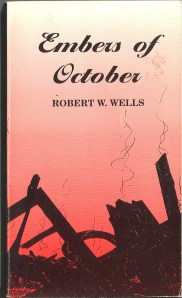
October 8, 1871 is remembered by many as the night of the great Chicago Fire. Few Americans ever learn that it was also the night of what many consider to be the greatest natural disaster in United States history: the Peshtigo Fire. The autumn of 1871 was tumbleweed dry in the upper midwest. A wildfire that burned over a million acres of northern Wisconsin and Michigan completely incinerated the town of Peshtigo, Wisconsin on the same night Chicago burned. 1,200 people were killed in a single night. One of the most terrifying books I’ve read is Robert Wells’ Embers of October (also published as Fire at Peshtigo), a factual horror story filled with survivors’ accounts and early aid workers’ reports. Many described the scene as reminiscent of Hell.

Gehenna in Wisconsin

Hell is an interesting concept. Following on from my podcast on the origins of the Devil, the concept of Hell is an equally interesting development. The Hebrew Bible knows of no Hell. The dead, good and bad alike, go to Sheol, the gloomy world of the dead, after they die. There is no punishment or torment beyond the languor of being deceased. People seem to be described as having some recollection of life and its benefits, but they are weak and sleepy and attached to their drying bones. The concept of an afterlife comes pretty late to the Israelites, depending on how you define “afterlife.” The book of Daniel, the latest in the Hebrew Bible, provides our first glimpses of a kind of resurrection for the righteous who died before their time. The earliest biblical Hell is the Gehenna of the Gospels, the garbage heap perpetually burning outside Jerusalem.

To picture an eternity of constant burning and torment requires a kind of distinction between an afterlife and afterdeath to be made. Zoroastrian influence on emergent Judaism provided the dualism that made a Devil possible after a few centuries. It also provided the distinction between the glorious afterlife of the good and the doleful fate of the wicked. Concepts that eventually blossomed into the theological constructs now regarded as Heaven and Hell drew their inspiration from an ancient religion of Afghanistan and Iran. Given what human imaginations are, Hell has naturally grown more and more gruesome over the centuries, but if one requires a sense of an entirely natural version of what can happen to good and bad alike, the Peshtigo Fire may also deliver many sleepless nights.


The Divine Finger

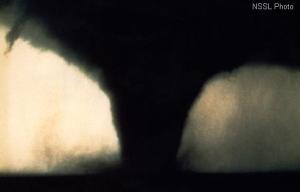
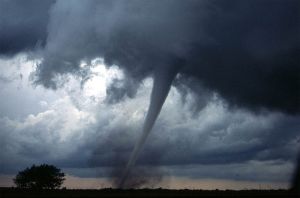
As the thunderstorms break out overhead yet once again, I am naturally reminded of tornadoes. I grew up in a part of the country relatively free from natural disasters. In my little corner of western Pennsylvania we felt secure from the earthquakes, volcanoes, wildfires, mudslides, and hurricanes that seemed to plague other parts of the continent. Then one night a tornado came. I happened to be a few hundred miles from home working a summer job when the cheery newscaster announced that a tornado had swept through my hometown during the severe thunderstorms we’d had the night before. I had always believed our unrelenting hills made us somewhat resistant to the tornadoes that plagued our next-door neighbor Ohio. It was probably then that my fascination with severe weather, especially the tornado, began.

Pulling the divine plug?

Pulling the divine plug?

One of the reasons for the entirely understandable fear accompanying tornadoes is that they have all the hallmarks of an ideal divine weapon. In an article soon coming out in Maarav, I argue that an obscure Hebrew word should probably be associated with whirlwinds rather than tumbleweeds. Although violent tornadoes are rare in Israel, the story of Elijah seems to imply that a weighty prophet may be hefted skyward by a whirlwind, and that sounds tornadic to me! There are passages where whirling winds are referenced as harbingers of divine wrath, an association that clings to tornadoes even today. I ended up writing an entire book on weather terminology in the Bible that had been fueled on by this ambiguous fascination. Publishers, it seems, alas, do not share my enthusiasm for the topic.

Classic F-5

Classic F-5

The popular media, however, shows a glimmer of understanding. The second half of the 1990s (when I finished my draft of my book/doorstop) was a bonanza of American storm fascination; Sebastian Junger’s The Perfect Storm (1997) was shortly followed by Erik Larson’s Isaac’s Storm (1999) and both tailed the much-touted movie Twister (1996). Being somewhat of a connoisseur of tornadoes, I was disappointed by Twister, but one scene remained scoured into my memory. A layman asks one of our overly-folksy, lovable storm-chasers what an F-5 tornado (the F-, or Fujita-scale is the measure of a tornado’s intensity based on the level of damage it leaves behind — 5 is the highest number on the scale) would be like. One of our jocular heroes becomes suddenly serious and replies, “The finger of God!” Despite the cornball, this is an accurate explanation of the awe that surrounds a storm as random as a tornado. Adjacent houses can suffer entirely different fates in a tornado, or, in a poignant story I’ve never forgotten, a Wisconsin tornado killed one of a set of young twins in the same house during the storm. Finger of God, indeed. If Moses had lived in Iowa I’m sure he would have made liberal use of the tornado for precisely that image.


Gods bless you

Which god sneezed?

Which god sneezed?

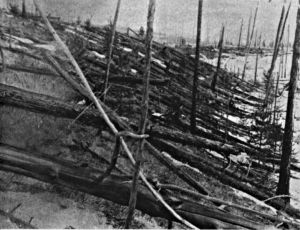
In a recent reading project to keep me edgy and paranoid, I went through Surenda Verma’s The Mystery of the Tunguska Fireball (Icon Books, 2005). Quite apart from giving me a quick X-Files fix, this book is a thorough and reader-friendly account of an event that, no matter what you make of Mulder and Scully, should have been a major wake-up call for those of us who call planet Earth home (some exceptions apply).

On June 30, 1908, a fireball exploded over a remote region of Siberia. Even today it is nearly impossible to reach the spot. The traces of this event, which don’t seem to support any given theory completely, point to an explosion on the order of 10–20 megatons (the bomb dropped on Hiroshima, for contrast, weighed in at about a thousand times lighter on the TNT scale). The sparsely populated region was devastated by shock waves and fire, and only by a slim thread of fate did all of us not end up on the extinction list. A blast of that intensity, had it been located lower in the atmosphere, could have easily brought on a nuclear winter — with no Jingle Bells!

Sometimes when life seems too intense, I find it helpful to think of what a wonder it is to be here at all. Perhaps it is a religion of wonder. Earth’s history is replete with mass extinctions that ultimately allowed for our own evolution, but which wiped out over 99 percent of all species that have ever lived. The Permian Extinction, which allowed for the rise of the dinosaurs, nearly obliterated life itself from our rocky home. When I look to the future I see disjunction and continuity. Jupiter was dealt a second cometic blow within two decades last week, and the odds are ticking on our own tiny planet. I wonder what ancient mythology would have made of Tunguska — who was the lady or lord of the fireball?